

A telescoping pool pole is only useful when it reaches the cleaning area and stays at the selected length. An undersized pole forces awkward stretching toward the deep end; an unnecessarily long one can turn a simple leaf-skimming job into difficult, tiring steering. Lock construction, stored length and head compatibility often matter as much as the maximum length on the label.
The best telescoping pool pole for a small above-ground pool can be different from the right handle for a wide in-ground pool. This guide compares compact 10.5- and 12-foot options, everyday 15- and 16-foot tools, and a specialized 24-foot extension model. Several also use different locking systems, including spring pins, push buttons, internal cams and threaded collars.
Start with the longest point you actually need to clean, the space available for storage, and the accessory heads you already own. A skimmer net can be controlled at a greater distance than a heavy vacuum head or stiff brush. Reach figures describe how far a shaft extends; they do not promise equal stability, comfort or cleaning force at full extension.
Quick Comparison of Telescoping Pool Poles
This overview separates the models by useful working length, their distinguishing hardware and the types of cleaning for which they are intended. The maximum figure is not a recommendation to keep the pole fully extended for every task.

- 16 ft extension for far-side cleaning
- Spring-loaded stainless pin length lock
- Replaceable parts and 490 Promise
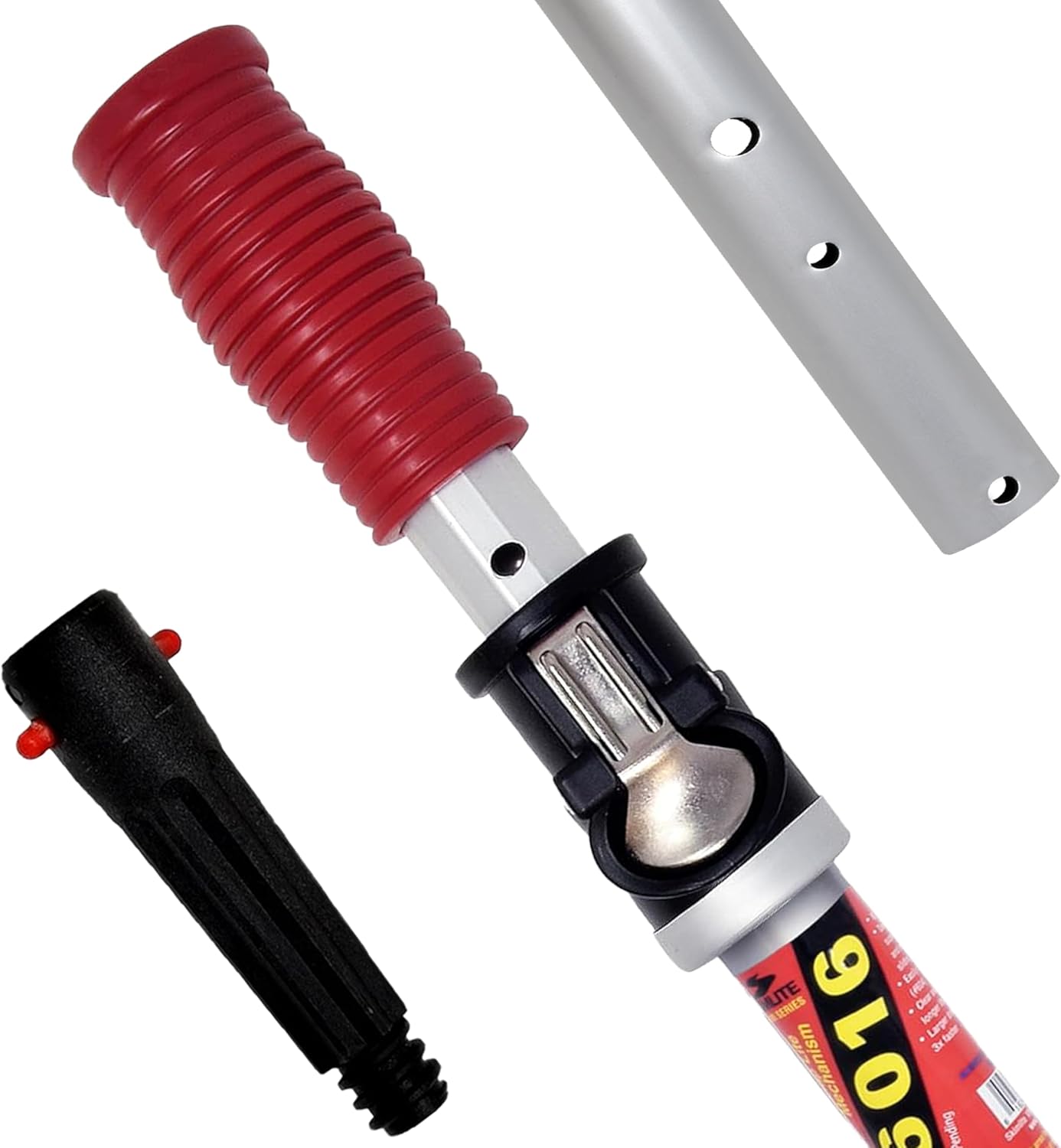
- 16 ft listed extension; two-piece 6016 series
- Push-button Snaplite length locking
- Anti-twist decagon-shaped tubing

- 9016 model; 8–16 ft nominal reach
- Two-piece pole with two locking systems
- Outside threaded lock plus internal cam

- 9024 model expands from 8 to 24 ft
- Three-piece Dually configuration
- External thread and internal cam locks

- 15 ft advertised working length
- Three-piece telescoping aluminum construction
- Grip and lock design for pool accessories

- Three-piece extension up to 15 ft
- Blue anodized aluminum shaft
- Manufacturer lists 3.4–15 ft adjustment

- 15 ft telescoping length
- Intended for net, brush and vacuum use
- General-purpose aluminum construction

- 10.5 ft maximum extension
- Anodized aluminum construction
- For skimmer, brush and vacuum heads

- 12 ft listed maximum
- Three-piece adjustable construction
- Intended for brushing and surface skimming

- 12 ft maximum reach
- Three-section aluminum construction
- For rakes, skimmers, brushes and vacuum heads

- 3.8–16 ft advertised range
- Aluminum extension for common pool tools
- Long reach with short stated minimum

- 8–16 ft listed operating range
- Green heavy-duty aluminum pole
- For vacuum heads, skimmers and brushes
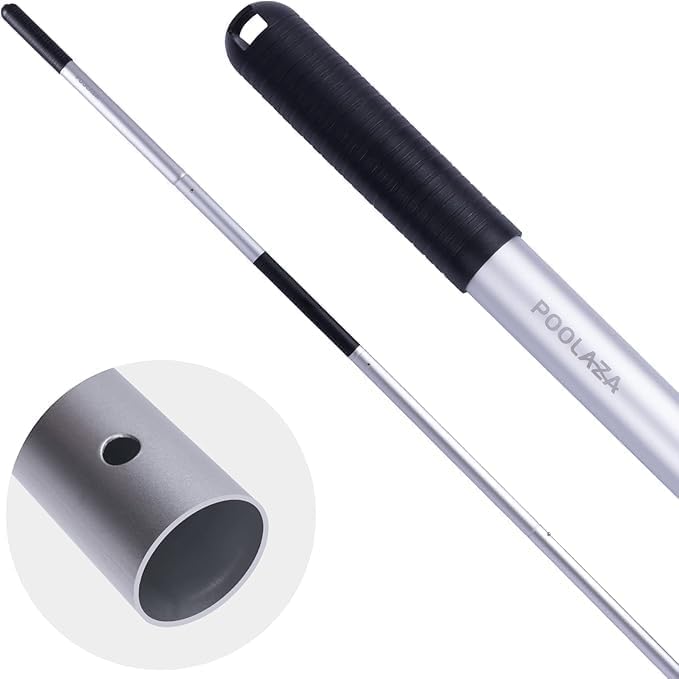
- 2.7–10.5 ft telescoping range
- Dual-grip handling arrangement
- For nets, brushes and vacuum heads

- 6.5–16.5 ft listed length range
- 1.30 mm shaft wall in product title
- For vacuums, brushes and skimmers
What to Look for Before Buying a Telescoping Pool Pole
Working reach versus pole length
Measure from the safest usable standing position on the deck to the farthest floor or wall area that needs cleaning. Include the working angle: a sixteen-foot shaft cannot provide sixteen feet of horizontal reach once it slopes downward into the water. The attached cleaning head adds some distance, but depending on it to compensate for an undersized pole makes control unpredictable. If deck access surrounds the pool, moving closer is usually preferable to using an extra-long pole.
Collapsed length and section count
A two-piece pole can have a significantly longer minimum length than a three-piece design with a similar maximum. This is why the Skimlite 9016 and 9024 both begin at a listed eight feet even though one reaches much farther. A two-piece, eight-foot-collapsed pole may suit an open garage wall but not a short outdoor cabinet. Measure the door opening, turning space and available storage height before ordering.
Lock mechanism under load
An extension lock must hold while a leaf rake pulls through water or a brush presses on a wall. A threaded collar secures through mechanical compression, an internal cam grips inside the shaft, and a spring pin engages an opening or indexed position. Each has a different adjustment feel. Look for clear engagement, easy cleaning of the mechanism and replacement components where available. Avoid over-tightening parts or using a pole with a visibly slipping joint.
Accessory ends and real compatibility
Most pool heads use a broadly familiar handle fitting, but the exact dimensions and retention method still vary. Examine whether your skimmer, brush or manual vacuum head has a spring button, clip hole or threaded connection. A threaded adapter supplied with one pole can be useful without making it universal. A head that falls off in a deep end creates more trouble than a pole that is a foot too short.
Handle grip and bending leverage
Grip texture affects control with wet hands. Yet a comfortable grip cannot prevent shaft flex, especially when a submerged attachment meets resistance far away. Tube diameter, wall thickness, extension overlap and number of joints are all relevant; a single ‘heavy duty’ label does not quantify these factors. Choose the smallest effective extension for the work and change your standing position before forcing a stubborn head sideways.
ProTuff 490 Promise 16 ft Lock-Right Pool Pole
- 16 ft extension for far-side cleaning
- Spring-loaded stainless pin length lock
- Replaceable parts and 490 Promise
ProTuff 490 Promise 16 ft Lock-Right Pool Pole offers 16 ft maximum of listed reach. Its defining construction is aluminum; spring-pin lock-right system. The following details explain where that combination is useful and where another pole design makes more sense.
Lock-Right construction
The distinguishing feature is ProTuff’s Lock-Right mechanism. Instead of depending exclusively on friction in a twist collar, a spring-loaded metal pin engages to secure the selected position. That matters when a heavy leaf rake meets water resistance or when a brush presses against a wall: accidental shortening interrupts the stroke and can bring the cleaning head unexpectedly closer to the user. The pin must still be fully engaged before pressure is applied.
Materials and serviceability
The manufacturer identifies 6061-T6 aluminum and marine-grade stainless hardware in its current pole design, alongside replaceable wear components. An aluminum shaft keeps corrosion management simpler than an unprotected steel tube, though it should still be rinsed after pool-chemical exposure. Repairable fittings are a meaningful advantage for frequent users because a damaged grip or mechanism need not automatically end the useful life of the whole pole.
Practical cleaning tasks
Sixteen feet of nominal extension puts a wall, deep-end floor or far-side skimmer within reach from many deck positions. A long pole is not automatically rigid at its full length, however. For vacuuming, extend only as far as needed and use smooth pushes rather than leveraging a heavy head sideways. The universal-attachment design is intended for common nets, brushes and vacuum heads, but users should check the actual connector on an existing accessory.
Ownership tradeoffs
The 490 Promise is unusually relevant to the purchase decision: ProTuff currently describes free replacement coverage for registered homeowners and different parts/replacement terms for professionals. Registration and the exact terms of the relevant program still matter. Buyers who mainly skim a compact above-ground pool may prefer a less elaborate 10.5- or 12-foot pole that stores and handles more conveniently.
Pros
- Mechanical pin lock avoids reliance on friction alone
- Manufacturer offers replacement components for its poles
- Useful 16-foot reach for skimming, brushing and vacuum heads
- Support program distinguishes home and commercial buyers
Cons
- A set-position pin mechanism differs from continuously variable twist adjustment
- More pole than many owners of small pools need
- Warranty benefits depend on buyer category and registration
Skimlite Snaplite 16 ft Button-Lock Pool Pole
- 16 ft listed extension; two-piece 6016 series
- Push-button Snaplite length locking
- Anti-twist decagon-shaped tubing
Skimlite Snaplite 16 ft Button-Lock Pool Pole offers 8–16 ft nominal of listed reach. Its defining construction is button lock; decagonal tubing. The following details explain where that combination is useful and where another pole design makes more sense.
Snap-button adjustment
Snaplite is built around quick engagement rather than a classic threaded compression collar. Depress the button, slide to a suitable position and let the button engage in its matching opening. For users who make frequent changes between skimming the surface and brushing the walls, visible engagement is straightforward to confirm. The compromise is that the permitted positions are determined by the pole’s button arrangement, not by an infinitely variable length setting.
Tube geometry and control
Skimlite describes decagon-shaped tubing as an anti-twist design. A pool pole rotates under load when a brush catches a corner or a net turns in the water, so rotational control can be as important as the stated length. The 16-foot Snaplite belongs to the maker’s 6016 two-piece family, a useful distinction from its three-piece longer Snaplite models. Its stowed length is consequently substantial.
Accessory connection
The provided listing mentions a universal threaded adapter for nets, brushes and vacuum heads. That can help where an accessory uses threaded connection hardware, but a threaded adapter does not make every conceivable head interchangeable. Check whether the skimmer or vacuum head uses a spring clip, a screw thread or another fitting. Attaching a mismatched head securely is more important than simply having enough reach to touch the pool bottom.
Best household use
The push-button approach especially appeals to cleaners who dislike repeatedly turning a wet collar to hold a setting. Sixteen feet provides meaningful reach for a larger in-ground pool, yet the extended shaft still requires controlled technique. Owners working around a small spa or narrow above-ground pool may find a shorter, more compact multi-piece pole easier to move between fixtures and easier to store.
Pros
- Button lock gives clear position engagement
- Ten-sided tubing is designed to limit section twisting
- Two-piece 16-foot version is straightforward to extend
- Threaded adapter broadens attachment options
Cons
- Button positions offer less granular adjustment than a continuously sliding collar
- Approximately 8 ft collapsed length is awkward in small storage areas
- Not the shortest option for closely spaced cleaning tasks
Skimlite Dually 9016 8–16 ft Dual-Lock Pole
- 9016 model; 8–16 ft nominal reach
- Two-piece pole with two locking systems
- Outside threaded lock plus internal cam
Skimlite Dually 9016 8–16 ft Dual-Lock Pole offers 8–16 ft of listed reach. Its defining construction is two-piece aluminum; external thread and internal cam. The following details explain where that combination is useful and where another pole design makes more sense.
Why the dual-lock arrangement matters
The Dually 9016 combines an outside threaded lock with an internal cam lock. This gives the operator different holding mechanisms for changing tasks instead of relying on one collar alone. For a light net pass, quick adjustment may be the priority; while brushing, locking resistance to sliding becomes more important. The two systems should not be confused with two independently extending shafts: the 9016 is the maker’s two-piece model.
Construction and usable length
Skimlite lists the 9016 in its 8-to-16-foot range and specifies commercial-grade tubing with serviceable fittings for the Dually series. Those details suit people who use a pole repeatedly throughout the season. But the minimum length is a very real purchasing consideration. An eight-foot item can be awkward in a small garage, behind a shed door, or along a narrow pool deck—even before a skimmer head is attached.
Performance with different heads
A light surface net applies much less resistance than a broad brush or a submerged vacuum head. The Dually arrangement is helpful because maintaining extension becomes more demanding as drag increases. Keep at least some shaft overlap and work with the pole at a comfortable angle, especially at full reach. The adapter described in the listing should be checked against the head connectors already owned.
Who should choose the 9016
Choose this configuration when sixteen feet is enough and a firm lock matters more than minimum storage footprint. It is a particularly logical comparison against the Dually 9024 because their locking concept is shared but the section count and maximum length differ. If the pool regularly requires reaching beyond sixteen feet, purchasing the 9016 for its build alone will not solve the reach problem.
Pros
- Offers two distinct ways to secure extension
- Two-piece construction simplifies section arrangement
- Commercial-style tubing and replaceable fittings
- Appropriate range for standard larger residential pools
Cons
- Two locks add adjustment decisions and hardware
- Eight-foot collapsed size requires generous storage
- Does not match the reach of the three-piece 9024
Skimlite Dually 9024 8–24 ft Dual-Lock Pole
- 9024 model expands from 8 to 24 ft
- Three-piece Dually configuration
- External thread and internal cam locks
Skimlite Dually 9024 8–24 ft Dual-Lock Pole offers 8–24 ft of listed reach. Its defining construction is three-piece aluminum; external thread and internal cam. The following details explain where that combination is useful and where another pole design makes more sense.
Extended reach without moving around the deck
The 9024 is the specialized reach option here. Its nominal 8-to-24-foot range can reduce the need to walk repeatedly between access points around a wide pool. The extra extension also changes the mechanics of cleaning. A small force at the far end creates considerable leverage at the hands, particularly when a vacuum head or loaded leaf net is underwater. Many owners will be happier working with less extension whenever the area can be reached another way.
Three pieces rather than two
According to Skimlite’s Dually model chart, the 9024 is a three-piece pole, whereas the 9016 is two-piece. Additional nesting is how the longer model achieves substantially more maximum reach without requiring a correspondingly longer stowed length. That construction means there are additional joints to manage and less rigidity as the pole approaches full extension. The manufacturer also lists two lock types: outside thread and internal cam.
Best applications
A very large pool, a difficult far wall or an inaccessible section of water is the clearest justification for twenty-four feet. Surface skimming with a light net is usually a more forgiving task than pushing a vacuum head at the outermost reach. Deliberate, slow motion reduces side loads on the pole and strain on the user. Heavy scrubbing should ideally take place closer to the operator even when this model can physically reach the surface.
Where it becomes excessive
This is not the sensible default for a small residential pool simply because the maximum number is the largest. Shorter poles place the attachment nearer the hands, giving more precise movement and reducing the effort of a long lever. If sixteen feet reaches all working areas, the Dually 9016 gives much of the locking concept with less extension complexity. Store the 9024 securely so its collapsed eight-foot form cannot fall or trip someone.
Pros
- Longest stated reach in this comparison
- Three-piece layout makes 24 ft extension possible
- Dual locking controls for varying loads
- Replaceable fittings from the Dually product family
Cons
- Long extension increases flex and leverage
- Can be tiring or unwieldy with broad submerged heads
- Still approximately 8 ft long when stowed
Poolvio 15 ft Three-Piece Aluminum Pool Pole
- 15 ft advertised working length
- Three-piece telescoping aluminum construction
- Grip and lock design for pool accessories
Poolvio 15 ft Three-Piece Aluminum Pool Pole offers 15 ft maximum of listed reach. Its defining construction is three-piece aluminum; adjustable grip and lock. The following details explain where that combination is useful and where another pole design makes more sense.
An everyday fifteen-foot format
Poolvio’s main proposition is uncomplicated: three telescoping aluminum sections with a maximum listed length of fifteen feet. This range makes sense for users who need more than a small spa pole but are not dealing with a particularly large commercial basin. The number of sections also matters during storage. A three-piece design can nest more shaft inside itself than a comparable two-piece design, although the exact closed length should be checked before purchase.
Grip and locking considerations
The listing emphasizes a strong grip and lock but does not establish an unusual two-stage mechanism like Skimlite Dually or a pin lock like ProTuff. Treat it as an adjustable general-purpose pole and pay attention to how securely the sections hold during brushing. A collar that seems secure with an empty net can feel different under the resistance of a wide brush. Tighten as instructed rather than over-torquing plastic components.
Matching the pole to the job
The three accessory types identified for this model are skimmer nets, vacuum heads and pool brushes. A net needs reach and low effort; a vacuum head adds mass, hose drag and resistance from water flow. This distinction is why a fifteen-foot pole should not always be used at fifteen feet. Extend the smallest amount that places the head comfortably on the required surface, then shorten for close work along the waterline.
Buyer fit
For a household with several cleaning attachments and limited interest in specialized locking hardware, this Poolvio is worth comparing against POOLWHALE, Sepetrel and POOLWHALE’s more specifically described 15-foot models. The choice should turn on your preferred grip, stowed dimensions and connector fit—not a claim that all fifteen-foot poles perform alike. Users seeking pin engagement or two separate locks have more explicitly documented alternatives.
Pros
- Three-piece extension is useful for mixed-size pools
- 15 ft reach covers many household cleaning paths
- Listed for nets, brushes and vacuum heads
- Fewer brand-specific attachment claims
Cons
- Precise minimum length is not established here
- No unique mechanical lock system is confirmed
- Maximum reach will feel less controlled than partial extension
POOLWHALE 15 ft Blue Anodized Aluminum Pool Pole
- Three-piece extension up to 15 ft
- Blue anodized aluminum shaft
- Manufacturer lists 3.4–15 ft adjustment
POOLWHALE 15 ft Blue Anodized Aluminum Pool Pole offers 3.4–15 ft listed by maker of listed reach. Its defining construction is three-section blue anodized aluminum. The following details explain where that combination is useful and where another pole design makes more sense.
Short storage and broad extension
POOLWHALE identifies this particular 15-foot pole as a three-section blue anodized aluminum model, and its product material specifies adjustment from about 3.4 to 15 feet. That is a distinctive combination for owners who want a pole short enough to keep in a utility area while still reaching beyond the near half of the pool. Make sure the area has room for the pole and its attached head, not just the retracted shaft.
Surface finish and moving joints
Anodizing adds a finished surface to aluminum but does not make the telescoping mechanism maintenance-free. Pool water leaves minerals at the sliding sections, and debris in a collar can increase friction. Rinse the shaft and fittings after use and let them dry before closing tightly for long-term storage. Never force a stuck section using a vacuum head as a lever; loosen and inspect the relevant joint first.
Using it with routine accessories
This listing specifically positions the pole for skimmer nets, vacuum heads and brushes. For a net, the available fifteen feet is useful when leaves gather beyond easy deck reach. With a brush, the distance between the hands and the head influences how reliably the bristles stay flat against a wall. Make shorter overlapping strokes whenever full extension makes the head wander rather than scrub.
How it compares within the 15-foot group
This product is most easily separated from Poolvio and Sepetrel by its stated blue anodized finish and maker-provided 3.4-foot minimum length. Those are tangible rather than promotional differences. If your storage space is very short, the exact packed or collapsed dimensions remain worth verifying. A shorter pole is still easier to handle if most cleaning happens directly in front of you.
Pros
- Useful reach with a relatively short listed minimum
- Anodized aluminum surface finish
- Manufacturer describes three-section adjustment
- Covers skimming, brushing and manual vacuum heads
Cons
- Three-section joints require correct tightening
- Anodized finish does not remove the need to rinse and dry
- Heavy underwater work benefits from using less than full reach
Sepetrel Professional 15 ft Telescoping Pool Pole
- 15 ft telescoping length
- Intended for net, brush and vacuum use
- General-purpose aluminum construction
Sepetrel Professional 15 ft Telescoping Pool Pole offers 15 ft maximum of listed reach. Its defining construction is adjustable aluminum pool-cleaning pole. The following details explain where that combination is useful and where another pole design makes more sense.
Reach for normal pool upkeep
Sepetrel’s professional 15-foot model targets the everyday combination of skimming, brushing and vacuuming. The advertised maximum covers a wider working area than the brand’s 10.5-foot pole, so it is more appropriate when the far wall and deeper floor are difficult to reach from the deck. That increase is useful only if you can steer the cleaning head; extension alone does not determine how quickly a pool is cleaned.
Construction and maneuverability
This is an adjustable aluminum design, not the short 10.5-foot Sepetrel model that appears separately in this guide. Do not transfer the smaller model’s retracted dimension or any connector measurement to this listing without confirmation. What matters day to day is the stiffness of the working length, the ease of resetting the lock with wet hands and how the pole feels when carrying a loaded rake of wet leaves.
Attachment planning
Before purchasing, examine the attachment end on any accessories you already own. Spring-button clips are common on pool heads, but universal language on a listing should not replace measuring and checking the connection. Also consider the vacuum hose: a compatible head may attach perfectly while the hose catches on the coping and makes the pole harder to steer. Route the hose loosely along the water whenever possible.
Best fit and restrictions
This is a reasonable length category for an owner who performs a complete cleaning routine from fixed deck positions. If reach is the main requirement, compare it against Poolvio and POOLWHALE; if a documented locking mechanism is the priority, look at ProTuff’s pin lock or Skimlite’s button and dual-lock models. The 15-foot marking should not persuade owners of small pools to carry unnecessary shaft every time they skim.
Pros
- Fifteen-foot reach suits many residential pools
- Works with common classes of cleaning heads
- Familiar adjustable-pole approach
- Can reduce repeated movement around a medium pool
Cons
- Precise collapsed length is not established here
- Full extension sacrifices handling precision
- No separately specified dual-lock system
Sepetrel 10.5 ft Anodized Aluminum Pool Pole
- 10.5 ft maximum extension
- Anodized aluminum construction
- For skimmer, brush and vacuum heads
Sepetrel 10.5 ft Anodized Aluminum Pool Pole offers 10.5 ft maximum of listed reach. Its defining construction is anodized aluminum extension pole. The following details explain where that combination is useful and where another pole design makes more sense.
Smaller scale, better control
A 10.5-foot maximum is not a weakness if the pool itself is compact. It keeps a cleaning head closer to the hands, which helps when working along a narrow waterline, around steps or near a ladder. Long poles can swing into nearby fences or landscaping before the tool even touches the water. A smaller extension range is often more pleasant for a homeowner who skims frequently rather than performing occasional long-distance deep-end cleaning.
Anodized aluminum shaft
This listing explicitly identifies anodized aluminum. The finish is useful for a pool tool exposed to splashes, but the operator should still rinse and dry the tube and clean out fine grit. Remember that a telescoping pole has sliding interfaces: even if the main tube surface looks clean, residue inside the lock can make extension less smooth. Storage out of direct sun also helps protect plastic grips and collars.
What it can realistically cover
A ten-and-a-half-foot pole is most valuable where the deck is accessible on more than one side. Instead of stretching to reach everything from one spot, move to an appropriate position and keep the shaft partly retracted. Using a light skimmer net at maximum length is generally easier than working a loaded vacuum head across the floor. Measure the farthest practical cleaning point before assuming the shorter model can handle the whole pool.
Sepetrel 10.5 versus Sepetrel 15
The 15-foot Sepetrel provides another four and a half feet of advertised maximum extension, but that difference matters primarily for large spans. If you can reach the center with the smaller pole while standing safely on the deck, you gain a more controllable routine tool. If the deepest or farthest surface remains out of reach, the 15-foot variant is the sensible one to examine. Do not confuse their product pages or specifications.
Pros
- More manageable reach for small pools
- Anodized aluminum shaft
- Less long-lever effort than 16–24 ft designs
- Versatile attachment use described
Cons
- Shorter reach can require changing deck positions
- Unsuitable as the only pole for very wide basins
- Exact configuration must be checked against the separate 15 ft Sepetrel
UNCO 12 ft Three-Piece Telescoping Pool Pole
- 12 ft listed maximum
- Three-piece adjustable construction
- Intended for brushing and surface skimming
UNCO 12 ft Three-Piece Telescoping Pool Pole offers 12 ft maximum of listed reach. Its defining construction is three-piece expandable pole. The following details explain where that combination is useful and where another pole design makes more sense.
A middle-ground reach
UNCO’s twelve-foot three-piece design fills the gap between short spa-friendly tools and substantial sixteen-foot shafts. Its maximum length can be sufficient where there is walkable decking around the pool and no unusually distant floor area. The advantage of stopping at twelve feet is that routine work need not require carrying the longest possible lever. It can also suit a household that puts the pole away after each use rather than leaving it by the pool.
Three-section adjustment
The listing identifies three expandable pieces. Segment count tells you how the length is achieved, although it does not by itself prove greater stiffness or lighter weight. Pay attention to how each telescoping section remains secured during a brush stroke. Inexpensive locks can be adequate for skimming but less pleasant if a wide brush repeatedly meets resistance. Tighten every joint as the manufacturer directs before attaching a loaded tool.
Use in day-to-day maintenance
The stated tasks are water-surface cleaning, skimming and scrubbing. Think about where the pole will spend most of its time: surface leaves often require less leverage than algae brushing near the bottom. At the pool edge, shortening the pole improves balance and reduces the risk of bumping nearby people or railings. Give the cleaning attachment enough distance from the hand grip that the head does not suddenly splash or catch a coping seam.
Who gets the most value
This is an uncomplicated option for a pool where twelve feet solves the reach problem without entering the largest-pole category. If your cleaning routes need just a little more span, the 15-foot models provide added headroom; if storage space is the binding constraint, inspect the POOLAZA 10.5-foot alternative. The precise collapsed size and connector should be checked on the actual variant rather than inferred from the section count.
Pros
- Intermediate size between short and full-length poles
- Three sections support adjustable handling
- Useful for brush and skimmer chores
- Less maximum lever arm than 16–24 ft models
Cons
- Limited on particularly broad or deep pools
- Construction details beyond listed sections are not independently established
- Attachment interfaces should be confirmed before purchase
U.S. Pool Supply 12 ft Three-Piece Aluminum Pool Pole
- 12 ft maximum reach
- Three-section aluminum construction
- For rakes, skimmers, brushes and vacuum heads
U.S. Pool Supply 12 ft Three-Piece Aluminum Pool Pole offers 12 ft maximum of listed reach. Its defining construction is three-piece aluminum telescoping pole. The following details explain where that combination is useful and where another pole design makes more sense.
Useful tools, one handle
U.S. Pool Supply makes the intended uses explicit: skimmer nets, leaf rakes, brushes and vacuum heads. The appeal of a twelve-foot aluminum pole is keeping one handle for a set of cleaning heads, provided the connectors fit. That cuts the number of long items kept in the storage area. It also means the grip and lock encounter different loads during one cleaning session, so the pole should be checked after changing tools.
Why three sections help
A three-piece expandable construction allows the handle to change length without requiring a single rigid twelve-foot tube. Retract for the waterline, extend to reach a deeper section and shorten again for cleaning around a ladder. This flexibility has a cost: each sliding joint deserves a rinse and periodic inspection. Do not assume the three sections produce the same stiffness as a continuous fixed-length pole.
Cleaning control
A twelve-foot pole provides a practical middle distance for many residential pools. With a broad rake, water resistance rises when the mesh fills; lift gradually rather than jerking the load out of the pool. With a brush, the key is consistent contact against the surface instead of maximum arm reach. Keeping the hands spaced comfortably apart is often more important than extending every inch of the shaft.
Where another pole is preferable
A large rectangular in-ground pool with a difficult deep end may justify sixteen feet or more. Conversely, a small above-ground pool with access on every side seldom needs the full twelve-foot reach. The UNCO 12-foot model is close in purpose, but U.S. Pool Supply’s aluminum construction and explicit rake/vacuum accessory positioning make the latter easy to consider for an existing multi-head cleaning kit.
Pros
- Versatile twelve-foot reach without excessive length
- Aluminum construction is explicitly listed
- Three-section design adapts to different tasks
- Lists several categories of pool heads
Cons
- Not as long as 15–16 ft choices
- Pole does not replace the cleaning head or vacuum system
- Compatibility of individual head fittings requires checking
16 ft Aluminum Pool Pole with 3.8 ft Minimum
- 3.8–16 ft advertised range
- Aluminum extension for common pool tools
- Long reach with short stated minimum
16 ft Aluminum Pool Pole with 3.8 ft Minimum offers 3.8–16 ft claimed of listed reach. Its defining construction is telescoping aluminum; generic-brand listing. The following details explain where that combination is useful and where another pole design makes more sense.
An unusually wide stated range
This product is presented as a 16-foot aluminum telescoping pole with an advertised minimum length of 3.8 feet. That combination deserves attention if both far-side pool access and compact storage are essential. It also deserves verification: the listing uses a largely descriptive title rather than a well-documented named product line. Before purchasing, confirm that the selected variant shows the same extended and retracted measurements.
Materials and adjustment
Aluminum is specified, but shaft diameter, alloy grade and the exact internal locking construction are not adequately identified by the information in the title. Avoid treating it as equivalent to a model that discloses commercial-grade tubing or a particular lock. A 16-foot tool can feel very different at its maximum length depending on wall thickness, overlap and the weight of the attached head. The listed length alone cannot predict deflection.
Compatibility expectations
The seller positions it for leaf skimmers, net bags, brushes and vacuum tools. Those are normal swimming-pool accessory categories, yet the phrase compatible is not a substitute for verifying the tip and fastening method. If you own several heads, compare their holes, spring buttons and thread type with the pole connection in the current listing photos. Avoid improvising tape or unsecured adapters that allow a head to detach in deep water.
Who should shortlist it
The right buyer has measured both available storage space and the maximum working reach and needs a wide range from one shaft. Those prioritizing documented post-purchase replacement parts or a defined locking architecture have stronger evidence from ProTuff and Skimlite. For ordinary medium-size pools, a 15-foot model with a clearly explained collar and closed length may be easier to evaluate than a generic maximum-length specification.
Pros
- 16 ft maximum with 3.8 ft listed minimum
- Attachment use spans nets, brushes and vacuums
- Broad working range if listing dimensions match shipment
Cons
- Brand and service support are less clearly identified
- Stated ranges alone do not verify stiffness or locking quality
- A long multi-section pole still needs careful joint maintenance
Aqua Select 8–16 ft Green Aluminum Pool Pole
- 8–16 ft listed operating range
- Green heavy-duty aluminum pole
- For vacuum heads, skimmers and brushes
Aqua Select 8–16 ft Green Aluminum Pool Pole offers 8–16 ft of listed reach. Its defining construction is green aluminum extension pole. The following details explain where that combination is useful and where another pole design makes more sense.
A classic eight-to-sixteen-foot layout
The Aqua Select model is listed as an 8–16-foot expandable green aluminum pool pole. Its size is the main deciding factor: compared with short-nesting 10.5- and 12-foot models, it occupies substantially more space at minimum extension. That is acceptable when a full-length garage wall or pool-equipment shed is available. The longer base length also means more pole must be maneuvered when cleaning directly beside the deck.
Accessory roles
The product is marketed for leaf skimmers, pool brushes and vacuum heads. These accessories behave differently underwater. A leaf skimmer is comparatively light until loaded, while a vacuum head is affected by hose placement and floor contact. Secure the head, keep the vacuum hose free of kinks and set only the extension needed to reach the work. The green shaft can also be easier to distinguish among similar cleaning equipment in a crowded storage area.
What heavy duty does and does not mean
Heavy-duty aluminum is the seller’s construction description, not an independently established bending-strength rating. Buyers should resist assuming equal stiffness among all sixteen-foot poles. Tube overlap, wall thickness, locking components and operating technique affect actual feel. The Aqua Select is best assessed on the practicality of its specified 8-to-16-foot range and its accessory interface, rather than an unsupported claim that it will never flex.
Which alternative to compare
This is a logical direct comparison with the Skimlite Dually 9016, because both are listed for eight to sixteen feet. The Dually discloses two lock types and two-piece commercial tubing; Aqua Select offers a more conventional simple aluminum-pole proposition. Owners who mainly skim a small pool should consider a shorter nested alternative rather than buying extra length they are unlikely to deploy.
Pros
- Full sixteen-foot maximum range
- Aluminum shaft with readily identifiable green finish
- Explicitly listed for common pool accessories
- Simple long-pole format for deck storage
Cons
- Eight-foot minimum complicates compact storage
- Not ideal for close-in maneuvering around ladders
- No special dual-lock or pin mechanism specified
POOLAZA 10.5 ft Dual-Grip Aluminum Pool Pole
- 2.7–10.5 ft telescoping range
- Dual-grip handling arrangement
- For nets, brushes and vacuum heads
POOLAZA 10.5 ft Dual-Grip Aluminum Pool Pole offers 2.7–10.5 ft of listed reach. Its defining construction is thickened aluminum; dual grip. The following details explain where that combination is useful and where another pole design makes more sense.
Retracts for tight storage
POOLAZA gives an advertised 2.7-to-10.5-foot range, one of the most compact minimum lengths among the options here. This is particularly meaningful in an apartment garage, narrow shed or backyard storage cabinet where an eight-foot closed pole will not fit. Small pools also benefit from a short starting length because the shaft is easier to maneuver around corners and equipment. Verify the collapsed dimension with any attached tool removed.
Dual-grip layout
The listing calls out a dual-grip aluminum construction. Two grip positions can make it easier to move the hands for changing tasks, but they do not alter the physics of a long submerged lever. On a light skimmer, the hands can stay closer together; for a heavier rake, more separation can improve control. Grip material and shape are individual preferences, so the stated design is more informative than an unsupported comfort promise.
An appropriate pool size
The 10.5-foot maximum works best where the user can reach the water from several safe deck positions. A pool with only one accessible side or a distant deep end can expose this model’s main limit. The alternative is not necessarily to buy the longest pole available: moving around the perimeter with a shorter handle often creates cleaner, more deliberate strokes and reduces fatigue compared with pushing a long tool at full extension.
Assembly and compatibility
POOLAZA positions this as an easy-assembly pole for nets, brushes and vacuum heads, with thickened aluminum construction. No precise shaft wall measurement is established here, so do not compare 'thickened' numerically with ARLBA’s stated 1.30 mm figure. Before using an existing vacuum head, check the physical end connection. When storing it, release tension in moving joints if the manufacturer recommends that procedure.
Pros
- Very short listed minimum length
- Dual-grip design may help reposition hands
- Suitable reach for small or accessible pools
- Thickened aluminum construction is specified
Cons
- Ten-and-a-half-foot maximum limits far-side reach
- Thickened is not a verified numeric wall thickness
- Extra grip hardware may be unnecessary for casual skimming
ARLBA 16.5 ft Aluminum Pool Pole, 1.30 mm Wall
- 6.5–16.5 ft listed length range
- 1.30 mm shaft wall in product title
- For vacuums, brushes and skimmers
ARLBA 16.5 ft Aluminum Pool Pole, 1.30 mm Wall offers 6.5–16.5 ft of listed reach. Its defining construction is aluminum; 1.30 mm claimed tube thickness. The following details explain where that combination is useful and where another pole design makes more sense.
A measurable material claim
ARLBA’s listing specifies a 1.30 mm thickened aluminum pole. This is more concrete than an unspecified heavy-duty label, but it should be interpreted carefully. Wall thickness does not tell you the complete shaft diameter, alloy, locking strength or resistance to bending when fully extended. Those factors interact. The useful takeaway is that a numerical wall claim exists for this model, not that it automatically outperforms every thinner or differently designed pole.
Working length from 6.5 to 16.5 feet
The listed operating range runs from 6.5 to 16.5 feet. Compared with eight-foot-collapsed models, its lower advertised length can be a little easier to accommodate in a storage area. Against a sixteen-foot model, the extra six inches of maximum extension will matter only if an actual reach measurement places the cleaning target near that boundary. Stiffness, handle comfort and the accessory interface often have greater influence on the cleaning experience.
Attachments and handling
The seller identifies uses with skimmer nets, brushes and vacuum heads. With a vacuum head, pressure should be directed along the cleaning path rather than using the pole to pry the head loose from a drain or seam. Long aluminum shafts are susceptible to leverage loads irrespective of the wall specification. Confirm the locking pieces are engaged before moving heavy debris and avoid leaving the extended pole unsupported where wind or traffic can knock it over.
Where it belongs on a shortlist
This ARLBA is worth attention for buyers who want a mid-to-long reach and care about a stated tube-wall measurement. It is not a replacement for checking actual length or accessory connection details. The ProTuff brings a clearly specified spring-pin mechanism, while Skimlite’s Dually models explain their two locking systems; ARLBA’s most readily established distinctive specification is its tube-thickness claim.
Pros
- Advertised wall thickness gives a tangible figure to examine
- Slightly greater maximum than 16 ft alternatives
- 6.5-foot stated minimum is shorter than many 8-foot poles
- Aluminum and multi-tool use are specified
Cons
- Wall thickness alone does not establish actual bending strength
- 6.5-foot closed length is not compact enough for every shed
- Extra half-foot reach is rarely decisive without measuring the pool
Detailed Buying Guide: How to Choose the Right Pool Pole
Measure the distance you must actually work over
Start by separating the pool diameter or width from the distance between your standing position and the target. Someone with walking access around a 20-foot-wide pool rarely needs to reach all 20 feet from one spot. A deck, fence, landscaped barrier or above-ground wall may change that calculation. Measure from the place where you can safely stand and control the tool, not merely from the edge of the coping.
Water depth also consumes some of the pole’s extension. For example, reaching a deep floor at an angle needs more shaft length than dragging a net across the water surface. The exact amount depends on where you stand, how far out the head is and the angle needed to keep it against the floor. This is why the deepest and farthest cleaning task—not the pool diameter alone—should determine the purchase.
Choose different lengths for skimming, brushing and vacuuming
Surface skimming is comparatively forgiving. A net floating near the top usually needs limited downward pressure, so a long extension can be practical when retrieving leaves from a distant corner. The challenge comes when a loaded net must be lifted: shortening the pole before removing the debris reduces unnecessary bending and strain.
Brushing introduces more resistance, especially across textured surfaces or steps. Manual vacuum heads need controlled contact with the floor while the operator guides the hose. A pole that feels manageable during leaf collection can feel cumbersome during these tasks. If you vacuum more often than you skim, prioritize a stable lock and a length that lets you work in deliberate overlapping passes.
Understand two-piece versus three-piece designs
Poles with two nesting sections are often simple to understand, with one main length-adjustment transition. Their tradeoff is the amount of shaft that remains when fully retracted. A three-piece model can bring the collapsed length down, or create a much greater extended length while retaining a manageable base section. The tradeoff is an additional joint that must stay clean and secured.
Section count alone is not a strength rating. The Skimlite Dually 9016 and 9024 provide a useful example: the 9016 is a two-piece 8–16 ft model and the 9024 is a three-piece 8–24 ft model. Despite its extra section, the longer version does not become shorter than eight feet when stored. Always compare the stated minimum rather than assuming an extra section means a compact closet fit.
Match the locking mechanism to your cleaning habits
A friction-based twist collar is familiar and can allow intermediate settings, but it depends on correctly tightening the joint. A button or pin system can provide a clear mechanical engagement at specific positions. Internal cams and external threads are other approaches. None makes a long pole completely immune to flex or guarantees that every accessory head will stay attached.
If you change length frequently, pay attention to how much turning, pushing or alignment a system requires. If you scrub hard or use a large vacuum head, holding the setting becomes more important. Inspect the joint before purchase where possible, and during use periodically check for grit, damage and parts that do not seat correctly. A pole that unexpectedly retracts should not be forced back into demanding service.
Look beyond the phrase heavy-duty aluminum
Aluminum is sensible for wet outdoor equipment because it is relatively light and corrosion resistant compared with untreated steel. Anodizing can protect the surface finish, but it is not a promise of indefinite resistance to chemicals or mechanical scratches. Different alloys, cross-sections, wall thicknesses and lock arrangements can produce quite different handling characteristics.
ARLBA advertises a 1.30 mm tube wall, whereas many competitors do not state a comparable numeric thickness. That number is useful to know, but it does not settle a strength comparison by itself. A larger-diameter tube of different thickness may behave differently. Treat any isolated construction measurement as one input rather than proof that a pole will remain perfectly rigid at its maximum reach.
Check the accessory connection before ordering
Pool nets, wall brushes and manual vacuum heads are frequently sold separately from the handle. Many attach with the common two-button V-clip style, while others rely on threaded fittings or adapters. Even when a retailer uses the word universal, examine photographs and connection descriptions for both the pole and the head. Check the end shape, attachment hole arrangement and the presence of any removable adapter.
If you already own several heads, compatibility matters more than a few extra inches of reach. A securely fitting rake is useful; a rake that rotates or detaches at the far wall is not. Keep existing clips and small adapters together when changing attachments, and do not assume that a separately sold universal adapter is included unless the exact product description confirms it.
Account for the accessory head and water drag
The shaft does not work alone. A broad brush, debris-filled leaf rake or vacuum head with hose resistance changes how much force the hands and pole must resist. A light net can feel easy at full reach while a heavier tool creates significant bending leverage. This is an important reason not to choose maximum advertised length as a stand-in for performance.
For stubborn dirt, shorten the extension or walk to another safe part of the deck. Avoid trying to pry a head free from a drain fitting, ladder foot or liner seam with the pole. The added leverage can damage the head, its connector or the pool surface. Slow, controlled movements generally improve placement and reduce sudden load on the adjustment mechanism.
Plan storage around the collapsed pole and the attached head
An 8-foot minimum length is not convenient in every pool shed. Check access doors, overhead obstacles, wall hooks and the available turning space rather than measuring only the wall where it will hang. A skimmer net attached to the pole makes the stored assembly longer and wider; removing the head may be necessary to fit the storage area.
Keep the pole off the ground where it would be stepped on or rolled over. Avoid hanging an extended assembly where wind can swing it into a wall or fence. A clean, fully retracted shaft generally takes less damage than one stored with a stiff brush or loaded net exerting a constant sideways pull on the end fitting.
Clean, inspect and maintain moving sections
Pool water, grit, sand and dried chemicals can interfere with telescoping joints. After use, rinse with fresh water as appropriate for the manufacturer’s instructions, then allow water to drain from the sections. Sand at a collar can make a normal mechanism feel sticky, and forcing it can damage the moving surfaces or locking pieces.
Inspect for sharp burrs, loose connectors, bent tubing, worn spring buttons and any joint that slips during normal movement. Do not apply a random lubricant to a friction lock; some products can reduce its ability to hold or damage a component. Consult the maker’s care guidance, particularly where replaceable parts or a registered support policy is available.
Think about replacement parts and support terms
A damaged tip, grip or collar should not always require discarding an otherwise serviceable metal shaft. Manufacturer parts availability can therefore matter to owners who clean frequently or hire pool-care professionals. ProTuff describes replaceable components and a 490 Promise, while Skimlite positions its professional series with serviceable fittings. Confirm that any relevant parts are actually offered for the selected model.
Warranty promises should be evaluated by eligibility and conditions, not only by the headline. Some programs differ for home and commercial use, require registration or limit what they replace. That is especially relevant if a pole is being purchased for a pool-service business rather than a private residence. Keep purchase records and check the written terms before treating support coverage as a deciding advantage.
Direct Comparisons: Which Pool Pole Fits Which Job?
ProTuff Lock-Right vs Skimlite Snaplite
The ProTuff and Snaplite both target roughly sixteen-foot jobs, yet they solve length locking differently. ProTuff’s spring-loaded Lock-Right pin is a mechanical engagement approach and its repairable components and owner support terms add an ownership consideration. Snaplite uses a push-button adjustment with decagonal anti-twist tubing. The more relevant question is whether a particular operator prefers its button positions or ProTuff’s pin-secured setting.
The Snaplite 6016 belongs to an eight-to-sixteen-foot two-piece design, so the storage footprint matters. ProTuff is also a relatively long pole compared with the compact products in this guide. Buyers who only work around a small pool should look at 10.5- or 12-foot options before paying attention to differences in advanced locking hardware.
Skimlite Dually 9016 vs Dually 9024
These two models are more alike in locking concept than in use. Both pair an external threaded lock with an internal cam lock and both start at a listed eight feet. The 9016 finishes at sixteen feet using two sections. The 9024 adds a third section and reaches twenty-four feet. That is an enormous practical difference when the only safe cleaning position is far from the target.
The longer 9024 also demands greater attention to flex, head weight and operator fatigue. If the pool can be cleaned completely with a sixteen-foot pole, the 9016 avoids carrying an unnecessary extra extension mechanism. Buy the 9024 for a genuine access problem, not simply because the larger number looks more capable.
POOLWHALE 15 ft vs Poolvio 15 ft vs Sepetrel 15 ft
These are natural competitors for a home pool needing a nominal fifteen-foot handle. The POOLWHALE emphasizes a blue anodized aluminum finish and a three-section design. Poolvio highlights a three-piece construction with grip and length locking, while Sepetrel sells a professional-style fifteen-foot telescoping pole for common cleaning heads. Their headline reach is similar, but the specifications offered do not establish that they have identical wall thicknesses, stiffness or connector dimensions.
Choose between them by looking closely at the exact collar type, minimum length, handgrip and included fitting. If the accessory head is difficult to hold at long reach, a better angle and shorter working extension can matter more than a surface finish. Avoid ranking any of these three as objectively stronger without comparable manufacturer testing.
POOLAZA 10.5 ft vs Sepetrel 10.5 ft
The strongest shared argument for these models is compactness. Both are positioned for shorter-reach jobs instead of distant deep ends. POOLAZA lists a 2.7–10.5 ft adjustment range and calls out dual-grip handling; Sepetrel’s compact anodized aluminum option also covers the ten-and-a-half-foot category. This is a better comparison for a small above-ground pool or narrow backyard than a commercial twenty-four-foot pole.
The POOLAZA dual-grip approach may appeal to someone who likes shifting hand position, while Sepetrel is a simpler-looking compact cleaning handle. Make the final call based on the connection at the tip, whether the grip fits the user’s handling style and where the pole needs to be stored. Neither should be chosen for a pool that routinely demands sixteen feet of reach.
UNCO 12 ft vs U.S. Pool Supply 12 ft
These twelve-foot three-piece options address a useful middle ground. They offer more maximum reach than the 10.5-foot compact designs without committing to a long eight-foot stored section. The U.S. Pool Supply product is advertised specifically for common rakes, skimmers, brushes and vacuum heads; UNCO positions its expandable handle for everyday surface and wall cleaning.
The shape of an existing accessory connector is the first useful discriminator. After that, look at the adjustment mechanism and collapsed footprint listed for the actual selected configuration. Both are sensible categories to examine if a fifteen-foot model feels excessive, but neither should be assumed to reach the far bottom of a large deep-end pool.
ARLBA 16.5 ft vs Aqua Select 16 ft vs 16 ft Aluminum Pool Pole
ARLBA advertises 6.5–16.5 feet and a 1.30 mm wall, making its numeric thickness claim the clearest material distinction in this set. The Aqua Select green pole lists an eight-to-sixteen-foot range for ordinary pool-cleaning heads. The separately listed sixteen-foot aluminum pole advertises a 3.8-foot minimum, which could make it particularly useful to someone facing a difficult storage space.
None of those figures alone proves which shaft will feel stiffest at full extension. A short collapsed length often requires more nesting and joints; a longer starting length can be awkward indoors. Choose by confirming the actual measured reach needed, the space for storage and whether the included or available head fittings match what you own.
Common Pool Pole Buying Mistakes
Buying the longest pole without measuring the cleaning task
A 24-foot telescoping pole is useful for a genuinely inaccessible area, but it is cumbersome if most cleaning takes place an arm’s length from the water. Extra sections and extended length increase the importance of correct technique. Record the farthest target, standing position and depth first. A shorter pole can be easier to direct and may store more conveniently while still covering every required task.
Mistaking maximum extension for comfortable working length
A shaft that technically reaches the far wall may still be difficult to use there with a heavy vacuum head. The farther the attachment is from the operator, the greater its leverage and the harder fine steering becomes. Work at the shortest reasonable extension and consider changing position around the pool. Reaching the spot is not the same as brushing it effectively.
Assuming universal fit means every tool will attach
Pool-head connectors vary in the way they engage. A seller may describe compatibility with ordinary nets, brushes and vacuums while using a particular adapter or clip arrangement. Before ordering, inspect the hole, button or threaded end of the cleaning head. If it cannot be secured properly, the advertised shaft length will not solve the problem.
Ignoring the pole’s retracted length
It is easy to focus on sixteen or twenty-four feet and overlook the space needed to put the product away. An eight-foot collapsed pole may not turn a corner in a small utility room. Measure the clear entrance as well as the intended storage location. For a narrow shed, a shorter nested configuration such as a compact 10.5-foot pole or three-piece handle could be more practical.
Comparing heavy-duty labels instead of usable construction
Marketing descriptions do not provide a comparable bend-resistance test. Look for a clearly identified alloy, locking mechanism, dimensions, section count and numeric wall thickness where available. Even a thickness measurement is only one piece of the comparison. A pole with secure joints and adequate overlap may be more suitable for the intended job than one promoted with vague strength language.
Forcing a slipping lock or a trapped vacuum head
When a collar begins to slip, pushing harder can damage the mechanism or abruptly collapse a section. Similarly, using a long pole to pry a vacuum head from an obstruction places unnecessary stress on the tip and shaft. Stop, release the load, shorten the pole and inspect the connection or lock. Correct the problem before continuing to brush or vacuum.
Frequently Asked Questions
How long should a telescoping pool pole be for an above-ground pool?
For many small above-ground pools, a 10.5- or 12-foot pole offers enough reach from accessible positions around the perimeter. Larger pools or limited access may justify a 15- or 16-foot model. Measure the farthest surface and floor target from a safe standing position rather than using pool diameter as the only guide. A pole must also be controllable with the particular brush, net or vacuum head attached.
Is a 24-foot pool pole better than a 16-foot pool pole?
Only if the additional reach solves a real access problem. A 24-foot model can access a far wall or section of a wide pool that a 16-foot one cannot. For normal skimming and vacuuming closer to the deck, the extra extension can make steering and storage less convenient. A longer shaft also increases leverage when loaded with a submerged attachment.
What is the difference between a two-piece and a three-piece pool pole?
The number describes how many sections nest and extend. Three-piece designs can provide a shorter stored length for a given reach or a substantially longer maximum extension, but they also have additional joints to operate. Two-piece poles commonly have a longer minimum length. Compare both ends of the advertised range and the lock arrangement, not section count alone.
Do all telescoping pool poles fit standard skimmer nets and brushes?
Many are intended to fit common skimmer nets, wall brushes and manual vacuum heads, but not every connector is interchangeable. Attachment ends can use spring clips, push-button holes, threaded hardware or adapters. Compare the exact pole-end fitting with the heads you own. Never rely solely on a generic universal-compatibility claim.
Can the same telescoping pole be used with a manual vacuum head?
Often yes, provided the vacuum head’s connector fits the pole and the shaft can be controlled under underwater drag. Manual vacuuming may place more resistance on the handle than surface skimming. A strong, properly engaged lock and a manageable working length matter. The vacuum hose must also be handled according to the head and pool-equipment instructions.
Is anodized aluminum a good material for a pool pole?
Anodized aluminum is a common practical choice because it offers a relatively light metal shaft with a protective finish. It still needs care. Scratches, chemical residue, grit in joints and rough handling can affect appearance and operation. Anodizing alone does not establish the strength of the entire pole, which also depends on the tube design and locking components.
Which locking system holds the pole at the selected length?
ProTuff uses a spring-pin Lock-Right system, Skimlite Snaplite uses a push-button approach, and Dually combines external threading with an internal cam. Other handles use adjustable grips or collars. Any of these can be suitable when clean, intact and properly engaged. Select a mechanism that is comfortable to adjust and appropriate for the amount of resistance your cleaning task produces.
Why does a pool pole bend when it is fully extended?
A long pole acts as a lever. Water resistance at the attachment and the shaft’s own weight create bending, especially when the sections are near their longest setting. Some deflection is expected from a long lightweight tool; severe bending, a slipping joint or visible damage is a reason to stop. Shortening the extension and moving around the deck reduce the leverage substantially.
Can I use a pool pole to remove heavy leaves or submerged debris?
A sturdy leaf rake attached to a compatible pole is useful for retrieving debris, but lifting a heavily loaded net at full reach can overstress the shaft and end fitting. Bring the rake closer, shorten the extension when practical and lift in smaller loads. Avoid dragging or prying against drains, fittings and liner seams. A purpose-built removal tool is more appropriate for very heavy or lodged objects.
How should I store and maintain a telescoping pool pole?
Rinse pool-water residue and grit from the shaft and moving joints according to the product instructions, then let it drain and dry. Retract it for storage and protect the end connector from impact. Periodically inspect buttons, collars, grips and tubing for wear or sharp damage. Never force a stuck mechanism or lubricate a friction lock without checking the maker’s guidance.
Does thicker tubing always mean a stronger pool pole?
No. Wall thickness is relevant but does not establish strength without tube diameter, alloy, connection design and extension overlap. ARLBA advertises a 1.30 mm tube wall, but that alone does not prove it bends less than every competing model. Lock quality and how far the shaft is extended are equally relevant to the way it behaves during a particular cleaning task.
Final Buying Considerations for the Best Telescoping Pool Pole
Start with usable reach and storage, then choose the adjustment hardware that fits your cleaning routine. The POOLAZA and compact Sepetrel handle make more sense for accessible smaller pools; twelve-foot options from UNCO and U.S. Pool Supply occupy a practical middle category. For broader everyday reach, the fifteen-foot Poolvio, POOLWHALE and Sepetrel options deserve comparison against sixteen-foot poles with more explicitly described locking hardware.
If preventing unwanted shortening matters most, pay attention to ProTuff’s pin-based Lock-Right mechanism, Snaplite’s button engagement and Skimlite Dually’s paired external-thread/internal-cam arrangement. The Dually 9024 belongs on the shortlist only when the pool really requires twenty-four feet. ARLBA’s 1.30 mm material claim and the compact minimum length of the unbranded sixteen-foot model can also matter, depending on whether construction detail or storage is your priority.
Before placing an order, confirm the exact length range, where the pole will be stored, the head connector and the heaviest cleaning task it must perform. The most useful pool pole is not necessarily the one with the longest number on its label. It is the one that reaches the work, keeps its chosen setting, fits existing equipment and remains comfortable to control.
Author