An above ground pool ladder with platform has to solve several fit problems at once. The wall or deck height must fall inside the ladder’s working range, the feet need a stable landing area, the top transition has to clear the pool structure, and the steps must suit the people who will actually use them. A ladder that looks substantial in a product photo can still be the wrong purchase if it is intended for a deck while your pool has no deck, or if its frame is incompatible with a soft-sided pool.
The seven models below cover three distinct layouts. The Confer 7200 and WDOT are molded A-frame systems with broad top platforms and access barriers. The stainless-steel, Intex, and Bestway models use more conventional two-sided A-frame construction. The Confer 6000X and Vinyl Works IN Deluxe 32 are different again: they are in-pool entry systems intended to attach to a deck rather than stand on both sides of a pool wall.
Those differences matter more than cosmetic style. A wider tread can provide more foot area, a lockable barrier can restrict access to the outside steps, and a deck-mounted entry can preserve space outside the pool. On the other hand, larger molded systems need more room, metal ladders need attention to corrosion and hardware, and a deck-only design is not a substitute for a freestanding A-frame ladder.
Before choosing, measure the actual wall or deck height, check the top-rail or coping geometry, confirm the pool type, and compare the manufacturer’s load limit with the heaviest intended user. Also plan for installation, seasonal removal, and local barrier requirements. A pool-access product should be treated as one part of a broader pool-safety setup rather than as a replacement for supervision or code-compliant fencing.
Quick Comparison

- Fits 48–56 in. above-ground pools
- 300 lb limit; 5 x 18 in. Comfortread steps
- Lockable Roll-Guard barrier and extra-large top platform

- For 48–52 in. pools
- Current listing specifies 600 lb load capacity
- HDPE A-frame with platform and lockable safety barrier

- For above-ground pools up to 54 in.
- Current listing specifies 551 lb load capacity
- 304 stainless-steel frame with four-step sides and top platform
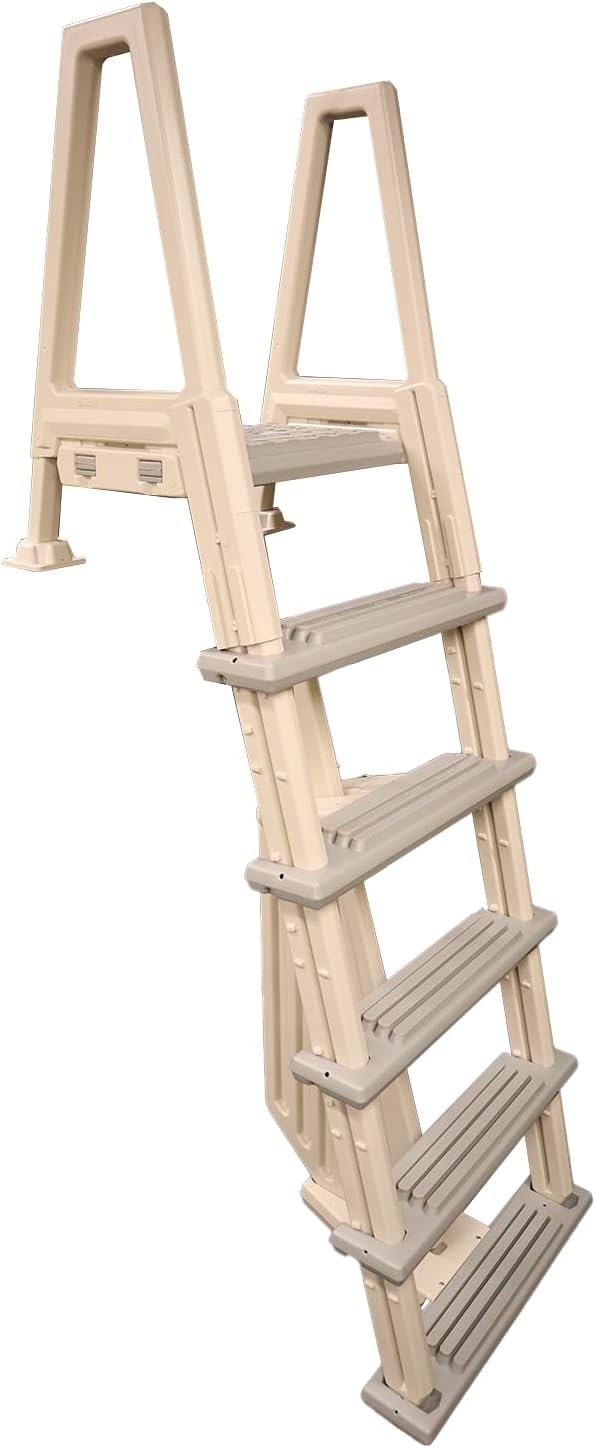
- Deck-mounted in-pool ladder; 42–56 in. deck range
- 300 lb limit
- Anti-entrapment barrier; optional extension kit available

- 32 in. wide in-pool step system
- Manufacturer lists 46–60 in. deck-height adjustment
- 300 lb limit with wide resin steps and double handrails
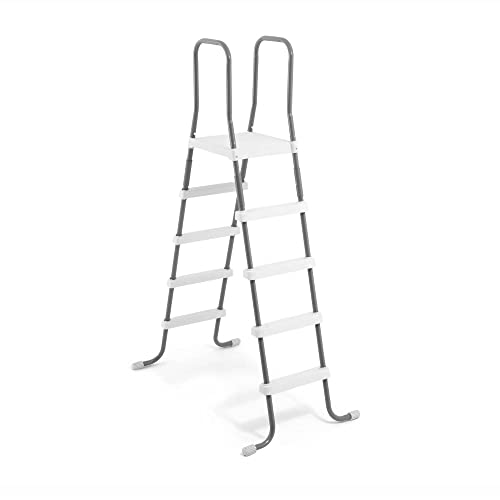
- Made for 52 in. wall-height above-ground pools
- 300 lb support rating on current listing
- Coated steel frame with slip-resistant double-sided steps

- For above-ground pools up to 52 in. high
- Metal frame with heavy-duty plastic double-sided steps
- Approx. 46 x 30 x 75 in. assembled dimensions
What to Look for When Buying an Above Ground Pool Ladder with Platform
Start With the Installation Type
The first decision is not material or price; it is whether the pool has a deck. A true A-frame ladder places one set of steps outside the pool and another inside, crossing over the wall at a top platform or transition area. That layout works for many deckless above-ground pools, provided the frame is approved for the pool type and the ladder can be secured as instructed.
A deck-mounted in-pool ladder works differently. The outside approach is the deck itself, so the ladder only provides the descent into the water and must be fastened to the deck. The Confer 6000X and Vinyl Works IN Deluxe 32 belong in this category. They are not substitutes for the Confer 7200, WDOT, Intex, Bestway, or stainless A-frame models on a pool with no deck.
Measure Actual Wall or Deck Height
Nominal pool size is not always the measurement a ladder manufacturer uses. A 52-inch pool wall does not automatically mean every “52-inch ladder” will sit correctly once top rails, caps, decking, pavers, or uneven ground are involved. Measure from the stable foot location to the intended transition height and compare that number with the ladder’s documented adjustment range.
Adjustability is especially useful when a ladder will remain through seasonal ground movement or when the deck surface is slightly above the pool’s top rail. The Confer 7200 covers 48–56-inch pools, while the WDOT listing targets 48–52 inches. Confer’s 6000X manual specifies deck heights from 42 to 56 inches, and Vinyl Works currently lists the IN-32 for 46–60-inch deck heights.
Pay Attention to the Top Platform and Rail Clearance
The platform is the point where a swimmer changes direction from climbing up to stepping down. More foot area can make that transition less cramped, but a larger platform also has to clear the pool structure and any top rail. The Confer 7200 is specifically designed around a large molded platform and accepts pool top seats up to 14 inches wide.
On lighter metal A-frame ladders, the top area is generally smaller and functions more as a crossover step than a standing landing. That saves material and floor space, but the feel is different. Buyers who want a broad, stair-like transition should focus more on molded systems or wide in-pool steps than on compact metal ladders.
Compare Tread Width, Depth, and Surface Texture
Step count alone says little about how a ladder feels underfoot. Tread width and depth determine how much shoe-free foot area is available, while molded ribs or textured surfaces help maintain traction when wet. Confer specifies 5 x 18-inch Comfortread steps on the 7200, a meaningful difference from narrow bar-style or shallow plastic treads.
The Vinyl Works IN Deluxe 32 takes the wide-step idea further by using a 32-inch-wide entry body rather than a conventional ladder rail layout. That design occupies more pool space but gives users a larger stair-like surface. Compact metal ladders trade some of that room for a smaller footprint and easier seasonal handling.
Treat Weight Capacity as a Limit, Not a Comfort Score
A higher stated load capacity can be important, but it does not automatically mean a ladder has wider steps, better hand placement, or a less steep climbing angle. The WDOT listing specifies 600 pounds, the stainless model specifies 551 pounds, and several other models in this comparison are rated at 300 pounds. Those figures should be respected as maximum limits, not as a suggestion that the structure will feel the same to every user.
Also consider where the load goes. A deck-mounted ladder transfers force into its mounting flanges and deck structure, while an A-frame spreads force through both sides of the ladder. Loose soil, soft pavers, a flexible deck board, or an incorrectly attached pool frame can undermine stability even when the ladder itself has an adequate published rating.
Match the Material to the Pool Environment
Molded plastic and resin do not rust, which reduces one common maintenance concern, but large molded ladders are bulkier and can require water ballast or secure attachment to control buoyancy. Metal-frame ladders are usually slimmer. Coated steel needs inspection where coatings chip or hardware corrodes, while stainless steel generally offers stronger corrosion resistance but still benefits from rinsing, cleaning, and attention to water chemistry.
Do not treat “corrosion resistant” or “stainless” as “maintenance free.” Chlorine, salt, acidic water, dissimilar metals, and trapped moisture can affect hardware and finishes over time. Inspect fasteners, rails, welds, feet, and step connections before the swimming season and periodically during use.
Access Barriers Help Only When Used Correctly
A lockable outside barrier is a useful distinction on the Confer 7200 and WDOT designs because it changes how the exterior steps can be accessed when the pool is not in use. That is different from a standard open A-frame ladder. However, a barrier on the ladder is only one layer of pool access control and does not replace adult supervision, fencing, gates, alarms, or local code requirements.
If restricting outside access matters in your installation, check how the barrier closes, locks, and interacts with the pool wall. Also verify whether your local rules require the ladder itself to be removable, lockable, enclosed, or protected by a separate barrier.
Confirm Soft-Sided and Inflatable Pool Compatibility
This is an easy place to make an expensive mistake. Confer states that the 7200 must attach to the pool frame and is not for soft-sided or inflatable pools. The Bestway listing, by contrast, describes its 52-inch ladder for above-ground pools including inflatable models up to the stated height. Compatibility language is model-specific, so do not assume that all A-frame ladders can be placed over any flexible-wall pool.
Also look at the shape of the feet and what they contact inside the pool. A liner should not be pinched, abraded, or loaded by a sharp or damaged foot. Use the feet, pads, cups, or protective parts specified for the ladder and place the unit on a stable, level surface.
Confer Plastics 7200 Roll Guard A-Frame Safety Ladder
The Confer Plastics 7200 is a molded A-frame system for deckless above-ground pools where the owner wants a substantial top platform and a way to close off the exterior steps. It fits pool heights from 48 to 56 inches and supports up to 300 pounds. Its defining feature is the Roll-Guard barrier, which pulls across the outside climbing side and can be locked when the pool is not in use.
Design and Build
This ladder uses molded plastic rather than a slim metal-tube frame. The result is a broad structure with curved handrails, integrated side barriers on the inner rails, and a large platform at the top. Confer specifies 5-inch by 18-inch Comfortread steps, giving the feet substantially more surface than the narrow treads found on many basic A-frame ladders.
The outside barrier is not just a removable panel. It is built into the entry side and is intended to close over the exterior steps. A lock is included. That construction makes the 7200 more physically substantial than a simple double-sided ladder, so buyers should plan for both the larger footprint and the storage space needed if it is removed for winter.
Important Specifications
The working height range is 48–56 inches, and the ladder is designed to accommodate pool top seats up to 14 inches wide. The published weight limit is 300 pounds. Confer also specifies a 5-year warranty against manufacturing defects and workmanship for this ladder line.
The top-seat clearance is particularly useful to verify before purchase because many rigid-wall above-ground pools have wide top rails. A ladder can be the correct nominal height and still be unsuitable if the crossover area cannot clear the rail or be attached according to the instructions.
Practical Use
The wide treads and oversized transition area make the 7200 feel closer to a compact stair system than a thin rung ladder. The handrails extend above the platform, providing a defined place to hold while moving over the wall. The Roll-Guard changes the everyday routine as well: after swimming, the outside climbing surface can be covered and locked instead of remaining exposed.
That access-control feature is useful only when it is actually closed and locked. It should not be treated as childproofing by itself. Pool fencing, gates, supervision, and local barrier requirements remain separate responsibilities.
Installation and Stability
Confer requires the 7200 to be attached to the pool frame. The side rails are filled with water to reduce floating, so the design does not require owners to pack sand or bricks into the ladder. This is convenient during assembly, but the frame attachment remains essential; water ballast is not a substitute for fastening the ladder as directed.
The ladder is not intended for soft-sided or inflatable pools. Owners who later add a deck can convert the 7200 to an in-pool configuration with the separately sold CK7200 kit, which gives the product a possible second use rather than forcing a complete replacement.
Important Strengths
The strongest reason to consider the 7200 is the combination of wide steps, broad platform, adjustable 48–56-inch fit, and integrated exterior barrier. Few basic A-frame ladders combine all four. The water-filled rails also avoid the need for loose ballast materials inside the structure.
Its 14-inch top-seat clearance is another practical specification for owners of rigid-wall pools with substantial rails. The molded construction does not eliminate maintenance, but it removes painted steel tubes from most of the structure and therefore avoids one common corrosion point.
Important Limitations
This is a large molded ladder, not a compact accessory. It needs more room around the pool, is heavier and bulkier to store than a simple metal ladder, and must be secured to a compatible rigid pool frame. Owners of soft-sided or inflatable pools should choose a model specifically approved for that construction instead.
The 300-pound limit is also lower than the published figures for the WDOT and stainless-steel models in this group. A higher capacity does not automatically make those ladders more comfortable, but the limit itself can be decisive for some households.
Who Should Consider It
The 7200 makes sense for a rigid-wall, deckless above-ground pool between 48 and 56 inches high when a wide molded platform and closeable exterior steps are priorities. It is especially relevant when the pool has a broad top seat and the owner prefers a substantial stair-like feel over a narrow metal A-frame.
Who Should Consider Another Option
Choose another design if the pool is inflatable or soft-sided, if storage space is very limited, if you already have a deck and only need an in-pool descent, or if the intended user requires a load rating above 300 pounds. The WDOT offers a higher listed capacity in a molded A-frame, while the Confer 6000X and Vinyl Works IN-32 are more logical for deck installations.
Pros
- Adjusts to 48–56 in. pool heights and clears top seats up to 14 in. wide
- 5 x 18 in. Comfortread steps and a large top platform provide generous foot area
- Lockable Roll-Guard barrier covers the exterior climbing side
- Water-filled rails provide ballast without sand or bricks
Cons
- 300 lb weight limit is lower than the WDOT and stainless models listed here
- Must attach to a compatible rigid pool frame
- Not intended for soft-sided or inflatable pools
WDOT A-Frame Pool Ladder with Platform and Safety Barrier
The WDOT is another molded A-frame ladder with a top platform and an exterior access barrier, but its specifications are aimed at a slightly narrower pool-height range. The current listing targets 48–52-inch pools and identifies high-density polyethylene as the main material. It also lists a 600-pound load capacity, which is materially higher than the 300-pound figure common to several other ladders in this comparison.
Design and Build
The frame is molded HDPE with five steps, integrated handrails, a top platform, and a barrier on the outside climbing side. The listing gives a width of 23.7 inches and an overall height of about 80 inches, with an item weight of 65 pounds. Those numbers indicate a sizeable molded structure rather than a lightweight seasonal ladder.
HDPE is well suited to wet environments because it does not rust, but the overall construction still depends on fasteners, joints, and correct assembly. The step surfaces are textured for traction, and the base is adjustable to help the A-frame sit correctly around the pool wall.
Important Specifications
WDOT specifies compatibility with 48–52-inch above-ground pools, five steps, and a 600-pound load capacity. The Amazon listing includes a seller clarification stating that some user manuals were printed with a lower load figure and that the intended rating is 600 pounds. Because documentation can remain in circulation after a correction, buyers should follow the current instructions included with the unit and confirm any load-limit marking on the product itself.
The narrower 48–52-inch height target can be an advantage if your pool is squarely within that range, because there is less reason to pay for adjustment you will not use. It is a disadvantage for 54- or 56-inch rigid-wall pools, where the Confer 7200 has a broader documented range.
Practical Use
Like the Confer 7200, the WDOT gives users a clear platform at the top rather than forcing an immediate pivot on a narrow rung. The five-step approach spreads the climb over multiple treads. The outside safety barrier can be closed when the pool is not in use, helping restrict direct access to the exterior steps.
Its relatively high listed load capacity is relevant for heavier adults, but capacity should be considered together with step dimensions and comfort. The WDOT listing does not present the same 5 x 18-inch tread specification that Confer publishes for the 7200, so buyers who prioritize a particular tread depth should examine the listing images and included dimensional documentation carefully.
Installation and Setup
This is a freestanding A-frame layout, but “freestanding” should not be interpreted as permission to place it casually on uneven ground. The exterior legs need a firm, level base, the in-pool side needs correct contact with the pool floor, and all barrier and platform hardware should be fully tightened. Follow the attachment and setup steps supplied with the exact unit.
Because the structure weighs about 65 pounds before any water-related forces are considered, plan where it will be assembled. Building it close to the pool can be easier than moving the completed frame across a yard, but hardware should be kept away from the liner while parts are being sorted.
Important Strengths
The WDOT combines three buying points that do not always appear together: a molded platform, an exterior access barrier, and a 600-pound listed load rating. Its HDPE body avoids the coating maintenance associated with painted or powder-coated steel frames. The 48–52-inch range also covers two very common above-ground pool heights.
Important Limitations
This is not the best fit for taller 54–56-inch pools, and its bulk is a consideration for off-season storage. Buyers should also pay attention to the load-rating clarification in the current listing rather than relying on an older printed manual that may show a different number.
As with any access barrier, the lockable section is only one layer of safety. It does not convert an otherwise open pool area into a code-compliant enclosure and does not replace supervision.
Who Should Consider It
The WDOT suits owners of 48–52-inch above-ground pools who want a broad molded A-frame rather than a narrow metal ladder and who place importance on a high listed load capacity. It is also a logical candidate for households that want the exterior climbing side to be closable when the pool is not being used.
Who Should Consider Another Option
Look elsewhere if your pool wall is above the documented 52-inch range, if you need a compact seasonal ladder, or if the pool already has a deck. A deck-mounted in-pool entry avoids having a full A-frame on the exterior side, while the Confer 7200 covers taller rigid-wall pools up to 56 inches.
Pros
- Current listing specifies a 600 lb load capacity
- HDPE molded A-frame avoids a painted-steel main structure
- Top platform and five-step layout provide a defined crossover path
- Lockable exterior barrier can close off direct access to the outside steps
Cons
- Height range is limited to 48–52 in. pools
- Large 65 lb molded structure takes more storage room than a basic metal ladder
- Current listing includes a correction for load figures printed in some manuals, so documentation should be checked carefully
Syagnos 54-Inch 304 Stainless Steel Pool Ladder with Platform
This 54-inch A-frame takes a very different approach from the molded Confer and WDOT ladders. The current Amazon listing identifies the brand as Syagnos and specifies 304 stainless steel, a four-step layout on each side, a top platform, and a 551-pound load capacity. It is designed for above-ground pools up to 54 inches high.
Design and Build
The ladder uses round stainless-steel rails with white step surfaces and a rectangular top platform. Two tall loop-style handrails rise above the platform so users have something to hold during the transition over the pool wall. The listing describes four non-slip pedals on each climbing side and suction-cup feet at the lower contact points.
Compared with a large molded A-frame, this construction is visually lighter and leaves more open space around the steps. It also weighs less than the WDOT molded system; the current product data lists about 34 pounds. That can simplify seasonal removal, although a lighter frame still has to be positioned and stabilized exactly as instructed.
Important Specifications
The key figures are a 54-inch intended pool height, 304 stainless-steel construction, four steps, and a listed 551-pound maximum load. Amazon’s catalog data gives an overall width of about 19.69 inches and height of about 67.72 inches. The narrower frame can be useful where deckless pool access space is tight, but always measure the actual footprint as well as the width.
The load limit is one of the highest published figures in this group. That is important for capacity planning, but it should not be confused with a guarantee of comfort. The tread depth and climbing angle still matter to anyone who dislikes narrow steps or steep approaches.
Practical Use
The top platform provides a clear crossover point, while the high handrails remain available as the user steps over the pool wall. The four-step arrangement means the vertical rise per step may feel different from a five-step molded ladder. People with limited confidence on ladders may prefer to compare actual tread spacing before ordering.
The suction-cup feet are intended to increase contact and stability at the base. They work only when the contact surface and installation conditions allow them to seat correctly. Debris, textured liners, wrinkles, or an uneven surface can reduce effective contact, so the feet should be inspected rather than assumed to be secure.
Material and Maintenance
304 stainless steel has better corrosion resistance than ordinary unfinished carbon steel, which is useful around chlorinated water. It is not immune to staining or corrosion. Pool chemicals, salt, low-pH water, and deposits around joints can still affect stainless components, particularly if water sits on hardware after the season ends.
Rinse the ladder as recommended, keep water chemistry within the pool manufacturer’s range, and inspect fasteners and joints for discoloration, looseness, or pitting. Avoid mixing replacement hardware of unknown metals because dissimilar metals can create additional corrosion concerns in wet environments.
Important Strengths
The main advantages are the 551-pound listed capacity, stainless-steel frame, relatively narrow open construction, and top platform. For buyers who want a higher-capacity A-frame but do not want a bulky molded ladder, those characteristics are meaningful. The tall handrails also create continuous grip points around the transition area.
Important Limitations
This model does not provide the lockable exterior barrier found on the Confer 7200 or WDOT. The four-step metal-frame layout also offers a different underfoot feel from broad molded Comfortreads or a 32-inch-wide resin step system. Anyone prioritizing access restriction or stair-like treads should compare those alternatives carefully.
Stainless construction also does not eliminate seasonal care. The frame and hardware still need rinsing, inspection, secure assembly, and protection from aggressive chemistry.
Who Should Consider It
This ladder is relevant for a deckless above-ground pool up to 54 inches when a higher listed load capacity and stainless-steel frame are more important than a lockable exterior barrier. It can also suit buyers who prefer a narrower, more open A-frame that is easier to move than a large molded entry system.
Who Should Consider Another Option
Choose a different ladder if you specifically need a barrier over the outside steps, a 56-inch fit, extra-wide molded treads, or deck-mounted access. The WDOT and Confer 7200 address barrier needs, while the Vinyl Works IN-32 offers a much wider stair-like entry for deck-equipped pools.
Pros
- Current listing specifies a 551 lb load capacity
- 304 stainless-steel frame offers strong corrosion resistance with proper care
- Top platform and tall loop handrails create a clear transition area
- Relatively open, narrower frame is easier to handle than large molded systems
Cons
- No lockable exterior step barrier
- Four-step layout is less stair-like than wide molded entry systems
- Stainless steel still requires inspection and maintenance around pool chemicals
Confer Plastics 6000X Heavy-Duty In-Pool Ladder
The Confer 6000X appears in searches for an above ground pool ladder with platform, but its installation is fundamentally different from the A-frame products above. It is an in-pool ladder for pools with a deck. The deck replaces the outside climbing side, and the ladder must be attached to that deck. Confer’s installation manual specifies an adjustable deck-height range of 42 to 56 inches and a 300-pound weight limit.
Design and Build
The 6000X uses molded plastic stringers, flat treads, tall handrails, a small deck-level platform area, and an anti-entrapment barrier behind the in-pool ladder. The warm-gray molded construction avoids a full metal frame and provides broad flat stepping surfaces rather than round rungs.
Because it occupies only the water side of the pool wall, the exterior deck stays clear of an A-frame leg assembly. That can be a major advantage around a permanent deck, but it also means the deck structure becomes part of the installation and must be capable of accepting the mounting hardware.
Important Specifications
Confer’s manual lists adjustment for deck heights from 42 to 56 inches, a 300-pound maximum user weight, and mandatory deck attachment. An optional 6000X-EXT kit can extend the ladder for deck heights from about 57 to 68 inches by adding extension boots, another tread, and associated hardware.
The anti-entrapment barrier is included on U.S. and Canadian versions described in the manual. Its purpose is to block access to the space behind the ladder structure. It should not be confused with the exterior access barrier on the Confer 7200; the 6000X barrier addresses the in-pool area behind the ladder, not access from the yard.
Practical Use
For a pool already surrounded by a deck, the 6000X creates a direct descent from deck level into the water. The user does not climb up one side, pause over the wall, and descend the other as with an A-frame. That reduces the amount of structure outside the pool and can make the access point feel integrated with the deck.
The molded treads are flatter and more substantial than metal rungs, but the ladder is still narrower than the 32-inch Vinyl Works step system. Buyers who want a stair-like entry with maximum foot area should compare those two deck-mounted products directly.
Installation and Ballast
The ladder must be attached to the deck. Confer’s instructions also call for the ladder to be filled with water so it submerges correctly. For pools taller than 48 inches, current product instructions specify adding 10 pounds of sand as directed; the sand is not included. This is a model-specific installation detail and should not be improvised with loose weights placed in the pool.
Before drilling a deck, verify board thickness, joist location, fastener requirements, and clearance from the pool wall. Local codes may impose additional requirements, and the ladder should not be installed in a location where the deck edge or pool structure flexes under load.
Important Strengths
The 6000X is useful because it solves a deck installation without leaving an unnecessary exterior ladder in the yard. Its 42–56-inch standard adjustment range covers a broad set of deck heights, and the optional extension kit adds flexibility for taller decks. The included anti-entrapment barrier and molded flat treads are also purpose-built details rather than add-ons.
Important Limitations
This product is not a freestanding A-frame. It is unsuitable for a deckless pool unless the owner adds an approved deck or another mounting structure specifically intended for the ladder. Its 300-pound limit should also be checked against the intended users.
Installation is more permanent than simply placing a seasonal A-frame next to the pool because the ladder attaches to the deck. That is a benefit for stability when done correctly, but it requires accurate measurement and proper mounting.
Who Should Consider It
Consider the 6000X when you already have a structurally suitable deck and want a conventional in-pool ladder rather than a wide staircase. It is especially practical when deck height falls within the 42–56-inch range or can be accommodated with the manufacturer’s extension kit.
Who Should Consider Another Option
A deckless pool needs an A-frame instead. A user who wants wider, stair-style treads may prefer the Vinyl Works IN Deluxe 32, while anyone who needs a lockable barrier on the outside approach should look at an A-frame system such as the Confer 7200.
Pros
- Official manual specifies adjustment for 42–56 in. deck heights
- Molded flat treads provide more foot area than narrow metal rungs
- Included anti-entrapment barrier blocks access behind the in-pool ladder
- Optional extension kit can accommodate roughly 57–68 in. deck heights
Cons
- Requires a deck and must be attached to it
- 300 lb weight limit
- Taller installations can require specified sand ballast and extra setup work
Vinyl Works IN Deluxe 32-Inch Adjustable In-Step
The Vinyl Works IN Deluxe 32 is best understood as an in-pool step system rather than a conventional narrow ladder. Its 32-inch width gives swimmers a broad set of resin treads with double handrails, while the deck provides the outside approach. The manufacturer’s current Model IN-32 page lists adjustment for 46–60-inch deck heights and a 22-inch footprint inside the pool.
Design and Build
The body is molded resin with flow-through side frames and risers intended to reduce trapped water and block large open spaces behind the steps. The taupe version in this listing uses the same wide stair layout as the white model. Stainless-steel hardware is used at the mounting points, and the system includes deck-mount flanges for attachment.
This design occupies more pool floor area than a slim ladder. In return, each step extends across a much wider entry path. For swimmers who dislike placing the middle of the foot on a narrow rung, that geometry can be more comfortable, though it should not be presented as a substitute for an accessibility assessment where mobility limitations are involved.
Important Specifications
Vinyl Works lists the IN-32 at 32 inches wide, with a 22-inch in-pool footprint and deck-height adjustment from 46 to 60 inches. The Amazon listing specifies a 300-pound load capacity for one user at a time. The current Amazon copy describes the top platform as adjusting from 44 to 60 inches, while the manufacturer’s current Model IN-32 page lists 46 to 60 inches. For fit planning, use the manufacturer’s current 46–60-inch specification and verify the installation instructions supplied with the unit.
The system is intended for above-ground pools with a flat bottom. That detail matters because a broad stair body needs stable, even support across its base; it is not designed to bridge an irregular or sloped floor.
Practical Use
The wide steps create a very different entry experience from an A-frame ladder. Users approach from the deck, hold the two extended rails, and descend into the pool on full-width treads. There is no outside ladder to climb, no wall crossover from one ladder side to another, and no narrow steel frame at the waterline.
The tradeoff is space. A 22-inch footprint inside the pool is noticeable, especially in smaller round pools where every foot of perimeter area matters. Before purchasing, map the proposed location and make sure the step body will not interfere with skimmers, returns, pool cleaners, or common swimming paths.
Installation and Deck Connection
The IN-32 is supplied with deck-mount flanges and is meant to be secured to a deck. That makes the quality of the deck connection as important as the resin step body. Mounting into a weak board, using incorrect fasteners, or positioning the flanges too close to an unsupported edge can compromise the installation.
The smooth, rounded lower surfaces are intended to be liner friendly, but the pool floor should still be clean and free of sharp debris before the step is placed. Recheck the base during the season so trapped debris cannot abrade the liner underneath.
Important Strengths
The IN-32’s main strength is usable step area. Its 32-inch width, double handrails, and wide resin treads make it much more stair-like than the Confer 6000X or a metal A-frame. The 46–60-inch manufacturer-listed adjustment range is also broad for deck installations.
Because the primary body is resin, rust is not a concern for the steps themselves. Hardware still needs inspection, but there is no coated steel frame running down both sides of the pool.
Important Limitations
The system requires a deck and a flat pool bottom. It also gives up a meaningful amount of in-pool space, which may be undesirable in compact above-ground pools. The 300-pound limit is adequate for many households but lower than the published figures on the WDOT and stainless A-frame products.
There is no exterior access barrier because the product does not include an exterior ladder; access control must be handled at the deck, gate, or enclosure level.
Who Should Consider It
The IN Deluxe 32 is appropriate for a deck-equipped above-ground pool when broad stair-like treads and a wide handrail path matter more than minimizing the in-pool footprint. It is particularly worth comparing against the Confer 6000X if users prefer more foot area on each step.
Who Should Consider Another Option
Choose a narrower in-pool ladder if swimming space is limited, or an A-frame if the pool has no deck. Anyone needing a weight rating above 300 pounds should also select a model whose published capacity meets the intended user.
Pros
- 32 in. wide stair-style entry offers substantially more tread area than narrow ladders
- Manufacturer lists adjustment for 46–60 in. deck heights
- Flow-through resin side frames and double handrails suit a permanent deck entry
- 22 in. in-pool footprint is clearly documented for layout planning
Cons
- Requires a structurally suitable deck and flat pool bottom
- Wide body occupies more pool space than a conventional ladder
- 300 lb load limit
Intex 28067E 52-Inch Steel Frame Pool Ladder
The Intex 28067E is a straightforward metal A-frame intended for above-ground pools with a 52-inch wall height. Intex identifies this exact SKU for 52-inch-depth pools and lists a coated steel frame to help resist corrosion. The current Amazon listing adds a 300-pound support rating and slip-resistant steps.
Design and Build
The frame uses coated steel tubing with plastic step surfaces on both sides. Four steps are arranged on each climbing side, and the rails rise above the wall to form handholds around the top transition. At 23.67 pounds on Intex’s current product page, it is substantially lighter than the molded WDOT or Confer 7200.
That lighter structure is useful for seasonal pools because it is easier to move and store. It also means the ladder relies on correct leg placement, fully tightened hardware, and a level base rather than the mass and broad molded sidewalls of heavier entry systems.
Important Specifications
The most important compatibility point is the 52-inch wall height. This is not marketed as a 48–56-inch adjustable system. Buyers with a different wall height should choose a ladder documented for that height instead of assuming the geometry will be close enough.
The current listing specifies a 300-pound support limit and high-impact, slip-resistant steps. Intex’s official page lists the ladder at 23.67 pounds. These figures describe a relatively light, conventional A-frame rather than a broad stair or safety-gate system.
Practical Use
For a standard 52-inch seasonal pool, the 28067E keeps the access setup simple. There are no water-filled rails, wide resin sidewalls, or roll-down gates. The user climbs one side, transitions over the pool wall at the top, and descends the other side.
The steps provide textured foot contact, but they remain much narrower than the Confer 7200 Comfortreads or Vinyl Works stair treads. Swimmers who want a more generous platform and step depth should treat that as a meaningful difference, not merely a style preference.
Setup and Seasonal Handling
A light A-frame is easier to assemble near the pool and remove at the end of the season. During setup, both sides need stable footing and the frame must not press against or damage the pool liner or wall. Tighten hardware evenly and recheck it after initial use because joints can settle as the ladder takes load.
Coated steel should be inspected for chips, scratches, or exposed metal. Rinse off chemical residue as recommended and store the ladder dry when the pool is taken down. Small coating damage is easier to address early than after corrosion spreads beneath the finish.
Important Strengths
The 28067E is simple, light, and model-specific for a common 52-inch Intex-style above-ground pool height. It does not demand the storage volume of a molded stair system and avoids the installation work of a deck-mounted ladder. The coated steel frame is also a familiar construction with widely understood assembly.
Important Limitations
The biggest limitation is specialization: it is intended for 52-inch walls rather than a broad adjustable range. It also lacks a lockable exterior barrier and has a 300-pound limit. Its narrower steps and smaller top transition are less stair-like than the large molded systems.
Who Should Consider It
The Intex is a practical match for a compatible 52-inch above-ground pool when the owner wants a conventional, relatively lightweight A-frame and does not need a large platform or lockable access barrier. Seasonal pool owners who regularly dismantle equipment may value the lower weight.
Who Should Consider Another Option
Consider another model if the pool is not 52 inches high, if a closeable outside ladder is important, if users need a higher load rating, or if wide stair-style treads are a priority. The Bestway covers pools up to 52 inches, while molded options offer larger platforms and barriers.
Pros
- Designed specifically for above-ground pools with 52 in. wall height
- Official product weight of 23.67 lb makes seasonal handling relatively easy
- Coated steel frame and slip-resistant double-sided steps use a simple familiar layout
- No deck is required for the A-frame installation
Cons
- Not a broad multi-height adjustable ladder
- 300 lb support rating
- No lockable exterior access barrier or wide stair-style platform system
Bestway 52-Inch Above Ground Pool Ladder
The Bestway 52-inch ladder is another conventional A-frame, but the current listing describes compatibility with above-ground pools, including inflatable pools, up to 52 inches high. It combines a metal frame with heavy-duty plastic double-sided steps and is approximately 46 x 30 x 75 inches assembled.
Design and Build
The structure uses curved metal legs with molded plastic steps on both sides and raised handrail loops around the top. Bestway describes the metal frame as corrosion resistant and the steps as heavy-duty plastic. The frame is more open and compact than the molded Confer and WDOT systems, which can make it easier to position around many seasonal pools.
An ASIN-specific instruction manual lists a 300-pound maximum load. That puts the Bestway in the same capacity class as the Confer 7200, Confer 6000X, Vinyl Works IN-32, and Intex listing rather than the higher-capacity WDOT and stainless models.
Important Specifications
The listing states compatibility with above-ground pools up to 52 inches high and gives assembled dimensions of approximately 46 inches long, 30 inches wide, and 75 inches high. The “up to” wording is important: confirm the actual wall height and the included setup instructions rather than assuming that every shorter pool automatically produces ideal step placement.
Bestway’s official ladder range uses heavy-duty plastic steps attached to corrosion-resistant metal frames. That construction keeps the climbing surfaces nonmetallic while retaining a slim tubular frame.
Practical Use
This is a direct, uncomplicated entry system. The user climbs the outer steps, uses the upper rails for support at the transition, then descends the inner steps. There is no separate lockable barrier, no water-ballasted sidewall, and no deck-mounting flange.
For a seasonal family pool, that simplicity can be a virtue because there are fewer bulky molded components to store. The tradeoff is that the step surfaces and top transition do not provide the same broad landing area as a dedicated molded platform ladder.
Installation and Pool Compatibility
Bestway markets this ladder for above-ground pools up to 52 inches, including inflatable designs. That makes it relevant where a rigid-frame-only ladder such as the Confer 7200 is not appropriate. Still, the pool’s own manual should be checked for ladder requirements because flexible-wall and frame-pool designs vary.
Set the exterior feet on firm, level ground and keep the in-pool feet clean and correctly positioned. Inspect the plastic steps for cracks and the metal frame for coating damage, loose fasteners, or corrosion. The ladder should be removed or secured according to the pool manufacturer’s access-control instructions when the pool is unattended.
Important Strengths
The Bestway’s main appeal is broad simplicity: it is a familiar two-sided ladder for pools up to 52 inches, uses corrosion-resistant metal construction with plastic steps, and is documented for use with a range of above-ground pool types. Its open frame also takes less storage volume than large molded safety-entry systems.
Important Limitations
The design does not include a lockable barrier over the exterior steps, and the 300-pound manual limit is lower than the WDOT and stainless products. Buyers seeking wide treads, an oversized platform, or a stair-like feel should look at molded or deck-mounted step systems instead.
Corrosion-resistant metal still needs inspection. Damage to the protective finish, persistent chemical residue, or wet storage can shorten service life if ignored.
Who Should Consider It
The Bestway is suited to a compatible pool up to 52 inches when the priority is a basic A-frame with straightforward assembly and modest storage requirements. It is also one of the options in this group whose current listing explicitly includes inflatable above-ground pools in the intended use.
Who Should Consider Another Option
Select another ladder if you need an exterior gate or barrier, a 54–56-inch height, a higher published load capacity, or deck-mounted access. The Confer 7200 and WDOT offer barrier systems, while the stainless model extends the conventional A-frame idea to a 54-inch height and higher listed capacity.
Pros
- Current listing covers above-ground pools up to 52 in. high, including inflatable models
- Metal frame with heavy-duty plastic double-sided steps keeps the design straightforward
- Approx. 46 x 30 x 75 in. assembled dimensions are available for footprint planning
- Open A-frame stores more compactly than large molded entry systems
Cons
- No lockable exterior access barrier
- ASIN-specific manual lists a 300 lb maximum load
- Metal frame still requires coating and corrosion inspection
Detailed Buying Guide for an Above Ground Pool Ladder with Platform
A-Frame Versus Deck-Mounted Entry
A deckless pool normally needs access on both sides of the wall, which is why A-frame ladders remain common. They create a complete bridge from the yard into the pool. Their biggest planning issues are exterior footprint, pool-wall clearance, compatible height, and how the outside steps are restricted when the pool is unattended.
Deck-mounted systems remove the exterior half of the ladder because the deck is already at entry height. This can make the pool area cleaner and reduce the amount of equipment on the ground, but it transfers the installation requirements to the deck. The deck must be structurally suitable, the fasteners must be installed correctly, and the access point needs to comply with local pool-barrier rules.
Do not buy an in-pool deck ladder simply because it has the width or tread shape you prefer if no deck exists. Likewise, an A-frame may be unnecessarily bulky beside a permanent deck. Installation type should be settled before comparing secondary features.
How to Measure Pool Height Correctly
Measure the vertical distance that the ladder actually has to span. For a freestanding A-frame, that usually means the stable exterior ground level to the top transition point at the pool wall. For a deck-mounted ladder, use the deck surface to the pool floor or the manufacturer’s specified deck-height reference. Do not rely on the pool’s marketing label alone.
If the ground outside the pool is built up with pavers, a pad, or compacted gravel, include that finished surface in your measurement. If a deck sits slightly above the top rail, use the deck surface rather than the pool-wall number. An adjustable ladder gives some margin, but it cannot compensate for an installation outside its published range.
Platform Size and Transition Geometry
A platform is most valuable at the direction-change point. Users climb upward facing the ladder, then have to move over the pool wall and descend. A broad, stable area gives more room for that pivot. The Confer 7200 is built around an oversized molded platform, while the WDOT also provides a prominent top platform. Metal A-frames generally use a smaller crossover area.
For a deck system, the deck is effectively the outside platform. The in-pool product may therefore need only a small top landing or flange area. This is why a deck-mounted ladder can look less substantial in photos yet still be appropriate for its intended installation. Compare the whole access path, not just the product in isolation.
Step Geometry Matters More Than Step Count
A five-step ladder is not automatically easier to climb than a four-step ladder. Tread depth, rise between steps, width, angle, and handrail position all affect use. Wide treads support more of the foot. Smaller rises can reduce the size of each movement, but a steep frame can still feel demanding.
The 5 x 18-inch Comfortreads on the Confer 7200 are a useful example of a specification that conveys real geometry. The 32-inch-wide Vinyl Works IN-32 goes further toward a stair format. In contrast, lightweight metal A-frames prioritize compactness and seasonal handling. Neither approach is universally better; the right choice depends on pool space and user preferences.
Understanding Load Ratings
Use the published load limit as a hard ceiling and leave reasonable margin for normal movement. Climbing creates dynamic forces that differ from a person standing still, which is why secure assembly and stable footing remain important. Never use a ladder above its documented limit or allow multiple people on a one-person entry system.
This group spans from common 300-pound ratings to the WDOT’s current 600-pound listing and the stainless model’s 551-pound listing. If capacity is a deciding factor, check the label and instructions supplied with the exact unit after delivery. Product families can include similar-looking sizes with different ratings.
Plastic, Resin, Coated Steel, and Stainless Steel
Molded plastic and resin are attractive around pools because the main structural surfaces do not rust. They can also be shaped into wider steps, integrated barriers, and large handrails. Their disadvantages are bulk, weight, and buoyancy, which is why some products rely on water fill or specified ballast.
Coated steel is compact and economical, but any damaged coating deserves attention. Stainless steel resists corrosion more effectively but can still stain or pit in aggressive environments. Regardless of material, rinse away deposits, maintain appropriate pool chemistry, and replace damaged hardware with manufacturer-approved parts.
Ballast, Anchoring, and Footing
Pool ladders are exposed to buoyant force on the in-water side and shifting force as users climb. Manufacturers address this in different ways. The Confer 7200 uses water-filled rails and frame attachment. The Confer 6000X fills with water and may require specified sand in taller installations. The stainless model uses suction-cup feet as part of its base design.
Do not improvise ballast by hanging weights, placing bricks on liners, or filling cavities with materials the manufacturer does not specify. Improvised weight can damage a liner, create sharp contact points, or make seasonal removal difficult. Follow the exact ballast and attachment method for the model.
Pool Liner and Floor Protection
The in-pool feet or base should be smooth, intact, and free of grit. Even a rounded pad can trap sand or small stones that abrade the liner as swimmers move the ladder. Clean the installation area before placing the ladder and check it during the season.
If a manufacturer calls for a mat, pad, or specific foot component, use the correct part rather than substituting a generic material that may react with the liner. Liner warranties can have their own restrictions regarding accessories placed on the pool floor.
Access Control and Local Codes
A ladder with a locking barrier can make the outside steps less accessible, but that feature should be viewed as one part of an access-control plan. Building codes and pool ordinances may address fence height, self-closing gates, removable ladders, deck gates, alarms, and clear zones around the pool. Requirements vary by location.
If a pool is accessible from a deck, the deck entrance may need its own gate or barrier regardless of the in-pool ladder design. If the ladder is the primary access point, determine whether local rules require the exterior steps to be enclosed, removed, lifted, or locked when the pool is not supervised.
Seasonal Maintenance and Storage
At the start of the season, inspect every step, rail, fastener, barrier hinge, mounting flange, foot, and platform. Look for cracks, UV damage, loose connections, rust, sharp edges, and missing hardware. Recheck after assembly and periodically during the season, especially after the ladder has been moved or subjected to heavy use.
For winter storage, clean and dry components before putting them away. Large molded ladders may require more shed or garage space, while light metal A-frames break down into smaller pieces. Keep installation hardware labeled so the next setup does not rely on mismatched fasteners.
Direct Product Comparisons
Confer 7200 vs WDOT A-Frame
These are the closest competitors in the group because both are molded A-frame systems with prominent platforms and barriers over the exterior climbing side. The Confer covers a wider height range at 48–56 inches, documents 5 x 18-inch Comfortreads, clears top seats up to 14 inches, and has a 300-pound limit. The WDOT targets 48–52 inches and currently lists a 600-pound load capacity.
The practical choice hinges on pool height, capacity needs, and how much value you place on Confer’s documented tread geometry and top-seat clearance. A 54- or 56-inch pool points away from the WDOT’s published range. A user requiring more than 300 pounds of rated capacity points away from the Confer 7200. Both remain large molded structures that need more storage space than a simple metal ladder.
Intex 28067E vs Bestway 52-Inch Ladder
Both are conventional metal A-frames with plastic steps and no lockable exterior barrier. Intex positions the 28067E specifically for 52-inch wall-height pools, while Bestway describes its ladder for above-ground pools up to 52 inches and explicitly includes inflatable pools in the current listing.
The Intex has an official listed weight of 23.67 pounds and a current 300-pound support rating. The Bestway’s ASIN-specific manual also lists 300 pounds, and its assembled footprint is about 46 x 30 x 75 inches. The better fit therefore depends more on exact pool compatibility and geometry than on headline load capacity.
Confer 6000X vs Vinyl Works IN Deluxe 32
Both require a deck, but they serve different preferences. The 6000X is a traditional in-pool ladder with flat molded treads, a 300-pound limit, and a 42–56-inch manufacturer-manual deck range. The Vinyl Works is a 32-inch-wide stair system with a 22-inch footprint, a 300-pound limit, and a current manufacturer range of 46–60 inches.
The Confer consumes less pool floor space and can be extended to roughly 68 inches with an optional kit. The Vinyl Works uses more space but supplies much more tread width and a stair-like path. Measure both the deck height and the pool floor area before deciding; these products solve the same installation category in very different ways.
Stainless Steel A-Frame vs Molded Platform Ladders
The Syagnos stainless ladder provides a 551-pound listed capacity, a 54-inch target height, a top platform, and a lighter open frame. The molded Confer 7200 and WDOT are bulkier but integrate broad side structures and exterior access barriers.
If seasonal portability and higher capacity matter more than an integrated access barrier, the stainless layout has clear advantages. If wide molded treads and a barrier over the outside steps are priorities, the molded systems offer features the stainless ladder does not.
Common Buying Mistakes
Buying by Pool Diameter Instead of Wall Height
A 15-foot, 18-foot, or 24-foot pool diameter does not tell you which ladder height to buy. The ladder spans the wall or deck height, so measure vertically and compare that number with the model’s documented range.
Assuming Every “52-Inch” Ladder Fits Every 52-Inch Pool
Top rails, frame tubes, inflatable wall shapes, foot positions, and deck surfaces differ. A nominal 52-inch height is only the first filter. Confirm the manufacturer’s pool-type restrictions and the actual crossover geometry before ordering.
Buying a Deck Ladder for a Deckless Pool
The Confer 6000X and Vinyl Works IN-32 are in-pool systems that attach to a deck. They do not include a yard-side climbing structure. If no deck exists, a compatible A-frame is the correct category.
Ignoring the Space the Ladder Uses Inside the Pool
Wide steps are comfortable, but they occupy more swimming area. The Vinyl Works IN-32 uses a documented 22-inch footprint inside the pool, and large A-frames also require clear floor space for their inner legs. Mark out the footprint before purchase, especially in smaller pools.
Treating a Lockable Barrier as the Entire Safety Plan
A barrier over ladder steps can restrict access, but it does not replace supervision or whatever fencing, deck gates, alarms, or other controls local rules require. Build the pool access plan around the site, not around a single ladder feature.
Assuming Stainless or Coated Steel Needs No Maintenance
Pool environments are chemically aggressive. Inspect finishes and hardware, rinse residues, maintain water chemistry, and store metal components dry when possible. Corrosion resistance extends service life; it does not remove the need for care.
Focusing on Load Capacity While Ignoring Tread Geometry
A high weight rating is essential when needed, but it does not describe tread depth, step rise, handrail position, or climbing angle. Compare the physical path users must climb as carefully as the maximum-load number.
Frequently Asked Questions
What height ladder do I need for a 52-inch above-ground pool?
Choose a model whose documented working range includes the actual installation height and whose manufacturer approves your pool type. Some products are specifically made for 52-inch walls, while others adjust across ranges such as 48–56 inches. Measure the finished ground or deck surface to the transition point rather than relying only on the pool’s nominal wall label.
Is an A-frame ladder the same as a deck ladder?
No. An A-frame provides steps on both sides of the pool wall and is generally used where there is no deck. A deck ladder or in-pool step attaches to the deck and provides only the water-side descent. The Confer 6000X and Vinyl Works IN-32 require deck installations, while the other five products here are A-frame designs.
Does a pool ladder platform make climbing easier?
A larger top platform provides more room at the point where the user changes direction from climbing up to descending. That can make the transition less cramped, but overall usability also depends on tread dimensions, rail placement, climbing angle, and correct installation.
Can I use the Confer 7200 on an inflatable or soft-sided pool?
No. Confer specifies that the 7200 must attach to the pool frame and is not intended for soft-sided or inflatable pools. Choose a ladder whose instructions explicitly include your pool construction.
Which ladders in this comparison have a barrier over the outside steps?
The Confer 7200 and WDOT molded A-frame ladders include barriers intended to restrict access to the exterior climbing side. The Confer 6000X also has a barrier, but it is an in-pool anti-entrapment barrier rather than an exterior access gate.
Are wider pool steps always better?
Wider treads provide more foot area, but they take up more physical space and usually create a bulkier product. A 32-inch stair system can feel more substantial than a narrow ladder, yet its larger in-pool footprint may be inconvenient in a small pool. Balance tread size against available space and seasonal storage.
How important is the ladder weight limit?
It is a hard compatibility requirement. The intended user must stay within the published limit, and the ladder still needs correct assembly, stable footing, and secure mounting. Do not infer a higher rating from a similar-looking model or from the material alone.
Will 304 stainless steel rust in a pool environment?
304 stainless steel is corrosion resistant, but it can still stain or corrode under aggressive conditions. Chlorides, salt, low pH, deposits, and dissimilar-metal contact can all contribute. Regular rinsing, balanced water chemistry, inspection, and dry seasonal storage help protect the material.
Do I need to anchor or ballast an above-ground pool ladder?
Follow the exact model instructions. Some ladders attach to the pool frame, some attach to a deck, some use water-filled rails, and some use specific ballast or foot systems. Do not invent a ballast method or place loose heavy objects on a pool liner.
Can I leave a pool ladder installed all year?
That depends on the pool, climate, and manufacturer instructions. Freezing conditions, winter covers, disassembled seasonal pools, and corrosion exposure can all affect the decision. Even if a ladder remains installed during the swimming season, inspect it regularly and remove or secure it when required for pool access control.
Final Buying Considerations
The right above ground pool ladder with platform starts with installation type and fit. For a rigid deckless pool from 48 to 56 inches, the Confer 7200 combines wide 5 x 18-inch treads, a large platform, and a lockable Roll-Guard barrier. The WDOT takes a similar molded approach for 48–52-inch pools but carries a substantially higher 600-pound load figure in its current listing.
The 54-inch stainless A-frame is a different option for buyers who want a higher listed capacity and a narrower open frame without a molded access barrier. Intex and Bestway keep the traditional metal A-frame format for 52-inch-class pools, with Bestway’s current listing extending compatibility language to inflatable above-ground pools up to 52 inches.
If a deck is already in place, compare deck-mounted products instead of forcing an A-frame into the space. The Confer 6000X is a narrower ladder with a 42–56-inch manual range and an available extension kit, while the Vinyl Works IN Deluxe 32 uses a much wider 32-inch stair body and is currently listed by its manufacturer for 46–60-inch deck heights.
Whichever layout fits the site, verify the exact height, pool construction, deck or frame attachment, load limit, step geometry, and storage plan before ordering. Those checks do more to prevent a bad purchase than choosing by appearance alone.
Author