
For an older adult, an above-ground pool entry is usually easier to manage when it behaves more like a small staircase than a vertical ladder. The most useful differences are tread width and depth, the number of steps, the height of each rise, the position of the handrails, and how solidly the unit anchors to the pool deck. A wide staircase can give both feet more room during a turn or pause, while two handrails provide support on both sides of the body.
That is why the best above ground pool steps for elderly swimmers are not automatically the model with the highest weight rating or the widest overall footprint. A 400-pound capacity matters when it matches the user, but a lower riser, a larger tread, secure deck mounting, and predictable handrail placement can be just as important in day-to-day use. Pool shape, wall height, deck height, and liner protection also determine whether a step system can be installed correctly.
The five products below take different approaches. The Confer Step-1X, Confer Curve CCX-AG, and Aqua Select Everest use broad four-step stair layouts. The Doheny’s Pool Step uses a three-step design with dual handrails, while the Vinyl Works Deluxe uses a narrower deck-mounted step ladder that takes up less space inside the pool. Those differences affect how much room a swimmer has for each foot, how much pool floor space the unit occupies, and how much installation work is required.
None of these products can remove the risk of slipping or falling around a pool. The practical goal is to select a correctly sized entry system, install it exactly as directed, keep the treads and handrails clean, and make sure the person using it can manage the step height and grip comfortably. If a swimmer has substantial mobility or balance limitations, the safest access plan may require more than a consumer pool step alone.
Quick Comparison

- 400 lb capacity and four-step staircase
- 27-inch-wide treads with dual handrails
- Fits flat-bottom pools and decks up to 60 inches

- 400 lb capacity with four 27 x 10 inch treads
- Adjustable base pads for a slightly dished floor
- Curved treads can face inward or outward
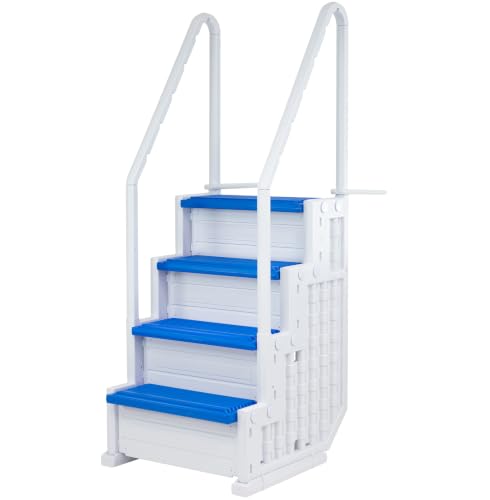
- 350 lb capacity and four-step design
- 9-inch riser with 27 x 11.75 inch individual steps
- Closed side panels; fits 48-54 inch pools

- 350 lb capacity with three-step layout
- Dual handrails and deck or pool mounting brackets
- For 48-54 inch walls; 31 inches wide

- 300 lb one-person capacity
- 32-inch-wide double-handrail entry
- Adjusts for roughly 46-60 inch deck heights and occupies about 22 inches of pool space
What to Look for When Buying Above Ground Pool Steps for Elderly Swimmers
Tread Width and Depth
A broad tread gives the swimmer more surface area for the whole foot. That matters most during the transition from water to deck, where a person may pause, shift weight, or reposition a foot before taking the next step. Among these products, the Confer Step-1X and Confer Curve use 27-inch-wide treads. The Curve specifies a 10-inch tread depth, while the Everest lists individual steps at 27 inches wide by 11.75 inches deep.
A wide stair can also make the entry feel less like a ladder. The tradeoff is footprint: larger treads extend farther into the pool and may reduce usable swimming space. If the pool is small, it is worth measuring the interior clearance before choosing a staircase-style unit.
Riser Height and Number of Steps
The vertical distance between treads changes how much knee and hip movement is required with each step. The Confer Step-1X uses an 11-inch riser, and the Confer Curve also specifies 11 inches. The Aqua Select Everest lists a 9-inch riser, which creates a shorter vertical move between steps. That difference can be meaningful for a swimmer who is comfortable using stairs but prefers smaller step-ups.
Step count also changes the feel of the climb. Step-1X, Curve, and Everest are four-step systems. The Doheny’s model in this comparison uses three steps. That does not automatically make the three-step model unsuitable, but it means it does not provide the same four-step progression as the broader staircase systems.
Handrails on Both Sides
Dual handrails are especially useful at the top transition, where the user moves between the submerged stairs and the deck. All five products here provide two-sided hand support. What changes is the rail shape and spacing. The Confer Curve uses sloping rails that follow the stair profile, while Vinyl Works places the handrails about 32 inches apart around its step entry.
Check more than the presence of a handrail. Make sure the rail height is comfortable for the intended user and that the deck installation leaves enough room to approach it without twisting around furniture, posts, or the pool top rail. A well-positioned rail is more useful than a rail that is technically present but awkward to reach.
Pool Wall and Deck Compatibility
Most full stair systems for above-ground pools depend on the deck for final stabilization. Step-1X is made for flat-bottom above-ground pools and fits decks up to 60 inches. The Curve is an in-pool step system that attaches to the deck and uses adjustable foot pads to accommodate a slightly dished pool floor. The Everest is intended for 48- to 54-inch above-ground pools and is not intended for soft-sided Intex, Bestway, or Coleman-style pools.
Vinyl Works is designed for above-ground pools with a flat bottom and deck mounting. Its 32-inch in-pool step assembly is commonly specified for deck heights around 46 to 60 inches. The Doheny’s step is listed for 48- to 54-inch wall heights. Before ordering any model, measure the pool wall, finished deck height, top rail width, and the distance available inside the pool.
Ballast and Deck Anchoring
Large resin steps want to float until they are properly ballasted. The Step-1X requires 40 pounds of sand. Confer’s current CCX-AG installation manual specifies 40 pounds of sand for the base Curve Step and 70 pounds for the complete Curve system with the add-on. The sand belongs inside the designated step panels, and the deck connectors still need to be installed as directed.
Do not improvise with loose concrete blocks, metal weights, or sharp objects on a pool liner. If a product calls for internal sand ballast, use the amount and placement described by the manufacturer. For products that use another approved ballast method, follow that system rather than assuming that more weight is always better.
Weight Capacity
A published capacity is a hard compatibility check, not a comfort score. Step-1X and Curve are rated to 400 pounds, Everest and Doheny’s to 350 pounds, and Vinyl Works to 300 pounds for one user at a time. The intended user should remain within the stated limit with an appropriate safety margin, and the unit should be installed exactly as specified.
Higher capacity does not automatically mean easier use. A 400-pound staircase with an 11-inch riser may feel different from a 350-pound staircase with a 9-inch riser. Capacity, step geometry, rail placement, and installation stability should be considered together.
Footprint, Water Circulation, and Cleaning Access
A wide staircase creates more submerged surface area, which can collect debris if water cannot circulate around it. Side openings or flow-through construction help, but the area behind and under the steps still needs routine cleaning. Vinyl Works has a relatively compact 22-inch in-pool footprint, while Step-1X projects about 32 inches into the pool and the Curve is also about 32 inches deep.
For a small pool, that footprint may be the deciding factor. For a swimmer who values a broad standing surface, the larger footprint may be worthwhile. Measure the pool interior with the ladder or step location in mind rather than judging size only from product photos.
Confer Plastics Step-1X
The Step-1X is a four-step resin staircase made for flat-bottom above-ground pools. Its strongest practical points are straightforward: the treads are wide, there are handrails on both sides, the stated capacity is 400 pounds, and the unit can fit decks up to 60 inches high. For an older swimmer who prefers a staircase feel instead of narrow ladder rungs, this format provides substantially more standing area for each foot.
Design and Build
Each tread is 27 inches wide and about 10 inches deep, with an 11-inch riser. The overall step body is roughly 31 inches wide and projects about 32 inches into the pool, with the top step about 47 inches above the pool floor. Those dimensions make it a fairly substantial object in the water, but they also explain why it feels more like a stair unit than a conventional vertical ladder.
The construction is plastic/resin rather than metal. That avoids exposed metal tread surfaces in the water and gives the design broad molded surfaces. The gray treads are visually distinct from the warm-gray body, which can make the edges easier to identify under water than an all-one-color assembly.
Important Specifications
- Four-step staircase with a 400 lb stated load capacity.
- 27-inch-wide treads and approximately 10-inch tread depth.
- 11-inch riser height.
- About 31 inches wide and 32 inches deep inside the pool.
- Top step is about 47 inches high; designed for decks up to 60 inches.
- Requires 40 pounds of sand as internal ballast.
- Includes mounting brackets for attachment to the pool or deck.
Practical Use for Older Swimmers
The main benefit is the combination of tread area and two-hand support. A user can place most or all of a foot on the step instead of balancing on a narrow rung. The 27-inch width also provides room to center the body between the rails before taking the next step. That can be useful for anyone who prefers to move deliberately rather than climb quickly.
The 11-inch riser is still a meaningful step-up. Someone who struggles with ordinary household stairs should not assume that a wide pool stair will automatically be easy. Compare that 11-inch rise with the Aqua Select Everest’s listed 9-inch riser if minimizing vertical lift is a priority.
Installation and Stability
Step-1X uses snap-together construction, but final stability depends on correct ballast and mounting. The current listing specifies 40 pounds of sand and warns against combining the internal ballast with improvised external weights. The deck brackets are part of the installation rather than an optional finishing touch.
Because the unit projects about 32 inches into the pool, verify that there is adequate flat floor area where it will sit. A protective step pad can also be a sensible addition on vinyl liners when the manufacturer or pool supplier recommends one. Keep the area behind the steps accessible enough to flush out debris during the season.
Important Strengths
Among the five products here, Step-1X combines the highest published capacity with broad treads and a relatively simple straight-stair layout. It also accommodates a wider range of deck heights than the 48- to 54-inch products. The simple geometry can be easier to plan around than a curved or add-on system.
Important Limitations
The main compromise is space. A 31-inch-wide structure projecting roughly 32 inches into the pool is not subtle, especially in a smaller round pool. The 11-inch rise is also taller than the Everest’s published 9-inch rise. Finally, it is intended for flat-bottom above-ground pools, so owners of soft-sided or unusual pool structures should not assume compatibility.
Who Should Consider It
Step-1X makes sense for a deck-equipped, flat-bottom above-ground pool where the user wants wide treads, dual handrails, and a 400-pound rating. It is particularly relevant when deck height exceeds the 54-inch ceiling used by several competing stair systems, provided the installation stays within the Step-1X fitting range.
Who Should Consider Another Option
Consider the Everest if a shorter listed riser is more important than maximum capacity, the Curve if adjustable base pads are useful on a slightly dished floor, or Vinyl Works if preserving interior pool space is a higher priority than having a deep staircase.
Pros
- 400 lb stated capacity is the highest tier represented in this comparison.
- Four wide 27-inch treads provide a staircase-style entry.
- Dual handrails support two-sided gripping during the climb.
- Fits flat-bottom pools with decks up to 60 inches high.
Cons
- 11-inch riser is taller than the Everest’s published 9-inch riser.
- Roughly 32-inch projection takes noticeable space inside the pool.
- Requires 40 pounds of sand plus secure deck or pool mounting.
Confer Plastics Curve CCX-AG Base Step
The Curve CCX-AG is another four-step, 400-pound-capacity system from Confer, but its geometry is different from Step-1X. The treads can be assembled curving inward or outward, the handrails slope with the stair shape, and the base includes adjustable foot pads that can compensate for a slightly dished pool floor. It can also be expanded later with the matching add-on section.
Design and Build
The base step uses four treads measuring about 27 inches wide by 10 inches deep with an 11-inch rise. The overall unit is approximately 38 inches wide and 32 inches deep, with the top tread about 47 inches high. Compared with Step-1X, the Curve is wider overall even though the individual tread width is similar.
The shape can be configured before final assembly so the stair curve faces inward or outward. This is primarily a layout and appearance choice, but it can also affect how the stair edge relates to the open pool area. Once the treads are fully assembled, treat the chosen layout as a permanent installation rather than something to flip back and forth during the season.
Important Specifications
- Four-tread base system with a 400 lb stated weight limit.
- Individual tread size: approximately 27 inches wide by 10 inches deep.
- 11-inch riser height.
- Overall base step approximately 38 inches wide by 32 inches deep.
- Top tread approximately 47 inches high.
- Current CCX-AG installation manual specifies 40 pounds of sand for the base step.
- Adjustable foot pads accommodate a flat floor or slight taper/dish.
- Optional add-on can create the larger Curve system.
Practical Use for Older Swimmers
The sloping rails and wide treads create a gradual visual path into and out of the water. The user has a handhold on both sides while stepping onto a full-width tread. For someone who dislikes narrow rungs, that broad support surface is the main advantage.
The 11-inch rise is the same published rise as Step-1X, so the Curve should not be chosen merely because it looks more stair-like in photos. The choice between these two Confer models is more about overall width, curved tread layout, base adjustment, and expandability than about step height.
Installation and Setup
The CCX-AG manual calls for 40 pounds of sand in the base step, divided between the side panels. The assembled unit should also be attached to the deck using its deck connectors. The manual recommends choosing a location close to the pool for assembly because the sand-filled unit becomes awkward to lift.
The adjustable foot pads are useful only when set correctly. They are not a substitute for leveling a severely uneven pool base. If the floor has more than a slight dish or taper, confirm compatibility before installation rather than forcing the step to sit at an angle.
Important Strengths
The standout difference is the floor-adaptation system. None of the other products in this group combines a 400-pound rating, four broad treads, and adjustable base pads in the same way. The option to add a second Curve section later also gives owners a path to a larger entry platform without replacing the original base step.
Important Limitations
The Curve base is the widest product body in this group at about 38 inches overall, and the add-on makes the system wider still. It also requires sand ballast and deck attachment. If pool space is limited, the aesthetic curve may be less valuable than the narrower footprint of Vinyl Works or the simpler straight Step-1X.
Who Should Consider It
The CCX-AG is a strong fit for a deck-equipped above-ground pool where the floor is flat or only slightly dished and the user wants broad four-step access with a high load rating. It also suits owners who like the idea of expanding to a larger two-part system later.
Who Should Consider Another Option
Choose Everest when a 9-inch riser is more appealing than an 11-inch riser, Step-1X when a straighter and slightly narrower overall body is preferable, or Vinyl Works when minimizing the amount of pool space occupied by the entry is the main concern.
Pros
- 400 lb stated capacity with four large treads.
- Adjustable base pads can compensate for a slightly dished pool floor.
- Treads can be assembled curving inward or outward.
- Expandable with a matching add-on section later.
Cons
- About 38 inches wide overall, so it uses substantial pool-edge space.
- 11-inch riser remains a fairly meaningful step height.
- Requires 40 pounds of sand for the base step and secure deck mounting.
Aqua Select Everest In-Pool Steps
The Aqua Select Everest is the most notable option in this group for step geometry. It uses four steps with a listed 9-inch riser and individual treads measuring about 27 inches wide by 11.75 inches deep. That creates a shorter vertical change and a slightly deeper landing surface than the 11-inch-riser Confer designs. Its stated capacity is 350 pounds.
Design and Build
The Everest uses a white resin body with blue treads on this exact Amazon variant. Closed side panels flank the steps, and two handrails extend above the stair assembly. The closed panels reduce open gaps around the sides of the staircase, while the thick tread surfaces give each foot a broad molded platform.
The step system extends about 32 inches from front to back. The listing describes it for above-ground pool walls or decks in the 48- to 54-inch range. It is not intended for Intex, Bestway, Coleman, or other soft-sided pool styles, an important limitation because those pools use different wall and support structures.
Important Specifications
- Four-step staircase with a 350 lb stated capacity.
- 9-inch listed riser height.
- Individual step size about 27 x 11.75 x 1.5 inches.
- Approximately 32 inches front to back.
- Double handrails and closed side panels.
- Designed for 48- to 54-inch above-ground pools with suitable deck mounting.
- Not intended for common soft-sided Intex, Bestway, or Coleman pool systems.
Practical Use for Older Swimmers
The 9-inch riser is the clearest reason to compare Everest closely with Step-1X and Curve. A two-inch reduction in published rise is substantial enough to notice in stair geometry, especially over repeated steps. The 11.75-inch tread depth also gives more front-to-back foot room than the 10-inch treads specified for the Confer models.
Capacity is lower at 350 pounds, so the geometry advantage only matters if the intended user is comfortably within the rating. The closed side panels can make the stair edges easier to understand visually, but they also create more solid surface area in the water, so regular cleaning and circulation checks remain important.
Installation and Compatibility
The Everest is a deck-oriented in-pool stair. The deck and pool wall must fall within its intended 48- to 54-inch range, and the deck structure needs to accept the mounting arrangement. This is not a universal drop-in staircase for every above-ground pool. Owners of soft-sided pools should choose a product explicitly designed for that pool type rather than adapting the Everest.
Because the step body has broad resin surfaces and enclosed sides, take time during placement to remove trapped air and confirm the stair sits correctly before final fastening. Follow the supplied ballast and mounting instructions for the exact version received rather than relying on a generic pool-step method.
Important Strengths
Everest offers the lowest published riser among these five products while keeping a wide four-step format and two handrails. Its 27-inch-wide, 11.75-inch-deep treads create a generous foot platform, and its 350-pound rating is higher than the Vinyl Works Deluxe.
Important Limitations
The 48- to 54-inch fit range is narrower than the Step-1X and Vinyl Works deck-height ranges. The 350-pound capacity is also below the 400-pound Confer models. Most importantly, soft-sided pool owners should treat the stated incompatibility as a firm restriction rather than an installation challenge to work around.
Who Should Consider It
Everest deserves close attention when the user prefers a shorter step rise and broad tread depth, and the pool is a rigid above-ground model within the 48- to 54-inch range. It is one of the clearest examples in this group of prioritizing stair geometry over maximum load rating.
Who Should Consider Another Option
Choose Step-1X or Curve if the intended user needs a 400-pound rating. Choose Vinyl Works if the pool is small and a 32-inch-deep staircase would take too much swimming space. Choose another pool-specific solution entirely if the pool has a soft-sided wall system.
Pros
- 9-inch listed riser is lower than the 11-inch risers on the two Confer stair systems.
- Four broad steps measure about 27 x 11.75 inches each.
- Dual handrails provide support on both sides.
- Closed side panels reduce open gaps around the stair body.
Cons
- 350 lb rating is lower than the 400 lb Confer models.
- Intended fit is limited to roughly 48-54 inch rigid above-ground pools.
- Not intended for Intex, Bestway, Coleman, or similar soft-sided pools.
Doheny’s Pool Step for Above Ground Swimming Pools
Doheny’s Pool Step takes a somewhat more compact approach than the four-step staircase models. The exact Amazon listing specifies three steps, a 350-pound capacity, two plastic handrails, and compatibility with above-ground pools using 48- to 54-inch wall heights. The body is listed at about 31 inches wide, 45 inches high, and 35.5 inches deep without the handrails.
Design and Build
The structure is molded plastic with large flat steps and handrails on both sides. The white treads are embossed for visibility and traction, and the unit uses mounting brackets to secure it to the pool or deck. It is not a narrow vertical ladder; the 31-inch width still creates a substantial entry platform.
The main difference is step count. With three steps rather than four, it provides fewer intermediate landing points between the pool floor and upper transition. Because the listing does not provide a precise tread rise for each step, it is better to treat that as a design difference rather than estimate a riser dimension from the overall height.
Important Specifications
- Three-step above-ground pool entry.
- 350 lb stated load capacity.
- Approximately 31 inches wide, 45 inches high, and 35.5 inches deep without the handrails.
- Designed for pools with 48- to 54-inch wall heights.
- Dual all-plastic handrails.
- Mounting brackets secure the step to the pool or deck.
- Plastic construction with high-visibility white steps.
Practical Use for Older Swimmers
The two handrails and broad step surfaces are the primary reasons to consider this model over a conventional A-frame ladder. A swimmer can grip on both sides while entering or leaving the water, and the step body is wide enough to provide a more stair-like stance.
However, an older user who specifically wants smaller vertical increments should compare the three-step layout against the four-step products before buying. Fewer steps can mean fewer opportunities to pause at intermediate levels, even if each individual tread surface is broad. The Everest is the better-documented option here for a lower 9-inch rise.
Installation and Setup
The step includes mounting brackets and is meant to be secured rather than left loose in the pool. Its 35.5-inch depth is actually greater than the roughly 32-inch depth of Step-1X and Curve, so it should not be assumed to be the smallest-footprint staircase just because it has fewer steps. Measure the pool interior and deck connection area before assembly.
As with other resin steps, the pool floor and liner deserve attention. Keep the base clean, follow the installation instructions for stabilization, and use any recommended liner pad or protective accessory appropriate to the pool.
Important Strengths
Doheny’s gives buyers a straightforward 350-pound, dual-rail step without the curved geometry of the Confer Curve or the closed sidewall emphasis of the Everest. Its 31-inch overall width is close to Step-1X, so it can appeal to owners who want a broad entry without moving to the 38-inch-wide Curve base.
Important Limitations
The three-step design is less gradual than the four-step formats in terms of the number of intermediate treads. Its published 35.5-inch depth also occupies considerable pool space. The 48- to 54-inch compatibility range should be checked carefully if the deck is higher or lower.
Who Should Consider It
This model is worth considering for a rigid above-ground pool in the 48- to 54-inch range when the user wants dual rails, broad steps, and a 350-pound capacity but does not need the Curve’s expandable design or Step-1X’s 400-pound rating.
Who Should Consider Another Option
Aqua Select Everest is the stronger comparison for a user who prioritizes a documented 9-inch rise. Step-1X and Curve are better aligned with users who require a 400-pound rating, while Vinyl Works is the more space-conscious option inside the pool.
Pros
- Dual handrails and broad flat steps create a stair-style entry.
- 350 lb stated capacity covers many adult users.
- Designed specifically for common 48-54 inch above-ground pool wall heights.
- Mounting brackets are included for secure attachment.
Cons
- Three-step layout provides fewer intermediate treads than the four-step competitors.
- About 35.5 inches deep, so it still occupies substantial pool space.
- Fit range is limited to the stated 48-54 inch pool-wall range.
Vinyl Works Deluxe 32-Inch In-Pool Step Ladder
The Vinyl Works Deluxe is the most compact design in this comparison in terms of how far it intrudes into the swimming area. The 32-inch-wide entry uses double handrails, non-slip tread surfaces, a rounded base, and a deck-mounted frame that occupies about 22 inches of the pool. It is rated for one person up to 300 pounds.
Design and Build
Vinyl Works uses maintenance-free resin with stainless steel hardware. The rounded base is intended to sit more gently on a vinyl liner than a sharp-edged frame, while the flow-through design allows water to circulate through the step assembly. The handrails are spaced about 32 inches apart, creating a defined corridor for entry and exit.
The unit is adjustable for deck heights around 46 to 60 inches and attaches with deck-mount flanges. This makes it flexible across a wider vertical range than the 48- to 54-inch-only systems, though the installation still depends on a compatible flat-bottom above-ground pool and a suitable deck.
Important Specifications
- 300 lb capacity for one user at a time.
- Approximately 32-inch-wide step entry with double handrails.
- Adjustable for roughly 46-60 inch deck heights.
- Occupies about 22 inches of space inside the pool.
- Maintenance-free resin construction with stainless steel hardware.
- Non-slip tread surfaces and flow-through design.
- Deck-mount flanges are used for stabilization.
Practical Use for Older Swimmers
The biggest advantage is space efficiency. In a smaller pool, saving roughly 10 inches of interior projection compared with a 32-inch-deep stair body can be meaningful. The user still gets two handrails and full step surfaces rather than narrow ladder rungs.
The tradeoff is the 300-pound limit, the lowest in this comparison. Buyers should also pay attention to the actual step geometry in the installation guide because the key appeal of this model is its compact structure, not a particularly low published riser. If minimizing step height is the primary goal, Everest provides clearer geometry data.
Installation and Liner Considerations
The system includes deck-mount flanges and should be anchored as directed. Because it is intended for flat-bottom above-ground pools, the base must sit correctly on the pool floor. Vinyl Works documentation and pool retailers commonly recommend a step or ladder pad beneath in-pool access equipment to reduce wear on the liner.
The flow-through stair layout helps water move around the structure, but it does not eliminate cleaning. Brush or flush the area around the base, check fasteners periodically, and keep the tread texture free of slippery buildup.
Important Strengths
Vinyl Works offers the broadest deck-height range in this comparison while taking up the least stated front-to-back space inside the pool. That combination is useful when the deck is relatively high but the pool itself is small. Stainless hardware and molded resin are also conventional, serviceable materials for a submerged entry system.
Important Limitations
The 300-pound rating is a firm limitation for heavier users. It also remains a deck-mounted system rather than a freestanding stair, and its compact footprint does not necessarily mean the climb is easier for someone who wants the shortest possible step rise.
Who Should Consider It
Vinyl Works is a practical match for a flat-bottom above-ground pool with a deck, especially when interior swimming space is limited and the intended user is comfortably within the 300-pound rating. It also fits owners who need more deck-height adjustability than the 48- to 54-inch stair systems offer.
Who Should Consider Another Option
Choose one of the Confer models for a 400-pound capacity, Everest for a documented 9-inch riser and deeper individual tread, or Doheny’s for a 350-pound middle ground with broad plastic steps and a simple three-step layout.
Pros
- Only about 22 inches of stated in-pool footprint, preserving more swimming space.
- 32-inch-wide entry with double handrails.
- Adjustable across roughly 46-60 inch deck heights.
- Resin construction, stainless hardware, and flow-through step design.
Cons
- 300 lb capacity is the lowest in this comparison.
- Requires a compatible deck and flat-bottom above-ground pool.
- Compact footprint does not provide the same deep staircase geometry as the wider four-step systems.
Detailed Buying Guide
Start With the Person Who Will Use the Steps
Pool access should be chosen around the least mobile regular user, not the strongest person in the household. Think about how that person handles ordinary stairs: Do they need both hands on rails? Do they pause with both feet on one tread before moving to the next? Is a taller step difficult? Those answers are more useful than choosing by brand name alone.
For a user who climbs one step at a time and pauses, tread depth and rail continuity matter a great deal. The Everest’s 11.75-inch-deep individual steps provide more front-to-back surface than the 10-inch treads on the two Confer systems. Step-1X and Curve counter with a higher 400-pound rating. The right tradeoff depends on the user rather than a single specification.
Measure the Pool Before Ordering
Measure the finished wall height and the deck surface height at the exact installation point. Do not assume a pool sold as “52 inch” has a deck exactly 52 inches above the interior floor. Deck boards, top rails, coping, and local construction details can change the mounting geometry.
Then measure interior floor space. Mark a 32-inch projection for Step-1X, Curve, or Everest-sized stairs, and compare that with the Vinyl Works 22-inch footprint. On a small round pool, a difference of ten inches can affect circulation paths and swimming room more than expected.
Understand the Top Transition
The hardest part of many pool entries is not the middle step; it is moving between the top tread and the deck. Look at where the rails terminate, whether the top tread sits near the deck level, and whether the deck has a clear landing area. The user should not need to twist around a post, lift a leg over an obstacle, or let go of both rails at the same time just to reach the deck.
Deck furniture, storage boxes, pool equipment, and railings can create conflicts even when the step itself technically fits. Plan a clear approach path around the entire entry system.
Do Not Ignore Ballast Instructions
Resin pool stairs displace water and can become buoyant. Ballast is part of the engineering of the entry system. Step-1X specifies 40 pounds of sand, and the Confer CCX-AG manual specifies 40 pounds for the base Curve Step. Adding extra loose weights outside the unit is not a substitute for following the instructions.
Use clean, dry material of the type called for by the manufacturer, fill the designated compartments, and close or vent the openings exactly as directed. During seasonal removal, remember that a sand-filled step is significantly heavier and more awkward than the empty carton suggests.
Protect the Pool Liner
Any submerged step creates concentrated contact with the pool floor. A smooth molded base helps, but dirt trapped underneath can still abrade a vinyl liner as the unit shifts slightly during use. A correctly sized protective pad is a relatively simple way to add separation between the step base and liner when recommended for the pool and step system.
Before installation, clean the floor area thoroughly. During the season, do not drag the step across the liner to reposition it. Lift and reposition according to the manufacturer’s instructions instead.
Keep Treads and Rails Clean
Textured or non-slip treads work best when the texture is not covered by algae, oils, sunscreen residue, or mineral buildup. Brush the steps regularly, including the edges and underside areas where circulation is weaker. Handrails should also be kept clean because a secure grip depends on a clean surface.
Flow-through openings help water movement, but they do not make the area maintenance-free. Wide stair systems create shaded zones where debris can settle. If the step blocks routine brushing, plan a cleaning method before the swim season starts.
Plan for Seasonal Removal
In climates where above-ground pools are winterized, large steps usually need to be removed, drained, cleaned, and stored. A 38-inch-wide Curve step with internal sand is far more cumbersome than a small ladder. Build and install it in a location where two people can safely handle removal later.
Dry the step before storage and inspect hardware, mounting brackets, rails, and tread connections before reinstalling the following season. Replacing damaged hardware before the pool opens is easier than discovering a loose connection after the system is submerged.
Capacity Is Only One Part of Fit
A user under a 400-pound rating can still find an 11-inch rise uncomfortable. A user under a 300-pound rating can still prefer the roomier feel of a larger stair. Think of load capacity as a mandatory threshold, then compare geometry and installation after that threshold is satisfied.
The Step-1X and Curve provide the highest published capacities here. Everest and Doheny’s sit in the middle at 350 pounds. Vinyl Works is the lowest at 300 pounds. Do not exceed these ratings or assume that extra deck fasteners increase the certified user capacity.
Soft-Sided Pools Need Different Hardware
Soft-sided pools use flexible walls and frame systems that are not equivalent to a rigid above-ground pool with a permanent deck. The Everest listing explicitly excludes common Intex, Bestway, and Coleman-style soft-sided pools. Even where another product listing is less explicit, never assume a rigid-pool stair can be attached safely to a flexible-wall pool.
For a soft-sided pool, use an entry system specifically listed for that pool construction and wall height. Compatibility is a structural issue, not just a matter of finding brackets that reach.
Direct Product Comparisons
Confer Step-1X vs Confer Curve CCX-AG
These two share a 400-pound rating, four-step layout, roughly 27-inch-wide treads, 11-inch risers, and about 32 inches of depth. Step-1X is the straighter, narrower body at roughly 31 inches overall, while the Curve spreads to about 38 inches and adds adjustable foot pads plus inward/outward tread orientation.
Choose between them based on floor shape and space rather than capacity. A slightly dished pool floor gives the Curve a practical advantage because of its adjustable pads. A tighter installation area favors Step-1X. Both require ballast and deck mounting.
Confer Step-1X vs Aqua Select Everest
Step-1X offers a 400-pound rating and fits decks up to 60 inches. Everest is rated to 350 pounds and is intended for 48- to 54-inch pools, but it lists a 9-inch riser and 11.75-inch tread depth. For a buyer focused on smaller vertical increments, Everest has the more favorable published geometry. For a heavier user or taller deck, Step-1X has the stronger fit on paper.
Confer Curve vs Aqua Select Everest
Curve gives up less in capacity and adds adjustable base pads, while Everest gives more detailed emphasis to shorter rise and deeper individual treads. Both are broad four-step systems with dual rails. If the floor is slightly dished, Curve is easier to justify. If a 9-inch rise is a priority and the pool is within 48-54 inches, Everest deserves the closer look.
Doheny’s Pool Step vs Vinyl Works Deluxe
Doheny’s is rated for 350 pounds, uses three steps, and has an overall depth around 35.5 inches. Vinyl Works is rated for 300 pounds but occupies only about 22 inches inside the pool and adjusts across a taller deck range. The choice is therefore between capacity and broad stair body on one side, and compact interior footprint on the other.
Both use dual handrails and deck mounting. Vinyl Works also uses stainless hardware and a flow-through design. Doheny’s is limited to the 48- to 54-inch pool-wall range, while Vinyl Works is generally specified around 46 to 60 inches of deck height.
Aqua Select Everest vs Vinyl Works Deluxe
Everest is the more staircase-like option: four steps, 9-inch rise, broad 27 x 11.75 inch treads, 350-pound capacity, and a 32-inch front-to-back body. Vinyl Works sacrifices some capacity and tread depth information in exchange for a much smaller 22-inch in-pool footprint and broader deck-height adjustability.
For an older swimmer who needs more gradual stair geometry, Everest is the more direct comparison. For a small pool where every inch of swimming space matters, Vinyl Works can be easier to accommodate.
Common Buying Mistakes
Buying by Weight Capacity Alone
A high load rating is important, but it does not describe how high each step feels, how much foot area is available, or how easy the handrails are to reach. Compare capacity only after confirming that the stair geometry suits the intended user.
Ignoring Deck Height
A pool wall height and a deck height are not always the same measurement. An entry system that is too short can create an awkward top transition, while one that is too tall may not mount correctly. Measure at the actual installation location.
Assuming Every Above-Ground Pool Is Compatible
Rigid-wall pools, soft-sided frame pools, dished-bottom pools, and flat-bottom pools do not use identical entry systems. The Everest explicitly excludes common soft-sided pool brands, and Step-1X is specified for flat-bottom above-ground pools. Treat compatibility statements as requirements.
Underestimating the Footprint
A 32-inch projection is large inside a small pool. Use tape or a lightweight template on the deck to visualize the space before ordering. A compact model such as Vinyl Works may be better if the pool already feels crowded.
Skipping Ballast or Deck Fastening
A wide resin stair can feel substantial on land yet become buoyant in water. Sand ballast and deck mounting are part of the installation. Do not use the steps until the specified stabilization system is complete.
Forgetting Seasonal Removal
The step must eventually come back out of the pool in many climates. Consider how two people will lift, drain, and store a sand-filled unit before choosing the largest staircase.
Letting Texture Become Slippery
Non-slip or textured treads still require cleaning. Algae and residue can cover the molded texture. Include the stair in the regular brushing and inspection routine rather than treating it as permanent pool furniture.
Frequently Asked Questions
Are wide pool steps easier for older adults than an A-frame ladder?
They can be easier for users who prefer a staircase motion and want more of the foot supported on each step. Wide steps also pair well with dual handrails. However, the actual riser height, deck transition, and the user’s mobility matter more than width alone.
What step height should I look for?
Lower risers generally require less vertical movement per step. In this comparison, Aqua Select Everest lists a 9-inch riser, while Confer Step-1X and Curve list 11-inch risers. If step height is a major concern, compare those numbers with the stairs the intended user already manages comfortably.
Which of these pool steps has the highest weight capacity?
Confer Step-1X and Confer Curve CCX-AG are both rated to 400 pounds. Aqua Select Everest and Doheny’s Pool Step are rated to 350 pounds, and Vinyl Works Deluxe is rated to 300 pounds for one person at a time.
Which option takes up the least space inside the pool?
Vinyl Works Deluxe has the smallest stated in-pool footprint here at about 22 inches. Step-1X and Curve are about 32 inches deep, Everest is also about 32 inches front to back, and Doheny’s lists about 35.5 inches of depth without the handrails.
Can I use these steps with an Intex or Bestway pool?
Do not assume so. The Aqua Select Everest specifically states that it is not intended for Intex, Bestway, Coleman, or similar soft-sided pool systems. For any soft-sided pool, use an entry system explicitly approved for that construction and wall height.
Do above-ground pool steps need sand or weights?
Many large resin steps require ballast because they are buoyant. Step-1X specifies 40 pounds of sand, and the Confer CCX-AG manual specifies 40 pounds for the base Curve Step. Follow the exact instructions supplied with the chosen model rather than adding improvised weights.
Should I put a mat under pool steps?
A liner-protection pad is commonly recommended under in-pool steps and ladders, especially on vinyl liners. It can reduce direct rubbing between the base and liner. Use a pad compatible with the pool and step system, and keep dirt from accumulating underneath it.
Are handrails more important than wider steps?
They solve different problems. Handrails provide upper-body support and a stable grip, while wider steps provide more foot contact. For many older swimmers, having both is more useful than maximizing only one feature.
Can these steps be left in the pool all winter?
Follow the manufacturer’s winterization instructions for the exact model. In freezing climates, large in-pool steps are commonly removed, drained, cleaned, and stored to avoid damage and to allow proper pool winterization.
How do I know if a pool step is stable enough?
Stability depends on correct assembly, the specified ballast, proper deck attachment, a compatible pool floor, and periodic inspection. A heavy-looking step that is not mounted or ballasted correctly should not be considered stable.
Final Buying Considerations
The most useful way to choose the best above ground pool steps for elderly swimmers is to start with stair geometry and installation fit, then use capacity as a firm compatibility check. A user who prefers smaller vertical changes may find the Aqua Select Everest’s 9-inch riser and deep 27 x 11.75 inch treads attractive. A user who needs a 400-pound rating should focus instead on the Confer Step-1X or Curve CCX-AG.
Between the two Confer models, Step-1X is the straighter and narrower overall staircase, while the Curve adds adjustable foot pads, configurable curved treads, and an upgrade path to the larger add-on system. Both use broad treads and dual handrails, and both require proper ballast and deck mounting.
Doheny’s Pool Step sits between the large four-step systems and the more compact Vinyl Works design. Its 350-pound rating and dual rails are useful, but the three-step layout is less gradual in step count than the four-step alternatives. Vinyl Works, meanwhile, is the most space-conscious choice here with a roughly 22-inch interior footprint, though its 300-pound rating is the lowest of the group.
Before purchasing, measure deck height, pool-wall height, and interior floor clearance. Confirm the pool has the bottom shape and wall structure required by the chosen step, and plan the ballast, mounting, liner protection, cleaning access, and seasonal removal. A correctly fitted and correctly installed stair system is more valuable than a larger model that does not match the pool or the swimmer.
Author