
An 8ft round pool liner needs to match more than the diameter of a pool. A liner made for a 52-inch steel wall is not the same product as one shaped for a 27.5-inch stock tank. Both can be advertised as eight feet round, yet the sidewall material, attachment method, and finished fit are substantially different. Buying by diameter alone can leave folds on the floor, excess material hanging down the wall, or a liner that cannot be mounted correctly.
The six options here divide into two groups. Smartline, Blue Wave, and VEVOR supply overlap liners for conventional steel-sided above-ground pools, with wall-height ranges of roughly 48 to 54 inches depending on the exact product. The other two target galvanized stock tanks or short-wall tank pools, where the walls are closer to 28–30 inches high. These are separate use cases, not interchangeable designs.
Pattern, vinyl grade, wall height, and fitting type all deserve attention. A decorative border changes the appearance of a filled pool; the vinyl's stated gauge helps distinguish product variants; and the way the upper edge attaches determines whether the liner can be installed under your existing top rail. The most useful starting point is a careful measurement of the actual pool structure, followed by the liner reviews and compatibility guidance below.
Quick Comparison of 8ft Round Pool Liners
The first four entries belong to the conventional steel-wall pool category. The final two are short-wall stock-tank choices. Keep that distinction in mind when comparing material descriptions and visual patterns.

- Sunlight pattern in the 25-gauge listing variant
- 8-foot round overlap construction
- For 48–52-inch steel-wall above-ground pools

- Plain blue appearance without a printed border
- 20-gauge virgin-vinyl listing variant
- For 48–52-inch steel-wall above-ground pools
- Standard-gauge vinyl with overlap installation
- 8-foot round, flat-bottom pool fit
- Specified for walls up to 54 inches

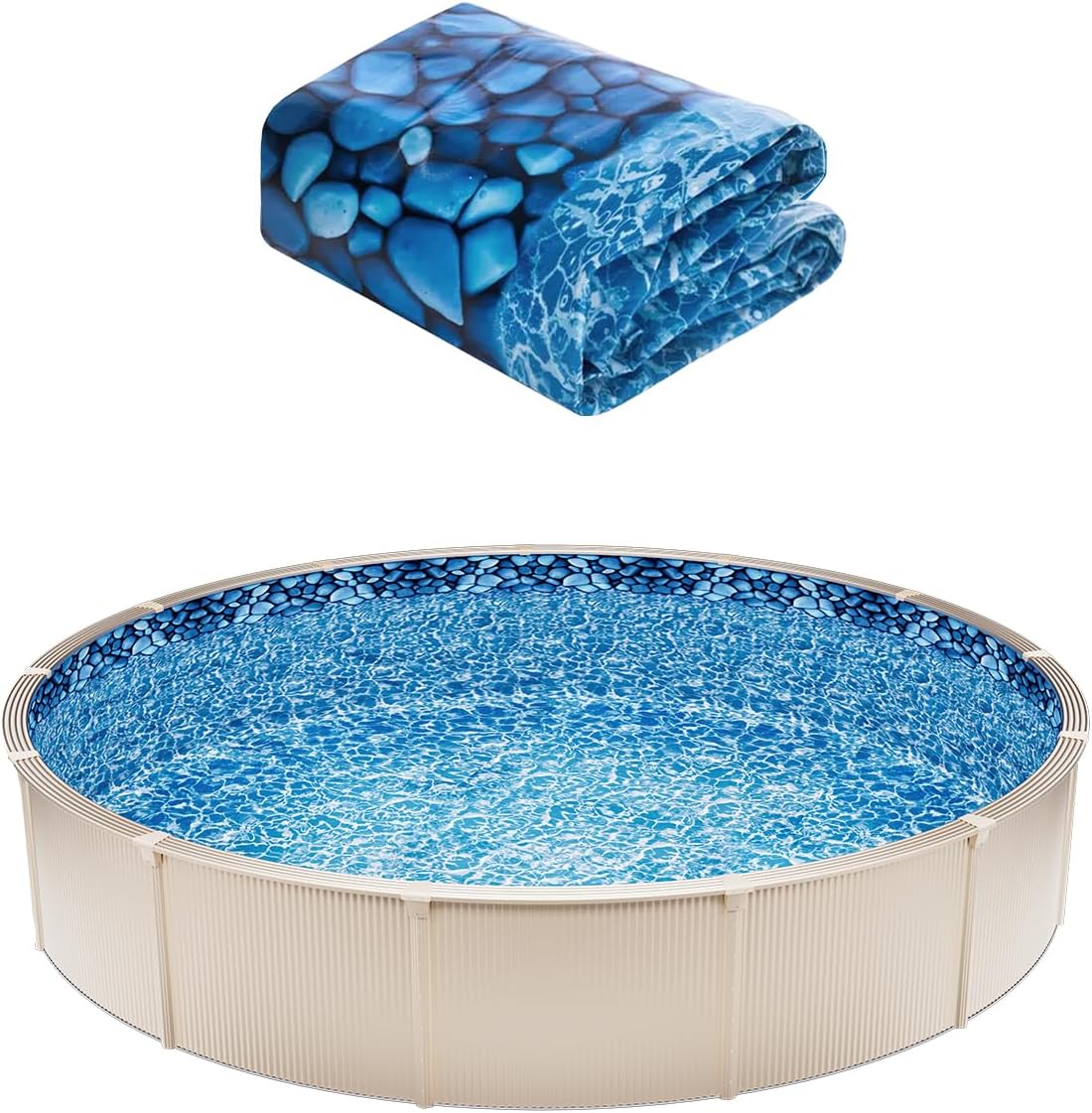
- Blue-green decorative border and blue patterned floor
- Standard-gauge vinyl with welded seams
- For 48–54-inch steel-wall pools; model NL600-20

- Short-wall design for 27.5-inch-high tanks
- 30-mil PVC construction specified by VEVOR
- Overlap installation with repair patches listed

- For an 8-foot round galvanized stock tank
- Listing specifies tanks with 30-inch walls
- Protective interior liner for tank-pool conversions
What to Check Before Buying an 8ft Round Pool Liner
Confirm the wall height before considering a pattern
Pool liners are shaped for a particular combination of diameter and wall height. Measure the exposed steel wall vertically, rather than estimating the water depth or using a ladder height as a substitute. A pool often contains less water than the full wall height because the waterline sits below the coping. The product must fit the wall itself, not just the operating water level.
Smartline states a 48–52-inch wall range for its two listed models. Blue Wave specifies 48–54 inches, and the standard VEVOR model is presented for up to 54 inches. A short-wall VEVOR stock-tank liner instead specifies 27.5 inches. The generic stock-tank listing describes an eight-foot tank with 30-inch walls. Mixing these wall-height categories can create a large amount of unwanted material, even when the circumference looks correct.
Check if the pool uses overlap, beaded, or unibead attachment
An overlap liner folds over the top of a steel wall and is normally secured by the pool's coping system before the top rails are reassembled. A beaded liner snaps into a dedicated receiver track. A unibead liner can provide more than one hanging configuration, but it still needs to match the wall and receiver arrangement. These attachment styles are not interchangeable just because the diameter is the same.
All six products in this guide are described as overlap or protective tank liners rather than ordinary beaded replacement liners. Inspect your existing top rail, coping strips, and track before ordering. If you currently have a beaded receiver, confirm whether the pool manufacturer permits an overlap installation instead of assuming that the replacement will mount without modification.
Separate liner gauge from an actual mil measurement
Pool liner listings often describe material as 20 gauge, 25 gauge, standard gauge, or heavy gauge. These labels are useful within a manufacturer's product range but do not always translate into a universal measurement across brands. A gauge number should not be casually treated as an exact thickness in thousandths of an inch. If a precise wall or floor thickness affects your purchase, find an explicit mil specification for the exact listing.
The Smartline Sunlight variant is presented as 25 gauge, and its Solid Blue counterpart here is 20 gauge. Blue Wave uses the standard-gauge label, while the conventional VEVOR pool liner does the same. For the VEVOR stock-tank version, VEVOR's published specifications give a 30-mil wall and bottom thickness. The generic tank-liner listing contains an unusually stated thickness measurement, so it is more useful to rely on the stated tank fit than to treat that figure as a comparable material rating.
Identify whether the floor is flat or dished
Most small above-ground steel-wall pools have a flat, level floor, often prepared with sand or a compatible pad. Liners engineered for flat-bottom pools may not have sufficient material for a dished or deep-center floor. An expandable liner, a bead-style liner for a specific wall design, or another geometry can be needed for a different bottom profile.
Before removing the old liner, observe how the floor transitions into the wall. A cove at the base of the wall provides a curved transition rather than an abrupt corner. Its shape and condition can influence the way a flat-bottom liner sits after filling. Do not infer that every liner marked eight feet round will stretch safely around an unusually deep or modified floor.
Measure the structure, not only the old vinyl
A removed liner can have stretched during its service life. Measuring its flattened fabric may give a misleading picture of the original size. Use the pool manufacturer's dimensions where possible, then cross-check with the assembled steel wall. Record the diameter across the inside of the wall and the height from the base to the upper rim.
For a stock tank, take measurements across the actual inside diameter as well as wall height. Rolled or folded metal rims can reduce usable width, and a tank wall may slope slightly. These details matter because a liner that looks round on a photograph can have a different shape at the rim and floor once fitted.
Smartline Sunlight 8-ft Round 25-Gauge Overlap Liner
- Sunlight pattern in the 25-gauge listing variant
- 8-foot round overlap construction
- For 48–52-inch steel-wall above-ground pools
The Smartline Sunlight model is for owners of a conventional eight-foot round steel-wall pool who want a decorative liner instead of a plain color. Its listed variant pairs the Sunlight pattern with 25-gauge virgin vinyl and an overlap mounting edge for 48–52-inch walls. The attraction is primarily a particular design-and-grade combination, not a claim that the product fits every eight-foot circular container.
Pattern and appearance
The Sunlight design places a repeating visual texture beneath the water rather than leaving the entire interior one uninterrupted blue. In a small round pool, the pattern is visible across much of the floor, so it can change the impression of water color and hide some of the visual flatness of a single-color surface. Actual appearance will still vary with sunlight, water clarity, viewing angle, and the pool's surroundings.
A patterned liner is a sensible choice for owners trying to preserve a traditional above-ground pool appearance after replacement. It does not improve filtration or water quality. If the primary goal is a quiet, neutral interior, the Solid Blue Smartline version has a simpler look and should be compared before deciding.
Construction and compatibility
The listing calls this variant 25-gauge virgin vinyl and identifies it for eight-foot round steel-sided pools with 48–52-inch walls. Those are the important compatibility boundaries. The overlap edge means installation takes place around the top perimeter of the steel wall, typically beneath coping and the upper rail. It is not a stock-tank insert intended to terminate at a 28-inch rim.
Gauge labels describe the selected Smartline variation, but they are not a substitute for a verified measured thickness. A shopper comparing it with another manufacturer's standard-gauge liner should ask for comparable technical specifications rather than assuming that the larger number always indicates a particular mil thickness.
How it behaves during installation
The first practical requirement is a smooth, properly prepared base. Small ridges beneath a vinyl floor become noticeable underfoot and can concentrate rubbing. A smooth cove is especially important where the wall meets the floor, because the liner should not be forced sharply around the metal corner. A pool-approved pad or surface preparation can help, provided it matches the pool manufacturer's installation instructions.
Position the print so it sits centered and runs evenly around the wall. As water is added, smooth the floor and monitor how the material settles. Removing a major crease becomes harder after a significant amount of water is in the pool. Do not cut skimmer or return openings until the liner has been seated, secured, and filled to the stage specified by the installation instructions.
Where its advantages end
A higher-grade Smartline variant is not a remedy for incorrect dimensions. A 54-inch wall is beyond the height range stated for this particular Sunlight listing, even though other eight-foot models in the guide accommodate 54-inch walls. Also, the pattern is a matter of preference rather than measurable performance; some owners will prefer plain blue when inspecting the pool floor for leaves, staining, or debris.
Choose this model when the pool has the right diameter, wall height, and overlap construction and you genuinely prefer the Sunlight finish. An owner replacing a stock-tank liner or working with a beaded receiver should look elsewhere.
Pros
- Identified 25-gauge Sunlight variation avoids confusion with other Smartline finishes
- Printed interior adds a decorative floor appearance
- Overlap edge matches the intended steel-wall pool construction
- 48–52-inch wall range is clearly identified
Cons
- Not specified for the taller 54-inch wall category
- Printed finish may be less appealing to buyers seeking a plain interior
- Overlap installation requires suitable coping and top-rail access
Smartline Solid Blue 8-ft Round 20-Gauge Overlap Liner
- Plain blue appearance without a printed border
- 20-gauge virgin-vinyl listing variant
- For 48–52-inch steel-wall above-ground pools
This Smartline Solid Blue liner shares the eight-foot round, 48–52-inch steel-wall use case but changes two buying details: it has a plain blue interior and is the 20-gauge version. That makes it a more straightforward option for someone whose priority is replacing a worn liner without introducing a decorative printed pattern.
Why a simple blue finish can be useful
The plain interior keeps visual attention on the water rather than on a printed motif. For a compact pool, that can be appealing because the exposed interior is a large proportion of the total view. Debris such as leaves and dark sediment may also be easier to distinguish on a relatively uniform surface, although actual visibility depends on light and the color of the material.
A solid-color finish is not inherently stronger or easier to sanitize than a patterned finish. Those outcomes depend on the vinyl's actual physical properties, compatible cleaners, water balance, and the preparation below the liner. Its main difference is a cleaner appearance and a different listed gauge option.
Exact size and selected grade
The Amazon variation shown here specifies 20-gauge virgin vinyl, an eight-foot round shape, overlap mounting, and 48–52-inch steel-wall compatibility. Smartline also markets 25-gauge versions of certain colors, so it is important to verify the selected gauge before checkout. A switch between color or material variations on a shopping page can lead to a different ASIN and therefore a different physical product.
The term 20 gauge should not be converted into 20 mil without documentation. A thickness comparison between this liner and the 25-gauge Sunlight selection is best understood as a difference between named Smartline product grades, while actual performance will still depend on installation and use.
Installation and practical ownership
The installation routine resembles that of the Sunlight model. Remove or release the top components as the pool manufacturer directs, position the liner evenly, secure the overlap with compatible coping, and begin filling while adjusting wrinkles. The important benefit of an overlap edge is that the material can be positioned around the wall; the tradeoff is that top-rail disassembly or coping work is commonly involved.
After installation, keep water chemistry within the levels advised for the pool and vinyl. Avoid allowing highly concentrated chemicals to settle directly on the floor. Use cleaning tools intended for vinyl surfaces, and inspect the liner at openings and wall transitions where abrasion or localized stretching is more likely.
Who should buy it—and who should not
The Solid Blue variation is appropriate for someone replacing a liner on an eight-foot pool with a wall in the listed height range and who wants a neutral color. It also makes sense where the goal is to match an existing blue interior rather than change the pool's visual theme. The uncomplicated design is its selling point.
It is not the correct answer for a short stock tank simply because both containers happen to be eight feet wide. A taller 54-inch steel wall likewise falls outside its stated 48–52-inch range. For those structures, the standard VEVOR or Blue Wave options need closer attention.
Pros
- Uninterrupted solid blue finish suits understated pools
- Exact 20-gauge Smartline variation is identifiable
- Fits the standard 8-foot round 48–52-inch steel-wall category
- Overlap edge matches familiar above-ground coping arrangements
Cons
- Wall compatibility does not extend to 54 inches in this listing
- No decorative border or floor print for buyers who prefer one
- Not built specifically for low stock-tank walls
VEVOR 8-ft Round Standard-Gauge Overlap Pool Liner
- Standard-gauge vinyl with overlap installation
- 8-foot round, flat-bottom pool fit
- Specified for walls up to 54 inches
VEVOR's standard-gauge eight-foot overlap liner enters a slightly different height category. The corresponding VEVOR documentation identifies model 8X54X0.32 for an eight-foot round flat-bottom pool with walls up to 54 inches. That extra stated range can matter where an older replacement liner was advertised only for 48–52-inch structures.
Dimensions and material specification
This is a standard-gauge vinyl liner for a conventional steel-wall above-ground pool. VEVOR lists an eight-foot round size and a maximum compatible wall height of 54 inches. Manufacturer documentation also names the model 8X54X0.32 and an unfolded measurement of roughly eight feet across by 4.8 feet in height. Those figures describe the supplied material and product family rather than promising that every installation will finish with exactly the same visible liner depth.
The pool should have a flat bottom and a suitable cove, not a pronounced dished floor. A liner cannot compensate for a badly uneven or structurally distorted wall. Before purchase, check both height and attachment type against your pool's original construction.
Overlap edge and fitting method
The liner is intended to drape across the wall and over the top edge before being secured. VEVOR recommends leaving sufficient material over the rim as specified in its directions, then positioning it carefully as the pool is filled. The upper section should sit evenly rather than being pulled tightly on one side and loose on another.
An overlap liner is convenient when the pool already uses compatible coping strips, but it is not a drop-in replacement for every beaded or unibead track system. Take a photograph of the current liner attachment before stripping the pool. That photograph often reveals compatibility details more clearly than the generic term above-ground pool.
Comfort, care, and real tradeoffs
The flexible vinyl creates a continuous water-retaining surface over a properly prepared base. Comfort comes chiefly from the smooth base, the cove, and any approved liner pad underneath, rather than the vinyl being thick enough to cover stones or raised fasteners. Sharp objects should be removed before placement even if the material is advertised as puncture resistant.
A standard-gauge product can be suitable for normal pool use when properly installed. Buyers seeking a verified heavy-gauge upgrade should compare actual material specifications instead of assuming this option has the same thickness as the short-wall 30-mil VEVOR stock-tank model. Those are different products for different geometries.
Where this VEVOR fits best
It deserves consideration for owners of an eight-foot round steel-wall pool with a flat floor, particularly when the wall measures close to 54 inches. The main reason to choose it is its size-and-height specification combined with overlap construction. A short galvanized stock tank would require the other VEVOR product in this guide, not this full-height liner.
The plain functional presentation also suits someone who is focused on replacement fit rather than selecting a distinctive printed border. If a specific decorative finish is the priority, Blue Wave's Emerald Coast or the Smartline Sunlight liner offers a more recognizable appearance.
Pros
- Official model specification identifies eight-foot round flat-bottom use
- Stated compatibility reaches walls up to 54 inches
- Overlap format suits compatible steel-wall coping systems
- Standard-gauge vinyl provides a straightforward replacement option
Cons
- Not the 27.5-inch VEVOR stock-tank variant
- No basis to treat standard gauge as a particular heavy-gauge thickness
- Fit depends on flat-bottom wall geometry and correct overlap mounting
Blue Wave Emerald Coast 8-ft Round Overlap Liner
- Blue-green decorative border and blue patterned floor
- Standard-gauge vinyl with welded seams
- For 48–54-inch steel-wall pools; model NL600-20
Blue Wave's Emerald Coast is the design-focused choice among the conventional steel-wall options. The verified eight-foot listing is model NL600-20, a standard-gauge overlap liner for 48–54-inch pools. Its blue-green border and patterned blue interior make it visually different from both the Solid Blue Smartline and the more utilitarian VEVOR listing.
Distinctive print and water appearance
The Emerald Coast design draws on blue and green stone-like colors. A border circles the upper part of the pool while the floor carries a blue sunlight-style pattern. That produces a more deliberate visual break between the wall and the floor. Buyers replacing a faded patterned liner may appreciate that it restores a designed look rather than creating a single continuous solid color.
Patterns can change the apparent shade of water, but color varies with depth, sun, weather, and water balance. Consider whether you like a prominent perimeter border in a compact pool. On an eight-foot circle, the wall pattern occupies a visible proportion of the interior and can become a main decorative element.
Brand-specified construction
Blue Wave identifies this version as standard-gauge vinyl with welded seams and UV-protective additives. Welded seams form the joins in the manufactured liner. They do not make a poorly fitted pool watertight if water slips behind the liner through a damaged fitting, badly cut opening, or an incorrectly installed upper edge.
The manufacturer lists the size range as 48–54 inches and describes a 15-year warranty for this product family. Warranty duration does not mean every tear, puncture, chemical stain, or installation mistake is covered. Review the actual coverage and exclusions before assigning long-term value to the stated number of years.
Mounting and finishing details
Emerald Coast uses the overlap attachment style, so the liner extends over the pool wall and is held under coping pieces and the top assembly. The pattern makes alignment particularly noticeable. Check that the upper printed border remains level relative to the top rim before the water rises too far for adjustments.
A clean base and sound wall matter just as much here as with the plain liners. Rusted wall spots, missing protective material around fasteners, or uneven cove sections should be repaired according to the pool manufacturer's directions before installing a new membrane. A colorful liner should not be used to conceal structural deterioration.
Best audience and important limitations
This Blue Wave option suits someone whose pool is within the stated diameter and wall-height range and who values a branded decorative finish plus clearly documented seam construction. It also has the benefit of an identifiable model number, NL600-20, making future record-keeping and warranty correspondence less ambiguous.
Someone looking for an unprinted blue interior can choose the Smartline Solid Blue model instead. Stock-tank owners should not treat the Blue Wave's 48–54-inch rating as flexibility to fit a 30-inch tank; the geometry is too different to assume a sound result.
Pros
- Recognizable Emerald Coast blue-green border and patterned floor
- Verified Blue Wave model NL600-20 with 48–54-inch fit
- Manufacturer documents welded seams and UV-protective vinyl
- Manufacturer advertises a 15-year limited warranty
Cons
- Pattern positioning is noticeable if the installation is uneven
- Standard gauge is not a verified heavy-gauge specification
- Not designed for shallow galvanized stock tanks
VEVOR 8-ft Stock Tank 27.5-Inch Overlap Liner
- Short-wall design for 27.5-inch-high tanks
- 30-mil PVC construction specified by VEVOR
- Overlap installation with repair patches listed
This VEVOR liner is specifically meant for much shorter steel-sided tanks. Its eight-foot diameter resembles the standard pool liners, but the manufacturer specifies a wall height of 27.5 inches and model 8X0.7X0.8. The short wall design is the defining feature. It is a stock-tank option rather than a substitute for VEVOR's full-height 54-inch liner.
Short-wall geometry and stated thickness
VEVOR identifies the stock-tank liner as an eight-foot round overlap style with PVC vinyl construction. Its specification sheet lists both wall and floor thickness at 30 mil, or 0.8 mm. That is a concrete figure tied to the short-wall model, rather than a vague gauge comparison. The manufacturer describes the color as Crystal and gives a 27.5-inch intended wall height.
The shorter vertical profile makes sense for stock tank conversions where the rim is only a little more than two feet above the floor. Fitting a 54-inch swimming-pool liner in the same space creates excessive material that has to be distributed somewhere. A purpose-shaped short-wall liner reduces that compatibility problem, provided the tank itself matches the liner's dimensions.
What the included patches mean
The Amazon listing advertises leak-proof repair patches. These are relevant to localized vinyl damage, but their presence does not make a permanently damaged, distorted, or corroded tank safe to use. Repairs should follow the patch instructions, and a damaged seam or extensive tear may require replacement rather than a small patch.
A repair kit is also no substitute for checking the tank wall and rim before fitting. Any exposed sharp metal, rough bolt head, or abrasion point can damage even a heavy vinyl liner. Smooth or protect the underlying surface using methods suitable for the stock tank and the liner material.
Installation in a galvanized tank
Start by cleaning and inspecting the tank. Confirm the interior shape is compatible, including its floor-to-wall transition and any rolled metal lip. The overlap edge must be held securely without trapping sharp pieces against the vinyl. A dedicated tank-liner fastening method should be selected according to the tank and liner instructions, because a standard swimming-pool top rail may not be present.
Inspect the locations of any drain, return, or pump fittings before filling. Openings should be cut only after the liner is correctly seated and the proper gaskets or faceplates are ready. Cutting a hole in the wrong place or leaving the metal opening unsealed can allow water to collect between the liner and tank.
Who gains most from this model
This is the clearest choice in the list for an eight-foot tank with approximately 27.5-inch walls when a heavy, model-specified vinyl insert is wanted. The 30-mil claim comes from VEVOR's documentation for the short-wall product, not from its standard-gauge swimming pool listing. That separation matters when comparing durability language between the two.
Owners of taller steel-wall swimming pools should choose a full-height liner. A tank with a noticeably different diameter, a noncircular profile, or a 30-inch wall also deserves an additional fit check; 27.5 and 30 inches are not identical height specifications.
Pros
- Purpose-built 27.5-inch wall fit for short steel tanks
- VEVOR documentation specifies 30-mil wall and bottom vinyl
- Eight-foot round overlap configuration suits its intended tank category
- Repair patches are listed with the product
Cons
- Not appropriate for a 48–54-inch steel-wall swimming pool
- 27.5-inch stated wall height needs checking against 30-inch tanks
- Metal rims and fittings still require careful preparation
8-ft Round Galvanized Stock Tank Protective Liner
- For an 8-foot round galvanized stock tank
- Listing specifies tanks with 30-inch walls
- Protective interior liner for tank-pool conversions
The 8-ft Galvanized Stock Tank Protective Liner targets owners who want to line a round galvanized tank rather than rebuild an above-ground swimming pool. Its listing specifies eight-foot round tanks with 30-inch walls. Unlike the VEVOR stock-tank product, this listing has less reliable independent technical documentation, so diameter, wall height, and intended use are the useful confirmed comparison points.
Tank-specific purpose
A galvanized stock tank is a different vessel from a purpose-built steel-wall pool. Its rim, bottom transition, drainage provisions, and wall height can differ substantially. This protective liner is presented for putting a flexible interior barrier inside an eight-foot round galvanized tank, where water would otherwise sit against the tank's own inner surface.
The protective function matters where owners want the water-contact surface to be vinyl rather than galvanized metal. It does not follow that lining a corroded or cracked container repairs its structure. Inspect and repair the tank itself, following its manufacturer's recommendations, before assuming a liner makes it usable.
What the specification does—and does not—establish
The listing describes a round eight-foot tank with 30-inch walls, providing a specific target size. It also describes a vinyl-based protective material. An unusually presented thickness claim appears in the marketing text, but it should not be equated with VEVOR's independently specified 30 mil. For a material-grade comparison, verify the actual wall and floor measurements from a manufacturer or seller specification sheet for this ASIN.
The product title does not identify a recognized pool-liner brand or engineering model. Its category is a protective stock-tank insert. Buyers choosing between it and a conventional swimming-pool liner should therefore start with the tank's wall height and edge shape instead of a presumed common construction standard.
Practical setup considerations
Measure the tank at the inside top and near the base. Some metal tanks are not perfect cylinders, and a narrow rolled rim can change the usable opening. Determine how the liner is intended to stay secured over the edge before ordering. A clamp, band, or other fastening system cannot be assumed to be included unless the specific seller confirms it.
If the tank contains plumbing for a small circulation pump, plan the water inlet and outlet fittings separately. A protective liner is not automatically supplied with gaskets, bulkhead fittings, or skimmer parts. Its waterproof surface can be punctured by careless cutting or by contact with a rough metal edge, so installation quality remains a deciding factor.
Where it fits compared with the alternatives
Consider this liner for a tank that truly measures eight feet round and approximately 30 inches high, especially if you are seeking a protective interior rather than a patterned swimming-pool finish. The VEVOR stock-tank option is more clearly documented for a 27.5-inch-high tank and carries a manufacturer-stated 30-mil material specification.
Neither stock-tank insert should be selected for a 48–54-inch conventional above-ground pool. Likewise, buyers who need a decorative border and the attachment hardware of a traditional steel-wall pool will be better served by one of the four dedicated swimming-pool liners.
Pros
- Intended for galvanized stock-tank pool conversions
- Listing specifies eight-foot diameter and 30-inch tank walls
- Protective liner concept avoids relying on tank metal as the water-contact surface
Cons
- Detailed thickness information is not reliably comparable with named pool-liner grades
- Fit and edge-fastening method require closer confirmation for a given tank
- No demonstrated compatibility with tall steel-wall swimming-pool construction
Detailed Buying Guide: Getting the Right Liner for Your Pool
Understand the two different eight-foot pool designs
A conventional above-ground steel-wall swimming pool uses a circular wall, top rails, vertical supports, and a liner held in place using a designated coping or bead system. The liner is part of a larger engineered pool structure. An eight-foot stock tank has a shallow metal vessel wall and usually a continuous rolled rim; it does not necessarily have detachable swimming-pool top rails or standard coping strips.
Those differences determine the amount of liner material required. A deep steel-wall pool needs more vertical fabric than a stock tank, while a stock-tank liner must fit a particular short wall and rim geometry. Even within tank designs, a 27.5-inch intended wall height is not automatically the same as a 30-inch one. The correct product matches the vessel, not simply the listing's diameter.
Steel-wall liner choices in this guide include the two Smartline variations, VEVOR's standard-gauge model, and Blue Wave Emerald Coast. Short-wall tank choices include VEVOR's heavy-gauge stock-tank liner and the generic galvanized tank protective liner. Decide which group applies before comparing aesthetic details.
Why wall-height ranges are not permission to ignore size
Overlap liners can provide some positioning flexibility around the top edge, but that is not a license to install arbitrary wall heights. The pool wall supports the liner, and the material must extend correctly around the bottom cove and across the floor. Too little material can stretch the sidewall or pull the floor upward. Excess material can fold, bunch, or interfere with the fastening edge.
If your pool has a 48-inch wall, review whether a particular 48–52 or 48–54 listing is intended for that size. If it has a 54-inch wall, the Blue Wave and standard VEVOR ranges are more directly aligned than the Smartline products in this group. If it is a 27.5-inch tank, the short VEVOR model deserves consideration. Check the actual top-of-wall dimensions rather than the waterline, which is deliberately lower.
Overlap attachment and the cost of top-rail work
An overlap liner extends over the metal wall at the rim and is secured by coping before the top assembly goes back together. This allows adjustment around the perimeter while the liner is positioned. The disadvantage is that replacing the liner may require partial disassembly of rails and coping pieces. Brittle or missing coping strips and rusted screws can add to the work.
A beaded system is different: its edge is designed to seat in a receiver track. If the pool uses beaded construction, buying an overlap liner without a compatible mounting plan creates a second installation problem. A unibead liner uses still another mounting arrangement. Photos of the existing liner edge are worth keeping before removal, particularly for pools whose model or original manual is no longer available.
Gauge, mil, seam construction, and sensible expectations
Two kinds of thickness language appear in this selection. The Smartline models use 20- and 25-gauge labels; Blue Wave and the standard VEVOR model use standard-gauge terminology. VEVOR's tank liner gives a measured 30-mil specification for the short-wall variant. Because gauge practices are not identical across all product listings, direct numeric comparisons can be misleading without a shared thickness unit and a measurement for each model.
Vinyl also relies on seam quality and proper geometry. Blue Wave specifically advertises welded seams. Other liners may also have factory-joined sections, but seam quality should not be inferred from an attractive photograph. Repeated abrasion near the base, stretched floor corners, or concentrated pool chemicals can damage the material independently of the nominal gauge. Correct installation and ongoing care are essential even for a heavier product.
How patterns influence appearance and cleaning
The Sunlight and Emerald Coast designs are more visibly decorative than the Solid Blue Smartline. A patterned floor can make a small pool feel more like a finished swimming area, and a border can create a clear visual division near the wall. A solid blue interior, by contrast, is restrained and easy to match with different outdoor settings.
No print makes water chemically cleaner or reduces the need for vacuuming. A busy pattern can sometimes make small specks less apparent at first glance, while plain colors may make contrasting debris easier to locate. Consider how you normally clean the pool, which color you prefer under full sun, and whether the pool is mainly viewed from inside or from a deck.
The importance of a flat, smooth foundation
A liner distributes water against the pool structure but is not a replacement for a sound, smooth foundation. Beneath a pool floor, even a small rock or hard ridge may become uncomfortable once the water presses the vinyl down. Where the wall meets the floor, a cove creates a smoother transition that helps avoid a sharp bend over metal edges.
Prepare the base to the pool manufacturer's requirements before placing the liner. Replace damaged padding, remove sharp debris, and correct uneven spots. Do not lay a new liner over an old torn liner just to hide a problem unless the pool manufacturer expressly permits that method. Moisture or dirt trapped between layers can complicate inspection and future maintenance.
Vinyl care in sunlight and treated water
UV exposure, high chemical concentration, abrasion, and unsuitable cleaning agents can all shorten the useful life of vinyl. Maintain water chemistry according to the pool and chemical manufacturers' instructions. Dissolve and distribute products as directed instead of allowing strong chemicals to rest on a single spot. Keep the circulation system in good order so treated water mixes appropriately.
Use cleaners and brushes specifically suitable for vinyl liners. A hard abrasive brush can scratch a surface, while some solvents can weaken or discolor it. For winter care, follow the pool manufacturer's instructions rather than completely emptying a liner pool without a plan. A drained liner can shift, shrink, or lose support depending on its condition and the structure.
Gaskets, skimmers, and return fittings
The pool's plumbing openings are common sources of avoidable problems. A liner must be sealed around skimmer and return fittings using the right faceplates, gaskets, and fasteners for that particular pool. Hardware provided for one brand or fitting may not match another. The hole should not be cut based solely on an approximate location measured from the old liner.
Install the liner and add water according to the specific installation instructions before cutting openings. That sequencing helps the vinyl settle into its final position before the fitting is exposed. Inspect the gasket surfaces, replace brittle parts where appropriate, and tighten fittings in the pattern and degree specified by their manufacturer. Excess force can distort plastic fittings or compress a seal unevenly.
Warranty terms and long-term value
A lengthy advertised warranty can seem reassuring, but the actual terms matter more than the headline duration. Some warranties are limited or prorated and may exclude chemical damage, improper water balance, installation errors, punctures, or misuse. Blue Wave explicitly advertises a 15-year warranty for Emerald Coast. That statement should be weighed alongside the official coverage conditions rather than treated as a guarantee of that many years of uninterrupted service.
For products where a reliable warranty document is not readily available, avoid assuming coverage based on another model from the same brand. Keep the exact product name, ASIN, receipt, and installation date in your records. These details are useful if a manufacturing defect emerges or a future replacement part must be matched.
How to Install an Overlap Liner Without Common Fit Problems
Inspect the empty structure first
Before removing the old liner, record the pool's diameter, wall height, and existing attachment details. Turn off and isolate the electrical equipment, disconnect components as directed, and drain according to the pool manufacturer's procedure. Some pool structures should not be left unsupported or emptied under unsuitable ground conditions. Never enter or work under a wall that appears unstable.
With the interior exposed, inspect for rust, sharp edges, damaged supports, loose fasteners, and rough floor patches. Repair the structure according to its manual before replacing the membrane. If the pool wall has significant corrosion or deformation, liner replacement alone is not the correct repair.
Choose a suitable installation temperature
Vinyl becomes more workable in moderate warmth, making it easier to unfold and position without strong tugging. Follow the temperature guidance for the exact liner and avoid handling it when it is unusually stiff from cold. Excessive heat is also unhelpful because the material may be awkward to position and can stretch unevenly when overhandled.
Do not drag folded vinyl across a rough patio, driveway, or metal rim. Place it on a clean protective surface for inspection. Identify the floor seam and wall sections before moving the material into the pool.
Center the floor and secure the edge evenly
Spread the liner in the middle of the prepared pool and bring the wall section up without twisting it. Arrange any visible pattern so it appears level all the way around. For an overlap design, ease the upper material over the wall as instructed and fit the correct coping pieces while keeping the floor centered.
Work around the circumference rather than fastening an entire section tightly before checking the opposite side. A small imbalance in a round pool can produce a pronounced wrinkle once the water adds weight. For stock tanks, use the tank-appropriate edge-securing method; standard steel-wall coping may not be present.
Fill gradually and leave openings until the correct stage
Introduce water slowly enough to monitor the floor and lower corners. Smooth wrinkles by hand or with a suitable soft tool as the manufacturer directs, while there is still little water weight on the floor. Do not use sharp implements to pull or push the vinyl. Stop if the wall section shows substantial tension or if the base appears to lift away from its intended position.
Install the skimmer and return assemblies at the stage set out in the pool's installation instructions. Making early cuts can leave openings misaligned after the liner settles. The sealing gasket arrangement matters just as much as the size of the opening.
Check the installed pool before regular use
Once filled and connected, inspect the perimeter, floor corners, and plumbing penetrations. Look for persistent folds, tension points, drips, or water escaping behind the liner. Verify that the top edge is held securely and that any removed coping or rail pieces have been reinstalled properly.
Check the circulation system separately before allowing normal pool use. A liner should not be expected to compensate for cracked fittings or loose pipe joints. Stock tank conversions also require a suitable approach to safe filtration, electrical protection, and water quality, rather than simply adding a liner to the tank.
Direct Comparisons: Which 8ft Round Liner Makes More Sense?
Smartline Sunlight 25-Gauge vs Smartline Solid Blue 20-Gauge
These are the most directly comparable products because both are Smartline overlap liners for eight-foot round pools with 48–52-inch steel walls. Their differences are the selected vinyl grade label and the finish: patterned Sunlight with 25 gauge against plain Solid Blue with 20 gauge. Buyers choosing between them do not need to solve a different wall-height problem first; they need to decide which variant meets their material and appearance preferences.
Choose Sunlight if a print matters to your finished pool and you want the exact listed 25-gauge variant. Choose Solid Blue if a quieter visual finish is the main priority. Do not assume that a gauge figure translates directly to a particular mil thickness or automatically guarantees a specific service life.
VEVOR Standard-Gauge vs Blue Wave Emerald Coast
Both target conventional round above-ground steel-wall pools and have specifications that reach a 54-inch wall. VEVOR presents a straightforward standard-gauge replacement and provides an identifiable technical model for an eight-foot flat-bottom structure. Blue Wave adds an Emerald Coast pattern, welded-seam details, UV-protection language, and a published 15-year warranty subject to its terms.
The choice is therefore less about nominal diameter and more about finish, documentation, and buyer priorities. A homeowner replacing a plain liner may favor the VEVOR's direct functional presentation. Someone who cares about an ornamental border and established Blue Wave liner documentation may lean toward Emerald Coast.
Smartline 48–52-Inch Options vs 54-Inch-Liner Options
The two Smartline models specify 48–52-inch walls. Blue Wave and the conventional VEVOR model identify heights up to 54 inches. If the pool wall is 54 inches, do not rely on the fact that every listing says eight feet round. Select a liner whose official specifications include that wall height and whose attachment method matches the pool.
For walls in the overlapping range, installation construction and preferred appearance become more meaningful differentiators. Actual wall height takes precedence over a color preference because a beautiful liner that does not fit correctly is not a useful purchase.
VEVOR 27.5-Inch Stock Tank vs 30-Inch Galvanized Tank Liner
The VEVOR stock-tank model specifies 27.5-inch walls and a 30-mil PVC material measurement. The generic galvanized stock-tank liner describes eight-foot round tanks with 30-inch walls, but has less consistent documentation about material thickness. These are both intended for short-wall tanks, yet their targeted heights are not identical.
Choose by your tank's real inside dimensions and rim arrangement. If material thickness is particularly important, VEVOR has the clearer documented number. If the tank wall is closer to 30 inches, the generic listing states that height more directly, although confirmation of the attachment method and exact measurements remains important.
Common Buying Mistakes to Avoid
Treating every eight-foot round container as the same pool
Diameter does not determine wall height, rim style, or floor contour. An eight-foot steel-wall swimming pool can be more than four feet high, while an eight-foot galvanized tank may stand only about two and a half feet high. Always make the initial separation between these construction types before comparing gauge or color.
Confusing a depth rating with the waterline
Advertised wall height generally describes the pool structure the liner must cover. The waterline is lower. Measuring only the water depth can make an otherwise correctly sized full-height pool look as if it needs a shorter liner. Measure the actual metal wall as directed by the pool manufacturer's sizing guide.
Ordering the wrong attachment edge
An overlap edge goes over the rim and is secured by coping; a beaded edge seats in a receiver. These systems are not automatically compatible. Look at how your existing liner attaches before choosing a replacement. If a tank does not have pool-style coping, determine how the new edge will be retained.
Assuming gauge labels equal exact mil measurements
A 25-gauge Smartline, a standard-gauge Blue Wave, and a 30-mil VEVOR stock-tank liner do not provide three directly comparable numeric thickness measurements. Gauge terminology and measured thickness are different kinds of information. Compare a shared unit only when the exact product supplies it.
Installing on top of rust, stones, or damaged padding
A new liner does not solve a rough or unstable base. Small protrusions may press into vinyl under water load and become wear points. Repair and prepare the floor, cove, and walls before installation. That work can matter more than the difference between two pattern options.
Cutting plumbing openings before the liner settles
Skimmer and return openings must align with installed fittings, not with an approximation drawn on loose vinyl. Secure the liner and add water to the stage required by the fitting and pool instructions first. A misplaced opening can be difficult or impossible to correct cleanly.
Expecting a new liner to repair a damaged tank
A protective liner can separate pool water from the tank interior, but it cannot restore metal strength to corroded walls or make an unstable vessel structurally sound. Investigate leaks, weak seams, and damaged rims before turning a stock tank into a recreational water container.
Frequently Asked Questions
Will an 8ft round pool liner fit any eight-foot pool?
No. The liner also has to match the wall height, floor geometry, and edge attachment. Conventional steel-wall pool liners in this guide target walls roughly 48–54 inches high, while stock-tank liners target much shorter walls. Compare the dimensions of your actual vessel against the exact listing.
Can I install a 54-inch liner on a 27.5-inch stock tank?
It is not a sound size substitution. The extra vertical material can bunch, fold, and complicate how the liner seats at the floor and rim. A liner specifically shaped for a short tank is the more appropriate starting point.
What is an overlap pool liner?
An overlap liner has a flexible upper edge that folds over the swimming pool wall. It is generally held in place with suitable coping under the top assembly. This differs from a beaded liner, which attaches to a dedicated receiver track.
Are 20 gauge and 20 mil the same measurement?
No. The gauge number printed in a pool liner listing must not be converted into mils without a manufacturer-provided relationship. Mil means one-thousandth of an inch. Compare independently documented mil measurements for the exact products when thickness is crucial.
Is the Smartline Sunlight liner the same as the Solid Blue liner?
They share the eight-foot round overlap format and stated 48–52-inch wall compatibility. The specified variants are different: Sunlight is the 25-gauge patterned option, while Solid Blue is the 20-gauge plain-color option. Always check the selected ASIN and variation.
Which listed liners specify compatibility with 54-inch steel walls?
The conventional VEVOR standard-gauge model lists walls up to 54 inches, and Blue Wave Emerald Coast specifies 48–54 inches. The two Smartline products in this particular selection state a 48–52-inch range.
Does a thicker pool liner prevent punctures?
Greater measured thickness can influence resistance to some kinds of mechanical damage, but it cannot eliminate punctures. Sharp objects, rough walls, poor base preparation, and concentrated stress can damage vinyl of different grades. Matching the liner to the structure is essential.
Do I need to remove the top rail to fit an overlap liner?
A standard above-ground steel-wall pool usually needs access to the wall rim and coping system for an overlap installation. The amount of disassembly depends on the pool design. Consult the original pool instructions before loosening structural parts.
Do stock tank pool liners require a special installation method?
They often do, because galvanized tank rims and walls may not include the coping found on steel-wall swimming pools. Use a liner sized for the tank and an appropriate edge-retention and fitting arrangement. Follow the tank and liner makers’ guidance, especially around sharp metal and plumbing penetrations.
When should I cut holes for a pool skimmer or return fitting?
Only after the liner is correctly positioned and filled to the installation stage specified for the pool and fitting. Use the appropriate faceplates and gaskets. Cutting while the vinyl is loose can leave the opening out of alignment.
Can I put a liner over a rusty galvanized tank?
Only after the tank’s condition is properly assessed. A liner does not restore damaged metal or guarantee the strength of the vessel. Rusted sharp edges can also abrade the vinyl. Repair or replace unsafe metal components before considering a liner.
How do I reduce wrinkles during a new installation?
Prepare a level smooth base, place the liner at a suitable temperature, center the floor, keep the wall material evenly distributed, and begin filling gradually. Smooth minor folds while the water is shallow, following the liner manufacturer’s instructions. Do not pull sharply on an already weighted liner.
Final Buying Considerations
The right 8ft round pool liner is determined first by the vessel: its inner diameter, true wall height, floor profile, and method of holding the upper edge. Those details eliminate more unsuitable products than any pattern or gauge label. Four of the products reviewed here belong to the conventional steel-wall swimming-pool category, and two belong to short-wall stock-tank use.
For a 48–52-inch steel-wall pool, the Smartline Sunlight 25-Gauge and Solid Blue 20-Gauge variations offer a clear decision between a decorative print and a plain interior. For a conventional structure reaching 54 inches, the VEVOR Standard-Gauge and Blue Wave Emerald Coast options are more directly aligned with the advertised wall range. Emerald Coast is the distinctive patterned choice with a documented Blue Wave model and manufacturer warranty.
For short tanks, compare the VEVOR 27.5-Inch Stock Tank liner with the 8-ft Galvanized Stock Tank Protective liner, whose listing specifies 30-inch walls. Do not treat the two heights or their material claims as interchangeable. Measure the tank and verify how the liner will be fixed over the rim before purchase. A correctly matched, carefully installed liner is a far better investment than a visually appealing one that does not belong in the pool.
Author