

A digital pool pump timer is useful only when its electrical format matches the pump and the scheduling controls fit the way the pool is actually operated. The biggest buying mistake is comparing timers only by the number of programs. A 40-amp hardwired box, a 15-amp household-style plug-in timer, and a 20-amp twist-lock timer can all offer 7-day programming, yet they are intended for very different circuits and pump connections.
The best digital pool pump timer for a particular installation therefore depends first on voltage, motor horsepower, receptacle or wiring type, and outdoor enclosure rating. Scheduling depth comes next. A pool that runs the same hours every day may need only a few weekly events, while a pool shared with a heater, salt system, lighting circuit, or different weekend routine can benefit from more program slots and easier manual override.
This guide compares seven digital timers ranging from heavy-duty hardwired boxes to plug-in models for above-ground pools. The hardwired choices cover 120V through 240V or 277V applications depending on model, while the two SURAIELEC plug-in timers are specifically rated for 125V equipment and use either a standard 5-15 connection or an L5-20 twist-lock connection. That distinction should be settled before comparing any convenience feature.
Quick Comparison

- 40A resistive, 120-277VAC hardwired timer box
- 7-day scheduling with up to 20 ON/OFF programs
- 2HP-class pool-pump application; ETL listed
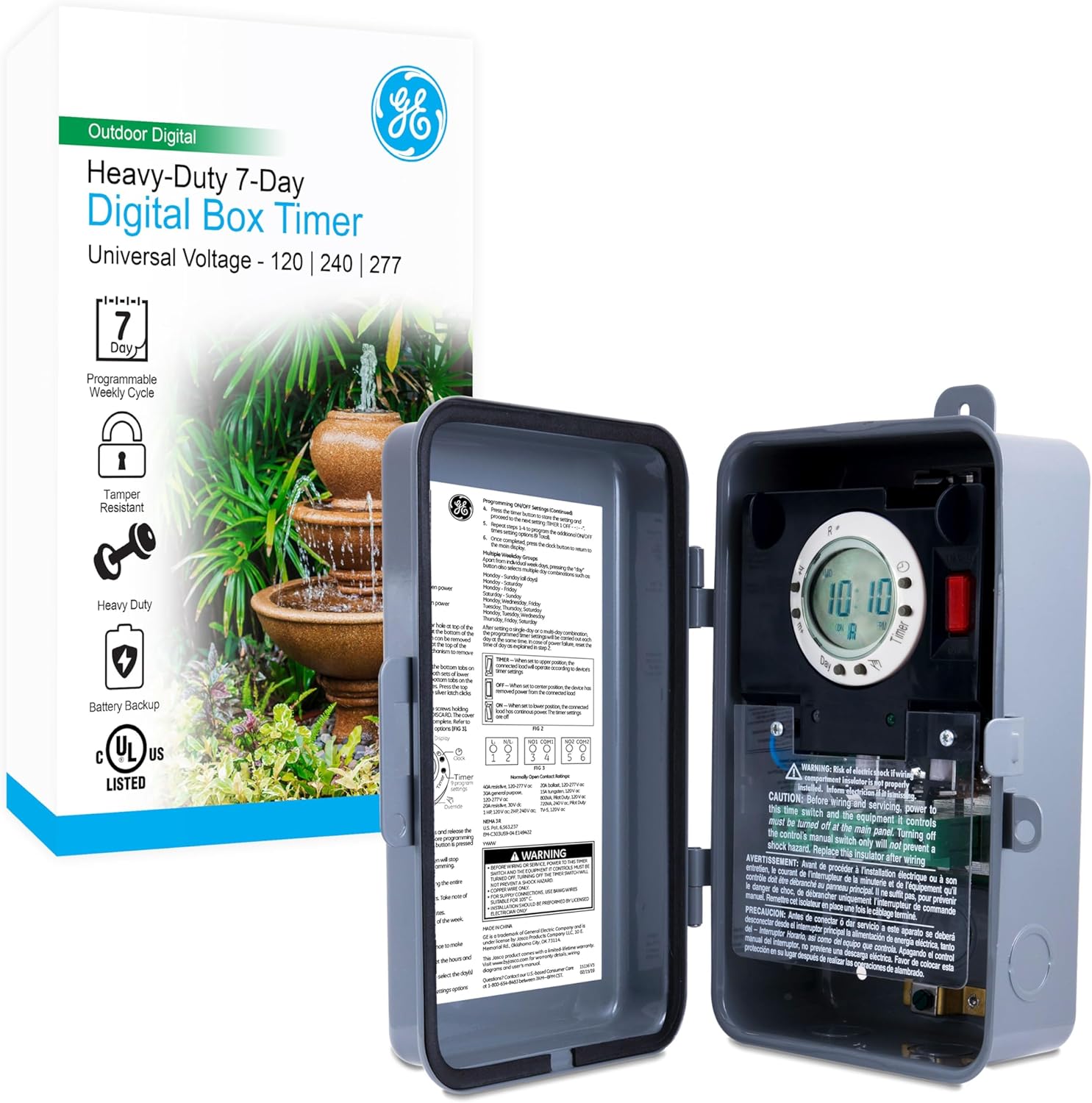
- 40A resistive; 1HP at 120V and 2HP at 240V
- NEMA 3R lockable metal enclosure
- Up to 9 weekly programs plus battery backup

- 40A, 120/240/277VAC hardwired switch box
- 7-day programming with up to 20 ON/OFF settings
- 12-hour display, DST function and ETL listing

- 30A resistive; 1.5HP at 120V and 2HP at 240V
- NEMA 3R lockable enclosure; 120/208/240V selectable
- 7 ON and 7 OFF weekly settings; 30-day program retention

- 40A resistive, 120-277VAC hardwired timer
- Up to 8 ON/OFF schedules per week
- ETL-listed PC/ABS outdoor enclosure

- Plug-in NEMA 5-15P/5-15R format; 15A, 125V, 1HP
- Two controlled 5-15R outlets
- 7-day schedule with up to 20 ON/OFF programs

- NEMA L5-20 twist-lock plug-in connection
- 20A, 125V, 1HP rating
- 7-day schedule with up to 20 ON/OFF settings
What to Look for in the Best Digital Pool Pump Timer
Start with the pump nameplate, not the timer display
Before comparing programming features, read the pump motor nameplate and the existing circuit. Confirm voltage, horsepower, full-load current where listed, and whether the pump is hardwired or cord-and-plug connected. A timer’s resistive current rating is not a substitute for its motor horsepower rating. Motors create starting loads that are different from simple resistive loads, so the motor rating is the figure that matters most when the load is a pool pump.
The hardwired timers in this guide are designed for larger electrical loads, but they are not identical. The GE 46537 is rated for a 1HP motor at 120V and 2HP at 240V, while the Honeywell Home TI040/U is rated for 1.5HP at 120V and 2HP at 240V. The DEWENWILS, SURAIELEC 40A, and BN-LINK boxes are marketed for 40A-class control and 2HP pool-pump applications, but voltage-specific motor limits still need to be matched to the equipment.
Hardwired box or plug-in timer
A hardwired timer becomes part of the branch circuit between the electrical supply and the pool equipment. This format is common for permanently installed pumps, heaters, and larger outdoor equipment. It also gives manufacturers room for larger switching contacts, lockable enclosures, conduit knockouts, and wiring terminals. Installation, however, involves line-voltage wiring and must follow the timer diagram, the equipment instructions, and local electrical requirements.
A plug-in timer is much simpler when the pool equipment already uses a compatible cord and receptacle. The SURAIELEC 5-15R model plugs into a 125V household-style GFCI receptacle and provides two controlled outlets. The SURAIELEC L5-20R version is for a 125V 20A twist-lock arrangement. These are not interchangeable connection styles, even though both models are rated for 1HP pool-pump use.
Voltage range and motor horsepower
Universal-voltage language needs careful reading. A timer that accepts 120V, 240V, and 277V does not automatically have the same motor horsepower rating at every voltage. GE’s documentation, for example, lists 1HP at 120VAC and 2HP at 240VAC. Honeywell Home specifies 1.5HP at 120VAC and 2HP at 240VAC for the TI040/U. That is a useful reminder that the circuit voltage and the motor load must be checked together.
The 125V plug-in models are more straightforward: SURAIELEC rates the 5-15R model at 15A, 125V, 1HP and the L5-20R model at 20A, 125V, 1HP. The higher current capacity of the twist-lock version does not increase the published motor rating above 1HP, so buyers should not assume a 20A receptacle automatically means support for a larger pump motor.
How many schedules are actually useful
More program slots are helpful when run time changes across the week or the pump is split into multiple circulation periods. DEWENWILS and the two SURAIELEC plug-in timers support up to 20 ON/OFF programs. The SURAIELEC 40A hardwired model is also designed around a 7-day, multi-program schedule. The GE 46537 supports up to nine scheduled programs, the BN-LINK model supports up to eight ON/OFF schedules per week, and the Honeywell TI040/U provides seven ON settings and seven OFF settings.
For a pool pump that runs one continuous block each day, all of these designs provide more scheduling capacity than necessary. The differences become more meaningful if the pool runs a morning and evening cycle, has different weekend hours, or shares timed control with other compatible equipment.
Outdoor enclosure and weather exposure
Outdoor use requires more than a plastic cover over the buttons. The GE 46537 and Honeywell TI040/U use NEMA 3R enclosures intended for outdoor weather exposure when installed as directed. The SURAIELEC and DEWENWILS hardwired boxes use weather-resistant polymer housings, while BN-LINK specifies a PC/ABS enclosure for outdoor use. The plug-in SURAIELEC timers use weatherproof covers and UV-resistant polymer housings, but they still need proper mounting and a suitable GFCI-protected receptacle.
No timer should be positioned where water can collect around the electrical connection. Covers also need to close properly around cords and conduit. A timer advertised for outdoor use does not make a damaged receptacle, undersized circuit, or poorly sealed cable entry safe.
Battery backup and program retention
Digital timers need a way to preserve the clock and schedule during an outage. GE includes battery backup so stored programming does not need to be rebuilt after normal power interruptions. Honeywell Home specifies that TI040/U programming is protected for 30 days without power. Some other models also use internal backup batteries or memory retention, but the exact behavior should be confirmed in the current manual before relying on a timer for a property that experiences frequent or extended outages.
A backup battery does not run the pool pump. It keeps the clock or programming alive while line power is unavailable. The pump can operate again only after normal circuit power returns.
DEWENWILS Pool Pump Timer, Digital Timer Box
The DEWENWILS digital timer box is a hardwired option aimed at pool pumps and other larger outdoor loads. Its listing identifies a 40A maximum resistive rating, 120-277VAC input range, 2HP-class motor application, ETL listing, and a 7-day schedule with as many as 20 ON/OFF programs. That combination makes it substantially different from a small plug-in timer even though both may use a similar LCD-style programming interface.
Design and electrical format
This timer installs as a wall-mounted switching box rather than plugging into a receptacle. DEWENWILS uses a nonmetallic weather-resistant enclosure, which avoids the corrosion concerns associated with bare steel while keeping the wiring and digital controls inside a covered housing. The exact model on the Amazon listing is HODT01C; DEWENWILS’ current digital pool-timer family uses the same 120-277VAC, 40A, 2HP class of electrical control.
For pool owners replacing a mechanical timer, the practical advantage is that the schedule is entered through buttons and a digital clock instead of moving trippers around a dial. That makes weekday/weekend differences easier to create and avoids the coarse interval limits common to many mechanical timers.
Scheduling and controls
Up to 20 ON/OFF schedules provide enough capacity for complex weekly routines. The timer can handle a single daily circulation window with only one ON and one OFF event, but the extra program memory is useful if run times are split across the day or vary by weekday. DEWENWILS also provides manual operating control so the pump can be run outside the programmed period without permanently deleting the schedule.
The important setup detail is making sure the unit is left in its automatic operating mode after programming. Digital timer boxes commonly provide always-on, always-off, and automatic states. A correctly entered schedule will not control the load if the front-panel mode remains in a manual state.
Practical use
This is the type of timer that makes sense for a permanent equipment pad where the pump is already hardwired or where an electrician is replacing an older box timer. It is also better suited than a plug-in design to installations that need 240V control. A 15A household plug-in timer cannot substitute for this type of circuit.
The 40A resistive figure should not be used by itself to approve a pump. Motor loads must remain within the timer’s motor rating and the pump’s voltage must match the supply. Wiring size, overcurrent protection, grounding, and GFCI requirements remain part of the overall installation.
Important strengths
The main advantage is the combination of broad input-voltage support and a large weekly program capacity. It can replace the repetitive daily pattern of a mechanical timer with separate schedules for different days without adding Wi-Fi, an app, or a cloud service. For buyers who want automation but prefer a local control panel, that is a useful middle ground.
Important limitations
The biggest limitation is also inherent to the design: this is not a plug-and-play accessory. Line-voltage conductors must be routed and terminated inside the enclosure. That is a different level of installation from plugging an above-ground pump into a timer, and the work should be handled by someone qualified to install outdoor line-voltage controls.
It also lacks the lockable metal-door format of the GE 46537 and the 30-day program-retention specification published for the Honeywell TI040/U. Buyers who specifically need a tamper-resistant metal box or documented long-duration outage retention may prefer one of those designs.
Who should consider it
Consider the DEWENWILS if the pump is hardwired, the circuit can fall within its 120-277VAC operating range, and a high number of weekly schedules is useful. It is particularly sensible for a pool owner replacing a basic mechanical box timer but not looking for app control.
Who should consider another option
Choose another timer if the pump already uses a 5-15 or L5-20 plug and there is no reason to convert to hardwiring. The SURAIELEC plug-in models are much simpler for those installations. A GE or Honeywell box may also be preferable where a lockable NEMA 3R enclosure is a priority.
Pros
- 120-277VAC hardwired format covers common pool-equipment supply voltages
- Up to 20 ON/OFF programs provides flexible weekly scheduling
- 40A resistive / 2HP-class design suits larger loads than ordinary plug-in timers
- ETL-listed digital control without requiring Wi-Fi
Cons
- Requires hardwired line-voltage installation
- Polymer enclosure is different from the lockable metal GE box
- Motor compatibility still depends on voltage and the specific pump nameplate
GE 46537 Digital Pool Timer Switch
The GE 46537 is a heavy-duty digital box timer with one of the more clearly documented electrical specifications in this group. Jasco, the company licensing the GE brand for this timer, specifies 40A resistive switching from 120 to 277VAC, a 1HP motor rating at 120VAC, and a 2HP motor rating at 240VAC. The enclosure is metal, lockable, tamper resistant, and NEMA 3R rated for outdoor installation.
Metal enclosure and wiring layout
A metal enclosure adds weight compared with the polymer timer boxes, but it also gives the 46537 a traditional equipment-pad format. The door can be locked, which can help keep casual users away from wiring and programming controls. Jasco includes 1/2-inch and 3/4-inch knockout provisions for conduit entry and uses block terminals for the hardwired connections.
The timer supports universal input voltage at 120VAC, 208/240VAC, or 277VAC. That does not mean a motor can be moved from one voltage to another without checking its own nameplate. The timer simply supports several supply configurations when wired according to its diagram.
Programs and operating modes
Up to nine programs can be scheduled through the week. That is less than the 20-program DEWENWILS and SURAIELEC designs but still sufficient for several daily run windows and different day groups. The GE also includes a countdown option and a summer-time setting, along with a manual override arrangement.
Indicator lights show timer power and load state, which is useful at an equipment pad because the user can distinguish a powered timer from an energized load without relying only on pump sound. Battery backup preserves the clock and schedule through outages.
Motor rating matters more than the shortened listing title
Some product titles and retailer databases create confusion by showing an unrelated low current figure next to this model. The manufacturer’s technical documentation is clearer: the normally open contacts are rated 40A resistive from 120 to 277VAC, while motor loads are rated 1HP at 120VAC and 2HP at 240VAC. For a pool-pump application, use the motor horsepower rating rather than treating the 40A resistive value as a motor rating.
Practical use
The 46537 is well suited to a permanent outdoor equipment area where a robust enclosure and flexible line-voltage control are more important than a very large number of program slots. It can control single-pole or double-pole switching arrangements, so it fits more electrical configurations than a simple single-circuit plug-in timer.
The lockable door is also useful when the timer is mounted in a shared yard, rental property, or other location where accidental changes are a concern. Locking the enclosure is not a substitute for a disconnect or code-required electrical protection, but it can reduce casual access to the programming and wiring.
Important strengths
Its strongest points are the documented motor ratings, NEMA 3R metal housing, universal-voltage capability, battery backup, and lockable door. Those are practical hardware features rather than marketing extras, and they make the 46537 easy to compare against an older outdoor mechanical box timer.
Important limitations
Nine programs are enough for most pools but fewer than the 20-program models. The metal enclosure is also heavier than plastic alternatives. Most importantly, installation requires hardwiring. Jasco recommends installation by a certified electrician, which is appropriate for a timer that may switch 120V or 240V motor circuits.
Who should consider it
The GE is a strong fit for owners who want a lockable metal outdoor box, need 120V or 240V pool-pump control, and value clearly stated motor ratings. It is also useful where an older outdoor time switch is being replaced and conduit-based wiring is already present.
Who should consider another option
If a 20-program schedule is important, DEWENWILS or the SURAIELEC 40A timer provides more programming capacity. If the pump plugs into a receptacle, one of the SURAIELEC plug-in timers can avoid unnecessary conversion to hardwiring.
Pros
- 40A resistive contacts with clear 1HP-at-120V and 2HP-at-240V motor ratings
- Lockable, tamper-resistant NEMA 3R metal enclosure
- Auto-sensing 120/240/277VAC capability and flexible switching configurations
- Battery backup and up to nine weekly programs
Cons
- Fewer program slots than 20-program digital models
- Hardwired installation is more involved than a plug-in timer
- Metal enclosure is heavier than polymer timer boxes
SURAIELEC Digital Pool Timer 40A
This SURAIELEC model is the hardwired member of the brand’s digital pool-timer lineup. The Amazon listing identifies model TD02A-1, 40A and 2HP-class control, 120/240/277VAC operation, a 12-hour display, 7-day programming, and ETL listing. SURAIELEC’s documentation for its 40A programmable box timers describes up to 20 ON/OFF settings and multiple day-combination options.
Hardwired design
Like the DEWENWILS and GE units, this timer sits between the supply and the controlled equipment. That makes it appropriate for permanently wired pool pumps, water heaters, and other compatible outdoor loads. The housing is polycarbonate rather than metal, which reduces enclosure weight and avoids rusting of the main shell.
Because the box supports 120V, 240V, and 277V circuits, it can fit more installations than a fixed 125V plug-in model. That flexibility does not remove the need to match each load to the published motor and current ratings.
Programming flexibility
The 7-day timer can create different schedules for individual days or repeated day groups. Up to 20 ON/OFF program slots give it the same broad scheduling class as the DEWENWILS. The Amazon version uses a 12-hour display, which some homeowners find more familiar than the 24-hour default used by certain industrial timers.
SURAIELEC also includes a daylight-saving-time function and manual override. Those features reduce two common annoyances with digital timers: resetting the clock seasonally and deleting a schedule just to run the pump outside its normal window.
Practical use
This timer works best where the pump’s daily operation changes during the week or where multiple run periods are useful. A pool that needs only one ON and one OFF event per day will not use most of the programming capacity, but the extra slots do not complicate normal operation once the schedule is saved.
A high program count can also be useful for staged circulation during hot weather or for a property where weekday and weekend pool use differs. The schedule should still be based on actual circulation needs rather than running the pump in many short cycles simply because the timer allows it.
Important strengths
The primary advantage is feature density: 40A-class hardwired switching, broad voltage compatibility, a 7-day calendar, up to 20 ON/OFF settings, and DST/manual controls in a weather-resistant enclosure. It provides more schedule memory than the GE and Honeywell timers.
Important limitations
The enclosure does not provide the same lockable metal format as the GE 46537 or the documented lockable NEMA 3R case of the Honeywell. Buyers should also avoid assuming that the 40A label alone proves compatibility with any 2HP motor at every supported voltage. The pump and timer ratings must be checked together.
Who should consider it
It makes sense for a hardwired pool system where weekly schedule flexibility matters more than a metal enclosure. It is also a logical comparison against the DEWENWILS if the buyer wants a similar 40A, multi-voltage, 20-program style of digital timer.
Who should consider another option
Choose GE or Honeywell if a lockable NEMA 3R cabinet is a specific requirement. Choose the SURAIELEC 5-15R or L5-20R timer instead if the pump already plugs into a matching receptacle and is within the 1HP, 125V limit.
Pros
- 40A, 120/240/277VAC hardwired control
- Up to 20 ON/OFF settings across a 7-day cycle
- 12-hour display with DST function and manual override
- ETL-listed outdoor/indoor switch box
Cons
- Requires line-voltage hardwiring
- Polycarbonate enclosure is not the same tamper-resistant metal format as the GE
- High current rating should not be confused with a universal motor horsepower rating
Honeywell Home TI040/U
The Honeywell Home TI040/U takes a more industrial approach than the newer 40A plastic timer boxes. Resideo’s technical documentation specifies a lockable NEMA 3R weatherproof enclosure, selectable 120V or 208/240V input, 30A resistive switching, and motor ratings of 1.5HP at 120V and 2HP at 240V. It provides seven ON settings and seven OFF settings per week.
Electrical ratings and voltage selection
The voltage selector is an important part of installation. The installer chooses the correct input-voltage position for the circuit before energizing the timer. The user guide warns that an incorrect selector setting can damage the product. This is one reason the TI040/U should be treated as electrical equipment rather than a simple consumer plug-in accessory.
Its 30A resistive rating is lower than the 40A figure on several competing boxes, but the motor ratings are still substantial: 1.5HP at 120VAC and 2HP at 240VAC. For many residential pool pumps, the 1.5HP-at-120V specification can be more informative than a higher generic current number.
Weekly programming
Programming is more restrained than on 20-program timers. The TI040/U stores up to seven ON and seven OFF settings each week. That is enough for one event pair per day or for repeated day groups. It is not intended for a very dense schedule containing many separate run windows every day.
The timer can operate manually or automatically, and its temporary bypass lets the load be changed without erasing the schedule. The clock can be switched between 12-hour and 24-hour display formats according to the installation guide.
Power-outage protection
Resideo specifies 30-day protection for stored programming during power outages. This is a meaningful distinction for seasonal properties or locations where power interruptions are more common. The feature protects the timer’s programming; it does not supply operating power to the pool pump itself.
Outdoor enclosure and remote switch option
The NEMA 3R case is designed for outdoor mounting and is lockable. Resideo also supports a remote single-pole switch connection that can provide three-way-style control. That can be useful if the timer is at the equipment pad but manual switching is desired at another accessible location.
Important strengths
The TI040/U combines a long-established industrial timer format with specific motor ratings, a lockable outdoor enclosure, selectable supply voltage, and unusually clear outage-retention documentation. It is less focused on maximizing program count and more focused on dependable hardwired control.
Important limitations
It does not support 277V in the same way as the DEWENWILS, GE, SURAIELEC 40A, and BN-LINK models. Its weekly program count is also lower. Buyers who want many split run periods may find the 20-program interfaces more flexible.
Who should consider it
The TI040/U is well suited to a 120V or 240V hardwired installation where a lockable NEMA 3R case, clear motor ratings, and 30-day schedule retention are more important than having the largest possible number of programs.
Who should consider another option
A 277V circuit requires another model. The same is true if the schedule needs more than seven ON and seven OFF events per week. Plug-connected above-ground pumps should generally be matched to an appropriate plug-in timer instead of being rewired simply to use this box.
Pros
- 1.5HP motor rating at 120V and 2HP at 240V
- Lockable NEMA 3R outdoor enclosure
- Programming protected for up to 30 days during a power outage
- Manual bypass and optional remote-switch compatibility
Cons
- 30A resistive rating is lower than the 40A hardwired alternatives
- No 277V operating option in the published TI040/U specification
- Seven ON and seven OFF settings offer less schedule density than 20-program timers
BN-LINK Digital Pool Pump Timer
BN-LINK’s digital outdoor timer box competes directly with the DEWENWILS and SURAIELEC 40A hardwired models. The Amazon listing specifies 2HP-class control, 40A maximum, and 120/240/277VAC use. BN-LINK’s own product documentation describes a 7-day programmable timer with up to eight ON/OFF schedules, an ETL-listed PC/ABS housing, and operation across a wide outdoor temperature range.
Construction and outdoor use
The enclosure is polymer rather than metal. BN-LINK describes the PC/ABS shell as resistant to oxidation and weather exposure, with an operating range from -40°F to 130°F. The lack of a steel outer case removes rust from the main housing, although installation details such as conduit fittings and cable entries still determine how well the overall installation handles rain.
Scheduling
Up to eight ON/OFF schedules per week puts the BN-LINK between the Honeywell and 20-program timers in schedule capacity. Eight events are more than enough for a single daily pump cycle and still allow several different day groups. Buyers planning multiple daily circulation periods throughout the entire week should count the required events before choosing it.
A digital schedule also makes seasonal adjustments easier than relocating mechanical trippers. If summer circulation time is longer than spring or fall operation, the clock values can be edited without changing physical hardware.
Electrical capacity
BN-LINK rates the timer for 120V, 240V, and 277V AC use with up to 40A resistive load. Its product information describes motor applications in the 1HP-to-2HP range depending on voltage. The same caution applies here as with every heavy-duty timer: confirm the pump’s voltage and motor rating rather than sizing from the 40A resistive number alone.
Practical use
This timer makes sense for an equipment pad where the owner wants a nonmetallic hardwired box and does not need 20 separate schedules. Its feature set is relatively focused: weekly digital programming, heavy-load switching, and an outdoor enclosure without app setup.
Important strengths
The main strengths are broad voltage compatibility, 40A-class switching, a weather-resistant PC/ABS case, and a straightforward eight-schedule digital interface. The ETL listing and stated outdoor temperature range also make the hardware specifications easy to evaluate.
Important limitations
Eight schedules are fewer than DEWENWILS and SURAIELEC provide. The box also does not offer the lockable metal enclosure of the GE or the 30-day power-outage program protection specified for Honeywell. As with the other hardwired units, installation is not plug-and-play.
Who should consider it
Consider BN-LINK if the pump is hardwired, 120-277VAC compatibility is useful, and eight weekly schedules are sufficient. It is a practical alternative for buyers who prefer a polymer enclosure over a metal box.
Who should consider another option
If the schedule is unusually complex, move toward a 20-program timer. If a lockable door is important, compare GE and Honeywell. If the pump uses a factory plug, the plug-in SURAIELEC timers may be simpler and more appropriate.
Pros
- 40A-class hardwired timer for 120/240/277VAC systems
- Up to eight weekly ON/OFF schedules
- ETL-listed PC/ABS enclosure avoids a rust-prone outer metal shell
- Published outdoor operating range extends from -40°F to 130°F
Cons
- Fewer schedules than the 20-program models
- No lockable metal cabinet
- Requires hardwired installation
SURAIELEC 15A NEMA 5-15R Digital Pool Timer
This SURAIELEC timer is fundamentally different from the five hardwired boxes above. It is built for 125V above-ground pool equipment using a standard NEMA 5-15 connection. The timer is rated 15A, 125V, and 1HP, and it provides two controlled 5-15R outlets under a weatherproof cover. SURAIELEC specifies up to 20 ON/OFF programs across a 7-day schedule.
Plug-and-play connection
No internal line-voltage wiring is needed for normal installation. The timer’s plug connects to a suitable GFCI-protected 125V receptacle and the pool equipment plugs into the timer outlets. This can be a much cleaner match for above-ground pools whose pumps were supplied with ordinary three-prong cords.
The timer does not convert voltage or increase circuit capacity. The connected equipment must remain within the timer’s combined electrical rating. Two outlets provide connection flexibility, but they should not be interpreted as permission to connect two full-load devices that together exceed 15A or the published motor limit.
Scheduling and manual control
Up to 20 weekly ON/OFF programs provide as much scheduling capacity as the larger DEWENWILS box. SURAIELEC also includes daylight-saving-time adjustment and a manual override. For an above-ground pool, that can be useful when the filtration schedule differs between workdays and weekends or when the pump needs to run temporarily outside its normal program.
Outdoor housing
The enclosure uses UV-stabilized, impact-resistant polycarbonate and a weatherproof cover over the controlled outlets. Product documentation lists dimensions of about 5.3 by 5.3 by 3.4 inches and recommends mounting the timer at least 3 feet above ground. Those compact dimensions make it easier to place near an existing outdoor receptacle than a large metal timer box.
Practical use
This is the most straightforward choice in the group for a compatible 125V pump with a conventional 5-15 plug. The buyer avoids selecting conduit, landing conductors on terminals, or converting a cord-connected pump into a hardwired installation. That simplicity is valuable only if the electrical ratings and plug style match the pump.
The dual outlets can also accommodate another compatible pool accessory such as lighting or a salt system, provided the combined load stays within the timer rating. If two devices must follow completely independent schedules, a single dual-outlet timer may not provide the required separation; the current manual should be checked before planning independent operation.
Important strengths
Its main advantage is installation simplicity. It delivers a true 7-day digital schedule, multiple program slots, and outdoor protection without opening a high-voltage timer box. For many above-ground pool owners, that is more useful than the higher ampacity of a hardwired timer they do not need.
Important limitations
The 15A, 125V, 1HP ceiling is the critical limit. It is not suitable for 240V pumps or equipment that requires an L5-20 twist-lock connection. The standard 5-15 plug can also be easier to disconnect accidentally than a locking connector, which is one reason some pool installations use twist-lock hardware.
Who should consider it
Choose this model for a 125V above-ground pool pump that already uses a standard 5-15 plug and falls within the 15A, 1HP rating. It is especially practical where a GFCI receptacle is already installed in the correct location.
Who should consider another option
Use the L5-20R SURAIELEC if the pump requires a 20A twist-lock connection. Use a hardwired timer if the pump is permanently wired, operates at 240V, or exceeds the plug-in timer’s published load limits.
Pros
- No hardwiring required for a compatible 5-15 plug-in pump
- Two controlled NEMA 5-15R outlets
- Up to 20 ON/OFF programs with 7-day scheduling
- Compact UV-resistant weatherproof enclosure
Cons
- Limited to 125V, 15A and 1HP
- Not compatible with L5-20 twist-lock equipment
- Combined load on both outlets must remain within the timer rating
SURAIELEC 20A L5-20R Twist-Lock Digital Pool Timer
The L5-20R version serves a narrower but important use case: 125V pool equipment that uses a 20A locking connection. It is rated 20A, 125V, and 1HP, with a programmable 7-day schedule and up to 20 ON/OFF settings. The twist-lock format helps keep the plug engaged once it is inserted and rotated into the mating receptacle.
Why the L5-20 connection matters
A NEMA L5-20 connection is physically different from the straight-blade 5-15 plug found on common household outlets. The locking geometry is intended to resist accidental unplugging. For pool equipment already designed around L5-20 hardware, using a matching timer preserves that connection style without rewiring the pump.
The twist-lock feature does not make the timer compatible with every 20A pump. SURAIELEC still publishes a 1HP motor limit at 125V. The plug type, current draw, voltage, and horsepower all need to match.
Weekly programming
Like the 5-15R version, this timer supports up to 20 ON/OFF settings across a 7-day cycle. It also includes daylight-saving adjustment and manual override. That gives a cord-connected twist-lock pump scheduling flexibility comparable to the larger hardwired 20-program timers.
Outdoor construction
The enclosure uses a heavy-duty polycarbonate housing and covered connection area intended for outdoor pool equipment. Published dimensions for this product family are approximately 5.3 by 5.3 by 3.4 inches, so the unit remains compact even though the L5-20 connector is heavier than a normal household plug.
Practical use
For the right pump, this is the simplest way in the group to add 7-day digital scheduling without changing the L5-20 electrical interface. It is particularly relevant to above-ground pool systems that use a twist-lock receptacle specifically to keep the pump connection secure.
It is less flexible than a hardwired multi-voltage box because it is fixed at 125V and 1HP. That is not a weakness in the intended installation; it simply means buyers should not select it as a universal timer.
Important strengths
The strongest feature is the exact combination of 20A L5-20 locking hardware and a 20-program weekly digital schedule. Hardwired boxes can handle larger or different-voltage loads, but they do not provide the same direct plug-in convenience for a factory twist-lock pump cord.
Important limitations
It is only useful when the plug and receptacle match. A standard 5-15 pump cannot be connected directly, and a 240V hardwired pump is outside the product’s intended format. The 1HP motor rating also remains in effect despite the 20A circuit connection.
Who should consider it
Choose it for a 125V, up-to-1HP pool pump that already uses an L5-20 connection and needs weekly digital scheduling without hardwiring a timer box.
Who should consider another option
Use the 5-15R version for ordinary 15A straight-blade plugs. Move to a hardwired timer when the pump is 240V, permanently wired, or above the published plug-in motor rating.
Pros
- Secure NEMA L5-20 twist-lock connection
- 20A, 125V plug-in format avoids timer-box hardwiring
- Up to 20 ON/OFF settings across a 7-day schedule
- Manual override and DST adjustment add convenience
Cons
- Limited to 125V and 1HP
- Only useful with matching L5-20 equipment
- Does not replace a hardwired timer for 240V pool pumps
Detailed Buying Guide for Digital Pool Pump Timers
Understand resistive current versus motor load
Timer packaging often puts a large amp number in the biggest type. That figure is useful, but it can mislead pool owners because a pump is an inductive motor load. A 40A resistive rating describes how the contacts handle a different type of electrical load. Motor horsepower ratings account more directly for the starting and running behavior of the pump motor.
The GE 46537 illustrates the distinction clearly: 40A resistive does not mean a 40A pool motor. The documented motor ratings are 1HP at 120V and 2HP at 240V. Honeywell publishes 30A resistive but supports a 1.5HP motor at 120V and 2HP at 240V. Comparing those two products by the amp number alone would give an incomplete picture.
Match the timer to 120V or 240V equipment
Many above-ground pool pumps are 120V cord-connected units, while larger or permanently installed pumps may use 240V. Hardwired timer boxes often support both, but the wiring arrangement changes. A 240V motor typically requires switching both ungrounded conductors, which is why double-pole capability matters.
The SURAIELEC 5-15R and L5-20R timers are 125V plug-in products. They should not be used as substitutes for 240V hardwired controls. Conversely, installing a 40A hardwired box is unnecessary complication when a small above-ground pump already has a compatible plug and is within the plug-in timer’s ratings.
Count program events before buying
One daily run period requires two events: one ON and one OFF. If the timer describes its capacity as ON/OFF pairs, the wording may count that differently than a timer listing individual events. Read the manual before assuming that a number such as eight, nine, fourteen, or twenty means the same thing across brands.
For a simple filtration schedule, capacity rarely becomes a limiting factor. It matters more for split circulation periods, weekday/weekend variations, or seasonal lighting and auxiliary equipment. A simpler program structure is usually easier to audit and less likely to contain an accidental overlap.
Look for an easy manual override
Pool equipment occasionally needs to run outside its normal schedule for vacuuming, chemical circulation, troubleshooting, or an unusually heavy swimming day. A good digital timer should let the user turn the load on or off temporarily without deleting the schedule. DEWENWILS, GE, SURAIELEC, and Honeywell all provide forms of manual control or override.
After an override, verify how the timer returns to automatic operation. Some units resume at the next programmed event; others require the user to select AUTO. Knowing that behavior prevents a pump from remaining on or off longer than intended.
Battery backup is about memory, not motor power
A battery or memory backup keeps the internal clock and programs alive when line power fails. It cannot run the pump. GE includes battery backup, and Honeywell Home specifies up to 30 days of program protection for the TI040/U. For other models, check the manual for the exact retention method and replacement-battery requirements.
Consider enclosure security
A lockable cover can be useful on shared property, rental homes, or exposed equipment pads. GE and Honeywell provide lockable outdoor enclosures. Polymer boxes are lighter and corrosion resistant, but they generally focus on weather protection rather than physical access control.
Think about service and replacement
Hardwired timers become part of the electrical installation, so future replacement may require disconnecting conductors and possibly conduit fittings. A plug-in timer is easier to swap, but only if the replacement has the same plug and receptacle configuration. Labeling the circuit, documenting the schedule, and keeping the manual can make future service easier.
Pool pump scheduling should follow circulation needs
A timer can reduce unnecessary run time only if the schedule is based on the actual pool system. Pump flow rate, pool volume, filtration needs, heater operation, salt-chlorine production, debris load, water temperature, and local conditions all influence run time. The timer should automate an appropriate schedule rather than determine the schedule by itself.
Variable-speed pumps may already include integrated scheduling or may need control methods different from simply switching line power. Before adding an external timer to a variable-speed or electronically controlled pump, verify the pump manufacturer’s instructions.
Direct Product Comparisons
DEWENWILS vs SURAIELEC 40A
These two are the closest match for buyers who want a hardwired 40A-class digital timer with a large weekly schedule. Both support 120-277VAC-class installations and up to 20 ON/OFF program settings. The SURAIELEC listing emphasizes a 12-hour display, DST function, and model TD02A-1; DEWENWILS emphasizes its 2HP, 40A digital timer family and ETL certification.
The choice is less about raw schedule count and more about the exact wiring layout, enclosure preference, manual interface, and motor compatibility with the installed pump. If replacing an existing timer, compare terminal diagrams and enclosure mounting before assuming either is a drop-in replacement.
GE 46537 vs Honeywell Home TI040/U
Both use lockable outdoor enclosures and have strong manufacturer documentation. GE has the higher resistive rating at 40A, supports 277V, and stores up to nine programs. Honeywell is rated 30A resistive, supports 120/208/240V, provides seven ON and seven OFF settings, and documents 30-day program protection during outages.
The motor ratings differ at 120V: GE specifies 1HP, while Honeywell specifies 1.5HP. Both reach 2HP at 240V. That difference can matter more than the GE’s higher resistive current rating for a 120V pool-pump installation.
BN-LINK vs DEWENWILS
Both target hardwired 40A, multi-voltage pool-pump control in polymer housings. DEWENWILS offers up to 20 ON/OFF schedules, while BN-LINK specifies up to eight. BN-LINK publishes an outdoor operating range of -40°F to 130°F; DEWENWILS’ current timer family is also designed for harsh outdoor temperatures.
A straightforward once- or twice-daily pump schedule may not benefit from DEWENWILS’ extra program capacity. A more complex weekly routine can.
SURAIELEC 5-15R vs SURAIELEC L5-20R
These timers share the same basic purpose and 7-day, 20-program control style, but the electrical connection decides between them. The 5-15R model is 15A, 125V, 1HP and uses standard straight-blade plugs with dual controlled outlets. The L5-20R version is 20A, 125V, 1HP and uses a locking connector.
Do not choose the L5-20 model merely because 20A sounds stronger. Choose it only when the pump and receptacle are already designed for L5-20. For a standard 5-15 cord, the 15A model is the matching format as long as the load stays within its published limits.
Hardwired 40A boxes vs plug-in timers
The hardwired timers are for permanent circuits and can cover 240V equipment that the plug-in units cannot. They are also better suited to larger motors and equipment pads with conduit wiring. The plug-in models are easier to install but deliberately narrower in scope: 125V, up to 1HP, and a specific receptacle format.
Neither category is universally better. The correct category is the one that matches the pump’s existing electrical design.
Installation and Setup Considerations
Hardwired timers
Turn off all circuit power before opening a hardwired timer, and verify de-energization with appropriate test equipment. Follow the exact wiring diagram for the timer model and pump voltage. Conductor size, grounding, GFCI protection, conduit, bonding requirements around pools, and local electrical rules all matter. If any part of the circuit is unclear, use a qualified electrician rather than treating a high-amperage timer as a basic DIY switch.
Mount outdoor timer boxes in the orientation required by the manual so water cannot enter through the top or cable openings. Honeywell specifically instructs upright installation. GE uses a rainproof NEMA 3R enclosure that also depends on the door being closed after use.
Plug-in timers
For plug-in models, confirm that the receptacle and cord are in good condition and that the outlet is GFCI protected where required. Do not use adapters to force an incompatible plug into another receptacle type. The SURAIELEC 5-15R timer belongs on a 5-15 connection; the L5-20R belongs on a matching L5-20 installation.
Mount the timer so water does not pool around the outlets or cord entries. Keep covers closed and provide proper cord routing so plugs are not pulled sideways by cable weight.
Programming after installation
Set the current day and time first, then enter the ON and OFF events. After programming, place the timer in AUTO and perform a short test schedule if practical. Confirm that the display shows the expected load state and that the pump starts and stops normally. Finally, restore the real schedule and keep a written copy or phone photo of the settings.
Common Buying Mistakes
Buying by amp rating alone
A 40A resistive timer is not automatically appropriate for a 40A motor load. Motor horsepower ratings and voltage-specific contact ratings are the better guides for pool pumps. Use the timer manual and pump nameplate together.
Ignoring plug type
A 5-15 straight-blade plug and an L5-20 twist-lock plug are not interchangeable. Choosing the wrong plug-in timer can leave the buyer with equipment that physically cannot connect, even if the voltage looks correct.
Assuming every 2HP label applies at 120V
Horsepower ratings can change with voltage. GE is 1HP at 120V and 2HP at 240V. Honeywell is 1.5HP at 120V and 2HP at 240V. The voltage-specific motor rating should be confirmed for every model.
Paying for programs that will never be used
Twenty ON/OFF settings sound more capable than eight or nine, but a pool that runs one block per day may never need the extra memory. Enclosure quality, motor compatibility, manual override, and outage retention can matter more than program count.
Replacing a mechanical timer without checking the wiring diagram
Two timer boxes that accept the same voltage can still use different terminal layouts and switching arrangements. Document the existing circuit, identify supply and load conductors, and compare the new manual before disconnecting anything.
Using an external timer with equipment that has its own electronics
Some variable-speed pumps, heaters, and automation systems are designed to remain energized and manage scheduling internally. Cutting their line power with an external timer may not be the intended control method. Follow the equipment manufacturer’s control instructions.
Frequently Asked Questions
What size timer do I need for a pool pump?
Match the timer to the pump’s voltage, motor horsepower, current requirements, and connection type. Use the timer’s motor rating rather than relying only on a resistive amp rating. For plug-in equipment, the plug and receptacle type must also match.
Is a 40A digital timer better than a 20A timer?
Not automatically. A 40A hardwired timer is intended for a different class of electrical installation than a 20A, 125V plug-in timer. The better choice is the timer that correctly matches the circuit and pump motor.
Can I use a 240V timer on a 120V pool pump?
Only if that exact timer is designed for 120V operation and is wired according to its 120V diagram. Multi-voltage timer boxes often support several voltages, but the switching configuration and motor rating may change with voltage.
How many timer programs does a pool pump need?
A single daily circulation period needs only one ON and one OFF event. Extra programs are useful for split run periods or different weekday and weekend schedules. Count the actual events you plan to use before deciding that a 20-program timer is necessary.
Will the timer remember the schedule after a power outage?
That depends on the model. GE includes battery backup, while Honeywell Home specifies 30-day programming protection for the TI040/U. Other timers use internal memory or batteries with model-specific behavior, so the current manual should be checked.
Can I install a hardwired pool timer myself?
Hardwired pool timers involve line-voltage wiring near pool equipment and must comply with applicable electrical and pool-safety requirements. If you are not qualified to install and verify that circuit, use a licensed or otherwise properly qualified electrician.
Do both outlets on the SURAIELEC 5-15R timer have separate schedules?
The product provides two controlled outlets, but buyers should not assume independent scheduling unless the current manual explicitly describes separate channels. Plan the combined connected load so it remains within the timer’s 15A, 125V, 1HP rating.
Is an L5-20 twist-lock timer safer than a standard plug timer?
A twist-lock connector is less likely to pull out accidentally because the plug rotates into a locking position. That is a connection-security feature, not a guarantee of overall electrical safety. GFCI protection, grounding, load matching, cord condition, and proper outdoor installation still matter.
Can a digital timer control a pool heater too?
Some hardwired timers are marketed for compatible water heaters and pool heaters, but heater loads vary widely. Confirm voltage, current, switching type, and any manufacturer control requirements before connecting a heater. Many modern heaters are meant to be controlled through low-voltage or automation inputs rather than simply switching line power.
Should I choose a timer with Wi-Fi instead?
Wi-Fi is useful for remote schedule changes and app control, but it adds network setup and software dependence. A conventional digital timer is often preferable when the goal is a predictable local schedule that keeps operating without internet access.
Can I use these timers with a variable-speed pool pump?
Check the pump manual first. Many variable-speed pumps have built-in scheduling and electronic controls and may be intended to stay continuously energized. An external line-power timer may not be the recommended control method.
Final Buying Considerations
The best digital pool pump timer is the one that matches the electrical installation before it adds scheduling convenience. For permanent hardwired systems, DEWENWILS and SURAIELEC offer broad 120-277VAC support with up to 20 ON/OFF programs, while BN-LINK provides a simpler eight-schedule alternative. GE 46537 is notable for its lockable NEMA 3R metal enclosure, 40A resistive rating, and clearly documented 1HP-at-120V / 2HP-at-240V motor limits. Honeywell Home TI040/U uses a similarly robust lockable format, with a 30A resistive rating, 1.5HP at 120V, 2HP at 240V, and 30-day programming protection.
For cord-connected above-ground pumps, the decision is much easier. Use the SURAIELEC 5-15R model for a compatible 15A, 125V, up-to-1HP straight-blade setup, or the L5-20R model for a compatible 20A, 125V, up-to-1HP twist-lock setup. Do not use adapters or choose by amperage alone.
Once voltage, horsepower, wiring style, and enclosure requirements are confirmed, program capacity becomes a preference rather than a safety issue. A simple pool may need only one daily cycle; a more variable routine may benefit from 20 program slots. Matching those practical needs is more useful than selecting the timer with the longest feature list.
Author