
The best swimming pool brush is determined first by the surface you need to clean. A stainless-steel algae brush can be useful on hard gunite or concrete finishes, but the same bristles can damage a vinyl liner or fiberglass shell. Nylon and polypropylene brushes are the more versatile choice for routine wall, floor, tile, step, and corner cleaning, although head shape and bristle layout still affect how much effort the job takes.
The five brushes in this guide cover three distinct approaches. LALAPOOL and Unipool use wide conventional nylon-bristle heads for general maintenance. The Wall Whale adds a water-pressure tail that pushes the brush against the surface during the stroke. Blue Torrent takes the opposite route with a smaller 12-inch 360-degree head designed to reach curves and confined areas. Poolmaster’s 20183 uses stainless-steel bristles for harder scrubbing on suitable gunite surfaces.
That makes this less about finding one brush that is universally “strongest” and more about matching bristle material, head width, corner design, pole fit, and brushing force to the actual pool. A wide head can reduce passes across open walls, but a smaller rounded brush can be easier around steps and curves. A more aggressive brush may remove stubborn growth faster on the right finish, yet be completely unsuitable on a softer surface.
Quick Comparison
The table below highlights the differences that matter most before you attach a brush to a telescopic pole: width, bristle material, special geometry, and surface limitations. Pool poles are not included with these brush heads unless a listing specifically states otherwise.

- Nominal 18-inch wide cleaning head with curved ends
- High-density nylon/poly bristles with aluminum and ABS-backed construction
- EZ-clip connection for most standard pool poles; pole not included

- 17.5-inch nominal head with seven rows of nylon bristles
- Rounded ends for corners, walls, steps, and curved transitions
- EZ clips fit most 1-1/4-inch standard pool poles

- 18-inch nylon-bristle brush with adjustable force-assist tail
- Manufacturer says moving water can create more than 10x wall pressure
- Attaches to an existing pool pole; intended for routine and algae brushing

- 12-inch head with 360-degree polypropylene bristle coverage
- Rounded construction reaches corners, curves, steps, and ladder areas
- Model AC 88072 with reinforced pole-connection design
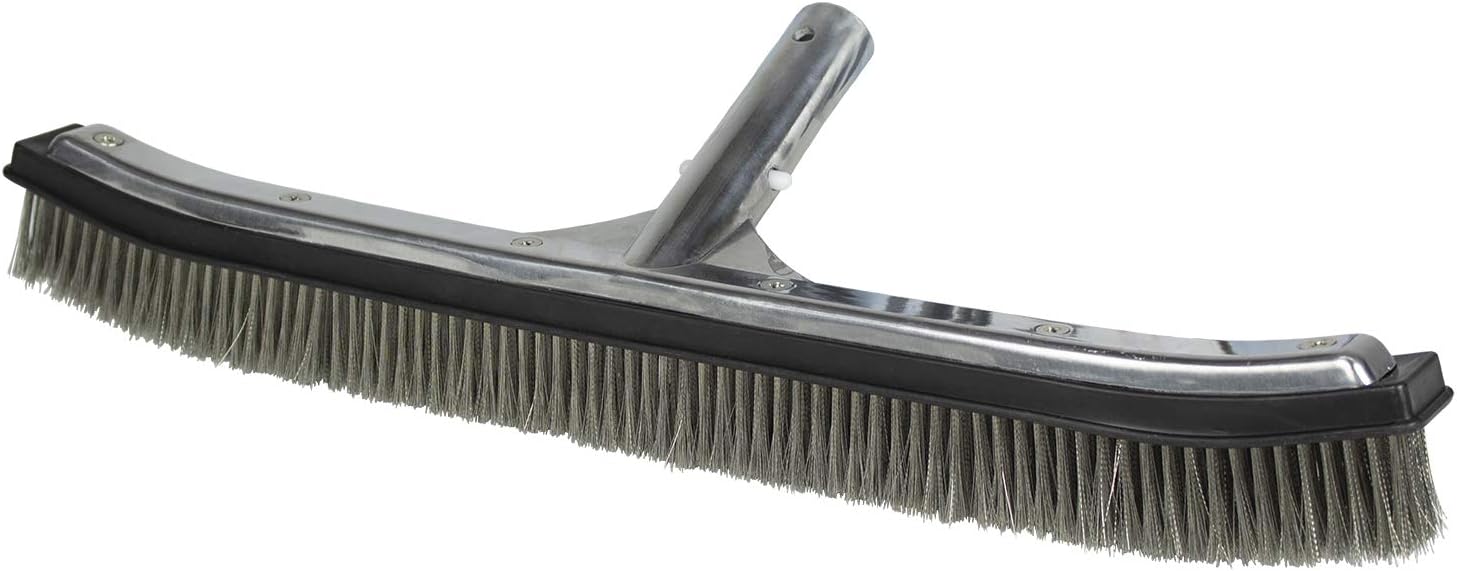
- 18-inch curved head with five rows of stainless-steel bristles
- Die-cast aluminum back and handle
- For hard-surface gunite pools; not for vinyl liners or fiberglass
How to Choose the Best Swimming Pool Brush
Match the Bristles to the Pool Surface
Bristle material is the first filter. Soft or medium synthetic bristles such as nylon and polypropylene are commonly used for routine brushing because they can clean walls and floors without the cutting action of stainless wire. They are the category to examine first for vinyl, fiberglass, painted surfaces, and general-purpose maintenance. Exact compatibility still depends on the brush and the condition of the finish.
Stainless-steel bristles belong in a different category. Poolmaster specifies its 20183 for gunite pools with hard-surface finishes and explicitly warns against using it on vinyl liner or fiberglass surfaces. Major pool-equipment manufacturers make the same distinction across their own brush ranges, reserving stainless brushes for plaster, concrete, and gunite-type finishes.
Choose Width for the Shape of the Pool, Not Just Speed
An 18-inch head covers a broad strip of wall with each pass. That is useful on long straight walls and large floor sections, and it explains why 17.5- to 18-inch brushes are so common. The drawback appears around steps, ladders, tight curves, benches, and small spas, where a wide rigid head can be harder to keep flat against the surface.
The 12-inch Blue Torrent GoRound 360 Pro gives up coverage in exchange for maneuverability. Its bristles wrap around the head, so it can contact corners and transitions without exposing a sharp edge. If most of your weekly work is on broad walls, an 18-inch brush is usually more efficient. If the pool has many shaped details, a smaller 360-degree design can save repeated repositioning.
Look at the Backing and Edge Design
An aluminum-backed brush generally feels more rigid when pressure is applied through a long pole. That rigidity helps keep a wide head from flexing excessively, especially when brushing a vertical wall. LALAPOOL and Unipool both use aluminum-supported designs, while Poolmaster uses a die-cast aluminum back and handle for its stainless-bristle algae brush.
The edge shape matters because the end of the brush often reaches a corner before the middle does. Curved or rounded ends can keep bristles in contact where a straight-ended brush might leave a narrow unbrushed strip. Unipool emphasizes rounded ends, LALAPOOL uses curved edges, and the Blue Torrent design goes further by wrapping bristles around the body.
Confirm Pole Compatibility Before Buying
A pool brush is only useful if it fits the pole you already own. LALAPOOL uses EZ clips and states compatibility with most standard pool poles. Unipool specifies compatibility with most 1-1/4-inch standard pool poles. Poolmaster’s brush family uses snap-adapt handles intended for standard pool poles.
Do not confuse the nominal pole diameter with the outside diameter of every telescopic pole on the market. Worn clips, unusually thick locking mechanisms, or proprietary poles can create fit problems. If you already own an expensive telescopic pole, check its accessory connection before choosing the brush head.
Consider How Much Downward Force the Design Creates
Conventional pool brushes rely on the user to push the bristles against the wall while also moving the brush. This gets harder with a long pole because some of your effort is spent controlling the pole rather than increasing contact pressure. A wide head also creates water resistance during the stroke.
The Wall Whale addresses that problem with an adjustable tail. As the brush moves through the water, the tail directs water pressure so the brush is pushed into the pool surface. The manufacturer says the design can create more than ten times the contact force of ordinary brushing. That is a manufacturer performance claim rather than a universal result for every pool, but the mechanism is the defining difference between the Wall Whale and a standard 18-inch head.
Decide Whether You Need Routine Cleaning or Targeted Algae Scrubbing
For weekly maintenance, a synthetic-bristle brush is the more flexible tool because it can be used on a wider range of finishes. Its job is to disturb films, dust, light growth, and material that circulation or an automatic cleaner may miss. Regular brushing also reaches waterline areas and corners that can become problem spots when they are ignored.
A stainless-steel algae brush is a more specialized tool. Poolmaster’s five rows of stainless bristles provide a harder scrubbing action for appropriate gunite surfaces. That does not make it the better everyday brush for every pool; it makes it useful where the finish can tolerate wire bristles and a more aggressive tool is actually needed.
LALAPOOL 18-Inch Swimming Pool Wall & Tile Brush
The LALAPOOL is the conventional all-purpose option in this group: a broad nylon-bristle head, aluminum-reinforced construction, curved ends, and an EZ-clip connection for a standard pool pole. The Amazon title markets it as an 18-inch brush. The product detail table currently lists overall dimensions of 17 x 1.7 x 5.3 inches, so the 18-inch label is best treated as the nominal brush size rather than a precision body measurement.
Design and Build
The backing combines aluminum with ABS/plastic components. That construction gives the brush more stiffness than a fully molded lightweight head while keeping the working edge free of stainless wire. The bristles are described as high-density nylon/poly material and are arranged across a wide cleaning face.
At about 10.4 ounces in the listing specifications, the head is relatively light. Weight matters more than it may seem because a brush is used at the end of a long pole. A heavy tool can feel much heavier when fully extended over the water, while a lighter head is easier to reposition from wall to wall.
Cleaning Coverage
The main advantage is coverage. A nominal 18-inch head sweeps a broad strip across flat walls and large floor areas. On a rectangular pool, that can reduce the number of overlapping strokes compared with a 10- or 12-inch brush. The curved outer sections help the bristles follow coved corners rather than leaving the ends of the head floating away from the surface.
Coverage does not automatically mean more cleaning force. A wide brush spreads the pressure you apply across more bristles, and water resistance increases as the head moves. For ordinary weekly cleaning that can be comfortable and efficient; for a small patch of stubborn algae, a narrower or force-assisted brush can concentrate effort better.
Pool Surface Use
LALAPOOL positions this as a brush for pool walls, tiles, and floors, and the nylon/poly bristle format is the appropriate category for routine cleaning where metal wire would be too aggressive. The smooth curved edges are also helpful around liners because the brush is less likely to present a sharp corner to the surface.
Even with a synthetic brush, avoid forcing the aluminum back or a damaged edge against a delicate liner. Inspect the head periodically for cracked plastic, exposed metal, or badly bent bristles. A brush that was originally liner-friendly can become a different tool if the body is damaged.
Pole Connection and Ease of Use
The EZ-clip fitting is intended for most standard pool poles, and the pole is not included. This is useful if you already have a telescopic pole for a skimmer or vacuum head because the brush can join the same cleaning system. The clip also makes it quicker to change between tools than a bolted connection.
The tradeoff is that a spring-clip connection can develop play if either the brush socket or pole end is worn. A small amount of movement is common in interchangeable pool tools, but excessive wobble makes it harder to keep the brush flat on a wall. Check both pieces before blaming the brush head alone.
Practical Strengths
This model works best as a straightforward maintenance brush. It does not introduce a force-assist tail, wire bristles, or an unusual pole joint. That simplicity keeps the learning curve low: attach it, angle the pole so the bristles stay in contact, and use overlapping strokes on walls and floors.
The combination of wide coverage and synthetic bristles also makes it useful as the primary brush in a pool-care kit when the pool surface does not call for stainless wire. It can handle broad weekly brushing while a smaller specialty brush is kept for steps, returns, and awkward corners.
Important Limitations
The rigid wide head is not as nimble as the 12-inch Blue Torrent in complicated geometry. It also does not generate extra wall pressure the way the Wall Whale does, so the user supplies all contact force through the pole. The listing’s nominal 18-inch description and 17-inch detail-table dimension are also a reminder not to use marketing width alone when storage or exact clearance matters.
Who Should Consider It
Consider the LALAPOOL if you want a conventional synthetic-bristle brush for routine wall and floor cleaning and already own a compatible standard pole. It is especially sensible for large, relatively open surfaces where a wide head saves passes. A pool with many tight step areas may benefit from the GoRound 360 instead, while a hard gunite surface with stubborn algae may call for the Poolmaster wire brush.
Pros
- Wide nominal 18-inch head covers large walls and floor areas efficiently
- Nylon/poly bristles suit routine cleaning better than aggressive wire on delicate finishes
- Curved edges improve contact near coved corners
- Lightweight aluminum/ABS-backed construction and EZ-clip pole connection
Cons
- Wide rigid head is less maneuverable in very tight steps and curves
- No force-assist feature, so wall pressure comes entirely from the user
- Amazon title and detail-table dimensions use slightly different width conventions
Unipool 17.5-Inch Swimming Pool Brush Head with Round Ends
Unipool takes the wide synthetic-bristle formula and puts more emphasis on edge coverage. The nominal 17.5-inch head uses seven rows of nylon bristles with rounded ends, and the Amazon listing identifies the reviewed color as Blue Grey. It is designed to attach with EZ clips to most 1-1/4-inch standard pool poles.
Seven-Row Bristle Layout
The seven-row arrangement gives the brush a deep cleaning face rather than relying on one narrow line of bristles. More rows can help the head maintain contact as the angle changes during a stroke, particularly when moving from a vertical wall toward a cove or floor. The practical benefit is consistency rather than simply “more bristles equals more power.”
Unipool describes the bristles as premium nylon. Synthetic bristles are a logical choice for routine cleaning because they can flex around small surface variations instead of scraping with a hard metal edge. The brush is intended for walls, tiles, and floors and is marketed as gentle on pool liners and painted pool floors.
Round Ends for Corners and Curves
The rounded ends are the feature most likely to matter in daily use. With a straight brush, the outer edge can lose contact in a curved corner, forcing you to rotate the pole and make another pass. A rounded end carries bristles farther around the edge of the head, allowing contact to continue into transitions.
This does not make it a true 360-degree brush. The Blue Torrent GoRound has bristles around the body and is more specialized for confined geometry. Unipool keeps the cleaning speed of a nearly 18-inch face while improving how the ends behave near corners.
Size and Published Dimensions
The product is sold as a 17.5-inch brush. Amazon’s current product-detail table lists overall dimensions of 17 x 7 x 4.5 inches. Those figures likely reflect a different point-to-point measurement than the nominal product name, but the important buying decision is clear: this belongs to the same broad-width class as an 18-inch wall brush, not the compact 12-inch category.
The seven-inch depth listed in the product table also helps explain why the head has room for multiple bristle rows and rounded end sections. A deeper brush can feel stable on a wall because more bristles are engaged, although it creates more drag in the water than a narrow strip brush.
Pole Connection
The listing states that the EZ clips fit most 1-1/4-inch standard pool poles. That is more specific than listings that simply say “standard pole,” and it is useful for checking an existing setup. The pole itself is not part of this brush-head purchase.
A secure connection matters because twisting forces increase when you deliberately use the rounded ends to scrub a corner. If a pole has a badly worn accessory hole or weak spring clip, the head can rotate or rattle under side load. Replacing a worn clip is often cheaper than replacing an otherwise good brush.
Surface Considerations
Unipool’s smooth rounded edges and nylon bristles are intended to avoid scraping or snagging liners during ordinary use. That makes this a far better match than the Poolmaster stainless wire brush for vinyl or fiberglass. Still, check the brush for accidental damage and avoid trapping grit or sharp debris between the brush body and a soft pool surface.
Who Should Consider It
This model fits a buyer who wants broad coverage but regularly deals with corners, curved walls, steps, or coves. It is a more geometry-focused choice than a simple straight 18-inch brush. Choose the 12-inch Blue Torrent if maneuverability matters more than width, or the Wall Whale if reducing the effort required to press a brush against vertical walls is the bigger priority.
Pros
- Seven rows of nylon bristles create a broad, consistent cleaning face
- Rounded ends improve contact in corners and curved transitions
- Near-18-inch width balances coverage with maneuverability
- EZ clips fit most 1-1/4-inch standard pool poles
Cons
- More water resistance than a smaller 12-inch brush
- Still not as maneuverable as a true 360-degree compact head
- Pole is not included
Wall Whale 18-Inch Swimming Pool Brush Head
The Wall Whale is the most mechanically distinctive brush in this comparison. Instead of asking the user to provide all of the pressure against the wall, it adds an adjustable tail above the 18-inch nylon-bristle brush. As the assembly moves through the water, the tail produces a hydrodynamic force that presses the brush toward the surface.
How the Force-Assist Tail Works
The idea is similar to a spoiler creating force from moving air, except the Wall Whale uses moving water. On the downward brushing stroke, the tail is positioned so water pressure pushes the head into the wall or floor. On the return stroke, the tail can flip forward to make the brush easier to pull back through the water.
The manufacturer states that the system can generate more than ten times the force between the brush and pool surface. That figure describes the manufacturer’s design claim, not a guarantee that every user will experience the same exact multiplier. Angle adjustment, stroke speed, pole position, water depth, and surface geometry all influence how the brush feels.
18-Inch Nylon Bristle Brush
The Classic version associated with this Amazon listing uses nylon bristles and an 18-inch cleaning width. The manufacturer recommends the nylon model for plaster, vinyl, fiberglass, and other common pool surfaces, while separately selling stainless and combination-bristle versions for harder finishes. That distinction is important because the Wall Whale name appears on multiple bristle configurations.
The nylon version is the one that makes sense as a general maintenance tool. It combines a familiar synthetic-bristle cleaning face with the pressure-generating tail, so the special feature changes the effort required rather than turning the head into an aggressive wire brush.
Technique Matters More Than With a Standard Brush
A conventional brush tolerates a fairly casual back-and-forth motion. The Wall Whale works best when the tail is moving through the water and can create pressure. The manufacturer recommends starting near the waterline and making a fluid stroke downward while keeping the brush moving.
That means there is a small learning curve. If you stop the head, reverse direction abruptly, or use it in a cramped shape where the tail cannot move freely, the advantage decreases. Once the motion is understood, the design can reduce how much upper-body force is needed to keep an 18-inch brush planted on a wall.
Vinyl and Fiberglass Caution
The manufacturer specifically says the nylon-bristle Wall Whale can be used on vinyl and fiberglass, but it also gives an important caution: the force-assist design can create substantial pressure. On older, brittle, patched, or vulnerable liners, the manufacturer advises using caution and avoiding corners and transitions where concentrated force could create damage.
That warning is meaningful because “soft bristles” do not automatically make every brushing technique harmless. A synthetic brush pressed very hard into a damaged liner can still cause problems. Use the nylon version, inspect the liner condition, and reduce the tail setting or pressure where the surface is vulnerable.
Pole and Storage Considerations
The Wall Whale attaches to an existing pool pole and does not need hoses, pumps, or motors. The added tail makes the overall head taller than a simple flat brush, though. That can affect storage in a narrow equipment rack and makes the assembly bulkier around ladders or very confined step areas.
Who Should Consider It
This is the most relevant option for someone who dislikes the effort of pushing a wide brush against vertical walls. It is also useful for larger pools where several minutes of hard wall brushing becomes tiring. Buyers who mainly need a compact corner brush will find the 12-inch GoRound easier to maneuver, while someone needing wire bristles for a hard gunite algae problem should look at the Poolmaster 20183 instead.
Pros
- Adjustable tail uses water movement to increase brush pressure against the surface
- 18-inch nylon-bristle head provides broad routine-cleaning coverage
- Manufacturer offers technique guidance and surface-specific bristle versions
- Attaches to an existing pole without hoses, pumps, filters, or motors
Cons
- Bulkier than a conventional flat brush because of the force-assist tail
- Requires a more deliberate brushing stroke to get the benefit of the design
- High generated pressure calls for caution on older, patched, or brittle vinyl liners
Blue Torrent GoRound 360 Pro Pool Brush 12-Inch
The Blue Torrent GoRound 360 Pro, model AC 88072, gives up some width to solve a different problem: keeping bristles in contact around curves, steps, corners, ladders, and other awkward areas. The Amazon listing specifies a 12-inch width and polypropylene bristles arranged around the head rather than only along one flat bottom edge.
360-Degree Bristle Coverage
The wraparound bristle layout is the reason to buy this brush. There are no exposed hard corners on the cleaning perimeter in the same way there can be on a conventional metal-backed head. When the brush rolls slightly as you change the pole angle, another group of bristles remains available to contact the surface.
That geometry is especially useful on curved transitions and tight areas where a wide flat brush repeatedly loses contact. It can also reduce the need to rotate a large head perfectly before each stroke. The tradeoff is simple: a 12-inch head needs more passes than a 17.5- or 18-inch brush on a large open wall.
Construction
Blue Torrent describes the brush as having a heavy-duty stainless-steel core with polypropylene bristles. The presence of stainless in the internal structure should not be confused with a stainless-wire cleaning face; the bristles that touch the pool are polypropylene. The listing also describes the design as having no rough exposed edges intended to scrape a liner.
Amazon currently lists dimensions of 3 x 12 x 3 inches and a product weight of roughly 11.2 ounces. That compact format is easy to store and light enough for extended-pole work. The smaller head also produces less drag through water than many broad brushes, which can make quick directional changes easier.
Pole Connection
The GoRound uses a pole-connection system designed to make the brush and telescopic pole feel more unified under load. This matters because a rounder head is often used with side-to-side and twisting motions in corners, creating forces that can expose weakness in a loose accessory joint.
Before purchase, compare the connector with your current pole. The listing identifies the brush as an attachment rather than a complete pole-and-brush package, so a telescopic pole should be treated as a separate requirement.
Practical Cleaning Use
This is the brush in the group most clearly optimized for detail cleaning. It can work along steps, curves, ladder areas, tile transitions, and confined spaces without asking the user to keep a long straight edge perfectly aligned. For a freeform pool or spa with many curves, that can matter more than maximum sweep width.
On a large rectangular pool, the opposite is true. Repeatedly covering long walls with a 12-inch head takes more passes than using an 18-inch LALAPOOL, Unipool, Wall Whale, or Poolmaster. Some owners may therefore prefer the GoRound as a second brush rather than the only brush in the equipment rack.
Surface Compatibility
The polypropylene bristle design and absence of rough perimeter edges make it a more appropriate category for liner-sensitive cleaning than a stainless-wire algae brush. As always, the condition of the pool surface matters. Torn vinyl, brittle patches, exposed fiberglass fibers, or damaged coatings should be handled carefully regardless of brush material.
Who Should Consider It
Choose the GoRound 360 Pro if your pool has many curves, steps, corners, or tight features and you value maneuverability over maximum coverage per stroke. It is also a useful companion to a wider wall brush. If your main task is long straight walls, a larger head will usually clean faster; if the problem is stubborn algae on suitable gunite, the Poolmaster’s stainless bristles are more specialized for that job.
Pros
- 360-degree polypropylene bristle layout maintains contact around curves and corners
- Compact 12-inch width is maneuverable around steps and ladders
- No conventional sharp brush-end geometry around the cleaning perimeter
- Lightweight head is easy to reposition on an extended pole
Cons
- Requires more passes than an 18-inch brush on large open walls
- Not a stainless-wire tool for aggressive hard-surface algae scrubbing
- Pole is a separate accessory
Poolmaster 20183 18-Inch Stainless Steel Pool Algae Brush
Poolmaster’s 20183 is the specialist in this group. It uses five rows of stainless-steel bristles on an 18-inch curved die-cast aluminum back and handle. Poolmaster specifies it for cleaning algae stains on gunite pools with a hard-surface finish and warns not to use it on vinyl liner or fiberglass surfaces.
Stainless-Steel Bristles
Wire bristles concentrate scrubbing action at many small contact points. On a compatible hard surface, that helps break up stubborn algae, scale-like deposits, and material that can resist a softer routine brush. The key phrase is “compatible hard surface.” The same stiffness that makes the brush useful on gunite is exactly why it should be kept away from softer liners and fiberglass.
The five-row arrangement spreads the wire across the full 18-inch head. That gives the brush enough width to cover large sections while retaining the aggressive action of stainless bristles. It is not simply a small spot brush enlarged; it is intended for wall, floor, and stair cleaning on suitable hard finishes.
Die-Cast Aluminum Back and Curved Body
Poolmaster uses a die-cast aluminum back and handle rather than a thin plastic body. A stiff backing is useful with stainless bristles because the user may apply meaningful pressure during algae treatment. The curved-body design helps more bristles stay in contact when the surface angle changes slightly.
The aluminum body also means the brush should be handled carefully around coping and other finished surfaces. The working side is the bristle field, not the metal back. If a brush is dropped, bent, or badly worn, inspect it before returning it to the pool.
Gunite and Hard-Surface Use Only
Surface restriction is the most important specification in this entire comparison. Poolmaster’s official product guidance says the 20183 is for gunite pools with hard-surface finishes and states in capitalized language not to use it on vinyl liner or fiberglass surfaces. That warning should override any assumption that a “stronger” brush is automatically better.
If you do not know the pool finish, identify it before using stainless wire. A plastered concrete/gunite shell behaves very differently from a flexible vinyl membrane or gel-coated fiberglass shell. Using the wrong brush can turn a maintenance task into surface damage.
Cleaning Role
This brush makes the most sense as a targeted tool for a pool that can safely accept stainless bristles. It can be used where algae or stains demand more mechanical action than a routine nylon brush supplies. Many hard-surface pool owners still keep a synthetic brush for ordinary weekly maintenance and reserve stainless for problem areas.
That two-brush approach also reduces unnecessary abrasion. There is little reason to use the most aggressive tool for light dust or routine circulation support. Match the brush to the contamination level and the finish rather than defaulting to maximum stiffness every time.
Pole Compatibility
Poolmaster’s brush line uses handles designed for standard 1-1/4-inch pool poles. A pole is not part of the product. Because wire brushing can involve higher forces, check that the spring clip and pole end are in good condition before applying pressure. A loose joint makes control worse and can cause the head to twist unexpectedly.
Who Should Consider It
The 20183 is for owners of hard-surface gunite pools who specifically need stainless-steel brushing action. It is not the general-purpose choice in this comparison and should not be bought for a vinyl or fiberglass pool. If the pool only needs routine maintenance, one of the synthetic-bristle brushes will usually be more versatile and less aggressive.
Pros
- Five rows of stainless-steel bristles provide aggressive scrubbing on compatible hard surfaces
- 18-inch width covers large gunite walls and floors efficiently
- Die-cast aluminum back and handle provide a rigid structure
- Poolmaster clearly documents intended hard-surface use and limitations
Cons
- Not for vinyl liner pools
- Not for fiberglass surfaces
- More aggressive than necessary for ordinary light weekly brushing
Detailed Buying Guide
Nylon vs. Polypropylene vs. Stainless Steel
Nylon and polypropylene are both synthetic bristle materials, but buyers should think of them primarily as the routine-cleaning category rather than obsessing over small differences in polymer names. These bristles flex, recover, and spread contact over a larger area. They are commonly used for walls, floors, tile, vinyl-liner applications, and fiberglass-compatible brushes.
Stainless steel is a specialized scrubbing material. It does not flex around delicate surfaces the way synthetic bristles do and can be far more abrasive. Manufacturers commonly restrict stainless-wire brushes to plaster, concrete, or gunite-type hard finishes. Never assume that a brush described as an “algae brush” is safe for every pool material.
Why Brush Width Changes the Workload
A wider brush can shorten a cleaning session on open surfaces because every stroke covers more wall. If two brushes move through the same distance and one is 18 inches wide while the other is 12 inches, the wider head can theoretically cover about 50 percent more width per pass before accounting for overlap, curved walls, and repositioning.
That advantage shrinks around detailed geometry. A 12-inch head can stay flat where an 18-inch head touches at only one end. If you repeatedly lift and rotate a wide brush to reach steps, the smaller brush may finish that part of the pool faster despite covering less area on paper.
Curved Ends, Rounded Ends, and 360-Degree Bristles
Curved and rounded ends solve a common weakness of flat wall brushes: the last inch or two of a straight head can lose contact at a cove. LALAPOOL curves its edges, and Unipool uses round-ended geometry with bristles extending into those sections. Both remain recognizably wide flat brushes.
The GoRound 360 Pro changes the concept more radically. Bristles surround the working body, so contact can continue even if the head rolls slightly. This is useful around stairs, ladders, and curves but less efficient for sweeping large flat areas. The design you choose should reflect the geometry that consumes most of your cleaning time.
Force-Assisted Brushes vs. Ordinary Heads
The Wall Whale demonstrates another way to improve cleaning: increase normal force against the surface rather than changing bristle stiffness. More contact pressure allows the bristles to work harder without requiring the user to push as aggressively through a long pole. The hydrodynamic tail creates that pressure while the brush is moving.
This does not remove the need for correct technique. Force assistance is most useful on broad walls where the tail has room to move through water. In a tight corner, the smaller GoRound may still be easier. On a hard-surface algae patch, stainless bristles may still provide more appropriate mechanical action.
Pole Length and Flex
A telescopic pole is a lever. Extending it farther gives reach, but it also amplifies flex and makes small movements at your hands turn into larger movements at the brush. An extremely flexible pole can make even a good brush feel vague because pressure is lost through bending.
For shallow steps and waterline tile, a shorter pole setting gives better control. Extend only as far as needed for deep walls and floors. This improves leverage, reduces fatigue, and helps keep the bristles flat instead of allowing the brush to chatter across the surface.
Spring Clips and Accessory Sockets
Most pool-brush heads use spring buttons or EZ clips because owners frequently switch one pole among a skimmer, brush, and vacuum head. The convenience is useful, but the connection becomes a wear point. Chlorinated water, UV exposure, and repeated tool changes can weaken plastic sockets or metal springs.
If a brush feels loose, inspect both the head and pole. A replacement clip may solve the problem. Continuing to scrub with a badly worn connection can oval the mounting holes or place side loads on the brush socket, making the looseness progressively worse.
How Often to Brush a Pool
Weekly brushing is a common baseline for routine residential pool care. Brushing may be needed more frequently after storms, heavy swimmer use, startup, visible algae growth, or chemical treatment that requires deposits to be disturbed from the surface. The ideal schedule depends on circulation, sanitizer management, pool finish, climate, and how quickly films develop.
Do not limit brushing to the obvious middle of the walls. Pay attention to behind ladders, steps, benches, corners, around returns, along the waterline, and any shaded area that receives weaker circulation. Those small zones are where a maneuverable brush can be more useful than the widest head.
Brushing Walls Correctly
Start near the waterline and work downward so loosened debris moves toward the lower part of the pool where circulation and cleaning equipment can deal with it. Use overlapping strokes. The goal is continuous bristle contact, not simply moving the pole quickly.
With a standard brush, angle the pole so the brush is pressed into the wall while moving down. With the Wall Whale, follow the manufacturer’s force-assist technique so the tail can do its job. If the head skips or chatters, slow down, shorten the pole, or change the angle.
Brushing the Floor
Floor brushing often requires a shallower pole angle, which can make it difficult to press the head downward. Work from a position where the pole is not fully extended when possible. Push material toward circulation points or areas where the pool cleaner can collect it rather than simply redistributing debris randomly.
A wide brush is useful across open floor areas. Around drains, steps, and curved transitions, switch direction or use a smaller brush so the bristles actually touch the surface. Coverage that looks complete from the deck can still miss narrow bands around fixtures.
Waterline Tile and Steps
Waterline deposits can be different from material on submerged walls because sunscreen, body oils, dust, and evaporation concentrate near the surface. A pool brush can help with ordinary films, but hard mineral scale may require a cleaning method appropriate to the specific tile and finish. Do not assume harder bristles are always the answer.
Steps deserve deliberate brushing because horizontal surfaces collect material and vertical risers can receive weak circulation. Round-ended and 360-degree brushes are helpful here. Use controlled strokes so the brush body does not strike decorative tile edges or exposed fittings.
When a Stainless Brush Is Appropriate
A stainless brush is appropriate only when the pool finish manufacturer and brush manufacturer permit it. Poolmaster’s 20183 is a clear example: it is intended for hard-surface gunite pools and prohibited on vinyl and fiberglass. The same principle should be applied to any wire brush, regardless of brand.
Use it for the job that requires its bristle stiffness rather than as a default tool for every pass. If the pool is new, recently resurfaced, damaged, or has a specialty coating, follow the finish installer’s brushing instructions before using metal bristles.
Brush Maintenance and Storage
Rinse the brush with fresh water after use, especially if pool chemistry is aggressive or the brush includes metal parts. Remove hair, leaves, and fibers trapped in the bristles. Allow the head to dry rather than leaving it submerged in a chemical environment between cleaning sessions.
Store it out of direct sun where practical. Synthetic bristles can deform if a heavy object rests on them, and UV exposure can age plastics over time. Hang the brush or store it flat on its back so the bristle pattern is not permanently crushed.
Know When the Brush Is Worn Out
Replace a brush when bristles stay flattened, the backing cracks, metal is exposed where it should not be, the pole socket becomes dangerously loose, or wire bristles are breaking away. A worn brush can clean poorly and may become more likely to scratch or snag a surface.
Uneven bristle wear is also useful diagnostic information. If one end is much shorter than the other, the brushing angle may be consistently loading one side. Correcting technique can improve cleaning and help the replacement brush wear more evenly.
Direct Product Comparisons
LALAPOOL 18-Inch vs. Unipool 17.5-Inch
These two are the closest direct competitors. Both are wide aluminum-supported synthetic-bristle heads with quick pole connections, and both are intended for walls, tiles, floors, and routine pool maintenance. LALAPOOL emphasizes an 18-inch nominal sweep with curved edges, while Unipool uses a 17.5-inch nominal head with seven rows of nylon bristles and more pronounced rounded ends.
Choose based on geometry rather than the half-inch name difference. LALAPOOL is a straightforward wide wall brush. Unipool places more emphasis on corner contact and publishes compatibility with most 1-1/4-inch standard poles. If your pool has coved corners and frequent step cleaning, the rounded Unipool shape is the more relevant distinction.
Wall Whale 18-Inch vs. LALAPOOL 18-Inch
Both provide broad nylon-bristle coverage, but they feel different in use. LALAPOOL behaves like a conventional brush: the user controls pressure entirely through the pole. Wall Whale adds an adjustable tail that uses water movement to push the brush into the wall.
The Wall Whale therefore makes the most sense when vertical brushing effort is the frustration you want to solve. LALAPOOL is simpler, flatter, and easier to store. It also requires less technique. For owners who already brush comfortably and simply need a standard wide replacement head, the added Wall Whale mechanism may be unnecessary.
Unipool 17.5-Inch vs. Blue Torrent GoRound 360 Pro
Both are designed to improve corner behavior, but they prioritize different things. Unipool keeps a nearly full-size 17.5-inch sweep and rounds the ends. Blue Torrent shrinks to 12 inches and wraps bristles around the head, making it easier to work in tight spaces from different angles.
A large rectangular pool favors Unipool because the wider head reduces passes. A freeform pool, spa, or stair-heavy design favors the GoRound because maneuverability matters more than sweep width. Some owners may find the best combination is a wide primary brush plus the GoRound for detail work.
Wall Whale 18-Inch vs. Poolmaster 20183
These brushes solve different problems despite sharing an 18-inch width. Wall Whale’s nylon-bristle Classic is a broad general-maintenance brush with a force-assist tail. Poolmaster’s 20183 is a stainless-wire algae brush for hard gunite finishes.
If the surface is vinyl or fiberglass, this comparison ends immediately: the Poolmaster 20183 is not appropriate. On compatible gunite, the decision becomes routine force-assisted brushing versus aggressive wire scrubbing. A hard-surface pool may reasonably use both tools for different jobs.
Blue Torrent GoRound 360 Pro vs. Poolmaster 20183
The GoRound is optimized for access; the Poolmaster is optimized for bristle aggression on a specific hard surface. The 12-inch Blue Torrent head can reach corners and curves with synthetic bristles, while the 18-inch Poolmaster covers more area and uses stainless wire.
They are not substitutes for one another. Buy the GoRound because the pool has difficult geometry or a liner-sensitive finish. Buy the Poolmaster because the pool has a compatible gunite surface and requires harder algae scrubbing.
Common Buying Mistakes
Buying a Wire Brush for a Vinyl or Fiberglass Pool
This is the most serious mismatch in this product group. Stainless wire can be appropriate for hard plaster, concrete, or gunite surfaces, but Poolmaster explicitly prohibits its 20183 on vinyl and fiberglass. If the pool finish is uncertain, identify it before ordering an aggressive brush.
Assuming the Widest Brush Is Always Faster
An 18-inch brush is faster only when most of the bristles stay in contact. On tight curves or steps, a 12-inch 360-degree head may require fewer corrective passes. Pool shape should determine width just as much as total square footage.
Ignoring Pole Compatibility
Many brush listings say “standard pole,” but connection dimensions and clip condition matter. Unipool specifies most 1-1/4-inch poles, while other models use common EZ-clip or snap-adapt fittings. Check the pole you own rather than assuming every accessory socket is identical.
Using Maximum Pressure on Every Surface
Harder is not always better. Excess pressure increases fatigue and can be risky on old liners, patched surfaces, coatings, and damaged finishes. The Wall Whale’s force assistance is useful, but its manufacturer specifically advises caution on vulnerable vinyl areas because the brush can create substantial contact force.
Brushing Only the Visible Walls
Algae and film can develop where circulation is weakest, not just where dirt is obvious from the deck. Steps, corners, behind ladders, coves, benches, and waterline zones deserve attention. A second smaller brush can sometimes improve maintenance more than replacing a good wide brush with another wide brush.
Leaving the Brush in Pool Water
A brush should be treated as a removable maintenance tool, not permanent pool equipment. Continuous chemical exposure ages bristles, clips, plastics, and metal parts. Rinse after use and store it where the bristles can dry without being crushed.
Frequently Asked Questions
What type of pool brush is best for vinyl liners?
A synthetic-bristle brush with smooth edges is the appropriate category for vinyl liners. Nylon or polypropylene brushes are commonly used because they are less aggressive than stainless wire. Avoid the Poolmaster 20183 stainless-steel algae brush on vinyl; its manufacturer specifically prohibits that use.
Can I use a stainless-steel pool brush on fiberglass?
Not the Poolmaster 20183 reviewed here. Poolmaster states that this stainless-steel model should not be used on fiberglass or vinyl liner surfaces. For fiberglass, use a brush specifically approved for that finish, generally with synthetic bristles and smooth edges.
Is an 18-inch pool brush better than a 12-inch brush?
An 18-inch brush covers open walls and floors faster, while a 12-inch brush is easier to maneuver around steps, corners, ladders, and curves. The better width depends on pool geometry. Blue Torrent’s 12-inch GoRound is designed around access, while the 17.5- and 18-inch models prioritize broader coverage.
What is the advantage of the Wall Whale pool brush?
Its adjustable tail uses water resistance to press the brush toward the pool surface during a moving stroke. The manufacturer says this can create more than ten times the contact force of ordinary brushing. The practical purpose is to reduce the effort needed to hold a wide brush against walls.
How often should I brush my swimming pool?
Weekly brushing is a common baseline. You may need to brush more often after storms, heavy use, visible algae, startup, or certain treatment procedures. Follow the pool-finish and chemical-treatment instructions for situations that require a specific brushing schedule.
Do pool brush heads come with telescopic poles?
The five products in this guide are brush-head products, and the listings should be checked carefully for included components. LALAPOOL explicitly states that the pole is not included, while Wall Whale and Blue Torrent are designed to attach to an existing pole. A compatible telescopic pole is normally a separate purchase.
What size pole connection do I need?
Many pool tools use the common 1-1/4-inch accessory format. Unipool specifically states compatibility with most 1-1/4-inch standard pool poles, and Poolmaster designs its brush range around standard pool poles. Check the socket and clip style on your actual pole before ordering.
Can a pool brush remove algae by itself?
Brushing physically disrupts growth and films on the surface, which is an important part of pool maintenance and algae treatment. It does not replace proper water chemistry, circulation, filtration, or the treatment procedure appropriate to the type of algae. A brush is a mechanical cleaning tool, not a standalone chemical treatment.
Should I buy a separate corner brush?
If your primary brush repeatedly misses steps, coves, ladders, or sharp transitions, a smaller detail brush can be useful. The Blue Torrent GoRound 360 Pro is designed to reduce that need by wrapping bristles around a 12-inch head, while Unipool uses rounded ends to improve corner reach without giving up as much width.
How do I keep pool-brush bristles from bending permanently?
Rinse the brush, let it dry, and store it so the bristles are not supporting the weight of other equipment. Avoid leaving it in direct sun or submerged in pool water for long periods. Replace the head once the bristles remain flattened or no longer recover enough to make consistent contact.
Final Buying Considerations
Finding the best swimming pool brush starts with the pool finish. If you have vinyl, fiberglass, or another surface that calls for gentle brushing, focus on synthetic-bristle models and smooth edge design. If you have a hard gunite surface and specifically need an aggressive algae tool, the Poolmaster 20183 belongs in a different category from the other four brushes.
For a conventional wide maintenance brush, LALAPOOL offers a simple nominal 18-inch nylon/poly head with curved edges, while Unipool adds seven rows of nylon bristles and rounded ends in a 17.5-inch format. The Wall Whale keeps the 18-inch width but changes the effort required by adding its water-pressure tail.
The Blue Torrent GoRound 360 Pro is the choice to examine when tight geometry matters more than maximum width. Its 12-inch 360-degree bristle design is better suited to curves, steps, and corners than a long rigid head. It can also complement a larger brush rather than replacing one.
Whichever design fits your pool, check pole compatibility and brush condition, use only bristle materials approved for the surface, and brush the areas circulation tends to miss. A correctly matched brush makes routine maintenance more effective without relying on unnecessary stiffness or excessive force.
Author