
Drop in pool steps for above ground pools can be much easier to climb than a narrow vertical ladder, but they also take up more room, need a secure connection to the deck, and often require ballast so the plastic structure stays on the pool floor. The best choice depends on pool-wall height, deck height, available swimming space, floor shape, user weight, and the size of the treads rather than simply the number of steps.
The five entry systems below cover several different designs. Confer’s Step-1X is a conventional four-tread stair with a 400-pound limit and a 31-inch overall width. The Confer Curve with add-on expands into a broad 58-inch wedding-cake-style entry. Doheny’s uses a compact 31-inch-wide footprint with a 350-pound rating. VINGLI combines four wide steps with a 400-pound listed capacity for pools under about 57 inches. The Vinyl Works IN-32 is built to conserve floor space and projects only about 22 inches into the pool.
Most of these products are intended to be connected to a pool deck rather than left free-standing in the water. That mounting requirement is important. Ballast prevents buoyancy, while deck brackets or flanges control movement at the top. One does not replace the other. Pool-floor compatibility matters as well: Confer’s Step-1X is specified for flat-bottom above ground pools, while the Curve system includes adjustable feet that can accommodate a slight dish.
The article focuses on the exact Amazon variants supplied. That matters with the Confer Curve because the selected ASIN is the warm-grey/grey-tread version with the wedding-cake add-on, not the narrower base-only version. It also matters with VINGLI because the selected listing is the full-beige four-step configuration, and with Vinyl Works because the ASIN is the 32-inch-wide white IN-32 rather than the narrower IN-24.
Quick Comparison
Use this table to compare the dimensions and installation requirements that affect fit most. Weight capacity describes the manufacturer or seller rating for the step system; it does not remove the need for proper deck attachment, correct ballast, a sound pool floor, and one-person-at-a-time use where required by the product instructions.

- 400 lb maximum user weight; four wide 27-inch treads
- 31 inches wide, 32 inches deep, 47 inches to top step
- Flat-bottom pools; 40 lb sand ballast and deck mounting required
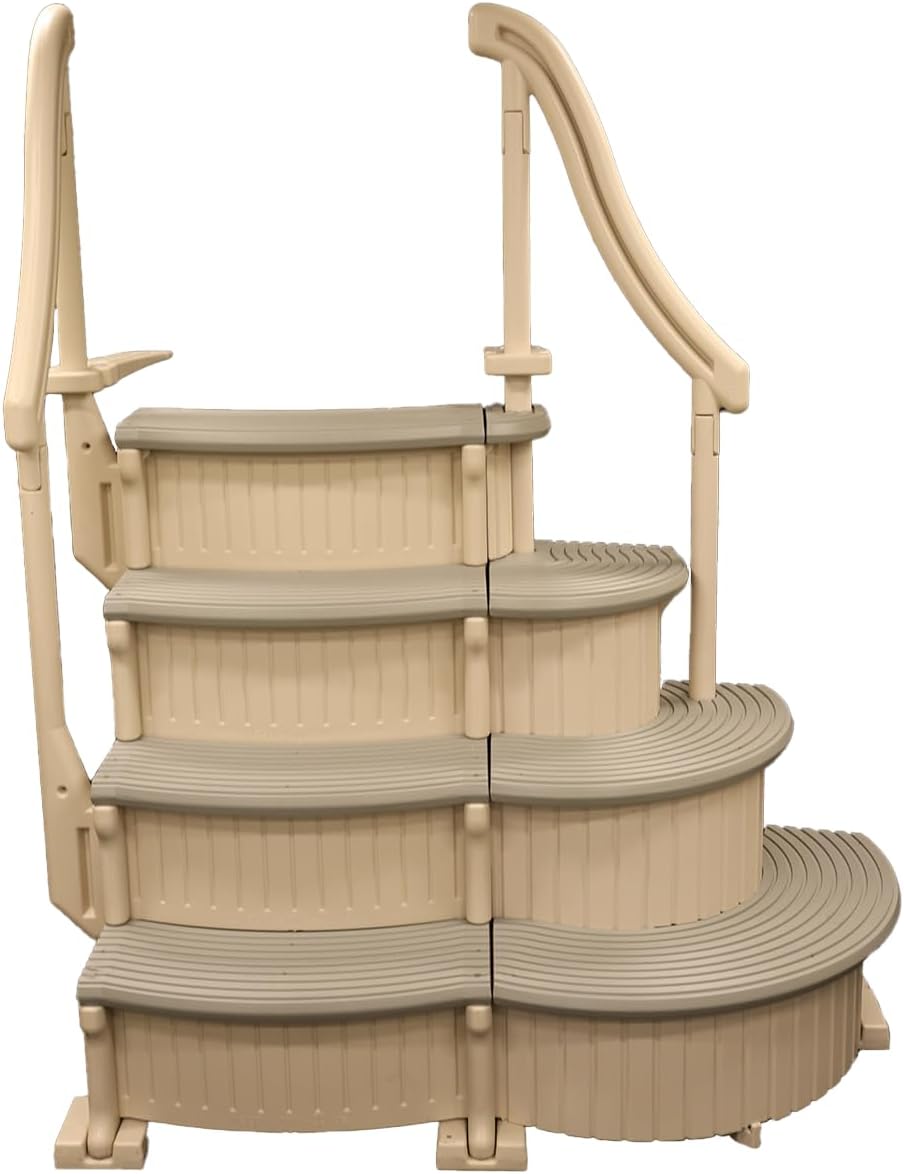
- 400 lb capacity with four 27 x 10-inch treads
- Complete add-on system is about 58 inches wide
- Fits 48-54 inch pools; full system requires 70 lb sand ballast

- 350 lb capacity with large high-visibility white steps
- 45 inches high, 31 inches wide, 35.5 inches deep without handrails
- Fits 48-54 inch wall heights; mounting brackets included
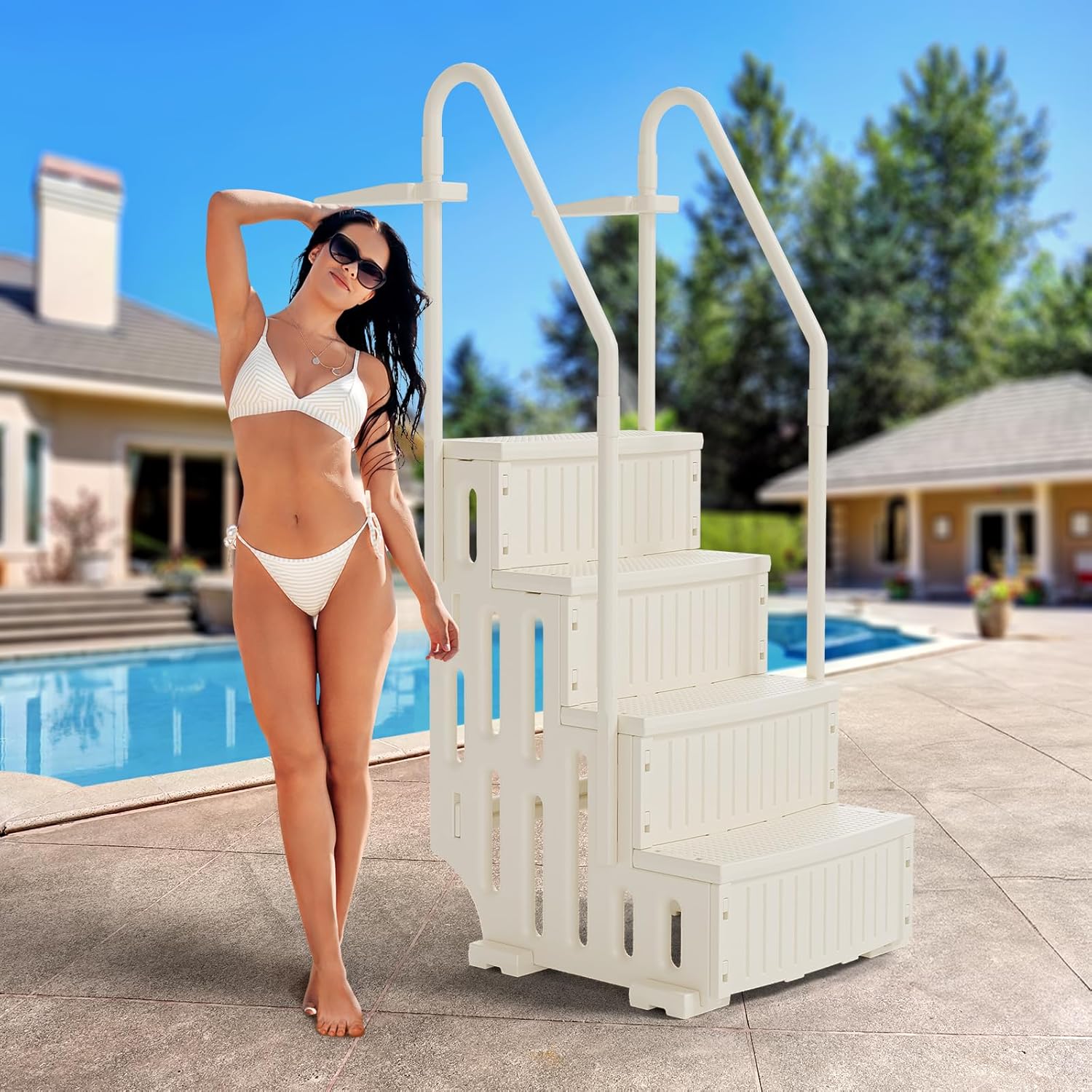
- Four steps, each about 27.6 inches wide and 8.9 inches deep
- 400 lb listed capacity with anti-slip tread strips
- For pools under 57 inches; requires sand to prevent floating

- 32-inch overall width with 28-inch by 8.5-inch treads
- 300 lb capacity and dual handrails
- Adjusts to 46-60 inch deck heights and projects about 22 inches into pool
What to Look for When Buying Drop In Pool Steps for Above Ground Pools
Pool Wall Height and Deck Height
Start with the vertical measurement from the pool floor to the deck surface where the step will be attached. Two pools with the same nominal wall height can have different finished deck heights, especially when the deck boards sit above the top rail. A step that is comfortable inside the water can become awkward if its handrails or mounting arms do not reach the actual deck.
Confer’s Step-1X is listed for decks up to 60 inches and has a top tread about 47 inches above the pool floor. The Curve system is intended for typical 48- to 54-inch above ground pools. Doheny’s lists compatibility with 48- to 54-inch wall heights. VINGLI states pool compatibility under about 57 inches. Vinyl Works gives the widest adjustment range here, with the current IN-32 configuration intended for deck heights around 46 to 60 inches.
Flat Bottom vs. Dished Bottom
The pool floor is not always level from wall to center. Some above ground pools have a deliberately dished center, while others have a flat base. Large plastic stairs need their feet or base to sit predictably because a rocking stair can load the liner unevenly and place extra stress on deck brackets.
Confer’s Step-1X manual specifically calls for a flat-bottom above ground pool. The Curve uses adjustable base pads that can compensate for a slight dish, but that should not be interpreted as permission to place it on a steep slope. Doheny’s conventional drop-in step is also best matched to a stable flat-bottom installation. Before purchasing, inspect the actual floor where the base will sit rather than judging the pool only by its wall height.
Tread Width and Tread Depth
A wide tread gives the foot more room to land and makes the entry feel more like stairs than a ladder. Confer’s Step-1X uses 27-inch-wide treads with roughly 10 inches of depth. The Curve uses the same 27-inch width and 10-inch tread depth in a more sweeping layout. VINGLI lists steps around 27.6 inches wide and 8.9 inches deep. Vinyl Works specifies 28 x 8.5-inch treads.
Depth matters alongside width. A shallow tread can still feel ladder-like even if it is wide. A deeper tread gives more fore-aft foot room but also pushes the entire stair farther into the swimming area. Buyers with smaller round pools should therefore evaluate the complete projection into the water, not only the tread dimensions.
How Much Pool Space the Steps Consume
In-pool stairs permanently occupy floor area while installed. The Step-1X projects about 32 inches into the pool. Doheny’s is about 35.5 inches deep without the handrail. The Confer Curve base is about 32 inches deep, but the wedding-cake add-on expands the system dramatically sideways to about 58 inches overall.
Vinyl Works is the clear space-saving design in this group: the manufacturer says the IN-32 occupies only about 22 inches of the pool. That can be important in a smaller round pool where a large staircase takes away useful swimming or play space. The tradeoff is a narrower overall footprint and a 300-pound capacity rather than the 400-pound ratings of the Confer and VINGLI options.
Ballast and Buoyancy
Large resin steps contain air and can float unless they are properly flooded and weighted. Ballast is therefore a functional installation requirement, not an optional accessory. Confer’s current Step-1X instructions call for 40 pounds of sand. The full Curve system with the add-on calls for a total of 70 pounds of sand, divided between the base and add-on sections.
VINGLI also requires the owner to provide sand and a funnel so the stair remains submerged. Follow the exact instructions for the selected version rather than adding random weights on top of a step. Improvised blocks, loose sandbags, or containers can shift, trap debris, rub the liner, or change how the stair is designed to carry load.
Deck Attachment
A drop-in stair should not be treated as free-standing furniture. Confer supplies mounting brackets with the Step-1X and deck connectors with the Curve system. Doheny’s includes mounting brackets for securing the stair to the pool or deck. Vinyl Works supplies mounting flanges and hardware, while VINGLI’s installation should also be secured according to the supplied instructions.
Deck attachment controls lateral and vertical movement at the top of the stair. The deck itself must be strong enough to accept the brackets. Thin trim boards, loose composite boards, rotted lumber, or unsupported decking should be repaired before the stair is installed.
Liner Protection
The base of a stair can rub the liner as swimmers use it or as the pool moves slightly. A compatible step pad is a simple way to create a sacrificial layer between the stair and liner, especially with older liners. Vinyl Works uses a smoothly rounded base and states that a step pad can be added for extra protection.
A pad is not a fix for a badly positioned stair or a rough damaged base. Inspect all contact points, remove molding flash or debris only as allowed by the manufacturer, and keep grit from collecting under the feet. Small grains trapped between a heavy stair and the liner can become abrasive over time.
Water Circulation Around the Stair
Large stairs can create dead zones where circulation is weaker. Debris and algae can collect behind side panels, under treads, and around the wall-facing side of the unit. Manufacturers address this with open risers, vents, and flow-through side structures, but the area still needs attention during cleaning.
The Confer Curve manual specifically recommends flushing behind the step system, and Vinyl Works designs openings through the side frames and risers to allow circulation. Whichever model you choose, include the stair area in routine brushing and vacuuming rather than assuming filtration will clean behind it automatically.
Weight Capacity
The Step-1X, Confer Curve, and VINGLI are each rated or listed for 400 pounds. Doheny’s lists 350 pounds. Vinyl Works lists 300 pounds for one person. These numbers should be treated as maximum user limits, not as targets or a measure of which stair is “safer.”
Real-world stability also depends on assembly, deck mounting, ballast, pool-floor support, and the way the handrails are used. Many manufacturer instructions specify one person on the stair at a time. If a user needs substantial body-weight support from the handrails, focus on secure installation and rail rigidity as much as the headline capacity.
Confer Plastics Step-1X Above Ground Pool Entry System
The Step-1X is a traditional full-width in-pool stair intended to replace the feel of climbing a narrow ladder with four large, flat treads and two handrails. It is made in the United States and carries a 400-pound maximum user weight in the current instructions and Amazon listing. The warm-grey body with grey treads is the exact color combination tied to this ASIN.
Dimensions and Footprint
The useful dimensions are more detailed than the simplified size line in Amazon’s product table. The assembled stair is about 31 inches wide and projects roughly 32 inches into the pool. The top step is about 47 inches above the pool floor, and each step offers about 27 inches of width with roughly 10 inches of tread depth.
That makes the Step-1X a medium-footprint stair rather than a compact ladder. A 32-inch projection is substantial enough that owners of smaller round pools should mark the footprint on the pool floor before ordering. In a larger pool, the same projection is often a reasonable trade for the more stair-like climbing angle.
Four Wide Treads
The broad treads are the main reason to choose this style. A swimmer can place more of the foot on a 27-inch-wide step than on a narrow ladder rung, and the riser arrangement creates a familiar staircase motion. The grey tread color also contrasts with the warm-grey body, helping the step edges remain visually distinct underwater.
The product uses four steps and a riser height of roughly 11 inches. That is still a noticeable rise, so anyone with limited knee or hip mobility should compare it with stairs they already find comfortable. A pool stair can be easier than a ladder without necessarily being suitable for every mobility limitation.
Flat-Bottom Requirement
The Step-1X manual specifies installation on flat-bottom above ground pools. This is an important limitation because the broad base expects a stable, level contact area. If the pool has a pronounced dish or slope exactly where the stair would sit, the Confer Curve’s adjustable base pads may be more appropriate.
Do not shim a pool stair with loose objects underwater. Any leveling method needs to be approved for the product and safe for the liner. A stair that rocks under load can transfer force unpredictably into the deck brackets and pool floor.
Ballast and Water Filling
Current Step-1X instructions call for 40 pounds of sand. The ballast is part of the assembly and helps counter the buoyancy of the hollow plastic structure. After placing the unit in the pool, the stair also needs to be tilted as instructed so trapped air can escape and the internal spaces fill with water.
This distinction is important: trapped air and insufficient ballast are different problems. A stair can have sand in it and still feel buoyant if large air pockets remain. Follow the flooding sequence in the manual rather than immediately adding unauthorized external weight.
Deck Mounting
Two mounting brackets are supplied. The assembled stair is positioned between the pool uprights and the brackets are secured to the deck. Confer’s instructions call for pilot holes and specifically warn against using a corded electric drill around the pool.
The deck must extend far enough for the brackets to land on a secure surface. If it does not, the deck should be modified appropriately rather than leaving the stair partially supported. This is a common reason to measure the deck before buying instead of focusing only on pool wall height.
Practical Strengths
The Step-1X combines a 400-pound capacity with relatively large treads while keeping the overall width close to 31 inches. That is a useful middle ground: broader and easier to climb than a conventional ladder, but far less wide than the 58-inch complete Curve system.
It also has a straightforward parts layout. The design uses molded plastic side panels, bases, risers, steps, posts, and handrails rather than a metal frame that sits constantly in chemically treated water. The absence of a large metal structure reduces rust concerns, although fasteners and deck hardware still need normal inspection.
Important Limitations
The flat-bottom requirement is the largest fit limitation. The 32-inch projection also uses more swimming space than the Vinyl Works IN-32. Finally, 40 pounds of sand must be supplied, and the unit should be removed or winterized according to the manufacturer’s instructions rather than simply left attached year-round in freezing climates.
Who Should Consider It
The Step-1X suits a deck-equipped above ground pool with a flat bottom and enough interior room for a 32-inch projection. It is especially relevant when users prefer a staircase motion and want a 400-pound rating without moving to a very wide wedding-cake design.
Who Should Consider Another Option
Choose another design if the pool floor is noticeably dished, if interior space is tight, or if the deck height and mounting geometry fall outside the allowed range. The Curve is more adaptable to a slight dish, while Vinyl Works is substantially shallower in pool-floor projection.
Pros
- 400-pound maximum user weight
- Four broad 27-inch treads create a more stair-like entry than a ladder
- Includes dual handrails and deck mounting brackets
- 31-inch width is much narrower than a full wedding-cake Curve system
Cons
- Specified for flat-bottom above ground pools
- Projects about 32 inches into the swimming area
- Requires 40 pounds of sand ballast supplied by the owner
Confer Plastics Curve CCX-AG Drop-In Pool Step with Add-On
This Amazon ASIN is the larger Curve configuration: the warm-grey and grey-tread base step with the wedding-cake add-on. That distinction is essential because Confer also sells a narrower base-only Curve under a different ASIN. With the add-on fitted, the overall system expands to about 58 inches across, creating the broadest entry in this comparison.
Wedding-Cake Layout
The Curve begins with four 27-inch-wide treads and adds a side section that enlarges the usable step surface. The result is a sweeping staircase rather than a straight rectangular stack. This can make the entry feel less ladder-like and can provide more standing area near the upper steps.
The treads can be assembled to curve inward or outward. Confer instructs the owner to choose the direction during assembly because the parts lock together in that configuration. This gives the system some visual and spatial flexibility, but it does not reduce the overall width once the add-on is installed.
Dimensions
The base unit is roughly 38 inches wide and 32 inches deep, with the top tread about 47 inches above the pool floor. Each tread is about 27 inches wide, 10 inches deep, and separated by roughly an 11-inch rise. Adding the wedding-cake section takes the complete width to about 58 inches.
That width is the biggest practical tradeoff. In a large round or oval pool, the entry can look proportionate and provide generous foot room. In a smaller pool, 58 inches along the wall can consume a noticeable section of usable swimming space.
Adjustable Base Pads
Unlike the Step-1X’s explicit flat-bottom requirement, the Curve includes adjustable base pads intended to compensate for a slightly dished pool floor. This is useful in above ground pools that are not perfectly flat at the wall, but the adjustment range is not intended for a steep or irregular slope.
The feet should all make stable contact without forcing the stair against the liner. If a floor shape is outside the product’s intended geometry, correct the installation plan rather than relying on the deck brackets to hold a rocking base in place.
Ballast Requirement
Confer’s assembly documentation calls for 40 pounds of sand in the base Curve step and an additional 30 pounds for the add-on, for 70 pounds total in the complete system. That figure is more relevant to this exact add-on ASIN than ballast information for the base-only configuration.
Dry, washed sand should be added in the locations described by the instructions before final placement. Once the stair is submerged, trapped air also needs to be displaced. The combination of ballast, water filling, and deck attachment is what keeps a large molded system stable.
Deck Connection
The Curve includes deck connectors and stainless hardware for securing the stair at the deck. The mounting brackets are long enough to reach across many pool top rails, but the exact deck arrangement still needs to be checked. A broad stair should never be allowed to lean on the pool wall as its primary support.
The larger footprint also means installation is easier to plan near the final position. Confer recommends assembling close to the pool, and a second person is useful because a complete system becomes awkward to lift once assembled and ballasted.
Cleaning Around a Large Step
The curved side panels are vented for circulation, but a 58-inch-wide stair creates a large sheltered area behind it. Debris can settle there and algae can develop if brushing and water movement are poor. Confer’s maintenance guidance calls for flushing behind the system with water during routine care.
A wedding-cake stair therefore needs more cleaning access than a slim ladder. Before installation, make sure you can reach behind or around it with a brush, hose, or vacuum tool.
Important Limitations
The system requires the most pool space and the most ballast of the five products here. It is also more parts-intensive to assemble than a narrow straight stair. Once the tread curve is chosen and the components are snapped together, changing the orientation is not something to treat casually.
Who Should Consider It
The full Curve is best for buyers who prioritize broad, stair-like entry and have enough wall length and pool-floor area to accommodate it. It also makes sense where the floor has a slight dish that can be handled by the adjustable pads.
Who Should Consider Another Option
A small round pool is the strongest reason to look elsewhere. Vinyl Works occupies only about 22 inches of floor depth, while Step-1X provides four wide treads in a much narrower overall package. Buyers who simply need a practical deck entry may not benefit from the extra width of the wedding-cake add-on.
Pros
- Broad wedding-cake add-on creates the largest standing and entry area here
- 400-pound rated capacity
- Four 27 x 10-inch treads with dual sloping handrails
- Adjustable base pads can compensate for a slightly dished pool floor
Cons
- Complete system is about 58 inches wide and occupies substantial pool space
- Requires 70 pounds of total sand ballast for the base plus add-on
- More assembly and cleaning area than a compact straight stair
Doheny’s Pool Step for Above Ground Swimming Pools
Doheny’s step sits between the Confer Step-1X and a compact ladder in overall scale. The exact Amazon listing describes a 45-inch-high, 31-inch-wide, 35.5-inch-deep stair body without the handrail, a 350-pound maximum user weight, large embossed white steps, and two all-plastic handrails. It is intended for above ground pools with 48- to 54-inch wall heights.
Size and Pool Fit
At 31 inches wide, the unit occupies about the same width class as the Step-1X. Its 35.5-inch depth is a little greater, so floor projection deserves attention in smaller pools. The 45-inch stair-body height is intended to work with common 48- to 54-inch wall heights once the handrail and deck mounting are taken into account.
Because the current listing does not advertise a broad deck-height adjustment range like Vinyl Works, buyers should measure the actual deck and mounting point carefully. A nominal 52-inch pool wall does not guarantee that every deck surface is at the same elevation.
High-Visibility White Steps
The white embossed treads are one of the clearest differentiators. Light-colored steps are easy to see through clear water, especially compared with a stair that blends closely with the liner. The embossing also creates texture underfoot rather than relying on a smooth molded surface.
Visibility is useful, but it should not be confused with a guarantee against slipping. Pool steps remain wet surfaces. Users should face the stair appropriately, use the handrails, and avoid jumping or diving from the entry system.
Dual Handrails
Two plastic handrails frame the climbing path. This gives the user a handhold on either side and makes the product function more like a small staircase than an in-pool ladder. The rails are molded plastic rather than a reinforced metal assembly, so they should be used for guidance and steadying in the way the manufacturer intends rather than as a place to apply large sideways loads.
The 350-pound capacity applies to the step system as a whole. Proper deck attachment remains critical because a user pulling on the rails creates leverage at the top of the stair.
Mounting Brackets
Doheny’s includes mounting brackets for securing the unit to the pool or deck. This is a major installation requirement, not a convenience feature. The stair should not be left to float or shift independently at the wall.
Before drilling, confirm that the attachment point is structural and that the stair sits squarely on the pool floor. If the deck boards flex under normal walking loads, reinforce them before relying on them to locate a pool entry system.
All-Plastic Construction
The body and handrails use plastic rather than exposed metal rails. That avoids the corrosion concerns associated with leaving a large metal staircase submerged in chlorinated water. It also keeps the molded surfaces relatively easy to rinse and clean.
Plastic still ages from UV exposure, chemicals, temperature cycling, and mechanical stress. Inspect the handrail sockets, tread connections, bracket areas, and any fastener locations at the start of each season.
Cleaning and Water Flow
The stair design includes openings intended to allow water to move around the structure. Even so, a 35.5-inch-deep body creates shaded spaces along the pool wall and floor. Brush and vacuum around the stair rather than waiting for visible algae to appear.
White treads can make surface dirt easier to notice, which is useful as a maintenance cue. Clean with methods compatible with the molded plastic instead of using abrasive tools that could roughen the surface.
Important Limitations
The 350-pound capacity is lower than the 400-pound ratings of the two Confer models and VINGLI. The 35.5-inch depth also consumes more floor space than Vinyl Works. The listing is designed around 48- to 54-inch pool walls, so unusual deck elevations need more scrutiny.
Who Should Consider It
This is a practical option for a standard 48- to 54-inch above ground pool with a deck, especially where high-visibility white treads and dual handrails are priorities. Its 31-inch width keeps it far more compact than the complete Curve system.
Who Should Consider Another Option
Buyers needing a 400-pound rating, a pronounced dish adjustment, or minimal floor projection have stronger alternatives in this group. Step-1X raises capacity to 400 pounds, the Curve adds adjustable pads, and Vinyl Works uses only about 22 inches of pool depth.
Pros
- Large high-visibility embossed white steps
- Dual all-plastic handrails
- 31-inch width keeps the stair relatively compact
- Mounting brackets are included for deck or pool attachment
Cons
- 350-pound capacity is lower than the 400-pound models in this comparison
- 35.5-inch body depth uses more floor space than the Vinyl Works IN-32
- Specified around 48-54 inch pool walls rather than a broad deck-height range
VINGLI 4-Step Pool Ladder for Above Ground Pools – Full Beige
The VINGLI is really a molded four-step stair system rather than a narrow ladder despite the product name. The selected ASIN is the full-beige four-step configuration. It lists a 400-pound capacity, anti-slip tread strips, broad 27.6-inch steps, and compatibility with pools under about 57 inches in height.
Four-Step Geometry
Each step is listed at roughly 27.6 inches wide, 8.9 inches deep, and about 11 inches high. That puts the tread width in the same class as the Confer products while using slightly less tread depth. The result is a staircase motion with a fairly compact fore-aft step surface.
The overall assembly is about 78 inches high, 27.6 inches wide, and roughly 33 to 34 inches deep depending on the measurement reference. At around 49 pounds before ballast, it is substantial enough to require planning when lowering it into the pool but still light enough to be buoyant without sand.
Pool Height Compatibility
VINGLI states that the four-step design is for pools under about 57 inches. This makes it relevant to common above ground pool heights, but buyers with a deck sitting well above the top rail should measure the complete deck relationship rather than relying on wall height alone.
The product is also marketed for shallow areas of some inground pools, but the keyword and comparison here are focused on above ground use. The exact floor, mounting method, and entry geometry need to suit the intended installation.
Sand Ballast
The manufacturer instructs users to provide a funnel and sand, then pour the sand into the designated openings so the unit does not float. The listing does not consistently publish one exact sand weight for every color and configuration, so the correct amount should be taken from the instructions supplied with this exact four-step version.
Do not substitute loose weights placed on the treads unless the manufacturer specifically approves them. A weight sitting on a tread can shift during swimming and does not necessarily stabilize the stair in the same way as ballast located inside the structure.
Anti-Slip Tread Strips
The tread design uses anti-slip strips rather than depending solely on molded texture. That provides a visually defined stepping area and additional surface grip. The strips should be inspected periodically because any applied or inserted traction component can wear, lift, or collect residue over time.
Keep sunscreen oils, algae, and biofilm off the steps. Even a textured tread becomes slippery if the surface is allowed to accumulate organic material.
Handrails and Material
The stair uses molded plastic construction with handrails rising above the entry path. Plastic is useful in a pool because it avoids an exposed steel frame, but the rails should still be checked for movement where they attach to the stair body.
A 400-pound listed capacity does not mean the rails themselves are designed to take 400 pounds of sideways force. Step on the center of the treads and use the rails for steadying rather than hanging from them.
Assembly
The product uses large molded components that need to be aligned and seated correctly. A rubber mallet is commonly useful with snap-fit pool stairs, but assembly should follow the current instructions rather than forcing pieces that do not line up. Build the unit near the pool because moving a fully assembled stair is more awkward than moving the separate panels.
After assembly and ballasting, make sure trapped air is released as the stair is submerged. Confirm that the feet rest evenly before completing the deck attachment.
Important Limitations
VINGLI does not offer the same compact 22-inch pool projection as Vinyl Works, and its stated pool-height limit is lower than the 60-inch deck-height capability of the IN-32. The need for owner-supplied sand is another installation step.
Who Should Consider It
The VINGLI fits buyers who want a four-step, 400-pound-rated resin stair with broad treads and a full-beige appearance. It is especially relevant when the pool is under about 57 inches and a 27.6-inch tread width is a comfortable fit.
Who Should Consider Another Option
Choose Vinyl Works if preserving swimming space is the priority, or the Confer Curve if a broad wedding-cake entry is desired. Owners who want a long-established flat-bottom design with clearly documented 40-pound ballast may prefer the Step-1X.
Pros
- 400-pound listed capacity
- Four broad 27.6-inch steps with anti-slip strips
- All-plastic stair body avoids a large submerged metal frame
- Full-beige color offers a different look from white or grey pool steps
Cons
- Requires owner-supplied sand and funnel for ballast
- Pool-height guidance is under about 57 inches
- Uses more pool depth than the compact Vinyl Works IN-32
Vinyl Works Deluxe IN-32 In-Pool Step Ladder with Handrails
The Vinyl Works IN-32 is the space-conscious model in this group. It is 32 inches wide overall, provides about 28.5 inches of clearance between the handrails, and projects only around 22 inches into the pool. The exact Amazon variant is white and is rated for one person up to 300 pounds.
Compact 22-Inch Projection
The 22-inch in-pool projection is the specification that most clearly separates this model from the others. Confer Step-1X projects about 32 inches, Doheny’s about 35.5 inches, and the broad Curve system occupies a much larger overall area. Saving ten or more inches of floor depth can be meaningful in a small round pool.
A compact footprint also makes it easier to keep a circulation path around the step. It does not eliminate the need to brush behind the unit, but there is less sheltered floor area than under a broad wedding-cake stair.
Tread Size
Vinyl Works specifies 8.5 x 28-inch treads. The width is slightly greater than the 27-inch Confer treads, while the depth is shallower. That helps explain how the system keeps its projection to 22 inches while still providing a broad place for the foot.
The shallower tread can feel less like a household staircase than the 10-inch-deep Confer steps. Buyers with large feet or limited balance should compare those dimensions rather than assuming every “full step” entry feels identical.
Deck Height Adjustment
The current manufacturer product page lists adjustment for roughly 46- to 60-inch deck heights. That is the broadest published range in this comparison and makes the IN-32 useful where the deck surface sits above a typical 48- or 52-inch pool wall.
The mounting system uses deck flanges and hardware, and the step should be adjusted so the handrails and top transition meet the deck correctly. The height range is useful only if the deck provides a solid mounting surface in the right location.
Dual Handrails
The two handrails provide about 28.5 inches of clear space between them, with an overall outside width of about 32 inches. That gives a defined climbing channel and lets a swimmer use either or both rails for balance.
As with the other products, the 300-pound capacity describes the intended user load for the assembled system. The rails and flanges should be inspected for looseness, especially after seasonal installation or removal.
Resin Construction and Stainless Hardware
Vinyl Works manufactures the step from maintenance-friendly resin and uses stainless hardware. That combination keeps the large structural surfaces free from rust while retaining metal fasteners where needed. The white finish also makes the treads and frame easy to see in clear water.
Stainless hardware can still accumulate deposits or show corrosion in aggressive conditions. Rinse and inspect fasteners during seasonal maintenance rather than assuming stainless components never require attention.
Liner Contact and Water Flow
The base is smoothly rounded to reduce the chance of damaging the liner, and the manufacturer notes that a separate ladder or stair pad can be used for additional protection. This is valuable for older liners or installations where the step may be removed and reinstalled each season.
Openings through the side frames and tread risers allow water circulation and are intended to reduce entrapment concerns. These openings should remain free of debris. Cleaning behind the step is still necessary because circulation alone cannot remove every deposit.
Important Limitations
The 300-pound capacity is the lowest in this comparison. The 8.5-inch tread depth is also shallower than Confer’s 10-inch treads. Buyers who want the broadest possible stair surface or a 400-pound rating should look at the Confer models or VINGLI.
Who Should Consider It
The IN-32 is especially useful for a smaller above ground pool where conserving interior space matters. Its 22-inch projection and 46- to 60-inch deck-height adjustment are practical advantages when a larger drop-in stair would dominate the pool.
Who Should Consider Another Option
Choose another model if the user needs more than a 300-pound capacity or strongly prefers deeper treads. The Step-1X offers a higher limit and 10-inch tread depth, while the Curve offers the most generous overall entry area.
Pros
- Projects only about 22 inches into the pool
- 32-inch overall width with broad 28-inch treads
- Adjustable for roughly 46-60 inch deck heights
- Dual handrails, resin construction, stainless hardware, and mounting flanges
Cons
- 300-pound capacity is the lowest rating in this group
- 8.5-inch tread depth is shallower than the Confer steps
- Compact design provides less standing area than the large Curve system
Detailed Buying Guide
Measure the Deck Surface, Not Just the Pool Wall
Above ground pool packaging often describes a pool as 48, 52, or 54 inches tall, but the deck can sit several inches above or below the top of the pool wall. Entry systems attach to the deck, so the measurement that controls fit is the vertical distance from the pool floor at the step location to the finished deck surface.
Take the measurement with the pool in its normal operating condition. If the floor settles or the liner base is dished, measure where the stair will actually stand. Compare that figure with the manufacturer’s adjustment range and top-tread height.
Check the Top-Rail and Deck Overhang
A deck may meet the pool wall flush, overlap the top rail, or sit several inches away. Long mounting brackets can bridge some gaps, but every system has limits. Confer’s Curve includes oversized deck connectors, and Step-1X uses adjustable mounting brackets. Vinyl Works uses flanges that need a suitable deck surface.
Measure horizontal distance as well as vertical height. A rail or top seat that sticks out toward the deck can interfere with the handrail posts or brackets. Never cut or alter the pool top rail simply to make a step fit unless the pool manufacturer specifically permits it.
Flat Floors Give Steps a Better Foundation
A full stair spreads user load through a large base. That is advantageous only when the base is supported evenly. On a flat floor, the side panels and feet can bear against the liner in the way the design intended. On a steep dish, one edge may carry most of the load.
If the pool has a shallow dish, choose a model with documented adjustment such as the Curve and keep the stair near the wall where the floor geometry is within the allowed range. If the floor shape is uncertain, inspect it before ordering rather than assuming every above ground stair is universal.
Why Sand Ballast Is Common
Molded plastic stairs displace a large volume of water and contain hollow cavities. Their dry weight can be far less than the buoyant force created once submerged. Sand adds dense weight inside the intended compartments without taking up extra deck or tread space.
Use the sand type and quantity specified by the manufacturer. Wet sand can be difficult to funnel and may not settle into the compartments correctly during assembly. Do not fill cavities with concrete, rocks, metal, or chemicals unless the manufacturer explicitly approves the material.
Internal Ballast vs. External Weights
Internal ballast is preferable when the product was designed for it because the weight remains contained and located where the manufacturer expected. External weights can slide, rub the liner, block circulation, or create a tripping obstacle on the steps.
Confer specifically instructs owners of the Step-1X not to combine the specified ballast approach with improvised external weighting. Treat the assembly manual as part of the structural design rather than as optional setup advice.
Why Deck Brackets Still Matter After Ballasting
Sand keeps the lower portion of the stair down. It does not stop the entire assembly from pulling away from the deck when someone climbs, pushes sideways, or grips the handrails. The top brackets control that movement and keep the entry aligned with the deck.
Fasten into structural deck material, not a loose fascia board. If the deck uses composite planks, check the framing below and use an attachment method compatible with the board manufacturer and stair instructions.
Tread Rise and Mobility
Tread rise determines how high the knee must lift with each step. Confer’s systems use roughly an 11-inch rise, and VINGLI lists a similar step-to-step height. That is larger than many household stair risers, so buyers seeking easier access for an older adult should compare the number directly with familiar stairs.
A wider tread helps balance, but it does not reduce the vertical rise. If mobility is significantly limited, a pool lift or another access system may be more appropriate than any standard residential drop-in stair.
Handrails: Guidance vs. Full Body Support
Dual handrails are valuable because they provide hand contact on both sides. They also help a swimmer orient toward the stair while exiting the water. However, many residential pool-step rails are molded plastic components rather than building-style structural guardrails.
Use them in the manner described by the manufacturer. Avoid sitting, climbing, pulling sideways, or allowing children to play on the rails. If a user must transfer substantial body weight through the handrails, professional assessment of the entry may be appropriate.
Pool-Space Tradeoffs
Large stairs improve foot room but reduce the pool’s usable interior. The Curve with add-on is the clearest example: the 58-inch system creates a generous entry but occupies a wide section of the pool perimeter. The Vinyl Works IN-32 deliberately goes the other direction, using only about 22 inches of pool depth.
Mark the footprint before buying. In a round pool, use tape or a cardboard template on the deck to visualize the width, then estimate how far the unit projects toward the center. The impact on swimming space is easier to understand physically than from a product photograph.
Water Circulation and Algae
Any large object placed against a pool wall changes water circulation. Step cavities can become low-flow areas where fine debris settles. Open risers and side vents help, but they do not create the same circulation as open water.
Brush behind the stair, flush openings, and vacuum around the base. If algae repeatedly appears in the same hidden area, improve cleaning frequency and review overall water circulation rather than assuming the stair material is causing the growth.
Step Pads
A liner-saving step pad can add a protective layer under the stair. This is especially useful if the liner is older, if the base is removed and replaced each season, or if the stair has a relatively small number of contact points.
Choose a pad intended for submerged pool use and large enough for the complete base. A pad that bunches or slides can create new pressure points. Clean the pool floor before placing it so grit is not trapped underneath.
Seasonal Removal and Winterization
Many above ground pool owners remove stairs for winter. A ballasted stair is heavy and awkward, so plan removal while the water is warm enough for a person to assist from inside the pool if the manufacturer instructs that method. Never attempt to lift a large water-filled or sand-filled unit alone.
Drain the stair as directed before storage. Store molded components away from impact and avoid stacking heavy objects on handrails or treads. If fasteners are removed each season, keep them labeled with the correct brackets.
Pools Without a Deck
Most products in this guide assume a deck or other approved mounting surface at the pool edge. An in-pool stair does not automatically provide a complete outside entry from the ground. Some manufacturers sell matching outside ladders, enclosure kits, or complete A-frame systems.
If the pool has no deck, plan both sides of the entry. A safe inside stair paired with no secure outside access is not a complete solution. Check local barrier and access-control requirements as well.
Child Access and Gates
A comfortable staircase can make pool access easier for everyone, including children. When the pool is not supervised, the entry system has to be incorporated into the pool’s required access barrier. Some step families have gate or enclosure accessories specifically for this purpose.
Do not rely on removing a handrail or placing an object in front of the steps as a child-safety measure. Follow local pool-barrier rules and use a self-closing, self-latching gate or approved access system where required.
One Person at a Time
Pool-step weight ratings commonly assume one person using the stair. Confer’s Step-1X instructions explicitly state one person on the ladder or stair at a time. This matters even when two smaller users together weigh less than the published limit because dynamic loads and side-to-side movement can be different.
Teach household members not to crowd the entry, jump from the steps, or use the handrails as play equipment. The stair is an access device, not a platform.
Assembly Near the Pool
Large stairs are easiest to handle as separate components. Assemble them close to the final location, particularly if the deck opening is narrow. The Curve with add-on becomes too wide to move casually once fully assembled.
Use a cordless drill around the pool when drilling is required, as Confer specifically warns against corded tools near water. Keep screws and small parts contained so they do not drop into the pool or damage the liner.
Inspecting the Installation
After the stair is installed, stand on the deck and try to move the unit gently by hand before anyone uses it. There should not be excessive rocking, lifting, or movement at the brackets. Check that the base is fully seated and the treads are locked into their intended positions.
Repeat the inspection periodically. Deck boards can loosen, fasteners can back out, and a stair can shift after heavy use or severe weather. Seasonal checks are especially important after reinstallation.
Weight Capacity Is Not the Whole Story
A 400-pound rating is useful when the expected user load demands it, but a higher number does not make a stair universally better. The Curve and Step-1X both carry 400-pound ratings, yet one is 58 inches wide with an add-on and the other is about 31 inches wide. They solve different space and floor-fit problems.
The 300-pound Vinyl Works model may be a better installation in a small pool because it consumes far less interior depth. Choose the capacity required for the household, then optimize around fit and usability rather than buying the largest rating simply because it is larger.
Direct Product Comparisons
Confer Step-1X vs. Confer Curve with Add-On
Both Confer systems use broad molded treads, dual handrails, a 400-pound capacity, and deck attachment, but they are designed for different priorities. Step-1X is about 31 inches wide and 32 inches deep, while the complete Curve expands to about 58 inches wide.
The Curve gives more standing area and adjustable base pads for a slight dish. Step-1X is much easier to fit in a smaller pool and has a simple straight stair footprint. Ballast also differs: Step-1X calls for about 40 pounds of sand, while the full Curve base plus add-on calls for about 70 pounds.
Confer Step-1X vs. Doheny’s Pool Step
These are close in width: both are about 31 inches across. Step-1X has a 400-pound rating and projects about 32 inches into the pool. Doheny’s lists 350 pounds and a body depth of about 35.5 inches.
Step-1X therefore offers the higher capacity and slightly smaller depth, while Doheny’s emphasizes embossed white high-visibility treads. Both depend on deck mounting and work best where the pool-floor geometry matches the design.
Confer Curve with Add-On vs. Vinyl Works IN-32
These products sit at opposite ends of the space spectrum. The complete Curve is about 58 inches wide and creates a broad wedding-cake entry. Vinyl Works is 32 inches wide overall and projects only about 22 inches into the pool.
The Curve carries a 400-pound capacity and deeper 10-inch treads. Vinyl Works carries 300 pounds and uses 8.5-inch-deep treads. Buyers with a large pool who value standing area may prefer the Curve, while owners of a small pool have a strong reason to consider the IN-32.
VINGLI 4-Step vs. Confer Step-1X
Both list 400-pound capacity and use four broad steps. VINGLI’s treads are about 27.6 inches wide by 8.9 inches deep, while Step-1X uses roughly 27 x 10-inch treads. Step-1X documents a 40-pound sand requirement; VINGLI requires sand but the amount should be taken from the instructions for the exact four-step version.
VINGLI’s full-beige finish is visually different from Confer’s warm-grey body and grey treads. Step-1X also has a clearly documented flat-bottom-only requirement. VINGLI is specified for pools under about 57 inches, while Step-1X is listed for decks up to 60 inches.
Doheny’s Pool Step vs. Vinyl Works IN-32
Doheny’s provides a higher 350-pound capacity and a deeper stair body. Vinyl Works is rated to 300 pounds but saves substantial swimming space with its 22-inch projection. Both are around 31 to 32 inches wide and use dual handrails.
Vinyl Works is the more adjustable option for deck height, with a current range around 46 to 60 inches. Doheny’s is targeted at 48- to 54-inch pool walls. The better fit depends on the deck geometry and whether compact projection is more important than the additional 50 pounds of capacity.
VINGLI 4-Step vs. Vinyl Works IN-32
VINGLI has the higher published capacity at 400 pounds and deeper 8.9-inch treads. Vinyl Works has a 300-pound capacity and 8.5-inch tread depth but uses much less pool floor. Both offer broad tread width in the high-20-inch range.
VINGLI is a good fit where capacity and a four-step molded staircase matter more than footprint. Vinyl Works is the logical comparison when the pool is small or the deck sits high enough that the 46- to 60-inch adjustment range is useful.
Common Buying Mistakes
Buying by Pool Diameter Alone
Pool diameter tells you how much water area exists, but it does not tell you deck height, floor slope, or available wall length beside the entry. A 58-inch Curve system may fit physically inside a small round pool while still consuming too much useful space. Measure the intended installation zone.
Ignoring the Floor Shape
A stair built for a flat bottom should not be forced onto a steep dish. Step-1X specifically requires a flat-bottom pool. The Curve offers limited adjustment for a slight dish. Match the model to the actual floor rather than trying to correct a mismatch with improvised shims.
Forgetting Ballast
An unballasted plastic stair can float or shift. Step-1X requires 40 pounds of sand, the complete Curve requires 70 pounds, and VINGLI requires sand for the four-step stair. Include ballast and a funnel in the installation plan.
Using Loose External Weights
Placing concrete blocks, loose sandbags, or improvised containers on a tread can create abrasion, entrapment, or shifting hazards. Use the manufacturer’s internal ballast method and approved accessories.
Mounting to Weak Deck Boards
A bracket attached to a loose fascia or unsupported board does not provide reliable control of the stair. Locate framing, reinforce the deck where necessary, and use the installation hardware correctly.
Assuming a Drop-In Step Works Without a Deck
Several in-pool steps still need a deck connection. If there is no deck, a matching outside ladder, enclosure, or complete entry system may be required. Plan both the outside and inside access paths before ordering.
Not Protecting an Older Liner
Large stairs create continuous pressure on the pool floor. A compatible step pad can protect an older liner from rubbing and trapped grit. Inspect the base and clean the floor before installation.
Leaving Dead Zones Uncleaned
Large stairs block normal brushing and can reduce circulation behind them. Build stair-area cleaning into the weekly routine. A system with vents still needs brushing and vacuuming around the base.
Treating Handrails as Climbing Frames
Residential pool-step rails are intended to assist entry and exit. Sitting on them, pulling sharply sideways, or allowing children to climb them can loosen joints and brackets. Use the rail as designed.
Skipping Seasonal Inspection
A stair that was solid at the beginning of summer can loosen after repeated use. Check deck screws, flanges, ballast, treads, rails, and liner contact periodically and whenever the unit is reinstalled.
Frequently Asked Questions
What are drop in pool steps for above ground pools?
They are in-pool stair systems that sit on the pool floor and connect to a deck or approved mounting point at the top. Most use broad molded treads and handrails, making them more stair-like than a vertical ladder. Many require sand ballast to keep the structure submerged.
Do above ground pool steps need sand?
Many do. Confer’s current Step-1X instructions call for 40 pounds of sand, the complete Curve with add-on calls for 70 pounds total, and VINGLI requires owner-supplied sand for the four-step system. Always use the amount and method specified for the exact model.
Can I use concrete blocks to hold pool steps down?
Improvised external weights are not a good substitute for the manufacturer’s ballast method. Blocks and loose weights can move, rub the liner, interfere with circulation, or create a foot hazard. Use the designed ballast compartments or approved accessories.
Which steps take up the least room in the pool?
Among these five, the Vinyl Works IN-32 has the smallest verified projection at about 22 inches into the pool. Step-1X is about 32 inches deep, while Doheny’s is about 35.5 inches deep without the handrail. The Confer Curve with add-on also occupies substantial width at about 58 inches.
Which of these steps support 400 pounds?
The Confer Step-1X, Confer Curve, and VINGLI four-step listing each carry a 400-pound maximum or listed capacity. Doheny’s is 350 pounds, and Vinyl Works IN-32 is 300 pounds. Follow each model’s one-person and installation instructions.
Can Step-1X be used on a dished pool bottom?
The current Confer Step-1X manual specifies a flat-bottom above ground pool. If the floor is slightly dished, the Confer Curve is more relevant because it includes adjustable base pads intended to compensate for a modest dish.
How wide is the Confer Curve with the add-on?
The base Curve is about 38 inches wide, while the complete system with the wedding-cake add-on is about 58 inches wide. The selected Amazon ASIN in this guide is the add-on configuration.
Do these pool steps attach to the deck?
Yes, the main drop-in stair systems here are designed to be secured at the deck or pool edge with brackets or flanges. Ballast keeps the bottom submerged; deck attachment controls movement at the top.
Can I use these steps without a deck?
An in-pool step alone usually does not provide a complete outside entry. Confer and other manufacturers offer matching outside ladders or enclosure systems for some models. If there is no deck, choose a complete entry solution intended for that installation.
Should I put a pad under above ground pool steps?
A compatible pool-step pad can add liner protection, particularly with an older liner or a heavy stair that is removed seasonally. Vinyl Works specifically notes that a ladder or stair pad can be used for additional protection.
How often should I clean behind pool steps?
Inspect and clean the area during routine pool maintenance rather than waiting for visible growth. Large stairs can create sheltered low-flow zones. Brush behind the sides, flush openings, and vacuum debris around the base.
Can drop-in pool steps stay in during winter?
Follow the manufacturer’s winterization instructions. Many owners remove large in-pool steps before freezing weather. Plan for the weight of sand and trapped water, and use more than one person where the instructions call for assistance.
Are wide pool steps easier than a ladder for older swimmers?
Wide treads and dual handrails can make the movement more like climbing stairs than a vertical ladder, which some users may find easier. Tread rise is still significant, however, and a standard residential stair does not replace a lift or accessibility system for someone with substantial mobility limitations.
How do I know if my deck is strong enough?
The bracket should attach to sound structural decking and framing, not a loose trim board. If the deck is old, flexible, or made with an unfamiliar system, have the attachment point evaluated before drilling.
What is the difference between pool wall height and deck height?
Pool wall height is the height of the pool structure. Deck height is the finished surface where the stair brackets attach. A deck can sit above the top rail, so it may be several inches higher than the nominal wall height. Measure from the pool floor to the actual deck surface.
Final Buying Considerations
The best drop in pool steps for above ground pools depend on fit before anything else. Confirm the pool-floor shape, measure the finished deck height, and mark how far the stair will project into the water. Then compare capacity, tread dimensions, ballast, and mounting hardware.
Confer Step-1X is the straightforward 400-pound option for a flat-bottom pool, with four broad steps in a roughly 31-inch-wide package. The Confer Curve with add-on is the opposite approach: a large 58-inch wedding-cake-style entry with more standing area, 400-pound capacity, adjustable pads, and a 70-pound total sand requirement.
Doheny’s provides a relatively compact 31-inch-wide stair with high-visibility white treads and a 350-pound rating for common 48- to 54-inch pools. VINGLI offers four broad anti-slip steps and a 400-pound listed capacity for pools under about 57 inches, with sand required to control buoyancy.
Vinyl Works IN-32 is the most space-efficient product here. Its 22-inch pool projection and 46- to 60-inch deck-height adjustment make it particularly relevant for smaller pools or higher decks, provided the 300-pound capacity and shallower 8.5-inch treads fit the users.
Whichever model you choose, proper ballast, solid deck attachment, liner protection, routine cleaning, and seasonal inspection are part of the purchase decision. A correctly fitted stair is far more useful than a larger or higher-capacity model that does not match the pool.
Author