

A removable inground pool ladder has two jobs that are easy to confuse. It must feel secure while someone is climbing it, but it also needs an anchoring system that allows the rails to be released when the pool is closed, serviced, covered, or prepared for winter. The ladder itself is only half of that equation. Rail diameter, anchor spacing, deck sockets, step depth, pool-wall contact, and the pool’s water chemistry all affect whether a replacement will actually fit.
The four models compared here use different approaches. Aqua Select is a conventional three-step replacement ladder with 1.90-inch rails and a 250-pound capacity, but its listing specifically says it is not intended for saltwater pools. Poolzilla also uses the common 1.90-inch anchor format, but it moves to 316 stainless steel and explicitly supports saltwater use and off-season removal. Saftron uses a high-impact polymer exterior around a reinforced core rather than exposing bare metal at the hand-contact surface. Goplus is the only four-step model in this group and has a substantially higher published load rating.
Before focusing on step count, measure the existing deck installation. The most useful numbers are the center-to-center distance between the two anchor sockets, the outside diameter of the rail tubing, the distance from the deck anchors to the pool wall, the vertical drop to the first usable tread, and the space available below the waterline. A ladder that is an inch or two wrong at the deck can be more troublesome than one with a less fashionable finish.
Quick Comparison
The table below focuses on the measurements and construction details that most directly affect replacement fit, water-chemistry compatibility, and ease of removal.

- 3 non-slip white plastic steps
- 54 in. tall with 1.90 in. rail diameter
- 250 lb capacity; not intended for saltwater pools
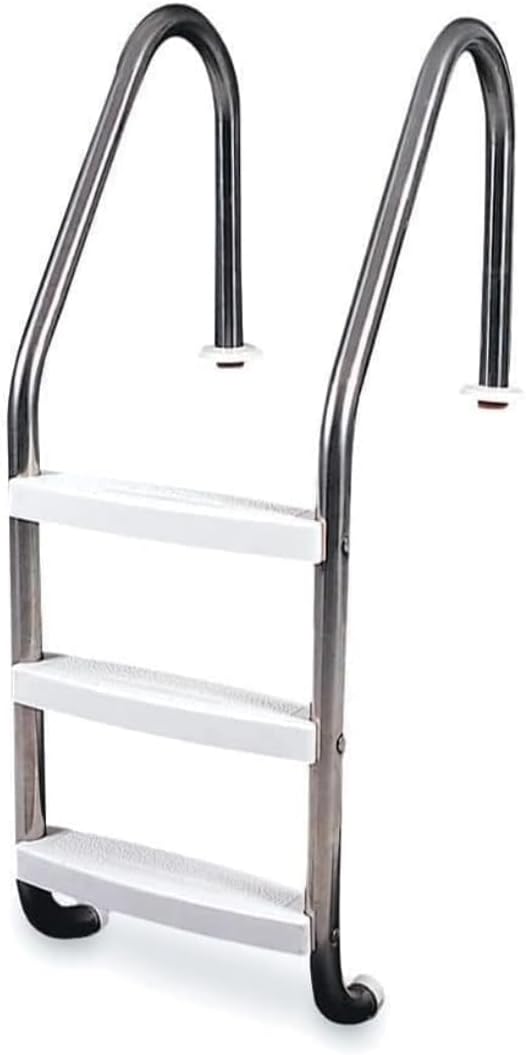
- 316 stainless steel for salt or chlorine pools
- 52.5 in. overall height; 1.90 in. anchor compatibility
- 250 lb capacity with 3 textured steps

- 53 in. tall × 24 in. wide; 20 in. center spacing
- High-impact polymer exterior over reinforced steel
- Salt/chlorine resistant; 3 polypropylene steps

- 4 steps with non-slip PVC pads
- 27.4 × 21.6 × 68.5 in.; 1.9 in. pipe diameter
- 440 lb listed capacity
What to Look for When Buying a Removable Inground Pool Ladder
Start with the deck anchors, not the ladder photo
Most removable inground ladders rely on two sockets embedded in the deck. The ladder rails slide into those sockets and are retained by wedges, bolts, or another clamping mechanism. That arrangement lets the ladder stay rigid in use while still allowing the rails to be lifted out after the fasteners are released. If your pool already has anchors, replacing the ladder is easiest when the new rail diameter and center spacing match the existing sockets.
A 1.90-inch outside rail diameter is common among residential pool ladders, and Aqua Select, Poolzilla, and Goplus all publish dimensions in that range. That does not make every 1.90-inch ladder interchangeable. The distance between the two rails, the setback from the anchors to the pool wall, and the geometry of the bends still matter. Measure the old ladder while it is installed if possible, then compare those dimensions with the new model before removing anything.
Decide how much vertical reach you need
Three-step ladders suit many standard residential inground pools because the lowest tread reaches far enough below the water surface for a swimmer to place a foot securely. A four-step ladder extends deeper, which can make the first step easier to reach for some users and in pools where the deck sits relatively high above the waterline. The tradeoff is a longer frame that takes up more wall space and more storage space after removal.
Step spacing matters as much as step count. Aqua Select publishes approximately 9 3/4 inches between steps, while Goplus lists 9.8 inches on its four-step model. Similar spacing means the four-step design mainly adds reach rather than creating unusually small climbing intervals.
Match the material to the water chemistry
Stainless steel is not a single material grade. Poolzilla specifies 316 stainless steel, a grade commonly chosen where corrosion resistance is a priority, and the company explicitly positions that model for salt or chlorine pools. Goplus specifies 304 stainless steel for this ladder family. Aqua Select uses a polished metal rail assembly but specifically warns that the model is not saltwater-friendly, so it is better treated as a conventional chlorinated-pool option.
Saftron takes a different route. Its ladder has a high-impact polymer exterior over a reinforced core, polypropylene steps, and 316 marine stainless hardware. The manufacturer states that the exterior is unaffected by pool chemicals, salt, and sun. That construction can be particularly useful where you want to minimize exposed hot metal around the deck.
Treat load capacity as a requirement, not a marketing number
The published load rating sets an important boundary, but it does not replace correct installation. Aqua Select and Poolzilla list 250-pound capacities. Goplus lists 440 pounds for the four-step version. Saftron’s current product information emphasizes reinforced construction rather than providing the same style of consumer-facing load figure, so this guide does not invent one.
If the intended user is close to a ladder’s stated capacity, a higher-rated model gives more margin on paper. Still, anchors, deck condition, rail clamping, and the wall bumpers all contribute to how the ladder behaves. A high-capacity ladder installed in loose anchors is not a good substitute for a sound installation.
Check what is included with the ladder
Replacement ladders differ in how complete the package is. Aqua Select includes the three plastic steps, two rails, two rubber bumpers, two escutcheon plates, and assembly hardware, but its deck anchors are sold separately. Poolzilla includes escutcheon plates and bumpers and is intended to fit existing 1.90-inch anchors, but anchors are also not part of the standard package. Goplus supplies its ladder and installation hardware, including the pre-embedded mounting components described by the manufacturer.
Saftron includes matching escutcheons with the P-324-L3 listing. For a new installation, Saftron recommends using its compatible anchor socket. If the goal is seasonal removal, verify that the anchor hardware can be loosened and reused without disturbing the deck.
Think about removal before the first installation
A removable ladder is most useful when the release hardware remains accessible. Deck sockets should not be buried under permanent trim, sealant, or a cover track that prevents the retaining bolt from being reached. If the ladder will come out every winter, keep the anchor sockets clean and use the correct plugs or covers when the rails are removed so grit does not collect inside.
Also plan where the ladder will go after removal. A three-step stainless ladder is awkward rather than especially heavy; a four-step model is longer and needs more wall or shed space. Avoid stacking it where the treads or bumpers will carry the weight of other pool equipment.
Aqua Select 3 Step Stainless Steel Pool Ladder
Aqua Select’s three-step ladder is built as a direct replacement for many conventional residential inground installations. The most important fit detail is its 1.90-inch rail diameter, a size commonly used with inground ladder anchors. The listing gives an overall height of 54 inches and a width of about 19 3/4 inches from rail center to rail center, so it is best suited to an existing deck layout in that range.
This is a straightforward option for a standard chlorinated pool where the old ladder already uses compatible anchors. It is not the right model to assume will tolerate saltwater simply because the rails are metal; the product information specifically says it is not saltwater-friendly.
Design and Build
The ladder uses two curved metal rails with three white plastic treads. The step length inside the rails is listed at 17 5/8 inches, and the treads are spaced about 9 3/4 inches apart. The plastic steps have non-slip surfaces, giving the foot a wider contact area than a narrow bare tube would provide.
At the bottom of the rails, rubber bumpers contact the pool wall. These are more important than they look. They reduce direct metal-to-wall contact and help keep the lower section of the ladder positioned against the pool side as someone climbs. The package also includes two escutcheon plates to cover the deck openings around the rails.
Important Specifications
- Three white non-slip plastic steps
- 54-inch overall height
- Approximately 19 3/4-inch rail-center width
- 17 5/8-inch step length inside the rails
- 18 1/2-inch setback from the back wall to the ladder bumper
- Approximately 9 3/4 inches between steps
- 1.90-inch rail diameter
- 250-pound published load capacity
The 18 1/2-inch setback deserves attention during replacement work. If the old ladder presses correctly against the pool wall but the new rail geometry places the bumpers several inches away, the ladder will not be supported as intended. Measure from the existing deck anchor centerline to the wall before ordering.
Practical Use
For a swimmer, the design is familiar: two continuous handrails rise above the deck, while the three treads descend along the pool wall. The 250-pound rating is adequate for many users, but it is not generous for every household. If a higher published capacity is important, the four-step Goplus model provides more headroom on paper.
The white plastic steps avoid a completely metal climbing surface, which can be comfortable under bare feet. They also create a clear visual contrast against the water. As with any submerged tread, algae, sunscreen residue, and mineral deposits can reduce traction, so the non-slip texture still needs routine brushing.
Installation and Removal
The replacement process is simplest when compatible 1.90-inch deck anchors are already installed. Aqua Select describes the ladder as a replacement unit that can be inserted after the old ladder is removed. The deck anchors themselves are sold separately, so a new pool or an incompatible old anchor system requires additional hardware and possibly deck work.
Once the rails are seated in releasable deck anchors, seasonal removal normally consists of loosening the anchor retainers and lifting the rails vertically out of the sockets. Do not assume every existing anchor is serviceable. Corroded wedges, stripped bolts, cracked deck material, or anchors filled with debris should be corrected before relying on a new ladder.
Important Strengths
Its strongest point is predictability. The dimensions are close to the conventional residential format many owners are replacing, the rail diameter is clearly stated, and the package includes the visible finishing pieces and wall bumpers. For a non-salt pool with compatible deck sockets, that can make replacement much simpler than converting to a different rail geometry.
Important Limitations
Saltwater compatibility is the main limitation. The listing explicitly warns against saltwater use, so a salt-chlorinated pool should move Poolzilla or Saftron higher on the comparison list. The second limitation is capacity: 250 pounds may be sufficient, but it leaves less margin than the 440-pound rating published for the Goplus four-step model.
Who Should Consider It
This ladder makes the most sense for someone replacing a conventional three-step ladder in a chlorinated inground pool and hoping to reuse existing 1.90-inch anchors. It is also a reasonable fit where white plastic treads are preferred over stainless treads.
Who Should Consider Another Option
Choose another design if the pool is saltwater, if the existing anchors are not close to the published spacing and setback, or if the intended user needs a higher load rating. A deeper entry area may also benefit from the fourth step on the Goplus model.
Pros
- Uses the common 1.90-inch rail diameter found in many existing inground-pool anchor systems
- Three plastic treads provide a broad, textured stepping surface without bare metal underfoot
- Includes rubber bumpers and matching escutcheon plates
- Straightforward replacement format for an existing three-step ladder
Cons
- The listing specifically states that this model is not saltwater-friendly
- Deck anchors are sold separately, so an older installation must already be compatible or new anchors are required
- Its 250-pound capacity is lower than the listed capacity of the four-step Goplus model
Poolzilla Three Tread Stainless Steel Pool Ladder
Poolzilla’s three-tread model is the clearest fit in this group for buyers who need a removable stainless ladder in a saltwater pool. The company specifies 316 stainless steel, three textured steps, a 250-pound capacity, and compatibility with 1.90-inch inground anchors. It also explicitly describes removing the ladder for off-season storage, which directly matches the removable-ladder use case.
The published geometry is useful for replacement planning: 20 inches center-to-center between the rails, 22 inches across the outside, 52.5 inches overall height, and a 23-inch setback from the front to the handrails. Those numbers let you compare the ladder against an existing deck layout before disturbing the anchors.
Design and Build
The rails are made from 316 stainless steel rather than the 304 grade used in the Goplus family. In pool hardware, that distinction matters most where chloride exposure is elevated. Poolzilla specifically positions the ladder for salt or chlorine systems and also uses salt-safe step hardware.
Three textured steps sit between the dual rails. The current manufacturer page describes the steps as non-slip and the Amazon listing identifies the white-step variation. White escutcheon plates cover the deck sockets and white bumpers protect the contact points near the pool wall.
Important Specifications
- 316 stainless steel construction
- Three non-slip textured steps
- 20-inch center-to-center handrail spacing
- 22 inches from outside edge to outside edge
- 52.5-inch total height
- Approximately 23-inch setback
- 1.90-inch inground-anchor compatibility
- 250-pound published load capacity
The center-to-center measurement is especially useful because deck anchors are installed to the rail centers, not the outer edges of the tubing. If your existing sockets are roughly 20 inches apart and accept 1.90-inch rails, this model is a more plausible drop-in candidate than a ladder whose spacing is undocumented.
Practical Use
Three steps keep the ladder compact, and the upper rail curves give both hands a continuous grip from the water to the deck. The published capacity is the same 250 pounds as Aqua Select. The practical differentiator is therefore not load rating but material grade and water-chemistry suitability.
The lower step section is about 29 inches, according to Poolzilla’s dimensional information. In a normal inground setting that provides a familiar reach into the water without the extra length of a four-step ladder. A user who has difficulty reaching a relatively high first tread may still prefer a four-step design.
Installation and Seasonal Removal
Poolzilla states that the ladder is designed for 1.90-inch inground anchors and that anchors are not included. That means it is most convenient as a replacement where compatible sockets are already in the deck. New installations need a matched anchor pair located at the proper spacing and setback.
The manufacturer also says the ladder can be removed when the pool season ends. In practice, keep the anchor fasteners and sockets maintained so that seasonal removal stays easy. After the ladder is out, rinse salt and pool residue from the rails, allow the assembly to dry, and store it where the step hardware and wall bumpers will not be crushed.
Important Strengths
The main strength is material selection backed by explicit saltwater positioning. Buyers do not have to infer that a generic stainless ladder will tolerate a salt system. The 316 grade, salt-safe hardware, and published anchor dimensions make the intended use much clearer.
Its second strength is replacement transparency. Poolzilla publishes center spacing, outside width, height, setback, anchor diameter, and capacity. Those numbers reduce the chance of buying by appearance alone.
Important Limitations
A 250-pound rating is not enough for every user, and the three-step format does not descend as far as the four-step Goplus. The ladder also depends on compatible deck anchors that are not supplied. If an old installation uses damaged or nonstandard sockets, part of the project may become an anchor replacement rather than a simple ladder swap.
Who Should Consider It
This model is well suited to a saltwater or chlorinated inground pool that already uses 1.90-inch anchors around 20 inches on center. It also fits owners who deliberately remove the ladder for winter storage, safety, maintenance, or pool-cover installation.
Who Should Consider Another Option
Consider Goplus if four steps or a higher published capacity are more important than dedicated saltwater positioning. Saftron is also worth considering where you prefer a polymer exterior and want less exposed metal around the deck.
Pros
- 316 stainless steel is specifically selected for improved corrosion resistance in saltwater environments
- Fits 1.90-inch inground anchors and is explicitly described as removable for off-season storage
- Three textured steps, dual rails, escutcheons, and ladder bumpers form a complete replacement assembly
- Published dimensions make it easier to compare against an existing 20-inch-center ladder opening
Cons
- Its 250-pound capacity may rule it out for users who need a higher published load rating
- Anchors are not included, so the deck still needs compatible 1.90-inch sockets
- Three steps provide less vertical reach than a four-step design in deeper entry areas
Saftron P-324-L3 Residential Inground Three-Step Pool Ladder
Saftron’s P-324-L3 approaches pool-ladder durability differently from the polished stainless models. The ladder has a high-impact polymer exterior over a reinforced internal structure, polypropylene steps with UV protection, and 316 marine stainless step bolts. The white three-step version is listed at 53 inches tall and 24 inches wide, with 20-inch center spacing.
That construction is useful for more than appearance. Saftron states that the exterior is unaffected by pool chemicals, salt, and sun and remains cooler to the touch than exposed metal. For a ladder located in strong sunlight or a salt-chlorinated pool, those characteristics address two common concerns at once.
Design and Build
The handrails are smooth polymer on the outside rather than bare polished steel. Inside, the rails are reinforced for rigidity. The three steps are also polymer-based, and the hardware uses 316 marine stainless steel where metal fasteners are required.
Because the color is part of the material rather than a painted surface coating, normal scratches do not expose a contrasting metal finish underneath. That does not make the ladder maintenance-free, but it avoids the flaking-paint problem that can occur with coated metal parts.
Important Specifications
- Model P-324-L3-W in the white three-step configuration
- Approximately 53 inches tall and 24 inches wide
- 20-inch center spacing
- Three high-impact polypropylene steps with UV protection
- High-impact polymer exterior over a reinforced core
- 316 marine stainless steel ladder bolts
- Matching escutcheons included
Saftron’s current product information emphasizes the material system and dimensional format rather than publishing the same type of consumer load-capacity figure shown for the other ladders. For that reason, a specific weight rating is not assigned to this model here.
Practical Use
The polymer hand-contact surface can be easier to live with on a sunny deck because it does not absorb and transfer heat in the same way as exposed stainless tubing. It also changes the visual character of the installation. Instead of a bright metallic ladder, the white version blends more closely with white coping, trim, or light-colored pool furniture.
The three-step arrangement suits a typical residential inground entry. As with the other three-step ladders, someone who wants the lowest possible first tread should compare the installed waterline and step depth rather than assuming three steps will reach far enough.
Installation and Removal
Saftron recommends its compatible anchor socket for this ladder. A retailer description of the P-324-L3 explains that the ladder pole slides into the anchor and the anchor is tightened to hold it in place. That arrangement allows the rail to be released and lifted out when the retaining mechanism is loosened, which is the basic requirement for a removable deck-mounted ladder.
The manufacturer’s no-grounding/no-bonding statement is conditional: it applies when the ladder is used with Saftron anchor sockets or a Saftron floor base. Pool electrical-bonding requirements are safety-critical and can vary by installation, so do not treat the material alone as permission to ignore local code or the pool builder’s bonding plan.
Important Strengths
Saftron’s strongest distinction is the polymer exterior. It addresses corrosion exposure, hot handrails, and finish durability without relying on a bare stainless surface. The manufacturer also explicitly describes the ladder as resistant to salt and common pool chemicals.
The published 20-inch center spacing is helpful for replacement planning, and the included escutcheons give the finished deck area a matched appearance. For an owner who dislikes the look or temperature of polished metal, this is the most different option in the group.
Important Limitations
The main limitation is that compatibility is more system-specific. If you want to rely on Saftron’s stated installation benefits, use the intended anchor components rather than assuming an unrelated metal anchor is equivalent. The polymer look is also a matter of preference; some pools are styled around polished stainless hardware and may look more consistent with a metal ladder.
Who Should Consider It
Saftron is a strong fit for salt or chlorine pools where a cool-touch polymer exterior, chemical resistance, and removable anchor-socket installation are priorities. It is also appealing where a white ladder matches existing pool trim.
Who Should Consider Another Option
If a clearly stated load capacity is essential to your purchase decision, compare models that publish one. If the deck already has standard metal anchors and the priority is a direct stainless replacement, Poolzilla or Aqua Select may require less adaptation depending on the existing spacing.
Pros
- High-impact polymer exterior isolates the hand-contact surface from bare metal and remains cooler in direct sun
- Manufacturer documentation states the exterior is unaffected by pool chemicals, salt, and sun
- Reinforced internal structure combines a rigid core with a corrosion-resistant exterior
- Can be installed in Saftron anchor sockets for a removable deck-mounted arrangement
Cons
- It uses a different construction approach from polished stainless ladders, which may not match a metal-heavy pool aesthetic
- Correct Saftron-compatible anchoring matters if you want the manufacturer’s no-bonding installation condition to apply
- The white finish can show surface dirt and splash-line residue more visibly than polished steel
Goplus 4-Step In-Ground Stainless Steel Pool Ladder
The selected Goplus ASIN is the four-step variation, and that extra tread is the main reason to consider it. Manufacturer specifications for the four-step model list overall dimensions of 27.4 by 21.6 by 68.5 inches, 1.9-inch pipe diameter, 17.9-by-3-inch treads, 9.8-inch step spacing, a 21-pound net weight, and a 440-pound capacity.
Those figures separate it from the three-step ladders immediately. It reaches farther into the pool and has the highest published capacity in this comparison. The current Amazon detail text mixes three-step and four-step copy in places, so the selected variation and dimensional chart should be checked carefully before ordering.
Design and Build
Goplus uses a polished stainless frame with curved twin handrails. The manufacturer identifies 304 stainless steel for this ladder family. Four wide treads descend between the rails, and each tread uses a non-slip PVC pad rather than relying only on polished metal for grip.
Rotating buffers at the lower end allow the ladder to meet the pool wall at different angles. These buffers should contact the wall squarely after installation. If they float away from the wall or press at an odd angle, recheck the anchor position and setback.
Important Specifications
- Four-step inground configuration
- 27.4 × 21.6 × 68.5-inch overall dimensions
- 17.9 × 3-inch tread dimensions
- Approximately 9.8 inches between steps
- 1.9-inch pipe diameter
- 21-pound listed net weight
- 440-pound published load capacity
- Stainless steel, ABS, and PVC construction
The 68.5-inch overall height is notably longer than the roughly 53- to 54-inch three-step models. That difference is not simply cosmetic; it is what gives the ladder room for the fourth tread and deeper reach. Measure the underwater wall area so the lowest tread and buffers do not interfere with a bench, ledge, return fitting, or sloped transition.
Practical Use
A fourth step can reduce the stretch required to reach the lowest tread from the water. That is useful for swimmers who prefer a deeper starting point or pools where the waterline sits lower relative to the deck. The 3-inch tread depth gives the foot a defined platform, while the PVC pads add texture.
The higher 440-pound published capacity also gives this model more margin than the two 250-pound ladders in the comparison. Capacity should still be treated as a maximum under correct installation, not as permission for two people to climb at once.
Installation and Removability
The rails use a 1.9-inch pipe diameter, and the manufacturer describes pre-embedded mounting parts for installation. That is broadly consistent with a conventional inground anchor arrangement. If you are buying specifically for seasonal removal, confirm that the supplied or existing deck sockets use a releasable clamp rather than a permanent set connection.
The longer frame is more awkward to move and store than a three-step ladder. Before closing the pool, rinse the assembly, inspect the PVC pads and lower buffers, let it dry, and store it horizontally or securely supported so the rails are not bent by other equipment.
Important Strengths
The extra step is the clearest practical benefit. It gives more underwater reach without requiring a radically different ladder style. The 440-pound published capacity is also substantially higher than the ratings listed for Aqua Select and Poolzilla.
The dimensional information is detailed enough to plan around the pool wall: tread size, overall dimensions, tube diameter, step spacing, and net weight are all available. That makes it easier to check whether the longer ladder will fit before installation.
Important Limitations
The Amazon page currently contains inconsistent copy for the selected variation, with some text describing a three-step model even though the title and selected option are four steps. The manufacturer page provides separate figures for the four-step version, so buyers should verify that the order summary still shows the four-step variant.
The second limitation is water-chemistry positioning. Goplus specifies stainless steel and identifies 304 stainless for the family, but it does not market this four-step ladder as a dedicated saltwater model in the same direct way Poolzilla does. For a salt system, a model explicitly built around 316 stainless or a salt-resistant polymer exterior gives clearer compatibility.
Who Should Consider It
This model suits a buyer who wants four steps, deeper reach, and a higher published capacity while retaining a conventional inground ladder format. It is especially relevant where a three-step ladder leaves the lowest tread uncomfortably high in the water.
Who Should Consider Another Option
Choose Poolzilla if saltwater compatibility is the priority. Choose Saftron if you want a polymer exterior and less exposed metal at the handrails. Aqua Select remains a simpler three-step replacement for a conventional non-salt installation.
Pros
- Four-step layout provides a lower final tread than the three-step ladders in this comparison
- Manufacturer specifications list a substantially higher 440-pound load capacity
- 1.9-inch pipe diameter and pre-embedded deck parts suit a conventional inground mounting format
- Wide 17.9 × 3-inch treads use non-slip PVC pads for added traction
Cons
- The current Amazon detail copy mixes three-step and four-step information, so the selected four-step variant should be confirmed before ordering
- 304 stainless steel is not positioned by the manufacturer as a dedicated saltwater model
- The longer 68.5-inch overall size needs more storage room after removal
Detailed Buying Guide for Removable Inground Pool Ladders
Measure rail diameter and anchor spacing separately
Rail diameter tells you whether the tube can physically enter the socket. Anchor spacing tells you whether both rails can enter their sockets at the same time. A ladder can have the correct 1.90-inch tube diameter and still be unusable if the rails are several inches farther apart than the existing anchors.
Measure center to center. Place the tape at the center of one rail or socket and measure to the center of the other. Do not use outside-to-outside width unless the manufacturer publishes the same reference point. Poolzilla, for example, publishes both 20 inches center to center and 22 inches outside to outside, illustrating why the reference point matters.
Check setback from the deck to the pool wall
Setback controls where the submerged half of the ladder lands relative to the wall. Too little setback can force the rails or treads against coping. Too much can leave the lower bumpers hanging away from the wall. Aqua Select publishes an 18 1/2-inch back-wall-to-bumper measurement, while Poolzilla lists a 23-inch setback using its own dimensional reference.
Because manufacturers may measure setback from different points, compare diagrams rather than relying on a single number. The safest replacement method is to record the old ladder’s anchor centerline, wall-contact point, and underwater footprint before removal.
Three steps versus four steps
Three-step ladders are compact and common. They work well where the water level sits close enough to the deck that the lowest tread is easy to reach. They are also easier to handle during winter removal and need less storage space.
Four-step ladders extend deeper into the pool. The extra tread can make entry more comfortable, but it also increases overall length. The Goplus four-step model reaches 68.5 inches overall, compared with roughly 52.5 to 54 inches for the three-step models here. Check for benches, sun shelves, return fittings, lights, or steep wall transitions below the proposed ladder position.
304 versus 316 stainless steel
Both grades are used for outdoor hardware, but 316 contains alloying additions that improve resistance to chloride-related corrosion. That is why 316 is commonly selected for marine and saltwater environments. Poolzilla explicitly uses 316 stainless steel and positions the ladder for saltwater pools.
304 stainless can perform well in many conventional chlorinated pools when maintained, but it should not automatically be treated as equivalent in a salt-heavy environment. Regular rinsing and cleaning help any stainless ladder, especially around the splash line where water evaporates and leaves concentrated salts or chemicals behind.
Polymer-covered rails
Polymer-covered ladders such as Saftron change the corrosion and heat profile. The exterior is not bare metal, so the handrail does not become as hot in direct sun and does not expose a polished stainless surface to the same chemical contact. The tradeoff is that the appearance is different and compatibility may depend more heavily on the manufacturer’s own anchor system.
Step material and traction
Plastic, polypropylene, and PVC-covered steps can all provide texture, but no submerged tread remains slip-resistant if it is coated with algae, scale, body oils, or sunscreen. Treat tread texture as one layer of traction, not a substitute for cleaning.
During routine pool maintenance, brush the top and underside of each tread. Pay attention to the corners where the tread meets the rail, because debris can accumulate there. If a tread pad loosens, cracks, or curls at the edge, replace it rather than relying on a partial surface.
Wall bumpers matter
The lower bumpers transfer part of the climbing load to the pool wall and keep the rail from scraping the finish. They should meet the wall squarely and remain securely attached. A missing bumper can allow metal or hard plastic to rub directly against plaster, tile, fiberglass, or a vinyl-lined surface.
When fitting a replacement ladder, check the contact location before tightening everything. A rotating or adjustable bumper, such as the type used on the Goplus, is useful only if it is adjusted to sit flat against the wall.
Deck anchors and removable hardware
For true removability, the anchor needs a release mechanism. Many inground ladder anchors use a wedge tightened by a bolt. Loosening the bolt releases the wedge so the rail can be lifted out. If an anchor is seized, do not twist the ladder violently; that can damage the deck, rail, or socket.
Keep anchor threads clean and use only lubricants or anti-seize products approved for the anchor material and pool environment. When the ladder is removed, cap or plug the sockets if the anchor system provides covers. That helps prevent pebbles, sand, and winter debris from filling the opening.
Bonding and electrical safety
Metal pool hardware can fall under electrical bonding requirements intended to keep conductive parts at the same electrical potential. The exact requirement depends on the ladder material, anchor system, pool construction, and local code. A product statement about grounding or bonding should not be generalized to a different anchor or installation.
Saftron specifically conditions its no-bonding claim on use with its anchor socket or floor base. For stainless ladders, follow the pool builder’s electrical plan, the anchor instructions, and local code. If you are unsure, use a qualified pool professional or electrician familiar with swimming-pool bonding.
Saltwater pools need more than a stainless label
Saltwater compatibility should be explicit. Poolzilla states that its ladder is designed for salt or chlorine systems and uses 316 stainless steel. Saftron states that its polymer exterior is unaffected by salt and pool chemicals. Aqua Select specifically says its three-step model is not saltwater-friendly.
Goplus identifies stainless construction but does not make the same explicit saltwater claim for the selected four-step model. That does not prove it will immediately fail in a salt pool; it simply means the safer buying decision is to prefer a model whose materials and intended chemistry are clearly documented.
Plan for winter storage
Removal is only useful if storage protects the ladder. Rinse the ladder with fresh water, brush residue from the treads, and dry the assembly before putting it away. Store it where the rails are supported and where freezing water cannot remain trapped in fittings.
Keep small hardware with the ladder or label it by pool location. If escutcheons lift off when the ladder is removed, store them with the assembly so they are not lost. Inspect bumpers, step fasteners, and anchor wedges before reinstalling in spring.
Do not ignore the pool cover
A safety cover, automatic-cover track, or winter cover can change whether a ladder can remain installed. A removable ladder is often preferable because it clears the deck area before the cover is tensioned. Measure the ladder anchors relative to the cover hardware so the escutcheons and anchor sockets do not interfere with straps, springs, or tracks.
Replacement parts can matter more than the initial package
Steps, bumpers, escutcheons, bolts, and anchor wedges are wear items. A ladder from a brand with identifiable replacement hardware can be easier to maintain than an obscure assembly whose small parts cannot be matched later. Before buying, look at the attachment method of the treads and bumpers and note any model-specific hardware.
Direct Product Comparisons
Aqua Select vs Poolzilla
These two ladders are closest in basic format: three treads, twin metal rails, roughly standard residential dimensions, 1.90-inch anchor compatibility, and 250-pound published capacities. The major difference is water chemistry. Aqua Select explicitly says its model is not saltwater-friendly, while Poolzilla uses 316 stainless steel and is specifically intended for salt or chlorine pools.
Poolzilla also provides more detailed replacement dimensions, including 20-inch center spacing and 22-inch outside width, and it explicitly mentions off-season removal. Aqua Select is attractive as a familiar non-salt replacement, particularly when its 19 3/4-inch rail-center measurement and 18 1/2-inch setback match an existing installation.
Poolzilla vs Saftron
Both are plausible choices for saltwater pools, but they solve corrosion differently. Poolzilla relies on exposed 316 stainless steel. Saftron uses a high-impact polymer exterior over a reinforced core and reserves 316 stainless steel for hardware. If you want the look of polished metal, Poolzilla is the more conventional design. If hot handrails and exposed metal are concerns, Saftron’s polymer exterior has a clear practical advantage.
Both can work as removable deck-mounted ladders when installed in suitable anchor sockets. Poolzilla is designed around 1.90-inch inground anchors. Saftron’s benefits are most clearly documented with Saftron’s own anchor socket or floor base.
Poolzilla vs Goplus 4-Step
Poolzilla is the more clearly documented saltwater choice. Goplus is the deeper-reaching choice. Poolzilla has three steps and a 250-pound capacity; the Goplus four-step version publishes a 440-pound rating and a 68.5-inch overall length.
For a swimmer who has trouble reaching the lowest tread of a three-step ladder, the Goplus geometry may matter more than material grade. For a salt-chlorinated pool where corrosion resistance is the dominant concern, Poolzilla’s 316 stainless construction is the more direct match.
Saftron vs Goplus 4-Step
Saftron prioritizes a polymer-covered handrail surface, salt and chemical resistance, and a three-step residential format. Goplus prioritizes step count, depth, and a higher published load capacity. The two products therefore serve different installation priorities rather than being near-identical substitutes.
The Goplus frame is longer and heavier to store, while Saftron’s 53-inch height is closer to a traditional three-step replacement. If the pool is used in strong sun, Saftron’s cooler-touch polymer can be valuable. If the first underwater tread needs to sit lower, four steps are the more relevant feature.
Aqua Select vs Goplus 4-Step
Aqua Select is simpler for a standard three-step non-salt replacement and uses plastic treads with a 250-pound rating. Goplus adds a fourth tread, extends to 68.5 inches, and raises the published capacity to 440 pounds.
The Goplus does require more dimensional checking because its underwater footprint is larger. Aqua Select’s shorter geometry is less likely to interfere with underwater benches or fittings, but it provides less reach. Neither should be chosen for saltwater by assumption: Aqua Select specifically advises against it, and Goplus does not position the selected four-step model as a dedicated saltwater ladder.
Installation Tips for a Removable Inground Pool Ladder
Dry-fit before final tightening
Assemble the ladder on the deck and place the rails into the anchors without forcing them. Confirm that both rails seat to the same depth, the escutcheons sit flat, the steps are level, and the lower bumpers meet the pool wall evenly. If the ladder twists when inserted, stop and recheck spacing.
Keep the rails parallel
Ladder rails that are pulled together or spread apart to fit mismatched anchors store stress in the frame. That stress can make removal difficult and can place side load on the deck sockets. The rails should enter the anchors naturally with only normal assembly tolerance.
Tighten step hardware evenly
A tread should not rock under foot pressure. Tighten the fasteners evenly and recheck them after the first few uses. Do not overtighten plastic or polymer parts to the point that they deform or crack.
Position bumpers before loading the ladder
The lower bumpers should contact the wall before the ladder is put into regular use. If an adjustable bumper can rotate, set it so the contact face is flat against the surface. This helps distribute load and reduces concentrated rubbing on the pool finish.
Test the removal process once
After installation, release the anchors and lift the ladder out once before the end of the season. That confirms the sockets are actually serviceable and gives you a chance to correct binding, debris, or inaccessible hardware while the installation is still new.
Common Buying Mistakes
Assuming all 1.90-inch ladders are interchangeable
Matching tube diameter is only one requirement. Center spacing, setback, overall rail geometry, and underwater wall clearance can still prevent a proper fit. Always compare at least three measurements: tube diameter, rail-center spacing, and distance from the deck anchors to the wall.
Buying stainless steel for saltwater without checking the grade
The word stainless does not tell you how a ladder is intended to behave in a salt pool. Poolzilla documents 316 stainless and saltwater use. Aqua Select explicitly says not to use its model as a saltwater-friendly ladder. Those two examples show why material and intended chemistry both need to be checked.
Choosing step count without measuring the waterline
A fourth step can be useful, but it is not automatically better. If the extra depth places the lowest tread against a bench, shelf, return fitting, or curved wall, a three-step ladder may fit more cleanly. Measure the actual underwater space.
Forgetting about anchor condition
A new ladder cannot fix a loose or corroded anchor. Before ordering, loosen and retighten the existing anchor hardware if it is safe to do so. If the socket is cracked, spinning in the deck, heavily corroded, or packed with debris, include anchor repair in the project.
Ignoring the removal path
A ladder can fit perfectly in the pool and still be frustrating to store. Confirm that you can lift it vertically out of the anchors without hitting a fence, railing, shade structure, or cover mechanism. Then make sure there is a dry storage location long enough for the frame.
Treating a load rating as the only safety measure
Capacity is important, but traction, anchor integrity, wall support, tread condition, and correct installation matter as well. A higher rating does not compensate for a loose deck socket or missing bumper.
Frequently Asked Questions
What makes an inground pool ladder removable?
A removable ladder uses deck anchors that hold the rails securely during use but can be released by loosening a wedge, bolt, or clamp. Once released, the rails lift out of the sockets. A permanently grouted or fixed mount is not removable in the same practical sense.
Can I reuse my existing pool-ladder anchors?
Possibly. The new ladder needs the correct rail diameter, center spacing, insertion depth, and setback for the existing sockets. A 1.90-inch rail is common, but that dimension alone does not guarantee compatibility.
Is a three-step or four-step ladder better for an inground pool?
Three steps are compact and suit many standard residential pools. Four steps reach farther below the waterline and may be easier to reach from the water. The correct choice depends on deck height, water level, wall geometry, and underwater obstacles.
Which of these ladders is intended for saltwater pools?
Poolzilla explicitly uses 316 stainless steel and is designed for salt or chlorine systems. Saftron states that its polymer exterior is unaffected by salt and pool chemicals. Aqua Select specifically says its compared three-step model is not saltwater-friendly. Goplus does not position the selected four-step model as a dedicated saltwater ladder.
Why does 316 stainless steel matter in a salt pool?
316 stainless generally offers better resistance to chloride-related corrosion than 304 stainless. That makes it a common choice for marine and saltwater exposure. Cleaning is still important because deposits can collect at the splash line and around fasteners.
Do removable pool ladders come with deck anchors?
Not always. Aqua Select sells its deck anchors separately, and Poolzilla states that its ladder is intended to fit existing 1.90-inch anchors. Saftron recommends its own compatible anchor socket. Check the package contents before assuming anchors are included.
How often should an inground pool ladder be removed?
There is no single schedule. Owners commonly remove ladders for winter closing, safety-cover installation, deck service, or off-season storage. Saltwater models may also benefit from removal and rinsing when the pool is shut down for an extended period.
How do I keep a removable ladder from getting stuck in the anchors?
Keep the deck sockets clean, make sure the retaining wedges or bolts move freely, and avoid forcing misaligned rails into the anchors. When the ladder is out, use appropriate socket covers or plugs if the anchor system provides them.
Are plastic steps weaker than stainless steps?
Step material alone does not determine the ladder’s overall capacity. Plastic and polypropylene treads can be durable when properly supported and fastened. Use the manufacturer’s published load rating and inspect the tread, hardware, and rail connection regularly.
Does a removable stainless ladder need electrical bonding?
Bonding requirements depend on the material and installation. Metal pool components can be subject to bonding rules, while Saftron states that its no-bonding condition applies when its ladder is used with specified Saftron anchor hardware. Follow local code and the pool’s electrical design rather than assuming all removable ladders are treated the same.
Can I leave a removable ladder installed all year?
It depends on climate, pool operation, and the cover system. In freezing climates or where a safety cover crosses the ladder location, removal is often practical. In year-round pools, the ladder can remain installed if the materials, anchors, and maintenance routine support continuous exposure.
How should I store a pool ladder after removal?
Rinse off pool chemicals and salt, clean the treads, dry the assembly, and store it where the rails are supported and protected from heavy objects. Keep escutcheons and small hardware with the ladder so the complete set is ready for reinstallation.
Final Buying Considerations
The best removable inground pool ladder is the one that fits the existing deck geometry, suits the pool chemistry, and gives the intended user a reachable first tread. Start by measuring anchor diameter, center spacing, setback, and underwater clearance. Those measurements should narrow the field before appearance or step color enters the decision.
For a conventional non-salt replacement, the Aqua Select three-step ladder follows a familiar 1.90-inch format and includes the visible finishing pieces and wall bumpers. For saltwater pools, Poolzilla provides the clearest stainless specification with 316 construction and explicit off-season removability. Saftron is the alternative for buyers who prefer a polymer exterior that stays cooler in sun and is designed to resist salt and pool chemicals. Goplus is the model to examine when four steps, deeper reach, and a higher published load capacity are the deciding factors.
Before purchasing, compare the selected ladder’s dimensions with the old ladder and deck sockets rather than relying on a product photo. A small mismatch at the anchors can turn an easy seasonal replacement into deck work, while a well-matched ladder can remain secure during use and still come out cleanly when the pool needs to be covered, serviced, or closed.
Author