Stainless steel swimming pool railings look simple, but the details that determine whether a rail fits well and holds up around a pool are not simple at all. Overall length, deck projection, base-plate size, steel grade, grip coverage, mounting hardware, step geometry, and the condition of the deck all affect how useful a rail will be once installed.
The biggest material decision is 304 versus 316 stainless steel. Both are common corrosion-resistant steels, but 316 contains molybdenum and is generally the stronger choice where chloride exposure is high. That matters around saltwater pools and in environments where splash, pool chemicals, and moisture stay on the rail for long periods. A 304 rail can still be appropriate for many conventional chlorinated pools, but it should not automatically be treated as equivalent to a 316 model in a salt-heavy environment.
Size is just as important. A 55- to 57-inch four-bend rail gives a long handhold along a stair run, while a compact 32-inch rail takes less deck space and may suit a short entry or spa. A replacement-style rail without anchors can make sense when compatible deck sockets already exist, whereas a base-plate rail is intended to be fastened to the deck surface. The comparisons below focus on these practical differences rather than assuming that the largest or highest-capacity model is automatically the right one.
Quick Comparison

- 316 stainless steel; 52 × 31 in
- 330-lb listed capacity
- Removable wedge-anchor mounting
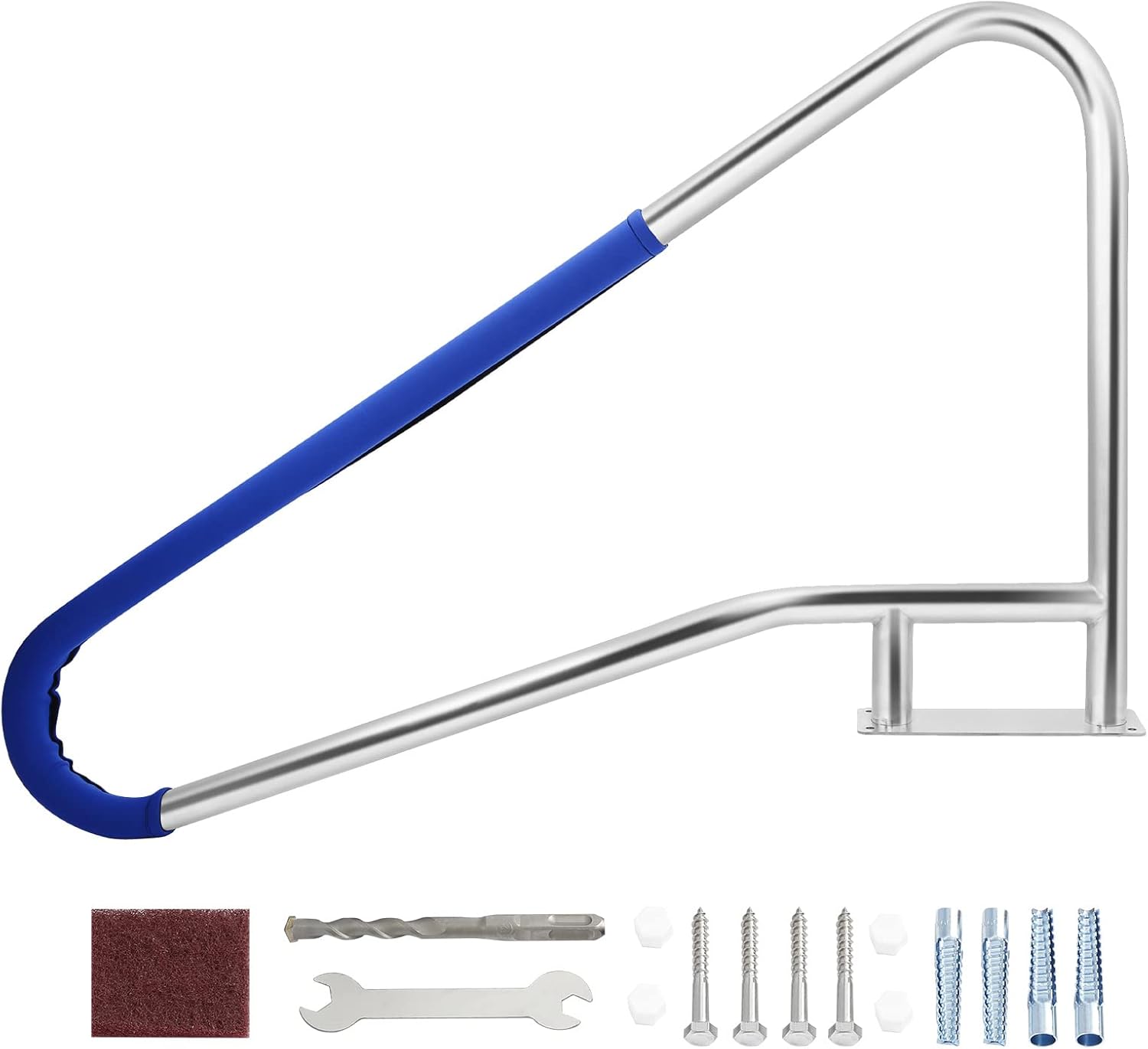
- 304 stainless steel; 57 × 35 in
- 385-lb listed capacity
- Detachable nylon grip cover

- 304 stainless steel construction
- About 45.88 × 37 in
- Sold without deck anchors

- 304 stainless steel; 55 × 32 in
- 250-lb capacity in current details
- 4-ft nylon grip; mounting kit

- 304 stainless steel; 55 × 32 in
- 375-lb listed capacity
- Quick-mount base and grip cover

- 2-mm 304 stainless steel tubing
- 250-lb listed capacity
- 6-ft grip cover; 4-mm base

- 304 stainless steel; 31.69 × 23.03 in
- 220-lb listed capacity
- Compact three-stage bend design
The table shows why these rails should not be treated as interchangeable. The Abimars model is the only 316-stainless option in this group and is explicitly removable from its wedge-anchor installation. The TCFUNDY and GarveeLife models emphasize higher listed load capacities and long four-bend shapes, the HECASA is a replacement-style rail sold without anchors, the yeezoo offers a long 52-inch rail with a six-foot grip cover, and the VEVOR is substantially more compact.
What to Look for When Buying Stainless Steel Swimming Pool Railings
Choose the steel grade for the water environment
A stainless label by itself does not tell you how a rail will behave around chlorides. Type 304 is widely used because it balances corrosion resistance, formability, availability, and cost. Type 316 adds molybdenum, which improves resistance to pitting and crevice corrosion in chloride-rich environments. For a saltwater pool, coastal air, or a deck where chlorinated splash remains on the metal, that extra resistance can materially change the maintenance burden.
That does not mean a 316 rail never needs care or that a 304 rail will immediately rust. Surface contamination, trapped moisture, cleaning chemicals, scratches, fastener quality, and water chemistry all matter. Treat ‘rustproof’ marketing cautiously. A better buying question is whether the steel grade, finish, fasteners, and cleaning routine match the pool environment.
Measure the stair run and the deck before comparing overall size
A long rail can give a swimmer something to hold before the first step and continue to provide support through several submerged steps. The tradeoff is a larger footprint and more deck projection. A compact rail takes less room, may look less dominant beside a spa or narrow deck, and can be easier to position around coping, but it provides a shorter gripping path.
Do not rely only on the advertised 55 × 32, 52 × 32, or 32 × 23 dimensions. Those dimensions describe the rail, not your installation. Check where the base plate or anchors will land, the distance from the pool edge, the direction of the stair run, the hand position at the top step, and what lies beneath the drilling area. Existing expansion joints, rebar, plumbing, electrical runs, or thin deck sections can turn a seemingly simple installation into a poor fit.
Understand base-plate mounting versus anchor-socket replacement
Most rails in this comparison use a surface base plate with predrilled holes and expansion-type fasteners. This format is straightforward when the deck is structurally suitable and the installer can drill at the planned location. It also makes the rail position independent of old ladder sockets. The base and fasteners, however, become critical parts of the installation; a thick rail tube does not compensate for weak concrete or an improperly installed anchor.
The HECASA NN261 is different because it is sold without anchors and is commonly used as a replacement-style rail. That can be useful when existing sockets are already correctly spaced, bonded, and structurally sound. It is not a universal drop-in replacement, so existing anchor spacing, rail diameter, and socket condition should be checked before purchase.
Treat load ratings as product limits, not installation guarantees
The rails here carry listed capacities ranging from 220 to 385 pounds, while the HECASA listing does not provide a comparable verified capacity. A higher number can provide more margin on paper, but the installed system includes the rail, welds, base plate, anchors, concrete or deck substrate, and the way force is applied. Pulling sideways or outward on a rail produces leverage that is different from a simple vertical static load.
For that reason, use the manufacturer’s listed rating as one selection factor rather than a promise about every installation. A 385-pound rail attached to deteriorated concrete with poorly seated anchors is not a stronger system than a lower-rated rail installed correctly in sound material.
Grip covers can improve comfort but add maintenance
Nylon or fabric grip sleeves keep hands off hot metal in strong sun and can provide a more tactile surface when wet. Long covers can be particularly useful on four-bend rails because a swimmer can keep a hand on the covered section through more of the entry path. The tradeoff is another component that can trap moisture, collect sunscreen and dirt, fade, or need removal for cleaning.
A bare polished rail is simpler to wipe down and inspect. If you choose a covered rail, make periodic cover removal part of maintenance so the stainless surface underneath does not remain hidden indefinitely.
Plan for bonding and local code before drilling
Metal pool handrails are commonly part of the pool’s equipotential bonding system. U.S. electrical codes and local rules can require metallic pool components to be bonded with other conductive parts around the pool. The exact requirement depends on the adopted code, pool construction, existing bonding grid, and local authority.
Do not treat the installation hardware in the box as a complete electrical-safety plan. If the project involves a new metal rail, a changed anchor location, or an uncertain existing bonding connection, have the installation evaluated under the rules that apply at the property. This is especially important before concrete is drilled or a replacement rail is assumed to be compatible with old sockets.
Abimars 316 Stainless Steel Removable Pool Handrail, 52 x 31 in
This Abimars rail is the material outlier in the group. The current Amazon listing identifies it as 316 stainless steel, measures it at 52 inches long by 31 inches wide, and lists a 330-pound capacity. Its base is described as 6 mm thick and it uses stainless wedge anchors. The feature that most separates it from ordinary base-plate rails is removability: the rail is designed so it can be taken off the deck when needed rather than treated as a permanently fixed seasonal obstacle.
Design and Build
The 52 × 31-inch format is long enough to follow a typical inground stair approach rather than functioning as a short grab bar. Its angled geometry places the upper handhold over the deck and extends the rail toward the water, so the user can transition from the deck to the steps without changing handholds immediately.
The mirror-polished finish differs from the brushed surfaces used on several other rails here. A smooth polished surface is easy to wipe and gives fewer visible grooves for grime to collect in, although fingerprints and water spotting may be more obvious. The practical material advantage is the 316 stainless construction, particularly for buyers who expect sustained chloride exposure.
Important Specifications
Amazon currently lists the rail at 52 × 31 inches with a 330-pound weight capacity. The base uses a reinforced 6 mm structure and stainless wedge anchors. Those details matter because the base and anchoring hardware carry the leverage created when someone pulls on the long upper section.
The listing specifically positions the 316 alloy for chlorinated and saltwater environments. That is a more meaningful distinction than a generic rust-resistant claim. Type 316 is normally preferred to type 304 where chloride exposure is more demanding, although maintenance and water chemistry still influence corrosion.
Removable Mounting and Seasonal Use
For owners who install a winter cover, a removable rail can solve a practical problem: a fixed rail can interfere with a tightly fitted cover or leave an awkward opening around the deck edge. This model is secured with wedge anchors but is designed so the rail itself can be removed. That makes indoor winter storage possible without giving up a substantial base-mounted handhold during the swimming season.
Removal should not be confused with frequent tool-free portability. The deck hardware remains part of the installation, and the anchors still have to be installed correctly in suitable material. The value is that the rail can be taken out for winterization, maintenance, or cover installation rather than that it is a temporary clamp-on accessory.
Important Limitations
At 52 inches long, this rail needs more clear space than a compact grab rail. Its mirror finish also does not include the insulated nylon grip found on several competing models, so the user holds exposed stainless steel. In strong sun, surface temperature is a practical consideration.
The 330-pound listed capacity is lower than the 375- and 385-pound claims on the GarveeLife and TCFUNDY models. That does not make it weak, but buyers selecting primarily by stated load rating should notice the difference.
Who Should Consider It
This model makes the most sense for a buyer who places steel grade and removability high on the list, particularly around saltwater or chloride-heavy environments. It is also a logical fit where a winter pool cover or seasonal storage makes a fixed rail inconvenient.
A buyer with a small spa deck, a short one-step entry, or no need for seasonal removal may prefer a smaller 304 rail. Someone who wants a padded or insulated handhold may also favor one of the covered models.
Pros
- 316 stainless steel provides stronger chloride resistance than the 304 models here
- 52 × 31-inch shape gives a long gripping path
- Removable design is useful for winter covers and off-season storage
- Stainless wedge anchors and 6 mm base are specified by the listing
Cons
- No padded grip cover is included
- Longer rail needs more clear deck and stair space
- 330-lb listed capacity is below the highest ratings in this group
TCFUNDY 57 x 35 in 304 Stainless Steel Pool Handrail
The TCFUNDY is a large four-bend rail aimed at buyers who want a long covered handhold and a high listed load rating. The Amazon listing specifies 57 × 35 inches, 304 stainless steel, a brushed-nickel surface finish, a detachable nylon grip cover, and a 385-pound capacity. Its base is listed at 4 mm thick, and the rail arrives with mounting accessories for the four predrilled base holes.
Design and Build
At 57 inches long and 35 inches high, this is the largest rail in the comparison. The four-bend profile creates a long transition from the deck down toward the water. That can be useful on a multi-step inground entry because the grip area continues farther along the stair path than a short upright rail.
The rail uses 304 stainless steel rather than 316. The brushed finish is less mirror-like than the Abimars finish and tends to visually hide minor handling marks better. A detachable nylon cover wraps the hand-contact area, providing insulation from hot or cold metal and extra texture when hands are wet.
Important Specifications
The current listing states a 385-pound support capacity, a 4 mm built-in base, and 57 × 35-inch overall sizing. It also lists 304 stainless steel and four approximately 0.39-inch predrilled mounting holes. Those are useful details for comparing the rail, but they do not replace checking the deck substrate and fastener installation.
The size deserves attention before buying. A 57-inch rail can reach across a significant portion of an entry, but that also means more leverage at the base when force is applied far from the mounting plate. Correct anchor embedment and sound concrete are particularly important with long rails.
Practical Use
The covered handhold is the TCFUNDY’s most obvious day-to-day feature. Bare stainless can become uncomfortable in direct sun, especially where the rail sits exposed all afternoon. A removable cover creates a more consistent touch surface and can help users keep a firm hold without squeezing polished metal.
The cover should occasionally be removed so the rail can be cleaned and inspected underneath. Sunscreen, body oils, dust, and splash residue can collect around seams and fasteners. A cover is useful, but it should not become a reason to ignore the metal surface.
Installation and Fit
The base is drilled for four mounting points and the listing includes a full accessory set. Before drilling, place the rail in its intended position and check where the user will naturally reach for it from both the deck and first submerged step. The longest possible rail is not useful if the grip starts behind the user’s shoulder or the base lands too close to a deck edge.
Because this is a base-plate design, it is a better match for a new mounting location than a buyer trying to reuse two existing anchor sockets. Existing bonding requirements also need to be handled as part of the installation rather than after the rail has been fastened.
Important Limitations
The main compromise is material. Type 304 stainless is common for pool hardware but does not have the same chloride resistance as 316. For a saltwater pool or a harsh coastal environment, a 316 rail deserves stronger consideration.
The rail is also physically large and the Amazon listing reports an item weight of 14.5 kg. That can make positioning and drilling a two-person job, especially when trying to hold the base perfectly aligned while marking holes.
Who Should Consider It
This rail fits buyers who want a long four-bend handhold, a removable grip cover, and a relatively high stated load rating. It is better suited to a full-size stair entry than a cramped spa edge.
Choose another design if deck space is limited, if you need to reuse existing sockets rather than drill a base plate, or if 316 stainless is a priority because of saltwater exposure.
Pros
- 385-lb listed capacity is the highest in this comparison
- Large 57 × 35-inch four-bend shape provides an extended handhold
- Detachable nylon cover improves grip comfort
- Four-hole base and mounting accessories are included
Cons
- 304 stainless is less chloride-resistant than 316
- Large footprint may be excessive for compact decks or spas
- Heavier rail can be awkward to position during installation
HECASA NN261 Pool Handrail, 37 x 45.8 in
The HECASA NN261 is fundamentally different from the base-plate rails surrounding it. It is a polished 304-stainless replacement-style handrail measuring about 45.88 inches by 37 inches, and the product is sold without deck anchors. That makes it most relevant to buyers who already have compatible anchor sockets and want to replace an older rail rather than drill a new four-bolt base into the deck.
Design and Build
The NN261 uses a smooth curved profile rather than a long four-bend base-plate layout. Its polished stainless surface gives it the familiar appearance of traditional inground pool rails. The verified model number is NN261, and the listing identifies the finish as polished.
The 304 stainless construction is a practical mainstream choice for many conventional pool installations. It still needs normal care, especially after chemical splash or in areas where water dries repeatedly on the surface. Buyers in salt-heavy environments should compare it with a 316 option rather than assuming every stainless grade behaves the same.
Replacement Compatibility
The absence of anchors is not simply a missing accessory; it changes the buying decision. If your pool already has deck sockets, measure the center-to-center spacing, confirm the rail tube diameter required by those sockets, inspect the anchor wedges or clamps, and verify that the existing hardware is structurally sound.
A replacement rail can be convenient because it avoids a new drilling pattern and may preserve an existing bonding arrangement. But compatibility should be measured rather than assumed from appearance. Two pool rails can look nearly identical while using different spacing or anchor hardware.
Practical Use
The roughly 37-inch-tall profile gives the user an elevated handhold near the deck while the curved lower portion reaches toward the pool entry. Compared with a 55- or 57-inch four-bend rail, it provides a shorter gripping path and occupies less visual space.
There is no long nylon grip sleeve in the listing, so the hand contacts polished stainless. That simplifies cleaning and inspection, but exposed metal can become warm in direct sunlight. A correctly fitted aftermarket rail cover may be an option, provided it does not interfere with grip or maintenance.
Installation Considerations
This model is best treated as a replacement component, not a complete new-install kit. The deck anchors, bonding connection, wedges, escutcheons, and any required fasteners need to come from the existing installation or a compatible system. If the old anchors are loose, corroded, incorrectly spaced, or not bonded as required, simply inserting a new rail does not correct those problems.
For an older pool, inspect the sockets before ordering. Movement at the deck is often an anchor or substrate issue rather than a rail-tube issue. Replacing only the visible stainless rail can leave the actual source of looseness untouched.
Important Limitations
HECASA does not provide a comparable verified weight-capacity figure in the current listing, so it should not be ranked against the other rails by an assumed number. It also lacks the included base plate and anchor set that make the other products more self-contained for a new mounting position.
Because it uses 304 stainless, it is not the strongest material match in this group for persistent salt or chloride exposure. Its advantage is compatibility with a traditional anchor-socket style installation, not maximum material specification.
Who Should Consider It
Consider the NN261 if you have an existing inground pool rail installation and need a polished stainless replacement with approximately 45.88 × 37-inch sizing. It can be a much cleaner purchase than a base-plate rail when the deck sockets are already in the right place.
A new-build installation, a buyer without existing anchors, or someone who wants a published load rating and included mounting kit should look at one of the base-plate models instead.
Pros
- Replacement-style format can reuse compatible existing deck anchors
- 304 stainless steel with polished finish
- More compact than the 55- and 57-inch four-bend rails
- Simple exposed-metal surface is easy to inspect and wipe clean
Cons
- Deck anchors are not included
- No verified comparable load-capacity figure is provided
- Compatibility with existing sockets must be measured before purchase
KODOM 55 x 32 in 304 Stainless Steel Pool Handrail
This 55 × 32-inch KODOM rail uses 304 stainless steel, a brushed finish, a four-bend shape, and a four-foot blue nylon grip cover. The current listing contains an important inconsistency: the product title says 300 pounds, while the feature bullets and detailed specification data state a 250-pound capacity. For a purchasing decision, the lower verified detail-section figure is the safer number to use unless the seller clarifies the discrepancy.
Design and Build
The overall form is similar to several long inground stair rails in this group: a horizontal base plate sits on the deck while the bent stainless tube extends forward and down along the pool steps. At 55 inches long and 32 inches high, it provides substantially more hand-contact length than the compact VEVOR.
The listing specifies 304 stainless steel with a brushed process. The base is approximately 13 inches long, 3.9 inches wide, and 0.16 inch thick. Four mounting holes are predrilled in the plate. That broad base distributes the attachment over four fasteners, but the condition of the deck remains a major part of the installed strength.
Grip and Practical Use
A four-foot nylon grip cover gives the hand a textured, insulated section instead of bare metal. This can be useful where the rail is in direct sun or where swimmers prefer a softer surface. The four-bend shape also lets the user follow the rail over a longer portion of the stair transition.
Because the cover is shorter than the full rail, some stainless remains exposed. The sleeve is removable, which is helpful for cleaning. Periodically taking it off makes it easier to rinse away trapped pool residue and check for staining or surface corrosion.
Mounting Kit
The listing includes four anchors, four screws, a drill bit, wrench, and four nut covers. That is a more complete package than the anchor-free HECASA. It is still important to match the supplied expansion hardware to the actual deck material; an anchor intended for solid concrete may not be appropriate for every stone, paver, hollow, or wood installation.
Before drilling, check the base footprint against the coping edge and expansion joints. The 13-inch-long plate needs a stable, flat seating area. If the plate rocks or bridges an uneven joint, tightening the fasteners harder is not a sound substitute for a proper mounting surface.
Capacity Discrepancy
The headline’s 300-pound claim and the detail section’s 250-pound claim should not be blended into a made-up middle value. The current Amazon bullets explicitly state 250 pounds, and third-party product data for the same ASIN also identifies 250 pounds. Buyers who need capacity above that figure should choose a model with a consistently documented higher rating.
This discrepancy is also a reminder to read beyond product titles. Marketplace titles are often edited separately from technical data, and a headline figure can remain after underlying specifications change.
Who Should Consider It
The KODOM is a reasonable format for a conventional inground stair where a long 55-inch rail and covered grip are useful, and where 304 stainless matches the expected environment. The included mounting kit can simplify a new base-plate installation on a suitable deck.
Buyers who require a clearly documented rating above 250 pounds, a compact rail, a replacement socket-style rail, or 316 stainless for more aggressive chloride exposure have clearer alternatives in this comparison.
Pros
- 55 × 32-inch four-bend shape gives a long handhold
- Four-foot removable nylon grip cover
- 304 stainless steel with brushed finish
- Mounting kit includes anchors, screws, drill bit, wrench, and nut covers
Cons
- Current listing conflicts between 300-lb title and 250-lb technical details
- 304 stainless is not the preferred alloy here for saltwater exposure
- Long base and rail require substantial clear deck space
GarveeLife 55 x 32 in 304 Stainless Steel Pool Handrail
GarveeLife’s 55 × 32-inch rail targets the same general use case as the KODOM and TCFUNDY: a long base-mounted handhold for inground steps. Its differentiators are a 375-pound listed capacity, 304 stainless construction, an anti-slip grip cover, and an 18-pound listed item weight. The quick-mount base format is intended for a new deck attachment rather than reuse of traditional two-socket pool-rail anchors.
Design and Build
The 55-inch length gives the user a continuous handhold over a substantial portion of the stair approach. The 32-inch dimension keeps the rail lower than the taller 57 × 35-inch TCFUNDY while still providing a full-size four-bend format.
Amazon identifies the material as 304 stainless steel and the finish as polished. The visible blue grip cover differentiates the contact section and adds texture. At 18 pounds, the rail is not unusually heavy for a large steel assembly, but it is still worth having a second person help hold the plate in position while holes are marked.
Capacity and Support
The current listing states a 375-pound capacity. That is higher than the Abimars 330-pound, yeezoo 250-pound, KODOM 250-pound technical figure, and VEVOR 220-pound ratings, and slightly lower than TCFUNDY’s 385 pounds.
The rating is useful when narrowing options, but the actual support a swimmer experiences depends on the finished installation. Long rails generate significant leverage at the base. Sound concrete, correct anchor depth, properly tightened hardware, and an appropriate bonding connection are part of the system.
Grip Cover and Maintenance
The anti-slip sleeve is useful where bare metal becomes hot or feels slick when wet. It also gives a clear visual cue about where the rail is intended to be grasped. This can matter for a long rail because the user can begin gripping it while still on the deck and continue into the water.
Remove and clean the cover periodically instead of leaving it in place indefinitely. Covered sections can hide discoloration, sunscreen residue, or early corrosion. Regular inspection is particularly important with 304 stainless in a wet chemical environment.
Installation
GarveeLife describes the product as a quick-mount base-plate rail and includes installation accessories. The practical benefit is that you can locate the rail according to the actual stair geometry rather than being constrained by existing sockets.
The limitation is that every mounting surface is different. Concrete thickness, deck condition, edge distance, and embedded utilities should be confirmed before drilling. If you are replacing an old socket-mounted rail, adding a base plate may also create a new bonding and deck-repair task.
Who Should Consider It
This model suits a buyer who wants a full-length 55 × 32-inch rail, a covered handhold, and a relatively high published capacity. It competes most directly with the TCFUNDY, but it is slightly smaller and lighter in overall dimensions.
A saltwater-pool owner prioritizing chloride resistance should compare the 316 Abimars first. A buyer with very limited deck space may find the VEVOR’s compact footprint easier to position.
Pros
- 375-lb listed capacity
- Full-size 55 × 32-inch stair-rail geometry
- 304 stainless construction with grip cover
- Stable base-plate format with installation accessories
Cons
- 304 stainless offers less chloride resistance than 316
- 18-lb assembly is easier to position with two people
- Large four-bend shape needs more deck clearance than compact rails
yeezoo 52 x 32 in 304 Stainless Steel Inground Pool Rail
The yeezoo rail combines a 52 × 32-inch four-bend shape with unusually specific construction details for this price-oriented category. The listing states 2 mm 304-stainless tubing, a 4 mm 304-stainless base plate, a fully welded connection, a 250-pound maximum load, and a six-foot non-slip rail cover. It also includes four 304-stainless expansion screws.
Design and Build
The 52-inch length sits between the compact VEVOR and the 55- to 57-inch rails. That can be useful when a buyer wants an extended grip path but has slightly less room along the deck or stair run. The 32-inch dimension is similar to the KODOM and GarveeLife.
Construction is specified more clearly than on many generic rails: 2 mm 304-stainless material and a 4 mm base plate. Those numbers do not make the rail automatically stronger than every competitor, but they give the buyer concrete dimensions to compare rather than relying on vague ‘heavy duty’ wording.
Six-Foot Grip Cover
The six-foot cover is one of the longest specified grip sleeves in this group. On a 52-inch four-bend rail, that gives broad coverage around the hand-contact portion and keeps much of the rail from being touched directly in strong sun.
Longer coverage means more fabric or sleeve material to keep clean. Periodic removal is useful for rinsing and inspecting the steel beneath it. If the cover becomes loose, worn, or saturated with residue, replacing the cover is preferable to allowing it to bunch under the hand.
Mounting and Deck Compatibility
The base has four predrilled holes and the kit includes four stainless expansion screws. The listing describes installation on concrete, brick, or wood, but anchor choice should still be matched to the actual substrate. A screw or expansion fastener that works in solid concrete does not automatically have the same capacity in wood, thin masonry, pavers, or a hollow deck system.
The manufacturer suggests measuring, marking, and drilling four approximately 9.5 mm holes. Before following any drilling pattern, verify the supplied hardware and instructions that arrive with the current unit, because fastener kits can change and local requirements may call for different hardware.
Capacity and Use Case
The verified maximum load is 250 pounds. That is lower than the Abimars, TCFUNDY, and GarveeLife ratings. If the expected user load or required margin calls for a higher published capacity, those models are easier to justify on specification alone.
For buyers within the documented rating, the yeezoo’s appeal is the combination of 52-inch reach, detailed material thickness, long cover, and a complete four-fastener base format. It is less about having the largest capacity number and more about getting a straightforward full-length stair rail.
Who Should Consider It
This rail is suitable for a medium-to-large inground stair entry where a 52-inch covered handhold makes sense and 304 stainless is appropriate for the water environment. Buyers who value a long protective cover may prefer it to models with shorter sleeves.
Choose another option if you need 316 stainless, a rating above 250 pounds, a replacement rail for existing sockets, or a much smaller footprint.
Pros
- 52 × 32-inch size balances long reach with slightly less length than 55- to 57-inch rails
- 2-mm 304 stainless and 4-mm base thickness are specified
- Six-foot non-slip cover provides extensive hand-contact coverage
- Includes four stainless expansion screws
Cons
- 250-lb listed capacity is lower than several full-size competitors
- 304 stainless is a weaker match than 316 for aggressive chloride exposure
- Long grip sleeve requires regular removal and cleaning
VEVOR 32 x 23 in 304 Stainless Steel Pool Handrail
The VEVOR is the compact option in this group. Amazon lists it at approximately 31.69 × 23.03 inches, 5.8 pounds, 304 stainless steel, and a 220-pound maximum capacity. Its three-stage bend design and small base footprint make it easier to place near a spa, short step entry, or deck where a 55-inch rail would dominate the space.
Compact Design
At roughly 32 × 23 inches, this rail is dramatically shorter than the full-size four-bend models. That changes how it is used: it functions more like a concentrated grab point at the pool edge rather than a handrail that follows the swimmer down a long stair run.
The compact size can be an advantage beside a spa, a narrow coping area, or a short entry where the user mainly needs help during the transition between deck and first step. It can also reduce visual obstruction around a small pool.
Material and Saltwater Warning
VEVOR identifies the rail as 304 stainless steel. More importantly, the current Amazon listing specifically warns that buyers with saltwater pools should choose 316 stainless steel or another material because this 304 rail may be at risk of rusting.
That manufacturer warning is more useful than generic rust-proof language in the product title. For a conventional chlorinated pool, 304 may be workable with sensible cleaning and water chemistry. For saltwater use, the 316 Abimars is the more directly matched material in this comparison.
Capacity and Structure
The listed maximum capacity is 220 pounds, the lowest published rating among the base-plate rails compared here. The rail uses a seamless one-piece design with thickened pipe walls and base construction according to the listing.
A 220-pound rating may be adequate for many users, but it offers less published margin than the 330-, 375-, or 385-pound alternatives. Buyers who expect heavier loads should select by the documented rating rather than assuming the compact rail has the same capacity as larger models.
Installation and Accessories
VEVOR supplies installation tools and hardware, including a wrench and drill bits. The listing says the rail can be mounted on concrete, wood, tile, or marble surfaces. In practice, the correct fastener and drilling method must match the substrate; brittle tile over concrete, for example, requires different drilling care than bare concrete.
Because the rail is small and weighs about 5.8 pounds, one person can more easily position it for marking than the larger rails. Still, deck integrity and electrical bonding requirements remain the same kinds of considerations.
Who Should Consider It
This model is best for a compact entry, spa, or pool deck where a short grab rail is more useful than a long stair-following rail. It also suits buyers who want a lighter piece of hardware that is easier to handle during layout.
It is not the first choice for saltwater pools, for users needing a capacity above 220 pounds, or for long stair entries where continuous hand contact down several steps is the priority.
Pros
- Compact 31.69 × 23.03-inch footprint suits small entries and spas
- Light 5.8-lb assembly is easier to position
- Grip cover and complete installation tools are included
- Current listing clearly identifies its 304 stainless material and limitations
Cons
- 220-lb listed capacity is the lowest published rating here
- VEVOR specifically advises saltwater-pool buyers to choose 316 or another material
- Short rail does not follow a long stair run like 52- to 57-inch models
Detailed Buying Guide for Stainless Steel Swimming Pool Railings
304 vs 316 stainless steel
The difference between 304 and 316 is more than a model-number detail. Both are austenitic stainless steels, but 316 includes molybdenum, which improves resistance to chloride-related pitting and crevice corrosion. Pool environments combine moisture, sanitizer residue, evaporation, and repeated wet-dry cycles, so chloride resistance can matter even though the rail is not continuously submerged.
For a conventional freshwater chlorinated pool that is rinsed and maintained, 304 stainless is widely used. For saltwater systems, coastal locations, or installations with persistent chloride exposure, 316 is the more conservative material choice. In this group, the Abimars is the only product whose current listing explicitly identifies 316 stainless steel; the TCFUNDY, KODOM, GarveeLife, yeezoo, VEVOR, and HECASA are 304-stainless products.
Finish also affects maintenance. Polished surfaces are smooth and easy to wipe, while brushed finishes tend to hide fingerprints and light scuffs. Neither finish changes 304 into 316, and neither makes stainless immune to corrosion. Avoid abrasive steel-wool cleaning that can leave iron contamination on the surface. Use cleaning methods appropriate for stainless and rinse away pool chemicals rather than allowing concentrated residue to dry repeatedly.
Rail length, height, and hand position
Advertised dimensions are only useful when translated into body position. A rail should be reachable before the user commits weight to the first step and should continue far enough toward the water to support the transition. Longer four-bend rails are good at this because they provide an extended horizontal-to-sloping hand path.
A compact rail works differently. It is a stable point to grab near the edge but may not remain within reach through several steps. That can be completely appropriate for a spa or a short stair arrangement. Sketch the deck edge and steps, then mark the proposed base location and approximate hand path before ordering. This simple planning step can prevent buying a large rail that lands in the wrong place or a small rail that ends before the user needs it.
Base plates, sockets, and removability
Base-plate rails bolt directly to the deck through four or more holes. They are useful when there are no compatible existing sockets or when the new rail needs to be positioned independently. Their strength depends on the base plate, fasteners, and deck substrate working together. Concrete cracking, insufficient edge distance, loose pavers, hollow areas, or inappropriate anchors can undermine the installation.
Socket-mounted replacement rails slip into embedded deck anchors and are clamped or wedged in place. Their advantage is a clean traditional appearance and easier rail removal when the sockets are compatible. The HECASA is the clearest example in this comparison because it is sold without anchors. Measure old hardware carefully; replacement compatibility is not guaranteed just because two rails have similar curves.
The Abimars is a third variation: it uses a base/anchor installation but is intentionally designed to be removable from its wedge-anchor setup. That can be useful for winter covers. If seasonal removal matters, think about what remains above the deck after the rail is removed and whether that condition is acceptable for the cover and walking surface.
What a load rating does and does not tell you
Published capacity is useful for screening products, particularly when there is a large difference such as 220 versus 385 pounds. It is not a complete engineering rating for the finished pool deck. The same rail can feel solid in thick sound concrete and loose in a cracked slab because the fasteners and substrate are carrying the load.
Also consider direction of force. A person does not press straight down on a pool rail like a static weight on a shelf. Users pull, twist, and lean sideways, creating leverage at the base. A longer rail gives better reach but also creates a longer lever arm. This is why installation quality matters just as much as a headline capacity.
If a household needs a specific accessibility or structural standard, do not assume a consumer product’s marketing capacity proves code compliance. Use products and installation details that meet the actual requirement for the property and have the work reviewed when necessary.
Grip sleeves: comfort, heat, and inspection
A grip sleeve can make a noticeable difference on a sunny deck. Stainless steel exposed to direct sun can become uncomfortable to touch, while a nylon cover buffers the hand from the metal and adds texture. TCFUNDY, KODOM, GarveeLife, yeezoo, and VEVOR all include covered grip areas.
The best cover is one that can be removed, cleaned, dried, and replaced without sliding during use. Check the closure and fit after the first few pool sessions. If the sleeve rotates or bunches, correct it rather than relying on friction alone. Periodically inspect the rail under the cover because hidden moisture and residue are easier to miss than stains on exposed metal.
Installation hardware and deck materials
Many product listings say their rails can install on several surfaces, but the included fastener set cannot be assumed to be optimal for every surface. Solid poured concrete, natural stone over concrete, brick, wood framing, composite decking, and pavers all behave differently. Tile can crack if drilled incorrectly, while an anchor in a thin paver may have little meaningful embedment.
For concrete, check slab thickness, edge distance, cracks, and the possibility of rebar or utilities below. For wood, verify that the rail fastens into adequate structural framing rather than only a deck board. For stone or tile, the top finish and the structural layer below it both matter. If the mounting surface is questionable, solve that problem before choosing the rail.
Electrical bonding is part of the installation
A stainless handrail is conductive, and pool electrical rules commonly require metal components around the pool to be connected into the equipotential bonding system. Bonding is not the same thing as simply grounding an appliance or driving a ground rod. Its purpose is to keep accessible conductive parts around the pool at substantially the same electrical potential.
For a replacement rail, verify that the existing anchor system and bonding connection remain intact. For a new base-plate location, do not assume the four mechanical anchors create the required electrical bond. Local code editions and inspection rules vary, so this is an area where a qualified pool professional or electrician can prevent an installation error that is invisible after the deck work is finished.
Cleaning and corrosion control
Stainless pool rails should be rinsed periodically with fresh water, especially after heavy splash or chemical treatment. Wipe off deposits rather than letting a crust of evaporated pool water remain on the surface. Use a non-scratching cleaner compatible with stainless and follow the rail maker’s care instructions.
Small brown marks on stainless are not always proof that the entire rail is failing; surface contamination can create localized staining. At the same time, recurring pitting around crevices, fasteners, welds, or under covers deserves attention. Cleaning cannot turn an unsuitable alloy into a saltwater-grade material. If corrosion returns repeatedly in a chloride-heavy environment, material selection may be the underlying issue.
Direct Product Comparisons
Abimars 316 vs TCFUNDY 304
These two rails represent different priorities. The Abimars is 52 × 31 inches, uses 316 stainless steel, lists a 330-pound capacity, and is designed for seasonal removal from stainless wedge anchors. The TCFUNDY is larger at 57 × 35 inches, uses 304 stainless, lists 385 pounds, and adds a detachable nylon cover.
Choose between them based on environment and geometry rather than the larger capacity number alone. The Abimars has the stronger material case for saltwater and chloride exposure, while the TCFUNDY offers a longer covered handhold and the higher published capacity. If the pool uses a winter cover, the Abimars removable format also has a practical advantage.
TCFUNDY vs GarveeLife
Both are full-size 304-stainless rails with grip covers and high listed capacities. TCFUNDY is 57 × 35 inches and lists 385 pounds; GarveeLife is 55 × 32 inches and lists 375 pounds. The two-inch difference in length and three-inch difference in the second advertised dimension can matter on a crowded deck, but neither is a compact rail.
TCFUNDY publishes more base detail, including a 4 mm base and four approximately 0.39-inch holes. GarveeLife is a little lighter in overall dimensions and uses a quick-mount base format. For either one, the deciding question should be where the base fits relative to the steps, not a ten-pound difference in stated capacity.
KODOM vs yeezoo
The KODOM and yeezoo are both 304-stainless, covered four-bend rails with verified 250-pound technical ratings. KODOM is 55 × 32 inches with a four-foot cover and a base around 13 × 3.9 inches. The yeezoo is 52 × 32 inches with a six-foot cover, 2 mm stainless construction, and a 4 mm base plate.
The yeezoo gives more specific material-thickness information and a longer grip sleeve. The KODOM is three inches longer and includes a detailed accessory set. The KODOM title’s 300-pound claim should not be used to distinguish them because the current technical data for the same ASIN states 250 pounds.
HECASA vs base-plate rails
HECASA is the choice to examine first if you are replacing a traditional rail already seated in deck sockets. It is sold without anchors, so its value depends on compatibility with what is already in the deck. The base-plate models are more self-contained for a new location because they include or specify surface-mount hardware.
Do not convert from sockets to a base plate simply because the base-plate kit looks easier. Existing sockets may already be correctly bonded and positioned, while a new base requires drilling and may create a new bonding task. Conversely, damaged or badly placed sockets are not a good reason to force a replacement rail into an unsuitable installation.
VEVOR 32 x 23 vs full-size four-bend rails
The VEVOR takes far less space and weighs only about 5.8 pounds. It works best as a compact grab point. The full-size rails provide a longer hand path but need more deck area and typically weigh much more. For a spa or short step entry, the VEVOR’s smaller size can be an advantage rather than a compromise.
Its limitations are equally clear: a 220-pound listed capacity and an explicit warning from VEVOR about saltwater use with 304 stainless. For a long inground stair entry or a user requiring a higher published capacity, one of the larger rails is a better specification match.
Common Buying Mistakes
Buying by appearance before measuring the deck
Pool rails often look smaller in isolated product photos than they do beside a real stair opening. Mark the proposed base outline on the deck with tape and check doorways, covers, cleaning equipment, walking paths, coping joints, and the natural line of the steps. A good-looking 57-inch rail becomes a nuisance if the upper bend projects into the primary walkway.
Assuming every stainless rail is equally suited to saltwater
The word stainless does not erase alloy differences. A 304 rail can perform well in many pools, but 316 offers better chloride resistance and is normally the stronger material choice for saltwater exposure. VEVOR’s own listing makes this distinction directly by warning saltwater owners to select 316 or another material.
Ignoring a conflict between the title and technical details
Marketplace titles can contain old or promotional numbers. The KODOM listing illustrates the problem: 300 pounds appears in the title, while current detailed specifications state 250 pounds. When an important number conflicts, use the more conservative verified figure or obtain clarification rather than assuming the larger number is correct.
Treating included anchors as universal hardware
A box of anchors does not mean the rail can be safely bolted to any surface. Fastener type, embedment, edge distance, deck thickness, and substrate condition determine whether the rail has a stable foundation. If the deck is pavers over sand, thin stone, hollow masonry, or wood without adequate framing, the installation may require different hardware or reinforcement.
Forgetting bonding until after drilling
Mechanical fastening and electrical bonding are separate issues. A rail can feel completely solid and still be improperly integrated into the pool’s bonding system. Plan the bonding connection before the final location is fixed, especially on a new base-plate installation.
Leaving grip covers in place permanently
Grip sleeves are comfortable, but they can hide the metal surface. Remove them periodically, rinse the rail, wash the cover according to its material, and let both dry. This makes it easier to catch staining, loose stitching, or a cover that is beginning to slide.
Frequently Asked Questions
Is 316 stainless steel better than 304 for a swimming pool railing?
For higher chloride exposure, especially saltwater pools or coastal environments, 316 generally has an advantage because its molybdenum content improves resistance to pitting and crevice corrosion. For many conventional chlorinated pools, 304 is commonly used and can perform well with correct maintenance. The water environment and maintenance routine matter more than choosing by appearance alone.
Can a stainless steel pool railing still rust?
Yes. Stainless steel is corrosion resistant, not immune to corrosion. Chlorides, chemical residue, metal contamination, crevices, scratches, trapped moisture, and poor water chemistry can all contribute to staining or pitting. Alloy selection and regular rinsing are important around pools.
How do I know what size pool handrail to buy?
Measure the stair run, deck area, planned mounting position, and where a user’s hand naturally reaches from the deck and first few steps. Then compare those measurements with the rail dimensions and base footprint. A long rail is useful only if it follows the path of movement without blocking the deck.
Are higher load-capacity pool rails always safer?
A higher verified rating can provide more capacity margin, but the finished installation also depends on the deck, anchors, welds, base, and installation method. A high-rated rail mounted poorly can be less stable than a lower-rated rail installed correctly in sound material. Follow the product limits and use a mounting system appropriate for the substrate.
Can I install a pool handrail into pavers?
It depends on how the pavers and supporting structure are built. A surface paver alone may not provide the same anchor strength as structural concrete. Many installations require fastening into a concrete footing or other structural support below the finished surface. Verify the substrate before drilling rather than relying on the visible deck material.
Do stainless pool handrails need to be bonded?
Metal handrails around pools are commonly subject to equipotential bonding requirements under applicable electrical codes. The exact method depends on the pool, rail mounting system, adopted code, and local authority. Mechanical anchor bolts should not be assumed to satisfy electrical bonding requirements by themselves.
Are pool handrail grip covers useful?
They can be. A cover can reduce direct contact with sun-heated metal and add texture for wet hands. The tradeoff is maintenance: covers should be removable for cleaning and inspection of the stainless steel underneath.
Can I reuse existing pool rail anchors?
Only if the new rail matches the existing anchor spacing and tube requirements and the old anchors are structurally sound. Also verify that the existing bonding connection remains correct. The HECASA NN261 is specifically relevant to this kind of replacement because it is sold without new deck anchors.
Which rail is best for a saltwater pool in this group?
The Abimars is the only rail in this comparison whose current listing specifies 316 stainless steel, making it the most directly matched material for saltwater exposure. The other verified models use 304 stainless, and the VEVOR listing explicitly warns saltwater buyers to choose 316 stainless or another material.
Which rail uses the least deck space?
The VEVOR is the compact option at approximately 31.69 × 23.03 inches. The other base-plate rails are roughly 52 to 57 inches long and are intended to provide a longer handhold along a stair entry.
Should I choose a removable rail for winter?
A removable rail can make winter-cover installation and off-season storage easier. The Abimars listing specifically describes a removable design using stainless wedge anchors. If removability is important, also check what hardware remains above the deck when the rail is removed and whether that arrangement works with your cover.
Final Buying Considerations
The right stainless steel swimming pool railings depend first on the pool environment and mounting situation. For saltwater exposure or a buyer prioritizing chloride resistance, the Abimars 316-stainless rail has the clearest material advantage and adds useful seasonal removability. For a large conventional stair entry where a long covered handhold and high listed capacity matter, the TCFUNDY and GarveeLife are the strongest specification matches in this group.
If you are replacing a traditional socket-mounted rail, the HECASA NN261 deserves separate consideration because it is sold without anchors and can make more sense than drilling a new base plate. The KODOM and yeezoo occupy the middle of the full-size group with 304 stainless, covered grips, and 250-pound verified technical ratings, while the VEVOR is better suited to a compact entry where a 32-inch rail is enough.
Before buying, verify three things on the actual pool: where the user’s hand needs support, what material and condition exist under the proposed mounting point, and how the new metal rail will be integrated with the pool’s bonding system. Those checks are more important than choosing by appearance alone and will do more to prevent an expensive purchasing mistake.
Author