

A search for a 4 wheel pool vacuum can lead to products that share wheels but use very different cleaning systems. Two of the models here are automatic suction-side cleaners powered by the pool circulation system, one is a corded 4WD robotic cleaner with its own debris canister, two are garden-hose leaf vacuums, and the remaining models are manual wheeled vacuum heads. The right choice depends less on the presence of four wheels than on what kind of debris you need to remove, how much manual work you want to do, and which power source fits your pool equipment.
For routine unattended floor coverage, a suction-side cleaner or robotic cleaner makes more sense than a manual head. For seasonal piles of leaves, a water-jet leaf vacuum can collect bulky debris in its own mesh bag without sending the leaves through the pool filter. A commercial-style manual vacuum head gives the operator direct control, which is useful when the goal is targeted cleaning rather than automatic coverage.
Pool size matters too. The Hayward AquaNaut 400 and Poolvergnuegen 4-Wheel are both listed for in-ground pools up to 20 by 40 feet and are designed around longer travel patterns than their two-wheel counterparts. The Polaris 9450 Sport is specified for in-ground pools up to 50 feet long and adds active scrubbing, wall cleaning, a debris canister, programmable cycles, and a dedicated power/control system. The manual leaf vacuums and vacuum heads do not cover a pool automatically; their effectiveness depends on the user, pole reach, hose setup, available water pressure or suction, and the type of debris on the floor.
The comparisons below focus on those practical differences. A wheeled head that is very effective for a concentrated pile of leaves can still be the wrong tool for fine settled dirt, and a sophisticated robot can be excessive if the only recurring problem is a layer of large leaves after a storm. Matching the cleaning mechanism to the job is the fastest way to avoid buying a pool vacuum that technically fits the pool but does not fit the maintenance task.
Quick Comparison

- Four-wheel suction-side automatic cleaner
- Rated for in-ground pools up to 20 x 40 ft
- V-Flex turbine, roller skirts and programmed steering

- Four-wheel suction-side automatic cleaner
- For in-ground pools up to 20 x 40 ft
- 40 ft hose; programmed 11–14 ft steering runs

- 14-inch commercial manual vacuum head
- 1-1/2-inch vacuum-hose swivel connection
- Adjustable ball-bearing wheels and metal swivel handle

- 15-inch garden-hose leaf vacuum
- Eight high-pressure water jets
- Four multidirectional wheels and reusable mesh leaf bag

- 15-inch ABS leaf-vacuum body
- Eight pressure jets and four 360-degree wheels
- Three perimeter brushes and two reusable debris bags
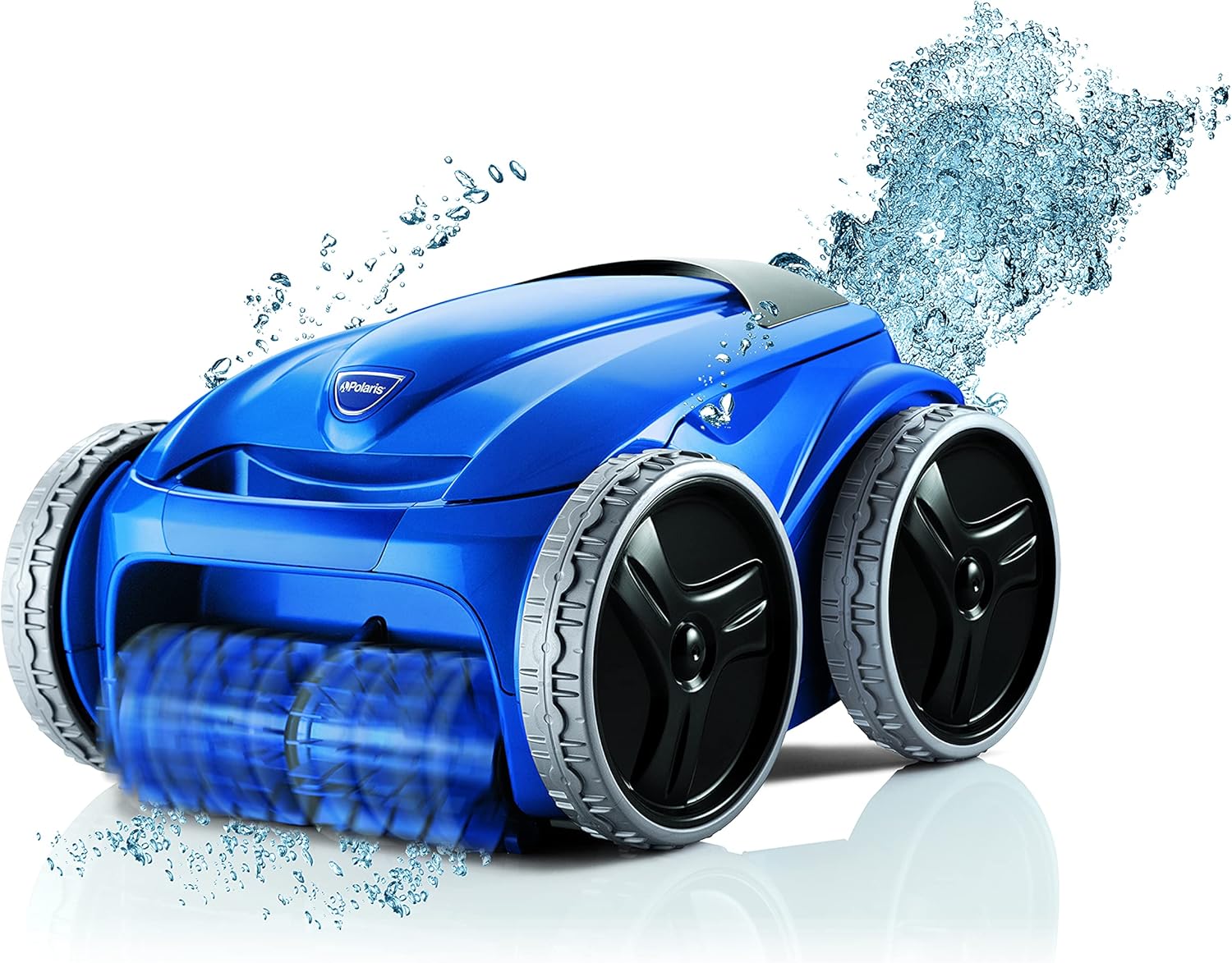
- 4WD robotic cleaner for in-ground pools up to 50 ft
- 60 ft swivel cable and 5 L top-access canister
- Floor or floor-and-wall modes with 7-day programming

- Manual wheeled vacuum head with four weighted plates
- Listing specifies water-pressure operation
- Fits most 1.25-inch poles; pole not included
What to Look for When Buying a 4 Wheel Pool Vacuum
Start with the cleaning system, not the wheel count
The most important distinction is how the cleaner creates suction or captures debris. A suction-side automatic cleaner connects to a skimmer or dedicated suction port and uses the existing pump and filter system. It can roam without a separate electric motor, but its movement depends on correct water flow and a clean circulation system. A robotic cleaner uses its own electric drive, internal filtration and programmed movement, so it is less dependent on the pool pump during the cleaning cycle.
Garden-hose leaf vacuums work differently. Water from the garden hose passes through jets under the vacuum body and creates an upward flow that lifts leaves into a mesh bag. They are well suited to bulky debris but are not a direct substitute for a suction head that sends fine material toward the pool filtration system. Conventional manual vacuum heads use the pool vacuum hose and pump suction while the operator moves the head with a telescopic pole.
Think about what the wheels are actually doing
Four-wheel automatic suction cleaners use their wheel layout for traction, steering and longer pool coverage. The wheels are part of a drivetrain, so tire condition, wheel speed and internal gearing can affect whether the cleaner climbs, turns or stalls. A four-wheel leaf vacuum uses wheels mainly to reduce drag and make manual movement smoother. That difference is important because four wheels do not automatically mean self-propelled operation.
The Polaris 9450 Sport uses a driven 4WD system as part of a robotic platform. In that design, the wheels support active navigation over the pool floor and up walls. The Pentair ProVac 214 and Uoark head are operator-controlled vacuum heads: wheels help them track over the surface, but they do not steer themselves.
Match the cleaner to pool size and connection location
Automatic suction cleaners need enough hose to reach the farthest point in the pool without excessive slack. Hayward specifies a 40-foot hose for the four-wheel AquaNaut configuration, and its troubleshooting guidance explains that the four-wheel version is intended to travel longer distances before turning. The Poolvergnuegen 4-Wheel likewise uses a longer travel pattern for larger pools. If the suction port is near one end of a long pool, hose length becomes especially important.
Robotic cleaners have a similar reach issue but use a power cable instead of a suction hose. The Polaris 9450 Sport includes a 60-foot swivel cable and is specified for in-ground pools up to 50 feet long. Manual heads are limited by pole reach and the length of the vacuum or garden hose attached to them, so measure the distance from the connection point to the farthest cleaning area before ordering accessories.
Separate leaf pickup from fine-dirt cleaning
Large leaves, seed pods and other bulky debris demand an open intake and a collection method that will not clog quickly. The Poolmaster Big Sucker and U.S. Pool Supply Leaf Terminator both use 15-inch bodies, water jets and mesh bags, which makes their basic architecture oriented toward leaf collection. Fine silt can pass through coarse mesh, so these tools should not be treated as precision fine-particle vacuums.
A suction-side cleaner can pick up a broader mix of common debris, but that debris ultimately enters the pool filtration system unless a separate inline canister is used. A robot such as the Polaris 9450 Sport keeps collected material in its own 5-liter canister. A manual vacuum head gives you direct control over where the suction is applied, which is useful for specific dirty areas, algae residue or settled sediment after other treatment.
Check what is included and what still has to be supplied
A product can look inexpensive until the missing accessories are added. The Poolmaster Big Sucker requires a standard garden hose and pool pole, and its product information says those items are sold separately. The U.S. Pool Supply Leaf Terminator also attaches to a garden hose and standard pool pole. The Uoark listing states that the pole is not included and specifies compatibility with most 1.25-inch telescopic poles.
The Pentair ProVac 214 is the vacuum head rather than a complete automatic system. It provides a 1-1/2-inch vacuum-hose swivel connection and a metal swivel handle, but the operator still needs a suitable pole, hose and functioning suction source. The Hayward suction cleaners include the cleaner and hose system required for their intended setup, while the Polaris robot includes its cable and transport caddy.
Maintenance requirements should fit your routine
Automatic cleaners save manual pushing time, but they add moving parts. Suction-side units have tires, turbine parts, bearings and steering components that can wear. Hayward troubleshooting information specifically ties poor coverage to issues such as incorrect wheel speed, worn tires, hose length, obstructions and flow settings. A robotic cleaner adds an electric drive system, cable, control box and filter canister that must be emptied and rinsed.
Manual leaf vacuums and vacuum heads are simpler. Bags, wheels, brushes, handles and hose fittings are the main service items. Simpler hardware can be easier to inspect and store, but it also means the user supplies the movement. Decide whether you would rather maintain a more automated machine or spend more time guiding a simpler tool across the pool floor.
Hayward AquaNaut 400 Suction Pool Cleaner (W3PHS41CST)
The AquaNaut 400 is a true four-wheel automatic suction-side cleaner built for larger in-ground pools. Model W3PHS41CST is listed for pools up to 20 by 40 feet. It connects to the pool suction system rather than using a separate booster pump or electric power supply, so its cleaning motion comes from water flow through the cleaner and the existing pump and filter.
This type of design suits an owner who wants regular automatic floor coverage without adding a second powered cleaning system. It is also one of the clearest matches for the phrase “4 wheel pool vacuum” because all four wheels are part of the cleaner’s drive and stability system rather than simply supporting a manual head.
Design and build
The AquaNaut uses a four-wheel chassis with high-traction tires, adjustable roller skirts and a turbine-driven internal mechanism. The roller skirts are significant because a suction cleaner must keep an effective seal beneath its body while crossing changes in floor contour or small obstacles. If the underside lifts too far from the surface, suction at the intake can fall sharply.
Hayward lists the cleaner body at about 13.4 inches long, 11.1 inches wide and 8.3 inches high on the Amazon product page. The four-wheel version uses a 40-foot hose system. Hayward service guidance explains that the four-wheel configuration is intended to make longer straight runs than the two-wheel version, which is useful when the cleaner must cover a larger pool or reach from a suction connection located near one end.
Important specifications and cleaning mechanism
The AquaNaut 400 uses Hayward’s V-Flex variable turbine vanes. Their purpose is to adjust as debris passes through the turbine area instead of relying on a rigid opening that can be easier to obstruct. This does not make the cleaner immune to clogs, but it is a meaningful feature for pools that collect mixed debris sizes.
Its movement still depends on correct suction. Hayward’s troubleshooting guidance specifies a right-front wheel speed of 11 to 14 RPM for proper operation. Too little flow can produce slow travel, stopping or poor coverage; too much can cause unstable behavior or excessive climbing. That makes initial flow adjustment an important part of setup, particularly with a variable-speed pump.
Practical use
Once the hose is primed and connected to a skimmer or dedicated suction line, the cleaner can move without manual steering. Pre-programmed steering periodically changes direction so the AquaNaut does not simply follow one repetitive path. The four-wheel layout and tire tread are intended to help it cross transitions and deal with obstacles such as main drains.
Because this is a suction-side cleaner, captured debris travels into the pool circulation path. That can be convenient because there is no onboard canister to empty after every cycle, but the tradeoff is greater dependence on the skimmer basket, pump strainer and filter condition. Pools that drop a heavy volume of leaves may benefit from an inline leaf canister so large debris does not load the circulation system as quickly.
Installation and setup
The main setup task is not complex assembly; it is hydraulic adjustment. The hose needs to be long enough to reach the farthest area, air must be removed from the line, and suction has to be set so the cleaner runs in the intended wheel-speed range. Hayward also recommends correct hose-float placement and points return fittings downward when return flow is pushing the cleaner away from parts of the pool.
That means the AquaNaut is easy to live with after the circulation system is dialed in, but it is less “plug in and ignore everything” than a robot with its own pump. If the pool filter is dirty or the suction path has a leak, automatic-cleaner performance can change even when nothing is wrong with the cleaner itself.
Important strengths
Its strongest practical advantage is automatic coverage without a separate booster pump. The four-wheel steering pattern is intended for larger pools, while the adjustable skirts and tire tread address the two common challenges for suction cleaners: maintaining suction over uneven surfaces and preserving traction around transitions.
Variable-flow tolerance is another useful characteristic for pools with variable-speed circulation pumps. The V-Flex turbine is specifically intended to work across changing flow conditions, although the cleaner still requires enough suction to maintain the specified wheel speed.
Important limitations
The cleaner relies on the health and adjustment of the pool circulation system. A clogged basket, dirty filter, blocked hose, air leak or unsuitable pump speed can reduce travel even though the cleaner itself is mechanically sound. Owners who want debris completely separated from the pool filter may prefer a robotic cleaner with an onboard canister.
It is also a more complex device than a manual vacuum head. Tires, wheel hubs, turbine parts and steering components are service items over time. The benefit is automation; the cost of that automation is a larger set of moving parts to inspect when coverage changes.
Who should consider it
Consider the AquaNaut 400 if you have a medium-to-large in-ground pool, already have a suitable suction connection, and want an automatic cleaner that can remain part of the normal circulation-based maintenance routine. It is particularly relevant where a long pool or end-positioned suction connection favors the longer 40-foot hose and four-wheel travel pattern.
Who should consider another option
A robotic model is a better fit if you want an independent debris canister, active scrubbing and programmable cleaning modes without routing debris through the pool filter. A leaf vacuum is a better seasonal tool if the main problem is large piles of leaves. A manual head is more appropriate when you prefer direct control over every pass and do not need automatic roaming.
Pros
- True four-wheel automatic suction-side design for in-ground pools up to 20 x 40 ft
- 40-foot hose configuration supports longer pools and distant suction connections
- V-Flex turbine and roller skirts are designed to preserve flow and suction around debris and uneven surfaces
- Uses the existing pump and filter, so no separate booster pump is required
Cons
- Cleaning performance depends on correct pool suction and circulation-system condition
- Debris enters the pool filtration path unless a separate leaf canister is added
- More moving wear parts than a simple manual vacuum head
Hayward Poolvergnuegen 4-Wheel Suction Pool Cleaner (W3PVS40JST)
The Poolvergnuegen W3PVS40JST is another four-wheel suction-side automatic cleaner for larger in-ground pools, with an advertised pool-size range up to 20 by 40 feet. It uses the pool’s existing pump and filter for power, connects through a skimmer or dedicated suction port, and does not require a booster pump.
Its core appeal is mechanical automatic cleaning with a programmed steering system. The design is particularly relevant to longer or deeper pools where the four-wheel model’s extended straight-line travel can cover more distance before each steering event.
Design and steering pattern
The cleaner uses four driven wheels, pronounced tire tread and adjustable roller skirts. Internally programmed steering periodically reverses the left wheel to change direction. Hayward’s product information states that this four-wheel model normally travels about 11 to 14 feet before turning, with turns ranging from about 90 to 540 degrees.
Those longer runs are a real differentiator from smaller two-wheel suction cleaners. A cleaner that turns too frequently in a long pool may spend more time changing direction than reaching distant zones. The Poolvergnuegen’s four-wheel steering pattern is intended to reduce that problem by extending the straight portion of the route.
Turbine and debris passage
Self-adjusting turbine vanes are used to extract motion from the water flow while allowing larger debris to pass. The idea is similar to an opening that can adapt to debris size rather than remaining fixed. This is useful in a suction cleaner because an obstruction at the turbine can stop both debris pickup and wheel movement.
The cleaner also uses adjustable roller skirts under the body. As one side crosses an obstacle, the skirt can move while the rest of the underside continues to hold suction. That helps preserve forward motion over floor irregularities and around features such as drains.
Practical use
After the hose is connected and suction is adjusted, the Poolvergnuegen can operate without the user pushing a pole. It is built for continuous roaming rather than precise spot cleaning. That makes it useful for routine maintenance, especially in pools where fine debris and ordinary leaves accumulate across a broad floor area.
The cleaner’s path is mechanical and pre-programmed rather than camera-based or app-based. It will not map the pool in the way some newer robotic cleaners attempt to do. Its coverage comes from repeated steering sequences over time, so placement of return jets, hose length and circulation balance can influence how effectively it reaches the whole pool.
Setup and compatibility
The four-wheel version includes a longer hose configuration associated with larger pools. The cleaner can be connected to a dedicated suction line or to a skimmer. As with any suction-side cleaner, the pump and filter must be operating correctly, the hose should be free of leaks, and suction needs to be sufficient without being excessive.
Hayward literature for this cleaner family also emphasizes tire choice and tread condition for different surfaces. The standard product is sold for common in-ground pool surfaces, but extremely slick tile or unusual finishes may require attention to tire condition or accessory tire options. Buyers with a nonstandard surface should confirm the recommended tire configuration before purchase.
Important strengths
The 11-to-14-foot straight travel pattern, four-wheel drive and traction-oriented tire design are the major reasons to choose this version instead of a smaller two-wheel cleaner. It also avoids the electrical cable and onboard filter associated with a robot. For owners who already run their circulation system during cleaning, that can be a straightforward arrangement.
Parts availability is another practical advantage of a long-running mechanical platform. Tires, skirts, internal gears and lower-body components are serviceable items rather than a sealed one-piece system. That does not remove maintenance, but it can make wear easier to address piece by piece.
Important limitations
The cleaner cannot operate independently of the pool pump. If suction is weak, the cleaner slows; if the filter or baskets load with debris, performance can change during the cleaning cycle. It also does not keep captured material in a self-contained canister.
The navigation system is deliberately simple. There is no app control, no floor-only selection and no programmable schedule built into the cleaner. Owners who want those functions should compare the Polaris robot rather than expecting a suction-side cleaner to provide electronic control features.
Who should consider it
The Poolvergnuegen 4-Wheel fits an owner who wants a proven mechanical suction cleaner for a larger in-ground pool and is comfortable tuning suction through the existing circulation system. It makes the most sense where automatic roaming is more valuable than electronic scheduling or onboard filtration.
Who should consider another option
Choose a robot instead if separating debris from the pool filtration system and gaining active scrubbing are priorities. Choose a manual vacuum if you mainly perform occasional targeted cleaning and do not need a device roaming the pool for extended periods.
Pros
- Four-wheel suction-side cleaner designed for larger in-ground pools up to 20 x 40 ft
- Programmed steering uses long 11–14 ft travel segments before turning
- Self-adjusting turbine vanes are intended to pass larger debris with less interruption
- No booster pump is required
Cons
- Requires a properly adjusted and maintained pool suction system
- Navigation is mechanical rather than mapped or app-controlled
- Collected debris generally becomes part of the pool filtration load
Pentair ProVac 214 Commercial Pool Vacuum (R201276)
The Pentair ProVac 214 is a very different kind of wheeled pool vacuum. It is a 14-inch commercial-style manual vacuum head, not an automatic four-wheel cleaner. Pentair identifies model R201276 as the ProVac 214 commercial model with a metal swivel handle, ball-bearing wheels and stainless-steel hardware.
This design is aimed at controlled vacuuming with a pole and suction hose. Instead of waiting for a cleaner to roam into a dirty area, the operator places the head directly over the debris and controls travel speed. That can be preferable for service work, spot cleaning and pools where the user wants predictable coverage.
Design and build
The ProVac 214 uses a broad vacuum head with multiple ball-bearing wheels supporting the body. The wheel arrangement allows the head to roll rather than scrape across the pool surface. Pentair also makes the wheels adjustable, which changes the distance between the head and the floor and therefore affects vacuum velocity at the intake.
The model uses a metal swivel handle and stainless-steel nut and bolt hardware. The swivel is useful because a rigid handle can make a wide vacuum head awkward to steer on slopes and transitions. The Amazon listing gives overall dimensions of about 24.75 inches long by 15 inches wide by 9 inches high and lists a 1-1/2-inch vacuum-hose swivel connection.
Suction chamber and debris control
Pentair describes a suction chamber that concentrates vacuum velocity across the working area, with full-width flex strips guiding debris toward the chamber. This is a different approach from a leaf vacuum with a mesh bag. The ProVac relies on the pool suction system, so the material being removed follows the connected vacuum line toward the pump and filter or another selected waste path.
The adjustable wheel height can be useful because very strong suction can make a manual head difficult to move, while too much clearance can reduce pickup at the floor. Fine tuning the wheel position gives the operator another way to balance mobility and suction concentration.
Practical use
A manual commercial head rewards slow, deliberate passes. Moving too fast can stir fine dirt into suspension before the intake captures it. The wide head can cover a useful strip with each pass, but the operator still needs to overlap paths just as with a floor-cleaning tool.
Because the ProVac is mechanically simple, there is no programmed steering, drive turbine or onboard filter to maintain. The user instead maintains the pole, hose, suction connection and the pool filtration equipment. For someone who already performs hands-on vacuuming, this simplicity can be more attractive than an automatic cleaner.
Setup
The key compatibility point is the 1-1/2-inch vacuum-hose connection. A suitable telescopic pole and hose are required, along with an operating suction source. The metal handle is part of the vacuum head, but the head is not a complete standalone cleaning system.
Before use, the vacuum hose should be filled with water so the pump does not ingest a large volume of air. Suction should also be adjusted so the head moves smoothly. Excessive suction can make any manual head feel pinned to the pool floor, while insufficient suction leaves dirt behind.
Important strengths
Direct control is the ProVac 214’s main advantage. The user can spend extra time on steps, slopes, corners and known dirty zones instead of relying on random or programmed movement. The metal swivel handle and ball-bearing wheels also make it more purpose-built than a basic lightweight consumer vacuum head.
Its design is also easier to understand mechanically. If the head stops rolling well, the wheels and bearings can be inspected. If pickup falls, the hose and suction path are the first things to check. There is no automatic steering system to diagnose.
Important limitations
The ProVac 214 does not clean unattended. Someone must guide it from the deck, and a full pool can take meaningful time to vacuum carefully. It also routes debris through the connected suction system rather than into an onboard bag or canister.
Buyers specifically looking for a self-propelled “four wheel pool vacuum” should not confuse this commercial wheeled head with an automatic four-wheel cleaner. Its wheels improve movement, but they do not provide propulsion.
Who should consider it
The ProVac 214 suits pool owners, maintenance crews and service-oriented users who prefer precise manual vacuuming and already have the necessary pole, 1-1/2-inch vacuum hose and suction setup. It is especially relevant when controlled cleaning quality matters more than hands-off operation.
Who should consider another option
If the goal is to reduce manual labor, the Hayward automatic cleaners or Polaris robot are more appropriate. If the problem is mainly large leaves, a mesh-bag leaf vacuum can remove bulky debris without sending it through the pool filter.
Pros
- Commercial-style 14-inch manual head with direct operator control
- Ball-bearing wheels are adjustable to change head clearance and vacuum velocity
- Metal swivel handle and stainless-steel hardware support repeated manual use
- 1-1/2-inch swivel hose connection matches common pool-vacuum equipment
Cons
- Requires manual pole operation for the entire cleaning job
- Needs a separate pole, hose and functioning pool suction source
- Does not collect debris in an onboard bag or canister
Poolmaster 28300 Big Sucker Leaf Vacuum
The Poolmaster 28300 Big Sucker is a manual leaf vacuum built around a 15-inch circular body. It uses a standard garden hose to power eight high-pressure water jets under the cleaner. Those jets create upward water movement that carries leaves and debris into a reusable mesh bag attached to the top of the unit.
This is one of the products in the list that genuinely uses four wheels, but the wheels do not drive the cleaner. They are multidirectional support wheels that help the user move the vacuum across the pool floor with a pole.
Design and debris capacity
The 15-inch ABS body gives the cleaner a broad footprint for collecting scattered leaves. Poolmaster specifies four multidirectional wheels and one reusable all-purpose leaf bag. The wide body is useful when leaves cover a large area because the operator can sweep across the floor without aiming a narrow suction opening at every individual leaf.
A mesh bag has a different job from a cartridge filter. It is intended to retain larger debris while allowing the water moving through the vacuum to escape. Fine dust and very small silt are not the main target, so buyers should view the Big Sucker as a leaf-management tool rather than a replacement for every other pool-vacuum method.
How the eight water jets work
The cleaner connects to a standard garden hose through a quick-connect fitting. Water enters the vacuum and exits through eight jets on the underside. That flow creates the upward current that lifts debris into the bag. Because the effect comes from household water pressure rather than pool-pump suction, the tool does not need to be connected to the skimmer vacuum line.
The practical advantage is that the collected leaves stay in the mesh bag instead of traveling through the pump basket and filter. That can be useful after storms or during heavy leaf drop, when sending a large debris load into the circulation system would require frequent basket cleaning.
Practical use
The user guides the vacuum across the floor with a standard pool pole. The rotating wheels allow changes in direction without dragging the full plastic body. A steady pace works better than abrupt movements because the goal is to bring the body over the debris while keeping the water-driven lifting action centered beneath it.
Bag condition matters. A bag packed with leaves reduces usable capacity and can interfere with water flow, so it should be emptied before it becomes tightly packed. Poolmaster sells replacement bag options, including finer mesh alternatives, which can be useful if the standard bag is too coarse for the debris normally found in the pool.
Setup and accessories
Poolmaster specifies use with a standard garden hose and a 1-1/4-inch pool pole, both sold separately. Setup is therefore simple but not completely self-contained. Buyers starting without maintenance tools should include the pole in the purchase plan.
The vacuum itself is listed at about 15 by 15 by 6.5 inches and roughly 1.8 pounds on Amazon. The low head weight makes it easy to carry, although the attached hose and bag add drag once the tool is submerged and moving.
Important strengths
The main advantage is efficient pickup of bulky debris without relying on the pool suction line. The 15-inch body, eight jets and four rotating wheels are all directed toward moving across a leaf-covered floor. The bag is reusable, so cleanup involves removing the bag, emptying it and rinsing it rather than opening the pool filtration system.
The design is also mechanically simple. There is no motor, gearbox, power cord or suction-turbine assembly. That simplicity can be valuable for a tool that may spend much of the year in storage and come out only when leaf loads increase.
Important limitations
Garden-hose pressure determines the lifting force, so performance can vary with household water pressure and hose restrictions. The mesh-bag format is also less suited to very fine sediment. For dust-like material, a conventional suction vacuum or a robot with appropriate filtration is usually more suitable.
The tool remains fully manual. The four wheels improve maneuverability but do not create automatic movement, and the operator needs enough pole reach to cover the pool.
Who should consider it
The Big Sucker makes sense for pools that frequently collect leaves, petals, acorns or other bulky debris, especially when the owner wants to keep that debris out of the pool filter. It can serve as a seasonal cleanup tool even when a different cleaner handles routine fine debris.
Who should consider another option
If you want automatic day-to-day cleaning, use a suction-side automatic cleaner or robot. If the main problem is silt rather than leaves, choose a conventional vacuum head or a cleaner with finer filtration.
Pros
- 15-inch body provides a broad working area for leaf pickup
- Eight garden-hose-powered jets lift debris into a reusable bag
- Four multidirectional wheels make manual steering easier
- Large debris stays out of the pool pump and filter
Cons
- Not automatic despite having four wheels
- Best suited to leaves and larger debris rather than very fine silt
- Garden hose and pool pole are required and sold separately
U.S. Pool Supply Professional Leaf Terminator Vacuum
The U.S. Pool Supply Professional Leaf Terminator follows the same basic water-powered leaf-vacuum concept as the Poolmaster but adds a few useful hardware differences. It has a 15-inch ABS body, eight pressure jets, four 360-degree rotating wheels, three perimeter brushes and two reusable leaf bags in the package.
Its purpose is straightforward: move across the bottom of an above-ground or in-ground pool, loosen and lift larger debris with water flow and brushes, and trap that debris in a bag. It does not need electrical power or a connection to the pool suction line.
Body, wheels and brushes
The circular 15-inch body gives the cleaner enough width to pass over broad debris areas without being as narrow as a standard suction head. Four fully rotating wheels allow multidirectional movement, which is helpful when the user changes direction around steps, drains or pool contours.
Three perimeter brushes distinguish this model from simpler leaf vacuums. The brushes can disturb debris that is resting against the floor before the water stream draws it upward. They are not a replacement for active motorized scrubbing, but they add mechanical contact that can help with loose dirt and debris around the vacuum path.
Water-powered suction and collection bags
A garden hose connects to the quick-disconnect fitting. Eight integrated pressure jets use the incoming water to create a vortex-like upward flow. Leaves and larger debris are carried into the bag above the body rather than into the pool’s filter system.
Two reusable all-purpose leaf bags are included. Having a second bag is useful during heavier cleanup because one bag can be emptied or rinsed while the other remains available. The bags should still be treated as coarse debris collectors, not as ultra-fine filters for dust-sized particles.
Practical use
The aluminum handle is made to connect to a standard-size pool pole, which is sold separately. The user moves the vacuum manually while the water jets provide the lifting action. A mar-proof perimeter bumper is included to reduce direct hard-edge contact with pool surfaces as the body approaches walls or other features.
This design works in both above-ground and in-ground pools according to the manufacturer listing. It is also a useful choice for owners who do not want to disturb their filtration balance merely to remove a pile of leaves. The water supply is external and the debris stays in the bag.
Setup and maintenance
Setup involves attaching the bag, connecting the garden hose, fitting a compatible pole and lowering the unit into the pool. After cleaning, the bag should be emptied and rinsed, and leaves should be removed from the wheels and brushes before storage. The body is ABS plastic, while the handle is aluminum.
U.S. Pool Supply lists a one-year warranty for this model. As with other water-powered vacuums, inspect the hose fitting and jet openings if performance falls; a restricted water supply reduces the flow that creates the lifting action.
Important strengths
The combination of four rotating wheels, perimeter brushes and two included bags makes the Leaf Terminator a fairly complete leaf-cleaning head. Its 15-inch body covers a broad area, and the brush contact can help disturb debris that a smooth underside might roll over.
Keeping leaf debris out of the pool pump and filter is another meaningful benefit during seasonal cleanup. A bag can be emptied quickly at poolside without opening a pump lid or backwashing a filter simply because the pool collected a large amount of organic material.
Important limitations
The cleaner still depends on manual movement and household water pressure. It will not roam unattended, climb walls or follow a programmed route. Fine particles can also escape a general-purpose mesh bag.
The pole is not included, so buyers without an existing compatible pole need an additional accessory. The added brushes and bag system also need rinsing before storage to prevent debris from drying into the components.
Who should consider it
Choose this model if leaf pickup is the main problem and you value a wide manual head with four rotating wheels, perimeter brushes and two bags. It is especially practical for seasonal cleanup where large debris would otherwise fill a skimmer or pump basket quickly.
Who should consider another option
If your pool mainly accumulates fine dirt, choose a suction vacuum head or a robot with finer filtration. If your priority is hands-off cleaning, the Hayward or Polaris automatic cleaners are better aligned with that goal.
Pros
- 15-inch ABS body with four 360-degree rotating wheels
- Eight pressure jets use a garden hose rather than the pool suction line
- Three perimeter brushes help disturb loose debris on the floor
- Includes two reusable leaf bags
Cons
- Manual operation requires a pole and user guidance
- Fine silt may pass through a general-purpose mesh bag
- Cleaning strength depends on available garden-hose water pressure
Polaris 9450 Sport Robotic Pool Cleaner (F9450)
The Polaris 9450 Sport is the most electronically self-contained cleaner in this group. It is a corded 4WD robotic cleaner for in-ground pools up to 50 feet long, with a 60-foot tangle-reducing swivel cable and a 5-liter top-access debris canister. Unlike the Hayward suction cleaners, it does not rely on pool-pump suction to move and collect debris during its cleaning cycle.
It is also built to do more than vacuum the floor. Polaris specifies floor cleaning, wall climbing and tile-line scrubbing with a pleated scrubbing brush. Two cleaning modes let the user choose floor-only cleaning or a floor-and-wall cycle.
Drive system and pool coverage
Four-wheel drive gives the robot active traction rather than simply letting it roll behind a hose. Polaris pairs that drivetrain with Aqua-Trac tires and an onboard motion-control system intended to help the cleaner adapt its path as it moves through the pool. The cleaner is designed for common in-ground pool surfaces and can climb walls as part of the full cleaning mode.
The 60-foot cable includes a swivel intended to reduce tangling as the robot changes direction. A swivel does not guarantee that a cable will never twist, so cable layout and storage still matter, but it addresses one of the common annoyances of corded robotic cleaners.
Filter canister and suction system
Debris is collected in a 5-liter top-access canister rather than being sent to the pool filter. Polaris calls its system Vortex Vacuum Technology, which is designed to keep debris suspended inside the canister so suction remains useful as debris accumulates. The practical benefit is separation: cleaning the robot means removing and rinsing its canister instead of loading the pool filter with everything it picks up.
The large intake is intended to accept larger debris than a narrow fine-dirt slot, while the pleated brush scrubs the surface in front of the collection path. This makes the 9450 more versatile than a leaf-only garden-hose vacuum, although very heavy leaf loads can still fill any onboard canister and require emptying.
Cleaning modes and scheduling
The 9450 Sport provides two modes: floor only, or floor and wall. Polaris states that a cleaning cycle can be completed in as little as 1.5 hours. It also includes a 7-day programmable schedule, which is useful for owners who want the robot to run on a repeating routine rather than starting every cycle manually.
There is no app control listed for this model. Programming is handled through the supplied control system, so buyers looking for smartphone mapping or remote steering should not assume those functions are included simply because the cleaner is robotic.
Handling and storage
Removing a water-filled robot from the pool can be awkward. The 9450 includes an Easy Lift function that brings the cleaner to a selected location and evacuates water as it is removed. A transport caddy is included for moving and storing the cleaner, cable and control equipment together.
The caddy also helps keep the cable from becoming a loose coil on the deck. Proper storage matters for a corded robot because repeated tight bends or careless cable winding can work against the swivel and create unnecessary strain over time.
Important strengths
The strongest benefit is independence from the pool suction system. The robot has its own drive, suction, brush and debris canister, so it can clean without asking the circulation pump to provide the motive force. That also keeps collected debris separate from the main filter.
Wall cleaning, tile-line scrubbing, two modes and weekly programming add functionality that the mechanical suction cleaners do not provide. For owners who want one machine to handle routine floor debris plus wall contact, the added complexity has a clear purpose.
Important limitations
The 9450 is more complex than the manual heads and suction-side cleaners. It has drive motors, electronics, a control unit, cable and canister system, all of which require care and make repairs more involved than replacing a simple wheel or bag.
It also remains a corded robot. The swivel reduces cable twisting but does not make the unit cordless. The cleaner should be removed and stored according to manufacturer guidance rather than being treated as a permanently submerged fixture.
Who should consider it
The Polaris 9450 Sport fits an owner with an in-ground pool up to 50 feet who wants an automatic cleaner with onboard filtration, wall cleaning and scheduled operation. It is especially relevant if you want to reduce the amount of cleaning debris passing through the pool’s main filter.
Who should consider another option
A Hayward suction cleaner can be a simpler fit if you prefer to use the existing circulation system and do not need onboard scheduling. A garden-hose leaf vacuum is more economical and easier to deploy if the only recurring task is removing seasonal leaves.
Pros
- 4WD robotic platform cleans floors and can climb walls and scrub the tile line
- 5 L top-access debris canister keeps collected material separate from the pool filter
- 60 ft swivel cable supports in-ground pools up to 50 ft
- Two cleaning modes, 7-day programming and included transport caddy
Cons
- More complex electrical and mechanical system than a manual or suction-side head
- Corded operation still requires cable handling and storage
- Onboard canister must be removed and rinsed as debris accumulates
Uoark 14-Inch Pool Vacuum Head with Wheels
The Uoark model is a compact manual wheeled vacuum head sold as a 14-inch heavy-duty design. It is not an automatic four-wheel cleaner, and the listing does not clearly establish a four-wheel drive arrangement. Instead, it uses wheels and four weighted plates to keep the head working near the pool floor while the user guides it with a pole.
The Amazon listing describes water-pressure operation and says the head can be used with a garden hose, while also listing compatibility with most 1.5-inch pool vacuum hoses or pipes. Because those connection descriptions cover more than one common vacuuming method, buyers should verify the exact hose configuration they intend to use with the supplied fittings.
Size and weighted head design
The product title identifies the head as 14 inches, while Amazon’s product-information section lists body dimensions of approximately 12.8 by 10.3 by 2.6 inches and a weight of about 1.03 kilograms. The difference between nominal working width and overall measured dimensions is common with accessories, but it is still worth checking if the head must fit between narrow steps or other fixed features.
Four weighted plates are listed as part of the design. Added weight helps a vacuum head resist floating or lifting as the hose moves, which can keep the intake closer to the surface. The wheels reduce drag so the added weight does not translate directly into a harder push across the floor.
Connections and accessories
The listing states compatibility with most 1.25-inch standard telescopic poles and notes that the pole is not included. It also references 1.5-inch pool vacuum hoses or pipes. Those are common accessory sizes, but “most” is not a guarantee for every quick-release button, handle geometry or hose cuff.
Before ordering, compare the pole connection and hose cuff already in your maintenance kit. A small mismatch can turn a simple vacuum head into an unnecessary accessory hunt.
Practical use
Like the Pentair ProVac, this head is controlled from the deck. The user decides where to vacuum and how slowly to move. The weighted plates should help keep the head settled, while the wheels allow smoother travel across the pool floor than a flat un-wheeled plate.
This type of tool is useful for spot work because it can be directed immediately to a dirty area. It is not intended to replace an automatic cleaner for owners who want the pool covered while they do something else.
Important strengths
The Uoark’s compact, weighted construction makes it easy to store and straightforward to use with common pool-maintenance accessories. There is no onboard motor, filter canister or steering mechanism to service.
Its low profile can also be useful around areas where a tall automatic cleaner cannot fit easily. The tradeoff is that every pass is created by the person holding the pole.
Important limitations
The main limitation is the listing’s mixed connection language. It describes garden-hose water pressure and also compatibility with 1.5-inch vacuum hose or pipe, so buyers should verify the intended setup for their pool before purchase rather than assuming every connection method is included.
It also should not be treated as a confirmed four-wheel automatic vacuum. The wheels support manual movement, and the four weighted plates are not the same thing as four driven wheels.
Who should consider it
This model is most relevant to buyers who want an inexpensive, compact manual vacuum head and already have a compatible pole and hose setup. It can serve as a backup or spot-cleaning tool even in a pool that normally uses an automatic cleaner.
Who should consider another option
If exact commercial hardware specifications and a clearly documented 1-1/2-inch suction connection matter, the Pentair ProVac 214 is the more defined manual-head option in this group. If hands-off cleaning is the goal, move to one of the automatic Hayward or Polaris models.
Pros
- Compact wheeled head uses four weighted plates to stay near the pool floor
- Compatible with most 1.25-inch standard telescopic poles according to the listing
- Low-profile manual design is easy to store
- No motor, control box or onboard filter to maintain
Cons
- Pole is not included
- Listing uses mixed descriptions for garden-hose and vacuum-hose operation, so connection details should be checked carefully
- Not a self-propelled four-wheel cleaner
Detailed Buying Guide for 4 Wheel Pool Vacuums
Automatic suction-side cleaners
Suction-side cleaners sit between a simple manual vacuum and a fully independent robot. They move automatically but borrow power from the pool’s hydraulic system. Water pulled through the cleaner turns a turbine or similar drive mechanism, which moves the wheels and transports debris through the suction hose.
This arrangement can be efficient because the pool already has a pump and filter. It also means cleaner performance is tied to system conditions. A full skimmer basket, dirty filter, partially closed valve or low variable-speed-pump setting can reduce cleaner movement. If you choose this category, plan to learn the correct suction setting rather than treating pump speed as unrelated to cleaning.
Four-wheel versions are most useful where the pool is long, deep or connected to the cleaner at a point that requires a longer hose path. The extra wheelbase can improve stability and the steering cam can be configured for longer straight runs. That does not mean a four-wheel model is automatically better in every pool; a smaller pool may not need the extra hose length or travel distance.
Robotic four-wheel-drive cleaners
A robotic cleaner contains its own electric drive and debris filtration. That isolates the cleaning cycle from the pool circulation system and lets the robot use active brushes, programmed modes and onboard sensors. The 9450 Sport demonstrates the category clearly with a 5-liter canister, floor and floor/wall modes, 4WD and a weekly timer.
The tradeoff is more equipment. The robot must be connected to its control system, the cable needs sensible handling, and the onboard filter must be cleaned. Electrical and drive components also make service more specialized than on a manual head. A robot earns its place when the automation features are actually useful to the owner, not simply because it is the most technically complex option.
Water-powered leaf vacuums
Leaf vacuums use the garden hose as a water source, not as a suction hose. The jets create upward flow that lifts debris into a bag. This makes them particularly effective at collecting bulky organic material while keeping that material out of the pool pump and filter.
Their limitation is particle size. A mesh bag that releases water readily may also release fine silt. Some brands offer finer replacement bags, but a leaf vacuum should still be selected primarily for leaves and similar debris. It is common for a pool owner to keep a leaf vacuum for seasonal cleanup and use another cleaner for ordinary dust and fine dirt.
Manual suction heads
A manual suction head is the simplest way to decide exactly where the cleaning effort goes. The user moves the head with a pole while pump suction removes debris through the hose. This is useful after brushing, after a localized spill, around stairs, or when a pool has an area that automatic cleaners repeatedly miss.
The downside is time. Manual vacuuming is only automatic in the sense that the pump supplies suction; the operator still performs every pass. Wide heads reduce the number of passes, but they also require good control on slopes and around curves. Wheels, swiveling handles and adjustable clearance can make that process noticeably easier.
Hose length and hydraulic resistance
Longer hoses improve reach but also add drag and resistance. Hayward’s own service information warns that adding excessive hose can eventually reduce suction at the cleaner and make the hose weight harder for the cleaner to pull. The goal is enough length to reach the farthest point, not unlimited extra hose.
For a manual head, hose length also affects handling. Excess hose can coil and fight the pole, while too little hose can pull the head off the floor near the far end. Measure the route from the skimmer or vacuum port to the farthest corner and allow enough working slack for the head to stay flat.
Wheel speed, traction and surface transitions
On a driven suction cleaner, wheel speed is a diagnostic measurement. Hayward specifies 11 to 14 RPM at the right-front wheel for the AquaNaut. A cleaner outside its intended flow range may fail to climb, turn poorly, tip or stall. This is one reason a suction cleaner should be adjusted by observing movement rather than simply opening a valve fully.
Traction matters on slopes, walls and around drains. Tire tread wears, and worn tread can change climbing behavior. Manual leaf vacuums do not have the same drivetrain issue, but their wheels still need to turn freely. Sand, hair and small debris around wheel axles can make a manual head feel much heavier than it should.
Debris path and filter load
Every pool vacuum sends debris somewhere. A suction-side cleaner and manual suction head usually send it toward the pool pump and filter. A leaf vacuum sends it into a mesh bag. A robot stores it in an onboard canister. This choice affects how often you clean baskets and filters and what happens during a heavy debris event.
For pools under trees, keeping leaves out of the main filter can reduce maintenance after storms. For mostly fine dust, the pool filtration system or a robotic canister with suitable media can be more effective. The correct debris path is often more important than the advertised suction language on the box.
Direct Product Comparisons
Hayward AquaNaut 400 vs Hayward Poolvergnuegen 4-Wheel
These two models target a very similar use case: automatic suction-side cleaning in larger in-ground pools up to 20 by 40 feet. Both use four-wheel layouts, traction-oriented tires, adjustable skirt systems and internally programmed steering. Both are powered by the pool pump and do not require a booster pump.
The AquaNaut listing emphasizes its V-Flex variable turbine technology and compatibility with variable-speed pump operation. The Poolvergnuegen listing emphasizes self-adjusting turbine vanes and provides a specific steering description of roughly 11 to 14 feet of travel between turns, with turns from about 90 to 540 degrees. In practical buying terms, the decision is less about one being a robot and the other not—they are both suction cleaners—and more about which exact Hayward platform, parts ecosystem and listing configuration you want to own.
For either one, confirm the suction connection, hose reach and pump settings before purchase. A cleaner designed for a 20-by-40-foot pool can still perform poorly if the hydraulic setup is not correct.
Poolmaster Big Sucker vs U.S. Pool Supply Leaf Terminator
Both are 15-inch, garden-hose-powered manual leaf vacuums with eight pressure jets and four rotating wheels. Both collect debris in a reusable bag and keep leaves out of the pool suction system. They are therefore much closer competitors to each other than to the Hayward automatic cleaners.
The main feature difference is the accessory package and floor contact. The U.S. Pool Supply model includes three perimeter brushes and two reusable leaf bags, while the Poolmaster 28300 includes one reusable all-purpose bag and has a long-established replacement-bag system. If you value brush contact and a spare bag in the initial package, the U.S. Pool Supply configuration has an advantage. If you prefer the Poolmaster replacement ecosystem and only need straightforward leaf pickup, the Big Sucker remains a simple design.
Neither is meant to be a fine-silt specialist or an automatic cleaner. Choose between them based on debris type, bag preference, brush need and accessory compatibility rather than expecting a major difference in the basic water-jet cleaning principle.
Pentair ProVac 214 vs Uoark 14-Inch Vacuum Head
Both are manual wheeled heads that require the user to guide the cleaning path. The Pentair is much more clearly specified as a commercial suction-vacuum head: it has a 1-1/2-inch swivel hose connection, metal swivel handle, adjustable ball-bearing wheels and a defined suction-chamber design.
The Uoark is lighter and simpler, with four weighted plates and compatibility claims for common pole and hose sizes, but its listing uses mixed language about garden-hose water pressure and 1.5-inch pool-vacuum hose connections. Buyers who already know they want conventional pool-pump suction will find the Pentair specifications easier to match to existing equipment. Buyers seeking a compact occasional-use head may prefer the Uoark design if its connection hardware matches their setup.
Polaris 9450 Sport vs four-wheel suction cleaners
The Polaris is the option for buyers who want the cleaner to bring its own drive, suction, brush and debris canister. The Hayward models are automatic too, but they depend on the pool pump and filter. That difference changes both installation and maintenance: the robot needs electrical control and canister cleaning, while the suction cleaners need hose setup and hydraulic adjustment.
The Polaris also adds wall cleaning, tile-line scrubbing, two selectable modes and 7-day programming. The Hayward models offer simpler mechanical automation with fewer electronic features. The better match depends on whether independent filtration and programmed functions are important enough to justify the added equipment and maintenance.
Common Buying Mistakes
Assuming every wheeled vacuum is automatic
A product can have four wheels and still require full manual operation. The Poolmaster and U.S. Pool Supply leaf vacuums use four rotating wheels only to support and steer the head. The Pentair and Uoark heads also rely on the user. If unattended operation is the goal, look specifically for an automatic suction cleaner or robotic cleaner.
Buying for the wrong debris type
Leaf vacuums are excellent at what their bags can capture, but fine silt can slip through coarse mesh. A powerful suction cleaner can handle ordinary mixed debris, but large leaf loads can fill baskets and filters quickly. Decide whether your dominant problem is leaves, fine dirt, wall film or a mix before comparing features.
Ignoring the suction source
Suction-side automatic cleaners and manual suction heads are only as effective as the hydraulic setup feeding them. A pump that is running too slowly, a clogged filter, a blocked hose or an air leak can make a good cleaner look ineffective. Verify that your pool can provide the required flow and that the intended skimmer or suction port is available.
Frequently Asked Questions
What is a 4 wheel pool vacuum?
The phrase usually describes a pool cleaner or vacuum head that rides on four wheels, but it does not define one specific cleaning system. Some four-wheel models are automatic suction-side cleaners, some are 4WD robots, and others are manual leaf vacuums with four free-rolling wheels. Check the power source and movement method before assuming the cleaner drives itself.
Is a four-wheel suction cleaner better than a two-wheel model?
It depends on pool size and connection location. Hayward’s four-wheel configurations are designed for longer pools and use longer travel patterns and hose systems. Smaller pools may not need that extra reach. A two-wheel model can be sufficient when the suction point is centrally located and the pool dimensions are modest.
Do four-wheel suction cleaners need a booster pump?
The Hayward AquaNaut 400 and Poolvergnuegen W3PVS40JST do not require a separate booster pump. They use suction from the existing pool pump and connect through a skimmer or dedicated suction port. The pump still has to provide suitable flow for the cleaner to move correctly.
Are garden-hose leaf vacuums good for fine dirt?
They are generally better for leaves and larger debris than for very fine sediment. Their mesh bags need to release water, so fine particles may pass through. If fine dirt is the primary problem, a conventional suction vacuum head or a cleaner with finer filtration is usually a better match.
Does the Polaris 9450 Sport use the pool pump?
No. It is a robotic cleaner with its own electric drive, vacuum system and 5-liter debris canister. It uses a power/control system and a 60-foot cable rather than drawing motive power from the pool suction line.
Can the Polaris 9450 Sport clean walls?
Yes. Polaris specifies two modes: floor only, or floor and wall. In the full mode it can climb walls and scrub the tile line with its pleated brush. Pool geometry and surface condition can still influence how consistently any robot reaches every vertical area.
How much hose does the Hayward AquaNaut 400 use?
Hayward specifies a 40-foot hose configuration for the four-wheel AquaNaut. The company’s service guidance explains that the four-wheel version is intended for longer travel and larger pools. Avoid adding unnecessary hose because excessive length can reduce suction at the cleaner and add drag.
What wheel speed should the AquaNaut 400 run at?
Hayward troubleshooting guidance specifies approximately 11 to 14 RPM at the right-front wheel. A speed outside that range can indicate too little or too much suction. Flow should be adjusted through the pool system rather than forcing the cleaner to operate at an unsuitable speed.
Which type keeps debris out of the pool filter?
Robotic cleaners with onboard canisters and garden-hose leaf vacuums with mesh bags keep captured debris separate from the pool filter. Suction-side cleaners and conventional manual suction heads normally send debris through the pool suction path unless an inline collection canister or another filtration arrangement is added.
Final Buying Considerations
The most useful way to choose a 4 wheel pool vacuum is to decide what should power the cleaner and where the debris should go. The Hayward AquaNaut 400 and Poolvergnuegen 4-Wheel are automatic suction-side choices for larger in-ground pools, using the existing pump and filter to provide movement and suction. They make sense for routine automatic coverage when the pool hydraulic system is suitable.
The Polaris 9450 Sport takes a more independent approach with 4WD, its own suction system, a 5-liter canister, wall cleaning and programmable cycles. It is the relevant option when onboard filtration and broader automation matter more than keeping the equipment simple.
For heavy leaves, the Poolmaster Big Sucker and U.S. Pool Supply Leaf Terminator use four rolling wheels, garden-hose-powered jets and mesh bags. They require manual guidance, but they keep large debris out of the pool filter. The U.S. Pool Supply model adds perimeter brushes and a second bag, while the Poolmaster keeps the design focused on straightforward leaf pickup.
The Pentair ProVac 214 and Uoark head are for buyers who prefer direct manual control. The Pentair provides a clearly specified commercial suction-head layout with adjustable ball-bearing wheels and a 1-1/2-inch hose connection. The Uoark is a compact weighted head, but its exact connection arrangement should be checked carefully against your existing hose and pole. Measuring the pool, identifying the dominant debris, confirming the connection method and deciding how much manual work you want to do will narrow this list faster than comparing wheel count alone.
Author