

A good pool closing kit handles the chemical side of winterization in a measured, repeatable way. The most useful kits do more than add one strong dose of sanitizer: depending on the formula, they may include an oxidizer or shock, an algae-control product, stain and scale protection, slow-release treatment, water-balance support, or oil-absorbing accessories. The right combination depends on pool volume, water conditions, surface type, sanitizer system, and how much control you want over each step.
The nine products compared here are not interchangeable. Some are conventional multi-component kits with separate treatments for oxidation, algae, metals, and stains. Others deliberately simplify closing into one liquid or a pair of drop-in capsules. Capacity ranges from 7,500 gallons to 45,000 gallons, which means the correct choice starts with an accurate pool-volume estimate rather than the number of items in the box.
A chemical kit also does not complete the mechanical side of winterizing. In climates where freezing is possible, closing can involve cleaning the pool, balancing the water, lowering the level where appropriate for the pool and cover system, draining or protecting equipment, blowing out or otherwise winterizing plumbing according to the equipment maker’s procedure, installing plugs or skimmer protection, and securing a winter cover. The chemical kit belongs inside that larger process; it does not replace it.
Quick Comparison of the Best Pool Closing Kits

- Rated for pools up to 15,000 gallons
- Chlorine-free shock plus winter treatment and stain control
- Includes oxidizer floater and Winter Sorb sponge

- Treats up to 35,000 gallons
- Three 1 lb oxidizing shock bags plus 3.6 lb winter tablets
- Includes Pool Magic + PHOSfree and METALfree

- Treats up to 45,000 gallons
- Includes pH powder, dichlor shock and winterizing powder
- Adds stain control and two pre-filled floating dispensers

- Sized for pools up to 30,000 gallons
- Includes 4 lb of soluble non-chlorine Winter Shock
- Liquid winter treatment plus Anti-Stain Control
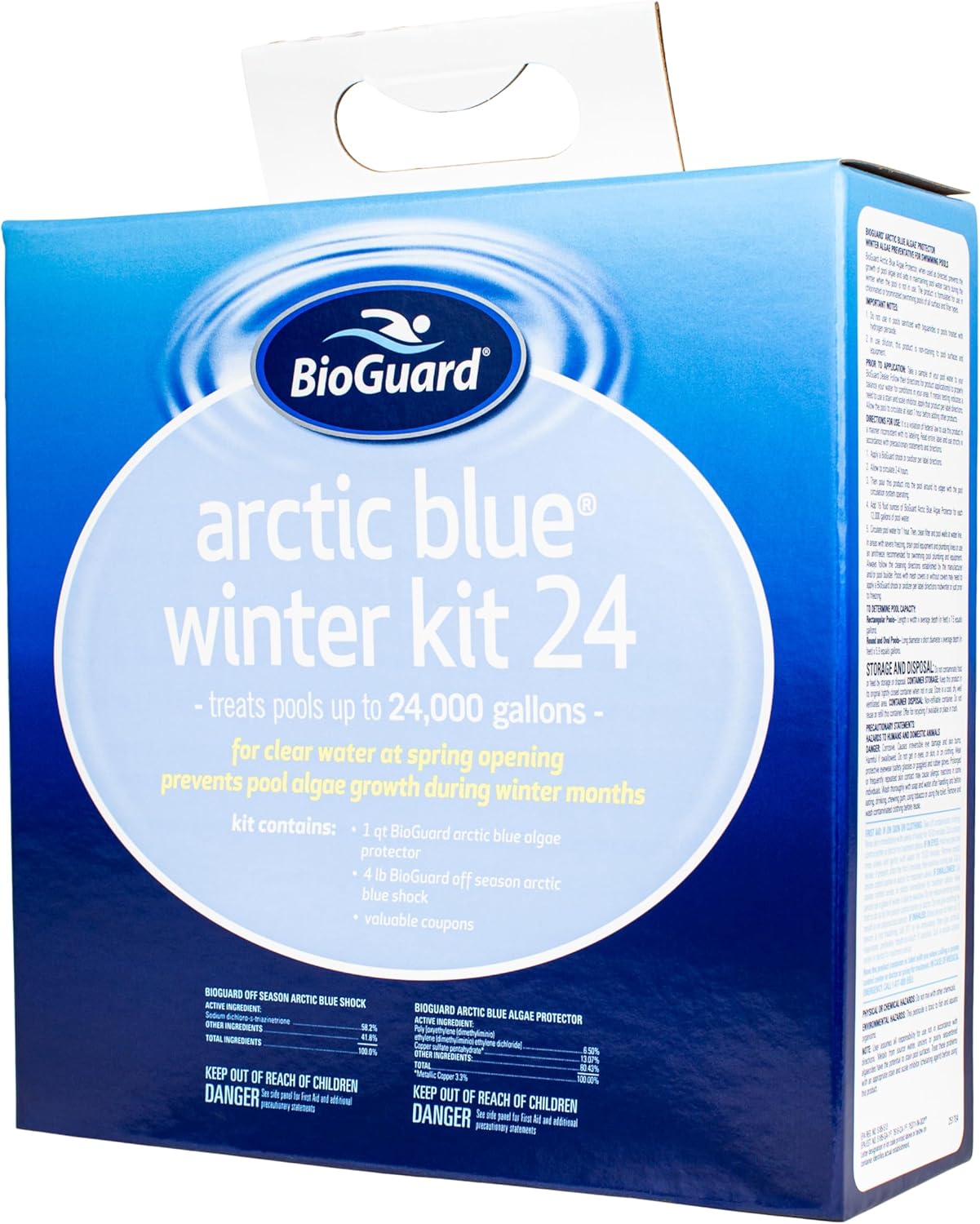
- Treats up to 24,000 gallons
- Two-part closing approach: shock plus algae protector
- Compatible with common pool surfaces and filter types per BioGuard

- Treats pools up to 30,000 gallons
- Two drop-in winter balls simplify dosing
- Listed for above-ground, in-ground and saltwater pools

- One 16 oz treatment covers up to 15,000 gallons
- Single-liquid closing treatment rather than separate packets
- Compatible with chlorine and saltwater pools when used as directed
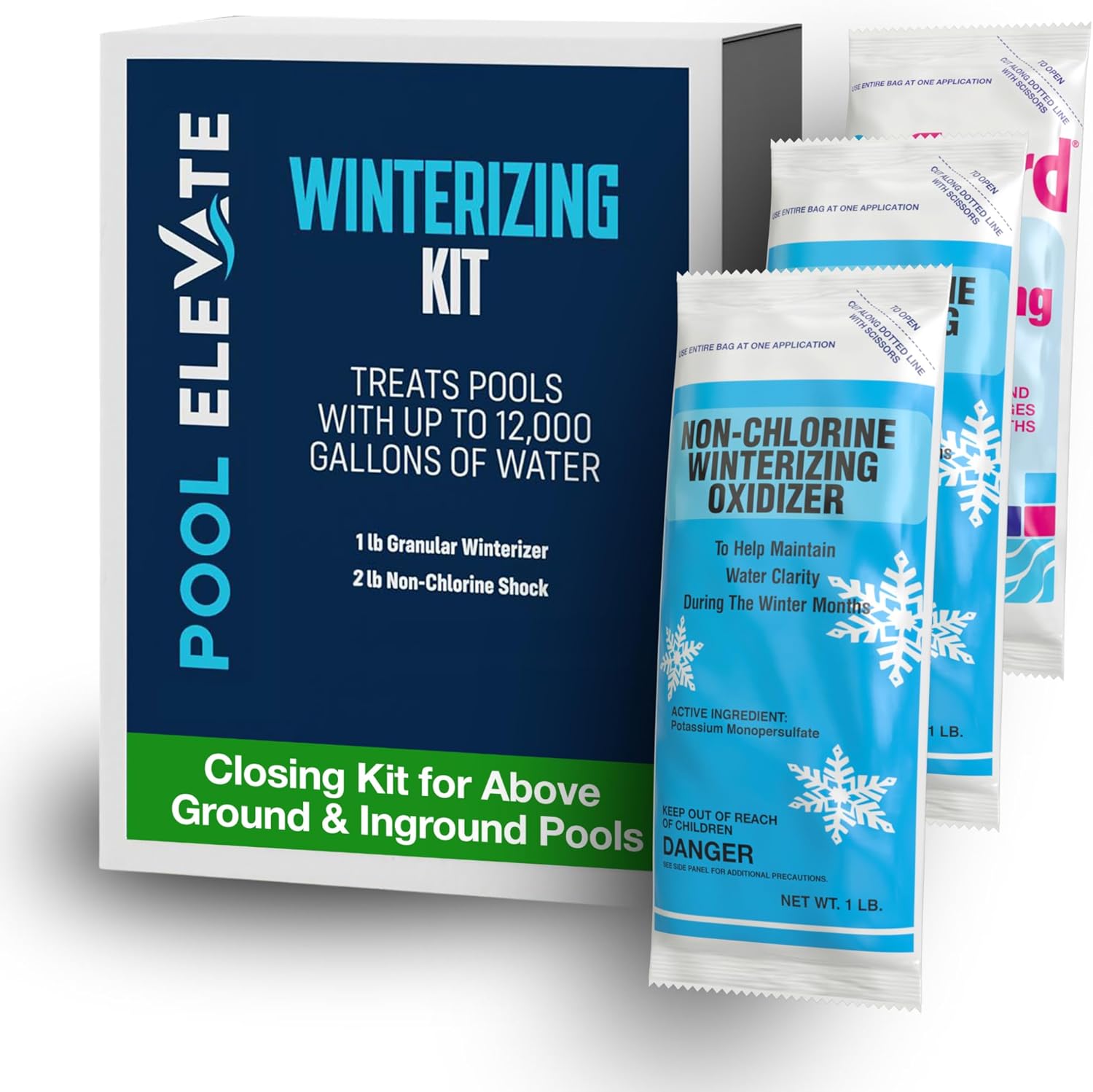
- Treats pools up to 12,000 gallons
- Includes 2 lb non-chlorine shock
- Includes 1 lb granular winterizer

- Sized for small pools up to 7,500 gallons
- Includes chlorine-free shock, winterizer, stain-away and balance product
- Floater, oil-absorbing sponge and plug-removal tool included
What to Look for When Buying a Pool Closing Kit
Match the Kit Rating to Actual Pool Volume
The gallon rating is the first filter. A 7,500-gallon kit is intended for a very different water volume from a 45,000-gallon kit, and stronger is not automatically better. Pool chemicals should be dosed according to the product label and the pool’s actual water volume. If your pool falls between package sizes, follow the specific manufacturer’s dosing or sizing instructions rather than improvising an overdose.
Volume estimates should reflect the real water depth, not simply the wall height. Rectangular, round, oval, and free-form pools use different volume calculations, and a sloped deep end changes the average depth. A reasonably accurate volume estimate helps the closing treatment reach its intended concentration without wasting chemicals or creating avoidable water-balance problems.
Decide Between a Multi-Step Kit and an All-in-One Treatment
Traditional closing kits separate functions into different products. That can be useful when you want to control oxidation, algae prevention, stain management, and slow-release treatment independently. In The Swim, Doheny’s, Rx Clear, Robelle, and POOLACC all follow this broader multi-component approach, although their exact contents differ.
AquaDoc and POOLHACKER move in the opposite direction. AquaDoc uses one 16-ounce liquid dose for a pool up to 15,000 gallons, while POOLHACKER uses two drop-in winter balls for a pool up to 30,000 gallons. These formats reduce measuring and package clutter, but they also give you less component-by-component control than a kit with separate shock, stain treatment, and algae-control products.
Check Whether Shock Is Chlorine-Based or Chlorine-Free
The word “shock” does not describe one universal chemistry. Several kits in this guide use non-chlorine or chlorine-free oxidizing products, including In The Swim’s listed chlorine-free winter shock and Robelle’s non-chlorine Winter Shock. Rx Clear’s All-in-One Shock X-Tra is a dichlor-based chlorine shock. Those products should not be treated as interchangeable or combined casually.
Use the exact sequence and dosage printed on the kit you buy. Never mix concentrated pool chemicals together in a bucket, feeder, or storage container unless the product label explicitly instructs it. Different oxidizers and sanitizers can be incompatible in concentrated form, so each product should be handled as its own chemical rather than as a generic “shock.”
Consider Metals, Scale, and Staining Risk
Pools with known metal content, hard water, scale history, or previous liner staining can benefit from a closing system that includes a dedicated stain or metal-control step. Doheny’s Master Kit includes Natural Chemistry METALfree, In The Swim includes Pool Winter Stain-Away, Rx Clear includes Winter Stain Out, Robelle includes Anti-Stain Control, and POOLACC includes a stain-away component.
A kit without a separate stain-control bottle is not automatically incomplete; it may simply be aimed at a simpler water profile or use a different formulation. If metals or scale have been a recurring problem, however, the presence of a clearly identified stain/metal component is a meaningful buying difference rather than an extra item with no purpose.
Look at Algae Control Separately from Oxidation
Oxidizing contaminants and suppressing algae are related parts of closing, but they are not the same function. BioGuard makes this distinction easy to see: the Arctic Blue kit pairs Arctic Blue Shock with Arctic Blue Algae Protector. Rx Clear identifies its Winterizing Powder as the algae-control part of the system. Other brands use terms such as winterizer or inhibitor.
This distinction matters for long off-seasons. A strong closing treatment cannot compensate for water that is closed while visibly dirty or actively green. The pool should be cleaned and brought into the condition required by the kit directions before winter chemicals are added.
Check Saltwater Compatibility Rather Than Assuming It
A saltwater pool still uses chlorine generated from salt during the swimming season, but the generator may be shut down or removed from service during winterization depending on the system and climate. Some closing products explicitly state saltwater compatibility. In The Swim and Doheny’s do, and POOLHACKER lists saltwater as an intended pool type.
For any kit, the product label takes priority over broad category claims. Saltwater equipment also has its own winterization requirements, so chemical compatibility does not mean the closing kit protects the cell, plumbing, heater, filter, or pump from freezing.
Count Useful Components, Not Just the Number of Pieces
A box with many packets is not automatically more complete. What matters is what each component does. A floater may extend treatment through the off-season. A stain-control product addresses metals and deposits. An oil-absorbing sponge can collect surface oils under the cover. A plug-removal tool is a convenience accessory, not a chemical treatment.
Compare functions instead of package count. That makes it easier to see why a small-pool kit such as POOLACC can include many accessories while a compact treatment such as AquaDoc contains only one bottle. They are solving the closing job in different ways.
In The Swim Pool Closing Kit – 15,000 Gallons
In The Swim’s 15,000-gallon closing kit is a broad multi-part system for pool owners who want oxidation, winter treatment, stain control, slow-release protection, and an oil-absorbing accessory in one package. The current manufacturer configuration lists one quart of Pool Winterizing Inhibitor, one quart of Pool Winter Stain-Away, 2 pounds of chlorine-free winter shock, a Winter Pool Floater containing 2.5 pounds of non-chlorine winter oxidizer, and one Winter Sorb sponge.
Chemical System and Included Components
The chlorine-free shock handles the initial oxidizing step without relying on a conventional chlorine shock. That is useful for owners who specifically want a non-chlorine closing shock, including vinyl-liner owners who are concerned about concentrated chlorine granules resting on the surface. The separate winterizing treatment and stain-away product give the kit more defined functions than a single-bottle closer.
The floating oxidizer is intended to release treatment after the initial closing application rather than putting the entire off-season treatment into the water at once. The Winter Sorb sponge has a different job: it floats at the surface to absorb oils that can collect under a closed cover. It does not replace filtration or chemical balance, but it addresses a type of contamination that liquid winterizer does not.
Pool Size and Compatibility
This package is sized for pools up to 15,000 gallons. In The Swim lists the kit for both chlorine pools and saltwater-generation pools. That capacity makes it a practical fit for many medium above-ground pools and smaller in-ground pools, but a larger pool needs the manufacturer-rated quantity rather than a single 15,000-gallon package stretched beyond its coverage.
Because this is a multi-component kit, it is better suited to an owner who is comfortable following a sequence of separate additions. The payoff is clearer control over oxidation, stain protection, and extended treatment. The tradeoff is more handling than an all-in-one liquid.
Practical Closing Use
The most useful way to approach this kit is as the chemical phase of an already-clean pool. Debris should be removed and the water brought into the balance range required by the label before closing chemicals are added. After chemical treatment, the pool’s plumbing, equipment, water level, accessories, and cover still need to be handled according to the pool and equipment manufacturers’ winterization procedures.
The chlorine-free shock is a meaningful distinction if you do not want to use dichlor-based shock at closing. It also makes this kit different from Rx Clear, which includes a chlorine shock. Neither chemistry is universally preferable; compatibility with the pool surface, sanitizer program, and label directions should guide the choice.
Important Strengths
The kit covers more than one winter-water problem. Stain control is already included, and the floater extends the treatment strategy beyond the day the pool is closed. The Winter Sorb sponge is also a useful accessory for pools that develop an oily waterline under a cover.
Important Limitations
A 15,000-gallon rating limits the convenience for large in-ground pools because multiple packages may be required according to the manufacturer’s sizing directions. The number of separate products also means more steps than AquaDoc or POOLHACKER. Owners who want the shortest possible closing routine may prefer a simpler format.
Who Should Consider It
This kit fits a pool owner with up to 15,000 gallons who wants a conventional, chlorine-free multi-step closing system with stain control and a slow-release floater included. It is especially relevant when spring staining and waterline oils have been recurring concerns.
Who Should Consider Another Option
Owners of much larger pools may find a higher-capacity kit more convenient. A 30,000- to 45,000-gallon pool can be covered more directly by products such as Robelle, Doheny’s, or Rx Clear. Someone who strongly prefers a one-dose closing treatment may also find AquaDoc easier to manage.
Pros
- Multi-component package addresses oxidation, winter treatment, stains and surface oils
- Uses a chlorine-free winter shock
- Includes a slow-release winter oxidizer floater
- Listed for chlorine and saltwater-generation pools
Cons
- Single kit is rated only to 15,000 gallons
- More separate steps than one-bottle or drop-in systems
- Does not replace plumbing, equipment or cover winterization
Doheny’s Master Pool Closing Kit – Up to 35,000 Gallons
Doheny’s Master Pool Closing Kit is aimed at larger pools and adds two Natural Chemistry products to the usual shock-and-winter-treatment structure. The current Master Kit is rated for pools up to 35,000 gallons and lists 3.6 pounds of Winter Oxidizing Tablets, three 1-pound bags of Oxidizing Shock, one quart of Natural Chemistry Pool Magic + PHOSfree, and one quart of Natural Chemistry METALfree.
What Makes the Master Kit Different
The Master Kit’s strongest distinction is the inclusion of Pool Magic + PHOSfree and METALfree. METALfree is the dedicated metal-management component, which is relevant for pools with known iron, copper, or staining concerns. Pool Magic + PHOSfree combines an enzyme-oriented cleanup product with phosphate-removal support, giving this package a broader water-treatment scope than a simple shock-and-algaecide kit.
The oxidizing tablets provide a separate slow-release winter treatment, while the three shock bags handle the initial oxidation step. This makes the package more modular than a single all-in-one closer. It also means the owner needs to follow the Doheny’s directions for order, circulation, and timing rather than combining the contents.
Capacity and Pool Type
The 35,000-gallon rating is one of the highest in this comparison. It is large enough for many full-size residential in-ground pools without combining several small-pool kits. Doheny’s also lists the Master Kit for saltwater pools, which is useful for owners who use a salt chlorine generator during the season.
Capacity is still a maximum treatment rating, not a reason to use the entire package in a much smaller pool without checking the instructions. If your water volume is substantially below 35,000 gallons, use the exact dosing guidance supplied with the kit.
Stain, Metal, and Phosphate Considerations
The inclusion of METALfree makes this kit particularly relevant where fill water or previous tests have shown metals. Metals can become more noticeable as water chemistry changes, and a long closed period gives stains time to develop. A dedicated metal-control step therefore has more value in a known problem pool than in water with no metal history.
Pool Magic + PHOSfree adds another layer. Phosphate management can be part of an algae-control program, but it should not be treated as a substitute for sanitizer or proper closing chemistry. Its presence is best viewed as an additional water-preparation tool within the kit.
Practical Use
This is a kit for an owner who is willing to perform a structured closing. The separate shock, tablets, metal treatment, and Pool Magic + PHOSfree are useful because they perform different tasks, but they also require more label reading than a one-bottle closer. The pool should be clean and balanced before the closing sequence begins.
The kit’s chemical completeness does not change the mechanical closing steps. Pumps, filters, heaters, salt cells, skimmers, returns, and plumbing need their own freeze-protection procedure where applicable. A chemical kit can help preserve water quality; it cannot stop water trapped in a pipe from freezing.
Important Strengths
Large capacity is the obvious advantage, but the water-treatment breadth is more important. Few kits in this group combine oxidation, slow-release tablets, metal control, and Pool Magic + PHOSfree in one package. That makes the Master Kit useful for a pool with more complicated off-season water concerns.
Important Limitations
The extra components are unnecessary complexity for an owner who only wants a basic oxidizer-and-winterizer routine. The kit is also sized far above many small above-ground pools, so a smaller package may be easier to dose appropriately.
Who Should Consider It
Doheny’s Master Kit is a strong match for medium-to-large pools, especially where metals, staining, or phosphate-related maintenance are already part of the owner’s routine. It also makes sense for saltwater-pool owners who want a complete multi-product closing package.
Who Should Consider Another Option
For a small pool under roughly 15,000 gallons, a lower-capacity kit can reduce waste and simplify dosing. Owners who prefer a single chemical treatment should look at AquaDoc, while those who want a minimal drop-in format may prefer POOLHACKER.
Pros
- High 35,000-gallon treatment capacity
- Includes three oxidizing shock bags plus winter oxidizing tablets
- Adds Natural Chemistry METALfree for metal management
- Includes Pool Magic + PHOSfree and is listed for saltwater pools
Cons
- More components and steps than simplified closing systems
- Large kit may be impractical for small pools
- Chemical treatment still requires separate mechanical winterization
Rx Clear Pool Closing Kit – Up to 45,000 Gallons
Rx Clear has the largest single-kit capacity in this comparison at up to 45,000 gallons. It is also one of the most traditional chemical bundles: the 45,000-gallon package includes three 1-pound bags of Alkaplus pH Powder, three 1-pound bags of All-in-One Shock X-Tra, three 1-pound bags of Winterizing Powder, one quart of Winter Stain Out, and two pre-filled floating dispensers.
A Broad Closing Package for Large Pools
The high capacity reduces the need to combine multiple small kits for a large in-ground pool. It also spreads closing tasks across clearly labeled components. Alkaplus supports pH adjustment, the shock oxidizes contaminants, Winterizing Powder supplies the winter algae-control step, Winter Stain Out addresses stain risk, and the floating dispensers provide an extended treatment element.
This structure is useful when the owner wants an organized box of closing chemicals rather than assembling separate products from different brands. It is not a substitute for testing the water. A pH-adjusting packet should be used according to the measured need and label directions rather than added automatically simply because it is included.
Chlorine-Based Shock Is a Key Difference
Rx Clear identifies All-in-One Shock X-Tra as a dichlor-based shock. That makes this kit chemically different from packages that emphasize chlorine-free or non-chlorine shock. A buyer specifically trying to avoid chlorine shock at closing should recognize that distinction before choosing the 45,000-gallon kit.
Dichlor can be an appropriate pool sanitizer and shock when used as directed, but concentrated chlorine products require careful handling. Follow the packet instructions, add products separately, and avoid allowing undissolved concentrated material to sit on surfaces if the label calls for pre-dissolving or circulation.
Stain Control and Floaters
Winter Stain Out gives the kit a dedicated stain-management step. That is useful in pools with a previous history of discoloration or metal-related deposits. The two pre-filled floating dispensers add a slow-release element, which distinguishes this package from Robelle’s liquid-and-shock approach.
A floater still needs to be used exactly as directed for the pool surface and cover type. It should not be improvised as a general chemical container, and unrelated chemicals should never be added to a pre-filled dispenser.
Practical Use
For a large pool, the main convenience is having one capacity rating that reaches 45,000 gallons. The tradeoff is a greater number of chemical packets and containers to handle. This is a better fit for an owner comfortable with a staged closing routine than for someone looking for a one-step treatment.
Because the kit contains a pH product, it is particularly important not to treat package contents as a mandatory dump-in sequence independent of test results. Balance the water to the ranges required by the pool and product instructions, then use the closing chemicals as directed.
Important Strengths
No other product in this group carries a higher stated gallon rating. The package also combines water-balance support, chlorine shock, algae-oriented winterizing powder, stain control, and slow-release floaters. For a large pool, that can reduce the need to shop for several separate closing products.
Important Limitations
The dichlor shock will not suit buyers specifically seeking a chlorine-free closing kit. The broad package can also be excessive for a small pool, and the included pH powder should not be viewed as something every pool needs in the same quantity.
Who Should Consider It
Rx Clear is suited to a large above-ground or in-ground pool where the owner wants a comprehensive multi-part closing package and is comfortable using chlorine-based shock. It is particularly relevant when stain control and extended floater treatment are priorities.
Who Should Consider Another Option
Choose another format if you want non-chlorine shock, a smaller gallon rating, or a minimal number of steps. In The Swim and Robelle provide non-chlorine shock approaches, while AquaDoc offers a single-liquid format.
Pros
- Largest stated capacity in this comparison at up to 45,000 gallons
- Includes pH powder, shock, winterizing powder and stain control
- Two pre-filled floating dispensers extend the treatment system
- Suitable for both above-ground and in-ground pool closing
Cons
- Shock component is dichlor-based rather than chlorine-free
- Many separate components require a more involved closing sequence
- Included pH powder should be used according to actual water-balance needs
Robelle 30,000 Gallon Triple-Action Winter Kit
Robelle’s 30,000-gallon Triple-Action Winter Kit takes a focused three-part approach. The current package centers on a liquid winter treatment, 4 pounds of Robelle Winter Shock, and two quarts of Anti-Stain Control. Robelle identifies the Winter Shock as a 100% soluble non-chlorine shock.
Three Functions Instead of a Large Accessory Bundle
The appeal of the Robelle kit is clarity. One component handles the winter treatment, one handles oxidation, and one addresses stains. There is no need to decide what to do with pH packets, enzyme products, sponges, or plug tools that may not be relevant to every pool.
That focused format also means the kit does not include every possible closing accessory. If your pool benefits from an oil-absorbing sponge, a slow-release floater, or a dedicated metal-control product, those may need to be purchased separately.
Non-Chlorine Winter Shock
The 4-pound Winter Shock component gives the package a substantial non-chlorine oxidizing step for a pool rated up to 30,000 gallons. A non-chlorine oxidizer can be attractive for owners who do not want to use a chlorine shock during closing. It still requires careful handling and label-based dosing; “non-chlorine” does not mean chemically harmless.
Solubility is useful because a fully soluble shock is easier to distribute through circulating water than a product that leaves undissolved granules. The pool’s pump and circulation system should be operated for the time stated in the kit directions before the mechanical shutdown steps begin.
Anti-Stain Control
Two quarts of Anti-Stain Control make stain management a major part of the Triple-Action formula. This is relevant for vinyl, plaster, and other surfaces where discoloration can become a spring-opening problem. The exact need still depends on water chemistry and metal content, but the component is already present rather than being an add-on purchase.
Robelle’s own and retail descriptions use slightly different naming for the liquid winter-treatment component, so the most useful buying point is its function rather than the front-label wording: the kit includes a separate winter-treatment liquid alongside shock and anti-stain liquid.
Capacity and Practical Use
A 30,000-gallon rating places the kit between BioGuard’s 24,000-gallon package and Doheny’s 35,000-gallon Master Kit. It is large enough for many residential in-ground pools while remaining simpler than the higher-component-count kits.
The absence of a floater can be a benefit or a limitation depending on preference. There is less hardware to manage under the cover, but buyers who specifically want a slow-release floating treatment should look at In The Swim, Rx Clear, or POOLACC.
Important Strengths
Robelle offers a straightforward three-function program without chlorine shock. The anti-stain quantity is generous relative to many smaller kits, and the 30,000-gallon capacity works for a broad range of residential pools.
Important Limitations
It does not include a floater, oil-absorbing sponge, pH adjustment product, or plug tools. Those omissions keep the package focused, but an owner who wants one box containing both chemicals and closing accessories may prefer POOLACC for a small pool or another multi-component kit.
Who Should Consider It
This kit fits a medium-to-large pool owner who wants non-chlorine oxidation, a dedicated stain-control step, and a simpler chemical program than Doheny’s or Rx Clear.
Who Should Consider Another Option
Buyers who need a larger 35,000- to 45,000-gallon capacity or who want slow-release floaters and more accessory items should compare Doheny’s and Rx Clear. Very small pools do not need a 30,000-gallon package unless the label provides an appropriate partial-dose method.
Pros
- Treats pools up to 30,000 gallons
- Includes 4 lb of soluble non-chlorine Winter Shock
- Dedicated Anti-Stain Control is part of the package
- Focused three-part system is easier to understand than large mixed bundles
Cons
- No slow-release floater is listed with the kit
- No oil-absorbing or mechanical closing accessories
- Less suitable for buyers wanting a single-dose treatment
BioGuard Arctic Blue Winter Closing Kit 24
BioGuard’s Arctic Blue Winter Closing Kit 24 is a simpler two-chemical system rated for up to 24,000 gallons. The 24,000-gallon package is sold with two 2-pound Arctic Blue Shock products and one quart of Arctic Blue Algae Protector. BioGuard positions the pair as an off-season oxidation and algae-control program.
Two-Part Closing Chemistry
The main advantage is that the two components have easy-to-understand roles. Arctic Blue Shock is the oxidizing/clarifying part of the program, while Arctic Blue Algae Protector is the algae-control component. There is no separate stain-control bottle or floater in this specific kit.
That simplicity reduces the number of products to handle, but it also means owners with known metal, stain, or scale issues may need a separate treatment recommended for their water conditions. BioGuard sells other closing products, but they should not be assumed to be included with the Arctic Blue Kit 24.
Surface and Filter Compatibility
BioGuard states that Arctic Blue Shock is suitable for common pool surfaces, while the Algae Protector is formulated for chlorinated and brominated pools and common filter types. That broad compatibility is helpful for owners who do not want a kit tied to one liner or filter configuration.
Compatibility is not the same as a universal dose. The Kit 24 is sized for 24,000 gallons, so a smaller pool should be treated according to the package directions rather than automatically receiving the full contents.
Algae Prevention Is the Centerpiece
A pool closed with active algae already present is much harder to manage than a clean pool. Arctic Blue’s algae-control component is intended for prevention through the closed season, not as a substitute for cleaning up an already green pool before closing.
This makes preparation important. Remove leaves and sediment, clean the filter as appropriate, and bring the water into the balance and sanitizer condition required by the BioGuard directions before the final closing treatment.
Practical Use
A two-part system is easier to organize than a box with five or six different products. It is a useful middle ground between AquaDoc’s one-bottle closer and the larger multi-component kits. The owner still retains a separate oxidation step and algae-control step rather than relying on one blended product.
Important Strengths
The Kit 24 gives a clear shock-plus-algae-protector program for a medium-size pool. Its 24,000-gallon rating covers many residential pools, and BioGuard publishes a straightforward division between the two chemical functions.
Important Limitations
There is no dedicated stain/metal product in the Kit 24 contents described above. There is also no slow-release floater or oil-absorbing sponge. Pools with recurring stains or metal issues may need an additional compatible product based on water testing and label guidance.
Who Should Consider It
BioGuard Arctic Blue Kit 24 suits a pool owner who wants a recognized two-part closing routine focused on oxidation and algae prevention without a large collection of accessory chemicals.
Who Should Consider Another Option
If metal and stain control are important, compare In The Swim, Doheny’s, Rx Clear, Robelle, or POOLACC, all of which include a specifically identified stain- or metal-control component. If maximum simplicity is the priority, AquaDoc uses only one 16-ounce treatment for up to 15,000 gallons.
Pros
- Simple two-part shock and algae-protector system
- Kit 24 treats up to 24,000 gallons
- Algae Protector is formulated for common pool surfaces and filter types
- Fewer separate chemicals to organize than large multi-part kits
Cons
- No dedicated stain or metal-control product in this kit
- No slow-release floater or oil-absorbing accessory
- Owners with complex water issues may need additional closing products
POOLHACKER 3 in 1 Winter Closing Kit – Up to 30,000 Gallons
POOLHACKER’s 3 in 1 Winter Closing Kit is the most unconventional format in this comparison. Instead of separate shock bags, algaecide bottles, and stain-control liquids, the system uses two drop-in winter balls and is rated for pools up to 30,000 gallons. The manufacturer lists it for above-ground, in-ground, saltwater, and traditional pools.
Drop-In Format
The central buying reason is convenience. The manufacturer directs the user to place both winter balls into the pool as part of the closing process rather than measuring several individual chemicals. For an owner who dislikes multi-step chemical packages, this can make the last chemical step of closing easier to organize.
The tradeoff is reduced modularity. Traditional kits tell you exactly which separate product is being used for shock, stain control, and algae control. POOLHACKER presents the treatment as an integrated 3-in-1 system, so it is less suited to an owner who wants to adjust each function independently.
Capacity and Pool Compatibility
The up-to-30,000-gallon rating places it alongside Robelle in overall pool size. That is enough capacity for many in-ground pools while still covering above-ground applications. Saltwater compatibility is also listed, which broadens its usefulness for pools that use a salt chlorine generator during the season.
The product’s passive format does not remove the need to prepare the water. Debris removal, water balance, sanitizer condition, filter cleaning, and mechanical winterization remain separate tasks. The balls should be used only in the manner described by the product instructions.
What the Simplified System Changes
With a conventional kit, an owner can choose to increase attention to metals, stains, or oxidation by selecting a package with a dedicated component. With this system, the benefit is fewer decisions at closing, while the limitation is fewer separate levers to adjust. That distinction matters more than the number “3 in 1.”
If your pool has a history of iron stains or scale, a specialist stain/metal product may still be appropriate depending on the product label and water test results. Do not add unrelated chemicals to the winter balls or assume that “all-in-one” means every possible water problem is covered.
Practical Use
A drop-in system can be attractive for seasonal above-ground pools where the owner wants to minimize chemical handling. It can also suit an in-ground pool that is already well balanced and has no recurring metal or stain issue. The 30,000-gallon rating gives it more reach than many simplified products.
Important Strengths
The low-step format is the defining advantage. Two winter balls are easier to inventory and deploy than multiple bottles and packets. The 30,000-gallon rating is also generous for a simplified product.
Important Limitations
The system gives less component-by-component control than a traditional closing kit. Buyers looking specifically for a named stain remover, pH product, or separate shock will find more transparent component lists in Rx Clear, Doheny’s, In The Swim, or Robelle.
Who Should Consider It
POOLHACKER fits an owner who values a short chemical-closing routine, has a pool up to 30,000 gallons, and is comfortable using an integrated treatment rather than separate chemicals.
Who Should Consider Another Option
Choose a multi-component kit if you need targeted stain/metal management, a specific shock chemistry, or a slow-release floater. Buyers who want a one-bottle liquid rather than floating treatment should compare AquaDoc.
Pros
- Two drop-in winter balls keep the chemical routine simple
- Rated for pools up to 30,000 gallons
- Listed for above-ground, in-ground and saltwater pools
- Requires less measuring than conventional multi-component kits
Cons
- Less component-by-component control over closing chemistry
- No separate stain-control or pH product is identified in the package
- Integrated format is less suitable for owners who prefer to tune each treatment separately
AquaDoc All-in-One Pool Closing Kit Chemical – 16 oz
AquaDoc’s Pool Closer is the most compact package here: one 16-ounce liquid treatment covers up to 15,000 gallons. The official directions call for adding one pint around the pool perimeter, with the sanitizer level below 5 ppm before application. AquaDoc also says to add the closer last and to wait at least 24 hours after superchlorination.
Single-Bottle Dosing
There are no separate shock bags, stain-control bottles, or floaters to coordinate in the base 16-ounce product. That makes AquaDoc attractive for an owner who wants the least complicated chemical addition at the end of closing. The entire bottle corresponds to the published 15,000-gallon dose.
The simplicity makes the directions more important, not less. AquaDoc specifically sets a sanitizer condition and timing relative to superchlorination. Combining the bottle with another kit’s shock schedule could conflict with those instructions, so the AquaDoc label should govern its use.
Compatibility
AquaDoc lists the closer for in-ground and above-ground pools and states compatibility with chlorine and saltwater pools when used as directed. That covers the major residential pool configurations without requiring a separate saltwater version.
No Mandatory Shock Step in the Product Directions
AquaDoc states that shocking is not necessary as part of using this closer. That is a significant difference from kits built around included shock packets. It should not be interpreted as a general rule that no pool ever needs corrective sanitation before closing. If the water is cloudy, dirty, or out of balance, correct those conditions according to appropriate pool-care guidance before applying the closing treatment.
The instruction to keep sanitizer below 5 ppm and to wait at least 24 hours after superchlorination is especially important if the pool has recently been shocked. The product is intended to be added as the final chemical step, not immediately on top of a high sanitizer dose.
Practical Use
For a well-maintained pool under 15,000 gallons, one measured bottle removes a lot of closing-day complexity. There are fewer containers to store and no slow-release device to retrieve later. This can be useful for small in-ground pools and many above-ground pools.
The limitation is the same feature viewed from the other side: the package does not give separate products for stain control, algae control, oxidation, and metal management. Owners with recurring specialty water problems may prefer a modular kit or may need additional compatible treatment based on the water test and label directions.
Important Strengths
AquaDoc is easy to size and easy to understand: 16 ounces for up to 15,000 gallons. Its official directions are also specific about sanitizer level and timing, which helps prevent the common mistake of layering closing chemicals too closely together.
Important Limitations
The 15,000-gallon capacity is modest, and the one-bottle format gives less ability to target metals, stains, or algae with separate products. Buyers who want an included shock should choose a kit designed around shock rather than adding one to AquaDoc without checking compatibility and timing.
Who Should Consider It
This product suits a small-to-medium pool owner who wants a minimal chemical closing step and is willing to prepare the pool correctly before adding the final treatment.
Who Should Consider Another Option
If you want a box containing shock, stain treatment, and slow-release components, compare In The Swim or POOLACC. Larger pools may be easier to cover with a 24,000- to 45,000-gallon kit rather than combining multiple bottles.
Pros
- One 16 oz liquid treats up to 15,000 gallons
- Simple final-step dosing with no separate packets to coordinate
- Listed for above-ground, in-ground, chlorine and saltwater pools
- Official directions clearly specify sanitizer and post-superchlorination timing
Cons
- Only 15,000 gallons of coverage per bottle
- No separate shock, stain-control bottle or floater in the base product
- Less modular for pools with specialized metal or stain problems
POOL ELEVATE Winter Closing Kit – Up to 12,000 Gallons
POOL ELEVATE uses a compact conventional format for pools up to 12,000 gallons. The corroborated package contents are 2 pounds of non-chlorine shock and 1 pound of granular winterizer, with instructions for closing. It is marketed for both above-ground and in-ground pools.
Straightforward Two-Chemical Structure
This kit is easy to understand because the two main products are familiar closing categories. The non-chlorine shock provides the oxidizing step, while the granular winterizer is the off-season treatment. There is no large assortment of balance packets or accessories to sort through.
That makes the kit a useful fit for owners who already have their preferred products for water balance, stain control, and mechanical winterization. It supplies the core closing chemistry without duplicating accessories they may already own.
12,000-Gallon Capacity
The 12,000-gallon rating puts POOL ELEVATE below In The Swim and AquaDoc in capacity and well below the large-pool kits. That is not a disadvantage for a 10,000- to 12,000-gallon pool; correctly sized chemistry is more useful than buying a large kit simply because it contains more product.
Owners of larger pools should use the number of kits or dose specified by the manufacturer rather than assuming one package can be stretched. Conversely, a very small pool should be dosed according to label directions rather than automatically receiving the entire package.
Non-Chlorine Shock
The included 2-pound shock is identified as non-chlorine. That makes POOL ELEVATE relevant to buyers who want an oxidizer without a dichlor shock at closing. As with Robelle and In The Swim, the distinction is about chemistry, not about eliminating chemical-handling precautions.
The shock and winterizer should be added separately and in the sequence on the label. Do not mix the dry products together before adding them to the pool.
What Is Not Included
No dedicated stain/metal-control bottle, floater, oil-absorbing sponge, or plumbing tool is listed in the corroborated package contents. This keeps the kit simple and compact, but owners with known metal or stain issues should plan their water-treatment needs separately.
Important Strengths
For a pool around 12,000 gallons, POOL ELEVATE delivers a straightforward shock-and-winterizer combination without a large kit designed for much more water. The non-chlorine shock is a meaningful differentiator from Rx Clear’s dichlor-based shock.
Important Limitations
The small capacity is not convenient for a large in-ground pool, and the package does not address stains or metals with a dedicated product. It is therefore better viewed as a core chemical kit than an all-accessories closing box.
Who Should Consider It
POOL ELEVATE fits owners of small in-ground or above-ground pools who want a conventional two-product winterizing routine with non-chlorine shock.
Who Should Consider Another Option
If you want stain control and a floater included, In The Swim is more comprehensive at a similar pool-size range. For a very small pool where accessories are also needed, POOLACC adds a sponge and plug-removal tool.
Pros
- Appropriately sized for pools up to 12,000 gallons
- Includes 2 lb of non-chlorine shock
- Simple 1 lb granular winterizer plus shock format
- Suitable for above-ground and in-ground pools
Cons
- Low capacity compared with the 24,000- to 45,000-gallon kits
- No dedicated stain or metal-control product listed
- No floater, sponge or mechanical closing accessories
POOLACC All-in-One Winter Pool Closing Kit – Up to 7,500 Gallons
POOLACC is the smallest-capacity package in this comparison, but it is one of the most accessory-rich. The Amazon listing rates it for pools up to 7,500 gallons and identifies chlorine-free oxidizing shock, pool winterizer, winterizing stain-away, a pool-balance component, a winter floater, an oil-absorbing sponge, a plug/return-jet removal tool, and guided instructions.
Designed Around Small Pools
A 7,500-gallon rating makes this kit much better aligned with compact above-ground pools and small in-ground plunge-style pools than with full-size residential in-ground pools. Small capacity can actually improve convenience because the owner is not buying a 30,000- or 45,000-gallon package and trying to work out what fraction to use.
The capacity must still match the real pool volume. Many round above-ground pools hold more water than owners expect once diameter and average depth are calculated, so verify the gallons before assuming the small kit is sufficient.
Chemical Components
The chemical side covers several distinct jobs. Chlorine-free shock supplies oxidation, winterizer handles the seasonal treatment, stain-away targets discoloration risk, and the balance product supports water preparation. The winter floater adds a slow-release element instead of relying entirely on the initial closing dose.
This arrangement resembles In The Swim’s broader multi-part strategy but at half the stated pool capacity. It gives a small-pool owner access to stain control and a floater without buying a large-pool kit.
Useful Physical Accessories
POOLACC also includes two non-chemical items that can be genuinely useful: an oil-absorbing sponge and a plug/return-jet removal tool. The sponge addresses oils that collect at the water surface, while the tool can assist with certain threaded plugs or return fittings during closing.
Practical Use
For a small pool, the appeal is having most of the common closing consumables in one box. There is less chance of forgetting a stain treatment or floater, and the physical accessories can reduce separate purchases. The kit is still more involved than AquaDoc because several products must be added individually.
The chlorine-free shock also separates it from Rx Clear’s dichlor-based system. If the pool owner prefers non-chlorine oxidation and wants a broad kit for a small water volume, POOLACC has a well-defined niche.
Important Strengths
This is the most complete small-pool package in the group from an accessory standpoint. It combines oxidation, winterizer, stain control, balance support, a floater, an oil sponge, and a fitting tool rather than supplying only one or two chemicals.
Important Limitations
The 7,500-gallon capacity is the lowest here, so it is not a practical one-box answer for medium or large pools. The extra accessories also add steps compared with a simplified liquid or drop-in treatment.
Who Should Consider It
POOLACC is suited to a small above-ground or in-ground pool owner who wants a chlorine-free multi-part kit and appreciates having closing accessories included.
Who Should Consider Another Option
Pools over 7,500 gallons should use an appropriately rated package or the exact quantity permitted by the manufacturer’s directions. If the goal is minimum chemical handling rather than maximum included components, AquaDoc is simpler.
Pros
- Comprehensive package for pools up to 7,500 gallons
- Includes chlorine-free shock, winterizer, stain-away and balance support
- Winter floater and oil-absorbing sponge are included
- Plug/return-jet removal tool adds practical closing value
Cons
- Lowest gallon rating in this comparison
- More individual steps than one-bottle or drop-in systems
- Mechanical accessory compatibility still depends on the pool’s actual fittings
Detailed Pool Closing Kit Buying Guide
Start With a Clean Pool, Not a Chemical Shortcut
Closing chemicals work best in water that is already physically clean. Leaves, insects, sediment, and biofilm consume oxidizer and can sit under the cover for months. Vacuum the floor, brush surfaces, empty baskets, and clean or backwash the filter as appropriate before the final chemical sequence.
If the pool is visibly green or cloudy, treat the underlying water problem before closing. A winter kit is intended to maintain off-season conditions, not to hide an active algae bloom until spring. Closing dirty water usually makes spring startup harder regardless of how many chemicals are in the kit.
Balance Water Before the Final Closing Products
pH, total alkalinity, calcium hardness, and sanitizer condition affect corrosion, scale, staining, and sanitizer efficiency. The exact target ranges can depend on surface type, sanitizer system, and the product being used, so follow the pool-equipment and chemical-label guidance rather than relying on a single universal number.
Some kits include a balance product or pH powder, but inclusion does not prove that your water needs the entire amount. Test first. Rx Clear’s pH powder is useful when adjustment is required; it should not be added simply to empty the packet.
Understand Oxidizer Versus Algaecide
An oxidizer helps break down organic contamination and can restore water clarity, while an algaecide or algae protector is intended to suppress algae growth. Several closing kits provide both functions separately because they address different parts of off-season water management.
This is why a two-part system such as BioGuard Arctic Blue can make sense despite containing fewer items than a larger bundle. Its shock and algae protector are two purpose-specific products. Product count is less important than whether the functions match your pool’s needs.
Know When Stain and Metal Control Matters
If your fill water contains iron or copper, or if the pool has shown brown, green, gray, or blue-green staining in the past, a closing kit with a clearly identified metal or stain component deserves attention. Long periods without normal circulation can make deposit control especially important.
Doheny’s includes METALfree, while In The Swim, Rx Clear, Robelle, and POOLACC include specifically named stain-control products. These are more relevant to a known stain problem than an extra pound of shock. Water testing can help determine whether metals are actually present.
Choose Slow-Release Treatment Deliberately
Floaters and tablets extend chemical delivery after the pool is covered. In The Swim uses a winter oxidizer floater, Rx Clear includes pre-filled floating dispensers, and POOLACC includes a winter floater. That can be useful during a long closed season, but the device must be compatible with the pool surface and used exactly as directed.
Do not repurpose an empty floater with a different chemical or combine incompatible products in the same dispenser. Residues can react with a new chemical even after the container appears empty.
Small Pools Need Correct Dosing Too
A small above-ground pool is not safer to overdose simply because it is inexpensive or easy to drain. Too much chemical can damage surfaces, alter water balance, and make spring adjustment harder. A kit such as POOLACC’s 7,500-gallon package or POOL ELEVATE’s 12,000-gallon package can be easier to size for compact pools than a 35,000- or 45,000-gallon kit.
Large Pools Benefit From Higher-Capacity Kits
Large in-ground pools can make low-capacity kits cumbersome because multiple packages may be needed. Doheny’s covers up to 35,000 gallons and Rx Clear up to 45,000 gallons, reducing the number of separate kits required. Robelle and POOLHACKER each cover up to 30,000 gallons.
Saltwater Pools Still Need Mechanical Winterization
A closing kit labeled for saltwater pools addresses the water chemistry, not the salt chlorine generator hardware. The cell, control system, flow switch, pump, filter, heater, and plumbing need whatever cold-weather shutdown procedure their manufacturers specify.
Vinyl Liners Require Careful Chemical Handling
Concentrated granular chemicals can discolor a liner if they sit on the surface. If the selected product calls for pre-dissolving, dilution, or circulation, follow that instruction. Non-chlorine shock can be appealing to vinyl-pool owners, but it still needs to be distributed according to its label.
Never toss incompatible powders together into one bucket to save time. Pool chemicals are safest when stored, measured, and added separately in accordance with the product directions.
A Closing Kit Does Not Winterize Plumbing
In freeze-prone climates, water trapped in pipes, pumps, filters, heaters, chlorinators, or other equipment can expand as it freezes. Chemical treatment in the pool cannot prevent that physical damage. The line and equipment procedure should follow the pool builder or equipment manufacturer, especially for complex in-ground systems.
Mechanical steps can include lowering the water level where appropriate, draining equipment, blowing or purging lines, installing winter plugs, protecting skimmers, removing accessories, and covering the pool. The exact method varies significantly by pool and climate, so a generic chemical-kit instruction should not override equipment documentation.
Store Leftover Chemicals Safely
If a kit leaves unused product, keep each chemical in its original labeled container, tightly closed, dry, and separated from incompatible materials according to the label. Never transfer pool chemicals to food containers or combine leftovers to save space.
Moisture, heat, contamination, and mixing can create hazardous reactions. If a product is damaged, wet, or unidentifiable, follow local hazardous-waste guidance rather than guessing how to use or discard it.
Direct Pool Closing Kit Comparisons
In The Swim vs POOLACC
These two kits use a similar broad philosophy: chlorine-free oxidation, winter treatment, stain control, a floater, and an oil-absorbing accessory. The main difference is scale. In The Swim is rated to 15,000 gallons, while POOLACC is rated to 7,500 gallons and adds a plug/return-jet removal tool plus a balance component.
For a small above-ground pool, POOLACC avoids buying capacity you do not need. For a pool closer to 10,000–15,000 gallons, In The Swim is the more appropriately sized one-kit option. Both still require separate mechanical winterization.
Doheny’s Master vs Rx Clear 45,000 Gallon Kit
Both target larger pools, but their chemistry differs. Doheny’s covers up to 35,000 gallons and adds Natural Chemistry METALfree plus Pool Magic + PHOSfree to its oxidizing shock and winter tablets. Rx Clear reaches 45,000 gallons and includes pH powder, dichlor shock, winterizing powder, Winter Stain Out, and two pre-filled floaters.
Choose between them based on the water issues you need to manage, not only gallon rating. Doheny’s is more clearly oriented toward metal and phosphate-related maintenance. Rx Clear provides the higher capacity and a more conventional balance/shock/winterizer/stain/floater package.
Robelle Triple-Action vs BioGuard Arctic Blue Kit 24
Robelle is rated to 30,000 gallons and adds a dedicated anti-stain product to its winter treatment and non-chlorine shock. BioGuard Kit 24 is rated to 24,000 gallons and keeps the program to Arctic Blue Shock plus Arctic Blue Algae Protector.
A pool with known staining concerns may benefit from Robelle’s included anti-stain component. A pool owner who prefers a concise oxidation-plus-algae-control routine may find BioGuard easier to manage. Neither package should be judged simply by the number of containers.
POOLHACKER 3 in 1 vs AquaDoc Pool Closer
Both are simplified systems, but their physical formats are different. POOLHACKER uses two drop-in winter balls and covers up to 30,000 gallons. AquaDoc uses one 16-ounce liquid application for up to 15,000 gallons and gives specific timing instructions around sanitizer and superchlorination.
POOLHACKER suits a larger pool owner who likes a passive drop-in approach. AquaDoc suits a smaller pool owner who prefers a measured liquid final step. Neither provides the same component-level control as a traditional multi-part kit.
POOL ELEVATE vs In The Swim
Both use non-chlorine shock and sit in the small-to-medium pool range. POOL ELEVATE is rated to 12,000 gallons and centers on 2 pounds of non-chlorine shock plus 1 pound of granular winterizer. In The Swim reaches 15,000 gallons and adds stain control, a slow-release oxidizer floater, and an oil-absorbing sponge.
POOL ELEVATE is the simpler core-chemistry package. In The Swim is the more comprehensive bundle for an owner who wants several winter-water functions in one box.
Rx Clear vs POOLHACKER for a 30,000-Gallon Pool
Both can cover a 30,000-gallon pool, but the ownership experience is very different. Rx Clear uses multiple measured chemicals and floaters, giving the owner more explicit control over pH support, shock, winterizing treatment, and stains. POOLHACKER reduces the chemical step to two winter balls.
An owner who wants transparency and separate treatment functions is better served by the conventional Rx-style structure. An owner who prioritizes a short dosing routine may prefer POOLHACKER. The final decision should also account for the pool’s known water problems and the label compatibility of each product.
Common Pool Closing Kit Buying Mistakes
Buying by Package Size Instead of Pool Gallons
A physically large box may contain accessories rather than more treatment capacity. Always compare the gallon rating first. POOLACC includes many pieces but covers only 7,500 gallons, while AquaDoc uses one small bottle for up to 15,000 gallons.
Assuming Every Kit Contains Algaecide, Stain Control, and Shock
The component mix varies substantially. BioGuard’s Kit 24 focuses on shock and algae protection. Robelle adds stain control. Doheny’s adds metal and phosphate-related products. AquaDoc uses one integrated liquid rather than separate categories. Read the component list instead of assuming the words “closing kit” describe a fixed formula.
Mixing Instructions From Different Brands
AquaDoc tells users to add its closer last and wait at least 24 hours after superchlorination. That timing should not be replaced with directions from a shock-heavy kit simply because both products are used at closing. Use one coherent set of label instructions for each chemical and confirm compatibility before combining separate products.
Closing a Dirty or Green Pool
Winter chemicals cannot compensate for heavy organic debris or an active algae problem. Clean the pool, correct water problems, and prepare the filter before the final closing treatment. Otherwise the oxidizer is consumed by contamination that should have been removed first.
Treating the Chemical Kit as Freeze Protection
No chemical bundle can protect a water-filled pipe from freezing. Mechanical winterization is a separate job. This is especially important for in-ground pools with heaters, complex plumbing, water features, or equipment located above the frost line.
Ignoring Metals and Staining History
If the pool has stained in previous seasons, buying the simplest shock-only system may leave out a function you already know you need. A kit with a dedicated stain or metal-control product can reduce the need to assemble that part separately.
Using a Large-Pool Kit in a Small Pool Without Dosing Guidance
More chemical is not better. Overdosing can create water-balance problems and surface risk. Choose a kit close to the pool’s actual volume or follow the manufacturer’s explicit partial-dose instructions.
Forgetting Spring Retrieval of Floaters and Accessories
Slow-release floaters and oil-absorbing sponges are useful during the off-season, but they are physical items that should be removed and disposed of or cleaned according to their instructions during opening. Do not leave depleted chemical devices circulating once the pool returns to normal service.
Frequently Asked Questions
What does a pool closing kit usually include?
There is no universal formula. Common components include oxidizing shock, winterizer or algae-control treatment, stain or metal control, slow-release floaters or tablets, and sometimes water-balance products or oil-absorbing sponges. Always check the exact kit contents rather than relying on the category name.
How do I know what size closing kit to buy?
Calculate the pool’s approximate water volume and choose a kit whose dosing directions cover that volume. Use average water depth rather than wall height where appropriate. If the pool falls between kit sizes, follow that manufacturer’s sizing instructions rather than automatically using extra chemical.
Do I still need to shock the pool if the kit includes a winterizer?
It depends on the product. Many kits include a separate shock because oxidation and winter treatment have different roles. AquaDoc’s closer specifically says additional shocking is not necessary as part of its use and gives timing requirements if the pool was superchlorinated. Follow the selected product’s label rather than applying one rule to every kit.
Are chlorine-free closing kits better for vinyl liners?
They can reduce the concern associated with concentrated chlorine shock contacting a vinyl surface, but non-chlorine products still need correct handling and distribution. A vinyl liner can also be affected by poor water balance, metals, and improper lowering of the water level. The pool and chemical instructions should guide the entire closing process.
Can I use a pool closing kit in a saltwater pool?
Some kits explicitly list saltwater compatibility, including In The Swim, Doheny’s, and POOLHACKER. Verify the exact product label before use. The salt cell and other equipment still need their own shutdown and winterization procedure.
Does a pool closing kit prevent pipes from freezing?
No. Closing chemicals treat the pool water; they do not remove water from plumbing or protect equipment mechanically. In freezing climates, lines and equipment must be winterized according to the pool builder’s or equipment manufacturer’s procedure.
Do I need a stain and scale product at closing?
It is most relevant when the water contains metals, hardness is high, or the pool has a history of staining or scale. Several kits include a dedicated stain or metal-control product. If those problems are not present, the extra component may be less important than correct oxidation and algae prevention.
What is the advantage of a winter floater?
A pre-filled winter floater or tablet system can provide slow-release treatment after the initial closing dose. It extends the chemical program into the closed season. Use only the chemical supplied or approved for that device and follow the surface-compatibility instructions.
Can I mix all the closing chemicals in a bucket first?
No. Concentrated pool chemicals can be incompatible and may react dangerously when mixed. Add each product separately according to its own label and the kit sequence. Never combine leftovers or put a different chemical into a dispenser that may contain residue.
Should I lower the water level before adding the closing kit?
The order depends on the pool, cover type, skimmer setup, climate, and product directions. Many closing procedures call for chemical treatment while circulation is still available, followed by water-level and plumbing steps. Use the instructions for the exact pool and equipment rather than applying one universal level to every installation.
Is a one-bottle closer enough for winter?
A one-bottle product such as AquaDoc can be the intended chemical closing treatment when its label conditions are met. It does not replace cleaning, water balancing, equipment winterization, line protection, or a suitable cover. Pools with special metal, stain, or algae problems may also need compatible treatment based on testing and product guidance.
When should I close the pool for winter?
The practical timing depends on local climate and water temperature. Closing too early while the water remains warm can increase the chance of algae growth under the cover. Follow regional pool-service guidance and the product directions, and complete the mechanical winterization before freeze conditions threaten the equipment.
Final Buying Considerations
The best pool closing kit is the one that matches the pool’s actual volume, sanitizer system, surface, and known water problems without adding unnecessary complexity. For a broad 15,000-gallon chlorine-free package, In The Swim combines shock, winter treatment, stain protection, a floater, and an oil sponge. Doheny’s Master Kit moves up to 35,000 gallons and adds dedicated metal and Pool Magic + PHOSfree products, while Rx Clear reaches 45,000 gallons with a chlorine-based shock, pH support, stain treatment, winterizing powder, and floaters.
Robelle is a focused 30,000-gallon choice for owners who want non-chlorine shock plus dedicated anti-stain treatment. BioGuard Arctic Blue Kit 24 keeps the chemistry to a simpler shock-and-algae-protector program. POOLHACKER goes further toward convenience with two drop-in winter balls for pools up to 30,000 gallons, while AquaDoc reduces the final chemical step to one 16-ounce liquid dose for up to 15,000 gallons.
For smaller pools, POOL ELEVATE provides a straightforward non-chlorine shock and winterizer package for up to 12,000 gallons. POOLACC is sized even smaller at 7,500 gallons but includes the broadest accessory set, with stain-away, a floater, an oil sponge, and a plug/return-jet tool alongside the core chemicals.
Whichever kit fits the water, keep the chemical and mechanical parts of closing separate in your planning. Clean and balance the pool, follow each chemical label, never mix concentrated products, protect the plumbing and equipment for the local climate, and secure the correct winter cover. A well-matched kit makes the water-treatment portion more organized; a complete closing process is what protects the pool through the off-season.
Author