

A commercial battery powered pool vacuum has to do more than remove a few leaves from a residential shallow end. The useful models reduce setup time between jobs, carry their own debris rather than loading the pool filter, work from a standard telescopic pole, and hold enough charge to finish meaningful sections of a large pool. Head width and suction matter, but so do filter type, bag capacity, retrieval weight, minimum operating depth, and how quickly the cleaner can be emptied for the next pass.
The three vacuums compared here approach that job very differently. HammerHead’s Remora XR1600 uses a 21-inch wheeled vacuum head connected to a wearable LiFePO4 battery pack, making it the closest to a dedicated service-route machine. The POOL BLASTER Max CG is much smaller and self-contained, with a 12.75-inch head and an internal filter chamber. KOKIDO’s XTROVAC 910, also sold as XV910, concentrates on high-flow leaf and debris pickup with a 1.72-gallon external bag and two filtration grades.
Those differences are more important than the shared “cordless” label. A service technician clearing broad floors may value a wide head and replaceable debris bags. A facility operator cleaning steps, spas, and corners may prefer a compact handheld body. A pool opening covered in leaves may reward a large external bag more than a narrow fine-debris chamber. The right choice depends on the debris you normally encounter and the amount of pool you need to cover per charge.
Quick Comparison
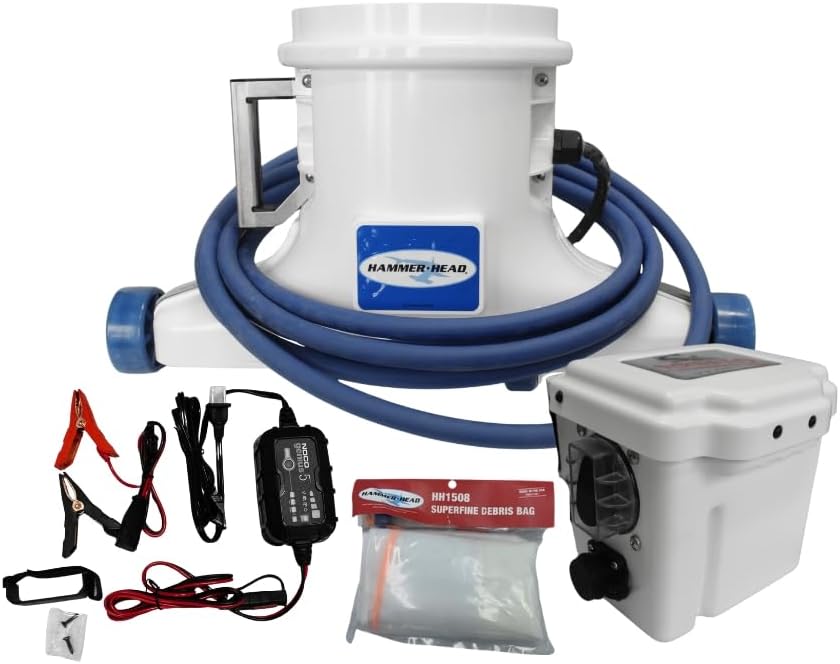
- 21-inch commercial vacuum head with 25-ft floating cable
- 18Ah LiFePO4 wearable battery; about 50 min high / 75 min low
- Reusable HH1508 superfine bag; two-speed Smart Switch operation

- 12.75-inch vacuum head with P30 motor design
- Up to 60 minutes per charge; 5.65-lb vacuum body
- 0.287-gallon debris chamber with two reusable filter bags

- About 61.5–62 GPM water flow and 75-minute runtime
- 1.72-gallon external debris bag
- 250-micron standard and 75-micron fine filter bags
The comparison immediately separates the three jobs. The Remora prioritizes floor coverage and professional portability. The Max CG prioritizes compact control and finer spot-cleaning flexibility. The Kokido prioritizes debris volume and leaf removal. None is simply a larger or smaller version of the others.
What to Look for in a Commercial Battery Powered Pool Vacuum
Cleaning Head Width
A wider vacuum head covers more floor with each pass, which is valuable on large rectangular pools, competition pools, apartment complexes, hotels, and service accounts where time on deck matters. The HammerHead’s 21-inch head is considerably wider than the Max CG’s 12.75-inch head. That does not automatically mean it finishes every job faster, because maneuverability, debris type, operator technique, and bag condition affect real cleaning speed.
Narrower heads have their own advantage. They turn more easily around steps, benches, tight radii, ladders, and spa sections. A 12.75-inch Max CG is easier to position in spaces where a broad wheeled head may need several passes or cannot sit flat. Think about the surfaces you actually clean rather than treating maximum width as the only performance measure.
Debris Capacity and Where the Debris Goes
Commercial work is slowed by stopping to empty the vacuum. The KOKIDO XV910 has the clearest capacity advantage in this group, using a 1.72-gallon external mesh bag. That design is particularly useful during openings, after storms, or on pools surrounded by trees because leaves and twigs occupy much more volume than sand.
The Max CG lists a roughly 0.287-gallon debris chamber. Its chamber is smaller, but the machine is also aimed at a different cleaning pattern: sand, silt, acorns, twigs, leaves, steps, attached spas, and routine whole-pool or spot work. HammerHead uses interchangeable reusable bags attached to the head, so capacity and filtration can be adjusted by changing bag grade rather than relying on a fixed internal canister.
Filtration Grade
A leaf vacuum and a fine-debris vacuum are not the same tool. KOKIDO includes a 250-micron standard bag and a 75-micron fine bag. The standard bag is more appropriate for bulk debris because it maintains flow while retaining leaves, gravel, and larger material. The 75-micron bag trades some openness for finer capture, which is more useful for small sandy particles.
POOL BLASTER includes an all-purpose bag and an Xtreme multilayer bag. HammerHead supplies an HH1508 superfine bag with the exact Amazon XR1600 configuration and offers other bag grades separately. Bag selection affects both what stays captured and how quickly flow drops as the media becomes loaded. A clogged fine bag can make a powerful vacuum feel weak, so commercial users benefit from carrying clean spare bags rather than using the finest filtration for every pass.
Runtime and Battery Arrangement
Runtime needs to be judged against work rate. A smaller vacuum with 60 minutes of runtime may suit a single large residential pool, while a wide commercial head can cover more floor during a shorter high-power session. HammerHead rates the Remora at about 50 minutes on high speed or 75 minutes on low from its 18Ah LiFePO4 pack. Max CG is rated for up to 60 minutes. KOKIDO lists up to 75 minutes on a full charge.
Battery position also changes handling. The Remora moves the five-pound battery pack onto the operator’s waist or shoulder, leaving the pool head connected by a floating cable. Max CG and Kokido carry their rechargeable power within the vacuum body. The integrated approach is simpler for occasional use; the wearable approach separates deck-side battery weight from the cleaning head and is intended for professional movement between pool sections.
Pole Compatibility
All three systems are intended to work with a standard telescopic pool pole, but a pole is not included with these configurations. For commercial work that is usually an advantage rather than a drawback because technicians often already carry preferred poles in different lengths and stiffnesses.
A heavy or flexible pole can make a high-suction vacuum harder to control. Large heads benefit from a pole that does not bow excessively when pushing across the deep end. Compact units are less demanding, but the pole connection still needs to be secure because lifting a vacuum full of water and debris places more load on the joint than ordinary brushing.
Minimum Operating Depth and Shallow Areas
Commercial facilities often include tanning ledges, beach entries, steps, and attached spas that are shallower than the main pool. HammerHead specifies operation in water as shallow as about 12 inches. Water Tech lists a minimum operating depth of 14.25 inches for the Max CG when held at a 45-degree angle.
KOKIDO uses an automatic shutoff when it is not submerged. That protects the motor from running dry, but it also means the unit needs enough water around its intake and body to operate properly. If shallow features are a major part of your workload, minimum depth should be checked before choosing a vacuum based only on deep-end performance.
HammerHead Remora XR1600 Portable Pool Vacuum
The Remora XR1600 is the most purpose-built commercial machine in this comparison. Instead of packaging the motor, battery, filter, and handle into a single handheld body, HammerHead keeps the familiar wide vacuum-head format and supplies a wearable battery pack. The exact Amazon listing specifies a 21-inch head, 25-foot premium floating cable, 18Ah LiFePO4 battery, G5 10-amp charger, carry handle, and HH1508 superfine reusable debris bag.
That layout is aimed at people who move from pool to pool rather than a homeowner pulling a small vacuum from a shed once a week. The head stays in the water on a standard pole while the battery remains with the operator on deck. There are no suction hoses to prime and no connection to the property’s circulation pump, so setup is limited to the vacuum, pole, battery, and debris bag.
Design and Build
The working end is a 21-inch injection-molded style head using wheels rather than the compact brush-head layout of a handheld vacuum. Amazon’s product description lists an 18-pound total operating system and a five-pound battery pack. Retailer documentation breaks the head and cord portion out at roughly 13 pounds, which helps explain why the wearable battery concept matters: not all of the system weight is pushed underwater at the pole.
The 25-foot floating power cable on this Amazon configuration runs from the head to the wearable battery pack. It is still a cable, but it is not a shore-power cord and it does not tether the cleaner to an outlet. The pack can be worn at the waist or shoulder, letting the operator walk around steps, gates, and pool edges while the vacuum stays submerged.
Battery, Runtime and Charging
- Battery: 18Ah LiFePO4 rechargeable pack.
- Battery-pack weight: about 5 lb.
- High-speed runtime: up to about 50 minutes.
- Low-speed runtime: up to about 75 minutes.
- Charging time: approximately 6 hours for the Amazon-listed configuration.
- Amazon-listed charger: G5 10-amp charger.
LiFePO4 chemistry is relevant in a commercial tool because it is commonly selected for cycle life and thermal stability. The exact listing describes about 2,000 duty cycles. Battery-life claims depend heavily on depth of discharge, storage temperature, charging practice, and age, so the cycle number is better treated as a design target than a guarantee of identical service life for every route.
One configuration detail deserves attention before purchase. The exact Amazon ASIN currently identifies a 25-foot cable and G5 10-amp charger, while some current HammerHead direct-support pages for the XR1600 describe a NOCO Genius 2 charger and shorter cable configurations. If charger speed or cable length is critical to your workflow, confirm the box contents on the exact seller offer rather than assuming every XR1600 package is identical.
Two-Speed Cleaning and Smart Switch
Two-speed operation is useful because heavy leaf pickup and light routine floor cleaning do not require the same operating strategy. High speed provides the strongest cleaning rate when time matters. Low speed stretches runtime toward the 75-minute rating and can be adequate for lighter debris.
The Smart Switch system adds automatic protection if the propeller is obstructed or if the vacuum remains out of water for more than about a minute. That does not eliminate the need to clear stringy debris or inspect the propeller area, but it reduces the chance that an unnoticed blockage continues loading the motor. For service crews, this is more meaningful than another cosmetic control because interruptions and damaged equipment cost time.
Debris Bags and Practical Filtration
The included HH1508 superfine bag is intended for small debris, while HammerHead sells other reusable bag grades ranging from coarse to ultra-fine. That modular approach is useful on mixed service routes. A coarse bag can maintain flow during a leaf-heavy opening, while a finer bag can be used later for sand or small settled material.
The bag is external to the vacuum head, so debris does not travel through the customer’s pool filter. This is especially useful when removing a concentrated mess that would otherwise fill a pump basket or increase filter pressure. The operator can empty the bag away from the circulation system and resume cleaning without changing valves or backwashing.
Commercial Use and Maneuverability
The Remora is best understood as a portable alternative to larger HammerHead service and resort systems, not as a tiny rechargeable handheld. A 21-inch head can cover broad floor areas quickly, yet the wearable power pack keeps the system compact enough to move through gates and around equipment areas. The integrated carry handle helps when transporting the head between truck and pool deck.
Minimum operating depth is about 12 inches, making it usable on many steps and shallow sections that would be awkward for a large suction hose. The standard pool pole is not included. Commercial operators should pair the head with a pole that is stiff enough to control a 21-inch vacuum under load.
Important Strengths
Its strongest advantage is floor coverage combined with independent battery power. The 21-inch head is much wider than the other two products, and the two-speed 18Ah battery system supports either stronger short sessions or longer low-speed sessions. Swappable bag grades also let the same head handle different debris without forcing one filter medium to do everything.
Important Limitations
The Remora is physically and financially a different class of tool from small cordless vacuums. It is more equipment to carry, the battery is worn rather than fully integrated, and the vacuum still uses a floating power cable between head and pack. It also needs a proper telescopic pole and enough storage space for the head, cable, charger, battery, and bags.
The exact XR1600 component package has changed across manufacturer and retailer pages, particularly charger and cable references. Buyers who need a specific G5 charger or 25-foot cable should verify that exact configuration before ordering.
Who Should Consider It
The Remora fits pool technicians, resorts, apartment or condominium maintenance teams, builders, and facilities with large floor areas where time per cleaning matters. It also makes sense for a homeowner with a very large pool who specifically wants service-grade manual control rather than a robotic cleaner.
Who Should Consider Another Option
Choose a compact vacuum if you mainly clean spas, steps, benches, or a single residential pool and do not need a 21-inch commercial head. Choose the Kokido if bulky leaf volume is the dominant problem and a large external bag matters more than a professional wheeled head.
Pros
- 21-inch head covers broad floor areas efficiently
- 18Ah LiFePO4 wearable battery separates power-pack weight from the vacuum head
- Two-speed operation with about 50 minutes high / 75 minutes low runtime
- Interchangeable reusable debris-bag grades for different cleaning jobs
- Smart Switch protection for blockage or extended out-of-water operation
Cons
- Larger and more complex to transport than compact handheld vacuums
- Standard telescopic pole is not included
- Floating cable still connects the head to the wearable battery pack
- XR1600 charger/cable package details vary across current seller and manufacturer pages
POOL BLASTER Max CG Cordless Pool Vacuum
The Max CG takes a very different route to commercial-style cleaning. It is a compact, self-contained rechargeable vacuum with the motor, lithium-ion battery, debris chamber, filter bag, and control built into one body. Amazon lists a 12.75-inch head, while Water Tech’s current manufacturer page rounds the head to 13 inches. Both descriptions refer to the same Max Li CG platform and its wide scrub-brush head.
The unit weighs about 5.65 to 5.7 pounds and runs for up to 60 minutes per charge. It can be used by hand in shallow areas or attached to a standard telescopic pole for whole-pool cleaning. That lower carrying weight and absence of a separate battery pack make it much easier to keep on a service truck as a secondary vacuum or use around spas and problem areas.
Design and Build
Water Tech lists the Max CG at approximately 23.5 inches long, 12.75 inches wide, and 7 inches high, with a UV-stabilized composite body and stainless-steel fasteners referenced on the Amazon listing. The cleaning head is removable, and a corner/crevice nozzle is included for areas the broad brush head cannot reach.
The 12.75-inch head is wide enough for ordinary pool-floor passes but noticeably narrower than HammerHead’s 21-inch head. That tradeoff is useful around steps and curves. The compact body can be guided into attached spas and small sections without carrying a second system or dragging a large vacuum head across coping.
Battery and Runtime
Max CG uses a rechargeable lithium-ion battery and is rated for up to 60 minutes of operation. Unlike the Remora, the battery is internal, so there is no waist pack or floating power cable. The machine is genuinely hoseless and cable-free while it is in use.
Integrated batteries make setup faster but also mean you cannot simply swap an external pack in the middle of a job. For a service route, charging discipline becomes important. If the Max CG is being used as a primary cleaner rather than a spot tool, it should return to the charger after the day’s work rather than being left partially depleted in the truck.
Suction, Debris Chamber and Filters
The P30 motor design is paired with a high-flow pump and an approximately 0.287-gallon debris chamber on the current Amazon listing. That capacity is far smaller than Kokido’s 1.72-gallon leaf bag, but the Max CG is not built as a dedicated leaf collector. Its strength is collecting a mixed load of sand, silt, acorns, twigs, leaves, and other settled debris without sending it through the pool’s filtration system.
Two reusable filter bags are included: an all-purpose bag and an Xtreme multilayer bag. The ability to switch bags matters because fine material can pass through a coarse screen, while very fine media can load quickly with bulky debris. A commercial operator should use the bag appropriate to the job rather than defaulting to the finest option for every pool.
Minimum Depth and Pole Use
Water Tech lists a minimum operating depth of 14.25 inches when the unit is held at a 45-degree angle. This is deeper than HammerHead’s roughly 12-inch minimum, but the Max CG’s compact body can still be convenient in steps and attached spa areas once enough water covers the intake.
The standard telescopic pole is not included. The attachment point allows the same vacuum to shift from hand use to deep-pool cleaning. That dual use is one reason the Max CG works well as a route-support tool: it can handle a quick bench cleanup without assembling a pole, then attach to the pole for a deep-end pass.
Maintenance and Serviceability
Because all collected material remains in the vacuum’s own chamber and bags, cleaning does not directly load the customer’s skimmer basket, pump basket, or main filter. After the job, the debris chamber and reusable bag need to be emptied and rinsed. Allowing fine silt to dry into the multilayer filter can reduce flow on the next use.
The manufacturer provides U.S.-based service support and lists a one-year limited warranty. The commercial value of a compact cordless tool depends partly on replacement filters, charger availability, and repair support, so those parts are worth checking if the vacuum will be used daily rather than seasonally.
Important Strengths
The Max CG’s advantage is versatility in a small package. It weighs a fraction of a large service vacuum, needs no external hose or battery belt, and can move between floor cleaning, steps, spas, corners, and spot work. The included two-filter system also gives it more fine-debris flexibility than a leaf-only vacuum.
Important Limitations
The smaller debris chamber requires more frequent emptying during leaf-heavy jobs. Its 12.75-inch head also takes more passes across a broad commercial floor than a 21-inch head. The internal battery cannot be exchanged as quickly as a separate service pack, so a depleted unit is finished until it is recharged.
Who Should Consider It
Max CG is well suited to maintenance teams and service technicians who want a compact secondary cleaner, as well as owners of large residential pools who need more capacity than a tiny spa vacuum. It is especially practical where steps, benches, attached spas, and sand or silt are common.
Who Should Consider Another Option
For long commercial lanes and large open floors, HammerHead’s wider head can reduce the number of passes. For spring openings with a large volume of leaves, Kokido’s 1.72-gallon bag is better aligned with the debris volume.
Pros
- Compact 5.65-lb class body is easy to carry and maneuver
- Up to 60 minutes of cordless operation with no hose or external battery cable
- Includes all-purpose and Xtreme multilayer reusable filter bags
- 12.75-inch head plus crevice/corner nozzle works well in mixed pool geometry
- Self-contained debris chamber keeps material out of the pool filter system
Cons
- 0.287-gallon chamber fills much faster than a large external leaf bag
- Narrower head requires more passes on broad commercial floors
- Internal battery cannot be swapped as simply as an external service pack
- Standard telescopic pole is not included
KOKIDO XTROVAC 910 / XV910 Heavy-Duty Pool Leaf Vacuum
KOKIDO’s XTROVAC 910 is the debris-volume specialist of the three. The Amazon ASIN uses model XV910 and describes commercial-power suction for pool opening, while KOKIDO’s own store names the product XTROVAC 910. The specifications align on the points that matter: about 61.5 to 62 gallons per minute of water flow, up to 75 minutes of operation, a 1.72-gallon debris bag, and two external filter bags rated at 250 and 75 microns.
This design is particularly useful when a pool contains leaves, twigs, gravel, bugs, and other material that would fill a compact canister quickly. The bag sits outside the main vacuum body, giving the debris more room and making it relatively simple to empty between passes. It is not intended as an algae-removal tool, and KOKIDO specifically says the fine bag is not for very small silt-like contamination.
Design and Cleaning Layout
The XV910 uses a compact vacuum body with a built-in brush area and external mesh collection bag. Amazon lists the product dimensions at 16.73 by 6.69 by 12.6 inches. A standard telescopic pole connects to the unit for floor cleaning; the pole is not included.
Its head is not as broad as the HammerHead commercial head, but the external bag changes how it behaves during a dirty opening. Instead of carrying debris in a small internal chamber, the vacuum can accumulate up to 1.72 gallons before the bag needs attention. That can reduce stops dramatically when the pool floor is covered with leaves.
Flow Rate and Runtime
KOKIDO’s own specification page lists 61.5 gallons per minute, while Amazon rounds the figure to 62 GPM. This is a water-flow specification rather than a direct measure of sealed vacuum pressure, so it should not be compared to motor wattage or a shop-vac rating. In practice, the number describes the high-volume water movement used to carry debris into the external bag.
Runtime is rated at up to 75 minutes on a full charge. KOKIDO support information recommends charging for roughly four to six hours before storage, while third-party manual data commonly lists about five hours for a full charge. Charging time can vary with battery state and conditions, so daily commercial use needs enough off-deck time between sessions.
250-Micron and 75-Micron Bags
The two supplied bags are one of the XV910’s strongest features. The 250-micron standard bag is intended for bulk material such as leaves, gravel, twigs, and larger debris. KOKIDO states that this bag can handle soft leaves up to about 10 inches, although Amazon warns that leaves or debris larger than about 7 inches can clog the inlet. For the exact Amazon configuration, treating 7 inches as the safer practical limit avoids relying on the more generous manufacturer example.
The 75-micron bag is intended for finer sandy particles. It is still not a substitute for a pool filter or treatment process for algae and very fine silt. Using the 75-micron bag during a leaf-heavy opening can also reduce flow sooner as the fabric loads, so start with the standard bag for bulk removal and switch to fine filtration for the cleanup pass.
Waterproofing and Automatic Shutoff
Amazon specifies IPX8-grade waterproofing and automatic shutoff when the unit is not submerged. That protection is useful during retrieval because a high-flow propeller-style vacuum should not be allowed to run dry unnecessarily. The large rotary control is also easier to operate with wet hands than a tiny recessed button.
KOKIDO advises rotating the device about 90 degrees during retrieval to reduce spillback. That detail matters with an external bag because lifting the machine directly through the water can allow loose material near the inlet to fall back into the pool. Operator technique can therefore affect how much of the collected debris stays captured at the end of each pass.
Pool Opening and Heavy-Debris Work
This is where the XV910 makes the strongest case. A spring pool opening can involve pine needles, acorns, softened leaves, small sticks, insects, and sand. A 1.72-gallon bag gives that material somewhere to go without forcing it through a narrow internal canister. KOKIDO demonstrates cleaning large floor areas quickly, but actual speed depends on debris density and how often the bag needs to be cleared.
For routine weekly maintenance after the pool is already clean, the oversized bag may matter less than maneuverability or fine-particle capture. This is why the XV910 can be very useful as a seasonal or storm-cleanup tool even if a service company also carries a smaller fine-debris vacuum.
Important Strengths
The large collection volume is the clearest strength. Combined with roughly 62 GPM flow and a 75-minute runtime rating, it is well suited to clearing bulky debris without constant bag changes. The two filter grades also let the operator switch from leaf pickup to finer sandy debris without buying a separate vacuum.
Important Limitations
The XV910 is not intended for algae or very fine silt, and large stringy leaves or hair can obstruct the inlet or propeller. The external bag also needs correct retrieval technique to minimize spillback. It is more of a high-volume debris collector than a precision step-and-corner cleaner.
Who Should Consider It
Consider the XV910 for pool openings, storm cleanup, tree-heavy properties, or commercial facilities where leaf volume is the main time sink. It also works for medium to large above-ground and inground pools that need independent cordless debris removal.
Who Should Consider Another Option
Choose the Max CG if sand, silt, steps, spas, and compact maneuvering are more important than leaf capacity. Choose the Remora if your priority is wide-head professional floor coverage across repeated service accounts.
Pros
- 1.72-gallon bag holds far more bulky debris than a compact internal chamber
- About 61.5–62 GPM water-flow specification
- Up to 75 minutes of runtime
- Includes 250-micron standard and 75-micron fine filter bags
- Automatic out-of-water shutoff and IPX8 waterproofing
Cons
- Not intended for algae or very fine silt cleanup
- Large or stringy debris can clog the inlet or propeller
- External bag requires careful retrieval to reduce spillback
- Standard telescopic pole is not included
Detailed Buying Guide
Commercial Grade Can Mean Different Things
“Commercial” is used broadly in pool-cleaner marketing. A useful way to interpret it is to look at the design rather than the label. HammerHead’s Remora uses a service-style wheeled head, wearable battery, large replaceable bag, two speeds, and a professional parts system. Max CG is a compact commercial-grade handheld line intended for whole-pool and spot cleaning. KOKIDO uses commercial-power language around high-flow leaf removal and a very large bag.
All three can be useful in paid maintenance, but they solve different bottlenecks. A service business should ask which task currently consumes time: broad floor passes, detailed spot cleaning, or bulk leaf removal. That answer is more useful than looking for the word “commercial” on the box.
Runtime Is Only Half of the Battery Story
A runtime number does not tell you how much pool gets cleaned. A 75-minute narrow vacuum working through heavy debris may cover less floor than a 50-minute wide head on a lightly soiled pool. High-power modes may also reduce runtime, as the Remora’s separate 50-minute high and 75-minute low ratings show.
Commercial users should plan charging around the day rather than expecting one battery to cover an unlimited route. If a tool is critical to revenue, consider whether replacement batteries are available, whether batteries can be swapped, and how long a charger needs. External battery architecture is an advantage only when spares and charging logistics support it.
Fine Debris vs Leaves
Leaves demand volume and unobstructed flow. Fine dust demands tighter filter media. Trying to maximize both with one bag creates a compromise because fine media clogs faster as particles accumulate. A sensible cleaning sequence starts with the coarsest bag that captures the debris you need to remove, then switches to finer filtration after the bulk load is gone.
This is especially important during spring opening. A 75-micron bag may catch small sand, but if it is immediately filled with decomposed leaves its effective flow will fall. The Kokido’s 250-micron bag or a coarse HammerHead bag is a better first pass. Fine media belongs later in the process.
Independent Filtration Reduces Load on Pool Equipment
All three vacuums collect debris in their own bags or chambers. That means leaves and dirt do not have to travel through the skimmer, pump basket, circulation pump, and main filter. On a dirty pool, this can reduce interruptions caused by a full basket or rising filter pressure.
It also makes spot cleanup possible without changing suction valves or attaching a long hose. For service companies, that saves setup time. For facilities, it lets staff remove an isolated mess without disturbing the normal circulation configuration.
Choose the Head for the Geometry
Large open floors reward wide heads. Steps, curves, sun shelves, benches, and attached spas reward compact heads. Many commercial properties have both, which is why a single tool may not be ideal for every part of the site.
A practical service setup can combine a wide primary vacuum with a smaller spot cleaner. If budget or storage limits you to one tool, choose based on the section that consumes most of your labor, not the largest dimension in the specification table.
Weight in Water vs Weight on Deck
A vacuum may feel lighter underwater because buoyancy supports part of its weight, but you still have to carry it to the pool, lower it through the water, retrieve it full of debris, and load it into storage. This is why total transport weight and retrieval technique matter.
The Remora distributes weight between the head and wearable battery. Max CG keeps everything in a compact roughly 5.65-pound body. Kokido adds debris weight to its external bag during a dirty pass. Consider who will be using the equipment and how often it must be carried through gates or up stairs.
Replacement Bags and Consumables
Reusable filter bags eventually wear, stretch, tear, or become difficult to clean. Commercial users should treat spare bags as service parts rather than optional accessories. Having a clean second bag can restore flow immediately while the first dries.
HammerHead offers several debris grades. Water Tech supports replacement Max CG filter bags. KOKIDO sells consumable and replacement parts through its support ecosystem. Availability is worth checking before committing a vacuum to daily use because a machine without the correct filter medium cannot perform its intended job.
Cleaning the Vacuum After Use
Rinse bags and chambers after each dirty job. Organic debris left wet in a bag can smell, stain, and harden into the fabric. Fine sand left around seals or moving parts can also increase wear.
Recharge according to the manufacturer’s instructions and let the unit dry before long-term storage. Keep charging connectors clean and dry, and inspect cables or battery housings for damage before the next use. Pool chemicals are harsh on neglected equipment even when the submerged components are designed for normal treated water.
Direct Product Comparisons
HammerHead Remora XR1600 vs POOL BLASTER Max CG
These two are separated most clearly by physical format. Remora uses a 21-inch wheeled head with a 25-foot floating cable leading to a five-pound wearable LiFePO4 pack. Max CG is a fully self-contained 12.75-inch vacuum weighing about 5.65 pounds. Remora is built around coverage; Max CG is built around compact control.
Runtime is similar on paper: Remora offers about 50 minutes on high or 75 on low, while Max CG is rated up to 60 minutes. The wider Remora can cover more open floor per pass, while Max CG is easier in attached spas and around complex geometry. Filtration is also different: Remora uses external reusable bags in multiple grades, while Max CG uses a small internal debris chamber and two included reusable bags.
For a multi-pool service route dominated by floor cleaning, the Remora format is closer to a dedicated professional vacuum. For mixed detail work, emergency spot cleaning, and facilities that want one compact unit without a wearable pack, Max CG is simpler.
POOL BLASTER Max CG vs KOKIDO XV910
Both are cordless and attach to a standard pole, but their debris systems point to different jobs. Max CG has a roughly 0.287-gallon chamber and can use a multilayer filter for fine particles. Kokido has a 1.72-gallon bag, more than five times the listed collection volume, and is explicitly designed around leaf and opening debris.
Kokido also publishes filter grades of 250 and 75 microns. Max CG does not frame its bags around those same micron numbers, but its Xtreme multilayer bag is intended for fine debris such as sand and silt. The Max CG body is better for corners and small features; the Kokido bag is better when frequent emptying is the main frustration.
HammerHead Remora XR1600 vs KOKIDO XV910
Both can move a lot of water and collect debris outside the pool’s filter, but they attack the problem differently. Remora’s 21-inch head is designed for controlled floor coverage and commercial route work. Kokido’s defining feature is the 1.72-gallon external bag and high-flow leaf pickup.
Remora offers two speed settings and a wearable 18Ah LiFePO4 pack; Kokido uses an integrated rechargeable battery and a single operating concept with up to 75 minutes of runtime. Remora has a broader ecosystem of bag grades and professional replacement components. Kokido is simpler and particularly attractive for seasonal heavy debris.
Commercial Cleaning Workflow
Start With Bulk Debris
If a pool contains leaves and twigs, remove the largest material first. A high-capacity bag or coarse debris bag maintains flow better than fine media during this stage. Empty the bag before it becomes packed against the intake.
This is the strongest use case for the Kokido XV910 or a coarse-bag setup on the HammerHead. A compact Max CG can collect leaves, but its smaller chamber means more interruptions when the pool floor is heavily covered.
Move to Sand and Fine Material
After the bulky debris is gone, switch to the finer filtration option. Slower passes help keep settled sand in the intake path rather than pushing it ahead of the vacuum. On plaster or other hard surfaces, brushing immediately before vacuuming can bring material into a more accessible line.
A fine bag should be cleaned once suction noticeably falls. Continuing with a loaded bag wastes battery because the motor is operating while water flow is restricted.
Finish Steps, Corners and Spas
Detail areas often require a smaller head or nozzle. Max CG has a clear advantage here because its compact body and crevice/corner nozzle can reach locations a 21-inch head cannot sit flat. A service crew using a wide primary vacuum may still save time by carrying a small secondary unit for this final pass.
For shallow features, check the minimum operating depth. Do not run a submerged vacuum dry on a shelf that is too shallow for its intake. Automatic shutoff protects some models, but correct use should not rely on protection systems as the normal operating method.
Empty and Rinse Before the Next Account
Debris left in a vacuum travels with you. Before moving to the next pool, empty bags and chambers, rinse loose organic material, and inspect for stringy debris around the impeller or intake. Commercial cleaning equipment also raises cross-contamination concerns, so companies should follow their own sanitation procedures between properties where appropriate.
A quick equipment check also catches torn bags, damaged cables, loose pole fittings, and low battery before the next job begins. The few minutes spent on the deck are usually less costly than discovering a problem after the vacuum is lowered into the next pool.
Common Buying Mistakes
Buying the Highest Runtime Without Looking at Coverage
A longer runtime is useful only if the vacuum is productive during that time. Head width, debris capacity, filter loading, and operator speed can matter just as much. Compare the complete cleaning system rather than ranking batteries alone.
Using a Fine Filter for Every Job
Fine filters are not automatically better. They restrict flow sooner when loaded with leaves or heavy debris. Start with a standard or coarse bag when the pool is dirty, then move to fine filtration for the finishing pass.
Ignoring Collection Capacity
A small chamber is manageable for weekly maintenance but frustrating during a storm cleanup. If leaves are your main problem, prioritize bag volume. If the pool mostly has sand and scattered debris, a compact chamber may be easier to handle and clean.
Assuming Cordless Means No Cable at All
Max CG and Kokido are self-contained in use. The Remora is cordless in the sense that it does not connect to household power or the pool pump, but a floating cable still runs between the submerged head and the wearable battery pack. This distinction matters for storage and movement around the deck.
Forgetting the Telescopic Pole
The three configurations here do not include a standard telescopic pool pole. Commercial crews usually already own poles, but a first-time buyer can otherwise receive a vacuum that cannot reach the deep end effectively. Match the pole length and stiffness to the pool.
Expecting a Vacuum to Solve Algae Problems
A vacuum can collect dead algae or material that is large enough for its filter, but it does not treat active algae growth or correct water chemistry. KOKIDO explicitly says the XV910 is not designed as an algae-cleaning solution. Filtration and chemical treatment still need to be handled by the pool system and proper maintenance process.
Running Until the Bag Is Completely Packed
Waiting until flow nearly stops wastes battery and can stress the cleaning system. Empty or rinse the bag when pickup performance drops. Commercial cleaning is often faster with two clean bags rotated through the job than with one bag pushed to its limit.
Frequently Asked Questions
What makes a battery pool vacuum suitable for commercial use?
Commercial suitability comes from work rate, durability, serviceability, debris capacity, runtime, filter options, and how quickly the equipment can move between jobs. A wide head and wearable battery may suit service routes, while a compact self-contained vacuum can be more useful for detail work.
Which of these vacuums has the widest head?
The HammerHead Remora XR1600 uses a 21-inch vacuum head. The POOL BLASTER Max CG uses a 12.75-inch head on the exact Amazon listing, which Water Tech rounds to 13 inches on its manufacturer page. KOKIDO’s XV910 is built around a smaller leaf-vacuum body rather than a 21-inch service head.
Which model has the largest debris capacity?
KOKIDO’s XV910 lists a 1.72-gallon external debris bag. The Max CG lists a roughly 0.287-gallon debris chamber. HammerHead uses external reusable bags, with capacity depending on the bag and how it is loaded rather than a fixed internal canister figure.
How long does the HammerHead Remora XR1600 run?
The exact Amazon configuration specifies up to about 50 minutes on high speed or 75 minutes on low from its 18Ah LiFePO4 battery pack. Runtime varies with operating conditions and battery age.
How long does the POOL BLASTER Max CG run?
Water Tech rates the Max CG for up to 60 minutes per charge. It uses a rechargeable internal lithium-ion battery.
How long does the KOKIDO XV910 run?
KOKIDO rates the XTROVAC 910 / XV910 for up to 75 minutes on a full charge. Charging information generally falls around five hours, with the manufacturer support page advising four to six hours before storage.
Can these vacuums replace the pool filtration system?
No. They collect settled debris independently so the material does not need to pass through the pool filter, but they do not replace circulation, water chemistry, sanitization, or the permanent filtration system.
Which vacuum is better for leaves?
Large-volume leaf work favors a large, open debris path and high-capacity bag. The KOKIDO XV910 is specifically built around a 1.72-gallon bag and a 250-micron standard filter. HammerHead can also use coarser debris bags. Max CG can pick up leaves but has a much smaller chamber.
Which vacuum is better for sand and silt?
Fine debris requires finer filtration. Max CG includes an Xtreme multilayer bag intended for fine material. KOKIDO includes a 75-micron bag for finer sandy debris but says the unit is not intended for very fine silt or algae. HammerHead offers multiple bag grades for different debris.
Do I need a pool pole?
Yes for normal deep-pool use. All three systems are compatible with standard telescopic pool poles, and the configurations discussed here do not include one.
Can a cordless pool vacuum clean steps and spas?
Yes, provided there is enough water depth for the model to operate safely. Max CG is especially convenient for steps and spas because of its compact body and crevice nozzle. HammerHead lists operation in water as shallow as about 12 inches, while Max CG lists 14.25 inches at a 45-degree angle.
Does the HammerHead Remora plug into a wall while cleaning?
No. The vacuum operates from its rechargeable wearable battery pack. Household power is used only by the charger. The submerged head connects to the battery pack through its floating cable.
Final Buying Considerations
The most useful commercial battery powered pool vacuum is the one that removes the bottleneck in your cleaning routine. HammerHead Remora XR1600 is the specialist for broad professional floor coverage, using a 21-inch head, two-speed operation, interchangeable debris bags, and a wearable 18Ah LiFePO4 battery system. Its larger equipment footprint makes sense when cleaning time across repeated accounts matters more than compact storage.
POOL BLASTER Max CG is easier to carry and more flexible in small spaces. Its 12.75-inch head, roughly 5.65-pound body, 60-minute runtime, crevice nozzle, and two reusable filter bags make it useful for large residential pools, steps, spas, and service-route spot work. The tradeoff is a much smaller debris chamber and slower coverage on wide commercial floors.
KOKIDO XV910 is the most debris-volume-focused option. The 1.72-gallon external bag, approximately 62 GPM flow specification, 75-minute runtime, and 250/75-micron bag choices suit openings, storm cleanup, and properties that collect leaves. It is less appropriate for algae and very fine silt, and very large stringy debris can obstruct the inlet.
Before ordering, decide what you pick up most often, how much floor you cover per visit, how frequently you can stop to empty a bag, and whether you need a compact tool or a professional wide head. Those practical factors will determine productivity more reliably than any single suction or runtime number.
Author