
A pool ladder can be one of the hardest parts of swimming for a person who has reduced leg strength, limited knee or hip range, or simply finds narrow vertical rungs awkward. Products sold under searches such as handicap pool ladders vary widely: some are still fairly ladder-like, while others use deeper stair-style treads, an inclined frame, and two handrails to make the movement into and out of the water more controlled.
The most important differences are not cosmetic. Tread depth, step rise, usable width, rail placement, pool-wall height, deck layout, anchoring method, and the load rating all affect whether a unit makes sense for a particular pool and swimmer. A five-step design is not automatically easier than a four-step design; a unit with fewer but much deeper treads may feel more like a staircase, while a narrow-tread five-step unit can still demand careful foot placement.
The five models below cover several different layouts. The XtremepowerUS and VEVOR products are inclined in-pool steps. UPHYB also uses a five-step, dual-rail layout with ballast features built into its polyethylene body. VINGLI uses four unusually deep treads and a 400-pound listed capacity. The Confer Step-1X with 8000X is the most structurally different option because it combines an in-pool staircase with an outside ground-to-pool ladder, creating a complete entry system for an above-ground pool without relying on a deck.
These products should not be confused with a certified accessible pool lift or a code-compliant sloped entry. For facilities subject to ADA requirements, ordinary consumer pool ladders and steps do not automatically satisfy accessible-entry rules. For a home pool, the useful question is more practical: can the intended swimmer safely manage the step height, tread depth, handrails, and transition at the top, and can the unit be installed securely on that exact pool?
Quick Comparison
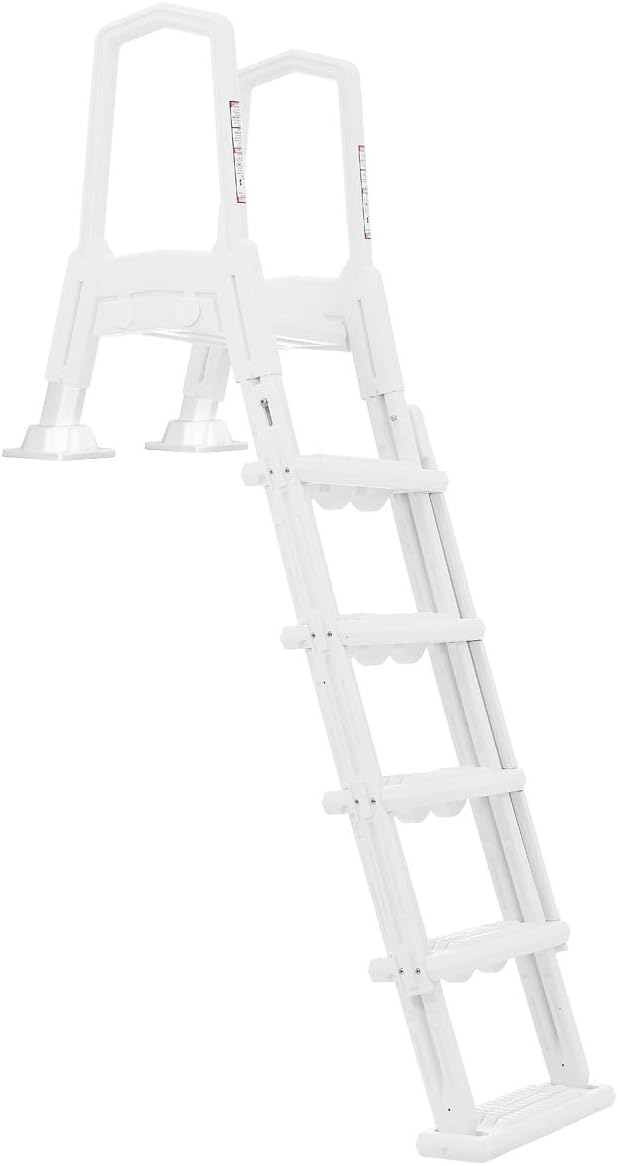
- Five-step polyethylene in-pool design for 48–52 in pools
- 18 in wide treads; top tread is 9.5 in deep
- Overall size about 25.5 in W × 30 in D × 78 in H

- Five-step, 75° inclined design for 48–54 in pools
- 300 lb listed load capacity with dual handrails
- 4.72 in deep textured treads; PE construction

- Complete outside-ladder plus in-pool stair entry system
- 8000X fits 48–54 in pools and is rated to 300 lb
- Step-1X uses wide treads and requires about 40 lb of sand

- Five steps for 47–54 in above-ground or in-ground pools
- 400 lb listed load capacity and dual handrails
- PE body with water-flow panels and fillable ballast pipes
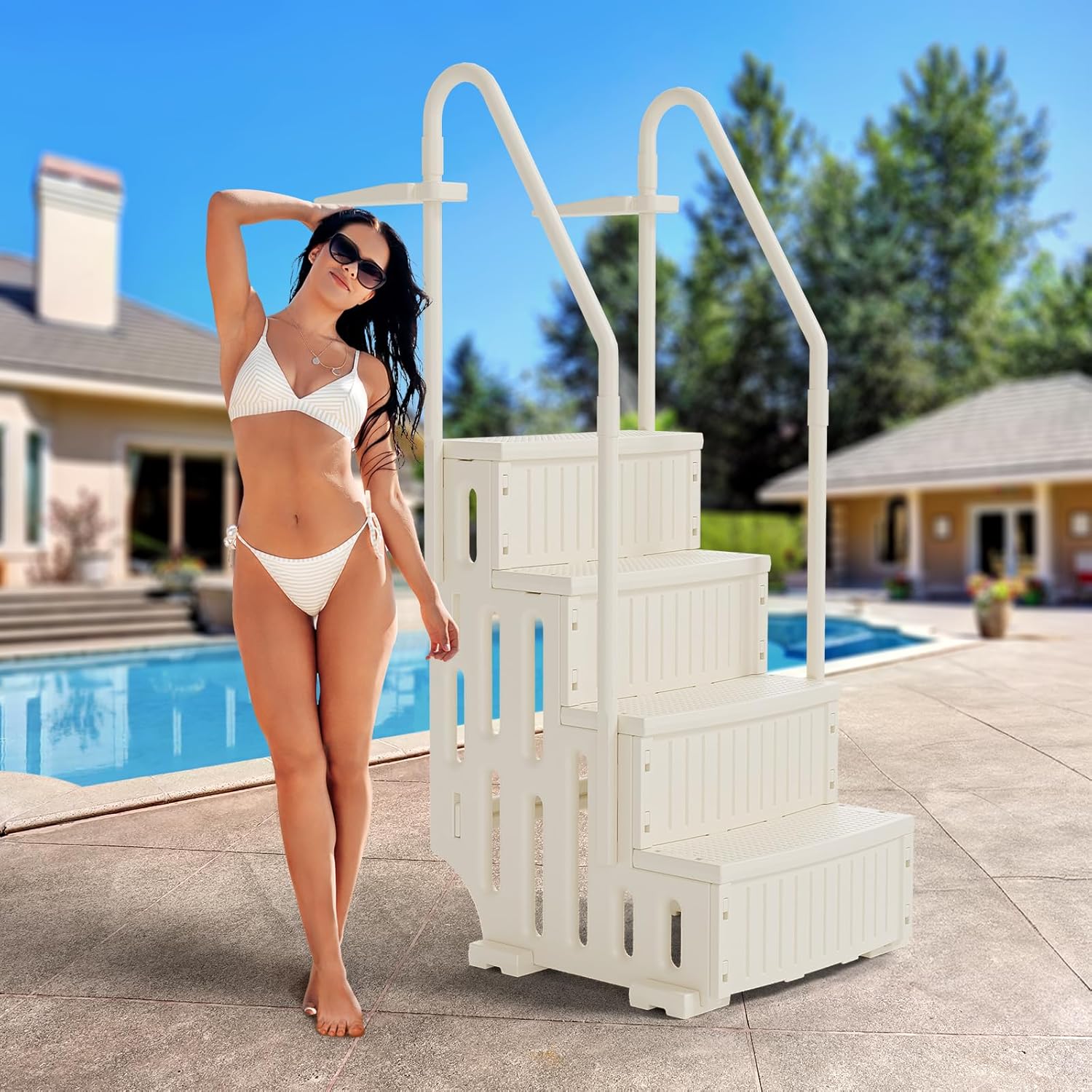
- Four stair-style treads, each about 27.6 in W × 8.9 in D
- 400 lb listed load capacity with plastic handrails
- For pool walls under 57 in; sand ballast is required
What to Look for When Buying Handicap Pool Ladders
The label on the box matters less than the geometry of the entry system. A person who struggles with a narrow vertical ladder may benefit from wide steps and a continuous grip, but the same person may still have trouble if the top transition requires a high step, a turn without support, or a long reach to the deck. Measure the pool and think through the entire movement from dry ground to water, not just the submerged steps.
Tread Depth and Usable Foot Area
Tread depth is one of the clearest differences among these models. XtremepowerUS uses 18-inch-wide steps, with a 9.5-inch-deep top platform and 4.5-inch-deep lower steps. VEVOR lists 4.72-inch tread depth. VINGLI moves much closer to a conventional staircase by using treads about 8.9 inches deep and 27.6 inches wide. That extra front-to-back space can matter to a swimmer who wants to place more of the foot on each step rather than balancing on a narrow rung.
Width matters too, but do not treat the overall product width as the same thing as usable standing area. Side panels and rails consume some of the structure. Check the actual tread dimensions where they are published, then consider whether the swimmer usually climbs straight ahead or needs room to reposition a foot before taking the next step.
Step Count, Rise, and Incline
More steps generally reduce the vertical gain per movement only if the total height and spacing support that result. The VEVOR is a five-step unit with a stated 75-degree incline, while VINGLI uses four steps with an approximately 11-inch rise between treads. The better layout depends on the swimmer. A shallower incline can feel more stair-like, but it occupies more pool space; a taller rise can be demanding for a person with limited knee flexion even when the treads themselves are deep.
Also look at where the final step lands relative to the deck or pool top. The hardest movement is often not in the middle of the staircase. It is the transition onto the deck, platform, or outside ladder, where body position changes and the swimmer may be wet and tired.
Handrails and the Top Transition
All five products provide two handrails or paired rail structures, but rail shape and mounting are not identical. A useful rail should be reachable before the user commits weight to the first step and should remain available through the top transition. Thick molded rails can be comfortable to hold, but their exact height and distance from the swimmer matter more than appearance.
If the intended user needs continuous two-hand support, inspect the installation drawing before buying. A deck-mounted unit may allow the handrails to continue above the waterline, while a complete A-frame or ground-to-step system may place the outside handholds differently. The user should not have to let go of both rails at the most difficult point in the transfer.
Pool Height and Pool Type
Pool-wall height is a hard compatibility limit, not a suggestion. The XtremepowerUS model is specified for 48–52-inch above-ground pools. VEVOR covers 48–54 inches. The Confer 8000X outside ladder is designed for 48–54-inch pools when paired with the Step-1X. UPHYB lists 47–54 inches. VINGLI is listed for pools under 57 inches.
Pool type is equally important. The Confer Step-1X manual specifies a flat-bottom above-ground pool and the 8000X manual excludes inflatable pools. Do not assume a heavy molded step can simply sit on a flexible soft-sided pool wall. The floor shape, liner, deck surface, and anchoring points must all match the product instructions.
Load Rating and the Weakest Component
A load rating should be treated as a limit for the complete installed system. UPHYB and VINGLI list 400-pound capacities. VEVOR lists 300 pounds. The Confer combination deserves closer reading: the Step-1X in-pool stair is rated to 400 pounds, but the paired 8000X outside ladder is rated to 300 pounds. Because the complete entry route includes the 8000X, 300 pounds is the relevant ceiling for the combined system.
XtremepowerUS product data is inconsistent across retailer catalog fields, so this guide does not assign it a load rating. The manufacturer’s technical product page confirms the dimensions, five-step layout, pool-height range, polyethylene construction, and ballast requirement but does not publish a dependable user-weight figure. If the intended swimmer needs a verified capacity, choose a model with a clearly documented rating or obtain the rating directly from the manufacturer before purchase.
Ballast, Anchoring, and Movement
Large plastic pool steps want to float. Several models address this with sand or fillable cavities. XtremepowerUS requires sand for installation. Confer specifies roughly 40 pounds of sand for the Step-1X. VINGLI instructs the owner to add sand through its fill openings. UPHYB uses fillable pipes and water-flow side panels intended to reduce buoyancy and help the unit settle.
Ballast does not replace the required top connection or deck anchoring. Follow the installation method for the exact model, use hardware suited to the deck material, and recheck the unit after the pool has been filled and used. A stair that shifts under load is a very different experience from one that stays planted.
Accessibility Needs Versus ADA Compliance
A wide-step pool ladder can be easier for some swimmers to use, but that does not make it an ADA-compliant accessible means of entry. U.S. accessibility standards distinguish pool lifts, sloped entries, transfer systems, transfer walls, and compliant pool stairs, with specific scoping rules for public facilities. For many public pools, at least one required accessible entry must be a compliant pool lift or sloped entry.
For a private home, think about the person rather than the search label. If the swimmer cannot climb stairs independently, cannot bear weight reliably, or needs a seated transfer, a conventional ladder or molded pool staircase may be the wrong equipment category. A pool lift or professionally planned accessible entry can address a different level of mobility need.
XtremepowerUS Deluxe Incline Above Ground In-Pool Swimming Pool Ladder
XtremepowerUS model 75129 is a molded polyethylene in-pool staircase for 48–52-inch above-ground pools. Its five-step layout takes up more horizontal space than a nearly vertical metal ladder, giving the swimmer a forward-facing route into the water. The manufacturer lists an overall size of about 25.5 inches wide, 30 inches deep, and 78 inches high.
Its most useful detail for a buyer with mobility concerns is the tread geometry. The steps are 18 inches wide. The top step is 9.5 inches deep, creating a larger landing area near the transition, while the lower four steps are 4.5 inches deep. That is more substantial than a narrow rung, but the lower treads are still much shallower than the 8.9-inch-deep steps on the VINGLI.
Design and Build
The ladder is made from polyethylene rather than metal tubing. For a permanently wet component, that avoids the corrosion concerns associated with unprotected steel, and the molded structure allows broad side panels and thick rounded handrails. The two rails rise above the stairway so the swimmer has a handhold while climbing toward the pool edge.
The inclined footprint is part of the tradeoff. A 30-inch-deep structure occupies meaningful floor area inside an above-ground pool. That is usually acceptable in a larger round or oval pool, but it can feel intrusive in a compact pool where every foot of swimming area matters. Measure from the inside wall toward the center and leave enough clearance around the bottom of the steps for normal circulation and cleaning.
Important Specifications
The manufacturer specifies five steps, an 18-inch tread width, a 9.5-inch-deep top step, and 4.5-inch-deep remaining steps. The stated pool-height range is 48–52 inches, and assembly is required. Sand is also required for installation but is not included. The product package includes the stair unit components, mounting hardware, and instructions.
One specification deserves caution: online catalog fields for this model do not consistently agree on load capacity or even step count. The manufacturer’s own product information clearly identifies five steps and the dimensions above, but it does not provide a load rating that can be treated as verified here. Buyers who need a documented capacity should not infer one from a similarly shaped model.
Practical Use
The wide top tread gives the swimmer more room to stabilize near the pool edge before transferring to the deck or platform. Lower down, the 4.5-inch tread depth supports more of the foot than a tubular rung, though it still encourages a careful, front-foot placement rather than a full-foot stair stance. A swimmer who wears water shoes or needs a large landing area should compare that dimension directly with the VINGLI’s deeper steps.
The white finish also makes the structure visually distinct in many pools. Visibility can be useful for judging where the next tread is under moving water, although lighting, water clarity, and glare still affect what the swimmer can see.
Installation and Pool Fit
This is an in-pool step, not a complete ground-to-water A-frame entry system. It makes the most sense where a compatible deck or platform already provides the outside approach to the pool. The 48–52-inch height range should be checked against the actual distance from the pool floor to the mounting surface, not just the advertised wall height of the pool.
Because the structure is buoyant polyethylene, sand ballast is part of the installation. Add ballast exactly as directed rather than improvising external weights that could shift or damage a liner. The top connection also needs to be secured to the intended mounting point so the stairs do not pull away from the wall during entry or exit.
Important Strengths
The strongest reason to choose this model is its simple five-step geometry combined with an especially deep top landing. It avoids a narrow metal-rung climb and keeps both handrails available through the ascent. Its manufacturer-published dimensions are also specific enough to plan the space before ordering.
The structure is less complicated than the Confer combination because there is no separate outside ladder to assemble. That can be an advantage for a pool that already has a solid deck and only needs a more substantial stairway on the water side.
Important Limitations
The lower steps are only 4.5 inches deep, so this is not the most stair-like option in the group. The unit also has a narrower supported pool-height range than the VEVOR, UPHYB, or VINGLI. Most importantly, a dependable load rating is not published in the manufacturer data used for this exact model, which makes it a poor choice for anyone who needs to verify capacity before purchase.
It also does not solve access from ground level to the top of an above-ground pool. Without a deck, the buyer would need a compatible outside access solution. For a complete no-deck entry route, the Confer Step-1X with 8000X is structurally closer to that need.
Who Should Consider It
This model fits a 48–52-inch above-ground pool with a deck or platform where the owner wants five molded in-pool steps, two substantial handrails, and a larger top tread. It is a better match for someone moving away from a vertical rung ladder than for someone who specifically needs deep residential-stair-style treads.
Choose another option if a verified 300- or 400-pound load rating is essential, if the pool wall is taller than 52 inches, or if the installation needs a complete outside ladder as well as the in-pool steps.
Pros
- Five-step polyethylene layout is more stair-like than a vertical rung ladder
- 18-inch-wide treads and a 9.5-inch-deep top landing
- Two thick molded handrails support a forward-facing climb
- Manufacturer publishes clear dimensions and a 48–52-inch pool-height range
Cons
- Lower four treads are only 4.5 inches deep
- Sand ballast is required and not included
- No dependable manufacturer-published load rating was verified for this exact model
VEVOR U10 Inclined 5-Step Swimming Pool Ladder, Taupe
VEVOR’s U10 is a five-step polyethylene pool stair designed around a 75-degree incline rather than a near-vertical ladder. It is specified for pools 48–54 inches high and carries a 300-pound maximum load rating. The official dimensions are about 31.9 inches wide, 23.8 inches deep, and 70.5 inches high without the base, with a listed product weight of 20.6 pounds.
This is a useful middle-ground design for a pool with a deck. It does not have the very deep treads of the VINGLI, but its five steps spread the climb across more levels, and its paired rails extend above the upper step for a two-handed approach.
Incline and Tread Geometry
VEVOR specifies a 75-degree incline and a tread depth of 4.72 inches. That is clearly more usable than a round ladder rung, but it remains a relatively compact foot platform. A swimmer with good balance who mainly wants to avoid a vertical climb may find the format sensible; a person who needs to place most of the foot on every step should compare it with a deeper-tread staircase.
The textured step surfaces are intended to improve traction when wet. Texture helps, but it does not make a wet stair slip-proof. Keeping the treads free of algae, sunscreen buildup, and debris remains important, especially around an entry point used by someone who already moves cautiously.
Pool Compatibility and Installation
The U10 is specified for 48–54-inch in-ground and above-ground pool installations. VEVOR describes it for use with common deck surfaces and provides pre-drilled base plates and installation hardware. For concrete or tile installation, the manufacturer notes that expansion bolts are required separately.
The practical point is that the deck substrate matters as much as the stair itself. Wood, masonry, concrete, and tile require different fasteners and edge clearances. The bottom step also needs to sit firmly on the pool floor. Do not rely on the top anchors to hold a stair that is rocking or suspended off the bottom.
Load Capacity and Construction
The listed capacity is 300 pounds. The body is polyethylene, which keeps the listed product weight to about 20.6 pounds before installation. That relatively low dry weight makes the pieces easier to handle during assembly, but it also explains why correct positioning and anchoring are central to the finished installation.
The taupe color differs from the white XtremepowerUS and UPHYB models. Color has little effect on access, but it may matter in a pool where owners want the steps to blend with a liner or deck. The more meaningful construction detail is the combination of molded steps and two rails rather than a single center handhold.
Practical Use
A five-step climb can be useful for a person who prefers more frequent, smaller movements instead of the four higher rises used on the VINGLI. The 75-degree angle still keeps the footprint fairly compact, so the stair does not project as far into the pool as a much shallower staircase would.
At the top, the rail height gives the swimmer something to hold before stepping onto the deck. That transition should be examined closely during installation: the final step, deck edge, and handrail position need to line up so the user is not forced to twist or reach sideways while weight is on one foot.
Important Strengths
The U10 has one of the broadest published pool-height ranges in this group and a clearly documented 300-pound rating. VEVOR also publishes a model-specific incline, dimensions, weight, and tread depth, which makes it easier to judge fit before purchase. The five-step arrangement is a useful alternative to both vertical ladders and large four-step staircases.
Another advantage is deck-surface flexibility. The design can be anchored to more than one type of deck, provided the correct fasteners are used for that substrate. That gives installers more options than a product intended only for one mounting material.
Important Limitations
The 4.72-inch tread depth is still shallow compared with a conventional household stair. A buyer whose primary concern is getting more of the foot onto each step may prefer the VINGLI’s 8.9-inch-deep treads. The VEVOR also stops at 300 pounds, while UPHYB and VINGLI list 400-pound capacities.
This is primarily an in-pool/deck-connected stairway. It is not the same kind of complete ground-to-water entry system as the Confer Step-1X plus 8000X. A pool without a deck needs a compatible outside approach rather than assuming this one component solves both sides of the wall.
Who Should Consider It
Consider the VEVOR U10 if the pool is 48–54 inches high, a solid deck is available for anchoring, and a five-step inclined route is more appealing than a vertical ladder. It is also a logical candidate when a documented 300-pound limit is adequate and the swimmer is comfortable with a 4.72-inch-deep tread.
Another model makes more sense if deeper foot platforms are the priority, the swimmer needs a capacity above 300 pounds, or the pool has no deck and requires a complete outside ladder.
Pros
- Five-step 75° incline reduces the feel of a vertical ladder
- Specified for 48–54-inch pools with a documented 300-pound capacity
- Dual handrails extend above the upper steps
- Manufacturer publishes model-specific dimensions, weight, and tread depth
Cons
- 4.72-inch tread depth is modest for users wanting full-foot support
- 300-pound rating is lower than the listed 400-pound ratings of UPHYB and VINGLI
- Some deck materials require separately sourced expansion anchors
Confer Plastics Step-1X with 8000X Ground-to-Step Ladder
The Confer combination is fundamentally different from the other four products. Step-1X is a wide in-pool staircase, while the 8000X attaches on the outside to create a ground-to-step access route for an above-ground pool. That makes this pair relevant to owners who do not have a surrounding deck and need to get from the yard, over the wall, and down into the water with one coordinated system.
The two components have separate specifications. The Step-1X itself is rated to 400 pounds, but the 8000X outside ladder is rated to 300 pounds. For the complete combined route, 300 pounds is the sensible system limit because every user must pass over the lower-rated outside ladder.
Step-1X In-Pool Stair Design
The Step-1X uses broad molded treads rather than narrow rungs, with paired handrails rising above the staircase. Its side openings allow water to move through the structure instead of trapping a large stagnant cavity. The stair must be used on a flat-bottom above-ground pool; Confer specifically excludes dished or sloped bottoms for this model.
Stability comes partly from ballast. The installation instructions call for about 40 pounds of sand in the Step-1X. That is a meaningful setup detail: the stair is not intended to be placed empty in the water and trusted to stay down under its own dry weight.
8000X Outside Ladder and Access Control
The 8000X is designed specifically to work with Step-1X and fits above-ground pools 48–54 inches high. It creates the exterior half of the entry route and has a 300-pound user limit. The outside section can swing up and close, which is useful for restricting unsupervised access when the pool is not in use.
That swing-up function is a practical difference from an exposed permanent staircase. It does not replace a pool barrier, gate, alarm, or any local code requirement, but it can remove the easily climbable outside steps from the normal position when the pool is closed.
Installation Requirements
The combined system is more involved to assemble than a simple in-pool stair. The Step-1X has to be assembled, ballasted, positioned on a flat pool floor, and connected at the top. The 8000X then has to be adjusted to the pool height and properly paired with the Step-1X. The manufacturer’s instructions should be followed in sequence rather than mixing hardware or dimensions from the stand-alone Step-1X configuration.
Inflatable pools are not compatible with the 8000X instructions. That matters because many soft-sided pools are advertised at similar wall heights. A rigid-wall above-ground pool provides a very different mounting environment from a flexible inflatable wall.
Practical Use
For a swimmer, the main benefit is continuity. Instead of climbing a narrow outside ladder, stepping across the top, and then facing an unrelated in-pool ladder, the system creates a defined approach on both sides. The in-pool half has stair-style treads, while the exterior half provides an integrated way to reach the top of the pool.
The outside section is still a ladder, not a broad staircase. Someone who can manage the in-pool Step-1X but struggles with the exterior ladder geometry may not find the complete system accessible enough. This is why looking at only the water-side steps can give a misleading picture of the whole entry route.
Important Strengths
The standout advantage is that the package addresses both sides of an above-ground pool wall. None of the other products in this comparison supplies the same ground-to-step configuration. The Step-1X also has a higher stand-alone rating than the complete system needs, wide molded steps, and a substantial ballast requirement that helps the in-pool section stay planted.
Confer manufactures the system in the United States and provides a five-year workmanship warranty for the Step-1X and 8000X manuals reviewed for these components. Warranty coverage still depends on the manufacturer’s terms and correct installation, but the published duration is longer than the basic coverage listed for several competing consumer ladders.
Important Limitations
The 300-pound 8000X rating governs the combined entry system, so buyers should not treat the Step-1X’s 400-pound rating as the capacity of the complete package. The flat-bottom requirement also rules out pools with a dished or sloping floor, and the 8000X is not intended for inflatable pools.
Assembly has more stages and more parts than the simpler in-pool-only models. The outside ladder can also remain the more demanding half of the journey for a user with limited mobility. If the primary goal is to avoid ladder-style climbing altogether and a deck is already available, a deep-tread in-pool staircase may be a better fit.
Who Should Consider It
The Confer combination is most relevant to a rigid-wall 48–54-inch above-ground pool without a deck, where the owner wants one coordinated ground-to-water entry system and the intended user is within the 300-pound limit. It is especially useful where a removable or closable outside ladder is desirable for access control.
Look elsewhere for an inflatable pool, a sloped-bottom pool, a user who needs more than a 300-pound system rating, or a swimmer who cannot comfortably manage the outside ladder portion.
Pros
- Only model here that combines an outside ground ladder with wide in-pool steps
- Step-1X uses broad molded treads, dual rails, and about 40 lb of sand ballast
- 8000X fits 48–54-inch pools and can swing up to restrict outside climbing
- Published five-year workmanship warranty for the component system
Cons
- Complete system is limited to the 8000X 300-pound rating
- Step-1X requires a flat pool bottom; 8000X is not for inflatable pools
- More involved assembly than an in-pool stair used with an existing deck
UPHYB 5-Step Pool Stairs with Double Handrails
UPHYB model KRLFHOT094WH is a five-step white polyethylene staircase listed for 47–54-inch above-ground and in-ground pools. Amazon lists a 400-pound load capacity, a 24-pound item weight, and overall dimensions of about 23.7 inches wide by 69.8 inches high. The design uses two handrails and textured steps, with molded side panels that allow water movement through the structure.
The combination of a 400-pound rating and a five-step layout separates it from the 300-pound VEVOR. It is also lighter in dry weight than a large, pre-ballasted staircase, which can simplify handling before installation but makes the ballast system especially important once the unit goes into the water.
Five-Step Layout and Handrails
Five steps divide the climb into more stages than VINGLI’s four-step design. For a swimmer who is comfortable making smaller repeated movements, that can feel more controlled than taking fewer, taller steps. Paired handrails keep both hands engaged instead of forcing the user to rely on a single central rail.
The listing describes the steps as wide and textured rather than publishing the detailed tread depth available for the VEVOR or VINGLI. Because that exact depth is not clearly documented, buyers who have a minimum foot-platform requirement should not assume the treads are as deep as the VINGLI’s 8.9-inch steps.
Buoyancy and Ballast Design
UPHYB uses hollow side panels with openings that allow water to pass through, reducing the amount of trapped air and helping the stair fill rather than float. It also incorporates fillable pipes with sand ports so the owner can add ballast. These features address a basic problem shared by large plastic pool steps: polyethylene is light enough that an unballasted assembly can be unstable in water.
The exact filling procedure should be followed during assembly. More ballast is not automatically better if it is placed in the wrong cavity or exceeds what the structure is designed to hold. Secure the top as directed and confirm that the feet sit evenly on the pool floor before regular use.
Pool Range and Construction
The stated 47–54-inch compatibility range is the widest lower-end range among these five options. That extra inch below 48 can matter for a pool whose actual wall or deck measurement falls short of the common 48-inch standard. Measure from the finished pool floor to the intended top mounting surface rather than relying only on the nominal pool size.
The all-PE construction is weather-resistant and avoids the corrosion associated with exposed ferrous metal. It still needs routine cleaning. Textured plastic can collect algae and fine debris in the grooves, and water-flow openings can trap leaves if circulation around the stair is poor.
Assembly and Setup
The listing uses a snap-on assembly approach and includes mounting hardware. Snap-fit components can reduce the number of fasteners, but every connection still needs to be fully seated before the unit is loaded. A partially engaged molded joint can look aligned while still having play.
The relatively light 24-pound dry weight makes the unfilled parts easier to move beside the pool. Once sand or water is added to the intended ballast areas and the stair is installed, removal becomes more work. Plan seasonal storage before filling it, especially in climates where the pool is winterized and steps are normally taken out.
Important Strengths
The 400-pound listed capacity is the clearest advantage over the VEVOR and the Confer combination. The five-step format also gives buyers a different motion pattern from the four-step VINGLI while retaining two rails and a broad molded structure. The 47–54-inch compatibility range covers several common above-ground pool heights.
Its water-flow and fillable-pipe features show that buoyancy has been considered as part of the structure rather than left entirely to improvised external weights. That is useful for an in-pool stair that needs to stay settled without placing loose objects on the liner.
Important Limitations
Detailed tread measurements are not clearly published for this exact model, so it is harder to compare foot area precisely with VINGLI or XtremepowerUS. The assembly also depends on correct ballast and fully seated molded connections. A buyer who wants a more heavily built, ground-to-water system will still need an outside access solution if there is no deck.
The listing covers both above-ground and in-ground use, but that does not mean every edge profile or deck layout will work. The handrail base, top connection, and bottom support still have to match the physical pool. An unusual coping shape or a sloped floor should be checked before ordering.
Who Should Consider It
UPHYB is a candidate for a 47–54-inch pool where the owner wants five molded steps, two rails, and a listed 400-pound limit. It is particularly relevant to buyers who prefer the five-step rhythm of the VEVOR but need a higher stated capacity.
Another option may be more suitable if the buyer needs published tread-depth dimensions, a full outside ladder for a pool without a deck, or a known flat-bottom-only system with detailed manufacturer manuals such as the Confer.
Pros
- Listed 400-pound capacity with a five-step layout
- 47–54-inch stated pool-height range
- Dual handrails and textured step surfaces
- Water-flow side panels and fillable ballast pipes address buoyancy
Cons
- Exact tread depth is not clearly published for this model
- Correct ballast and full snap-joint engagement are important to stability
- Still requires a compatible deck or outside access arrangement
VINGLI 4-Step Pool Ladder for Above-Ground Pools, Full Beige
VINGLI model VL-pool ladder-0036 takes a different approach from the five-step units. It uses four large molded steps, each listed at approximately 27.6 inches wide, 8.9 inches deep, and 11 inches high. The complete unit is about 27.6 inches wide and 78 inches high, weighs roughly 49 pounds dry, and carries a 400-pound listed load capacity.
Those tread dimensions are the main reason to consider it for someone who dislikes narrow pool-ladder footing. An 8.9-inch depth allows substantially more of the foot to rest on the platform than the 4.5–4.72-inch treads on the XtremepowerUS lower steps and VEVOR. The compromise is the approximately 11-inch vertical rise between levels, which is a larger movement for the knee and hip.
Deep Treads Versus Higher Rise
A deeper tread and a lower rise solve different problems. VINGLI gives the foot more front-to-back surface, which can make placement feel less like balancing on a rung. At the same time, each 11-inch rise asks the user to lift the foot higher than on many household stairs. A swimmer with good leg strength but poor confidence on narrow rungs may appreciate that trade; a swimmer with limited knee flexion may not.
The four-step format also means fewer total movements before reaching the top. That can be useful for someone who tires with repeated stepping, but only if the taller rise remains comfortable. The intended user should compare the 11-inch rise with a familiar stair before buying.
Construction and Visibility
The structure is plastic, with molded handrails and anti-slip strips on the steps. The listing describes white step surfaces against the full beige body so the treads are easier to distinguish underwater. High contrast can help a swimmer judge the next foothold, though it is not a substitute for good pool lighting and clear water.
At about 49 pounds before adding ballast, the unit is heavier than the 20.6-pound VEVOR and 24-pound UPHYB. That extra mass does not remove the need for proper stabilization; VINGLI still instructs owners to add sand through the designated openings to keep the stairs from floating.
Pool Compatibility and Ballast
The listing specifies use with pool walls under 57 inches. That upper range is taller than the limits published for the other products in this comparison. Owners should still check the actual top-transition height and mounting geometry, especially if a deck sits higher than the nominal pool wall.
Sand is a required installation material, and the buyer supplies it as well as a suitable funnel for filling. This is worth planning before assembly because a large molded stair is awkward to reposition once it is in the pool and partly filled. Complete the dry fit first, confirm the mounting points, and then follow the ballast sequence.
Practical Use
The VINGLI feels the most stair-like underfoot in this group because of its 8.9-inch tread depth. A swimmer can place a larger portion of the foot on the step, which may make deliberate, two-handed climbing easier. The 27.6-inch width also provides lateral room without forcing the feet into a narrow channel.
The 11-inch rise is the counterpoint. A person choosing a product specifically because of limited mobility should not focus on tread depth alone. If stepping onto an 11-inch-high surface is difficult on land, it may be more difficult in water where buoyancy, wet surfaces, and changing body position alter balance.
Important Strengths
The combination of deep treads, broad width, dual handrails, and a 400-pound listed capacity makes this one of the clearest departures from a traditional pool ladder. It can suit a user who wants a wide standing surface and does not mind a four-step climb.
The under-57-inch pool-height range also gives it more vertical flexibility than the 48–52-inch XtremepowerUS. Buyers with a taller above-ground wall therefore have an option to examine before trying to adapt a shorter unit beyond its intended range.
Important Limitations
The step rise is substantial. For a user with stiff knees, limited hip flexion, or difficulty lifting a foot high, the deeper tread may not compensate for that 11-inch climb. The structure also takes up more visual and physical space than a narrow ladder, and sand filling adds to installation work.
As with the other in-pool stair units, a pool without a deck still needs a compatible outside entry route. The listed warranty is one year, which is shorter than the five-year workmanship coverage published for the Confer system.
Who Should Consider It
VINGLI is a strong fit for a buyer who places a high priority on deep, broad treads and needs a listed 400-pound capacity. It is also useful to consider for above-ground pools approaching, but remaining below, a 57-inch wall height.
Choose a five-step alternative if the intended swimmer prefers smaller vertical increments, or the Confer combination if the pool has no deck and needs an integrated outside ladder.
Pros
- 8.9-inch-deep, 27.6-inch-wide treads provide the largest published foot platform here
- Listed 400-pound capacity
- Suitable for pool walls under 57 inches
- Dual handrails and contrasting step surfaces support clear foot placement
Cons
- Approximately 11-inch step rise can be demanding for limited knee or hip motion
- Sand ballast is required and must be supplied by the owner
- Four-step layout may feel too steep for users who prefer smaller increments
Detailed Buying Guide for Accessible Pool Steps and Ladders
A good purchase starts with the swimmer and the pool as one system. Product photos can make every molded staircase look spacious, but a few inches of tread depth or one extra step can change the movement considerably. Use the measurements below as decision tools rather than treating any single specification as proof that a ladder is accessible.
Measure the Complete Entry Route
Take three measurements before comparing products: pool floor to top edge, pool floor to finished deck surface, and clear horizontal space inside the pool. If there is no deck, also measure the ground-to-top height outside the pool. A nominal 48-inch pool can end up with a different effective transition once coping, deck boards, pavers, or a raised platform are included.
Then look for obstructions. Return jets, skimmer openings, braces, deck posts, fencing, and pool covers can all interfere with the stair or rails. The selected location should let the user approach the rails directly rather than squeezing between a fence and the ladder.
Compare Tread Depth With a Familiar Stair
Numbers become easier to understand if you compare them with something the swimmer already uses. A 4.5-inch pool tread is much shallower than a typical residential stair tread; 8.9 inches provides much more foot area. Have the user stand on a dry surface with a similar depth and notice whether the heel hangs off, whether the foot needs to turn, and whether both feet can pause on one level if necessary.
This comparison is especially helpful for water shoes. A larger shoe can extend well beyond a shallow tread, and soft soles can make edge position harder to feel. The goal is not to find the largest possible step; it is to find a platform the intended swimmer can place a foot on predictably.
Do Not Ignore Step Rise
Deep treads can attract attention in product photos, but vertical rise controls how high the user must lift the leg. VINGLI publishes an 11-inch rise. That is a meaningful movement. A five-step unit may divide a similar total height into more increments, although exact spacing should still be checked in the installation drawing.
For someone with limited knee or hip motion, test the approximate rise on a dry step while using a stable rail. If that movement is uncomfortable on land, water will not necessarily make it easier. Buoyancy can reduce body weight but can also change balance and foot control.
Think About Handrail Continuity
The best rail position is one that is available before the first difficult step and remains available until the swimmer is fully stable at the destination. Two rails are useful because they allow the upper body to share some work and reduce the need to rotate sideways. Still, two rails only help if the spacing is comfortable and the user can reach them without leaning.
Inspect the top view and side view of the product. Some rails terminate near the deck connection; others continue well above it. If the user needs to turn at the top, identify which hand can remain on a rail during the turn. A dry run after installation, before regular swimming, can reveal awkward reaches that are hard to see in a product diagram.
Use the Published Load Rating Conservatively
A load rating is not a target. It is the manufacturer’s maximum for the product under the stated installation conditions. Include the swimmer’s body weight and consider any extra force created by pulling hard on the rails or stepping abruptly. Do not exceed the published limit or assume that a visually similar product has the same rating.
For a multi-part system, the lower-rated component controls the route. The Confer example is useful: Step-1X is rated higher on its own, but the 8000X outside ladder is 300 pounds, so a person using the complete system passes through a 300-pound component. If the rating for an exact model cannot be confirmed, do not borrow a number from another size or revision.
Plan Ballast Before the Stair Goes Into the Pool
Molded plastic staircases can trap air and float. Manufacturers solve this with sand-filled cavities, water-flow openings, or both. Sand is common because it adds a lot of mass in a compact space and remains in place, but the specified quantity and fill location vary by model.
Use pool-safe installation instructions rather than hanging improvised weights from the stair. A loose weight can abrade a vinyl liner or move into a swimmer’s path. If sand is required, use the fill ports provided by the manufacturer and close them as directed. After installation, check whether the bottom feet stay in full contact with the floor when a user applies force to the rails.
Match Anchors to the Deck
A deck-mounted pool stair transfers significant force into the top connection. The fastener suitable for a thick wood deck is not automatically suitable for concrete, pavers, composite boards, or tile over a slab. VEVOR, for example, specifically notes that expansion bolts for concrete or tile may need to be sourced separately.
If the deck material is uncertain, have a qualified installer choose the anchors. The goal is not merely to keep the ladder from drifting; the connection has to resist repeated forward, backward, and upward forces from a wet person using the rails.
Check the Pool Floor and Liner
Wide steps put a larger structure in contact with the pool floor. Confer specifically limits Step-1X to flat-bottom pools, which is a reminder not to assume every molded staircase can sit on a slope. A unit that rocks on a dished floor can concentrate force on a small area and alter the top mounting angle.
With a vinyl liner, follow any pad or liner-protection instructions provided for the exact product. Keep grit out from under the feet during installation. Sand trapped between a loaded plastic foot and a liner is different from ballast sealed inside a stair cavity.
Allow Room for Cleaning and Circulation
Large pool stairs create shaded surfaces and low-flow corners where algae and debris can collect. Water-flow openings help, but they do not eliminate maintenance. Brush the treads, risers, side panels, and the pool floor around the unit as part of normal cleaning.
If a robotic or suction cleaner operates in the pool, confirm it can move around the stair without repeatedly wedging underneath it. A slightly wider clearance from nearby walls or fittings can make routine maintenance much easier.
Decide How the Pool Will Be Winterized
A stair that weighs 20–50 pounds dry becomes much harder to handle after it is assembled, ballasted, wet, and partially filled with water. Before installation, decide whether the product stays in place year-round or must be removed for winter according to the pool and ladder manufacturer instructions.
If removal is required, plan how ballast is drained or handled, where the parts will dry, and where the tall handrail pieces will be stored. Seasonal handling can be a major difference between a compact ladder and a large molded staircase.
Know When a Pool Lift Is the More Appropriate Category
Wide steps help people who can still climb steps with adequate control. They do not provide seated transfer or powered lifting. If the swimmer cannot reliably bear weight, cannot manage repeated step-ups, or needs to transfer from a wheelchair, compare pool lifts and compliant transfer systems rather than forcing a staircase to serve a job it was not built to do.
This distinction also matters for public and commercial facilities. ADA pool-access rules are specific about compliant accessible means of entry; a consumer product found under the phrase handicap pool ladder should not be assumed to meet those requirements simply because it has wide treads and handrails.
Direct Product Comparisons
XtremepowerUS vs VEVOR U10
Both are five-step, dual-rail in-pool designs aimed at common above-ground pool heights, but their published geometry differs. XtremepowerUS covers 48–52 inches and uses 18-inch-wide steps with a 9.5-inch-deep top landing and 4.5-inch-deep lower treads. VEVOR covers 48–54 inches, specifies a 75-degree incline, and lists 4.72-inch tread depth.
VEVOR has the clearer capacity documentation at 300 pounds and a broader height range. XtremepowerUS offers the deeper top landing and a straightforward 25.5-by-30-inch footprint, but its exact load rating is not reliably published by the manufacturer. If capacity documentation is central to the decision, that difference is more important than the small lower-tread depth difference.
VEVOR U10 vs UPHYB
These two are the closest in overall concept: five steps, dual rails, polyethylene construction, and compatibility around the 48–54-inch pool range. VEVOR publishes more precise geometry, including the 75-degree incline and 4.72-inch tread depth, and rates the unit at 300 pounds.
UPHYB raises the listed load limit to 400 pounds and starts its stated compatibility range at 47 inches. Its water-flow side panels and fillable ballast pipes are specific structural features, but its exact tread depth is not clearly published. A buyer choosing between them should decide whether a known tread dimension or the higher listed capacity is the more important requirement.
Confer Step-1X with 8000X vs VINGLI
These products solve different installation problems. The Confer package is a complete ground-to-water system for a 48–54-inch rigid-wall above-ground pool without a deck. VINGLI is a large in-pool stair intended to connect at the pool edge or deck and is listed for walls under 57 inches.
VINGLI offers the deepest published treads in this comparison at 8.9 inches and a 400-pound rating. The Confer combination is limited to 300 pounds by the 8000X, but it adds an outside ladder that can swing up and close. Choose based on whether the pool already has a deck before comparing tread size; the installation architecture is the larger difference.
UPHYB vs VINGLI
Both list 400-pound capacities and use molded plastic construction with paired rails, but they distribute the climb differently. UPHYB uses five steps, while VINGLI uses four 8.9-inch-deep treads with an approximately 11-inch rise. That makes VINGLI more generous under the foot but asks for a higher step-up.
A swimmer who dislikes narrow platforms may prefer the VINGLI geometry. A swimmer who prefers more stages in the climb may prefer the five-step UPHYB. The pool-height range also differs: UPHYB lists 47–54 inches, while VINGLI is listed for walls under 57 inches.
XtremepowerUS vs VINGLI
These two show why the number of steps alone does not determine ease of use. XtremepowerUS has five steps, but its lower treads are 4.5 inches deep. VINGLI has only four steps, yet each tread is 8.9 inches deep and 27.6 inches wide.
XtremepowerUS therefore suits a buyer who values more step levels and a deep 9.5-inch top landing within a 48–52-inch pool range. VINGLI suits a buyer who values much deeper foot platforms and a 400-pound listed capacity but can comfortably manage an 11-inch rise.
Common Buying Mistakes
Assuming Every Wide-Step Ladder Is an Accessible Entry
Wide steps and handrails can make pool access easier for some people, but they do not turn a consumer ladder into a lift, ramp, or code-compliant transfer system. Start with what the swimmer can actually do. If independent step climbing is not realistic, buying a larger staircase does not address the core problem.
Measuring Only the Advertised Pool Wall Height
The mounting surface may sit above the pool wall, and the pool floor may not be perfectly level. Measure the real installation rather than relying on the pool box. A one- or two-inch mismatch can alter the top step height, rail position, and mounting angle.
Ignoring Tread Depth
Product photos often make molded steps look deeper than they are. Compare published numbers. A 4.5-inch tread and an 8.9-inch tread create very different foot support even if both products are described as wide pool stairs.
Choosing a Higher Weight Rating but Ignoring Geometry
Capacity is essential, but a 400-pound rating does not tell you whether the user can lift a foot 11 inches or comfortably hold the rails. Treat load rating, tread depth, rise, and rail placement as separate requirements that all need to work.
Skipping Ballast or Improvising Weights
If the instructions call for sand or fillable ballast, that step is part of the installation. Loose concrete blocks, hanging weights, or random containers can create hard edges around a liner and may shift under water. Use the built-in ballast system.
Assuming Included Hardware Fits Every Deck
The right fastener depends on the substrate. A screw for wood should not be treated as a concrete anchor, and a masonry anchor should not be installed through a deck board without checking the structure below. VEVOR specifically calls out separate expansion bolts for some hard surfaces; other models also need secure mounting suited to the site.
Forgetting the Outside Half of an Above-Ground Pool
An in-pool staircase only solves the water side. If there is no deck, the user still needs a way to reach the top of the wall from the yard. The Confer Step-1X with 8000X addresses both sides; the other models generally depend on a compatible deck, platform, or separate outside access arrangement.
Frequently Asked Questions
Are handicap pool ladders ADA compliant?
Not automatically. The shopping term “handicap pool ladder” is used loosely for wide-step or handrail-equipped products, but ADA-compliant pool access has specific technical and scoping requirements. Public facilities may need a compliant pool lift or sloped entry, and larger pools can require an additional accessible means of entry. Verify the applicable standard rather than relying on a retail label.
Are pool stairs easier to use than a vertical pool ladder?
For many people who can climb steps, a forward-facing stair with broad treads and two rails is easier to manage than narrow vertical rungs. That does not apply to everyone. Step rise, tread depth, rail reach, and the top transition can still be difficult for someone with limited strength or range of motion.
Which of these models has the deepest published steps?
VINGLI publishes the deepest main treads in this group at about 8.9 inches. XtremepowerUS has a 9.5-inch-deep top landing, but its lower steps are 4.5 inches deep. VEVOR lists 4.72-inch tread depth. Exact tread depth is not clearly published for the UPHYB model reviewed here.
Which options have a 400-pound load capacity?
UPHYB and VINGLI list 400-pound capacities. The Confer Step-1X in-pool stair is also rated to 400 pounds by itself, but the complete Step-1X plus 8000X entry system is limited by the 8000X outside ladder’s 300-pound rating. VEVOR lists 300 pounds. A dependable manufacturer rating was not verified for the exact XtremepowerUS model, so this guide does not assign it a capacity.
Can these pool steps be used without a deck?
The Confer Step-1X with 8000X is the clearest no-deck solution in this group because it includes an outside ground-to-step ladder. The other models are primarily in-pool stairs that need a suitable top connection and an outside approach, commonly a deck or platform. Do not assume an in-pool stair alone provides a complete entry route.
Can I use these ladders with an inflatable pool?
Do not assume so. Confer specifically states that the 8000X is not for inflatable pools. Flexible soft-sided walls and frames may not support the same mounting forces as rigid above-ground pools. Check the pool manufacturer and exact ladder instructions before attaching any heavy staircase or rail system.
Why do plastic pool stairs need sand?
Large polyethylene structures are buoyant and can trap air. Sand adds mass inside designated cavities so the stair stays in contact with the pool floor. XtremepowerUS, Confer, and VINGLI all call for sand in their installation approach, while UPHYB uses fillable ballast pipes and water-flow features. Follow the specified method rather than adding loose weights around the stair.
Is a five-step pool ladder always easier than a four-step ladder?
No. Five steps can reduce the amount of height gained per movement, but tread depth and exact spacing also matter. VINGLI’s four treads are 8.9 inches deep but have an approximately 11-inch rise. A five-step unit may offer smaller increments while giving less foot area. The intended swimmer’s comfort with both motions should drive the choice.
How should I measure an above-ground pool for a ladder?
Measure from the pool floor at the intended ladder position to the actual top mounting surface. If a deck is present, record the deck height as well as the pool-wall height. Also measure the clear floor area inside the pool and check for skimmers, returns, braces, rails, or fencing that can interfere with installation.
How do I keep wide pool steps from becoming slippery?
Use the texture and anti-slip surfaces supplied by the manufacturer, then keep them clean. Brush algae and biofilm from the treads and rails, maintain normal pool chemistry and circulation, and remove debris around water-flow openings. No textured wet surface should be treated as impossible to slip on.
Should pool stairs be removed for winter?
That depends on the pool and ladder manufacturer instructions and local winter conditions. If removal is required, plan for the weight and size of a ballasted stair before installation. Drain or handle ballast only as the product instructions allow, clean the parts, let them dry, and store them where the plastic and hardware are protected from damage.
What if the swimmer cannot climb steps independently?
A conventional staircase may not be the right equipment category. If the person needs seated transfer, powered assistance, or cannot safely bear weight on repeated steps, compare pool lifts, compliant sloped entries, or professionally designed transfer systems. Those products solve a different access problem than a wider household pool ladder.
Final Buying Considerations
The right handicap pool ladder is the one whose geometry matches both the swimmer and the pool. Start with non-negotiable limits: pool height, floor shape, deck or no deck, required load capacity, and whether the user can manage the published step rise. Then compare tread depth and handrail continuity.
For a 48–54-inch pool with a deck, the VEVOR U10 gives a five-step 75-degree layout with a documented 300-pound rating and clearly published tread depth. The UPHYB covers a similar five-step use case while increasing the listed capacity to 400 pounds and adding water-flow and ballast features, although its exact tread depth is less clearly documented.
For a swimmer who strongly prefers a larger foot platform, the VINGLI is the standout by measurement: its 8.9-inch-deep, 27.6-inch-wide treads are much more stair-like than the shallower lower treads on several competitors. The tradeoff is an approximately 11-inch rise, so the intended user should be comfortable with that leg movement.
The Confer Step-1X with 8000X is the practical outlier for a rigid-wall above-ground pool without a deck because it provides both the outside approach and the in-pool steps. Its complete route is limited to 300 pounds by the 8000X, and the Step-1X requires a flat pool bottom. The XtremepowerUS is a simpler five-step choice for 48–52-inch pools with a deck, offering an especially deep top landing but no dependable published load rating for this exact model.
A careful fit matters more than a product label. Verify the exact measurements, use the required ballast and anchors, and judge the steps by the movements the swimmer can comfortably make. If ordinary stairs are not a realistic entry method, move beyond consumer pool ladders and evaluate a lift or professionally designed accessible entry instead.
Author