

Plastic swimming pool steps are a practical alternative to narrow ladder rungs, but the products in this category are not interchangeable. Some are compact deck-mounted entry systems, some rely on sand or gravel ballast, and others use wide stair-style treads that occupy considerably more room inside the pool. Wall height, deck height, pool-floor shape, tread width, handrail position, and the way the step is anchored all affect whether a particular model will fit correctly.
The six models below cover several common approaches to above-ground pool access. The Champlain Plastics model emphasizes a molded one-piece body and simple drop-in installation. Vinyl Works uses a narrower 24-inch entry with a small in-pool footprint and an adjustable deck-height range. Confer offers both the straightforward Step-1X and the larger Curve CCX-AG, while Doheny’s and VINGLI provide wide stair-style options with different height ranges and load ratings.
Before choosing among them, measure the pool wall and deck, check whether the floor is flat or dished, and confirm how the step will be secured. Plastic steps are naturally buoyant, so models that call for ballast need to be filled and installed exactly as their instructions specify. A correctly sized step that is properly weighted and mounted is more useful than a wider or heavier model that does not match the pool.
Quick Comparison of Plastic Swimming Pool Steps
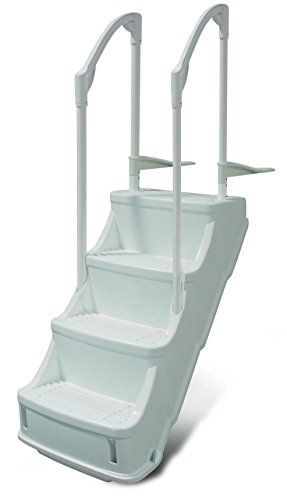
- One-piece molded drop-in body
- For 48, 52, or 54-inch above-ground pools
- Uses deck-mounted handrails and a ballast container
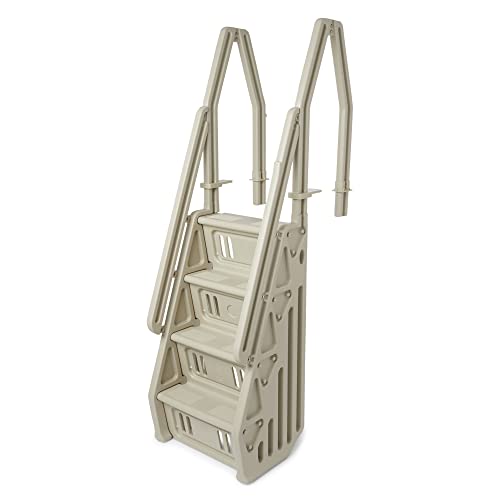
- 24-inch-wide entry with double handrails
- Adjusts for 46 to 60-inch deck heights
- 300-pound capacity and about 22-inch in-pool footprint

- 400-pound load rating
- 27-inch-wide treads with dual handrails
- Flat-bottom pools; 40 pounds of sand required

- 400-pound load rating
- 27 x 10-inch treads with 11-inch rise
- Curved treads can face inward or outward

- 350-pound load rating
- Fits 48 to 54-inch above-ground pool walls
- 45 x 31 x 35.5 inches without handrails

- Four 27.6-inch-wide steps
- 400-pound load rating
- For pools under 57 inches high
What to Look for When Buying Plastic Swimming Pool Steps
Pool Wall and Deck Height
Height compatibility is the first measurement to verify because an entry system can be otherwise well made and still be unsuitable for a particular pool. The Champlain drop-in step is intended for common 48, 52, and 54-inch above-ground pool heights. The Vinyl Works IN24-T has a broader adjustable range for deck heights from 46 to 60 inches. Confer’s Step-1X is specified for above-ground pool installations with decks up to 60 inches, while the Curve CCX-AG is commonly specified for 48 to 54-inch pools.
Doheny’s lists its pool step for 48 to 54-inch wall heights. VINGLI takes a different approach and lists the four-step model for pools under 57 inches high. These ranges are not simply marketing numbers. The top tread, mounting brackets, and handrail geometry must line up with the pool and deck so that the entry feels natural and the mounting points are not forced into an awkward position.
Tread Width, Depth, and Rise
Wide treads create a stair-like entry rather than the rung-by-rung movement of a conventional ladder. Confer specifies 27-inch-wide treads on both the Step-1X and Curve CCX-AG. The Curve’s treads are also 10 inches deep with an 11-inch rise, giving the foot more usable surface than a narrow ladder rung. VINGLI lists each step at 27.6 inches wide, 8.9 inches deep, and 11 inches high.
Vinyl Works is narrower at 24 inches, which can be an advantage in a smaller above-ground pool because it occupies only about 22 inches of swimming space. The tradeoff is straightforward: a larger staircase provides more room for the foot and may feel less ladder-like, while a compact model leaves more of the pool open for swimming. Buyers should decide which matters more before comparing small differences in appearance.
Flat Bottom Versus Dished or Sloped Pool Floor
Pool-floor shape is one of the easiest details to miss. The Confer Step-1X manual specifies installation on a flat-bottom above-ground pool. Vinyl Works also describes its IN-24 system for a flat-bottom above-ground pool. Installing a flat-base staircase on a dished or sloped floor can leave the unit rocking, place uneven loads on the structure, or change the intended relationship between the steps and the pool wall.
The Curve CCX-AG is more accommodating because it uses adjustable base pads intended to compensate for a slightly dished floor. That does not mean it should be treated as a universal solution for every slope. A strongly angled or irregular pool floor still needs careful compatibility checking. The safest approach is to identify the exact floor profile before ordering rather than assuming that ballast will correct a poor fit.
Ballast and Buoyancy
Large molded plastic components contain enough air to float until they are filled or weighted as intended. Several products here therefore rely on ballast. The Champlain manual calls for approximately 50 pounds of pea gravel for its step system. The Confer Step-1X manual calls for 40 pounds of sand. VINGLI instructs the owner to add sand through the designated openings so the staircase does not float.
The Curve CCX-AG also relies on sand ballast, although published amounts can vary depending on whether the base step is used by itself or as part of the complete Curve system. Follow the instructions supplied with the exact configuration rather than borrowing a quantity from another model or add-on. External weights should not be substituted where a manufacturer specifically directs ballast to be placed inside the step structure.
Deck Mounting and Handrail Support
Most stair-style above-ground pool entries are not simply placed in the water and left freestanding. They use brackets, flanges, or arms that connect the upper structure to the deck. Champlain’s design uses handrails that attach to the deck. Vinyl Works includes deck-mount flanges and front-mount hardware. Confer includes mounting brackets with the Step-1X, and Doheny’s includes brackets intended to secure the step to the pool or deck.
This makes the deck itself part of the system. A weak board, loose composite panel, or poorly positioned mounting surface can undermine an otherwise sturdy step. Check the deck structure, fastener requirements, and local pool-safety rules before drilling. The rail should serve as support while entering or exiting; it should not be treated as a climbing frame or as a substitute for proper mounting.
Load Capacity
The verified load ratings in this group range from 300 to 400 pounds. Vinyl Works lists 300 pounds for one user at a time. Doheny’s lists 350 pounds. Confer rates the Step-1X and Curve CCX-AG at 400 pounds, and VINGLI also lists a 400-pound capacity for the four-step model. A higher rating can be relevant for larger adults, but capacity is not the only stability factor. Correct ballast, firm deck attachment, a level base, and intact components still matter.
Do not use the rated number as permission to exceed the intended one-person use pattern or to load the handrails sideways. The published capacity applies to the system when it is assembled and installed correctly. If the installation instructions impose stricter limits than a retailer description, follow the current manufacturer instructions supplied with the product.
Champlain Plastics Drop in Step for Above Ground Pools
The Champlain Plastics Drop in Step, Amazon ASIN B0104O430E and model 832068, is the most assembly-light design in this group. The main staircase is a molded one-piece body rather than a collection of separate risers and stringers. The practical appeal is easy to understand: there are fewer large structural pieces to align, and the installation centers on adding the handrails, filling the ballast container, lowering the step into the pool, and securing the rail assembly to the deck.
Design and Build
The selected Amazon variant is white and uses weather-resistant plastic. Champlain’s current instruction material for this style of above-ground step specifies compatibility with 48, 52, and 54-inch pools. The body is intentionally simple and broad enough to function as stairs rather than ladder rungs, while the two handrail posts give the user support at the deck transition.
A one-piece body has a useful maintenance advantage because there are fewer tread-to-stringer joints to inspect. It also makes the geometry fixed. You cannot rearrange the tread curve, alter the width, or reduce the in-pool body size in the way that a modular system sometimes allows. Measure the available swimming space before ordering, especially in a smaller round pool.
Ballast and Installation
Champlain’s instructions call for approximately 50 pounds of pea gravel to complete installation. That ballast is not an optional convenience; it counters the buoyancy of the hollow plastic structure. The step should be positioned on a solid base, and the mounting arms or handrail assembly must be attached to the deck as directed.
The manufacturer’s instructions also call for a small clearance between the inner pool wall and the step so that the structure is not pressed directly against the liner. This matters because a heavy, ballasted step that rubs continuously on the liner can create wear. The installation is therefore simple in terms of major parts, but it still requires careful placement.
Practical Use
This model suits a buyer who wants a broad stair surface without assembling several individual treads. It is particularly logical for a permanent deck installation where the step can stay aligned with a dedicated entry point. Because the rails attach to the deck, it is not a drop-in freestanding staircase for an undecked pool.
The molded white body is easy to see in clear pool water, but white plastic also shows dirt, scale, and algae readily. That is not a structural problem; it simply means the step surface should be brushed as part of normal pool maintenance. Seasonal pools also need a plan for removal, draining, and dry winter storage according to the manufacturer’s guidance.
Who Should Consider It
Consider the Champlain model if the main priority is reducing assembly complexity and the pool is one of the common 48, 52, or 54-inch above-ground heights. It makes the most sense when a deck is already available for secure handrail attachment and there is enough floor area for a fixed one-piece staircase.
Who Should Consider Another Option
A buyer with a 56 to 60-inch deck height has better documented fit ranges from Vinyl Works or the Confer Step-1X. Anyone who wants a staircase that can curve inward or outward should look at the CCX-AG. If a compact in-pool footprint is the key concern, the 22-inch footprint of the Vinyl Works model is easier to evaluate against a small pool.
Pros
- One-piece molded stair body reduces major assembly work
- Designed for common 48, 52, and 54-inch above-ground pool heights
- Uses deck-mounted handrails for a fixed entry point
- Manufacturer instructions specify a dedicated pea-gravel ballast system
Cons
- Requires ballast and secure deck attachment
- Fixed one-piece geometry offers less configuration flexibility
- Not the best documented fit for decks above 54 inches
Vinyl Works Deluxe Adjustable 24 Inch In-Pool Step Ladder Entry System, Taupe
The Vinyl Works IN24-T, ASIN B002WKKENO, takes a more compact approach. Its entry is 24 inches wide, it uses two handrails, and the system occupies about 22 inches of space inside the pool. It is also one of the most adjustable models here, with a documented 46 to 60-inch deck-height range. Those dimensions make it useful for a buyer who wants stair-style access but does not want a 31 to 38-inch-wide staircase taking up more of a smaller pool.
Construction and Hardware
Vinyl Works uses maintenance-free resin for the main step structure and stainless steel hardware for the fastened components. A smoothly rounded base is intended to sit against the pool floor without presenting a sharp edge to the liner. The two handrails are set around the 24-inch entry width and extend upward to provide support during the transition between the water and deck.
The construction is modular rather than one-piece, so there is more assembly than with the Champlain drop-in step. The benefit is a system built around adjustable mounting geometry. The package includes deck-mount flanges, and retailer documentation also identifies front-mount hardware. This makes the installation more structured and allows the unit to be fitted to a wider range of deck heights.
Important Specifications
The verified capacity is 300 pounds for one user at a time. The step is 24 inches wide, is adjustable for 46 to 60-inch deck heights, and uses only about 22 inches of in-pool footprint. The relatively narrow footprint is the specification that most clearly separates it from the Confer Curve and the wider Doheny’s and VINGLI systems.
Vinyl Works also uses textured or non-slip tread surfaces and a flow-through layout intended to allow water circulation around the entry. Water movement matters because large plastic stairs can otherwise create sheltered areas where debris and algae collect. Openings and routine brushing do not eliminate maintenance, but they make it easier to keep water moving around the structure.
Practical Use and Fit
The 300-pound capacity is lower than the 400-pound ratings of both Confer models and the VINGLI four-step system. For users within the limit, however, the narrower body may be a better fit in a 12- or 15-foot round pool where every foot of open water is noticeable. The adjustable height range also gives it an advantage when the deck sits higher than the common 48 to 54-inch wall range.
This is still a deck-oriented entry system. The flanges are part of the stability strategy, so it should not be chosen on the assumption that the step can simply rest inside a pool with no suitable mounting surface. The pool bottom should also be flat, as specified for the model.
Who Should Consider It
The IN24-T is well suited to a compact above-ground pool with a deck, especially where the deck height falls anywhere in its 46 to 60-inch adjustment range. It is also a logical choice for someone who wants stair treads and double rails but prefers a narrower entry over a broad curved staircase.
Important Limitations
The main limitation is the 300-pound rating. Buyers who need a higher published capacity should compare the Confer or VINGLI models. The narrower entry also gives less standing area than a 27-inch tread system. Finally, the deck-mount configuration is an advantage only when there is a suitable deck structure available for secure fastening.
Pros
- Broad 46 to 60-inch deck-height adjustment range
- Compact 22-inch in-pool footprint
- Double handrails and textured tread surfaces
- Resin structure with stainless steel hardware
Cons
- 300-pound capacity is lower than several alternatives here
- 24-inch entry is narrower than the 27-inch Confer and VINGLI steps
- Designed around secure deck mounting and a flat pool bottom
Confer Plastics Step-1X Above Ground Entry System
The Confer Plastics Step-1X is a straight stair-style entry system with a 400-pound load rating, dual handrails, wide treads, and a flat-bottom installation requirement. Amazon lists model number 62044 for the selected warm grey version with grey treads. The system sits between the compact Vinyl Works entry and the larger curved CCX-AG: it gives the user a full stair surface without adding the Curve model’s wider 38-inch exterior footprint.
Size and Step Geometry
The treads are listed at 27 inches wide. The assembled step body is about 32 inches deep and 31 inches wide, with the top tread about 47 inches above the base. Amazon lists an overall height of about 85 inches to the top of the handrail. These numbers matter because the staircase occupies substantially more floor space than a ladder but offers a broad surface for each step.
The step is intended for flat-bottom above-ground pools and can be used with deck heights up to 60 inches. That height range is useful for pools whose deck surface sits above the wall rather than level with it. The mounting brackets are part of the installation and should be fixed to a solid structure.
Ballast and Assembly
The Step-1X manual specifies 40 pounds of sand. The sand goes into the designated bases or chambers as part of the manufacturer’s assembly process. Confer specifically warns against using unrelated external weights in place of the intended ballast arrangement. That is important because loose blocks or improvised weights can create sharp contact points against a vinyl liner.
The system uses snap-together structural components plus screws and mounting hardware. It therefore requires more assembly than the one-piece Champlain step, but the parts are purpose-built for the staircase geometry. A mallet or hammer with a wood block is among the tools identified in the manual, and careful seating of the components is important before the step is moved into the pool.
Practical Use
The 400-pound capacity is the headline difference compared with the 300-pound Vinyl Works and 350-pound Doheny’s ratings. The 27-inch treads also provide more width than the 24-inch Vinyl Works entry. For a pool owner who wants a conventional straight staircase with a relatively high load rating, the Step-1X is one of the clearest fits in this group.
The warm grey and grey-tread color scheme is less visually stark than a bright white stair. Visibility underwater will depend on water clarity, lighting, and pool-liner color, so appearance should not be treated as a safety feature by itself. The tread texture and handrails are the more relevant functional elements.
Who Should Consider It
This model fits buyers who have a flat-bottom above-ground pool, a suitable mounting point, and enough interior space for a 32-inch-deep staircase. It is also the better match among these six for someone who wants a 400-pound published capacity but does not need the CCX-AG’s curved configuration.
Who Should Consider Another Option
A slightly dished floor points toward the adjustable base pads of the Curve CCX-AG. A very small round pool may be better served by the more compact Vinyl Works footprint. Buyers who want the fewest large assembly steps should compare the one-piece Champlain design.
Pros
- 400-pound published load rating
- 27-inch-wide stair treads
- Dual handrails and mounting brackets included
- Specified for deck heights up to 60 inches
Cons
- Requires 40 pounds of sand ballast
- Flat-bottom pool installation only
- 32-inch depth takes more pool-floor space than a compact ladder-style system
Confer Plastics Curve CCX-AG Drop-In Above Ground Pool Step
The Confer Curve CCX-AG is the most configurable stair system in this selection. It keeps the 400-pound load rating and 27-inch tread width of the Step-1X, but changes the shape, base support, and expansion options. The base step can be assembled so the treads curve inward or outward, and the system can later be expanded with the matching Curve add-on if a larger entry configuration is wanted.
Dimensions and Curved Layout
The base step is approximately 32 inches deep and 38 inches wide, with the top tread about 47 inches high. Each tread is listed at 27 inches wide and 10 inches deep, with an 11-inch rise. The handrail extends roughly 30 inches above the top step. This creates a broad staircase footprint, so the Curve is better suited to pools where in-water space is less constrained.
The ability to reverse the direction of the curve is more than a styling choice. Inward-curving treads can keep the outside edge tighter, while outward-curving treads can present a more open approach depending on the deck and pool layout. The exact effect depends on installation orientation, so sketching the 38 x 32-inch footprint beside the pool before purchase is useful.
Base Pads and Floor Compatibility
The Curve uses adjustable base pads intended to compensate for a slightly dished pool floor. That gives it an important advantage over the Step-1X, which is specifically a flat-bottom model. The pads help level the staircase, but they do not turn the step into a solution for a steeply sloped deep end. The base still needs firm, stable contact.
The step uses sand ballast in its sidewalls. Published ballast quantities depend on configuration, so the current manual for the exact base-step or complete-system setup should control the installation. The key buying point is that this is a sand-ballasted stair system rather than a simple unweighted plastic shell.
Expandability
The CCX-AG can be purchased as the base staircase and later combined with the matching add-on to create a wider complete Curve system. The complete system is around 58 inches wide, which is a major increase from the 38-inch base. That modular path is useful if the pool area may be upgraded later, but buyers who know they will never add the second side are paying mainly for the curved geometry and adjustable base design.
Who Should Consider It
The Curve makes sense for someone who wants a wide, four-step-feeling staircase, a 400-pound capacity, and more flexibility in tread orientation. It is also the strongest candidate in this list for a slightly dished pool floor because of the adjustable base pads. Owners who may later build a larger paired-entry system have a clear expansion route.
Important Limitations
The 38-inch width and 32-inch depth are significant in a small pool. Sand ballast adds setup work and makes seasonal removal more involved. The base step is also not the complete two-sided Curve system, so buyers should distinguish carefully between the CCX-AG base and listings that include an add-on.
Pros
- 400-pound published load rating
- 27 x 10-inch treads create a broad stair surface
- Curved treads can be assembled inward or outward
- Adjustable base pads help on slightly dished pool floors
Cons
- 38-inch exterior width uses substantial pool space
- Requires sand ballast and careful seasonal handling
- Base-step listing is not the same as the complete Curve system with add-on
Doheny’s Pool Step for Above Ground Swimming Pools
Doheny’s Pool Step, ASIN B09D4R4LRM, is a white all-plastic stair system with broad flat steps, two handrails, and mounting brackets. It is rated for 350 pounds and designed for above-ground pools with 48 to 54-inch wall heights. Its body measures about 45 inches high, 31 inches wide, and 35.5 inches deep without the handrail.
Design and Visibility
The step surfaces are embossed and white, which makes the stair edges visually distinct in many pools. The embossing also adds texture to a surface that will normally be wet. As with any pool step, traction still depends on keeping the treads free from algae, sunscreen residue, and debris. Texture helps, but it does not replace cleaning.
The two handrails are plastic rather than metal. This avoids submerged metal hardware on the rails themselves, while also keeping the visual style consistent with the stair body. Plastic rails can flex more than heavy metal rails, so the main use should be steadying the body during entry and exit rather than pulling aggressively sideways.
Size and Capacity
At 31 inches wide and 35.5 inches deep without the handrails, the Doheny’s step occupies more floor area than the Vinyl Works model. The added space is part of what gives it a stair-like feel. Its 350-pound rating falls between the Vinyl Works 300-pound limit and the 400-pound limits of the Confer and VINGLI options.
The 48 to 54-inch wall range is narrower than the Vinyl Works adjustment range, so owners of taller above-ground pools should not assume it will fit simply because the stair body itself is 45 inches high. Pool wall, deck surface, mounting bracket position, and handrail height all need to work together.
Installation and Maintenance
The package includes mounting brackets for securing the step to the pool or deck. That reduces the need to source a proprietary mounting system separately, but fasteners and deck structure still need to suit the actual installation surface. Large plastic steps should also be positioned so the base cannot grind against the liner as swimmers move on and off the staircase.
White plastic makes dirt easy to spot, which can be useful during maintenance. Brush the tread surfaces, sidewalls, and sheltered areas around the base. Large stair units can reduce water movement behind them, so the area around the step should be included in normal circulation and cleaning routines.
Who Should Consider It
This model suits a conventional 48 to 54-inch above-ground pool owner who wants a broad white staircase and does not need a 400-pound rating. The 31-inch width gives more room than the Vinyl Works entry without becoming as wide as the 38-inch Confer Curve base.
Who Should Consider Another Option
If the pool wall or deck is close to 60 inches, the Vinyl Works or Step-1X specifications provide a clearer match. A buyer who specifically needs a 400-pound published rating should look at either Confer model or the VINGLI four-step. Those with very limited interior pool space should compare the Doheny’s 35.5-inch depth against the more compact Vinyl Works footprint.
Pros
- Broad flat embossed step surfaces
- 350-pound published load rating
- Dual all-plastic handrails
- Mounting brackets included for pool or deck installation
Cons
- 48 to 54-inch compatibility range is narrower than some alternatives
- 35.5-inch depth uses noticeable pool-floor space
- 350-pound capacity is below the 400-pound Confer and VINGLI ratings
VINGLI Pool Ladder for Above Ground Pools 4-Step, Full Beige
The VINGLI four-step model, ASIN B09SW7YQRG and model VL-pool ladder-0036, is a 400-pound plastic stair system intended for pools under 57 inches high. The selected Amazon variant is Full Beige. Its published dimensions are 27.6 inches wide by 78 inches high, and the unit weighs about 49 pounds before ballast is added.
Four-Step Geometry
Each step is listed at 27.6 inches wide, 8.9 inches deep, and 11 inches high. This is a useful middle ground between the 10-inch-deep Confer Curve tread and the narrower overall Vinyl Works entry. Four equal stair surfaces create a predictable climb, and the anti-slip strips add texture at the point where wet feet contact the tread.
The full 78-inch height includes the upper rail structure rather than representing a 78-inch pool-wall requirement. VINGLI lists the system for pools under 57 inches high. This distinction is important because overall product height and compatible wall height are different measurements.
Ballast and Placement
VINGLI instructs the owner to supply sand and a funnel, filling the designated openings so the staircase stays down in the water. That makes preparation more involved than simply assembling the dry parts. It is better to plan the sand fill before moving the complete unit to the pool edge because a ballasted staircase is harder to handle.
The product is described for above-ground pools and can also be used in suitable shallow-end in-ground configurations that do not already have built-in steps. That broader positioning does not remove the need to check floor level, water depth, and mounting arrangement. A pool step should sit fully supported rather than bridging an uneven surface.
Capacity and Material
The 400-pound rating puts the VINGLI beside the two Confer systems at the top of this group by published capacity. The structure is plastic, which avoids the corrosion concerns associated with a fully submerged metal stair frame. Plastic can still age from sun exposure, pool chemistry, and seasonal temperature changes, so inspection for cracks, loosened joints, and damaged anti-slip material remains important.
Who Should Consider It
The VINGLI model suits buyers who want four wide steps, a 400-pound rating, and compatibility with pool walls below 57 inches. It is also useful for someone who prefers a 27.6-inch tread width but does not need the 38-inch-wide curved body of the Confer CCX-AG.
Important Limitations
The required sand ballast adds installation work, and the 49-pound dry weight means the assembled structure is not especially light even before filling. Its under-57-inch pool-height specification also makes it less suitable than the Vinyl Works or Step-1X for a 60-inch deck installation. Buyers should also confirm the exact attachment arrangement for their pool rather than assuming that a broad staircase is automatically self-supporting.
Pros
- 400-pound published load rating
- Four 27.6-inch-wide steps
- Anti-slip strips on the tread surfaces
- Plastic construction avoids a submerged steel stair frame
Cons
- Requires user-supplied sand ballast and a funnel
- 49-pound dry weight makes handling more involved
- Specified for pools under 57 inches rather than 60-inch deck heights
Detailed Buying Guide for Plastic Pool Steps
Measure the Entry Zone, Not Just the Pool Wall
A pool can have the correct wall height and still lack enough usable space for the step. Measure the horizontal floor area from the wall toward the center of the pool and the width available along the wall. Compare those numbers with the full staircase footprint, not just the tread width. For example, the CCX-AG base is about 38 inches wide and 32 inches deep, while the Doheny’s body is about 31 inches wide and 35.5 inches deep without the rails.
Small round pools feel the loss of floor area more strongly than large oval pools. A 22-inch in-pool footprint such as the Vinyl Works design can preserve more swimming area even though its entry is narrower. Marking the footprint with painter’s tape on the deck or on a nearby floor gives a better sense of scale before a large box arrives.
Check the Pool Liner Contact Points
Vinyl liners need protection from hard edges and concentrated pressure. Rounded bases, adjustable feet, and properly seated pads matter because a step can move slightly as users climb. Never place sharp improvised ballast, bare concrete blocks, or metal edges directly against the liner. If the manufacturer specifies a pad, base, or internal ballast chamber, use the intended arrangement.
Clearance from the pool wall is also important. Champlain’s instructions call for space between the step and inner wall to reduce the chance of entrapment and liner damage. Similar anti-entrapment considerations apply to other large stair structures. The step should be positioned exactly as its manual shows rather than pushed tightly against the wall to save a small amount of space.
Understand the Difference Between a Step and an A-Frame Ladder
All six products here are in-pool step or stair systems rather than traditional two-sided A-frame ladders. That usually means they are intended to connect to a deck or to another compatible exterior access component. If the pool has no deck, do not assume that an in-pool staircase includes a complete outside ladder. Check exactly how a swimmer will reach the top platform from outside the pool.
This distinction is especially important for seasonal above-ground pools. A deck-mounted in-pool staircase can be a very comfortable interior entry, but it does not automatically solve exterior access or child-access control. Local codes may require gates, barriers, removable ladders, or other protective measures that are separate from the stair itself.
Choose Capacity With Margin
Do not buy a step that barely matches the heaviest expected user. The published capacity is a maximum limit under the intended installation conditions. Repeated dynamic movement, wet surfaces, and handrail loading make it sensible to choose a capacity that comfortably covers normal users. In this group, 400-pound options include the Confer Step-1X, Confer Curve CCX-AG, and VINGLI four-step.
A capacity number should never be used to compare overall quality by itself. A 300-pound Vinyl Works model can still be the more suitable product for a compact pool if every user is well within the limit and the narrow footprint is valuable. Fit and installation quality matter more than selecting the largest number on the page.
Plan for Seasonal Removal
Above-ground pool steps should not be forgotten at winter closing. A ballasted plastic staircase can become heavy and awkward after a season in the water. Before installation, think through how it will be drained, unfastened, lifted, cleaned, and stored. Two-person handling is appropriate for many larger models, particularly after ballast and trapped water are involved.
Dry storage protects plastic parts from freeze-thaw stress and prevents hardware from sitting in dirty water for months. It also creates an opportunity to inspect every fastener, bracket, tread surface, and rail joint before the next swimming season.
Water Circulation and Cleaning
Any large in-pool staircase changes local water flow. Debris can collect underneath, and algae can develop on shaded surfaces that receive less circulation. Open risers and flow-through panels help, but they do not make the area maintenance-free. Brush the treads, sidewalls, underside edges, and pool liner around the base as part of the normal cleaning routine.
If a robotic cleaner or suction cleaner cannot pass behind the step, plan for manual brushing or occasional repositioning when the pool is being serviced. Choosing a staircase that is easy to clean around can be more useful over several seasons than choosing one based only on appearance.
Direct Product Comparisons
Champlain Plastics Drop-In Step vs Vinyl Works IN24-T
These two products solve different installation priorities. Champlain minimizes major assembly by using a molded one-piece staircase. Vinyl Works uses a modular 24-inch entry with a documented 46 to 60-inch adjustment range. If simplicity of the stair body is the main concern and the pool is 48, 52, or 54 inches high, Champlain is easier to understand. If deck-height flexibility and a compact 22-inch in-pool footprint matter more, Vinyl Works has the stronger specification set.
The Vinyl Works system is rated at 300 pounds and uses stainless steel hardware with resin components. Champlain relies on its molded body, deck-mounted handrails, and pea-gravel ballast. Both need secure installation; neither should be treated as an unanchored freestanding stair.
Confer Step-1X vs Confer Curve CCX-AG
Both Confer models publish a 400-pound capacity and use wide 27-inch treads. The Step-1X is the straighter, simpler layout and is specified for flat-bottom above-ground pools with decks up to 60 inches. The Curve CCX-AG is wider at about 38 inches, uses reversible curved treads, and adds adjustable base pads for a slightly dished floor.
The choice is therefore less about capacity and more about pool geometry. A flat-bottom pool with limited width favors the Step-1X. A larger pool where a curved entry and adjustable base support are useful favors the CCX-AG. The Curve’s add-on compatibility is another reason to choose it if a larger complete system may be wanted later.
Doheny’s Pool Step vs VINGLI 4-Step
Doheny’s is rated at 350 pounds and fits 48 to 54-inch walls. VINGLI is rated at 400 pounds and is specified for pools under 57 inches high. The VINGLI gives exact individual tread dimensions of 27.6 inches wide by 8.9 inches deep with an 11-inch rise, while Doheny’s emphasizes broad embossed white steps and a 31 x 35.5-inch body footprint.
The Doheny’s design is a sensible middle-capacity choice for a conventional 48 to 54-inch above-ground pool. VINGLI offers the higher load rating and a clearly defined four-step layout, but it also has a 49-pound dry weight and requires user-supplied sand ballast. That makes setup more involved.
Vinyl Works vs Confer Step-1X for a Small Pool
For a small round pool, the most relevant difference is space. Vinyl Works occupies about 22 inches inside the pool and is 24 inches wide. The Step-1X is around 32 inches deep and has 27-inch-wide treads. The Confer provides the higher 400-pound capacity and a broader step, while Vinyl Works preserves more open water.
If every user is comfortably below 300 pounds, the Vinyl Works dimensions may be more important than the higher capacity. If a 400-pound rating is needed, the pool should be measured carefully to make sure the larger Step-1X footprint does not interfere with normal swimming.
Installation and Maintenance Tips
Assemble on a Flat Surface Before Moving to the Pool
Lay out every part and compare it with the current parts diagram before snapping or fastening anything together. Plastic components can look similar but may have left, right, upper, or lower positions. Fully seat each joint before adding ballast because a partially assembled stair becomes much harder to correct once it is heavy.
Add Ballast Only Where the Instructions Specify
Use the exact ballast material and location specified for the model. The Champlain system calls for pea gravel, the Step-1X calls for sand, and VINGLI instructs the user to fill its designated openings with sand. Do not place sharp loose weights on the liner or hang makeshift loads from handrails. Ballast is part of the installation design, not merely extra mass.
Secure the Deck Connection
Mounting brackets and flanges transfer movement from the staircase to the deck. Tighten hardware to the manufacturer’s instructions and inspect the deck boards for softness, cracking, or loose fasteners. Composite decking may require different fastener practices from pressure-treated wood, so the deck manufacturer should also be considered.
Inspect Before Each Season
Look for cracked plastic, loose rails, worn tread texture, missing anti-slip strips, corroded hardware, and distorted mounting brackets. Small problems are easier to address before the step is ballasted and placed in the pool. Replace damaged structural parts rather than relying on improvised repairs in a load-bearing area.
Common Buying Mistakes
Buying by Weight Capacity Alone
A 400-pound rating is useful only if the step fits the pool. A too-large staircase can interfere with swimming, while a step made for a flat floor may sit poorly on a dished bottom. Start with fit, then compare capacity among the models that actually suit the installation.
Confusing Pool Wall Height With Overall Product Height
VINGLI’s overall height is about 78 inches, but it is specified for pools under 57 inches. Similarly, a stair’s top tread may be around 47 inches while the handrails extend much higher. Always use the stated pool-wall or deck-height compatibility rather than trying to infer fit from the total product height.
Ignoring the Need for a Deck or Exterior Access
In-pool steps are not automatically complete entry systems for both sides of an above-ground pool. Many depend on a deck for mounting and for outside access. If the pool has no deck, verify the compatible external ladder or entry arrangement before ordering the inside step.
Using Improvised Ballast
Concrete blocks, exposed metal weights, and loose stones can damage a vinyl liner or shift under load. Follow the intended internal ballast method. If the step will not stay planted after correct assembly and filling, re-check the manual and installation rather than adding random objects to the pool floor.
Forgetting Winter Removal and Storage
Large steps can be awkward to remove after they are full of ballast and pool water. Plan the closing procedure before installation. Know which ballast stays in the step, which parts drain, how the deck brackets release, and where the clean dry structure will be stored.
Frequently Asked Questions
Are plastic swimming pool steps better than a regular ladder?
They serve a different purpose. Stair-style plastic steps provide wider surfaces for the feet and usually dual handrails, while a conventional ladder occupies less space and may be easier to remove. A staircase is useful when a broad entry is the priority; a ladder is useful when compactness and simple seasonal handling matter more.
Do plastic pool steps need sand?
Many do, but not every model uses the same material or amount. Confer’s Step-1X manual specifies 40 pounds of sand, VINGLI directs the owner to add sand, and the Champlain system uses approximately 50 pounds of pea gravel. Follow the manual for the exact step rather than assuming one ballast method applies to all plastic stairs.
Can I use these steps with an Intex or other soft-sided pool?
Do not assume compatibility. These products are generally designed around rigid above-ground pool walls, flat or defined pool floors, and deck or bracket mounting. Soft-sided and inflatable pools may not provide the structural mounting surface the step expects. Use only a system specifically approved for the exact pool type.
Which of these steps has the highest published load capacity?
The Confer Step-1X, Confer Curve CCX-AG, and VINGLI four-step model each publish a 400-pound load rating. Doheny’s lists 350 pounds, while the Vinyl Works IN24-T lists 300 pounds for one user at a time. Fit and installation still need to be checked before capacity is used as the deciding factor.
Which model takes up the least pool space?
Among the products with a clearly published in-pool footprint, the Vinyl Works IN24-T is specifically described as occupying about 22 inches inside the pool. That is useful for smaller round pools. Larger stair systems such as the Confer Curve and Doheny’s model provide broader bodies but use more floor area.
Can pool steps sit directly against the vinyl liner wall?
They should be positioned according to the manufacturer’s clearance instructions. Champlain specifically calls for space between the inner pool wall and the step to reduce entrapment and liner damage. Pressing a ballasted staircase tightly against the liner can create abrasion and should not be used as a way to stabilize the step.
Are wider steps always easier to use?
Wider treads give the foot more room, but tread depth, rise, handrail position, and overall stability matter too. A 27-inch tread with a comfortable depth can feel more stair-like than a narrow rung, yet a wider system also takes more pool space. The best geometry is one that fits both the user and the pool.
Can the Confer Curve CCX-AG be used on a dished pool floor?
The CCX-AG uses adjustable base pads intended to compensate for a slightly dished floor. That gives it more leveling flexibility than the flat-bottom-only Step-1X. It should not be assumed suitable for a steep slope or irregular deep-end floor without confirmation from the current installation instructions.
How often should plastic pool steps be cleaned?
Include them in the normal pool-cleaning schedule. Brush tread surfaces and any shaded areas where algae or residue can reduce traction. Also clean around the base and behind the staircase because large structures can create lower-flow zones where debris settles.
Should the steps stay in the pool during winter?
Seasonal above-ground pool steps are generally better removed, cleaned, drained, and stored as directed by their manufacturer. Champlain specifically instructs owners to remove the step and store it dry for winter. Freezing water, trapped debris, and off-season movement can damage steps or liners.
Final Buying Considerations
The right plastic swimming pool steps are determined first by pool geometry and only then by features. A compact deck-mounted installation points toward the Vinyl Works IN24-T, with its 24-inch entry, 22-inch in-pool footprint, and 46 to 60-inch adjustment range. A buyer who wants a simpler one-piece body for a common 48, 52, or 54-inch pool can compare the Champlain Plastics drop-in step.
For higher published load capacity, the Confer Step-1X, Confer Curve CCX-AG, and VINGLI four-step each list 400 pounds. The Step-1X is the straighter flat-bottom design, the CCX-AG adds reversible curved treads and adjustable base pads, and VINGLI uses a four-step 27.6-inch-wide layout for pools under 57 inches. Doheny’s sits between the lower and higher capacity models with a 350-pound rating, 48 to 54-inch wall fit, and a broad white stair body.
Before ordering, confirm wall or deck height, pool-floor shape, available in-water footprint, ballast method, mounting surface, and exterior access. Those checks prevent the most common purchasing mistake in this category: choosing an appealing staircase that does not match the pool. Once fit is confirmed, tread size, capacity, rail layout, and maintenance needs become useful deciding factors rather than substitutes for proper compatibility.
Author