A pool pad sits where a small setup mistake can become expensive: between a heavy, water-filled pool and the surface beneath its liner. The best pool pad for above ground pool use is the one that fits the actual pool floor, works with the manufacturer’s installation method, and forms a sensible barrier against abrasion. Buying a pad that is too small, the wrong shape, or the wrong material type can undo that protection before the pool is even filled.
The twelve options here cover round, oval and rectangular pools. Most are textile-style geotextile underlays; one is a waterproof PVC ground mat. Some brands publish fabric mass in grams per square meter, while others specify only the material family. Those distinctions matter because a liner protector, a foam cushioning system and a general outdoor tarp are not interchangeable just because they all sit beneath a pool.
Start by matching the exact diameter or floor dimensions. Then consider whether the pool uses a rigid wall with a separate vinyl liner or a soft-sided frame that needs ground protection beneath the entire structure. A flat, debris-free and properly compacted foundation remains essential with every product in this comparison.
Quick Comparison of Above-Ground Pool Pads

- 24-foot round, pre-cut format
- 220 g/m² nonwoven geotextile fabric
- Thin protective buffer for larger round pools

- Pre-cut for 18 x 33-foot oval pools
- Dense cloth-fiber floor protector
- Convenient fit for a large oval footprint

- Blue Wave model NL122
- Pre-cut 18-foot round floor pad
- Permeable, felt-like geotextile

- Model LL1224RE; 12 x 24-foot rectangle
- Black polyester geotextile
- Pre-cut for rectangular pool floors

- Pre-cut for 18-foot round pools
- Felt-like polypropylene geotextile
- Moisture-permeable pool-floor underlay
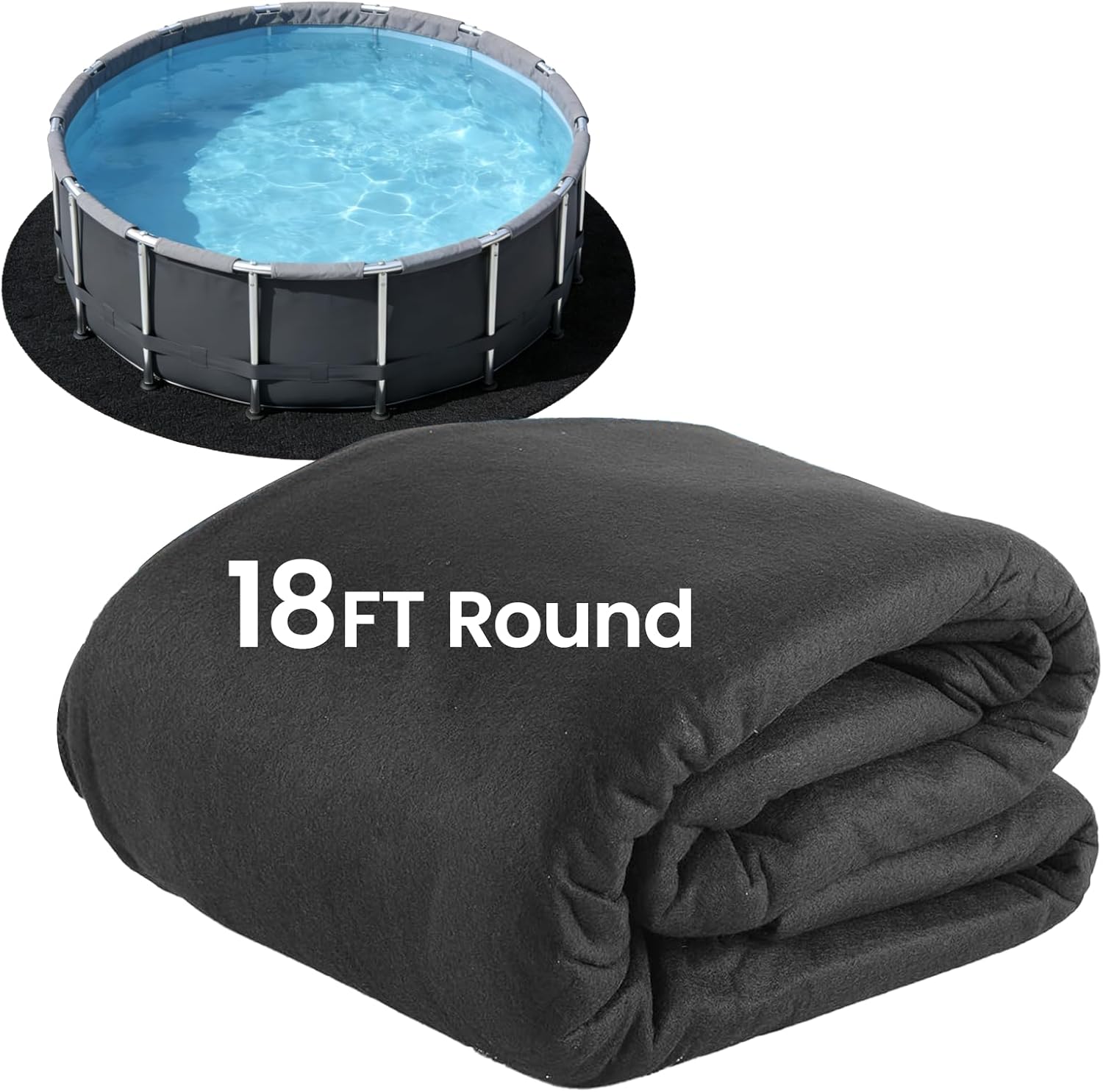
- 18-foot round geotextile underpad
- Barrier against minor roots and debris
- Pre-sized for round above-ground pools

- 350 g/m² stated fabric mass
- Single-piece 18-foot round format
- Black geotextile underlayment

- Model 18R; 18-foot round
- 180 g/m² black geotextile
- A lighter specified underlay option

- 15 x 30-foot oval footprint
- GLI Armor Shield geotextile design
- Permeable floor underlayment

- 12 x 18-foot rectangular pad
- 300 g/m² stated fabric mass
- Seamless one-piece format

- Model RPFM18X9
- 18 x 9-foot rectangular footprint
- Flexible under-pool ground protector

- 21-foot round PVC ground mat
- Waterproof tarp-style construction
- Different moisture behavior from geotextile
What to Look for Before Buying a Pool Liner Pad
The exact floor shape is the first filter
A 24-foot round pool needs a different sheet from an 18-foot round pool. Oval pools require the curved ends to be covered, while a rectangle may have straight sides and rounded internal corners. A listing that says “18 feet” without clearly identifying round, oval or rectangular geometry is not enough information to make a safe choice.
For a replacement liner, inspect the original pool manual and measure the interior floor shape where possible. The frame’s outside dimensions and the water-contact floor do not always have identical boundaries. An underpad should cover the intended supporting area without large folds, exposed strips or improvised patches.
Geotextile, felt and PVC are not the same
Most of the pads below are made from polypropylene, polyester or other fiber-based geotextiles. These are thin, flexible sheets intended to separate the vinyl liner from the prepared foundation. They often permit moisture to pass through rather than trapping it against a solid plastic film.
The 21-foot Ahpuhtan product is a waterproof PVC ground mat, which makes it more similar to a tarp. PVC can be useful where the particular pool manufacturer allows that type of ground cloth, but its resistance to water flow changes drainage behavior. Neither material solves persistent pooling, incorrect grading or soil settlement.
Fabric mass versus thickness
Fabric weight is commonly stated in g/m², also called GSM. The VEVOR round model is listed at 180 g/m², U.S. Pool Supply Ground Shield at 220 g/m², Safana at 300 g/m² and TIXANF at 350 g/m². Those figures describe the mass of fabric spread over an area; they do not directly indicate how tall the fabric is or how easily it punctures.
A higher GSM often means more material for a comparable fabric type, but a true comparison also depends on fiber structure, density, manufacturing quality and pressure testing. A compact textile can be heavier without being softer. Do not translate a GSM claim into a guaranteed number of extra years of liner life.
Protection starts with the base
Even the thickest-sounding underlay is poor insurance against a sharp rock protruding from poorly prepared soil. Remove stones, debris and roots, create the specified level base, compact it where required, and smooth the final support surface. Place the protector only after that work is complete.
Plan around the pool’s wall track, foam cove, bottom rails, frame legs or other structural details. A flat textile mat is not a foundation system, a structural paver or a replacement for required blocks beneath frame supports. The pool manufacturer’s site and installation requirements should guide the order of layers.
U.S. Pool Supply Ground Shield 24-Foot Round Pad
- 24-foot round, pre-cut format
- 220 g/m² nonwoven geotextile fabric
- Thin protective buffer for larger round pools
What the 24-foot coverage changes
The major benefit of this Ground Shield version is its 24-foot circular footprint. A pad for a large round pool needs to lie flat over a substantial floor area, so shape and size matter more here than small differences in packaging. Its USP LP-R24 designation also helps distinguish it from the manufacturer’s smaller and rectangular versions.
The listed nonwoven polypropylene geotextile weighs 220 g/m². That is a useful material-mass specification, although it does not tell you the height of the cushioning after the pool is filled. It creates a separating layer that should reduce direct rubbing between a prepared base and vinyl; it does not turn uneven soil into a smooth surface.
Where it fits into an installation
A 24-foot round pool spans a large surface, and a sheet this size can shift as the liner is unfolded. Work with another person, start with a smooth, compacted and level foundation, and check the mat for folds before placing the liner over it. Smoothness near the cove and wall line is especially important because creases there become difficult to correct later.
The fabric can be trimmed where appropriate, but cutting generously before checking the pool position could leave exposed areas. Lay out the pad, confirm the center, then follow the pool and liner manufacturers’ installation instructions about whether material should terminate at the wall or be positioned around the cove.
Where the 220 g/m² specification helps
Among the products in this guide, the Ground Shield provides a middle-ground published fabric mass: heavier on paper than VEVOR’s 180 g/m² option, but lower than Safana’s 300 g/m² and TIXANF’s 350 g/m² offerings. Those products come in different sizes and shapes, so they are not direct replacements. The comparison is useful for understanding material specifications, not for selecting the wrong footprint.
Owners installing a large permanent-frame vinyl pool may find that known fabric weight and a clearly matched diameter reduce uncertainty. Still, the pad cannot protect a liner from every sharp object, and no fabric underlay should be placed over visible glass, jagged stones or raised roots.
Who should choose something else
Choose another format if the pool is oval, rectangular or smaller than 24 feet. A heavily oversized pad can sometimes be cut down, but buying the correct geometry generally saves effort and reduces waste. Anyone seeking a soft, springy floor should also understand that this is a geotextile protector rather than thick foam padding.
This is most logical for a 24-foot round vinyl-lined pool where the base has already been properly prepared and the buyer wants a known 220 g/m² fabric specification instead of an unquantified ground cloth.
Pros
- Correct round footprint for a 24-foot pool
- Published 220 g/m² fabric weight
- Fabric can be trimmed around the installation edge
- Suitable for rigid-wall and suitable soft-sided installations
Cons
- Not a replacement for removing rocks or leveling the base
- A 24-foot diameter sheet is bulky to position alone
- Adds limited softness compared with dedicated foam cushioning
Rhino Pad 18 x 33-Foot Oval Pool Liner Pad
- Pre-cut for 18 x 33-foot oval pools
- Dense cloth-fiber floor protector
- Convenient fit for a large oval footprint
Why an 18 x 33-foot oval needs its own pad
An 18 x 33-foot oval has two rounded ends joined by a longer central section. A rectangular sheet with the same outside length and width leaves substantial corner material, while a round pad cannot cover the elongated center. The Rhino Pad is supplied for this specific oval footprint, which makes positioning easier during a liner replacement.
The padding uses dense cloth fiber rather than rigid boards or interlocking foam tiles. A single pre-cut sheet prevents edges of separate sections from moving against one another. That matters most on large pools where reaching a displaced center section becomes awkward once the vinyl is partially installed.
Underfoot feel and puncture protection
Rhino Pad adds a fabric buffer between the prepared ground and the vinyl liner. It is sensible protection against small irregularities remaining after careful base work, but the words “puncture resistant” should not be taken to mean that sharp rocks can remain in place. Any pointed material concentrates pressure under thousands of gallons of water.
Because the material is a dense fiber sheet, expect a relatively thin underlayment, not a mattress-like pool floor. If extra softness is the priority, examine approved foam floor systems and their required installation layers separately rather than expecting a woven or felt-like geotextile to feel the same.
Installation details that affect large ovals
Clear the ground and deal with vegetation before positioning the Rhino Pad. Spread it across the full oval outline and check how the sidewalls, buttresses and cove are arranged before the liner goes in. The installer should not assume that all 18 x 33-foot oval frames have identical details at their supporting structures.
Its pre-cut shape reduces the amount of field trimming, but “pre-cut” is not permission to skip a dry fit. Some pool systems specify a particular cove material or method for seating the liner; those directions take priority over general pad advice.
The buyer it fits
This is a practical candidate for someone replacing the liner of an 18 x 33-foot oval above-ground pool and wanting a straightforward fiber layer. It competes with GLI Armor Shield primarily on oval-pad purpose, but not on size: GLI in this list is for 15 x 30 feet.
Buyers trying to compare density numerically should know that a dependable grams-per-square-meter figure was not established for this exact Rhino Pad configuration. Compare its fit and construction rather than assigning it a guessed GSM value.
Pros
- Large oval shape avoids building a pad from small pieces
- Dense fiber forms a protective layer under vinyl
- Pre-cut outline simplifies centering during installation
- Useful for replacement liners in established oval pools
Cons
- Not suitable for a rectangular pool of similar overall dimensions
- A pad this large needs careful unfolding and alignment
- No dependable fabric-weight figure for this exact variant
Blue Wave Gorilla NL122 18-Foot Round Pool Pad
- Blue Wave model NL122
- Pre-cut 18-foot round floor pad
- Permeable, felt-like geotextile
What the NL122 model identifies
Blue Wave sells Gorilla floor protection in several pool diameters, but NL122 identifies its 18-foot round pad. That model number is helpful because “Gorilla Pad” alone can point to many sizes. This is a geotextile layer installed below the vinyl liner, not a new vinyl liner and not wall foam.
The pre-cut circular shape is intended to reduce piecing together strips of padding. For a regular 18-foot round steel-wall pool, an appropriately sized continuous sheet is easier to align than several narrower sections that could overlap or pull apart during installation.
Material behavior on a sand foundation
The felt-like geotextile is permeable, allowing moisture to move through rather than behaving as a waterproof tarp. Pool-floor fabric is commonly placed on a smoothed sand foundation to limit abrasion and reduce the imprint of small surface irregularities. A thin protector can help maintain a more uniform liner surface, but it will not conceal large footprints or trenches.
Specialist product information describes the Gorilla pad at approximately one-eighth inch thick. That describes a thin protective textile, not meaningful impact cushioning. Localized pressures, poor compaction and sharp stones still need to be addressed before the pool is filled.
When the Blue Wave format is convenient
For a buyer who already knows that the pool is 18 feet in diameter, the NL122 avoids ambiguity about the intended footprint. Lay the sheet on the finished base, remove wrinkles, and confirm that it lies correctly at the wall-to-floor transition. Check for any construction-specific requirement about the foam cove or liner overlap.
Because the pad is below the liner, routine cleaning is not the same as maintaining a visible floor mat. Its practical value appears during installation and whenever a liner is replaced; otherwise, the relevant maintenance is observing the pool for leaks, settlement, protruding objects and moisture around the structure.
Where it compares with other 18-foot rounds
TIXANF lists 350 g/m², VEVOR lists 180 g/m², and Shop Square and Poolvio do not supply equally clear mass ratings for the exact variants discussed here. Blue Wave instead offers a recognizable model and published fabric-style installation information. A thicker-sounding marketing name alone does not prove a better puncture resistance score.
Choose NL122 if a pre-cut, permeable 18-foot round geotextile from Blue Wave is the priority. Choose another material type only after deciding what additional property, such as published fabric mass or waterproofing, actually matters for the prepared site.
Pros
- Established NL122 model identification
- Pre-cut round pad for a common pool size
- Permeable fabric permits drainage through the underlayment
- Designed to sit directly beneath a vinyl pool liner
Cons
- Not thick foam or a substitute for a smooth sand base
- Only fits the specified round footprint without awkward changes
- Underlayment does not prevent every possible puncture
Liner Life LL1224RE 12 x 24-Foot Rectangle Pad
- Model LL1224RE; 12 x 24-foot rectangle
- Black polyester geotextile
- Pre-cut for rectangular pool floors
The significance of LL1224RE
The LL1224RE model is a 12 x 24-foot rectangular liner pad. That geometry matters because a 12 x 24-foot oval is not the same floor shape, even though some marketplace descriptions mix the words “oval” and “rectangle.” For a true rectangle, the straight edges and corners help the installer position the material with fewer unexpected offcuts.
Liner Life uses polyester geotextile material. Polyester is a different fiber chemistry from the polypropylene identified for several other products. The meaningful buying point is still the manufacturer’s intended fit and barrier function; fiber name alone cannot establish which sheet will withstand a sharp object under load.
How to use the rectangular outline
After the foundation is flat and free of debris, position the pad so its long sides follow the pool floor. Check corners carefully because bunching tends to show up where a straight side turns. If your pool has rounded interior corners, follow the maker’s instructions for the liner and the pad rather than assuming hard ninety-degree corners everywhere.
The pre-cut format reduces the need to assemble one large surface from several pieces. A single-piece pad is particularly convenient under a rectangular frame whose corner supports or perimeter channels leave little room for adjustment once assembly progresses.
Comfort expectations and actual protection
Polyester geotextile adds a thin layer between the liner and the base. It can reduce friction against small grains and help preserve a smoother visual floor, but it cannot remove bumps formed by underlying construction mistakes. The product’s listed dimensions describe its shape, not its actual softness after loading.
The listed model does not have a sufficiently dependable public fabric-weight or thickness figure for a numeric comparison with 180, 220, 300 or 350 g/m² options. That omission is not necessarily a product defect, but it limits how precisely shoppers can compare material volume.
Who should buy it
This pad belongs on the shortlist for a 12 x 24-foot rectangular above-ground pool using a compatible vinyl liner. It is a particularly logical candidate when liner replacement is already planned and the buyer wants the floor protector sized in advance.
For a 12 x 18-foot rectangle, the Safana pad is closer to the footprint. For an 18 x 9-foot narrow rectangle, MJZ is the more directly sized option. Trying to force LL1224RE onto those floors requires cutting more material and risks getting the edge placement wrong.
Pros
- Clear manufacturer model number and rectangular fit
- Polyester geotextile underlayment
- Pre-cut shape limits measuring and joining
- Useful for rectangular liner replacements
Cons
- Rectangle is not the same as a 12 x 24-foot oval
- Material weight and thickness are not reliably specified
- Does not correct bumps, hollows or raised fittings
Shop Square 18-Foot Round Geotextile Pool Pad
- Pre-cut for 18-foot round pools
- Felt-like polypropylene geotextile
- Moisture-permeable pool-floor underlay
A practical 18-foot round geotextile
Shop Square’s version is a pre-cut 18-foot round polypropylene geotextile pad. It works as an underlayment between a carefully prepared foundation and the pool floor. The most useful feature is its straightforward match to a common pool diameter, rather than a complex accessory system.
This is a felt-like protector, not a foam tile set. It is meant to remain hidden beneath the pool, where it separates vinyl from smaller debris and rough base texture. Some owners specifically comment that this class of material feels thinner than they expected, so looking at material type before ordering is important.
What permeable material does and does not do
The polypropylene geotextile allows moisture to pass through the fabric. That is different from the waterproof PVC ground mat further down this guide. Water movement through a pad is useful to understand, especially where runoff or groundwater can collect, but neither option replaces grading and drainage around the pool site.
For protection, the underlayment addresses incidental contact rather than structural movement or protruding debris. The fabric cannot stop roots from growing indefinitely, and strong weed-barrier wording should never be treated as a guarantee that vegetation will not return beneath the pool.
Fitting the pad beneath the frame
For a true 18-foot round pool, a pre-cut sheet should reduce work compared with general-purpose landscape fabric. Test the position against the finished pool base and avoid stretching the material to cover a slightly oversized area. If the pool instructions require the floor pad to sit against or behind a cove, follow that detail precisely.
You can trim a small excess in an installation that permits it, but do not cut away material at a critical liner-support point merely to make the pad look tidy. There is no benefit to sharp exposed ground at the perimeter.
How it differs from the other 18-foot pads
Shop Square emphasizes common-size convenience and geotextile construction. TIXANF’s specific appeal is a published 350 g/m² fabric mass, while VEVOR states 180 g/m². Without a dependable stated mass for this Shop Square variant, it would be misleading to rank the three purely by apparent thickness in pictures.
This is a sensible pick for someone who wants a familiar pre-cut 18-foot textile underpad and does not need a published GSM rating to decide. Buyers seeking foam-like softness or a certified puncture-resistance threshold should look beyond the marketing description.
Pros
- 18-foot round footprint suits a widely used pool size
- Pre-cut sheet avoids piecing together small mats
- Permeable polypropylene fabric under the vinyl
- Can be trimmed carefully where the installation requires
Cons
- Felt-style sheet is not plush foam cushioning
- Fit must be checked at the wall-to-floor junction
- Fabric weight is not published clearly for this variant
Poolvio 18-Foot Round Geotextile Liner Pad
- 18-foot round geotextile underpad
- Barrier against minor roots and debris
- Pre-sized for round above-ground pools
What is distinctive about Poolvio
The Poolvio pad follows the same broad geotextile approach as several competitors, but its specific configuration is a round 18-foot sheet. This makes it relevant to pool owners buying a first floor protector or replacing one during a vinyl-liner change. No unusual installation tools or rigid panels are part of the stated concept.
The retailer describes protection against punctures and interference from weeds. Treat those descriptions as the intended purpose of an underpad, not as measured proof that the sheet will resist every rock or aggressive plant. Its role is to add a buffer on ground that has already been made pool-ready.
Preparation matters more than branding
Before fitting any 18-foot sheet, dig out roots, remove sharp stones, and finish the base according to the pool manufacturer’s requirements. A geotextile pad is often most successful when it has very little left to correct. Folds, ridges and uneven sand below it can still be felt through a filled liner.
Spread the Poolvio mat fully and confirm its center before unrolling the liner. Under a flexible-sided pool, also follow the frame manufacturer’s instructions about the base footprint and ground protection because the floor and supporting legs may require different treatment.
Limitations of a lightly specified listing
A verified fabric-mass figure is not available here, so the Poolvio should not be described as heavier or lighter than TIXANF, Safana or VEVOR. Photos also cannot establish its actual loaded thickness. The safest comparison is its 18-foot round fit, stated geotextile construction and use as a liner barrier.
There is also an important distinction between protecting a liner from incidental abrasion and resolving weeds. The pad may slow contact with vegetation, but persistent weeds should be removed and controlled using methods approved for the pool installation rather than relying on the underlay as the only defense.
Who should consider this model
Poolvio makes sense for an 18-foot round pool where the buyer wants a plain geotextile separator rather than a waterproof sheet. It is less compelling if the purchase decision depends on a specific fiber mass, a tested puncture figure or an independently verified warranty term.
An informed choice here is about correct sizing, proper installation and reasonable expectations of thin geotextile. Those basics carry more weight than broad claims about extending the liner’s life by an unspecified amount.
Pros
- Round 18-foot shape eliminates large corner offcuts
- Geotextile separates the liner from the prepared base
- Basic one-layer underpad without complicated components
- Can suit a first installation or a liner replacement
Cons
- No verified fabric-weight measurement for this listing
- Weed-barrier wording is not a guarantee against plant growth
- Cannot compensate for projecting rocks or an uneven floor
TIXANF 18-Foot Round 350 g/m² Liner Pad
- 350 g/m² stated fabric mass
- Single-piece 18-foot round format
- Black geotextile underlayment
Understanding the 350 g/m² rating
The TIXANF pad advertises 350 grams per square meter of geotextile fabric for its 18-foot round version. GSM is a mass-per-area measurement. It makes the listing easier to compare with other products that also publish GSM, but it does not directly measure thickness, softness or puncture resistance.
Among the listed 18-foot round pads with stated GSM, TIXANF’s figure is higher than VEVOR’s 180 g/m². That suggests more fabric mass across an equivalent area if the measurements are comparable. It does not establish that the TIXANF is twice as protective, because weave, fibers, compaction and test methods also matter.
Why the single-piece construction helps
The listing identifies a seamless, pre-cut circular sheet. Avoiding a central join is helpful because overlapped fabric can leave a raised line beneath a vinyl liner. A one-piece pad still needs smoothing, but it removes one common source of unevenness from improvised multi-panel installations.
At 18 feet across, the pad is large enough that it should be unfolded patiently. Do not pull so hard that edges shift while the liner is being set. Having the site ready before bringing the sheet out also reduces the chance that loose grit becomes trapped underneath.
Protection versus comfort
A relatively high GSM is useful when the buyer wants a denser specified textile rather than the lightest fabric available. Yet there is a difference between protective density and softness underfoot: a firm, dense pad may not feel like thick foam. The pool’s finished base and the vinyl liner determine much of the final sensation.
No verified laboratory puncture-test results permit a precise ranking against the other pads in this list. The sound purchasing argument is a known material mass and appropriate size, with the understanding that large stones and roots still must be removed.
Who should compare it closely
TIXANF is especially relevant to someone deciding between 18-foot round geotextile pads with different stated fabric weights. It offers a more concrete number than listings that describe themselves only as “heavy duty.”
Choose a different size for any pool that is not 18 feet round. A buyer who wants water-impermeable ground cover should also understand that this fabric is a textile-style underpad, not the same type of sheet as the 21-foot PVC option.
Pros
- Stated 350 g/m² weight aids material comparison
- Single-piece round sheet avoids internal joins
- Pre-cut dimensions reduce trimming work
- Useful when a denser felt-style pad is desired
Cons
- Heavier fabric does not eliminate the need to clear sharp debris
- A high g/m² number is not a certified puncture rating
- Fabric mass alone does not establish exact loft or thickness
VEVOR 18-Foot Round 180 g/m² Pool Liner Pad
- Model 18R; 18-foot round
- 180 g/m² black geotextile
- A lighter specified underlay option
The manufacturer’s model and density
VEVOR identifies this configuration as model 18R, a black geotextile floor pad for an 18-foot round above-ground pool. The manufacturer specifies 180 g/m² and describes recycled geotextile material. These are more concrete details than generic “extra thick” wording.
An 180 g/m² textile may be adequate as a separator on a well-prepared site, but its lower stated mass makes it a different choice from the TIXANF 350 g/m² version. GSM by itself cannot establish the pressure needed to puncture either product; it only helps buyers understand that the listed quantities of fabric per area differ.
Lighter construction in practical terms
The point of a liner pad is to prevent direct contact between vinyl and the most abrasive parts of the foundation. VEVOR’s relatively light specified fabric can still provide a separate surface, provided the base has been finished correctly. Do not depend on it to conceal pebbles, ridges or the outline of unevenly compacted sand.
The pre-sized round format also matters during setup. Fold lines should be smoothed before the vinyl goes over the pad, particularly around the edges where the weight of the wall and liner can lock material in place.
Material specification and drainage
VEVOR calls this a geotextile underlayment rather than a solid waterproof tarp. That places it in the moisture-permeable family of pool-floor protectors and makes it more similar in concept to Shop Square than the Ahpuhtan PVC mat. Still, no fabric can correct a location that regularly floods or sheds runoff beneath the wall.
Its recycled-material claim is part of the manufacturer’s description. Buyers who prioritize recycled content can take it into account, but it is not by itself a measure of liner protection or a substitute for proper installation.
Where it belongs on the shortlist
The VEVOR is well suited to buyers who want an 18-foot round pad with clearly stated, relatively light fabric mass and an identifiable model. It provides a useful comparison point against higher-GSM products.
It is not the logical substitute for a 21- or 24-foot diameter floor, and it should not be selected for a rough base in the expectation that adding geotextile eliminates site preparation. Its strongest buying argument is clear sizing and specifications rather than extraordinary cushioning claims.
Pros
- Manufacturer supplies a specific 180 g/m² rating
- Model 18R is identifiable for the round version
- Recycled geotextile material is specified
- Pre-sized pad for a common 18-foot pool
Cons
- Lighter stated mass than the 220, 300 or 350 g/m² choices
- Not intended to smooth badly prepared ground
- Manufacturer descriptions of thickness refer to fabric mass, not height
GLI Armor Shield 15 x 30-Foot Oval Floor Pad
- 15 x 30-foot oval footprint
- GLI Armor Shield geotextile design
- Permeable floor underlayment
Why the Armor Shield model is different
GLI’s 15 x 30-foot oval Armor Shield addresses a footprint that the 18 x 33-foot Rhino Pad cannot fit. GLI identifies Armor Shield as a polypropylene geotextile underlayment that reduces direct contact between vinyl and the sand or soil below. Its recognizable product family and documented purpose are useful when selecting components for a replacement liner.
GLI also describes moisture permeability, resistance to common substances found around pools and a pre-cut pattern. The material is an underlay rather than a solid membrane, so it behaves differently from a waterproof PVC tarp if water reaches the underside of the pool.
How to install around an oval floor
The 15 x 30-foot pad needs to line up with the rounded ends and long straight sides of the pool. Check the center line, smooth the ends and verify the wall-to-floor cove before the vinyl is fitted. Careless alignment can pull fabric away from the exact areas where the liner bends.
The manufacturer emphasizes pre-cut patterns and avoiding unnecessary joining. That is particularly useful on an oval where strips joined at the center would create long raised seams. Follow the pool installation manual, especially for supports and any bottom-track details.
What the material cannot guarantee
Even a reputable geotextile pad is not a structural foundation, animal barrier or answer to severe ground settlement. Rocks, roots and construction debris should be removed rather than left under a shield. A pad should improve the interface between prepared ground and vinyl, not serve as an excuse to ignore the base.
Warranty statements for Armor Shield differ across individual retailer listings and may depend on whether a qualifying GLI liner was purchased. GLI’s own warranty-extension language applies to specified liner families and conditions; it should not be interpreted as universal extended coverage for any above-ground pool.
Who will appreciate GLI
This is a sound candidate for a 15 x 30-foot oval vinyl-lined pool whose owner values a manufacturer-documented liner protection system. Its closest shape-based competitor in this guide is Rhino Pad, though the size difference is large enough to make the actual pool measurement decisive.
For buyers wanting a material with a publicly listed GSM number, the other options may be easier to compare quantitatively, but they are mostly different geometries. Matching a 15 x 30-foot oval correctly is more important than obtaining an arbitrary GSM figure from an unrelated round model.
Pros
- GLI manufacturer documentation supports material and purpose
- Pre-cut large oval outline
- Permeable geotextile suits prepared soil or sand bases
- Available fitting guidance for vinyl-lined oval pools
Cons
- Oval cannot be substituted for a 15 x 30-foot rectangle
- Advertised warranty descriptions vary between sellers
- Pad is not a barrier against tunneling animals or major ground movement
Safana 12 x 18-Foot 300 g/m² Rectangle Pad
- 12 x 18-foot rectangular pad
- 300 g/m² stated fabric mass
- Seamless one-piece format
A heavier specified rectangular format
Safana identifies this sheet as a 12 x 18-foot rectangular pool pad with stated 300 g/m² geotextile material. It is described as seamless, meaning the buyer is not expected to piece together short strips to span a normal rectangular floor of that size.
That combination is relevant when a rectangular pool needs continuous underlayment. It also offers a published material mass, which some comparable rectangular listings do not provide. Material weight gives useful context but does not amount to a standardized abrasion or puncture certification.
Rectangle versus oval compatibility
The title refers to rectangle and oval use, yet the named physical pad is rectangular. A 12 x 18-foot oval has rounded ends, so any such installation calls for careful measuring and possibly trimming excess material. Do not assume the corners of a rectangle pad will lie neatly inside an oval wall without adjustment.
Conversely, a nominal 12 x 18-foot rectangular frame may contain support details or rounded interior edges that affect the true flooring outline. Check the manufacturer’s base diagram and use the pad dimensions as a starting point, not the only measurement.
Installation and floor appearance
Spread a one-piece sheet over a smooth, compacted foundation and keep the edges flat. The simplest setup is often to position and inspect the underpad before bringing in the vinyl liner, because correcting a wrinkle becomes harder as the liner is centered. Keep the material clear of sharp hardware and any drain or fitting locations specified by the pool instructions.
The fabric may make small residual texture less abrasive, but a 300 g/m² rating does not promise a soft floor. Larger lumps, hollows and shifted fill can still become visible or uncomfortable once the pool is filled.
Who should choose Safana
Safana makes the strongest shape-based case for a buyer with a 12 x 18-foot rectangular floor who also wants a stated GSM rating and a one-piece design. If you own a 12 x 24-foot rectangular pool instead, the Liner Life LL1224RE is the closer direct fit.
The Safana is less appropriate if you need a 12 x 18-foot oval cut exactly to the curve and do not want to trim. It is also a poor substitute for the MJZ 18 x 9-foot pad simply because the longer dimension is 18 feet in both products.
Pros
- Specified 300 g/m² weight supports comparison
- Rectangle outline matches the named footprint
- One-piece sheet avoids central seam overlap
- Potentially trimmable for a smaller correctly measured floor
Cons
- Oval use requires confirming dimensions and trimming
- Fabric mass is not a standardized puncture-test result
- No basis to assume suitability for larger rectangle pools
MJZ 18 x 9-Foot Rectangular Pool Liner Pad
- Model RPFM18X9
- 18 x 9-foot rectangular footprint
- Flexible under-pool ground protector
Why 18 x 9 feet is a distinct size
MJZ sells this pad in a relatively narrow 18 x 9-foot rectangular format, identified in product information as RPFM18X9. That is not interchangeable with a 12 x 18-foot pad. Six feet of width difference changes coverage substantially, even though both have an 18-foot long side.
For a smaller rectangular pool, buying a pad close to the actual floor outline reduces the amount of trimming and avoids unwanted folds along the long edges. The sheet is an underlay and should sit beneath the liner or base according to the pool manufacturer’s instructions.
Felt-like padding and surface conditions
The product is marketed as thickened floor padding. Available descriptions refer to a felt-style fabric, but the thickness and textile-weight claims are not consistently presented in comparable measurement units. It is therefore safer to judge the pad by its dimensions and intended protective role than to assign it a precise advantage in density.
It can help separate the pool bottom from minor abrasive contact on a carefully prepared surface. It cannot safely bridge holes, smooth protruding stones or create the structural strength that a level compacted pad of earth, sand or another approved base supplies.
Careful fitting around rectangular supports
With a long, narrow rectangle, centering matters because a small sideways shift can expose a large length of one edge. Position the sheet, work down both long sides and check that the corners and any support leg footprints comply with the pool setup directions.
If this mat is being used under a soft-sided frame-style pool, remember that some systems put load on legs outside the water-floor footprint. A liner-floor pad should not be assumed to provide the required support beneath those legs; consult the actual pool manual.
The best buyer for this option
MJZ is relevant to owners who specifically need an 18 x 9-foot rectangle and want to avoid cutting down a much wider pad. Its claim of thicker material is secondary to a dimension match that can be verified before checkout.
Anyone with an oval, round or larger rectangular pool should start with a pad built for that shape. Material thickness cannot compensate for missing floor coverage, and a pad that must be stretched to reach the walls is not an appropriate fit.
Pros
- Uncommon 18 x 9-foot dimension suits specific rectangular pools
- Model RPFM18X9 distinguishes the configuration
- Flexible sheet can follow a properly prepared base
- Simpler than combining multiple generic ground cloths
Cons
- Wrong shape for round and most oval frames
- Marketing thickness claims are not directly comparable with GSM ratings
- No reason to assume it fits other 18-foot pool widths
Ahpuhtan 21-Foot Round PVC Pool Ground Mat
- 21-foot round PVC ground mat
- Waterproof tarp-style construction
- Different moisture behavior from geotextile
PVC ground cloth rather than porous felt
This 21-foot round product is associated with the Ahpuhtan brand and described as a waterproof PVC ground mat. That changes how it should be compared with the geotextile pads in this article. The material is more tarp-like, whereas polypropylene or polyester geotextile generally allows water to move through its textile structure.
The manufacturer’s stated diameter is 21 feet, intended for a matching round pool. The large, one-piece footprint could appeal to someone seeking a separate ground cloth, but identifying the installation layer is important: a ground tarp used under the whole pool is not automatically equivalent to padding positioned directly beneath a vinyl liner inside a steel-wall pool.
How waterproof construction affects installation
Waterproof PVC can keep surface moisture from passing straight through the sheet, but that also means water arriving from the side or collecting beneath it can remain trapped. On sites with heavy runoff, drainage and edge treatment should be examined carefully. A waterproof material is not a substitute for grading water away from the structure.
A tarp-style material also feels different from a felt-like geotextile. It should not be chosen on the assumption that it provides the same cushioning as Blue Wave, TIXANF or other textile pads. Inspect the pool manufacturer’s required base layers before placing it under any permanent-wall vinyl liner.
How to interpret the puncture claim
The listing advertises resistance to wear and contact with small debris. PVC can serve as a physical separator, but it is still susceptible to damage from pressure concentrated at sharp points. The installer should remove glass, stones, thorny roots and other debris before spreading the cloth.
Because it is presented as a multipurpose outdoor mat, buyers should distinguish the pad’s pool-footprint sizing from specific manufacturer approval for their pool system. A product that works as a protective groundsheet for a portable frame may not be the approved replacement for a particular vinyl-liner underlay.
Who should consider the 21-foot mat
This is the logical shape match for a 21-foot round pool only when that pool’s construction allows a PVC ground mat in the proposed location. It is especially different from the geotextile entries when permeability and moisture management matter.
If your priority is a traditional permeable liner-floor fabric, seek a 21-foot geotextile pad made for your installation. Do not buy an 18-foot round geotextile merely because you prefer its material, and do not treat a waterproof sheet as universally better protection.
Pros
- 21-foot round footprint fills a gap in the shortlist
- Waterproof PVC offers a distinct ground-cloth approach
- Designed to unfold without sewn-together smaller pads
- Can double as an outdoor protective sheet in suitable situations
Cons
- Waterproof sheet does not drain like permeable geotextile
- Must manage trapped water and site drainage carefully
- Does not provide the same felt-like surface as textile underlays
Detailed Buying Guide: Building a Better Pool Floor
Determine which layer the pad is meant to protect
Pool-product descriptions often use “under pool,” “liner pad” and “ground cloth” as if they mean the same thing. For a rigid-wall above-ground pool, a liner pad usually lies on the prepared floor underneath the separate vinyl liner. On many portable frame pools, the ground cloth sits below the pool’s integrated bottom, often extending outside the water-holding footprint. Those two arrangements create different demands.
Check the assembly diagram before ordering. A pad designed for contact with a vinyl liner should not automatically be placed under structural frame feet. Conversely, a waterproof groundsheet beneath a frame-style pool should not automatically replace specified textile lining inside a permanent-wall model. The product’s floor dimensions and the manufacturer’s installation sequence both need to match.
Size the base rather than guessing from advertising photos
Round sizes refer to diameter: an 18-foot round pad covers a very different area from a 24-foot round one. Rectangular pads use two straight dimensions, while an oval of the same stated length and width includes curved ends. When a pad is pre-cut for a given shape, that convenience becomes a liability if the actual floor has a different footprint.
Confirm the finished interior floor outline, not just the outside of a pool box. Review the pool maker’s instructions for how much padding should reach the edge or sit near the cove. Avoid buying a smaller pad to save material, since exposed strips beneath the liner can become concentrated points of abrasion. Buying a much larger pad can also cause awkward folds and excessive trimming.
Know what happens when water moves around the pool
A permeable geotextile lets moisture pass through the sheet, while a solid PVC mat resists direct passage through its surface. Neither one independently drains the site. Runoff can still enter from the pool perimeter, and groundwater can rise into the base during prolonged wet weather.
Water collecting beneath a tarp may stay in localized pockets if the surface is not graded correctly. Permeable fabric does not solve standing water either; it simply does not form the same solid barrier. Think about the slope of surrounding land, gutter discharge, irrigation and rainwater before deciding which type of underlay belongs in the installation.
Understand cushioning realistically
The word “pad” can imply something as soft as a foam mat. Geotextile pool protectors are usually much thinner. Their main job is to reduce abrasive contact with an already smooth base and provide a modest buffer. They will not erase foot-shaped hollows in sand or make a poorly leveled foundation feel professionally finished.
If floor comfort is a major purchasing goal, assess compatible foam underlayment separately and verify whether the pool system permits it. Foam sheets may need precise joining and edge treatment; thick material can also change how a liner seats around the cove. Do not place multiple unspecified layers under a liner on the assumption that more padding always means better fit.
Look for useful measurements, not exaggerated adjectives
A published model number, exact footprint and fabric mass are meaningful facts. Words such as “heavy duty,” “upgraded” and “extra thick” offer far less information without a consistent measurement. Compare GSM only when it is given for the exact configuration, and remember that fabric weight is not a laboratory measure of resistance to pointed objects.
Product photos can also mislead because a folded pad looks much thicker than a single loaded layer. Focus on construction and accurate sizing rather than judging a folded edge as the final floor thickness. If a specification is missing, it is better to leave the comparison unresolved than to assume the nearest model shares the same measurements.
Plan the installation sequence before delivery
A practical installation begins with location, level and soil suitability. The next steps depend on the pool: prepare the specified foundation; build or place the required wall and supports; fit the bottom cove if applicable; lay and smooth the pad in its approved position; and fit the vinyl liner or pool floor as directed. Some kits specify a different order, so their instructions always take precedence.
Keep the new pad clean as it is unpacked. A pebble accidentally dropped between the finished base and the sheet defeats part of the reason for buying it. Work gradually from the center outward to remove folds and do a final perimeter check before concealing the protector beneath the vinyl.
Do not overlook the wall-to-floor transition
The seam where the floor curves toward the wall deserves particular attention. A vinyl liner needs proper support at this transition, which is often provided by a shaped cove or the pool’s own base design. A floor pad cannot replace the cove if the manufacturer requires one.
The underlay should not bunch into thick ridges at the transition or leave the liner resting directly against an abrasive point. Avoid aggressive trimming near this area until the liner manufacturer’s directions are clear. A tidy-looking edge is less important than complete support under the actual liner path.
Consider the long-term replacement process
The pad will generally remain hidden until the liner or pool is removed. That means installation quality is more important than routine cleaning access. When changing a liner, inspect the exposed pad for tears, stretched sections, embedded grit, damp damage, vegetation and displacement before deciding to reuse it.
A sheet that still looks intact is not automatically appropriate for reuse if the base has moved or the pad has collected sharp debris. Rebuilding a smooth supporting surface before a new liner goes in is often more valuable than keeping an older underlay in the same position. Check liner and pad warranties separately, since they may have different terms and exclusions.
Direct Comparisons That Matter
TIXANF 350 g/m² vs VEVOR 180 g/m²
These are the most direct numerical comparison in the list because both are 18-foot round geotextile pads with stated GSM values. TIXANF specifies 350 g/m², whereas VEVOR model 18R specifies 180 g/m². That is a measurable difference in listed fabric mass per unit area, not proof of any particular puncture rating or softness.
Choose TIXANF if a denser stated fabric is the priority for your installation. VEVOR offers a lighter documented textile and an identifiable manufacturer model. The prepared site should be equally smooth for either product, and neither should be used as an excuse to leave sharp objects in the foundation.
Blue Wave Gorilla vs Shop Square vs Poolvio
All three are listed for 18-foot round pools and are intended as protective underlays rather than solid PVC sheets. Blue Wave is identifiable as NL122 and has established information about its permeable geotextile design. Shop Square uses polypropylene geotextile, while Poolvio lists geotextile fabric without a clear exact-variant GSM rating.
The practical selection is less about calling one “strongest” and more about trusted model identification, installation details and fit. When numerical density is decisive, compare the TIXANF or VEVOR listings instead. If fabric type and a pre-cut 18-foot outline are enough, these three are more closely related than their marketing phrases suggest.
Rhino Pad 18 x 33 oval vs GLI Armor Shield 15 x 30 oval
Both are purpose-built oval floor protectors, but they fit different pools. Rhino is 18 x 33 feet with dense cloth-fiber padding; GLI Armor Shield is 15 x 30 feet with documented polypropylene geotextile construction. Buying the wrong one leaves a meaningful gap or forces unwanted excess around an oval perimeter.
GLI brings detailed manufacturer information about its Armor Shield material and liner-related conditions. Rhino offers a large pre-cut oval footprint for a different size of pool. Measure first: the manufacturer name and fabric description should only decide the purchase after the correct floor geometry is established.
Liner Life 12 x 24 rectangle vs Safana 12 x 18 rectangle vs MJZ 18 x 9 rectangle
These three pads share a rectangular theme but have very different proportions. Liner Life LL1224RE is 12 x 24 feet and made of polyester geotextile. Safana is 12 x 18 feet with a stated 300 g/m² geotextile. MJZ is the notably narrow 18 x 9-foot option with model RPFM18X9.
There is no universal winner among these rectangles. A correctly fitted 18 x 9-foot pad is more useful beneath an 18 x 9-foot pool than a higher-GSM 12 x 18-foot pad whose width does not match. Once dimensions are correct, compare the specified materials and how much trimming the pool’s internal corners require.
Ground Shield 24-foot round vs Ahpuhtan 21-foot PVC mat
The size difference is already decisive: Ground Shield covers a 24-foot round footprint, while the Ahpuhtan mat is for 21 feet. There is also a material difference. Ground Shield is a 220 g/m² nonwoven geotextile intended to act as a liner protector; Ahpuhtan is a waterproof PVC ground mat.
Do not treat the PVC mat as simply a thicker or thinner version of Ground Shield. It manages moisture differently and may belong to a different pool-construction arrangement. Choose only the diameter and material the pool instructions permit, rather than comparing the two as interchangeable products.
Common Mistakes When Buying a Pool Pad
Choosing by diameter but ignoring shape
A listing marked 18 feet may refer to round, oval or the longer dimension of a rectangle. Product pages can group several variants together, making the selected shape easy to overlook. Confirm the exact variant and footprint before buying, especially when an older review or image shows another configuration.
Using a pad instead of fixing the foundation
A pad cannot make soft fill stable or remove protruding stones. Compact and level the base as required by the pool manufacturer. Fix sharp spots and drainage issues before laying anything down, since the weight of filled water will amplify defects that look minor during dry installation.
Assuming higher GSM equals guaranteed protection
A 350 g/m² pad contains more stated mass per square meter than a 180 g/m² pad, but that does not establish twice the puncture resistance. Fiber type, structure and test methods matter. Treat GSM as one comparison measurement, not a substitute for actual manufacturer performance data.
Confusing liner-floor padding with a ground tarp
The waterproof 21-foot PVC option has a different design from permeable geotextile. Pool instructions may call for one layer inside the wall and another under the structure. Buying the right-sized product for the wrong layer can create installation problems even when its promotional description mentions pool protection.
Leaving creases, grit or exposed strips
Wrinkles under the vinyl can remain visible after filling, and grains trapped beneath the protector can produce local pressure points. A dry fitting inspection should cover the center, perimeter and wall cove. Correct any displaced material before the next heavy component is installed.
Frequently Asked Questions
Do I need a pool pad if I already have sand under the liner?
A well-prepared sand foundation provides the required support in many approved installations, while a geotextile pad adds separation between that surface and the vinyl. Follow the pool and liner manufacturers’ directions; a pad can help reduce abrasive contact but does not replace proper grading, compaction or the specified depth and shape of the base.
What is the difference between a pool liner pad and a ground cloth?
A liner pad commonly sits immediately under a separate vinyl liner inside a rigid-wall pool. A ground cloth is often placed beneath the complete structure of a portable or frame-style pool. Terminology varies, so check where the particular product is intended to sit rather than relying only on its name.
Is 350 g/m² better than 180 g/m²?
It means the stated fabric mass per square meter is higher, assuming the measurement is accurate and comparable. It does not by itself prove better softness, puncture resistance or lifespan. Base preparation, fiber structure and actual fit remain important.
Can I use a rectangular pad under an oval pool?
Sometimes a rectangular sheet can be trimmed to a smaller oval shape, but only if its usable dimensions fully cover the intended oval floor. Straight corners must not bunch under the liner. A properly pre-cut oval pad is usually easier to position for an oval pool.
Can an above-ground pool pad stop weeds and roots?
Geotextile can provide a barrier between the finished foundation and liner, but it is not a permanent guarantee against vigorous plant growth. Remove vegetation and roots during site preparation, and follow the pool manufacturer’s approved methods for ground treatment. Never assume the pad makes aggressive plants harmless.
Will a pad prevent every pool liner puncture?
No. Sharp debris, unsuitable soil movement, incorrect wall or cove construction and liner installation errors can still cause damage. The pad is one protective layer in a system that depends on proper foundation work and correctly seated vinyl.
Can I put the pad directly over grass?
Do not assume this is acceptable. Many above-ground pool systems require removal of sod, leveling and a properly prepared foundation before installation. Grass can decay or leave uneven ground beneath a loaded pool. Use the pool manufacturer’s site-preparation directions.
Does a waterproof PVC mat improve drainage?
A waterproof sheet blocks water passing directly through the material; it does not create a drain. Water can collect beneath or around it if the surrounding site is poorly graded. Use appropriate drainage and ground preparation regardless of the pad type.
How much softer will a geotextile pad make the floor?
Most geotextile underlays add a thin fabric buffer, not the thick cushioning of foam. Floor feel is still influenced heavily by the finished base and liner. Check the type of material and any verified thickness information before expecting a noticeably cushioned surface.
Can I reuse the pad when replacing a vinyl liner?
Only after examining it for damage, embedded debris, displacement and suitability for the new liner installation. Also inspect and repair the exposed foundation. A damaged or contaminated underpad should not automatically be reused to avoid the cost of replacement.
Should I choose an oversized pad and cut it down?
A limited amount of trimming can be reasonable where the manufacturer permits it, but a substantially oversized sheet creates unnecessary work and potential folds. A pre-cut pad matching the exact footprint generally makes installation easier and reduces waste.
Which pad should I buy for an 18-foot round pool?
Several products in this guide fit that diameter: Blue Wave NL122, Shop Square, Poolvio, TIXANF and VEVOR 18R. If a stated fabric mass matters, TIXANF lists 350 g/m² and VEVOR lists 180 g/m². Otherwise, consider the material type, installation instructions and how the pad matches your pool’s floor system.
Final Buying Considerations for Above-Ground Pool Pads
The best pool pad for above ground pool installations is first a fit decision. A 24-foot round Ground Shield, 18 x 33-foot oval Rhino Pad and 12 x 24-foot rectangular Liner Life sheet solve different coverage problems. Their sizes are not marketing details; they determine whether the liner is supported across the intended floor area.
Next, match the material to the construction. Among 18-foot round geotextiles, TIXANF and VEVOR provide notably different published GSM values, while Blue Wave, Shop Square and Poolvio offer more conventional pre-cut textile approaches. GLI offers an established Armor Shield system for a 15 x 30-foot oval; Safana and MJZ serve distinctive rectangular footprints. The 21-foot Ahpuhtan mat should be considered as a waterproof PVC ground cloth rather than assumed equivalent to permeable felt.
Whichever pad matches your pool, spend the most care on the foundation, the correct installation layer and the edge transition. A precisely fitted sheet over a smooth, stable, debris-free base is far more valuable than a heavily advertised pad placed over avoidable problems.
Author