

A swimming pool 3 way diverter valve decides where circulating water travels when a system has two possible branches. On an equipment pad, that can mean selecting the pool or spa, dividing a return flow, or sending water through a heater or solar loop. A replacement that looks nearly identical to the old valve can still have the wrong socket diameter, body material or operating stops.
This comparison covers 17 specific three-port models from Jandy, Pentair, Hayward, CMP, FibroPool, ATIE and an aftermarket Jandy-compatible listing. The key differences are between 1½-inch and 2-inch socket families, slip and female-threaded connections, PVC and CPVC construction, and general-purpose versus solar drain-down design. Compare the existing valve part number and the physical connection method before considering handle style or brand.
Quick Comparison of 3-Way Pool Diverter Valves

- 1½-inch socket / 2-inch spigot connection family
- Three ports with positive-seal diverter
- NeverLube CPVC construction

- 2-inch socket / 2½-inch spigot connection family
- CPVC NeverLube valve body
- Larger three-port flow-path option

- 3-way valve in the 2-inch socket family
- Grey PVC body
- 2½-inch slip-over-exterior fitting option

- Identified as manufacturer part 263037
- 1½-inch slip socket / 2-inch spigot exterior
- Grey PVC three-way design

- Pentair part 263026
- 2-inch socket / 2½-inch outside slip
- Manufacturer-listed CPVC body
- Pentair part 263035
- 1½-inch internal socket / 2-inch exterior
- Three-port CPVC construction

- Purpose-built solar valve with drain-down
- 2-inch CPVC three-port connection family
- 2½-inch exterior slip option

- Hayward PSV3S model
- 1½–2-inch family with CPVC body
- Manual indexed three-way control

- 2–2½-inch Hayward connection family
- Manufacturer-listed CPVC
- Three-way handle with index setting

- PVC member of Hayward smaller PSV family
- 1½-inch socket / 2-inch coupling option
- Three-way port selection

- 2–2½-inch family for larger connections
- PVC construction; DGR suffix
- Hayward PSV three-port diverter design

- CMP part 25913-204-000
- 2-inch socket / 2½-inch spigot
- Black CPVC HydroSeal construction

- 1½-inch slip / 2-inch spigot family
- POSI-Close diverter and PTFE seats
- Manufacturer specifies CPVC despite listing PVC wording

- 2-inch internal slip / 2½-inch external spigot
- Manufacturer-listed CPVC
- Three-port POSI-Close with PTFE seats

- 1½-inch female-threaded connections
- ABS three-way rotating-handle design
- Serviceable top and stainless screws
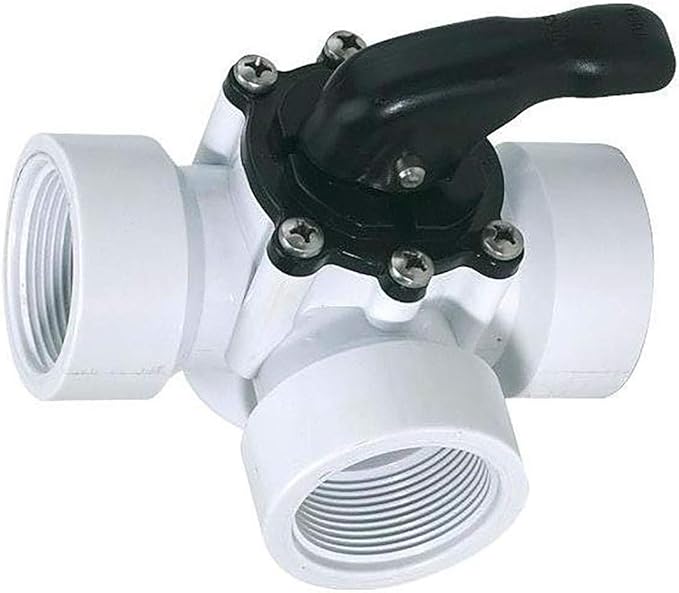
- 1½-inch female-threaded three-way ports
- Manual valve for pool/spa routing
- Threaded alternative to glued slip diverters

- Aftermarket listing claiming Jandy 4715 compatibility
- 1½–2-inch connection family
- Three-port positive-seal-style diverter
Start with the existing manufacturer number, usually molded or printed near the cover. Then identify the pipe entering the socket: a “1½–2-inch” label generally does not mean the inside of the valve accepts either size of plain pipe. Material and stop configuration are the next checks, followed by whether the application needs a standard diverter, a threaded body or the purpose-built solar version.
What to Look for Before Buying a Swimming Pool 3 Way Diverter Valve
Match nominal pipe size to the actual port geometry
Pool plumbing labels describe nominal pipe sizes, not every measured diameter on a valve. Many three-way diverters provide an internal socket for 1½-inch pipe and an outer spigot used with a 2-inch coupling. Larger versions commonly accept 2-inch pipe internally and use an outer diameter for a 2½-inch coupling. This is why valve titles list a pair of sizes for one model.
Measure the installed pipe, inspect whether it enters the body or a coupling, and read the old valve’s number. A valve with the right nominal size but a different insertion depth can still complicate a tight replacement. Buying based on the largest dimension in the title is a common reason parts do not fit.
Distinguish slip sockets, spigots and female threads
A slip socket receives plain compatible pipe for solvent welding. A spigot connection presents a pipe-size exterior and normally needs a suitable coupling. A female-threaded port requires matching male threads and a plastic-compatible sealing approach. These connection methods are not freely interchangeable, even if the same number of inches appears on the box.
For existing glued plumbing, a same-size slip valve normally involves less redesign than a threaded unit plus three adaptors. On a unionized or threaded layout, however, the right threaded valve can simplify removal. Inspect all three arms separately; prior repairs sometimes leave a combination of couplings, reducers and short nipples.
Choose PVC or CPVC by the installation requirements
PVC and CPVC are different specified housing materials. Pentair’s own list identifies 263028 and 263037 as PVC while 263026 and 263035 are CPVC. Hayward separates CPVC PSV3S/PSV3S2 from PVC PSV3SDGR/PSV3S2DGR. Similar color, handle appearance or nominal pipe size does not remove that distinction.
The correct material depends on the temperature exposure, chemical environment, local plumbing requirements and the surrounding system. Pentair advises against using its PVC valves where air temperatures can exceed 140°F. The material stamped on the actual part is more useful than a generic online claim that every pool valve is heat-resistant.
Know what the three ports must do
Most three-way diverters have one common route and two alternatives, but the practical layout depends on where the incoming water and branches connect. A return-side valve may select destinations; on the suction side it can choose between sources. Some configurations allow partial balancing while others are purposely indexed to avoid a dangerous end position.
A manually operated valve must preserve the pump and heater’s required flow. Do not assume that rotating the handle to a visually convenient position leaves the system protected. Consult the valve’s marking and the circulation system schematic before adjustment, particularly where a spa, solar collector or chemical treatment line is involved.
Jandy NeverLube 4715 1½–2-Inch 3-Port Valve
- 1½-inch socket / 2-inch spigot connection family
- Three ports with positive-seal diverter
- NeverLube CPVC construction
The 4715 is the familiar standard-size Jandy three-port body for managing two pool or spa branches. It suits a return-line split, a pool-and-spa selection arrangement, or another three-port location where the plumbing and intended shutoff positions match its diverter. Buyers replacing an existing 4715 have an especially clear starting point: the original part number and the pipe entry arrangement can be checked before cutting anything.
Design, Material and Operation
Jandy specifies a CPVC body with its NeverLube diverter sealing system. The absence of scheduled diverter lubrication reduces one maintenance task, but it does not make a leaking external joint or a damaged cover seal self-repairing. A pool valve lives outdoors for years, so exposure, plumbing stress and proper support still matter. The familiar handle shape also makes it straightforward to identify the closed leg once the stops are correctly set.
Connection Size and Installation Fit
The smaller connection family accepts nominal 1½-inch pipe into its socket and has a 2-inch spigot exterior suited to the appropriate coupling. Those two dimensions describe different ways of joining plumbing, not two independent full-bore openings. Check the outside diameter and proposed fitting type before ordering; a pipe that merely looks close is not evidence of a solvent-weld fit.
Where This Valve Makes Sense
For pool/spa equipment pads using established Jandy layouts, this is a logical replacement because many technicians already know the body and actuator ecosystem. It can be operated by hand or paired with a compatible valve actuator where the plumbing and control system support that use. Mark the common line and each branch before dismantling the old valve, then verify that the stop setting does not allow an unsafe flow state.
Important Tradeoffs
The 4715 is not a substitute for the larger 4717. It is also not a three-way check valve: it does not automatically stop reverse flow when the pump turns off. Installation normally requires cutting and solvent-welding PVC/CPVC connections, which makes orientation and clearance decisions permanent after curing.
Pros
- Genuine Jandy 4715 model with established replacement identification
- NeverLube sealing design avoids routine plug lubrication
- Suitable connection family for common 1½-inch pool plumbing
- Actuator-compatible valve family for planned automation
Cons
- Requires the correct socket or spigot fitting arrangement
- Not a direct match for larger 2-inch-socket plumbing
- Does not automatically prevent backflow
Jandy NeverLube 4717 2–2½-Inch 3-Port Valve
- 2-inch socket / 2½-inch spigot connection family
- CPVC NeverLube valve body
- Larger three-port flow-path option
The 4717 takes the NeverLube approach into the larger Jandy body. It deserves consideration when the existing diverter and surrounding fittings belong to the 2-inch plumbing family. This is not simply a high-capacity version that should replace every smaller valve: the joint geometry and available space around a crowded equipment pad are as important as the nominal pipe number.
Design, Material and Operation
Like the 4715, the 4717 belongs to Jandy’s CPVC NeverLube range. It uses a positive-seal diverter with a serviceable cover assembly rather than requiring periodic internal lubrication. A larger body can need more clearance around neighboring unions, filters and heater piping; measure the footprint as well as the pipe size before the old valve is removed.
Connection Size and Installation Fit
Its socket takes 2-inch nominal pipe, while its spigot exterior corresponds to the 2½-inch fitting family. Do not mistake the outer spigot description for a 2½-inch socket opening. Confirm whether your existing plumbing enters the body or meets it through a fitting, and check the wall thickness and adhesive system used on the rest of the installation.
Where This Valve Makes Sense
A larger-pipe return manifold, spa selection line or equipment bypass is a plausible application. The three-way diverter permits selection or balancing between branches within its allowed travel. If automated operation is planned, the matched actuator, stop positions and controller must all be checked; the fact that a valve is actuator-capable does not mean an actuator is included.
Important Tradeoffs
The clearest reason not to select the 4717 is a 1½-inch circuit that already fits the smaller Jandy body: installing a larger valve through reducers introduces extra fittings without necessarily providing any benefit. The handle remains a manual control unless separate automation hardware is supplied.
Pros
- Genuine 4717 identification for larger Jandy replacements
- CPVC body and NeverLube internal design
- 2-inch socket supports larger pool circulation plumbing
- Potential integration with compatible valve actuators
Cons
- Larger fittings and body need equipment-pad clearance
- Not interchangeable with a 4715 without plumbing changes
- Actuator hardware is not part of the base valve
Pentair 263028 2-Inch PVC 3-Way Diverter Valve
- 3-way valve in the 2-inch socket family
- Grey PVC body
- 2½-inch slip-over-exterior fitting option
The Pentair 263028 is a standard three-way PVC diverter for 2-inch pool plumbing. It makes most sense when you are matching an existing Pentair part, replacing a similar-sized tee-layout valve, or planning a new manual flow split where the manufacturer’s permitted stop positions can be observed. Its grey finish helps identify the PVC family but is not a reliable substitute for reading the model number.
Design, Material and Operation
Pentair lists this specific part as PVC rather than CPVC. That distinction matters around unusually hot equipment locations and specific chemical service conditions; the manufacturer specifically cautions that its PVC valves are not recommended for areas reaching air temperatures above 140°F. In ordinary pool plumbing, correct installation and supported joints matter as much as a more expensive material label.
Connection Size and Installation Fit
Its nominal 2-inch socket takes pipe internally; the outside fits a 2½-inch coupling as specified for the series. Plan enough straight pipe for solvent bonding and a clear path to turn or remove the handle. Check whether the current system uses slip joints, unions or threaded adaptors instead of assuming that all grey pool valves connect in exactly the same way.
Where This Valve Makes Sense
The Pentair family permits field-adjustable stops and can be incorporated into configurations using appropriate industry-standard actuators. Manual operation offers a simple way to steer flow toward one return branch or balance two paths. For an automated pool/spa changeover, select the actuator and programmed end points to preserve the equipment’s required water route.
Important Tradeoffs
Choose a CPVC version such as Pentair 263026 if the intended installation calls for the manufacturer’s CPVC construction. The 263028 does not come with an automatic check mechanism, and fitting it with reducers does not change the valve’s original intended size.
Pros
- Clear Pentair 263028 part identification
- 2-inch PVC body for correctly matched plumbing
- Field-adjustable stop concept within Pentair family
- Works in a manual diverter role without an actuator
Cons
- PVC material differs from Pentair CPVC counterparts
- Not suitable where manufacturer PVC temperature caution applies
- Requires sound solvent-weld joints and handle clearance
Pentair 263037 1½-Inch PVC 3-Way Valve
- Identified as manufacturer part 263037
- 1½-inch slip socket / 2-inch spigot exterior
- Grey PVC three-way design
The Amazon title for this valve emphasizes the 2-inch spigot and 1½-inch slip connection rather than the part number. The listing identifies the actual model as Pentair 263037, which is important because the closely named 263035 belongs to the CPVC family. This smaller PVC valve is the one to examine for a nominal 1½-inch line when matching Pentair’s 3-way layout.
Design, Material and Operation
The PVC housing serves a conventional pool diversion function with a movable internal key. It differs from the CPVC 263035 in material, even though their joining dimensions fall in the same broad size class. If a current valve has aged from heat, external loading or persistent leaks, check the reasons for failure before installing the same construction again.
Connection Size and Installation Fit
A 1½-inch nominal pipe slips into the socket; the valve also presents a 2-inch spigot outside for the appropriate joining method. A common ordering error is to see “2-inch spigot” and assume the product has a 2-inch socket. Examine the pipe end and the old valve’s port before selecting fittings, since solvent-weld work leaves little room for a trial fit after cement is applied.
Where This Valve Makes Sense
This model is relevant to a smaller pool return split or auxiliary water feature line where the system calls for a three-port manual diverter. A pool owner seeking easy future servicing may prefer to install nearby unions while rebuilding the line. Unions are separate plumbing choices, not features supplied automatically by the valve.
Important Tradeoffs
The PVC version is not the Pentair solution for every higher-temperature or CPVC-specified setup. It should also not be selected merely because its Amazon photo resembles the 263035 or 263026. Verify the stamped part number, solvent-weld dimensions and space between existing elbows.
Pros
- Exact Pentair 263037 model identified despite shortened marketplace title
- Useful smaller connection family for 1½-inch PVC lines
- Two joining approaches through socket and exterior spigot
- Appropriate for a straightforward manual three-way split
Cons
- PVC rather than CPVC
- 2-inch outside dimension can be mistaken for socket size
- Solvent-weld replacement can require cutting existing fittings
Pentair 263026 2-Inch CPVC 3-Way Valve
- Pentair part 263026
- 2-inch socket / 2½-inch outside slip
- Manufacturer-listed CPVC body
The Pentair 263026 is the material counterpart to the 263028 in the larger three-port connection family. It is particularly relevant where the equipment layout specifies CPVC or a previous 263026 is being replaced. Both may appear visually similar in compact Amazon images; checking the model number is the dependable way to avoid substituting the wrong material.
Design, Material and Operation
CPVC is the identifying construction difference. Pentair lists its diverter line for shutoff, mixing and flow-selection applications and provides adjustment of handle stops. Actual suitability still depends on site conditions and piping specifications; calling a product CPVC does not establish a particular maximum water temperature or chemical rating unless independently documented.
Connection Size and Installation Fit
The 2-inch internal socket and 2½-inch exterior slip dimension reflect Pentair’s fitting convention. The outside option is intended for compatible coupling geometry rather than direct insertion of nominal 2½-inch pipe into the inside of the valve. Examine existing unions and clearance because any fixed three-way assembly is difficult to rotate after cement cures.
Where This Valve Makes Sense
This is a practical candidate for a heater bypass assembly with large enough plumbing, a pool/spa return split, or a loop that must direct water to one of two branches. On the suction side, the plumbing layout must be designed to avoid restricting every inlet. A three-way valve only provides the flow control the plumbing designer allows it to provide.
Important Tradeoffs
Its main tradeoff relative to 263028 is the construction choice, not a verified gain in gallons per minute. Neither one is automatically motorized. Those choosing an automated arrangement must confirm actuator fit, permitted stop range and controller requirements separately.
Pros
- Genuine Pentair 263026 identifier
- CPVC construction for CPVC-specified installations
- 2-inch connection family with a 2½-inch outside option
- Adjustable flow-routing stops in the Pentair valve range
Cons
- Not a drop-in for smaller 1½-inch socket pipe
- Automatic operation requires additional compatible equipment
- No basis to assume greater flow than similarly sized PVC model
Pentair 263035 1½-Inch CPVC 3-Way Valve
- Pentair part 263035
- 1½-inch internal socket / 2-inch exterior
- Three-port CPVC construction
The 263035 provides a smaller CPVC option within Pentair’s three-port series. It is often the sensible comparison to the 263037 when the pipe is nominal 1½-inch and the deciding factor is the specified material rather than another connection size. The Amazon main image is a generic-looking Pentair valve photo also used on another Pentair listing, so identification should rest on the model and the port specifications.
Design, Material and Operation
Pentair classifies this exact part as CPVC. That helps separate it from the grey PVC 263037, although color is not a dependable engineering specification in isolation. The housing and diverter perform the same essential task: controlling which one of two branches receives or contributes flow under a three-port plumbing arrangement.
Connection Size and Installation Fit
Its 1½-inch socket is the internal connection; the 2-inch slip-over exterior works through the appropriate coupling. For a replacement, first record how all three arms of the old valve connect. Where the lines run tight against a wall or pump, a replacement with the right nominal bore can still be troublesome if handle sweep and union access are ignored.
Where This Valve Makes Sense
Pool owners using a heater loop or return-line split may select this size for a compact installation that still benefits from CPVC construction. Pentair’s valve family permits field-set travel limits, which can help prevent an operator from closing a critical flow route when configured properly. Travel-limit settings should be verified against the equipment manufacturer’s hydraulic requirements.
Important Tradeoffs
Compared with 263026, the 263035 uses smaller plumbing. Compared with 263037, it has a different manufacturer-specified material. It is not a threaded valve and is not the special solar drain-down version: those jobs need their own connection or hydraulic design.
Pros
- Pentair 263035 specific replacement identification
- CPVC body with smaller 1½-inch socket size
- Exterior connection option for suitable 2-inch coupling
- Can be incorporated into adjustable-stop valve layouts
Cons
- Different part from lookalike 263026
- Solvent-weld design is not directly threaded
- No solar drain-down feature specified
Pentair 263047 2-Inch CPVC Solar Diverter Valve
- Purpose-built solar valve with drain-down
- 2-inch CPVC three-port connection family
- 2½-inch exterior slip option
The 263047 should not be treated as just another standard pool-return diverter. Pentair explicitly identifies it as a three-way solar valve with a drain-down provision. That special function matters in solar-heating plumbing, where a valve arrangement may need to let collectors drain after circulation stops rather than trapping water in elevated panels.
Design, Material and Operation
The valve uses CPVC construction and shares the larger nominal 2-inch connection family with other Pentair valves. The distinction lies in its specified solar purpose and drain-down feature. A homeowner replacing a solar controller valve should check the existing hydraulic schematic, because changing one part can affect the route water takes when the pump is off.
Connection Size and Installation Fit
Installation requires accurate identification of common and solar branches, suitable pipe supports and correct connection sizing. A 2-inch pipe fits internally, and the exterior is sized for an appropriate 2½-inch fitting. The drain-down feature is not a substitute for proper solar plumbing slope, check-valve placement or freeze protection where required.
Where This Valve Makes Sense
This model makes more sense than a generic three-way diverter when the equipment calls for the Pentair solar variant. It can also be part of a motorized solar setup when used with a compatible actuator and controller, but those must be selected separately. The valve by itself cannot sense roof temperature or decide when to direct water to collectors.
Important Tradeoffs
If a project has no solar heating or drain-down requirement, the special design is unnecessary and a standard matching valve may be simpler. Do not assume that every solar system should drain freely: check the manufacturer’s intended arrangement and local climate requirements before modification.
Pros
- Explicitly identified by Pentair as a solar drain-down valve
- CPVC construction in larger 2-inch plumbing family
- Suited to properly designed solar collector bypass arrangements
- Distinct 263047 number reduces confusion with standard diverters
Cons
- Specialized design can be unnecessary for ordinary pool returns
- Requires correct solar plumbing orientation
- Actuator and solar controls are separate
Hayward PSV3S 1½-Inch CPVC 3-Way Valve
- Hayward PSV3S model
- 1½–2-inch family with CPVC body
- Manual indexed three-way control
Hayward’s PSV3S is the smaller CPVC member of its three-way PSV range. Owners of an existing Hayward equipment pad can keep the valve family consistent without moving to the larger PSV3S2 body. This model is meant for flow routing through three ports; it should not be confused with similarly named PSV two-way models.
Design, Material and Operation
Hayward documents the PSV3S as CPVC. The manual describes a handle and index mechanism that indicate which internal path is blocked, plus a cover-and-key assembly that can be oriented for the plumbing layout. Those details matter more in practice than the color of the handle: the wrong index setting can let an operator move the valve into an unintended position.
Connection Size and Installation Fit
This version takes nominal 1½-inch pipe into the socket. The manufacturer’s manual describes using a suitable 2-inch coupling for the larger outside connection. That does not mean a 2-inch pipe should be pushed inside the smaller port. Before gluing, dry-plan all three arms and confirm the handle is accessible without reaching past energized equipment.
Where This Valve Makes Sense
The PSV3S works in pool/spa selection or balancing arrangements designed to accommodate three-port diversion. Hayward’s instructions specify finger-tightening its operating knob and checking the stop alignment. After servicing, confirm actual water movement instead of relying solely on a handle label that a previous installer may have repositioned.
Important Tradeoffs
Its limits are mostly physical compatibility. PSV3S2 is the larger Hayward size; PSV3SDGR uses PVC instead of CPVC. This valve is not a pressure-relief device, and the selected plumbing design must preserve the flow needed by pumps and heaters.
Pros
- Official Hayward PSV3S CPVC model
- Matching smaller pipe family for existing Hayward installations
- Documented handle-index adjustment procedure
- Three-way diverter can divide or select configured flow routes
Cons
- Different dimensions from larger PSV3S2
- Index alignment must match the plumbing
- Not a direct threaded connection
Hayward PSV3S2 2-Inch CPVC 3-Way Valve
- 2–2½-inch Hayward connection family
- Manufacturer-listed CPVC
- Three-way handle with index setting
The PSV3S2 is the larger CPVC choice within Hayward’s basic PSV three-way valve series. It targets equipment already assembled around nominal 2-inch pipe or a new manifold with that sizing. It should not be selected merely because the outer port can work with a 2½-inch coupling; the way existing pipe enters the valve determines whether the replacement will fit.
Design, Material and Operation
Hayward specifies CPVC construction for the PSV3S2. The family uses an adjustable indexing arrangement so the operator can set which branches are accessible in the intended travel range. For a spa changeover, this detail is not cosmetic: an incorrect stop could isolate the wrong connection or allow unplanned crossflow.
Connection Size and Installation Fit
The 2-inch socket receives compatible pipe, while the larger 2½-inch outside port connects through a fitting. Hayward’s instructions describe using an appropriate coupling for the outer size. Space around each of three solvent-weld joints needs to be checked carefully, particularly when existing plumbing branches approach the valve from different heights.
Where This Valve Makes Sense
It can serve a return selector, suction selector or distribution branch in a correctly planned pool system. The handle is useful for occasional adjustments, and a technician can check the closed-leg indicator during commissioning. The installer must follow the Hayward instructions when positioning the diverter and reassembling the cover.
Important Tradeoffs
The difference from PSV3S is sizing, not a verified promise of stronger circulation. If the rest of a line is only 1½-inch, a 2-inch valve by itself does not change that restriction. PVC counterpart PSV3S2DGR may suit an installation where PVC is specified instead of CPVC.
Pros
- Hayward-specific larger CPVC valve choice
- Accepts nominal 2-inch pipe through inside sockets
- Documented stop indexing and flow-diversion controls
- Relevant to larger equipment-pad manifolds
Cons
- Larger body may complicate replacements in tight spaces
- Not interchangeable with PSV3S on 1½-inch socket connections
- Does not include automation hardware
Hayward PSV3SDGR 1½-Inch PVC 3-Way Valve
- PVC member of Hayward smaller PSV family
- 1½-inch socket / 2-inch coupling option
- Three-way port selection
Hayward PSV3SDGR has the same general nominal plumbing family as PSV3S, but the final DGR model suffix identifies the manufacturer’s PVC version. This makes it useful for a planned PVC equipment-pad replacement when the existing line is nominal 1½-inch. It is not accurate to describe it simply as a CPVC Hayward valve because another PSV model has similar dimensions.
Design, Material and Operation
The valve uses the PSV adjustable handle-and-index arrangement, allowing flow to be diverted between the two branches within its configured travel. The body’s PVC construction must be considered in relation to heat exposure and the pool system’s chemical conditions. The proper comparison is not which plastic looks heavier in photographs, but which specification the installation requires.
Connection Size and Installation Fit
Hayward’s manual explains the 1½-inch internal socket fit and the alternative 2-inch coupling approach outside. A technician should check both, particularly if a previous repair added reducers or shortened the straight pipe. The valve also needs enough access above the cover for the handle and future service.
Where This Valve Makes Sense
This PVC variant has a place in a simple manual pool/spa circuit where its material and pipe family are suitable. Mark the active and inactive branches on the plumbing after the new valve is installed, because return and suction arrangements can look similar at a glance.
Important Tradeoffs
Unlike the CPVC PSV3S, this is Hayward’s PVC option. Unlike PSV3S2DGR, it does not use the larger 2-inch internal connection. A common ordering error is overlooking the S2 portion of Hayward part numbers while comparing otherwise similar three-way handles.
Pros
- Explicit Hayward PSV3SDGR part identification
- PVC choice for correctly specified 1½-inch circuits
- Uses documented Hayward indexing arrangement
- Outer coupling option helps with some repair configurations
Cons
- Not a CPVC substitute where CPVC is specified
- Smaller connection family than PSV3S2DGR
- Correct handle-stop setup is essential
Hayward PSV3S2DGR 2-Inch PVC 3-Way Valve
- 2–2½-inch family for larger connections
- PVC construction; DGR suffix
- Hayward PSV three-port diverter design
The PSV3S2DGR is the larger PVC member of Hayward’s PSV three-way line. It is best assessed alongside PSV3S2, the similarly sized CPVC valve, rather than alongside the much smaller PSV3SDGR. Owners replacing a failed Hayward valve should read the complete model number rather than relying on “PSV3” alone.
Design, Material and Operation
The valve is made from PVC as specified by Hayward’s model guide. It has the same basic diverter purpose and a handle-index arrangement that must be set for the plumbing pattern. For most residential installations, correct routing and clean valve seats matter more than unsupported claims about a particular color having superior performance.
Connection Size and Installation Fit
Nominal 2-inch pipe enters the socket; the exterior of the port supports the correct 2½-inch coupling connection. A full three-branch replacement may require more working space than the amount visible around the old handle. Consider joint insertion depth and whether a nearby union can be preserved before making cuts.
Where This Valve Makes Sense
In operation, the valve is suitable for a planned pool/spa or auxiliary branch arrangement with enough pipe capacity for the required flow. Hayward instructions explain that the position marked on the handle corresponds to the closed path. Following the manual’s indexing procedure helps avoid accidentally isolating the main circulation path.
Important Tradeoffs
The drawback relative to the CPVC PSV3S2 is the material choice, not a measured flow penalty. In a circuit that explicitly calls for CPVC, selecting the DGR version because its price seems attractive is poor fitment practice. Likewise, if an existing line is 1½-inch throughout, a larger valve body is not automatically a sensible upgrade.
Pros
- Correct 2-inch Hayward PVC SKU for large plumbing
- Three-way directional control with indexed handle
- Can accommodate compatible 2½-inch outer coupling arrangement
- Useful for PVC-specified equipment replacement
Cons
- PVC differs from otherwise similar PSV3S2 CPVC
- More installation room needed than smaller valve family
- Requires appropriate socket/coupling selection
CMP HydroSeal 25913-204-000 2-Inch CPVC 3-Port Valve
- CMP part 25913-204-000
- 2-inch socket / 2½-inch spigot
- Black CPVC HydroSeal construction
CMP’s HydroSeal 25913-204-000 is a particularly interesting alternative for owners matching the larger Jandy 4717 connection family. CMP itself cross-references this exact part to Jandy 4717, which is stronger compatibility evidence than an arbitrary marketplace statement that two valves look alike. Dimensions and usable clearance should still be checked before considering it an exact drop-in for a unique installation.
Design, Material and Operation
The manufacturer identifies this model as a black CPVC three-way diverter with a 2-inch socket and 2½-inch spigot. The HydroSeal line offers another route to controlling or isolating branches in a pool equipment pad. Construction is a relevant difference from generic PVC replacements, although a particular lifetime or leak-resistance advantage should not be assumed without comparative evidence.
Connection Size and Installation Fit
This item’s model number matters: CMP also sells other three-way HydroSeal variants with unions, different pipe sizes, and grey PVC bodies. This exact part is the standard black CPVC unit in the larger connection family. If a pipe currently enters a 4717 socket, confirm the location and face-to-face dimensions of the new valve in addition to nominal diameters.
Where This Valve Makes Sense
An owner rebuilding a pool/spa selector or heater bypass may appreciate a manufacturer-documented comparison part instead of a generic unbranded listing. A useful replacement still requires the installer to mark common and branch pipes, preserve appropriate flow and ensure the diverter has the necessary travel stops.
Important Tradeoffs
Although CMP lists a Jandy comparison, that is not proof that every Jandy actuator, cover, or replacement diverter component transfers directly to the CMP valve. Treat seals and actuator fittings as model-specific unless the makers explicitly confirm cross-compatibility.
Pros
- Manufacturer-documented comparison to Jandy 4717
- Confirmed 2-inch socket and 2½-inch spigot
- Black CPVC body in a named HydroSeal product range
- Clear CMP replacement part number
Cons
- Cross-reference does not guarantee identical service parts
- Not for smaller 1½-inch valve sockets
- Solvent-weld dimensions still need checking
FibroPool 1½-Inch POSI-Close 3-Way Diverter Valve
- 1½-inch slip / 2-inch spigot family
- POSI-Close diverter and PTFE seats
- Manufacturer specifies CPVC despite listing PVC wording
This 1½-inch POSI-Close is a compact alternative to established Jandy, Pentair and Hayward models. FibroPool identifies the POSI-Close family by its ability to direct or balance flow while shutting off a single branch. The most important ordering issue is a discrepancy in product wording: the supplied Amazon listing uses PVC in its title, while FibroPool’s own table lists the 1½-inch POSI-Close as CPVC.
Design, Material and Operation
The company describes temperature- and impact-resistant CPVC with lube-free PTFE seats. That manufacturer statement is more specific than the inconsistent marketplace material label, but buyers who require a documented plastic grade should verify the actual product packaging or ask the seller before installing it. Never infer chemical compatibility from appearance alone.
Connection Size and Installation Fit
FibroPool lists a 1½-inch internal slip connection with a 2-inch external spigot for this POSI-Close size. Those dimensions are appropriate for two distinct fitting methods. The valve cannot be installed into a female threaded port without a suitable adapter; this is a solvent-weld-style POSI-Close product, not the brand’s separate rotating-handle threaded version.
Where This Valve Makes Sense
In a suitably sized circuit, the valve can control a heater bypass or return split. The value of the PTFE-seat arrangement is in its specified lube-free operation, not a promise that normal wear, grit or poor plumbing alignment can never cause leaks. The operator should identify the closed path from the handle position and the actual water routing.
Important Tradeoffs
This is worth comparing with genuine 4715 or PSV3S units when the connection family fits. Buyers prioritizing material documentation need to resolve the Amazon-versus-manufacturer description before treating “PVC” or “CPVC” as conclusively reconciled for every shipment.
Pros
- POSI-Close flow control and lube-free PTFE seats
- Manufacturer documentation provides nominal connection dimensions
- Potential alternative for smaller 1½-inch equipment runs
- Service choice beyond major OEM valve families
Cons
- Amazon and manufacturer material descriptions differ
- Slip construction is not female threaded
- Not an automatically actuated or backflow-checking valve
FibroPool 2-Inch POSI-Close CPVC 3-Way Valve
- 2-inch internal slip / 2½-inch external spigot
- Manufacturer-listed CPVC
- Three-port POSI-Close with PTFE seats
The 2-inch POSI-Close shares its operating concept with the smaller FibroPool valve but serves the larger pipe family. The genuine size change is in the joining geometry: a 2-inch nominal pipe fits into the valve, and the outer spigot is intended for the appropriate 2½-inch fitting. This matters to anyone replacing a Jandy 4717-type or another large-bodied diverter.
Design, Material and Operation
FibroPool identifies the 2-inch POSI-Close as CPVC with lubeless PTFE seats. Its three-port layout permits diverting or balancing the two branches subject to how the valve is oriented. The company lists pool chemical-feed, salt-cell and heater-bypass applications, but the overall equipment layout still determines whether a given branch can be closed safely.
Connection Size and Installation Fit
Dry-lay out every connection before gluing because a larger three-port tee can be difficult to maneuver between existing elbows. A handle requires room to sweep and, in some setups, to be reached from the front of the pad. Any new unions or couplings should be selected for actual nominal sizes rather than “close enough” outside measurements.
Where This Valve Makes Sense
One appeal is keeping a larger flow path without shifting to a very different installation size. It is an option for pool owners who do not need the exact Jandy or Hayward repair-parts ecosystem. For eventual actuator use, obtain a specific compatibility statement instead of assuming all three-way handles can receive the same motorized head.
Important Tradeoffs
If the current system is 1½-inch, the smaller POSI-Close is more straightforward; a 2-inch body is not automatically an improvement when reducer fittings control the system bore. The valve is also a manual directional device, not a check valve or solar drain-down component.
Pros
- Correct 2-inch POSI-Close size and CPVC material
- PTFE seat system does not call for routine lubrication
- Manufacturer-stated 2½-inch outside fitting option
- Useful alternative to other larger three-way diverters
Cons
- Not dimensionally equivalent to smaller 1½-inch POSI-Close
- Actuator compatibility requires separate confirmation
- Does not provide solar drain-down or one-way check action
FibroPool 1½-Inch ABS Threaded 3-Way Valve
- 1½-inch female-threaded connections
- ABS three-way rotating-handle design
- Serviceable top and stainless screws
This FibroPool three-way valve differs substantially from the brand’s POSI-Close slip products. It belongs to the 1½-inch threaded family and has a rotating, locking handle rather than the same solvent-weld port presentation. That makes it relevant when a pool assembly already uses male-threaded fittings or needs a compact manually removable threaded connection.
Design, Material and Operation
FibroPool identifies the model family as ABS with stainless-steel screws and a serviceable top. Some Amazon descriptive material mentions CPVC in addition to ABS; the maker’s actual specification table identifies the threaded valve as ABS. For a chemical-injection location or high-temperature branch, material suitability should be checked rather than carrying over claims made for a different FibroPool CPVC product.
Connection Size and Installation Fit
The nominal port is 1½-inch FIPT female pipe thread. Threaded connections are not interchangeable with smooth 1½-inch slip sockets even when their pipe label matches. Use the proper compatible threaded fitting and sealant recommended for plastic pool components; overtightening can damage a plastic housing. Check whether the existing equipment uses straight threads or tapered pipe threads.
Where This Valve Makes Sense
The rotating handle gives a simple means to redirect water between two routes, and the removable cover provides a way to inspect its internal seal. It may be easier to remove from some threaded arrangements than a permanently solvent-welded body, but only if the surrounding plumbing provides rotation or union access. Do not build a rigid installation that must twist attached pipe to remove the valve.
Important Tradeoffs
It is a poor replacement for a slip-fit POSI-Close without adding adaptors and allowing more space. Pressure and chemical compatibility must follow the exact threaded model, not the manufacturer’s larger CPVC diverter specifications.
Pros
- Direct 1½-inch female-threaded connection option
- ABS body and serviceable cover identified by maker
- Locking rotating handle for manual branch selection
- Different connection approach from common solvent-weld valves
Cons
- Threads cannot directly replace smooth slip sockets
- Plastic fittings require careful tightening
- Material/pressure limits differ from CPVC POSI-Close family
ATIE 1½-Inch Female-Threaded 3-Way Pool Valve
- 1½-inch female-threaded three-way ports
- Manual valve for pool/spa routing
- Threaded alternative to glued slip diverters
The ATIE three-way valve is another option for plumbing that already terminates in nominal 1½-inch male-threaded fittings. Its defining point is not a branded lube-free mechanism or unusually large bore; it is a female-threaded connection format that may suit a particular repair without needing three solvent-weld sockets. Match the existing thread system carefully before buying.
Design, Material and Operation
The listing identifies a three-way body with a manual handle, but a comprehensive manufacturer engineering sheet with verified pressure, temperature and polymer specifications is less readily available. It would be unwise to treat it as equal to a documented CPVC NeverLube body for demanding chemical or heat conditions on the strength of photos. Choose based on confirmed requirements, not a guessed material.
Connection Size and Installation Fit
Fittings must have compatible nominal 1½-inch male pipe threads, adequate engagement and a sealant appropriate to plastic threads. Even with matching threads, a rigid equipment pad may require unions or removable nipples for practical disassembly. Do not force a valve to turn into a position that twists a connected pump or heater manifold.
Where This Valve Makes Sense
The primary application is manual routing between two pipe branches in an appropriate pool or spa layout. It may also be useful in a temporary or easily disassembled service assembly, subject to the valve’s verified operating limits. Since the handle does not measure pressure, a separate control design must ensure no vital pump path is shut.
Important Tradeoffs
Buyers using glued 1½-inch PVC should generally compare the true slip-style valves first. This ATIE model is also not a substitute for a pressure regulator, a one-way check or an automatically controlled valve simply because it has three ports.
Pros
- 1½-inch female-threaded connection style
- No requirement to insert bare pipe into solvent-weld valve sockets
- Manual three-port water-routing function
- Distinct option for threaded pool plumbing assemblies
Cons
- Limited verified technical material specifications
- Not direct fit for slip-glued equipment pads
- Thread engagement and service access require attention
Jandy 4715-Compatible 1½–2-Inch 3-Way Valve
- Aftermarket listing claiming Jandy 4715 compatibility
- 1½–2-inch connection family
- Three-port positive-seal-style diverter
This product is marketed as a replacement for Jandy 4715 rather than sold as a genuine Jandy NeverLube 4715. That distinction should remain visible throughout any comparison. It could be considered for a standard-size replacement where the owner is comfortable evaluating an aftermarket part, but a compatibility claim does not establish identical diverter materials, actuator fittings or replacement-cover availability.
Design, Material and Operation
The supplied listing emphasizes use in pool and spa branches including heater, chemical-feed and salt-related plumbing. Such examples describe possible plumbing positions, not verified resistance to every chemical concentration or operating temperature. Compare actual material markings and supplier documentation before installing the valve in a more demanding loop.
Connection Size and Installation Fit
The stated connection family is 1½-to-2-inch, conventionally representing a smaller internal pipe socket and an exterior spigot coupling arrangement. Confirm those dimensions on the delivered model and do not rely on an image of a similar Jandy part. Check the existing 4715’s pipe entry, handle clearance and shaft orientation before removing any fittings.
Where This Valve Makes Sense
A buyer seeking a lower-commitment manual replacement may find the compatibility claim useful as a starting point. Still, the original 4715 is part of a documented service and actuator ecosystem; an aftermarket unit should be evaluated as a complete valve, not as a guaranteed donor for genuine Jandy replacement parts.
Important Tradeoffs
The key limitation is verification. Do not describe the product as genuine Jandy or assume the same warranty terms, sealing compound or lifetime maintenance characteristics. If automation, standardized spares or long-term cross-compatibility is required, seek explicit manufacturer or seller confirmation.
Pros
- Listed for the common Jandy 4715 connection class
- Three-way flow-selection function
- Potential aftermarket alternative for an established valve layout
- Published 1½–2-inch size family aids initial comparison
Cons
- Not a genuine Jandy 4715
- Seals and actuator fit should not be assumed identical
- Technical specifications need confirmation for critical installations
Detailed Buying Guide: Sizing, Plumbing and Long-Term Service
Understand common-port placement before cutting the existing valve
A three-way tee contains one internal diverter, but different plumbing assemblies do not necessarily use the same arm as the common port. Some manufacturers allow the inlet to be connected to any port and provide a way to move the index or stops. Others identify a preferred layout. Photograph the existing equipment pad, draw arrows showing each source and destination, and label the pipe arms before loosening anything.
When a pump runs, the closed route must be intentional. On a suction manifold, blocking all suction sources risks starving the pump. On a return or heater bypass, isolating the only discharge path can produce damaging pressure or interrupt heater flow. For pool/spa combinations, the suction and return valves may need to change together rather than independently. If the original equipment drawing is unavailable, have a qualified pool technician identify the hydraulic arrangement.
Socket size is not the same as an outside fitting label
The 1½-inch socket/2-inch spigot family and the 2-inch socket/2½-inch spigot family are the recurring connection patterns in this guide. A solvent-weld socket surrounds the outer diameter of plain nominal pipe. The spigot-style outer body is intended to engage an appropriate coupling. This dual-function design gives installers options, but those options are not interchangeable by pushing a larger pipe into a smaller socket.
If the existing pipe has already been cut too close to the old valve, a replacement might require a slip repair coupling, short pipe extension or added union. Those components affect total length. Lay out the repair with the handle installed, because adjacent pumps, automation actuators and filter housings can block the handle after all three connections are fixed. Never file down a port to force a poor fit.
Solvent welding versus threaded service joints
A slip-type valve usually needs the correct primer and solvent cement for the compatible materials and conditions specified by the plumbing manufacturer. The joint is not ready for pressure immediately after assembly; required cure time changes with environmental conditions and pipe dimensions. Keep cement and debris out of the valve’s working cavity and protect seals from inappropriate chemicals.
Female-threaded valves avoid gluing pipe directly into the housing, but a threaded connection brings different risks. Plastic bodies can crack when overtightened, especially with metal male adaptors. The pipe should align without side-loading the threads, and any sealant or tape must be approved for the particular plastic and thread design. A threaded body trapped between rigid pipes can still be impossible to remove without nearby unions.
Stop positions, handle markings and partial flow
The handle usually indicates the path that is blocked, not simply the direction in which water will travel. Hayward’s PSV instructions use an engraved closed indicator and describe how to adjust its indexing disk. Pentair supplies field-adjustable stops in its diverter range. An older actuator might already have stop positions set for a particular plumbing arrangement, which should not be copied blindly onto a new valve.
Partially diverting water can balance a feature circuit, but a partially closed valve may create pressure loss and can affect heater or chlorinator operation. The safe operating position depends on the specific hydraulic design, not just whether the handle physically turns. Make controlled adjustments while observing normal pump flow, filtration pressure and relevant equipment operating conditions.
What solar drain-down actually changes
Pentair 263047 has a stated drain-down function for solar heating loops. Pool solar collectors are often installed above the equipment pad; some systems are intended to drain water from the panels when solar circulation stops. If water is trapped in a poorly planned arrangement, unwanted temperature or freeze-related problems can follow. A special solar diverter is one component of that plumbing strategy, not the entire strategy.
Verify collector height, check-valve positions, drain or vacuum-break arrangements, controller sequence and local freeze requirements. A conventional three-way valve should not be substituted simply because it has identical pipe sockets. Similarly, a solar-specific drain-down design should not be assumed appropriate for a solar installation designed to remain charged with water.
Actuator compatibility and automation planning
Some Jandy, Pentair and Hayward valve families are designed to cooperate with selected actuator systems. This permits scheduled water-feature operation or coordinated pool/spa routing, but a bare three-way valve normally arrives as a manual component. Confirm shaft interface, mounting holes, actuator travel range, controller voltage and the final positions before purchasing any motorized accessory.
An actuator installed on the wrong common port can move reliably while routing water incorrectly. In a new build, leave space for the actuator housing, wiring and future cover removal. If the valve will remain manual, check that its handle is visible and accessible without reaching through a crowded electrical equipment area.
Checking for leaks and preserving maintainability
A drip at the cover and a leak at a newly glued socket have different causes. Cover O-rings, diverter seals, shaft seals and loose cover fasteners need model-specific investigation. A solvent-weld joint that was poorly prepared may require replumbing; tightening the handle will not repair it. Record the new valve’s model and keep the original purchase details for future parts identification.
For long-term service, support connected pipes so their weight does not distort a plastic valve body. Check seals and screw condition during routine equipment-pad inspections. Shut off power and relieve line pressure before opening a filter, pump or valve assembly, and follow the individual maker’s servicing instructions rather than opening a pressurized cover to investigate a minor drip.
PVC, CPVC, ABS and seal compatibility
Material selection must consider both the housing and the seals. Two valves with CPVC bodies can use different diverter mechanisms, and an ABS threaded model should not inherit pressure or temperature claims from a CPVC POSI-Close model. The chemical concentrations in a circulation line, especially near chemical feeding equipment, should remain within the stated limits for all wetted components.
Use a manufacturer’s actual model specification when one exists. For example, Pentair and Hayward publish which individual models are PVC and which are CPVC. FibroPool publishes ABS for its rotating-handle threaded product and CPVC for the POSI-Close family. If Amazon and the maker use different material terms for a listing, resolve the exact shipment details before using the valve in a critical application.
Rebuild an existing valve or replace the whole body?
A valve may feel stiff because of debris, aging seals or a damaged diverter rather than failure of the entire body. If the housing and plumbing joints are intact, a manufacturer-specified service kit could avoid cutting three pipe runs. Check whether the cover, handle, O-rings and key are available for the exact model; a visually similar aftermarket valve might not accept the same parts.
Full replacement is more reasonable when the housing is cracked, joints are suspect, the model is obsolete or the replacement includes a required material or connection change. A technician should first isolate pressure and check the system’s plumbing supports. Installing a new valve into the same stressed arrangement can reproduce the original failure.
Direct Product Comparisons That Matter
Jandy NeverLube 4715 vs 4717
Both Jandy units use NeverLube CPVC construction and three-port positive sealing, but the 4715 fits the 1½-inch-socket/2-inch-spigot family while the 4717 fits 2-inch-socket/2½-inch-spigot plumbing. For a direct replacement, the old part number is more informative than a guess about which valve offers more flow. Moving to the larger unit typically means replumbing at least part of the manifold.
Pentair 263028 vs 263026 and 263037 vs 263035
These two pairs neatly show why suffix-free valve descriptions cause mistakes. The 263028 and 263026 are both in Pentair’s 2-inch internal family, but 263028 is PVC and 263026 is CPVC. The smaller 263037 and 263035 follow the same material distinction for 1½-inch sockets. Select the right model based on both installation size and the specified plastic; do not infer one from the other.
Pentair 263047 solar valve vs a standard three-way diverter
The 263047 is listed by Pentair as a CPVC solar diverter with drain-down. The regular 263026 is also a 2-inch CPVC three-way valve, yet Pentair gives them different intended functions. In an existing solar loop, identify whether the original valve provides drain-down before installing the standard unit. The shared port-size family is not proof of hydraulic interchangeability.
Hayward PSV3S vs PSV3SDGR
Both belong to Hayward’s smaller three-way size family, but PSV3S is CPVC and PSV3SDGR is PVC. Their model names differ only in the suffix, so a marketplace picture or a technician’s verbal “PSV3S” description is inadequate for a specification-critical purchase. The same CPVC-versus-PVC relationship applies to larger PSV3S2 and PSV3S2DGR models.
Jandy 4717 vs CMP HydroSeal 25913-204-000
CMP expressly cross-references its black CPVC 25913-204-000 model against Jandy 4717, with a 2-inch socket and 2½-inch spigot. This is a meaningful starting point for a replacement shortlist. However, shared nominal pipe connections do not mean the handle position, actuator interface, cover or internal diverter repair kit is interchangeable. Check physical dimensions and service support if keeping an existing actuator is important.
FibroPool POSI-Close vs FibroPool ABS threaded valve
POSI-Close uses slip/spigot-style plumbing and PTFE seats according to FibroPool, with 1½-inch and 2-inch versions. The separate rotating-handle 1½-inch ABS valve uses female-threaded ports. These are different installation approaches, not two finishes of the same fitting. A homeowner with glued PVC equipment piping should check the POSI-Close geometry first; an existing threaded manifold calls for a different inspection.
Genuine Jandy 4715 vs the Jandy-compatible aftermarket listing
The aftermarket model uses 4715 as a fitment reference but is not the genuine Jandy part. The genuine Jandy has a documented NeverLube system and known OEM replacement identity. The aftermarket version may be suitable where its exact dimensions and operating limits are confirmed, but the Jandy service parts and automation interfaces should never be assumed to transfer. The final decision depends on technical certainty, not promotional compatibility wording.
Common Mistakes When Replacing a Pool Diverter
Using the outer spigot measurement as the socket diameter
A label showing “1½–2 inches” does not normally mean either nominal pipe size fits inside the valve. The larger figure commonly refers to the outside of the port and requires a corresponding coupling. Confusing these sizes can leave a homeowner with a valve that cannot be connected to any of the three existing arms.
Ordering a two-way or check valve instead of a three-way
A two-way valve has two plumbing ports; a three-way diverter has three. A check valve lets water flow in one direction and responds automatically to pressure differences. None of these categories can be substituted merely because the bodies share a material or brand. Count the actual connected pipes and understand the required function.
Replacing a specialized solar valve with a generic model
A solar diverter identified as having drain-down functionality is a different engineering requirement from ordinary branch selection. Using a standard three-way valve without assessing the solar layout can alter collector drainage. Verify the solar equipment manual, elevation and plumbing sequence before treating any standard valve as a replacement.
Assuming a similar valve accepts the old actuator
A matching body size does not guarantee matching shaft geometry, mounting points or travel limits. Aftermarket models may offer nominal replacement compatibility while using different internal service parts. Confirm actuator and controller support with the exact model, and verify that all programmed end positions maintain a usable water route.
Forgetting valve-cover and handle clearance
A three-way valve connects three pipes, so its orientation may be more constrained than a simple inline union. A body can fit between pipes while leaving its handle impossible to rotate or its cover screws inaccessible. Account for future seal inspection and possible actuator installation before permanently gluing the joints.
Ignoring existing plumbing stress and water pressure
Cracked plastic housings can result from poorly supported pipe loads, freezing, impact or incorrect joint handling. A replacement installed in exactly the same stressed position can fail again. Turn off the system, release pressure and resolve the cause of damage rather than assuming a new body alone fixes the problem.
Frequently Asked Questions
What does a 3-way diverter valve do in a swimming pool?
It selects or balances water movement among three connected ports, usually allowing a common line to communicate with one or both branches according to the valve design and stop settings. Pool/spa switching, return splits and heater bypasses are common applications.
Is a three-way pool valve the same as a three-way check valve?
No. A manually operated diverter controls the route selected by its handle or actuator. A check valve responds to flow direction and is intended to resist reverse flow. A three-port diverter does not automatically act as a check valve when the pump stops.
What does 1½-inch by 2-inch mean on a diverter?
For many pool models, the smaller number identifies the internal socket for nominal 1½-inch pipe, while the larger number describes the outside spigot connection for a suitable 2-inch coupling. The manufacturer’s individual fitting diagram determines the exact interpretation.
Can I put a 2-inch diverter valve on 1½-inch pool plumbing?
It can require reducers and additional plumbing, so it is not a direct same-size replacement. A larger valve does not eliminate restrictions in the rest of the smaller pipe system. Matching the existing valve and pipe geometry is generally the simpler repair.
Is CPVC always better than PVC for a pool diverter?
Neither material should be selected by name alone. Use the material required by the site conditions and manufacturer’s installation guidance. Pentair and Hayward sell both PVC and CPVC three-way models in matching nominal size classes; the exact SKU identifies which you are ordering.
Do NeverLube pool valves really need no maintenance?
The Jandy NeverLube system is designed without routine internal diverter lubrication. Plumbing joints, cover seals, external stresses and general equipment-pad condition still deserve inspection. A “never lube” label does not guarantee that every part of the installation will remain leak-free.
Can I adjust a three-way valve while the pump is running?
Operating procedures depend on the system. The critical rule is to avoid closing every suction source or discharge route or otherwise interrupting required equipment flow. For unfamiliar pool/spa or heater plumbing, turn off equipment and have a qualified technician establish the correct valve positions.
Can all three-way pool diverters be motorized?
No universal fit should be assumed. Certain Jandy, Pentair and Hayward families work with selected actuators, but mounting, shaft, travel and controller requirements vary. A product described only as a manual three-way valve should not be treated as automation-ready without a specific compatibility confirmation.
Which Pentair valve is made for solar drain-down?
Pentair identifies part 263047 as a 2-inch CPVC three-way solar valve with a drain-down feature. This distinguishes it from standard three-way Pentair 263026 and 263028 valves. The full solar plumbing configuration still needs to follow the solar system design.
What is the difference between slip and female-threaded valves?
Slip sockets require a compatible solvent-weld pipe joint. Female-threaded ports accept a matching male-threaded fitting using the appropriate sealing method. Similar nominal sizes do not mean a threaded fitting can be pushed into a slip socket or vice versa.
Will an aftermarket replacement for Jandy 4715 fit an original Jandy actuator?
A listing that claims compatibility with the 4715 body does not establish actuator or replacement-part interchangeability. Ask for the exact shaft and mounting compatibility and compare the dimensions and travel stops before relying on an existing motorized assembly.
How can I tell which valve port is closed?
Read the indicator on the actual handle and follow the maker’s instructions. Hayward describes a marked closed position and an index disk; other families have their own travel-stop methods. Confirm water routing after setup because an old valve may have been assembled in a different orientation.
Final Buying Considerations
A swimming pool 3 way diverter valve should first match the pipe connection style, the actual socket family and the intended hydraulic route. For established Jandy equipment, 4715 and 4717 provide different size families; Pentair and Hayward further separate PVC from CPVC models. Pentair 263047 belongs on the shortlist for solar drain-down, while threaded FibroPool or ATIE models address a different installation format from conventional glued slip valves.
Read the number on the old housing, measure the pipe and allow for the handle and any future actuator. Resolve conflicting material labels before buying, and do not treat an aftermarket compatibility statement as proof of identical internal parts. The most successful replacement is the one that joins correctly, preserves safe circulation and can still be operated and serviced after installation.
Author