
The best pool handrails for inground pools differ in more than overall length. A rail that works well beside shallow entry steps can be a poor fit on a narrow deck, while a compact bolt-down rail may not provide enough reach for a deeper first step. Mounting style matters just as much: some rails fasten to a surface plate, while traditional commercial-style rails slide into deck anchors that must be installed or already present in the correct positions.
The eight rails below cover both approaches. Seven use a surface-mount base intended for newly drilled holes, making them practical retrofit candidates for many residential decks. The S.R. Smith DMS-102A uses the more traditional anchor-socket approach and is sold without its recommended deck anchors and escutcheons. That difference affects installation cost, removability, deck preparation, and the amount of hardware you need to buy separately.
Material also deserves attention. Most of the surface-mount models here are listed as 304 stainless steel. That is common for pool hardware, but stainless steel is not immune to staining or corrosion, particularly around chlorides, salt chlorination, coastal air, fasteners, and crevices. Rail dimensions, tube diameter, grip covers, base-plate design, and the quality of the deck beneath the anchors should all be checked before drilling.
Quick Comparison
Use this table to narrow the field by size, mounting approach, listed load rating, and included hardware. A seller-rated load capacity is not a substitute for proper anchoring: the finished installation is only as dependable as the deck, fasteners, hole placement, and workmanship supporting the rail.

- 54-inch center grab rail with 1.90-inch outside-diameter tubing
- 0.049-inch wall stainless-steel construction
- Traditional anchor-socket installation; anchors and escutcheons sold separately

- 31.5 x 18.5-inch compact 304 stainless-steel rail
- 1.5-inch tube; seller-rated 330-pound load capacity
- Expansion screws and anchors included for newly drilled mounting holes

- 55 x 32-inch 304 stainless-steel rail
- Seller-rated 385-pound load capacity
- 4 mm base plate, four mounting holes, and removable nylon grip cover

- 30 x 22-inch compact 304 stainless-steel design
- 2 mm rail wall and 4 mm base plate; seller-rated 250-pound capacity
- Four-foot grip cover plus four expansion screws

- 48 x 30-inch 304 stainless-steel rail with 1.65-inch tube
- Seller-rated 330-pound load capacity
- Six-hole surface-mount base with screws and expansion anchors

- 55 x 32-inch rail with 1.9-inch tube and 13 x 4-inch base
- Seller-rated 375-pound load capacity
- 15.75-inch removable nylon grip sleeve and mounting accessories

- 55 x 32-inch rail with 1.89-inch tube and 2 mm tube wall
- Seller-rated 250-pound load capacity; 4 mm base plate
- Four-foot grip cover, M8 drill bit, anchors, and fasteners included
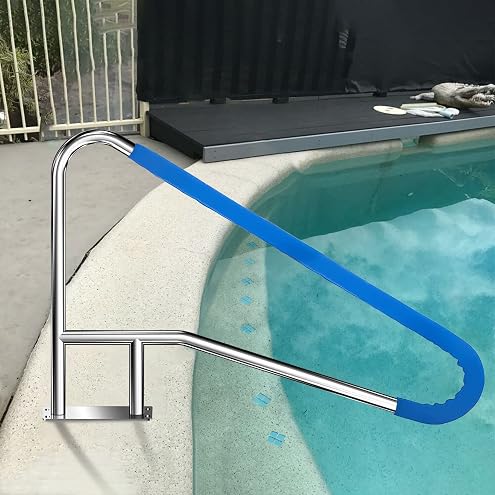
- 54 x 32-inch surface-mount configuration
- 304 stainless steel used for the rail, base, and listed expansion bolts
- Seller-rated 250-plus-pound support with blue grip cover and drill bit
What to Look for When Buying Pool Handrails for Inground Pools
Rail Geometry: Height, Reach, and Step Position
A pool rail is useful only if the gripping section lands where a swimmer naturally reaches for it. Product dimensions such as 55 x 32 inches do not tell the whole story by themselves; the shape of the bends determines how much of the rail projects toward the water and how high the usable grip sits above the deck. Before ordering, compare the product diagram with the exact location of the top step, coping edge, deck surface, and intended mounting point.
Longer 48- to 55-inch rails generally give you more horizontal reach than compact 30- to 32-inch designs. That can be useful where the first step begins farther from the deck edge. A compact rail, however, can leave more walking space around the pool and may suit a smaller entry zone. The practical question is not simply which rail is larger; it is whether the grip follows the route a person actually uses while entering and leaving the water.
Surface-Mount Base Plates vs. Deck Anchors
Most rails in this guide use a welded base plate with pre-drilled holes. This style is attractive for retrofit work because the rail can be positioned on an existing deck, the hole locations can be marked, and suitable anchors can then be installed. Several listings include expansion hardware and even a drill bit. The convenience does not remove the need to verify that the supplied fasteners are appropriate for your particular concrete, brick, or wood structure.
The S.R. Smith DMS-102A is different. It is designed around deck anchors rather than a welded surface plate. S.R. Smith lists AS-100P or AS-100B anchors and EP-100F escutcheons as recommended accessories, sold separately. An anchor-socket installation can create a clean, established pool-rail setup and can allow the rail to be removed from its anchors, but it involves more deck planning than simply bolting down a flange.
304 Stainless Steel, Salt Chlorination, and Corrosion
Seven of the products here are explicitly listed as 304 stainless steel. S.R. Smith offers its DMS rail family in 304 stainless steel and in a separate 316L Marine Grade configuration. The distinction matters around salt. S.R. Smith specifies 316L Marine Grade as its minimum stainless grade for salt pools, while VEVOR warns on its 304 stainless listing that saltwater users should select a 316 stainless or other suitable option because 304 can be vulnerable to rust in that environment.
Even in a conventional chlorinated pool, stainless steel benefits from routine care. Pool-rail manufacturers recommend frequent freshwater rinsing and cleaning with mild soap because chlorides and other deposits can undermine the protective surface film. Inspect welds, bolt heads, mounting hardware, and crevices rather than assuming a polished surface means the rail is maintenance-free.
Tube Diameter and Grip Feel
Tube diameter affects how a rail feels in the hand. The JENLER uses a listed 1.5-inch tube, the DOEL 1.65 inches, and the VEVOR and PhoenixCrest designs are close to 1.9 inches. S.R. Smith lists the DMS-102 tubing at 1.90 inches outside diameter. A smaller tube may feel easier to wrap the fingers around for some users, while a larger tube gives a broader surface to hold.
Grip covers change the feel again. WIMART, yeezoo, PhoenixCrest, VEVOR, and Coocure include or list removable covers. Besides adding texture, a cover can reduce direct skin contact with sun-heated metal. The cover should still be inspected, cleaned, and replaced if it loosens or degrades; it should not be treated as a substitute for a securely anchored rail.
Load Ratings Need Installation Context
The surface-mount listings publish capacities ranging from 250 pounds to 385 pounds. Those figures help compare how the sellers position their products, but a handrail rating does not describe the strength of your pool deck or the quality of an installation. A rail fastened into cracked concrete, weak decking, improperly sized holes, or unsuitable anchors can move regardless of the number printed on the listing.
If the handrail will be relied on heavily for body-weight support, examine the substrate first. Confirm deck thickness and condition, keep holes away from crumbling edges, and avoid drilling blindly where plumbing, electrical conduits, post-tension cables, or reinforcement may be present. When the deck construction is uncertain, a pool contractor or qualified installer is the safer route.
Hardware and Installation Tools
Included hardware varies substantially. VEVOR includes a listed M8 drill bit, anchors, screws, and nut covers. Coocure also lists a drill bit and expansion bolts. DOEL includes screws and expansion anchors but specifically notes that a drill bit is not included. S.R. Smith supplies the rail itself while its recommended anchors and escutcheons are separate purchases.
Do not choose solely by the length of the accessory list. What matters is whether the hardware is correct for your deck. Expansion anchors intended for sound concrete are not automatically interchangeable with hardware for wood framing, hollow masonry, pavers, or a thin overlay. The rail should transfer force into a solid structural substrate, not just a decorative surface.
S.R. Smith DMS-102A 3-Bend Deck Mounted Braced Swimming Pool Handrail
The S.R. Smith DMS-102A is the outlier in this comparison because it is a traditional pool-equipment rail rather than a compact surface-flange retrofit kit. The DMS-102 family is intended for pool stairs and sloped entries, and the DMS-102A version is identified as a 54-inch center grab rail made from 1.90-inch outside-diameter tubing with a 0.049-inch wall. It is sold as a single rail.
Design and Build
The three-bend braced shape gives the DMS-102A a long, continuous gripping path. S.R. Smith specifies six-inch bend radii for the DMS-102 family. The polished stainless construction is visually familiar around built-in pools, and the absence of a large welded base plate keeps the deck appearance relatively clean once proper anchor sockets and escutcheons are installed.
The important variant detail is the suffix. S.R. Smith lists both standard 304 stainless and separate 316L Marine Grade versions in the DMS family, with “-MG” added to the part number for marine grade. The Amazon product here is the DMS-102A, so buyers should not assume it is the 316L marine-grade configuration merely because the broader product family offers one.
Installation and Required Hardware
This rail is not a complete bolt-down kit. S.R. Smith recommends AS-100P or AS-100B anchors and EP-100F escutcheons, and those components are sold separately. That makes the DMS-102A most logical when you are planning a proper deck-anchor installation, replacing a compatible rail, or working with a contractor who can position the anchors accurately.
The anchor approach has a practical advantage: the rail can be retained in dedicated sockets rather than permanently welded to a surface flange. It also creates a different installation burden. The center-to-center relationship of the rail legs and the position of the sockets must be correct, so this is not a product to order on dimensions alone and then improvise after the concrete work is finished.
Practical Use
At 54 inches through the center grab section, the DMS-102A provides substantially more reach than the 30- and 31.5-inch compact rails in this guide. That makes it relevant for sloped entries and stair approaches where a user benefits from a handhold that continues farther along the path into the pool. The 1.90-inch outside diameter also gives it a full-size pool-rail feel rather than the narrower grip of the JENLER.
There is no fabric or nylon grip sleeve supplied with the standard polished rail. In full sun, bare stainless can become uncomfortable to touch, and the user should evaluate local exposure and cleaning needs accordingly. S.R. Smith also emphasizes that stainless pool rails need regular rinsing and cleaning rather than being treated as corrosion-proof hardware.
Important Limitations
The biggest limitation is installation complexity and incomplete hardware. Buyers expecting a box that includes a drill bit, anchors, bolts, and a flange will need a different model. The standard DMS-102A is also not the manufacturer’s marine-grade version; S.R. Smith identifies 316L Marine Grade as the minimum stainless grade for salt pools, so a salt-chlorinated installation deserves special attention to the exact finish and model selected.
Who Should Consider It
This model makes sense for a permanent, traditional inground-pool installation where anchor sockets are already part of the plan. It is also the most established choice here for someone who specifically wants a recognized pool-equipment rail format rather than a welded retrofit plate. Buyers prioritizing fast surface mounting on an existing deck should look first at the other seven models.
Pros
- 54-inch center grab section provides long reach for stairs and sloped entries
- 1.90-inch outside-diameter tubing gives a substantial full-size grip
- Traditional deck-anchor format avoids a large welded surface plate
- Manufacturer documents recommended anchors, escutcheons, tubing size, and material variants
Cons
- Recommended deck anchors and escutcheons are sold separately
- More installation planning is required than with a bolt-down flange kit
- The standard DMS-102A should not be confused with the separate 316L Marine Grade version
JENLER 31.5 x 18.5-Inch Stainless Steel Pool Handrail
The JENLER is one of the smallest rails in the group. Its listed dimensions are 31.5 inches long by 18.5 inches high, with a 1.5-inch tube. For a compact pool entry or a deck where a 55-inch rail would occupy too much space, that shorter geometry is the main reason to consider it.
Design and Build
The rail is listed as 304 stainless steel with a polished silver finish. At a listed 4.6 pounds, it is also relatively light compared with larger rail assemblies. The seller rates it for 330 pounds, but the more useful design distinction is the narrow 1.5-inch gripping tube and compact 80 x 47 cm form.
Unlike the larger VEVOR, WIMART, PhoenixCrest, and Coocure rails, the JENLER does not use a long blue grip sleeve in the product configuration reviewed here. That keeps the look simple but leaves bare metal exposed to sunlight. The listing itself cautions that steel may heat in direct sun.
Installation and Setup
JENLER supplies screws and expansion anchors and promotes the rail as requiring no pre-embedding. The base is intended to be located on the finished surface, marked, drilled, and then fastened. The listing specifically says it can be installed on concrete, wood, or brick with newly drilled holes.
One detail should not be missed: the seller states that this model is not suitable for holes that were prepared in advance. That makes sense because the hole pattern must match the actual base. If you already have an older handrail footprint in the deck, measure the hole pattern rather than assuming this compact rail will be a direct replacement.
Practical Use
The short 18.5-inch listed height means this rail sits much lower than the 30- to 32-inch models. That can be useful where the intended grip location is close to the deck, but it can also be a poor match if the user needs a high handhold before stepping down. Measure the intended hand position rather than assuming a smaller rail is automatically easier to use.
The 1.5-inch tube is the smallest verified diameter in this group. For users who prefer to wrap the hand more completely around the rail, that may feel natural. The tradeoff is that the rail has less visual and physical bulk than the roughly 1.9-inch models.
Important Limitations
Compact dimensions limit reach. If the top pool step is set well inside the water or the user needs continuous support across several steps, the 31.5-inch length may end sooner than desired. The lack of a supplied grip cover also means there is no insulated hand-contact zone when the stainless is exposed to strong sun.
Who Should Consider It
The JENLER suits a buyer who wants a small surface-mount rail, values a narrower tube, and has a mounting location where an 18.5-inch-high rail reaches the hand naturally. It is less suitable for a large stair opening where a 48- to 55-inch rail would provide a longer gripping path.
Pros
- Compact 31.5 x 18.5-inch dimensions suit smaller entry areas
- 1.5-inch tube can be easier to wrap the fingers around than a larger rail
- Seller-rated 330-pound capacity
- Expansion screws and anchors are included for a new surface-mount installation
Cons
- Shorter reach than the 48- to 55-inch rails in this comparison
- No long grip sleeve is included in the reviewed configuration
- Seller states it is not intended for previously prepared mounting holes
WIMART 55 x 32-Inch 304 Stainless Steel Pool Handrail with Grip Cover
WIMART combines the common 55 x 32-inch format with the highest published seller load rating in this comparison: 385 pounds. It is a surface-mount rail built around 304 stainless steel, a 4 mm base plate, four pre-drilled mounting holes, and a removable nylon grip cover.
Design and Build
The 55-inch length gives the WIMART far more reach than the compact JENLER or yeezoo models. Its 32-inch height is also in the taller group with VEVOR, PhoenixCrest, and Coocure. That geometry is useful when a buyer wants a prominent grip starting on the deck and continuing toward the water rather than a short grab point beside one step.
The listing specifies a 4 mm-thick base. Base thickness matters because surface-mount rails concentrate force where the plate meets the deck. It does not by itself establish installation strength, but a documented base thickness gives buyers a concrete specification to compare against lighter or less thoroughly described alternatives.
Grip Cover and Practical Comfort
The removable nylon cover is one of the features that separates this design from the bare-metal JENLER and S.R. Smith rails. It creates a more textured contact surface and reduces direct contact with hot stainless under sun exposure. Because it is removable, it can also be inspected or replaced rather than being permanently bonded to the rail.
A cover should still be treated as a wear component. Pool chemicals, ultraviolet exposure, repeated wetting, and hand contact can eventually affect fabric or fastener condition. Periodic inspection is especially important if the rail is used frequently.
Installation
The base has four pre-drilled holes, each listed at about 0.39 inch. That makes the layout straightforward: position the rail, verify alignment with the pool steps and deck edge, mark the holes, move the rail aside, and drill for the appropriate anchors. The finished strength still depends on the substrate and anchors, not simply the 385-pound number in the listing.
Before drilling near a pool edge, confirm what lies below the surface. Concrete decks can contain reinforcement, while pool surrounds may hide plumbing or electrical runs. A rail this large also needs enough clear deck area that the base does not create a trip point in a narrow walkway.
Important Limitations
WIMART lists 304 stainless steel, so salt-chlorinated or aggressive chloride environments deserve caution. The higher seller-rated capacity may be attractive, but it should not be interpreted as proof that the rail will support that load on every deck. Installation quality and the condition of the deck remain critical.
Who Should Consider It
This rail is a strong candidate for a buyer who wants the longer 55 x 32-inch format, a removable grip cover, and a relatively high published load rating. A smaller pool entry or a deck with limited mounting room may be better served by the JENLER or 30 x 22-inch yeezoo.
Pros
- Large 55 x 32-inch geometry gives a long gripping path
- Seller-rated 385-pound capacity is the highest listed figure in this group
- 4 mm base plate provides a clearly documented mounting specification
- Removable nylon grip cover adds texture and reduces direct contact with hot metal
Cons
- Large footprint may be excessive for a narrow deck or compact step area
- Four-hole surface mounting still depends heavily on deck quality and correct anchors
- 304 stainless steel needs careful maintenance in chloride-rich environments
yeezoo 30 x 22-Inch Inground Pool Rail with Cover
The yeezoo 30 x 22-inch rail is the shortest rail in this guide by listed length, making it a notably different proposition from the 48- to 55-inch models. The listing specifies 304 stainless steel, a 2 mm-thick rail wall, a 4 mm base plate, a seller-rated 250-pound capacity, and a four-foot grip cover.
Compact Geometry
A 30-inch rail can work well where the job is to provide a focused grab point at a compact set of steps without extending a long tube across the deck or far over the pool. Its 22-inch height is taller than the JENLER’s 18.5-inch listed height, yet still much lower than the 30- to 32-inch group.
That middle ground makes measurements especially important. If the mounting plate must sit back from the coping because of deck construction, a 30-inch rail may lose more useful reach than expected. Trace the intended hand path from standing on the deck to the first submerged step before deciding that the smaller overall size is sufficient.
Construction and Mounting Base
The listing gives more structural detail than many compact rails: 2 mm stainless thickness for the rail and a 4 mm 304 stainless base plate. The base and grab bar are described as fully welded. Four pre-drilled holes accept the included expansion screws.
The installation instructions call for four 9.5 mm holes and list concrete, brick, or wood as possible mounting surfaces. Those materials require different fastening strategies in real installations, so the included expansion hardware should be checked against the exact substrate rather than used automatically.
Grip Cover
The four-foot cover is unusually long relative to the 30-inch nominal rail length because it follows the usable rail path rather than simply matching a straight-line dimension. It provides a broad contact area for hands and reduces direct exposure to sun-heated metal. The cover uses fastening strips, so it can be removed for cleaning or inspection.
Important Limitations
The seller-rated 250-pound capacity is lower than the published figures for JENLER, DOEL, PhoenixCrest, and WIMART. More importantly, the rail’s compact reach may not span enough of a large stair entry. It is a purposefully small product, so buyers should view that as a fit decision rather than simply a disadvantage.
Who Should Consider It
Choose this format when deck space and a compact grip location matter more than maximum reach. It can suit a smaller residential pool entry where a long 55-inch rail would feel oversized. For broad stairs or users who need a handhold extending farther into the pool, DOEL, VEVOR, WIMART, PhoenixCrest, or Coocure provide more length.
Pros
- Compact 30 x 22-inch size works where a long rail would occupy too much space
- 2 mm rail wall and 4 mm base thickness are explicitly listed
- Four-foot removable grip cover provides a large textured contact area
- Includes four stainless expansion screws for the listed surface-mount system
Cons
- Short reach can be limiting on broad or deep step approaches
- Seller-rated 250-pound capacity is lower than several alternatives here
- Included anchors still need to be matched to the actual deck substrate
DOEL 48 x 30-Inch 304 Stainless Steel Pool Handrail
The DOEL sits between the compact rails and the 54- to 55-inch full-length designs. Its listed dimensions are 48 inches long by 30 inches high, with a 1.65-inch tube and a seller-rated 330-pound capacity. That combination gives it more reach than JENLER or yeezoo without requiring the full size of a 55-inch rail.
Design and Grip
The 1.65-inch tube is another middle-ground specification. It is larger than JENLER’s 1.5-inch tube but smaller than the approximately 1.9-inch tubing used by S.R. Smith, VEVOR, and PhoenixCrest. For buyers who care about how fully the fingers wrap around the rail, this is a meaningful ergonomic difference.
DOEL uses polished 304 stainless steel and does not rely on a long grip sleeve in the reviewed configuration. That keeps the hand-contact surface simple and easy to wipe down, but bare metal can become hot in direct sun. A poolside location with strong afternoon exposure is worth considering before installation.
Six-Hole Mounting Base
The most distinctive installation feature is the six-hole base. Many competing surface-mount rails here use four holes, while DOEL spreads its listed mounting pattern across six. The seller supplies matching screws and expansion anchors and instructs the installer to drill six 10 mm holes.
A six-hole pattern does not automatically make an installation stronger. All holes still need sound material around them, adequate edge distance, and correct anchor engagement. It also means more drilling, and the product listing notes that the required drill bit is not included.
Compatibility and Setup
The seller lists concrete, wood, and brick as possible surfaces and specifies that the product is for newly drilled holes on flat ground rather than previously prepared mounting holes. Buyers replacing an old rail should therefore measure the existing footprint instead of assuming the old holes can be reused.
The 48 x 30-inch geometry is easier to fit than the 55 x 32-inch models where deck area is moderately constrained. It still offers a long enough rail to follow a user from the deck toward the first steps in many conventional inground-pool layouts.
Important Limitations
There is no supplied drill bit, and the rail is not designed around an existing anchor-socket system. As with the other 304 stainless rails, chloride exposure and cleaning need to be considered. The six-hole base can also be a disadvantage when the deck location has limited solid material or hidden services that make drilling several closely placed holes undesirable.
Who Should Consider It
DOEL is a useful compromise for someone who finds a 30-inch rail too short but does not need 55 inches of reach. The 330-pound seller rating and six-hole base may appeal to buyers who want a substantial surface-mounted design, provided the deck can accept the full mounting pattern.
Pros
- 48 x 30-inch dimensions provide useful reach without the full bulk of a 55-inch rail
- 1.65-inch tube offers a middle ground between narrow and large-diameter grips
- Seller-rated 330-pound capacity
- Six-hole base comes with matching screws and expansion anchors
Cons
- Six mounting holes require more drilling than common four-hole bases
- Drill bit is not included
- Seller specifies newly drilled holes rather than reuse of pre-existing mounting holes
PhoenixCrest 375-LB 55 x 32-Inch 304 Stainless Steel Pool Handrail
PhoenixCrest uses the same broad 55 x 32-inch format as WIMART and VEVOR, but its details are different. The listing specifies a 1.9-inch rail tube, a 13 x 4-inch base, a 15.75-inch removable nylon grip sleeve, and a seller-rated capacity of 375 pounds.
Size and Structure
The 55-inch length is intended to create a long handhold from the deck toward the water. With a listed 32-inch height, it also gives the user a relatively high starting grip compared with the 18.5- and 22-inch compact designs. The 1.9-inch tube is close in diameter to S.R. Smith’s and VEVOR’s full-size tubing.
The base plate is listed at 13 inches long by 4 inches wide. That specification is useful when checking whether there is enough uninterrupted deck surface for the rail. Measure around coping joints, drains, expansion joints, tile edges, and other obstacles before assuming the plate will sit flat.
Grip Sleeve
PhoenixCrest includes a 15.75-inch detachable nylon sleeve. That is much shorter than the four-foot grip covers listed for VEVOR and yeezoo, so the PhoenixCrest leaves more of the stainless tube exposed. Buyers who want only a defined padded or textured hand-contact zone may prefer that approach; those wanting a long covered section may prefer VEVOR.
Because the sleeve is removable, it can be repositioned or taken off for cleaning. It also means the rest of the rail remains bare steel, which can heat in direct sun and still requires normal stainless-steel maintenance.
Mounting Hardware
The listing includes anchors, self-tapping screws, nut caps, mounting screws, a wrench, and a drilling accessory in the mounting package. As with any bundled hardware, compatibility with the actual deck should be verified before installation. A 13-inch base must sit on structurally sound material rather than over a weak overlay or a loose paver.
Important Limitations
The 375-pound number is a seller rating, not a guarantee for every installation. A larger rail also places meaningful leverage on its base when someone pulls sideways or upward, so anchor quality is critical. The 304 stainless construction also calls for particular care around salt chlorination or coastal chloride exposure.
Who Should Consider It
This model fits buyers who want a long 55 x 32-inch rail, a nearly 1.9-inch grip, and a relatively high published load rating, but prefer a short removable grip sleeve rather than a cover running along much of the rail. WIMART is the closest alternative on overall size and published capacity; VEVOR is the closer alternative if a long cover and clearly specified drill hardware matter more.
Pros
- Long 55 x 32-inch format provides substantial reach
- 1.9-inch tube gives a full-size handrail grip
- Seller-rated 375-pound capacity
- 13 x 4-inch base and 15.75-inch removable nylon sleeve are clearly specified
Cons
- Grip sleeve covers a much shorter section than VEVOR’s four-foot cover
- Large rail and base require adequate clear deck space
- 304 stainless steel warrants extra attention in salt and coastal environments
VEVOR 55 x 32-Inch 304 Stainless Steel Pool Rail
VEVOR’s 55 x 32-inch rail is one of the most completely specified surface-mount kits in this group. The product data lists a 1.89-inch tube diameter, 2 mm tube wall, 4 mm base plate, 13 x 3.9-inch base footprint, four-foot nylon grip cover, and a seller-rated 250-pound capacity.
Design and Construction
The rail uses 304 stainless steel with a polished silver finish. Its 1.89-inch tube is almost the same diameter as the S.R. Smith and PhoenixCrest rails, providing a substantial grip. The 2 mm tube thickness and 4 mm base thickness also make it easier to compare construction dimensions directly rather than relying on generic descriptions such as “heavy duty.”
At 55 inches long and 32 inches high, this is a large rail. It is intended to provide a handhold that begins well above the deck and continues toward the pool steps. The size can be beneficial for entry support but may interfere with circulation on a narrow deck if placement is not planned carefully.
Four-Foot Grip Cover
The blue nylon cover extends four feet along the rail, creating one of the largest covered grip zones in this comparison. That can make the surface easier to hold and reduce direct contact with sun-warmed stainless. The cover is removable, which also makes inspection and cleaning simpler than with a permanently bonded coating.
A long fabric cover can retain moisture or pool residue if it is never removed, so periodic cleaning of both the sleeve and the steel underneath is sensible. Stainless maintenance remains relevant even where the hand does not touch the bare metal.
Installation Kit
VEVOR includes an M8 drill bit, anchors, M8 x 60 self-tapping screws, and nut covers. The base has four pre-drilled holes of about 9.5 mm. For a concrete installation, that makes the package more self-contained than DOEL, which does not include a drill bit, or S.R. Smith, which requires separate anchors.
The included kit should not override substrate requirements. If the deck is wood, brick, unusually thin concrete, cracked concrete, or a decorative layer over another structure, use fastening hardware and installation methods appropriate to that construction.
Saltwater Consideration
VEVOR specifically warns on this 304 stainless version that saltwater pool owners should choose 316 stainless steel or another suitable material because 304 can have a risk of rust. That warning is useful because polished stainless often looks more corrosion-proof than it actually is. For salt chlorination, material selection deserves more weight than the convenience of the included installation kit.
Important Limitations
The seller-rated capacity is 250 pounds, which is below WIMART’s 385-pound and PhoenixCrest’s 375-pound published ratings. That does not prove those competitors are stronger in every installed condition, but it is a clear difference in how the products are rated. The large rail also requires adequate deck area for its 13 x 3.9-inch base.
Who Should Consider It
VEVOR suits a buyer who wants a long rail, a four-foot grip cover, detailed construction specifications, and a kit that includes the drill bit and listed mounting hardware. Buyers with saltwater pools should give the manufacturer’s 304-stainless warning serious attention and consider a material intended for that environment.
Pros
- Detailed dimensions include 1.89-inch tube diameter, 2 mm wall, and 4 mm base
- Long 55 x 32-inch shape gives substantial reach
- Four-foot removable grip cover creates a large textured contact zone
- M8 drill bit, anchors, fasteners, and nut covers are included
Cons
- Seller-rated 250-pound capacity is lower than several competing listings
- Large 13 x 3.9-inch base needs adequate clear deck area
- Manufacturer warns that this 304 version can be vulnerable to rust in saltwater pools
Coocure 54 x 32-Inch 304 Stainless Steel Inground Pool Handrail with Cover
The Coocure 54 x 32-inch rail is another full-length surface-mount option, positioned very close in size to the 55 x 32-inch VEVOR, WIMART, and PhoenixCrest rails. Its listing specifies 304 stainless steel for the rail, base, and expansion bolts, a removable blue grip cover, a high-speed-steel drill bit, and support rated by the seller at more than 250 pounds.
Design and Size
At 54 inches long and 32 inches high, the rail is large enough to extend the handhold from the deck toward the water in many residential stair layouts. That extra reach should be compared with the actual step geometry, because an inch of nominal difference between this and a 55-inch model is less important than how the bends and base position line up with the pool.
The selected Amazon variant is the 54 x 32-inch configuration. That matters because rails in this product family can be offered in multiple sizes, and mounting footprints or geometry should never be assumed to match across variants.
Materials and Grip Cover
The listing identifies 304 stainless steel not only for the rail but also for the base and expansion bolts. Keeping visible and structural hardware within the same stated stainless family can simplify maintenance expectations, although 304 stainless still needs routine cleaning and is not immune to chloride-related staining.
The blue cover uses a removable fastening design. It gives the user a textured hand-contact area and reduces direct contact with hot polished steel. As with other removable sleeves, it should occasionally be opened so the covered steel can be inspected and cleaned.
Installation
Coocure includes a drill bit and expansion bolts for its four pre-drilled mounting holes. That makes the kit convenient for a straightforward retrofit onto an appropriate solid deck. The presence of a drill bit does not establish the required hole depth, substrate strength, or suitability of the included anchors for every possible surface, so the deck still needs to be evaluated before drilling.
A 54-inch rail creates substantial leverage at the base when someone pulls on it from the water. Tight fasteners and a sound substrate are therefore essential. Recheck fasteners after installation and periodically inspect for loosening, corrosion around bolt heads, or movement at the base.
Important Limitations
The listing gives a “250+ pounds” support figure rather than a more specific higher rating like WIMART’s 385 pounds or PhoenixCrest’s 375 pounds. The product information also provides fewer verified tube and base dimensions than VEVOR’s listing, so buyers who want highly detailed construction measurements may find VEVOR easier to evaluate before ordering.
Who Should Consider It
Coocure is appropriate for someone seeking the common 54- to 55-inch tall surface-mount format with a grip cover and bundled drilling hardware. It is less compelling for a compact deck, and saltwater owners should weigh the limitations of 304 stainless before choosing it over a rail specifically intended for a more corrosive environment.
Pros
- 54 x 32-inch size provides a long handhold for conventional pool-step approaches
- Rail, base, and listed expansion bolts are specified as 304 stainless steel
- Removable blue grip cover reduces direct contact with bare metal
- Drill bit and expansion hardware are included
Cons
- Seller uses a 250-plus-pound support claim rather than a higher specific rating
- Fewer tube and base dimensions are published than for the VEVOR
- Large format may be inconvenient on a narrow pool deck
Detailed Buying Guide for Inground Pool Handrails
Start With the Pool Steps, Not the Product Photo
The most common mistake is choosing a rail because its shape looks familiar. Start by standing at the pool entry and identifying where a hand naturally reaches before the first step, while stepping down, and while climbing out. Mark that path mentally or with temporary tape. Then compare it with the rail’s height, length, bends, and base position.
The first submerged step may sit well inside the coping, especially on broad wedding-cake style steps or a sloped beach entry. A compact 30-inch rail can be perfectly adequate beside a tight stair opening yet leave too little handhold over a broad entry. Conversely, a 55-inch rail can create unnecessary obstruction if only a short grab point is needed beside a narrow step.
Check Deck Space and Edge Distance
Surface-mount rails need more than enough room for the visible base. Drilled holes must also have sound material around them. A base set too close to a cracked deck edge, expansion joint, drain, coping seam, or weakened patch can be less secure than the same hardware installed in intact structural concrete.
Measure the available flat area and note anything that prevents the base from sitting fully flush. Decorative overlays, sloped drainage surfaces, raised tile, and uneven pavers can all complicate a plate-mount installation. A rail should not be forced flat by over-tightening anchors across an uneven surface.
Understand What “No Pre-Embedding Required” Means
JENLER, DOEL, and several similar surface-mount rails emphasize that they do not require pre-embedded sockets. That is useful for an existing deck because the base can be installed after the concrete has cured. It does not mean the rail can be attached anywhere with minimal preparation. You still need accurate drilling, suitable anchors, and a substrate capable of carrying the loads transferred through the base.
An anchor-socket rail such as the S.R. Smith DMS-102A takes the opposite approach. Dedicated deck anchors are part of the installation system. That can be desirable during pool construction, deck renovation, or a planned replacement where sockets already exist, but it usually demands more precise layout and additional components.
Do Not Treat 304 Stainless as Maintenance-Free
Stainless steel resists corrosion because chromium in the alloy helps form a protective surface film. Pool environments challenge that protection with chlorides, chemicals, moisture, crevices, and deposits. Manufacturers recommend regular inspection and cleaning around welds, bolt heads, escutcheons, and mounting hardware because stagnant moisture and contamination can concentrate in those locations.
For routine care, mild soap, warm fresh water, and a soft cloth are safer starting points than aggressive cleaners. Rinse thoroughly. Avoid assuming that any cleaner labeled for stainless is automatically suitable for polished pool hardware, because abrasive or chloride-containing products can damage the surface finish.
Saltwater Pools Need Extra Material Scrutiny
A salt-chlorinated pool changes the material decision. S.R. Smith’s documentation identifies 316L Marine Grade as the minimum stainless grade for salt pools in its rail range, and VEVOR separately warns that its 304 stainless model can be at risk of rust in saltwater. If the pool uses salt chlorination, do not let a low-effort retrofit kit distract from the material question.
Coastal air can matter even when the pool itself is conventionally chlorinated. Chlorides can settle on the rail from the surrounding environment, so rinsing and material selection remain relevant. Where corrosion resistance is a major priority, evaluate 316L or a manufacturer’s coated or salt-friendly system rather than assuming all “stainless” rails are equivalent.
Grip Covers: Comfort vs. Maintenance
A fabric or nylon cover has two useful functions: it adds texture and keeps the hand from touching bare metal directly. That can be especially welcome on a rail exposed to strong sun. Long covers such as VEVOR’s four-foot sleeve create a broad contact zone, while PhoenixCrest uses a much shorter 15.75-inch sleeve focused on one part of the rail.
The tradeoff is maintenance. A removable cover can trap moisture or residue against the steel if left untouched for long periods. Remove or open it periodically, rinse the rail, inspect for discoloration, and allow both surfaces to dry. Replace the cover if fastening strips lose grip or the material becomes damaged.
Tube Diameter Is an Ergonomic Specification
Small differences in rail diameter are noticeable in the hand. JENLER’s 1.5-inch tube allows more finger overlap than the approximately 1.9-inch tubes on VEVOR, PhoenixCrest, and S.R. Smith. DOEL sits between them at 1.65 inches. There is no universally ideal diameter because hand size, grip strength, and personal preference vary.
If a household member has limited hand closure or strongly prefers a particular grip size, compare the new rail with an existing stair rail that feels comfortable. Diameter is easier to evaluate before drilling than after installation.
Treat Load Capacity as One Part of the System
Published capacities in this group range from 250 pounds to 385 pounds, but the rail itself is only one part of a load path. Force travels through the tube, welds, base plate or sockets, fasteners, and finally into the deck. The installation can therefore be limited by a weak anchor or damaged concrete even if the rail has a higher seller rating.
This is particularly important with long rails. A 55-inch handrail gives the user useful reach, but it also creates leverage at the base when pulled sideways. Tightening hardware correctly and mounting into sound structure matters at least as much as choosing the largest capacity number.
Consider Removability and Future Deck Work
Traditional anchor sockets can be useful when a rail needs to be removed for deck service, seasonal storage, or replacement, depending on the anchor design. Surface-flange rails are also removable, but the plate and drilled holes remain part of the deck, and repeated removal can affect fasteners or threads.
Think about future resurfacing before installation. If the deck is likely to be refinished soon, drilling a new bolt pattern immediately may create extra patching work. During a planned renovation, it may be easier to choose and position the rail before the final deck surface is completed.
A Handrail Is Not the Same as a Complete Accessibility System
A residential pool handrail can provide a stable place to hold during entry and exit, but it should not be described as eliminating fall risk or making every pool accessible. Users with substantial mobility needs may require paired rails, steps with specific dimensions, a pool lift, a transfer system, or professional guidance appropriate to the setting.
Commercial and public pools can also be subject to accessibility and building requirements that go beyond the presence of a handrail. If the installation is for a regulated facility rather than a private residential pool, verify the applicable local and federal requirements before purchasing hardware.
Direct Product Comparisons
S.R. Smith DMS-102A vs. VEVOR 55 x 32
These two rails are similar in tube diameter but very different in installation philosophy. S.R. Smith uses 1.90-inch outside-diameter tubing and a traditional anchor-socket system, with recommended anchors and escutcheons purchased separately. VEVOR uses a welded surface plate and comes with a drill bit, anchors, fasteners, and a four-foot grip cover.
Choose between them based primarily on the deck system. The S.R. Smith makes more sense for a planned or existing socket installation and offers a documented 316L Marine Grade family option under a different part-number suffix. VEVOR is more convenient for a retrofit onto a suitable existing deck but is specifically sold here as 304 stainless, with a saltwater rust warning.
JENLER 31.5 x 18.5 vs. yeezoo 30 x 22
These are the two compact rails. JENLER is slightly longer at 31.5 inches but lower at 18.5 inches, while yeezoo is 30 inches long and 22 inches high. JENLER has a narrower 1.5-inch tube and a 330-pound seller rating; yeezoo lists a 250-pound rating, a 2 mm rail wall, a 4 mm base, and a four-foot grip cover.
JENLER is better suited to buyers who want a small bare-metal rail and a narrow grip. yeezoo is more appealing where a covered hand-contact surface and documented tube/base thickness matter. For either one, confirm that the short reach actually overlaps the intended step location.
WIMART 55 x 32 vs. PhoenixCrest 55 x 32
These two are close on overall dimensions and published capacity. WIMART lists 385 pounds and a 4 mm base plate, while PhoenixCrest lists 375 pounds, a 1.9-inch tube, and a 13 x 4-inch base. Both use 304 stainless and provide a removable grip cover.
The cover arrangement is one of the clearest differences. PhoenixCrest specifies a 15.75-inch sleeve, leaving much of the rail bare. WIMART describes a removable nylon cover but does not need to be chosen solely on the higher rating; the better fit depends on deck footprint, preferred covered area, and verified hardware compatibility.
DOEL 48 x 30 vs. JENLER 31.5 x 18.5
Both list a 330-pound capacity and surface-mount installation without pre-embedding, but their scale differs sharply. DOEL is 48 x 30 inches with a 1.65-inch tube and six mounting holes. JENLER is 31.5 x 18.5 inches with a 1.5-inch tube and a much shorter gripping path.
DOEL is the better geometric match for a stair approach that needs more reach. JENLER is easier to fit where deck space is limited. The six-hole DOEL base also means more drilling, while both products should be installed using newly positioned holes that match their actual base patterns.
VEVOR 55 x 32 vs. Coocure 54 x 32
These two occupy almost the same size class. VEVOR is 55 x 32 inches; Coocure is 54 x 32 inches. Both are 304 stainless surface-mount rails with blue grip covers and drilling hardware. VEVOR publishes more construction detail, including a 1.89-inch tube diameter, 2 mm tube wall, 4 mm base, and 13 x 3.9-inch base footprint.
Coocure’s listing specifies 304 stainless for the rail, base, and expansion bolts and rates support at more than 250 pounds. VEVOR states 250 pounds and includes a four-foot cover. If pre-purchase dimensional detail is important, VEVOR is easier to assess; if the one-inch difference in overall length affects a tight layout, measure the actual deck and product diagrams before deciding.
Common Buying Mistakes
Buying by Load Rating Alone
A higher published load number can be reassuring, but it should never outrank mounting quality. A 385-pound rail bolted into weak concrete is not automatically more dependable than a 250-pound rail installed correctly into sound structure. Compare the entire system: tube, welds, base, anchors, substrate, and installation.
Ignoring the Existing Hole Pattern
Many retrofit rails are intended for newly drilled holes. JENLER and DOEL explicitly warn against assuming previously prepared holes will fit. If an older rail is being replaced, measure center-to-center hole spacing and base dimensions before ordering. Filling and redrilling may be necessary when the patterns differ.
Assuming All Stainless Steel Is Equally Salt-Friendly
The words “stainless steel” are not enough for a salt-chlorinated pool. Several rails here are 304 stainless. S.R. Smith specifies 316L Marine Grade as its minimum for salt pools within its product system, and VEVOR warns about rust risk for its 304 version in saltwater. Material grade should be checked before installation, not after corrosion appears.
Mounting Too Close to the Deck Edge
The rail has to resist forces in several directions, including side loading as a swimmer pulls upward. Holes drilled into cracked, thin, or crumbling material near the edge may not give anchors the support they need. Leave appropriate structural margin and follow the anchor manufacturer’s requirements.
Forgetting About Hot Metal
Bare polished stainless can become uncomfortable in strong sun. JENLER specifically cautions about heat, and several competitors include grip covers for this reason as well as texture. Consider sun exposure, especially where the rail will be touched by children, older adults, or anyone who may not release a hot surface quickly.
Treating the Grip Cover as Permanent
A removable cover is useful, but it should be opened or removed for cleaning and inspection. Moisture and pool residue can remain underneath. A clean rail surface and secure cover are preferable to leaving fabric permanently wrapped around stainless without checking what is happening below it.
Frequently Asked Questions
What size pool handrail is best for an inground pool?
The best size is the one that places the gripping section where users naturally reach during entry and exit. Compact 30- to 32-inch rails can work beside small step openings, while 48- to 55-inch rails provide more reach toward the water. Measure the mounting location, deck edge, top step, and desired hand position before choosing.
Is 304 stainless steel suitable for a pool handrail?
304 stainless is commonly used for pool handrails and is the listed material for most surface-mount models in this guide. It still requires cleaning and can be vulnerable to chloride-related staining or corrosion. Salt-chlorinated pools deserve extra caution; manufacturers such as S.R. Smith point to 316L Marine Grade for salt applications, and VEVOR warns about rust risk with its 304 model in saltwater.
Do pool handrails get hot in the sun?
Bare metal can become hot when exposed to direct sunlight. A removable nylon or fabric grip cover reduces direct hand contact with heated stainless and adds texture. If the rail has no cover, consider the pool’s sun exposure and test the surface before use on hot days.
Can I install a pool handrail on an existing concrete deck?
Many surface-mount rails are specifically intended for retrofit installation on existing concrete, provided the concrete is structurally sound and suitable anchors are used. The exact drilling diameter, depth, edge distance, and fastener type should match the rail and anchor instructions. If the deck condition or buried services are uncertain, use a qualified installer.
Can I reuse holes from an old pool handrail?
Only if the new rail’s base pattern and the condition of the old holes are compatible with the intended fasteners. Some products, including JENLER and DOEL, explicitly call for newly drilled holes rather than pre-existing ones. Never force a new base to align with mismatched holes.
Are surface-mount pool rails removable?
They can usually be unbolted, but the drilled holes and anchor system remain in the deck and may need protection or repair. Traditional socket-mounted rails such as the S.R. Smith DMS-102A are designed around dedicated deck anchors and can be more natural where periodic rail removal is part of the plan.
Is a 250-pound load rating enough?
A published rating should be compared with the intended user and the manufacturer’s instructions, but it is only one part of the decision. The deck, anchors, welds, base plate, and installation determine how forces are transferred. Do not use the rail’s listed capacity as permission to mount it in weak or damaged material.
How often should stainless pool handrails be cleaned?
Pool-equipment manufacturers recommend regular freshwater rinsing and periodic washing with mild soap and water, with more attention in salt, coastal, indoor, or chemically aggressive environments. Inspect hardware, welds, bolt heads, and covered sections for deposits or corrosion. Avoid harsh chloride-containing or abrasive cleaners that can damage the polished surface.
Is one handrail enough for older adults or people with limited mobility?
A single rail can provide a useful handhold, but it does not guarantee safe access for every user. Some people benefit from paired rails, different step geometry, a pool lift, or another accessibility solution. For significant mobility limitations, choose the access system around the user’s needs rather than relying on a standard residential handrail alone.
Should I choose a handrail with a grip cover?
A grip cover is useful if you want more texture or less direct contact with sun-heated stainless. Long covers such as VEVOR’s four-foot sleeve provide a larger contact zone, while PhoenixCrest uses a shorter 15.75-inch sleeve. Covers need cleaning and inspection, so buyers who prefer the simplest maintenance may favor bare polished stainless.
Final Buying Considerations
The best pool handrails for inground pools are the ones that match the step geometry, deck construction, material environment, and user’s natural reach. Start with measurements, then decide whether the project calls for a surface-mount retrofit or a traditional deck-anchor rail. Only after those two questions are settled should details such as grip cover length and published load rating break a tie.
For a traditional socket-mounted installation, the S.R. Smith DMS-102A is materially different from every other option here, but its anchors and escutcheons must be purchased separately. For a compact surface mount, JENLER and the 30 x 22-inch yeezoo occupy much less space than the larger rails. DOEL provides a middle-size 48 x 30-inch format and a six-hole base.
Among the full-length surface-mount models, WIMART and PhoenixCrest publish the higher seller load ratings, while VEVOR supplies unusually detailed construction measurements plus a four-foot cover and M8 installation hardware. Coocure offers a similar 54 x 32-inch footprint with a removable cover and bundled drill hardware.
Finally, do not treat stainless steel as maintenance-free or assume that a rail rated for a certain load will perform the same way on every deck. Sound anchoring, suitable materials, regular inspection, and proper placement are what turn a handrail from a piece of hardware into a useful part of a pool entry.
Author