A swimming pool flow meter measures the actual water passing through a particular pipe in gallons per minute (GPM). That is more useful than assuming a pump’s speed setting proves its flow rate. Filter resistance, plumbing length, valves, heater bypasses, and equipment changes all affect what reaches the return line.
The first buying decision is not the brand. It is the pipe size, expected flow range, and available installation position. The 12 meters compared here cover everything from 1.5-inch residential PVC lines to six-inch circulation mains, plus an inline check-valve model. Some clamp onto an existing pipe after drilling a hole; one replaces a section of plumbing. Their measuring ranges and mounting rules are not interchangeable.
A 2-inch pipe with 25 GPM flow requires a different choice than a 2-inch pipe operating near 130 GPM. Likewise, an upright meter designed for the top of a horizontal pipe should not be turned onto a vertical rise. Use the comparison to narrow the options, then check the installation requirements before purchasing a flow meter for swimming pool circulation.
Quick Comparison of Swimming Pool Flow Meters
The sizes below are nominal pipe sizes. GPM spans refer to each indicated model or applicable pipe schedule; a range describes what the meter can read, not what a particular pool pump will deliver.

- 1.5-inch IPS PVC pipe
- 10–70 GPM calibrated range
- Top-mounted, horizontal-pipe design

- 2-inch IPS PVC pipe
- 20–120 GPM measurement range
- Horizontal top-mount R-300 construction
- 2.5-inch IPS PVC pipe
- 30–150 GPM range
- Residential FLOWREAD horizontal meter

- 1.5-inch nominal PVC pipe
- F-300 horizontal pitot-tube format
- 10–70 GPM on Schedule 40

- 2-inch nominal PVC pipe
- F-300 top-mount construction
- 20–120 GPM on Schedule 40

- 2.5-inch horizontal PVC pipe
- NSF 50-listed F-300 family
- 29–150 GPM on Schedule 40

- 3-inch horizontal PVC pipe
- 45–240 GPM on Schedule 40
- F-300 clamp-on acrylic meter

- 4-inch F-30400P model
- Horizontal acrylic F-300 design
- Manufacturer chart: 75–420 GPM (Sch 40)

- 6-inch nominal PVC pipe
- 170–1,100 GPM on Schedule 40
- F-300 horizontal high-flow meter

- 1.5-inch PVC/galvanized configuration
- 25–60 GPM range
- Top-mounted Rola-Chem 570341-T

- 2-inch PVC/galvanized pipe
- 40–140 GPM calibrated range
- 570351-T top-mount design
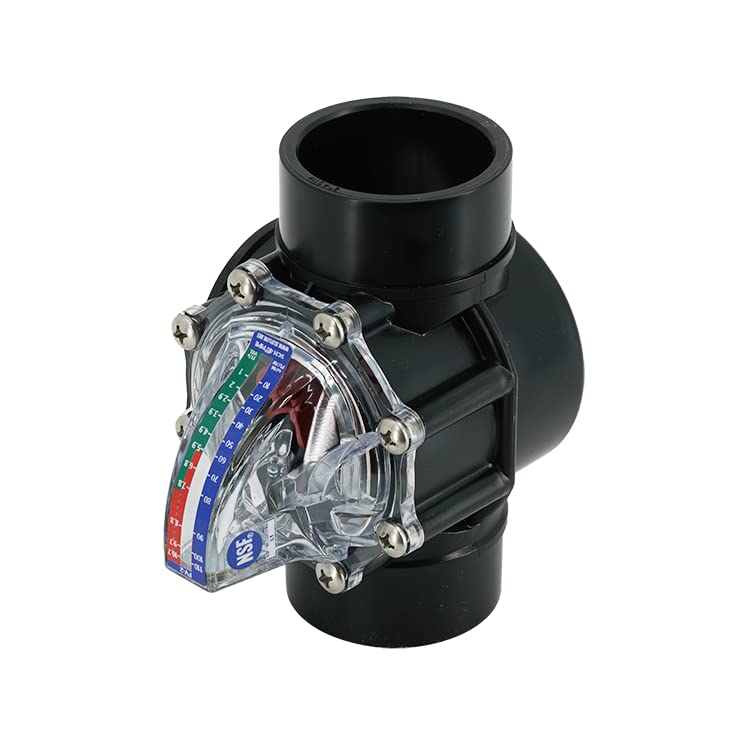
- 2-inch Schedule 40 inline body
- Built-in check valve and GPM scale
- Flexible mounting orientation
What to Look for Before Buying a Pool Flow Meter
Pipe diameter versus actual internal diameter
Pool plumbing is commonly identified by nominal IPS size such as 1.5-inch or 2-inch. The inside passage depends on the pipe schedule and wall thickness. Read the label on the pipe or consult the installer’s records rather than deciding from a quick ruler measurement of the outside wall alone. Manufacturer calibrations for pitot meters assume specific pipe geometry.
Blue-White F-300 models include separate Schedule 40 and Schedule 80 calibrations; the ranges are not identical. Rola-Chem also distinguishes materials such as copper and PVC/galvanized. A 2-inch nominal copper part and a 2-inch PVC part must not be substituted just because both say “2 inch.” The actual model number is an important fit check.
Use the normal operating GPM, not the largest printed number
Pick a calibrated span that includes the flow levels you actually want to assess. A meter marked 40–140 GPM is not a reliable instrument for confirming 20 GPM circulation. A model with a lower scale can be more useful for energy-saving pump settings even if it has a lower maximum.
If the pool has several pump speeds, note the approximate operating flows for the settings that matter most. Manufacturer pump curves may give a starting estimate, but they depend on total system head. An existing service report, commissioned equipment reading, or properly selected diagnostic instrument can make the choice more precise.
Horizontal saddle meter or inline check-valve meter
FLOWREAD, Blue-White F-300, and the listed Rola-Chem instruments place a sensing tube into existing pipe, typically from above a horizontal run. The installer drills and seals an opening; the full section of pipe usually remains in place. They can be relatively convenient retrofits when the position and straight-run clearance are suitable.
The FlowVis FV-2 works differently. The inline check-valve body must be connected into the plumbing and combines a flow scale with a reverse-flow checking function. That design is attractive when a check valve is already needed or an acceptable pitot location is unavailable. It also means pipe cutting and appropriate joining are part of installation.
Straight runs, bends, and turbulence
A pitot-style meter senses water movement at a particular point within the pipe. Nearby elbows, pump outlets, tees, or throttled valves disturb flow patterns. Blue-White’s R-300 and F-300 guidance calls for a straight run equivalent to five nominal pipe diameters upstream and two downstream. Rola-Chem gives model-specific distances in inches. These are practical requirements, not optional aesthetic preferences.
The FlowVis approach tolerates more orientation flexibility and much less straight-pipe space under its product design. Still, it should be installed using its own instructions and in an appropriate portion of the hydraulic circuit. The best location is one where the measurement answers the intended operating question.
What the reading actually represents
A single sensor measures flow through its own line. If a return manifold splits into three branches, a sensor on one branch does not report the total circulation before the split. A meter placed on a bypass can likewise show bypass flow rather than the flow through a heater or sanitizer.
For troubleshooting, write down the pump speed, valve arrangement, filter condition, and the exact meter location alongside the GPM reading. That context makes a measurement meaningful and prevents normal operational changes from being misread as faults.
Blue-White FLOWREAD R-315 1.5-Inch Pool Flow Meter
- 1.5-inch IPS PVC pipe
- 10–70 GPM calibrated range
- Top-mounted, horizontal-pipe design
Why this size matters
The R-315 addresses a common situation: a residential pool with nominal 1.5-inch return plumbing and a pump that changes speed during the day. Its 10–70 GPM scale gives the owner a way to observe how the circuit responds when pump speed, filter condition, or valve position changes. A flow reading can help distinguish an intentional lower-speed setting from a restriction, provided the reading stays within the instrument’s usable range.
The 1.5-inch designation refers to IPS pipe sizing, not a promise that every pipe has a literal 1.5-inch internal opening. Check the pipe material and nominal size, and confirm that the line actually carries the water stream you want to assess. Installing a well-matched meter on the wrong branch of a system will give a true reading of that branch, not of the entire pool circulation flow.
Construction and placement
The R-300 FLOWREAD family uses a clear acrylic meter body with a pitot-tube sensor, a float, and a calibrated scale. A clamp and gasket secure the meter over a hole in the existing PVC line. The assembly leaves the main pipe in place, unlike an inline device that needs a section removed and replacement fittings joined.
However, avoiding pipe cutting is not the same as tool-free installation. The hole must be accurately located at the top of a horizontal, fully flooded pipe, with the sensor facing the correct direction of travel. A short elbow-to-valve run often is not the right location even when it is the most convenient area to reach.
Practical readings
A low-flow meter is useful when adjusting a variable-speed pump for everyday filtration. If the pump is slowed until the meter drops below 10 GPM, the model no longer offers a meaningful in-range measurement; it should not be used to declare that flow is zero. Check the minimum circulation requirements of the filter, heater, and sanitizer separately.
A flow meter is diagnostic rather than corrective. If the reading declines as the filter loads, cleaning the filter or investigating suction-side restrictions could be more appropriate than immediately increasing pump speed. Comparing readings at the same valve and pump settings is generally more informative than comparing unrelated operating conditions.
Who it fits and what to check
For a straightforward 1.5-inch pool equipment pad, this is the most directly matched FLOWREAD option in the selection. It is less useful on an equipment pad dominated by 2-inch plumbing, even if the pump itself happens to have smaller ports. Confirm a straight section with adequate clearance to read the scale and room to remove the meter for service or winterization.
Before drilling, isolate power, depressurize the plumbing, and review the current manufacturer instructions. If the run is vertical, choose an instrument specifically calibrated for that orientation rather than turning this horizontal unit sideways.
Pros
- 10 GPM lower scale suits lower-flow 1.5-inch circuits
- Clamp-on installation avoids cutting out a pipe section
- Clear acrylic body displays a direct flow reading
- Purpose-made R-300 model for residential pool plumbing
Cons
- Not sized for 2-inch or larger plumbing
- Needs straight horizontal pipe and drilled access hole
- Does not measure flow below its 10 GPM scale
Blue-White FLOWREAD R-320 2-Inch Pool Flow Meter
- 2-inch IPS PVC pipe
- 20–120 GPM measurement range
- Horizontal top-mount R-300 construction
A useful range for a larger return line
The R-320 expands the FLOWREAD concept to a nominal 2-inch PVC pipe. Its stated 20–120 GPM range is important in both directions: there is more upper headroom than with the 1.5-inch R-315, but less visibility into very low flow. Pool owners who operate a variable-speed pump at unusually low settings should check the expected operating point before deciding the 20 GPM threshold is sufficient.
Two pool systems can both use 2-inch PVC yet have different hydraulic behavior. One may have a single long return circuit; another may split through heaters, chlorinators, water features, and bypass valves. A meter installed on only one branch reports the flow of that branch. Location should therefore be chosen around the actual question the owner wants answered.
Body design and installation demands
This version belongs to Blue-White’s R-300 residential pool series. The clear acrylic housing and pitot-tube arrangement let the installer monitor flow without inserting a bulky inline fitting between two new PVC joints. A correctly placed drill hole and secure clamp seal are still essential; the pipe must not be pressurized when work starts.
Horizontal mounting means the line itself runs horizontally while the meter stands upright at the twelve-o’clock position. It is not a general-purpose instrument for a vertical riser. The placement must also respect straight-run clearance from nearby tees, elbows, and valves because disturbed water can make a flow indicator misleading.
What the display helps establish
Owners often use a meter like this to record a clean-filter baseline at a particular pump speed. Later readings taken at the same speed make a practical comparison. If flow drops, possible causes include a loaded filter, changed valve setting, clogged baskets, or restrictions; the number alone does not reveal which condition is responsible.
For heaters and salt systems, compare the measured flow against the equipment manufacturer’s specified requirements. The R-320 reports a rate, not an approval that every item downstream is operating safely. When multiple branches exist, the sensor may be upstream of the split or measure only one portion of total return flow.
Best match and principal compromise
The R-320 is the straightforward residential FLOWREAD choice for a 2-inch horizontal IPS PVC line with expected operation inside its 20–120 GPM scale. Buyers who want a more traditional Blue-White professional-series meter should also consider the F-30200P configuration reviewed below. Those looking for a built-in check valve or unusually flexible orientation should compare the FlowVis FV-2.
The main mistake to avoid is purchasing by pipe label alone. Check both the flow operating point and the physical space around the existing plumbing before selecting the meter.
Pros
- Scale matches many mid-size 2-inch pool circulation lines
- 120 GPM upper scale is broader than the R-315
- No pipe section needs to be removed for installation
- Visible GPM reading helps compare pump settings
Cons
- 20 GPM lower limit may miss very low-speed circulation
- Only suitable for the specified horizontal PVC installation
- Incorrect position near elbows can compromise readings
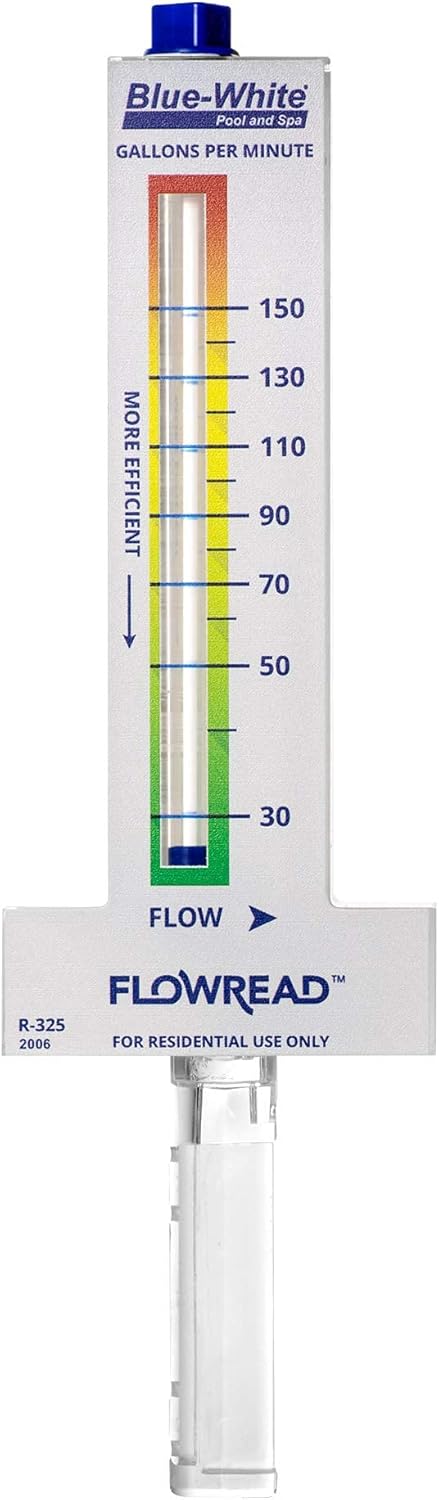
Blue-White FLOWREAD R-325 2.5-Inch Pool Flow Meter
- 2.5-inch IPS PVC pipe
- 30–150 GPM range
- Residential FLOWREAD horizontal meter
A high-flow residential option
The R-325 is calibrated for nominal 2.5-inch PVC and 30–150 GPM. That makes it the member of the FLOWREAD trio with the largest compatible pipe size and the highest minimum reading. It belongs on a line that actually moves enough water to keep the float in the marked range; fitting it to a larger pipe purely because the meter looks more substantial misses the point of calibration.
Larger plumbing is often used to limit resistance on higher-flow installations. A separate 2.5-inch meter can reveal the circulation rate through a main line, but it cannot replace understanding how a multi-pump setup divides the flow. The presence of a large pipe does not establish the operating GPM without measurement or a carefully built hydraulic model.
Why the 30 GPM floor matters
The upper end of 150 GPM might appear to make this the most versatile FLOWREAD product. For low-speed, overnight circulation, however, the 30 GPM floor is a meaningful limitation. Users who want to compare settings around 15 or 20 GPM should not expect a reliable number from this scale.
The meter therefore fits situations where the high-flow end matters more than extremely low-flow visibility. Its reading can support equipment troubleshooting and system balancing when kept in range, but it should never be treated as evidence that a variable-speed pump has stopped moving water simply because the float drops below the lowest mark.
Installation and durability considerations
The R-325 is a top-mounted pitot-tube device rather than an inline replacement body. Install it on an accessible, horizontal, full-flow section of 2.5-inch IPS PVC. Drilling, sealing, and tightening the included clamps are operations requiring particular care because the meter penetrates the pipe wall.
Like any clear-bodied meter, the reading should remain visible and the measuring passage should be kept free of obstructing debris. The manufacturer provides care and cold-weather guidance. If the system is winterized in a freezing climate, follow those instructions rather than assuming a water-filled exposed meter can stay in place unchanged.
When this is the sensible size
This model makes sense for a genuine 2.5-inch residential circulation line with normal operation between 30 and 150 GPM. The professional-series Blue-White 2.5-inch alternative uses a related pitot concept and may appeal to those following an existing commercial installation standard. A 2-inch line, a vertical rise, or a flow that is routinely below the stated scale each calls for a different selection.
Measure the plumbing, inspect the available straight run, and verify expected flow before ordering; those checks matter far more than choosing the largest range printed on a label.
Pros
- Sized specifically for larger 2.5-inch PVC piping
- 30–150 GPM span covers higher-flow circuits
- No cut-and-rejoin of the pipe is required
- Acrylic graduated meter can be read at equipment pad
Cons
- Cannot resolve flows below 30 GPM on its scale
- Top-of-pipe horizontal mounting is required
- Oversized choice for a standard 1.5- or 2-inch line
Blue-White F-300 1.5-Inch Horizontal PVC Flowmeter
- 1.5-inch nominal PVC pipe
- F-300 horizontal pitot-tube format
- 10–70 GPM on Schedule 40
The established F-300 design
The Blue-White 1.5-inch horizontal flowmeter corresponds to the F-30150P size in the manufacturer’s F-300 family. On Schedule 40 PVC, the published range is 10–70 GPM; for Schedule 80 the manufacturer provides a different, 10–60 GPM scale. This distinction matters when a pool has upgraded or unusual wall-thickness pipe, because the internal diameter changes the meter calibration even when the nominal diameter does not.
The F-300 series has a machined acrylic body with a graduated display and a pitot-tube sensor projecting into the pipe. It is designed as a flow-reading instrument rather than a flow-control valve. It does not adjust pump output; it helps the operator see the result of adjustments made elsewhere.
Reading the correct scale
A dual-calibrated display has an advantage when used correctly: an installer can select the markings corresponding to the actual pipe schedule. The downside is that the wrong markings may produce a convincing but inaccurate result. Confirm pipe specification before interpreting the float; do not substitute a nominal 1.5-inch OD measurement for the manufacturer’s IPS specification.
The R-315 residential FLOWREAD has a similar stated Schedule 40 GPM span but is a different product line. Pick the F-300 if you are matching an existing F-300 installation or need its particular labeled Schedule 40/80 configuration. Pick the R-315 if the residential series is your intended installation standard.
Physical fit on equipment plumbing
The horizontal F-300 attaches above a drilled opening in an already installed pipe. The instrument must stand upright and follow the water-flow arrow. Blue-White specifies straight pipe upstream and downstream to reduce disturbances from elbows, pumps, and tees. An exposed pipe with convenient access is not necessarily the best measuring point if it sits directly after a ninety-degree bend.
For routine care, check the seal, keep the body legible, and monitor for deposits that interfere with float movement. Pool equipment should be shut down and pressure fully relieved before installation or removal. Pool water chemistry and freezing conditions also affect how an installed meter is maintained.
Who should choose it
The F-30150P-sized meter is useful for 1.5-inch horizontal PVC where the operator values an established product family, a known calibration, and the ability to compare pump settings over time. It is a poor substitute for a vertical instrument or for an inline check-valve assembly. If a heater’s minimum flow sits close to the edge of the meter’s scale, choose the instrument carefully enough to read around that specific operating point.
Professional-series branding should not be mistaken for universal fit. Correct pipe schedule, position, and flow range make the measurement meaningful.
Pros
- F-300 family offers Schedule 40 and 80 scales
- 10–70 GPM Schedule 40 range suits smaller circuits
- Top-mount clamp-on design for existing pipe
- Manufacturer supplies model-specific service guidance
Cons
- Pipe schedule affects the scale used
- Needs hole drilling and a straight horizontal run
- Not the same as the F-300 upward- or downward-flow models
Blue-White F-300 2-Inch Horizontal PVC Flowmeter
- 2-inch nominal PVC pipe
- F-300 top-mount construction
- 20–120 GPM on Schedule 40
A conventional 2-inch F-300 configuration
The 2-inch version corresponds to Blue-White’s F-30200P configuration. Its published Schedule 40 flow range is 20–120 GPM, and Schedule 80 uses 18–100 GPM. The separate markings are not decorative; the differences reflect pipe geometry. An owner upgrading a pool pad with Schedule 80 fittings must still identify the actual pipe where the meter will be installed.
This model is especially relevant to established 2-inch pool installations where a technician expects a visible F-300 flow indicator. It provides a physical reading at the pipe, so the operator can see changes directly without interpreting a pump’s speed display as if it were measured gallons per minute.
How it differs from the R-320
The FLOWREAD R-320 and this F-300 share a 2-inch nominal target and a 20–120 GPM published range for the applicable configuration. The F-300 belongs to the manufacturer’s broader professional flowmeter family, which includes additional sizes and separate products for vertical flow. That does not mean this particular horizontal unit can simply be rotated for a vertical run.
For a buyer replacing a meter, exact model and calibration are more useful clues than superficial appearance. Compare the printed scale, mounting instructions, and available pipe section. Avoid automatically swapping the R-320 and F-30200P in a system where a specific instrument is already documented.
Meter location and system data
A single flow number can help troubleshoot filtration. Record a baseline with the filter clean, the valve arrangement fixed, and the pump at a known speed. If the reading changes while those settings remain the same, investigate the equipment path rather than assuming the pool’s total volume somehow changed.
Where valves split circulation between water features and returns, placement decides which branch you are measuring. A flow reading downstream of a branch is not the same as the combined flow through a filter upstream. A diagram of the plumbing can prevent this simple interpretive mistake.
Limitations to accept
A top-mounted device needs a horizontal, water-filled segment with clearance for the upright body. Blue-White also specifies straight-run spacing because turbulence disturbs the pitot response. These requirements can make an otherwise affordable meter inconvenient on a crowded equipment pad.
The meter is a sensible choice for a correctly sized conventional 2-inch line if accurate installation is practical. Buyers who cannot provide the needed straight run or who already need a check valve should evaluate the FlowVis design instead, while checking that its inline installation requirements fit the job.
Pros
- Dual Schedule 40/80 markings support the correct pipe type
- 20–120 GPM Schedule 40 span
- Clamp-on sensor avoids adding two inline joints
- Suitable for comparing flow at fixed pump settings
Cons
- Schedule 80 has a different calibrated range
- Requires top mounting on horizontal pipe
- Less flexible near closely spaced equipment fittings
Blue-White F-300 2.5-Inch Professional Flowmeter
- 2.5-inch horizontal PVC pipe
- NSF 50-listed F-300 family
- 29–150 GPM on Schedule 40
Where the professional series adds relevance
A 2.5-inch pool meter is often selected because the plumbing and duty cycle are larger, not because the homeowner wants a visually bigger display. This Blue-White professional-series unit falls within the F-300 family and is associated with the 2.5-inch F-30250P configuration. The manufacturer lists 29–150 GPM for Schedule 40 and 25–130 GPM for Schedule 80.
Its NSF 50-listed F-300 family identification can matter on pools where equipment approval and specification matching are part of the installation process. Listing or certification language should still be checked against the exact supplied version and project requirements instead of assumed to apply indiscriminately to every model bearing the Blue-White name.
Accuracy and pipe assumptions
Blue-White separates accuracy classes by pipe size across the F-300 family, with its 2.5-inch and larger versions in a different class from some smaller models. That is one reason a meter should be used to understand operating flow rather than to promise laboratory-level precision. The meter’s most valuable readings are those taken within its calibrated span, under stable and repeatable operating conditions.
Users should also distinguish Schedule 40 and Schedule 80, because the specified ranges differ. On a complex installation, a photograph of pipe markings and the F-300 scale can help a service technician confirm that the correct configuration was ordered.
Site preparation and care
The horizontal F-300 is designed for pitot insertion through the top of the pipe and clamp attachment. Prepare an adequate straight pipe section before drilling. Debris, trapped air, or partially filled lines compromise the relationship between actual water movement and the float indicator.
The clear meter body should be protected against impact and kept readable. If flow is unusually erratic, inspect system air entrainment, pump behavior, and valve positions before concluding that the meter is defective. For a cold-weather outdoor pad, maintenance must also account for water that can freeze inside the meter.
Best application
Use this version on a genuine 2.5-inch horizontal PVC line when the F-300 series and its certification context match the installation. It is not an all-purpose replacement for the 2.5-inch R-325, even though their upper ranges look similar. The precise pipe schedule, model family, and documented layout should determine the choice.
For modest residential circuits operating at 20 GPM or less, a 2.5-inch F-300 cannot produce an in-range reading. Choosing by actual expected flow rather than by the highest number on the dial prevents disappointment.
Pros
- Nominal 2.5-inch version for larger plumbing
- NSF 50-listed F-300 product family
- Uses Schedule 40 and Schedule 80 scale information
- Readout supports larger circulation-system checks
Cons
- F-300 2.5-inch calibration differs from 2-inch units
- Manufacturer specifies lower full-scale accuracy class than smaller sizes
- Requires suitable horizontal straight pipe for installation
Blue-White F-300 3-Inch Horizontal PVC Flowmeter
- 3-inch horizontal PVC pipe
- 45–240 GPM on Schedule 40
- F-300 clamp-on acrylic meter
A step up in plumbing scale
A nominal 3-inch pipe can serve a large circulation loop, an aquatic feature, or a more demanding commercial installation. Blue-White’s F-30300P size corresponds to 45–240 GPM on Schedule 40, with a separate Schedule 80 range of 40–215 GPM. These figures are far above the lower flow found in many single-pump residential pools. That is a reason to check the actual design GPM before ordering this size.
The F-300 clamp-on concept remains the same as smaller models: a sensor enters an existing pipe and displays flow using a calibrated acrylic body. The measurement scale, however, is not interchangeable. A larger pipe generates different fluid conditions at the same GPM, so a 2-inch gauge placed on a 3-inch pipe is not a shortcut.
Reading large-circuit circulation
A flow measurement becomes useful when linked to equipment requirements. For instance, a large filter bank or water-feature circuit may be sized around a target flow that operators need to verify after maintenance. The installed meter shows the flow in that particular line, helping check whether a changed pump or valve setting moved the system toward its specified operating point.
The display should not be treated as an independent measure of filtration quality or pool sanitation. It says how much water passes the sensor per minute under current conditions. Water treatment performance depends on additional equipment, operating schedules, maintenance, and chemistry.
Position, pipe fill, and installation
A larger pipe does not erase the straight-pipe requirement. The F-300 horizontal meter needs a horizontal run with the meter installed upright. The manufacturer’s standard spacing guidance becomes physically more demanding as nominal diameter increases: five diameters upstream and two downstream correspond to longer clear runs on 3-inch plumbing than on 1.5-inch plumbing.
Careful location planning before cutting or drilling prevents interference with pipe supports, bulkheads, or nearby equipment. Confirm direction of flow, full pipe conditions, access to the scale, and enough room around the fitting for future service.
A specialized buy, not an everyday default
This version makes sense where the line is truly 3-inch IPS PVC and the flow sits comfortably within its 45–240 GPM Schedule 40 span. The fact that a large pool uses high-horsepower pumps is not enough evidence by itself; plumbing diagrams and design flow information matter.
Smaller installations should choose a correctly calibrated smaller meter. A 3-inch line running below its scale needs a different instrument or monitoring strategy rather than a forced interpretation of an out-of-range float.
Pros
- Dedicated 3-inch calibration for higher-flow lines
- Schedule 40 and Schedule 80 scales are specified
- Installs into an existing line without inline unions
- Useful for large pool or water-feature circuits
Cons
- 45 GPM bottom of Schedule 40 scale is high for small pools
- Horizontal straight-run requirements restrict placement
- Not suitable on nominal 2.5-inch piping
Blue-White F-30400P 4-Inch Horizontal Flowmeter
- 4-inch F-30400P model
- Horizontal acrylic F-300 design
- Manufacturer chart: 75–420 GPM (Sch 40)
The listing range needs checking
The Amazon listing identifies the F-30400P 4-inch horizontal Blue-White meter and describes a 79–400 GPM span. Blue-White’s current F-300 documentation lists the F-30400P as 75–420 GPM for Schedule 40 and 70–375 GPM for Schedule 80. Those values should not be blended into a new claimed range. The printed scale and the exact current model documentation should control the installation decision.
For buyers dealing with procurement or inspection, a photograph of the delivered instrument’s scale and catalog marking can resolve the difference. An approximate summary in a retail title is not enough to establish how the unit should be read. Confirm the system’s pipe schedule at the same time.
A meter for substantial volume
A 4-inch circulation main is a different application from a compact backyard pool return. The attraction of this model is its calibration for higher-volume water movement. When a facility operates large filters or multiple pumps, operators may need a visible reference to see how much water is circulating under different equipment configurations.
The meter offers a local reading, not a stored data log. If records are required, someone must document them or use separate monitoring equipment. The acrylic scale remains useful for quick checks provided the person reading it has access to the equipment area and uses the right schedule markings.
Installation becomes a planning task
Top-mount pitot meters still rely on a fully flooded, reasonably undisturbed line. On four-inch plumbing, the necessary upstream and downstream spacing occupies more physical room than on smaller pipes. The instrument should also be positioned where staff can read it without standing on piping or reaching through equipment.
Installation involves penetrating a pressure-containing pipe. The system must be shut down, isolated, depressurized, and prepared according to the installation instructions. On a commercial or high-flow system, selecting a qualified installer and checking applicable facility requirements is a sensible part of the project.
When to choose this listing
Choose this ASIN for a verified F-30400P requirement, not merely for its 4-inch description. Its model specificity is a benefit when matching a specification, but the range discrepancy makes a final confirmation important. The 3-inch F-300 or 6-inch model are not interchangeable alternatives; changing pipe size changes calibration and installation fit.
Small residential systems will get more usable information from a lower-range meter. This large unit only makes sense where the measured system actually operates inside its marked flow range.
Pros
- Made for nominal 4-inch high-flow piping
- F-300 design mounts on the existing pipe
- Large calibrated span for major circulation loops
- Specified F-30400P model simplifies matching
Cons
- Amazon range wording and manufacturer chart differ
- Minimum flow is too high for typical small pools
- Large-pipe straight-run clearance is substantial
Blue-White F-300 6-Inch Horizontal PVC Flowmeter
- 6-inch nominal PVC pipe
- 170–1,100 GPM on Schedule 40
- F-300 horizontal high-flow meter
For large aquatic facilities
The 6-inch Blue-White F-300 meter is associated with the F-30600P configuration. Blue-White specifies 170–1,100 GPM for Schedule 40 and 160–1,000 GPM for Schedule 80. These are large-facility numbers. A private pool with a 1.5- or 2-inch equipment pad cannot gain insight by buying the six-inch meter because the scale looks expansive.
The scale is useful where a large filtration plant, aquatic facility, or shared circulation main must be checked against an operating specification. In these installations, the meter is one instrument among pumps, filters, valves, safety devices, and possibly automated monitoring.
Understanding the measurement
Reading 600 GPM is meaningful only if the sensor sits on the relevant full-flow line and the pipe geometry matches the calibration. On a header fed by multiple pumps, the number reflects whatever pumps and branches are operating at that moment. It is good practice to note the equipment configuration next to each logged reading.
Large-system hydraulic performance can change when filters are backwashed, pumps are staged, or a valve bypasses part of the loop. The meter helps observe that change but does not determine whether the entire facility meets its circulation or health-code obligations. Those requirements must be handled through the relevant equipment and regulatory guidance.
Installation realities at six inches
The F-300 still needs the manufacturer-specified orientation, pipe fill, and adequate clearance away from turbulence. On nominal six-inch pipe, the straight-run requirement can be a sizeable part of the mechanical room. Making room for the upright scale and for future maintenance is also important.
A high-flow installation has substantial stored water and equipment energy. Pipe drilling or removal is not an appropriate live-system task. Planned shutdown, isolation, pressure relief, and the relevant installation standards should be part of the work. Frost protection or winterization should reflect the facility environment.
Best buyer and alternatives
This meter is for operators who already know they need a six-inch horizontal PVC flow instrument and whose expected rates fall within the calibrated band. It is not the right choice simply because a facility has several pumps; the line being measured must itself be six inches.
If the run is cramped, vertical, or unsuitable for a pitot instrument, consider an approved meter technology designed for that location rather than compromising the F-300 placement rules. A valid reading on the wrong installation geometry can be worse than no reading because it encourages a false sense of precision.
Pros
- Purpose-sized for six-inch circulation mains
- Broad high-flow reading span for large facilities
- Schedule 40 and Schedule 80 ranges documented
- Pitot-tube arrangement avoids an inline meter body
Cons
- Not appropriate for household-scale low-flow lines
- Very long straight-run access may be needed
- Pipe size and flow range must be professionally checked
Rola-Chem 570341-T 1.5-Inch Top-Mount Flowmeter
- 1.5-inch PVC/galvanized configuration
- 25–60 GPM range
- Top-mounted Rola-Chem 570341-T
A focused flow band
The Rola-Chem 570341-T is a top-mounted meter intended for nominal 1.5-inch PVC or galvanized pipe and a 25–60 GPM calibrated span. That band is notably narrower than the 10–70 GPM Blue-White R-315. A narrow band is not automatically a flaw: it suits a system that actually spends its time near the middle of the marked scale. It is a weakness if pump settings frequently fall below 25 GPM.
The exact model suffix matters. Rola-Chem separates mounting styles with T for top, S for side, and V for vertical, and its sizing chart distinguishes the 570341 PVC/galvanized version from the 570340 copper model. Buying a familiar-looking Rola-Chem body without checking its code risks a calibration mismatch.
Straight pipe requirements
Rola-Chem’s chart gives minimum distances relative to downstream and upstream disturbances. For the 570341 size, it lists 8 inches downstream and 15 inches upstream. Those details make planning simpler than guessing where there is enough exposed pipe. They also mean that a very compact equipment pad can be incompatible even if the pipe diameter is correct.
Place the display where it can be read upright, keeping it within the manufacturer’s mounting instructions. Any installation involving a drilled pipe penetration requires shutdown and depressurization. Confirm fittings and clearances before preparing a permanent hole.
Practical decision-making
If a pool typically runs at approximately 30–50 GPM on the relevant 1.5-inch circuit, this meter’s range may be well suited. If the goal is to investigate a 15 GPM economy setting, however, the display cannot give a validated in-range reading at that point. The owner should select a lower-range model rather than trying to extrapolate beneath the scale.
The unit offers a visual flow reference that helps compare pump speeds, filter condition, and valve positions. It does not diagnose the cause of reduced flow on its own. A technician should still check baskets, air intrusion, equipment restrictions, and other system factors.
Compatibility comes first
This is a strong contender when Rola-Chem’s exact 570341 top-mount configuration is specified on a 1.5-inch PVC/galvanized system. It is not a substitute for the manufacturer’s copper-pipe version or for other mounting geometries. As with all such meters, the pipe must be fully flooded during operation.
A buyer comparing it with Blue-White should focus on whether 25–60 GPM or a wider range better describes actual use, and on the available installation location. Brand preference is secondary to those facts.
Pros
- Useful 25–60 GPM span for steady medium-flow 1.5-inch lines
- Official sizing chart specifies installation clearances
- Top-mount configuration is clearly identified
- Dual GPM and LPM measurement family
Cons
- Does not cover the 10–24 GPM portion of the R-315 scale
- Straight-run needs may be difficult on compact pads
- Must not be confused with Rola-Chem copper or side-mount variants
Rola-Chem 570351-T 2-Inch Top-Mount Flowmeter
- 2-inch PVC/galvanized pipe
- 40–140 GPM calibrated range
- 570351-T top-mount design
A higher starting point than Blue-White
The Rola-Chem 570351-T serves nominal 2-inch PVC/galvanized plumbing and displays 40–140 GPM. Compare that with the Blue-White R-320 and F-30200P Schedule 40 span of 20–120 GPM. The Rola-Chem sacrifices visibility below 40 GPM but adds calibrated range above 120 GPM. That difference may matter more than a small change in purchase cost.
For a pool that runs a variable-speed pump at 25 or 30 GPM during long filtration hours, the Rola-Chem is a poor match for that operating point. For a higher-flow circuit closer to 100–130 GPM, it is worth comparing. Do not assume a 2-inch pipe necessarily implies a 100 GPM flow; the system’s hydraulic characteristics determine actual movement.
Installation space is important
Rola-Chem’s model chart indicates a 20-inch minimum upstream distance and 10 inches downstream for the 2-inch 570351 size. A top-mounted instrument must also have overhead room to sit upright. This may rule out a cramped return manifold even if its nominal pipe diameter is correct.
As with all pipe-mounted measuring devices, select a full-pipe location, follow the flow direction, and prepare the pipe using the current instructions. Fitting on a disturbed section directly adjacent to an elbow risks numbers that look precise but do not describe the true rate reliably.
Who gets the most from the display
A facility that normally operates above 40 GPM can use the reading as a stable reference for filter servicing, valve adjustment, or comparing pump configurations. For example, a repeatable decline at the same pump speed may prompt inspection of a dirty filter or partially closed valve. The flow meter provides an observation, not the diagnosis.
Rola-Chem’s scale is a simple visual interface. No electricity, screen configuration, or digital pairing is required for the mechanical measurement, but someone must be present to read and record it. The instrument is not a replacement for flow interlocks or automatic equipment protection.
What not to substitute
The top-mount 570351-T should not be confused with 570350 copper models or a side/vertical version. Likewise, a Blue-White F-300 for the same nominal diameter has its own scale and installation requirements. Verify the physical plumbing, the expected lower flow, and the access space before choosing one.
If the goal is to combine flow metering with a check valve in one inline device, the FlowVis FV-2 below offers a fundamentally different design. That may make more sense during a plumbing rebuild than adding a separate top-mounted instrument.
Pros
- 140 GPM upper mark supports higher-flow 2-inch circuits
- Manufacturer documents 20-inch upstream clearance
- PVC/galvanized and top-mount version are identified
- Useful for stable medium-to-high circulation rates
Cons
- 40 GPM lower limit misses lower-speed 2-inch flow
- Not interchangeable with the 570350 copper model
- Requires longer straight-run clearance than some compact pads have
FlowVis FV-2 2-Inch Flow Meter with Check Valve
- 2-inch Schedule 40 inline body
- Built-in check valve and GPM scale
- Flexible mounting orientation
A different measurement system
The FlowVis FV-2 is not another saddle-mounted acrylic float meter. It uses a purpose-built inline body with a check-valve function and a readable gallons-per-minute scale. That integrated function is the practical distinction: buyers who need a check valve at the same location as the meter can potentially address both needs with one component. The exact FV-2 in this listing targets 2-inch Schedule 40 plumbing, not the similarly named union or 2.5-inch variants.
The visible moving element responds to water moving through the valve body. The manufacturer also identifies velocity information for this model. Do not confuse a reading in feet per second with GPM; they represent different hydraulic measurements, and equipment flow requirements are typically expressed in gallons per minute.
Flexibility on a crowded equipment pad
FlowVis is designed to tolerate installation orientations that conventional horizontal pitot meters cannot. The manufacturer describes horizontal or vertical placement and minimal straight-pipe demands. That can be a decisive advantage where pool plumbing makes a sharp turn immediately after a filter or where the available horizontal run is short.
There is an important tradeoff: installing an inline body requires a correctly planned pipe connection. In a retrofit, that typically means cutting out a suitable section and joining the new assembly following the model’s instructions. A clamp-on pitot meter usually avoids this larger plumbing change. The installation cost and disruption could outweigh the flexibility for an otherwise simple setup.
Check-valve function and limits
The integrated check valve is useful only where backflow prevention by this type of valve is appropriate. Check valves are not universal replacements for code-required backflow prevention assemblies or every hydraulic safety component. The valve direction, other equipment, serviceability, and local rules must all be evaluated in the real system.
The FlowVis unit can be especially useful on a return line where avoiding reverse flow matters and a flow number helps verify pump operation. It should not be installed in the wrong flow direction or forced to serve as a valve type that the plumbing design does not call for.
Best purchasing scenario
Choose the FV-2 when a confirmed 2-inch Schedule 40 pool system needs both inline flow indication and a check-valve function, or when pitot-meter location rules cannot be met. A buyer replacing an existing FlowVis should verify the exact body, unions if any, and connection geometry rather than selecting merely from a picture.
For an untouched horizontal PVC line with sufficient straight length, the R-320 or F-30200P may involve less plumbing alteration. The decision is fundamentally about installation architecture, not about declaring one flowmeter technology universally better.
Pros
- Combines flow measurement with a check valve
- Horizontal and vertical installation options
- Less straight-run space required than pitot meters
- FlowVis manufacturer identifies NSF 50 certification
Cons
- Requires cutting into plumbing for inline installation
- Specified for 2-inch Schedule 40 configuration
- Valve behavior and placement must suit system layout
Detailed Buying Guide: How to Choose a Flow Meter for Swimming Pool Plumbing
Understand the main technologies
A pitot-tube flowmeter uses a small probe installed into the water stream and a calibrated visual indicator to estimate gallons per minute. Its relatively small sensor can fit through a drilled hole, which avoids replacing a full section of pipe. That simplicity comes with sensitivity to how water approaches the probe. The meter needs the specified pipe, orientation, and a reasonably stable flow profile.
An inline flow-indicating check valve measures flow through a purpose-built body. The FV-2 belongs to this category. Its advantage is a more flexible placement geometry and the presence of a check-valve mechanism in the same component. Its tradeoff is that the body becomes part of the pipe run and needs correctly joined connections.
Neither type makes the pump produce additional water movement. A meter is an instrument for understanding the circuit. The best kind depends on the installation layout and whether reverse-flow control is also required.
Compare GPM ranges properly
A flowmeter typically has a calibrated range with a lower and upper bound. Readings outside that marked band should not be treated as precise measurements. On a system that operates from 20 to 50 GPM, a 10–70 GPM scale covers both settings while a 40–140 GPM scale loses the lower end. Conversely, if the main interest is flow around 125 GPM, a meter ending at 120 GPM cannot cover the target.
On Blue-White F-300 instruments, note which set of markings corresponds to Schedule 40 and which corresponds to Schedule 80. A nominal 2-inch meter may read 20–120 GPM on the former and 18–100 GPM on the latter. The ability to distinguish schedules is useful only if the reader identifies the installed pipe correctly.
Avoid estimating actual pool turnover from a flow meter without knowing the pool volume and whether the entire indicated water stream goes through the treatment path of interest. Flow rate, pump run time, system branching, and effective circulation are related but not identical ideas.
Read pipe markings before ordering
A common purchasing error is treating a fitting’s outside measurement as its nominal pipe size. PVC dimensional standards deliberately make fitting dimensions and actual internal diameters different from the nominal label. If markings are faded, use an appropriate pipe size reference or ask a pool professional to identify the pipe.
A section of 2-inch plumbing might be Schedule 40 while another replaced section is Schedule 80. Use the specification of the actual mounting location. Check for unusual pipe materials, repairs, reducers, or nonstandard arrangements before buying a meter that must penetrate the wall.
For a 4-inch F-30400P requirement, compare the specific printed instrument scale with the manufacturer’s current model information because the supplied retail title and current F-300 table describe different endpoints. Do not simply choose whichever numbers appear more convenient.
Choose a meaningful measurement point
A meter on the discharge of a filter can be used to track flow after filtration. This is often a practical place to record a clean-filter baseline. But if that section includes an immediate elbow, tee, or complex return manifold, a different straight section may be necessary for a pitot installation.
If a spa spillover and main pool returns share the equipment, valve changes can divert flow between paths. Write down exactly which valves are active during a reading. A measurement taken with the spa open should not be compared directly with one taken with the pool returns only unless the comparison is intentionally studying that change.
The pipe must stay full of water during operation. A partially filled section or one containing trapped air can give poor readings and interfere with the physical measuring element.
Know what installation involves
Before any work, switch off the relevant pump and equipment, isolate and depressurize the piping, and confirm there is no stored pressure. For a top-mounted pitot unit, follow the model’s drilling instructions, remove burrs, align the sensing probe with the water direction, position the gasket, and tighten clamps evenly. The Blue-White guidance describes a 5/8-inch opening for its R-300 and F-300 families, but the current product manual should always be used for the exact job.
For the FlowVis inline valve body, the plumbing must be cut or constructed to accept the required connections. Dry-fitting the location, confirming flow-direction arrows, allowing access for cover or valve service, and following approved joining procedures are part of a proper installation. A check valve also needs to be placed where its reverse-flow function is appropriate.
A flowmeter leak can damage equipment areas and reduce circulation; do not commission a newly drilled or glued installation without the required cure, inspection, and pressure testing under the manufacturer’s instructions. Commercial equipment rooms may also have specific installation and compliance requirements.
Use pump readings without confusing RPM and GPM
Variable-speed pumps let owners choose revolutions per minute, not a guaranteed GPM. The delivered water depends on hydraulic resistance. A speed increase can raise flow, but its effect varies as filters load, valves change, or a water feature is turned on.
A flowmeter makes the real result visible. To compare settings, hold the valve positions constant, let the flow stabilize, and record the reading. Do not use a new meter to run a heater, sanitizer, or filter outside that equipment’s allowable flow limits. The flow target should come from those products’ instructions.
If a control panel already provides a calculated flow estimate, a physical meter can provide an independent observation, though different measurement methods have their own accuracy and installation limitations.
Consider accuracy, certification, and project requirements
An accuracy rating needs context. Blue-White lists different full-scale accuracy classes for different F-300 pipe sizes. Full-scale percentage does not mean a constant percentage of the reading at every operating point. A meter used near the bottom of its range can therefore be less informative than a buyer expects from an attractive percentage in a specification table.
NSF 50 listings can matter for pool-equipment procurement, especially on public or commercial installations. Check that the exact model and installation configuration satisfy the project’s requirements. A family description or retail title should not replace inspection of the actual approved equipment and applicable local rules.
A meter is not a certified safety interlock merely because it displays a number. If equipment needs automatic low-flow protection, use the appropriate approved sensors and controls prescribed by the equipment manufacturer.
Maintenance, winterization, and long-term readability
Clear acrylic makes a mechanical meter convenient to read, but deposits, scale, and physical damage can interfere with visibility and operation. Check for persistent air, abnormal float behavior, damaged clamps, or weeping around the gasket. The current manual describes the permitted cleaning approach and replacement parts.
Outdoor locations bring sunshine, temperature changes, and winter conditions. Blue-White provides guidance for removing, cleaning, and storing its R-300 meter when freezing may occur. It is not safe to assume an exposed water-filled instrument will tolerate freezing simply because the housing is suitable for outdoor use.
If a meter is positioned in direct splash or maintenance traffic, consider access and protection from accidental strikes. Keeping the scale legible and reachable matters just as much as making the initial installation look tidy.
Direct Comparisons That Matter Before Buying
FLOWREAD R-315 vs Blue-White F-300 1.5-Inch
These two are aimed at the same nominal 1.5-inch PVC size, and both provide a 10–70 GPM Schedule 40-type span. The F-300 belongs to the broader professional family and specifies an additional Schedule 80 calibration. The R-315 is the residential FLOWREAD line. Choose according to your actual pipe schedule, replacement requirement, and physical installation documentation; a shared nominal size does not mean every individual component is interchangeable.
FLOWREAD R-320 vs Rola-Chem 570351-T
Both target 2-inch pipe, but their flow bands tell different stories. The R-320 reads from 20 to 120 GPM while the Rola-Chem 570351-T is marked 40–140 GPM. For lower-speed operation around 25–35 GPM, the Blue-White range is more useful. For a higher-flow loop operating around 125–135 GPM, the Rola-Chem band is the more relevant one. Rola-Chem also specifies its own installation spacing, so compare available straight pipe before choosing.
FLOWREAD R-325 vs F-300 2.5-Inch
The R-325 reads 30–150 GPM on 2.5-inch residential PVC, while the F-300 2.5-inch Schedule 40 range is listed at 29–150 GPM. Although these endpoints are similar, the product series and schedule information differ. If the installation calls for a particular NSF 50-listed F-300 instrument or a Schedule 80 calibration, confirm the F-300 variant. The R-325 remains a distinct residential-series option.
Blue-White 2-Inch F-300 vs FlowVis FV-2
The F-300 attaches to a drilled opening in existing horizontal pipe and calls for straight-run clearance. The FlowVis inserts an inline body into 2-inch Schedule 40 plumbing but is less restrictive about orientation and nearby bends. FlowVis also provides a check valve. If replacing an existing check valve or planning a new plumbing build, the inline design can simplify the function layout. For a straightforward retrofit with ample straight pipe, the saddle-style instrument can mean less pipe reconstruction.
Three-Inch, Four-Inch, and Six-Inch Blue-White Models
These are not graduated upgrades for the same pipe. They are separately calibrated instruments for different nominal diameters and high-flow duties. A 3-inch F-300 covers 45–240 GPM on Schedule 40, the current manufacturer F-30400P chart covers 75–420 GPM, and the six-inch F-30600P covers 170–1,100 GPM. The four-inch retail listing uses different endpoints, so match the exact delivered scale to the current model documentation. Correct pipe size and real operating flow determine the choice.
Common Pool Flow Meter Buying Mistakes
Using nominal pipe size as a flow estimate
A large pipe does not automatically carry more GPM in every real system. Pump performance, equipment resistance, valves, and branch connections determine flow. Choose the meter using both physical pipe fit and expected operating rate.
Installing too close to a pipe bend
Pitot-style meters need adequately developed flow. A convenient short stub immediately after an elbow may be unsuitable. Check the manufacturer’s upstream and downstream clearances before drilling.
Choosing a meter that cannot see the lowest pump setting
A 40–140 GPM model cannot confirm a 20 GPM energy-saving speed. Select a calibrated span that includes the conditions you plan to measure, not just the peak pump output.
Rotating a horizontal model onto a vertical pipe
The F-300 horizontal and FLOWREAD R-300 horizontal variants must be installed in the documented upright orientation on a horizontal pipe. Blue-White sells other model families for upward or downward flow. Do not treat those variants as mere mounting accessories.
Ignoring Schedule 40 versus Schedule 80
Nominal size is not the whole calibration. The F-300 family gives different range markings for different pipe schedules. Using the wrong marks risks reporting a flow rate that is not supported by the instrument.
Forgetting that a branch reading is not total circulation
A flowmeter measures the water passing through the line where it sits. Split returns, spas, and bypasses can make a local reading different from total pump delivery. Map the system before interpreting the number.
Treating a flow meter as a safety control
A visual GPM display does not automatically stop a heater, sanitizer, or pump if water movement is too low. Required low-flow switches, check valves, and safety devices serve distinct functions and must be selected to meet applicable equipment instructions.
Frequently Asked Questions
What does GPM mean on a swimming pool flow meter?
GPM means gallons per minute. It describes the volume of water moving past the measuring point each minute under the current pump and valve conditions. It is not the same as pump RPM or a guarantee of the pool’s treatment effectiveness.
What pipe size flow meter should I buy for a typical residential pool?
Read the marking on the exact pipe where the meter will go. Many residential pads use nominal 1.5-inch or 2-inch PVC, but the correct choice depends on your installation. Confirm the pipe schedule, expected flow range, and horizontal or vertical routing as well.
Can I install a horizontal pool flow meter vertically?
Not unless the exact model is explicitly designed and calibrated for that direction. The listed Blue-White R-300 and horizontal F-300 versions require top mounting on horizontal pipe. FlowVis FV-2 offers more flexible orientations under its own instructions.
Do I need to cut the pipe to fit a Blue-White flowmeter?
The listed Blue-White pitot-tube designs normally fit through a drilled opening in the existing pipe rather than requiring a section to be removed. Drilling and sealing still require depressurization, precise placement, and the proper installation procedure.
Will a flow meter help set a variable-speed pool pump?
It can show the actual circulation achieved by a particular speed setting. Record the reading after the system stabilizes, and compare it with the minimum and maximum flow requirements of connected filters, heaters, and sanitation equipment. Do not assume the lowest measurable GPM is automatically a safe or effective operating target.
What is the difference between Schedule 40 and Schedule 80 flowmeter scales?
For a given nominal PVC diameter, Schedule 80 pipe has a thicker wall and a different internal passage than Schedule 40. A calibrated pitot meter may therefore have different marked ranges for the two schedules. The Blue-White F-300 family publishes separate values, so read the one applicable to the actual pipe.
Is Rola-Chem 570341-T better for low flow than FLOWREAD R-315?
No, not at the low end of the scales listed here. The Rola-Chem 570341-T covers 25–60 GPM, while the R-315 covers 10–70 GPM. The R-315 is more useful for confirming a reading between 10 and 24 GPM, assuming installation and pipe compatibility are correct.
What is special about the FlowVis FV-2?
It combines a flow indicator and check-valve function in an inline body for the specified 2-inch Schedule 40 pipe. It also offers more mounting flexibility than typical top-mounted pitot instruments. Its installation requires appropriate inline plumbing connections.
Can a flow meter show that my filter is dirty?
It can help identify a reduction in flow when pump speed and valve settings are held constant. A declining reading may be consistent with increased resistance from a dirty filter, but clogged baskets, valve changes, air, and other restrictions can create similar symptoms. Use it as one diagnostic measurement.
Does a pool flow meter reduce electricity consumption?
The meter itself does not save electricity by regulating the pump. It provides a measured reference that can help evaluate pump settings. Any change in energy use depends on pump operation and the system’s required flow and treatment performance.
What should I do if the meter float stops moving?
Shut down and depressurize the system before inspecting the device. Check the manufacturer’s guidance for blocked sensing openings, scale deposits, incorrect flow direction, and air or insufficient flow. Do not force the float or dismantle a pressurized fitting.
Can I use the 4-inch Blue-White retail GPM range without checking the meter?
The supplied 4-inch Amazon listing says 79–400 GPM, while the manufacturer’s current F-30400P chart lists 75–420 GPM for Schedule 40. Identify the delivered model, examine its printed markings, and follow the appropriate manufacturer documentation rather than assuming the two statements are identical.
Final Buying Considerations for a Swimming Pool Flow Meter
The right flow meter for swimming pool circulation is the one calibrated for the exact plumbing and operating conditions, not the one with the longest list of features. Check the nominal pipe material and size, the schedule where applicable, the lowest and highest flow you need to observe, and the available room for correct installation. An attractive GPM range cannot compensate for an incorrect mount or a disturbed measuring location.
For common residential systems, the FLOWREAD R-315, R-320, and R-325 cover specific 1.5-, 2-, and 2.5-inch PVC configurations. The Blue-White F-300 family offers a broader set of specified pipe sizes and separate Schedule 40/80 calibrations. Rola-Chem’s 570341-T and 570351-T give different operating spans for their 1.5- and 2-inch PVC/galvanized configurations. The FlowVis FV-2 is the distinct option for buyers seeking an inline two-inch flow meter with an integrated check valve.
For three-, four-, or six-inch plumbing, sizing and commissioning information should guide the purchase. Confirm the F-30400P range discrepancy before relying on its markings. Once a properly installed meter is in place, recording baseline GPM alongside pump speed, valve positions, and filter condition makes future readings far more useful.
Author