

An insulated pool pump cover can mean several very different products. Some covers are sized for the compact electric pump motor on a pool circulation system, while others are large enough to cover a pool heater or heat pump cabinet. The distinction matters because a cover that fits a 24-inch pump motor cannot substitute for a 40-inch-plus heat-pump cover, and a large heater cover can be unnecessarily loose around a small pump.
The three products compared here show that difference clearly. Outdoor Solutions’ Climate Shield OSCS-HPC measures 41.5 inches long by 35 inches wide by 43 inches high and is intended for electric pool heat pumps and outdoor central-air units. The smaller Climate Shield OSCS-HC measures 37.5 by 30.5 by 36 inches and is aimed at pool heaters and heat pumps. Bitubi’s cover is only 24 by 11 by 11 inches and is intended for the pump motor itself.
There is another point buyers should understand before treating any soft cover as freeze protection. None of these three listings publishes a thermal R-value. The Climate Shield covers use polyvinyl shells with non-woven linings and ventilation, while the Bitubi uses 600D Oxford fabric with a plush lining. Those linings help separate the cover material from the equipment and add a layer between the cabinet and weather, but they are not the same thing as a rigid insulated enclosure with a documented thermal rating.
A cover should also complement proper winterization rather than replace it. Water trapped inside pumps, plumbing, heaters, or heat exchangers can freeze even when the exterior is covered. For a pump motor, airflow is equally important: manufacturers such as Hayward instruct owners to keep motor air vents free of obstruction. The practical goal is therefore to keep weather and debris off the equipment while preserving the drainage, ventilation, access, and clearances required by the equipment manufacturer.
Quick Comparison

- 41.5″L × 35″W × 43″H
- Polyvinyl with non-woven lining and side mesh vents
- Hook-and-loop seams and cinch-style adjustment for larger heat pumps
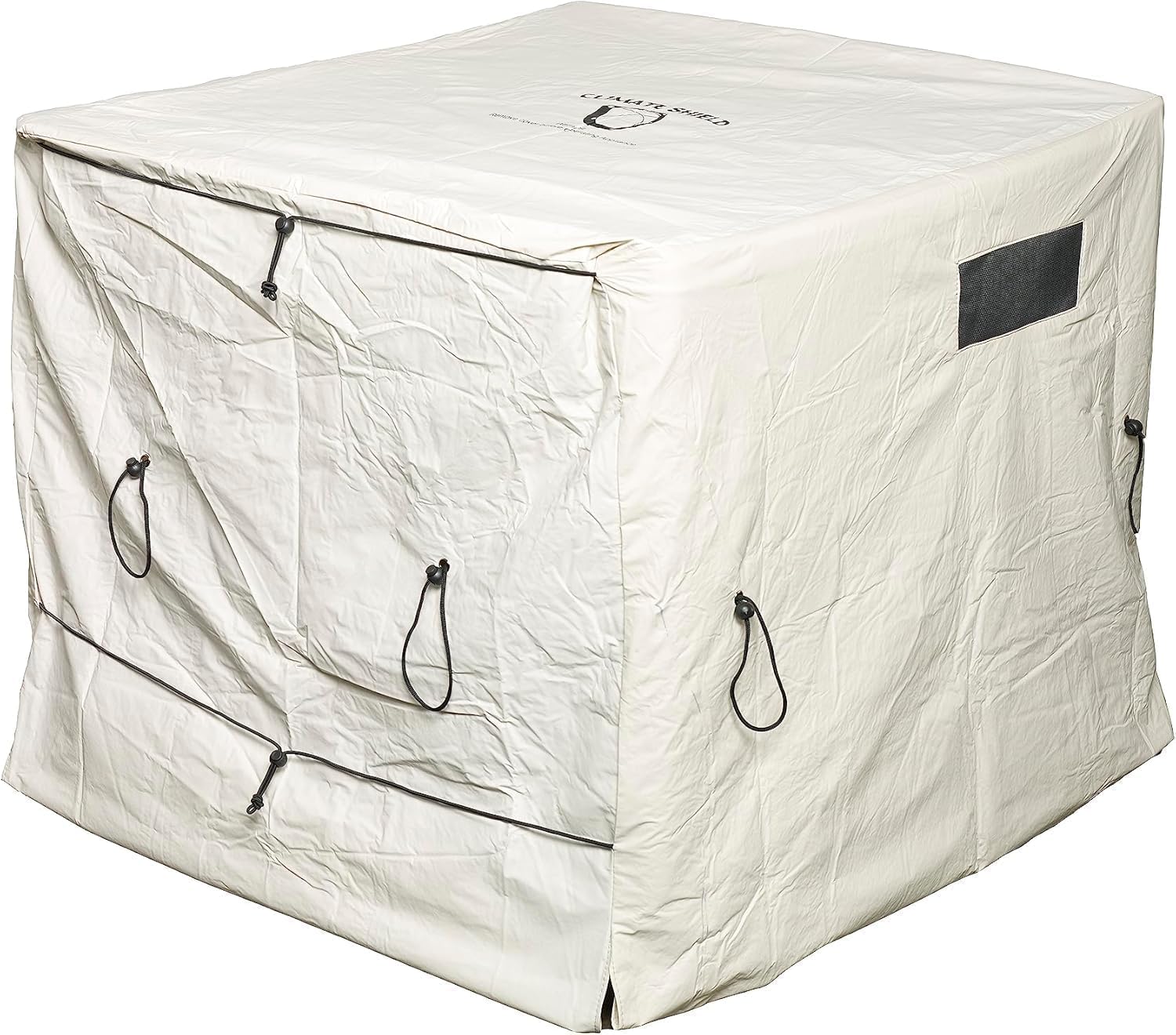
- 37.5″L × 30.5″W × 36″H
- Heavy polyvinyl with non-woven lining and mesh ventilation
- Hook-and-loop seams, straps, drawstrings, and plumbing-friendly fit

- 24″L × 11″W × 11″H
- 600D Oxford fabric with plush lining
- Openable vents, hook-and-loop opening, buckle, and two drawstrings
What to Look for When Buying an Insulated Pool Pump Cover
Start by identifying what you are actually covering
The phrase “pool pump” is often used loosely for equipment sitting on the same pad, but a circulation pump, gas pool heater, electric heat pump, filter tank, and control panel are separate components with different shapes and ventilation needs. Before comparing cover materials, identify the exact component that needs protection. A motor-sized cover should be judged by whether it clears the pump housing, motor vents, unions, control panel, and attached plumbing. A heat-pump cover needs enough volume for a cabinet that can be several times larger.
This is the biggest practical difference among the three products in this guide. The Bitubi is a compact rectangular cover for a pump assembly or motor area. The OSCS-HPC and OSCS-HC are cabinet-style covers. Buying solely from the keyword can therefore lead to a cover that is dramatically too large or too small even if the product description repeatedly uses “pool equipment.”
Measure the equipment, plumbing, and control protrusions
Measure maximum length, width, and height rather than the visible motor housing alone. Include raised control panels, wiring compartments, union fittings, pipe elbows, valve handles, or refrigerant connections that sit inside the area the cover must pass over. A listed 24 × 11 × 11-inch cover is not useful if a variable-speed drive makes the pump 14 inches tall, even when the motor body itself is narrow enough.
Allow enough room for installation without pulling the fabric hard across corners. A cover under constant tension around sharp cabinet edges can wear faster and may make plumbing openings sit in the wrong place. Excessively loose covers have their own drawback because unsupported material can flap in wind. Adjustable straps, drawstrings, hook-and-loop seams, and buckles help manage that extra material, but they cannot correct a major size mismatch.
Understand what the lining does—and does not do
The word “insulated” can suggest a measured ability to resist heat transfer. That is not established here because no R-value is listed for any of these covers. Climate Shield describes a non-woven inner cloth that absorbs moisture and keeps the vinyl from sticking to equipment. Bitubi uses a plush inner lining beneath its 600D Oxford exterior. Both approaches add separation between the weather-facing shell and the equipment, but neither listing establishes a temperature at which the cover will prevent freezing.
That distinction is especially important in climates with sustained subfreezing temperatures. Freeze damage usually comes from water expanding inside pump housings, pipes, or heat exchangers. An exterior cover can reduce direct exposure to snow, ice, rain, and wind-blown debris, but it does not remove that water. The equipment manufacturer’s winterization procedure should remain the primary guide for freezing conditions.
Ventilation matters as much as weather protection
A completely sealed cover can create its own moisture problem. Climate Shield addresses this with mesh inserts on the sides of its covers, allowing cross-ventilation. Bitubi uses openable vents. Ventilation is particularly useful during storage because temperature swings can create condensation beneath a cover even when rain never reaches the cabinet directly.
For a running electric pump motor, airflow is more critical. Pool pump motors are air-cooled, and manufacturer instructions commonly require the motor vents to remain unobstructed. A cover that physically fits should not automatically be assumed appropriate for continuous operation. If the pump must run while covered, verify that the cover arrangement leaves the exact intake and discharge ventilation paths required for that pump model.
Look at closures, hose access, and wind retention
Pool equipment rarely sits as a clean freestanding box. Pipes leave in several directions, electrical conduit may enter low on the cabinet, and heaters can have exhaust or service-panel features that need space. Hook-and-loop seams can be more useful than a closed bottom because they let the cover wrap around existing plumbing instead of requiring pipes to be disconnected.
Wind retention is another practical issue. Drawstrings and rear straps let the Climate Shield covers tighten around the equipment footprint. Bitubi adds a buckle plus two adjustable drawstrings. These features are most valuable when the cover is somewhat larger than the protected item, but attachment points still need to be positioned so they do not squeeze fragile wiring, small drain lines, or control housings.
Choose between off-season protection and in-service protection
The operating state changes what a cover must do. A winter or off-season heat-pump cover can prioritize shielding the cabinet after the system has been shut down and winterized. A pump cover that stays on while the circulation system runs has to preserve cooling airflow and provide room for routine inspection. A gas heater adds combustion-air and exhaust considerations that make improvised full coverage inappropriate during operation.
For this reason, treat the Climate Shield heater and heat-pump covers primarily as weather and storage covers unless the equipment manufacturer explicitly permits operation with the specific cover configuration. Bitubi’s listing describes openable vents and says the cover can remain in place without disconnecting hoses, but the pump manufacturer’s own ventilation and clearance rules still take priority.
Outdoor Solutions Inc Climate Shield Heat Pump Cover (OSCS-HPC)
- 41.5″L × 35″W × 43″H
- Polyvinyl shell with non-woven inner lining
- Side mesh vents plus adjustable hook-and-loop and cinch-style fit
The OSCS-HPC is the largest cover in this comparison and the one most clearly aimed at large electric pool heat pumps rather than the circulation pump motor. Its listed dimensions are 41.5 inches long, 35 inches wide, and 43 inches high. That volume is useful for taller outdoor cabinets, especially where a smaller heater cover would sit too tightly over the top and side panels.
Outdoor Solutions identifies the model as OSCS-HPC. The Amazon listing gives a 2.4-pound item weight, polyvinyl material, a beige color, water-resistant construction, and a hook-and-loop closure. The important buying question is not the low weight; it is whether those 41.5 × 35 × 43-inch dimensions leave enough room around the exact heat-pump cabinet and its attached lines without creating excessive loose material.
Design and Build
The exterior is polyvinyl rather than a hard enclosure. That keeps the cover flexible enough to work around plumbing and irregular cabinet details, while the non-woven lining separates the vinyl from the equipment surface. The listing specifically describes the lining as helping prevent the exterior material from sticking to the metal cabinet, which can matter when a cover sees strong summer sun as well as winter weather.
Built-in mesh vents on the sides are a more important feature than they may first appear. A winter cover that blocks precipitation but traps humid air can leave the cabinet damp for long periods. Cross-airflow reduces that sealed-bag effect. It does not make the cover equivalent to open-air storage, but it is a purposeful design response to condensation rather than simply wrapping the cabinet in non-breathable material.
Important Specifications
- Model: OSCS-HPC
- Dimensions: 41.5″L × 35″W × 43″H
- Listed weight: 2.4 lb
- Material: Polyvinyl with non-woven lining
- Closure: Hook-and-loop with adjustable fitting features
- Ventilation: Side mesh vents
- Listed water resistance: Water resistant
The larger size is the specification that should drive the choice. Compared with OSCS-HC, the OSCS-HPC adds 4 inches of length, 4.5 inches of width, and 7 inches of height. Those differences are substantial around a bulky heat-pump cabinet. The extra height in particular can be the difference between a cover settling naturally around the unit and one being stretched across the top corners.
Practical Use
This model makes sense around equipment that stays outdoors year-round and needs a removable barrier against rain, snow, UV exposure, and wind-blown debris during periods when it is not operating. The hook-and-loop seams and adjustable fit are useful because heat pumps often have fixed electrical conduit, refrigerant connections, and water plumbing that make a simple closed-bottom bag awkward to install.
It is less suitable for someone who simply wants to shield a small circulation pump motor. On a compact pump, the 35-inch width and 43-inch height would leave a large amount of unsupported material. That can make access more awkward and makes it harder to maintain intentional ventilation around the motor.
Installation and Fit
Measure the cabinet before ordering, including any protruding control housings and plumbing. The cover should slide over the unit without needing to be forced around sharp corners. Position the hook-and-loop seams around fixed lines rather than pressing them into fittings, then use the adjustment system to control slack. The cover should be secure enough to resist ordinary wind movement without being tensioned so tightly that the seams carry continuous load.
For winter storage, complete the heat pump’s required draining and electrical isolation steps first. Hayward, for example, instructs owners to isolate and drain a heat pump and then use a special winter cover. A cover placed over a water-filled heat exchanger should not be expected to prevent internal freeze damage simply because the exterior is shielded.
Important Strengths
The OSCS-HPC’s main advantage is its combination of larger dimensions and flexible weather protection. It is big enough for many electric heat-pump cabinets yet still uses seams and cinch-style adjustment rather than relying on one rigid geometry. The non-woven lining and mesh ventilation also address two common soft-cover problems: sticking to hot metal and trapping condensation.
Important Limitations
This is not a thermally rated enclosure. No R-value or guaranteed freeze-protection temperature is provided. It is also listed as water resistant rather than as a sealed waterproof housing. Buyers in freezing climates therefore still need to winterize the underlying equipment correctly.
Its broad “universal” positioning should also be treated as a sizing concept, not a guarantee. Heat-pump cabinets differ in fan placement, top profile, line-set routing, and service-panel geometry. The listed measurements should be checked against the actual unit instead of relying on brand compatibility alone.
Who Should Consider It
Consider the OSCS-HPC if the equipment to be covered is a larger electric pool heat pump or similarly sized outdoor HVAC cabinet and the measured dimensions fall comfortably inside 41.5 × 35 × 43 inches. It is especially relevant where a smaller heater cover would be tight in height or width and where fixed lines make a fully closed cover difficult to fit.
Who Should Consider Another Option
Choose a more compact design if the target is the pool circulation pump motor. The Bitubi is much closer to that use case. Also consider the smaller OSCS-HC if the heater cabinet fits within 37.5 × 30.5 × 36 inches, because buying significantly more cover than necessary can make wind management and neat fitting harder.
Pros
- Larger 41.5 × 35 × 43-inch size suits many pool heat-pump cabinets
- Polyvinyl exterior is paired with a non-woven lining
- Side mesh vents support cross-ventilation during storage
- Hook-and-loop and adjustable fitting features work around fixed lines
Cons
- No published thermal R-value or guaranteed freeze-protection temperature
- Far too large for many compact circulation pump motors
- Universal-fit language does not eliminate the need to measure the exact cabinet
Climate Shield Pool Heater Cover (OSCS-HC)
- 37.5″L × 30.5″W × 36″H
- Heavy polyvinyl with non-woven inner cloth
- Mesh vents, adjustable straps, drawstrings, and hook-and-loop seams
The OSCS-HC is the smaller of the two Climate Shield cabinet covers. Its 37.5 × 30.5 × 36-inch dimensions put it between the large OSCS-HPC and the compact Bitubi pump cover. It is marketed for pool heaters and heat pumps, and pool-equipment retailers list compatibility with several familiar heater families including Hayward H-Series and LoNox, Pentair MasterTemp and Max-E-Therm, Raypak Digital and Millivolt, and selected Jandy and Lochinvar heaters. Dimensions should still be checked because model generations and plumbing layouts vary.
The design uses a heavy polyvinyl shell with a non-woven cloth lining, mesh ventilation panels, hook-and-loop seams, adjustable straps, and cinch drawstrings. The combination is more relevant than any one material description: the shell blocks direct weather, the lining keeps vinyl from sitting directly on the cabinet, the vents allow air exchange, and the closure system adapts around installed plumbing.
Design and Build
Unlike a fitted molded cap, the OSCS-HC behaves like an adjustable jacket around the heater. That flexibility is valuable because pool heaters rarely have perfectly clear sides. Water unions, gas lines, electrical conduit, and exhaust-related features can make a simple box-shaped cover inconvenient. Hook-and-loop seams allow the material to close around existing connections rather than requiring equipment to be dismantled merely to install the cover.
The non-woven lining serves two practical purposes described by the manufacturer: absorbing some moisture and preventing the polyvinyl from sticking to the equipment surface. Mesh inserts on each side provide cross-ventilation. This is preferable to treating “insulation” as meaning airtightness; a winter cover that traps damp air against metal can create a corrosion problem even when the exterior looks protected.
Important Specifications
- Model: OSCS-HC
- Dimensions: 37.5″L × 30.5″W × 36″H
- Amazon-listed weight: 2.4 lb
- Material: Heavy polyvinyl exterior
- Lining: Non-woven cloth
- Ventilation: Mesh panels on the sides
- Adjustment: Hook-and-loop seams, rear straps, and cinch drawstrings
Those measurements are the most useful way to compare OSCS-HC with OSCS-HPC. The HC is 4 inches shorter, 4.5 inches narrower, and 7 inches lower. If a heater sits well inside the smaller dimensions, the HC can provide a neater fit with less material to gather at the base. If the top or side clearances are marginal, moving to the larger HPC is more sensible than stretching the smaller cover over edges and fittings.
Practical Use
The OSCS-HC is best understood as an off-season equipment cover. It can keep leaves and airborne debris from collecting around cabinet openings and reduce direct exposure to snow, rain, and UV while the heater is out of service. Because the lining and vents are integrated into the design, it is more purposeful for long-term equipment storage than an ordinary plastic tarp tied around the cabinet.
The cover does not change the heater’s winterization requirements. Gas heaters and heat pumps contain water-bearing components that must be drained according to the manufacturer’s procedure in freezing climates. A soft cover can protect the exterior after that work is done, but it should not be treated as a substitute for draining, isolating valves, or switching off power when those steps are required.
Plumbing and Exhaust Openings
Retail and distribution documentation for the OSCS-HC describes hook-and-loop adjustment around existing plumbing and elastic openings that can accommodate exhaust-related protrusions. That can simplify installation on a heater that cannot be disconnected easily. The important distinction is between accommodating a protrusion during storage and providing operating clearance. A cover should not be assumed safe for running a combustion heater simply because it has an opening near the exhaust area.
Before installation, trace every pipe, gas line, wire conduit, drain, and exhaust path that passes through or under the cover. Position closures so they do not bend smaller lines or pull against unions. If the cover must be removed for service access, arrange the drawstrings and hook-and-loop sections so technicians can reach panels without having to disturb plumbing.
Important Strengths
The strongest part of the OSCS-HC design is its combination of weather shielding and adjustability. It is more fitted than a generic tarp but still flexible enough to work around a range of heater cabinets. The smaller dimensions also make it more appropriate than OSCS-HPC for medium-size pool heaters where a 43-inch-tall cover would create unnecessary slack.
Important Limitations
Like the larger Climate Shield, the OSCS-HC has no published R-value. The inner cloth should therefore be viewed as a protective lining rather than proof of a particular level of thermal insulation. The cover is also too large and too heater-oriented for many standard pump motors, while very large modern heat pumps may exceed its 37.5 × 30.5 × 36-inch envelope.
Color descriptions can vary by sales channel, with the exact retail presentation sometimes described as white, gray, or a light neutral shade. Color has little effect on fit, but buyers matching equipment aesthetics should rely on the current listing image rather than old retailer descriptions.
Who Should Consider It
The OSCS-HC suits a pool owner with a heater or heat-pump cabinet that measures comfortably under 37.5 inches long, 30.5 inches wide, and 36 inches high, particularly where existing plumbing makes a split or adjustable cover more practical than a closed-bottom bag. It also makes sense when cross-ventilation and a non-woven liner are priorities during the off-season.
Who Should Consider Another Option
Move to OSCS-HPC if the cabinet is too tall or wide for the HC dimensions. Move in the opposite direction to a pump-motor cover such as Bitubi if the only component needing protection is a compact circulation pump. The best choice is the smallest cover that fits without tension and still accommodates required clearances.
Pros
- 37.5 × 30.5 × 36-inch size fits many medium-size pool heater cabinets
- Non-woven lining separates the heavy polyvinyl from equipment surfaces
- Mesh side vents reduce the sealed-cover effect during storage
- Hook-and-loop seams, straps, and drawstrings help fit around existing plumbing
Cons
- No published R-value or specific freeze-protection temperature
- Not sized as a close-fitting cover for most circulation pump motors
- Cabinet and plumbing measurements still need checking despite universal-fit claims
Bitubi Pool Pump Cover with Plush Lining
- 24″L × 11″W × 11″H
- 600D Oxford fabric with plush lining
- Openable vents, hook-and-loop opening, buckle, and two drawstrings
Bitubi’s 24 × 11 × 11-inch cover is the product in this group that most directly matches the ordinary meaning of an insulated pool pump cover. Instead of wrapping a full heater cabinet, it is intended for the pump or motor area on in-ground and above-ground systems. The outer material is 600D Oxford fabric and the interior uses a plush lining, giving it a padded fabric construction rather than the vinyl-jacket design of the Climate Shield models.
The dimensions deserve close attention because modern variable-speed pumps can be bulky. A drive or controller mounted above the motor can make the pump significantly taller than an older single-speed motor. The listing itself instructs buyers to measure their equipment, and that is especially important with an 11-inch width and 11-inch height.
Design and Build
The 600D Oxford shell is a woven synthetic fabric commonly used where abrasion resistance and outdoor durability are useful. Bitubi describes the material as water resistant in its product bullets and positions the cover for exposure to snow, rain, sun, and outdoor debris. The listing’s product details also use the term “waterproof,” but because those descriptions are not perfectly consistent, it is more accurate to treat the cover as a weather-protective fabric shell rather than assume it forms a watertight enclosure.
The plush lining adds a soft inner layer around the equipment. It can reduce direct rubbing between the outer fabric and the pump housing, and it adds more material between the motor and outside weather. There is still no published R-value, so the plush should not be translated into a guaranteed number of degrees of freeze protection.
Important Specifications
- Dimensions: 24″L × 11″W × 11″H
- Listed weight: approximately 0.39 kg
- Outer material: 600D Oxford fabric
- Inner material: Plush lining
- Ventilation: Openable vents
- Access: Hook-and-loop opening intended to work around hoses
- Wind retention: One buckle and two adjustable drawstrings
- Handling: Padded handle
The 24-inch length is generous for many motor sections, but the 11-inch width and height are more likely to determine fit. Measure the highest point of any controller, capacitor housing, terminal box, or rear motor shroud. Also check the distance between pipes on either side of the pump; a cover that technically clears the motor can still bind where plumbing crowds the sides.
Practical Use
This design is useful where the pump sits exposed on an equipment pad and the goal is to reduce direct weather on the motor housing without building a permanent enclosure. The fabric format is easy to remove for service, and the padded handle helps with repeated installation. The drawstrings and buckle are particularly relevant for above-ground systems or open pads where a loose fabric cover would otherwise lift in wind.
Because the cover is compact, it can also be easier to inspect around than a large tarp draped over the whole equipment set. That is useful for spotting leaks at unions, checking the pump basket, or accessing drain plugs. The exact placement of the fabric still matters: do not let the cover conceal a slow leak for weeks or rest against a hot or moving component that the pump manufacturer says must remain clear.
Ventilation and Running the Pump
Bitubi’s listing highlights openable vents and says the design can remain on without removing hoses. That is convenient, but it should not be interpreted as a blanket rule that every pump can operate under any cover configuration. Electric pool pump motors use airflow for cooling, and Hayward manuals specifically instruct owners to keep motor air vents free of obstruction.
Before leaving the pump running, identify where the motor draws and expels cooling air. Make sure the cover and plush lining cannot collapse against those openings. If the pump has a variable-speed drive with its own cooling requirements, follow that model’s manual. In hot weather, a cover that reduces solar exposure can be useful only if it does not simultaneously trap motor heat.
Winter Use
The cover can protect the outside of a winterized pump from precipitation and debris, but the pump itself still needs to be drained according to the manufacturer’s instructions where freezing is expected. Water left in the strainer housing or connected plumbing can freeze and expand. A plush-lined cover does not provide a documented thermal barrier strong enough to replace draining.
During storage, avoid cinching the cover so tightly that moisture cannot leave through the designed vents. Hayward’s winterization guidance also warns against wrapping a pump in plastic film or bags because trapped condensation can contribute to corrosion. Bitubi’s fabric-and-vent approach is different from a sealed plastic bag, but the same general lesson applies: weather protection and ventilation need to work together.
Important Strengths
The Bitubi is the most purpose-specific choice here for a pump motor. Its smaller footprint avoids the excessive slack of a heater cover, while the hook-and-loop opening is useful around connected hoses and pipes. The combination of a buckle, dual drawstrings, and padded handle also makes it better suited to frequent removal and refitting than a plain rectangular bag.
Important Limitations
The biggest limitation is size compatibility. An 11-inch height can be restrictive around variable-speed pumps with raised electronics, and an 11-inch width may not clear every strainer housing or pipe arrangement. The cover’s lining also should not be confused with quantified insulation: no R-value or freeze threshold is provided.
The water-resistance wording is another reason to use measured expectations. The listing presents the cover as suitable for harsh outdoor exposure, but fabric seams, hook-and-loop openings, and ventilation panels are fundamentally different from a sealed rigid housing. Position the pump pad so standing water can drain away rather than expecting the cover to solve a flooding or drainage problem.
Who Should Consider It
Consider Bitubi if the actual component needing protection is a compact pool pump or motor and the complete assembly fits inside 24 × 11 × 11 inches without blocking cooling vents. It is also relevant for owners who want a removable fabric cover with wind-retention hardware rather than a large cabinet-style heater cover.
Who Should Consider Another Option
Choose a larger or differently shaped cover if the pump has a tall variable-speed controller, unusually wide strainer housing, or closely spaced plumbing that prevents the 11-inch width from fitting correctly. If the target is a pool heater or heat pump rather than the circulation pump, one of the Climate Shield cabinet covers is the more relevant format.
Pros
- 24 × 11 × 11-inch format is aimed directly at pump and motor protection
- 600D Oxford exterior is paired with a plush inner lining
- Openable vents and hook-and-loop access work around installed hoses
- Buckle, dual drawstrings, and padded handle support secure fitting and removal
Cons
- 11-inch width and height may not clear bulky variable-speed pumps
- No published R-value or documented freeze-protection temperature
- Motor cooling vents must still remain unobstructed during operation
Detailed Buying Guide for Insulated Pool Pump and Equipment Covers
Lined cover versus true thermal enclosure
A lined cover and an insulated enclosure solve different problems. A lined soft cover primarily creates a weather barrier and separates the outer shell from the equipment. It can reduce direct wind, snow, rain, sun, and debris exposure, but without a published thermal-resistance value it is not possible to calculate how long the covered equipment will remain above freezing.
A true freeze-protection enclosure would require more information: insulation type and thickness, R-value, air leakage, outside temperature, wind, ground contact, heat generated inside the enclosure, and the amount of water that remains in the equipment. None of the three products here provides that data. Buyers should therefore judge them as protective covers, with the lining as a construction feature rather than a substitute for winterization.
Why condensation deserves attention
Moisture does not only enter from rain. A covered metal cabinet can cool overnight and warm during the day, creating condensation from humid air trapped underneath. If the cover is airtight, repeated wet-dry cycles can keep terminals, fasteners, and cabinet surfaces damp. That is why mesh side vents on the Climate Shield covers and openable vents on Bitubi are meaningful features rather than decorative details.
Do not defeat the ventilation system by wrapping another sheet of plastic tightly around the cover. Additional weather layers can block the very airflow the design uses to manage moisture. If wind-driven rain reaches the equipment pad, improve drainage and positioning first rather than turning a breathable cover into a sealed bag.
How much extra room should a cover have?
There is no single correct allowance because the closure design matters. A soft adjustable cover can tolerate some extra room, but it should not have to stretch around the equipment. Measure the maximum equipment envelope and compare it with the internal space the cover must provide. Extra room is especially useful around pipe elbows and control housings, while excessive unused height can become a wind-catching sail.
For cabinet covers, prioritize height and the widest point of the top section. For pump covers, inspect the rear motor fan area, top-mounted controls, strainer lid, and pipe unions. A pump may be 24 inches long overall but still fail to fit an 11-inch-wide cover because the wet end or plumbing extends farther sideways.
Weather resistance and pad drainage
A cover protects best when the equipment pad itself drains properly. If water pools around the pump base, moisture can reach the motor from below regardless of how effective the top cover is. Keep soil, mulch, and leaves from building up against the motor or heater cabinet, and maintain a path for rainwater to leave the pad.
Also inspect how the cover sheds water. The top should not form a deep pocket where snowmelt or rain can accumulate. If the cover is much larger than the equipment, use its adjustment system to reduce broad horizontal folds while still preserving ventilation. Do not create tension that pulls closures apart or presses the fabric into sharp corners.
Motor airflow and thermal management
Running motors produce heat. Pool pump manufacturers use external vents and internal fan paths to remove that heat, so the correct cover arrangement is different during operation than during storage. Locate the cooling openings before fitting any fabric. If the cover’s inner lining can touch those openings, reposition or remove the cover while the pump runs unless the equipment and cover manufacturers explicitly approve that operating setup.
Variable-speed pumps deserve extra care because the drive electronics can have their own cooling requirements. A cover that fit an older single-speed replacement motor may interfere with a taller variable-speed control module. This is another reason dimensions alone are necessary but not sufficient: the location of airflow paths matters as much as the overall box size.
Winterization sequence
In freezing climates, put the cover on near the end of the winterization process rather than at the beginning. The equipment should first be shut down according to its manual, water should be drained where required, drain plugs and unions should be handled correctly, and any manufacturer-specific antifreeze instructions should be followed. Electrical isolation may also be required for heaters and heat pumps.
Once the equipment is winterized, inspect the pad for leaves and standing water, allow wet surfaces to dry, then fit the cover so the designed ventilation remains open. Recheck after the first strong wind or snowfall. A drawstring can loosen, heavy snow can deform soft fabric, and accumulated debris can block mesh vents over a long winter.
Access for maintenance and inspection
A cover that takes too long to remove can discourage routine inspection. Check that drain plugs, union fittings, basket lids, electrical disconnects, and service panels remain accessible when needed. Bitubi’s padded handle and hook-and-loop opening make repeated access simpler on a pump, while the Climate Shield seams and drawstrings are more useful around a larger cabinet that may stay covered for longer off-season periods.
During the season, inspect the underside of any cover for moisture, staining, or abrasion. Also check the equipment surface for rust marks, trapped debris, insect nests, or leaks. A protective cover should make maintenance easier, not hide a developing problem until the next season.
Direct Product Comparisons
Climate Shield OSCS-HPC vs OSCS-HC
These two models share the same basic design idea: a polyvinyl exterior, inner cloth lining, ventilation, and adjustable fitting around installed equipment. The meaningful difference is size and intended cabinet type. OSCS-HPC measures 41.5 × 35 × 43 inches, whereas OSCS-HC measures 37.5 × 30.5 × 36 inches.
Choose between them by measurement rather than assuming the larger model is automatically better. A larger cover is useful if the smaller one would stretch across the top or side connections. If the heater fits comfortably inside the HC dimensions, however, the smaller cover can be easier to cinch neatly and may present less loose material to wind.
Climate Shield OSCS-HPC vs Bitubi
These products protect different equipment. OSCS-HPC is 43 inches high and 35 inches wide, making it appropriate for a large heat-pump cabinet. Bitubi is only 11 inches high and 11 inches wide, making it a pump-motor cover. The OSCS-HPC uses polyvinyl and non-woven cloth; Bitubi uses 600D Oxford fabric and plush lining.
If the target is a circulation pump, Bitubi is the more relevant geometry. If the target is an electric pool heat pump, the Climate Shield is the relevant format. Trying to use one in place of the other sacrifices fit before material quality even becomes part of the decision.
Climate Shield OSCS-HC vs Bitubi
OSCS-HC is smaller than OSCS-HPC but still a full heater cover at 36 inches high. Bitubi remains the compact option. The Climate Shield’s hook-and-loop seams and drawstrings are designed around cabinet plumbing, while Bitubi’s buckle and two drawstrings are more focused on securing a small fabric cover around a pump assembly.
The choice therefore comes down to the protected component, not which product has more fasteners. Measure the heater cabinet if covering a heater. Measure the pump, controller, and motor ventilation area if covering a circulation pump.
Common Buying Mistakes
Buying a heater cover for a pump motor
This is the easiest mistake with the keyword “insulated pool pump cover.” Pool equipment pages often group pumps, heaters, and heat pumps together, but their dimensions are completely different. A 43-inch-tall OSCS-HPC is not a close-fitting pump-motor cover. Confirm which component you need to protect before comparing materials or reviews.
Assuming plush or cloth lining equals freeze protection
A lining can cushion the equipment, prevent sticking, and add another material layer. It does not establish a thermal performance rating. Without an R-value or temperature specification, do not base winterization decisions on the assumption that a lined soft cover will keep water inside the pump or heater above freezing.
Ignoring motor ventilation
A pump cover can fit physically and still be wrong operationally if it blocks the motor’s cooling path. Inspect the rear and side vents and any variable-speed electronics before fastening the cover. If airflow cannot be maintained exactly as the equipment manual requires, remove or reposition the cover while the pump operates.
Measuring only the equipment body
Controllers, unions, elbows, wiring boxes, and valves can extend beyond the basic housing. Measure the complete envelope. For a heater, include any upper protrusions and plumbing; for a pump, include the wet end, motor, controller, and nearby pipes that the cover must pass around.
Using the cover instead of winterizing
Exterior protection and freeze preparation are separate jobs. A covered pump can still crack if water freezes inside it. A covered heater can still suffer heat-exchanger damage if water remains where the manufacturer says it should be drained. Follow the equipment’s winterization instructions first, then use the cover as the exterior layer.
Making the cover airtight
More sealing is not always better. Both Climate Shield models intentionally use mesh ventilation, and Bitubi includes openable vents. Blocking those features with plastic wrap can trap condensation. Secure the cover against wind without eliminating the ventilation built into its design.
Ignoring water around the equipment pad
A top cover cannot protect a motor sitting in standing water. Clear leaves and mulch from the pad, correct drainage problems, and keep the motor base out of puddles. The most effective weather protection combines proper equipment placement, drainage, winterization, and a correctly fitted cover.
Frequently Asked Questions
Does an insulated pool pump cover stop a pump from freezing?
Not reliably unless the cover has a documented thermal design that is adequate for the conditions. The three products in this guide do not publish an R-value or a guaranteed freeze-protection temperature. Drain and winterize the pump or heater according to its manufacturer instructions, then use the cover for exterior weather protection.
Can I run a pool pump while it is covered?
Only if the cover arrangement preserves the airflow and clearances required by that exact pump. Bitubi includes openable vents and is designed around a pump, but electric motors still need unobstructed cooling openings. Check the pump manual and make sure the fabric or lining cannot collapse against the motor vents.
Can a pool heat pump run under the Climate Shield cover?
Treat the Climate Shield products primarily as protective covers for periods when the equipment is not operating. Heat pumps move large volumes of air through their coils and fans, and restricting that airflow can affect operation. Remove the cover before operation unless the heat-pump manufacturer and cover instructions explicitly approve the installed configuration.
What is the difference between OSCS-HPC and OSCS-HC?
Size is the main difference. OSCS-HPC measures 41.5 × 35 × 43 inches and targets larger heat-pump or AC-style cabinets. OSCS-HC measures 37.5 × 30.5 × 36 inches and is aimed at pool heaters and heat pumps that fit inside that smaller envelope. Both use lined polyvinyl and ventilation.
Will Bitubi fit a variable-speed pool pump?
It depends on the complete dimensions of the pump and its controller. Bitubi measures 24 inches long by 11 inches wide by 11 inches high. Many variable-speed drives add height or width above the motor, so measure the highest and widest point rather than assuming compatibility from the pump’s horsepower or brand.
Is a waterproof cover better than a ventilated cover?
Not necessarily. Pool equipment needs protection from direct precipitation, but trapped moisture can also cause problems. A ventilated cover attempts to balance weather shielding with air exchange. Good pad drainage and correct winterization remain important even with a highly water-resistant exterior.
Should the cover touch the motor or heater cabinet?
Light contact with a lined soft cover may be part of the design, but the material should not be stretched tightly across sharp corners, hot surfaces, moving parts, exhaust paths, or cooling vents. Leave enough room for the intended ventilation and adjustment system to work without putting continuous stress on the fabric or seams.
How should I measure for a pool equipment cover?
Measure maximum length, maximum width, and maximum height across the complete assembly. Include controllers, plumbing unions, elbows, wire housings, and any part that the cover must pass over. Compare those measurements with the listed cover dimensions and leave enough room to install the cover without force.
Do I need to remove plumbing to install these covers?
The Climate Shield covers are specifically designed with hook-and-loop seams and adjustable features so they can work around existing plumbing. Bitubi also uses a hook-and-loop opening intended to accommodate connected hoses. Exact plumbing layouts vary, so inspect the route of each pipe and line before tightening the cover.
How often should a pool pump or heater cover be checked?
Inspect it after strong wind, heavy rain, or snowfall and periodically during long storage periods. Check that drawstrings and buckles remain secure, vents are not blocked, water is not pooling on top, and the underside is not staying wet. Also inspect the equipment itself for leaks, corrosion, pests, or debris.
Final Buying Considerations
The right insulated pool pump cover starts with identifying the component, not the keyword. If the goal is to cover a large electric pool heat pump, the 41.5 × 35 × 43-inch Climate Shield OSCS-HPC provides substantially more cabinet room than the other options. If the equipment is a medium-size pool heater or heat pump, the 37.5 × 30.5 × 36-inch OSCS-HC offers the same general lined, ventilated approach in a smaller envelope.
For the circulation pump motor itself, Bitubi is the more relevant design. Its 24 × 11 × 11-inch size, 600D Oxford shell, plush lining, openable vents, buckle, and dual drawstrings are built around a much smaller piece of equipment. Measure carefully if the pump has a variable-speed controller or bulky plumbing, because the 11-inch width and height are more restrictive than the 24-inch length may suggest.
Finally, judge all three as weather-protective lined covers rather than as quantified thermal enclosures. None supplies an R-value. Correct winterization, drainage, motor ventilation, heat-pump airflow, and heater clearances remain more important than simply adding another layer around the equipment. A cover works best after those fundamentals are already correct.
Author