

A pool backwash valve needs to match the filter inside the tank, the location of the tank connections, and the existing plumbing. A valve that looks identical from above can route water differently through sand or diatomaceous-earth (D.E.) media. That is why a correct replacement starts with the original valve number and filter model, not with the number of handle positions or the diameter printed in a product title.
The pool backwash valves below include top-mounted sand-filter multiports, side-mounted sand and D.E. multiports, and two-position slide valves. Their differences affect everyday cleaning, pipe alignment, installation work, and the ability to send water to waste or bypass the filter. The comparison highlights those distinctions before the individual product reviews.
Never change the valve position while the pump is running. Shut down and depressurize the equipment before removing a valve, clamp, lid, or union. A replacement should follow the filter manufacturer’s current installation and operation instructions, particularly where the housing contains pressure and where D.E. powder must be replenished after backwashing.
Quick Comparison of Pool Backwash Valves

- 1½-inch female-thread ports
- Top mounting for compatible sand filters
- Seven selectable valve positions

- Two-position push-pull operation
- 7½-inch port centerline
- Almond-colored PVC slide-valve body

- Side-mount configuration for sand filters
- 1½-inch female-thread plumbing
- Six positions; gauge specified
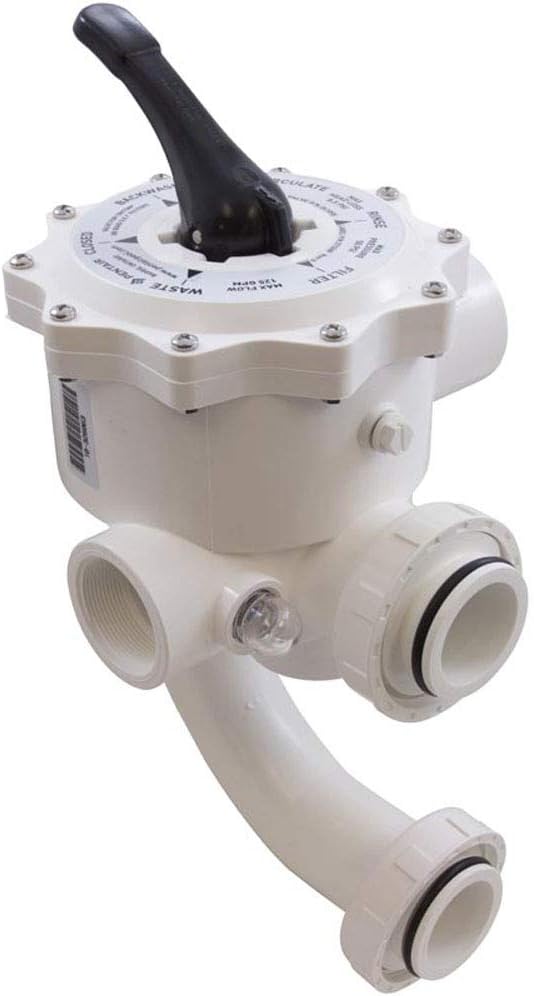
- 2-inch side-mount multiport valve
- 7½-inch filter-port centerline
- Pentair Triton and Quad D.E. family

- 1½-inch nominal valve size
- ABS body specified in listing
- Six-position sand-filter multiport

- Side-mount D.E. filter control valve
- 2-inch female-thread plumbing
- Six selectable valve positions

- 2-inch top-mounted sand-filter valve
- Six-position Vari-Flo control
- Clamp and O-ring identified with assembly

- 1½-inch female-thread side-mount valve
- Six settings for D.E. filtration
- Hayward XR50 flow configuration

- 2-inch threaded side-mount multiport
- 7½-inch filter-port centerline
- For Pentair FNS, FNS Plus, and NSP families

- Two-position push-pull configuration
- 2-inch D.E. filter plumbing
- Aftermarket SP0410X502S-compatible listing

- 1½-inch female-thread ports
- Top-mount sand-filter replacement format
- Six-way control described in listing

- 2-inch side-mount sand-filter valve
- Six-position Vari-Flo operation
- Gauge supplied with listed assembly

- 2-inch PVC socket connections
- Four operating positions for D.E. filters
- Side-mount Selecta-Flo configuration
What to Check Before Buying a Pool Backwash Valve
Sand, D.E., or cartridge filter
Sand and D.E. systems often use multiport or slide valves to reverse water flow during cleaning. Many cartridge-filter setups do not have a standard backwash cycle at all; cartridges are usually removed and cleaned according to their manufacturer’s instructions. A sand valve is not automatically suitable for a D.E. grid filter because the normal and reversed water paths can differ. Determine the actual filter media and find the model plate on the tank before choosing a valve.
Top-mounted or side-mounted tank connections
A top-mounted valve fits a tank opening at the top, typically using a specified neck, O-ring, standpipe, and clamp arrangement. Side-mounted valves have two filter connections along the tank side. These mounting systems are not interchangeable simply because the pump and waste pipes are the same diameter. Measure the centerline between side ports where applicable and compare the filter’s parts diagram before considering a replacement.
One-and-a-half-inch versus two-inch ports
Pipe-size labels describe nominal plumbing connections. A 1½-inch female-thread valve does not have an internal opening or outside measurement exactly 1½ inches across. The pipe-thread standard also differs from a two-inch slip or solvent-weld socket. Check whether the original has female pipe threads, glued PVC sockets, filter unions, or a proprietary connection. Replacing the correct part may avoid expensive and potentially stressful changes to existing rigid pipe.
Two, four, six, or seven settings
A slide valve may only move between FILTER and BACKWASH. Multiports offer separate paths for rinse, waste, recirculation, or closed operation, depending on the specific design. Hayward’s SP0740DE, for example, has four normal operating modes, while its top-mounted SP0714T is listed with seven positions. Extra choices are useful only if the filter and plumbing support them. Never equate a position count with compatibility or superior flow.
Original versus compatible replacement
Manufacturer-branded valves and aftermarket compatible versions can serve similar needs, but they should not be confused. Confirm exactly which seals, clamps, unions, and accessories arrive with the product. A part number in an aftermarket title can indicate what it is intended to replace, not who produced it. If a critical fit dimension or filter compatibility remains unclear, resolve it using a proper parts diagram or professional installer before ordering.
Hayward SP0714T Vari-Flo 1½-Inch Top-Mount Valve
- 1½-inch female-thread ports
- Top mounting for compatible sand filters
- Seven selectable valve positions
The SP0714T is the Hayward choice here for a sand filter with a top-mounted valve and 1½-inch plumbing. The handle selects seven positions, rather than simply switching between filtration and cleaning. That flexibility is valuable when the original system uses the valve for vacuum-to-waste, recirculation, or winter preparation as well as routine backwashing.
Fit comes before the seven positions
The defining specification is top mounting. The valve attaches at the upper opening of a compatible sand-filter tank, so it cannot replace a side-mounted assembly merely because the pipe diameter is the same. The tank neck, clamp system, standpipe engagement, and sealing arrangement must all match. Confirm the original valve part number and filter model, not just the wording on an online listing.
Ports, operating positions, and handling
Hayward lists the SP0714T with 1½-inch female iron pipe-thread connections and seven positions. The additional settings give the owner ways to bypass the filter or direct water to waste without changing external plumbing. The handle must be repositioned only after the pump is fully stopped. Forcing the handle while the pump is running can damage internal sealing surfaces and send flow along the wrong path.
What the physical design means
A lever and circular position dial make valve status visible at the equipment pad. The body is reinforced thermoplastic, not a metal pressure manifold. That is appropriate for the specified pool-filter application, but the plastic threaded outlets should not support long, unsupported plumbing runs. Use sound mounting and the thread-sealing method recommended for the specific connections to avoid stressing the ports.
Why the filter media distinction matters
Despite occasional product-title references to D.E. filters, Hayward’s technical specification identifies SP0714T as a sand-filter valve. Sand and diatomaceous-earth filters do not necessarily send water through the tank in the same direction. An apparently fitting valve with the wrong internal routing can cause improper operation. A D.E. pool filter deserves a manufacturer-approved D.E. valve instead.
Who should choose it
This is a strong candidate when the existing unit is an SP0714T or the filter manual explicitly calls for that part. Someone replacing an SP071620T with 2-inch connections should not downgrade to this model based on appearance. Likewise, an owner with a side-mount Hayward Pro Series tank needs the appropriate side-mount assembly rather than this top-mount design.
Pros
- Seven valve positions for a compatible sand-filter setup
- Top-mount format suits systems specified for SP0714T
- 1½-inch female-thread ports are clearly identified
- Provides bypass and waste-routing options
Cons
- Not an all-purpose D.E. filter valve
- Will not substitute for side-mount plumbing
- Tank-neck and clamp fit still require verification
Pentair 263064 7½-Inch-Centerline PVC Slide Valve
- Two-position push-pull operation
- 7½-inch port centerline
- Almond-colored PVC slide-valve body
Pentair 263064 trades the multiport dial for a push-pull mechanism that selects normal filtration or backwash. Its central purchasing detail is the 7½-inch centerline between filter connections. That measurement is especially important on side-mounted filter installations where both lines need to meet the tank without being forced out of alignment.
How a push-pull valve changes daily use
A slide valve is deliberately simpler than a six-position multiport. It moves a piston between two flow paths; the operator does not get an integrated waste, recirculate, or rinse selection. For a filter maintained with a straightforward filtration-and-backwash routine, fewer selectable modes can be convenient. Buyers who regularly vacuum directly to waste will need to consider how their overall plumbing provides that function.
The 7½-inch measurement is not optional
The stated centerline describes the separation between the two filter-side connections, not the overall width of the valve. Pentair identifies this model as a 7½-inch-centerline PVC push-pull valve in almond. A similar-looking slide valve with a different spacing can force major changes to the return and waste plumbing. Measure center-to-center on the current equipment and compare the original filter documentation.
Compatibility is more than a Pentair label
Pentair uses several valve bodies and unions across Triton, Quad D.E., and FNS families. The 263064 has a defined connection geometry, while different installations may need a particular union kit or adapter. Confirm the inlet and outlet orientation before replacing an older valve. The existence of another Pentair filter on the equipment pad does not, by itself, establish compatibility.
Seals, pressure relief, and upkeep
A piston-style valve relies on its internal seals remaining intact. Leaking to waste during filtration, stiffness, and seepage around the shaft are reasons to inspect the approved service parts. The system must be stopped and depressurized before adjustment or service. Depending on its age, replacing worn seals rather than the entire assembly could be the sensible repair, but only with the correct parts.
When a multiport is preferable
Choose a multiport if the system needs separate rinse or waste settings built into the valve. The Pentair 261055 and 261152 provide a different control concept for particular filter families, but they are not generic drop-in substitutes for this slide valve. This model is most useful when a two-position, 7½-inch slide valve is specifically what the installation calls for.
Pros
- Simple filter/backwash selection
- Defined 7½-inch centerline for fit comparison
- PVC construction and identifiable Pentair part number
- No multi-position dial to index
Cons
- No dedicated rinse, waste, or recirculate modes
- Wrong centerline can require plumbing alterations
- Seal wear can still lead to internal bypass
Hayward SP0710X62 1½-Inch Sand Valve with Gauge
- Side-mount configuration for sand filters
- 1½-inch female-thread plumbing
- Six positions; gauge specified
The Hayward SP0710X62 is a side-mounted Vari-Flo assembly made for the sand-filter branch of the Pro Series. It is easy to confuse with SP0710XR50 because the numbers nearly match. That final letter group matters: the X62 belongs to sand-filter installations, while the XR50 is the D.E. counterpart.
The side-mounted connection arrangement
Instead of entering through the top of the tank, the valve lines up with two connections on the side of the filter. It directs water through the sand bed during filtration and reverses the relevant path for backwashing. A replacement must match the tank’s upper and lower ports, union arrangement, and pipe spacing. The 1½-inch plumbing designation is only one part of this fit.
Six positions and the included gauge
Hayward’s specification identifies SP0710X62 as a six-position, 1½-inch female-thread side-mount valve for sand filters. The Amazon product is described as an assembly with gauge. A gauge can help owners track pressure relative to their filter’s clean operating baseline, but it cannot identify the correct valve on its own. Check that the full assembly and required union parts match what is being replaced.
Practical strengths during backwashing
A multiport handle supplies filter, backwash, rinse, recirculate, waste, and closed settings on this style of valve. The rinse stage is useful for a sand bed after backwashing, subject to the filter manual. Waste mode provides another route for water management, while recirculation bypasses the filtering media. These choices are useful only when connected to a correctly installed waste line.
What can go wrong in a replacement
Owners sometimes select an XR50 because the shell and handle appear almost identical. Internal porting differs by intended filter type; do not swap sand and D.E. versions. Another risk is treating the threaded pipe connection as proof that the two filter-side union ports align. Compare the complete model and installation diagram before breaking old joints.
Best buying scenario
Consider the SP0710X62 when repairing a compatible Hayward side-mount sand filter with 1½-inch piping and a matching existing valve. Those moving from a top-mounted S-series tank should use a top-mount selection. An owner with a D.E. filter should investigate the SP0710XR50 or another model explicitly listed in the applicable filter manual.
Pros
- Purpose-built side-mount sand-filter layout
- Six functional settings instead of two
- 1½-inch port size distinguishes it from larger X62 model
- Gauge included in the specified assembly
Cons
- Not appropriate for a D.E. filter requiring XR50 routing
- Side-port unions and spacing must match
- More internal parts than a two-position slide valve
Pentair 261055 2-Inch Triton/Quad D.E. Multiport Valve
- 2-inch side-mount multiport valve
- 7½-inch filter-port centerline
- Pentair Triton and Quad D.E. family
Pentair 261055 is one of the most important comparison points in this group because the same brand sells another 2-inch multiport, 261152, for a different filter family. The manufacturer specifies 261055 for Triton and Quad D.E. applications with a 7½-inch centerline. The differences concern internal water routing and the filter-side connections, not just naming.
Manufacturer-listed filter families
Pentair identifies this unit as a 2-inch multiport for Triton and Quad D.E. filters, marked SM 20-3. A side-mounted valve serves the upper and lower tank connections rather than seating into a top collar. Confirm the precise Triton generation or Quad model because equipment families can include several connection arrangements over time. The 7½-inch centerline is a measured requirement, not a broad compatibility guarantee.
What its six-mode design adds
The multiport design gives the operator different flow paths without changing valves or hoses. Filter and backwash handle routine circulation and cleaning; other settings are used for bypass, waste discharge, and service procedures when supported by the filter manual. This makes it more flexible than a two-position slide valve. The operator must still follow the filter-specific sequence and stop the pump before moving the handle.
Understanding the 2-inch plumbing
Two inches describes nominal pipe connection size, not a promise of any particular gallons-per-minute performance. Pump sizing, filter resistance, fittings, and pipe layout all affect the flow delivered. The larger ports may suit a system already plumbed in 2-inch pipe, but they do not justify converting the rest of the pad without evaluating hydraulics and equipment ratings.
The real difference from 261152
Both Pentair valves can be described as 2-inch, side-mounted, multiport, and 7½-inch centerline. Yet Pentair lists 261055 for Triton/Quad D.E. and 261152 for FNS/FNS Plus/NSP. Matching centerline and thread size does not settle internal direction through the tank. A wrong-family valve may connect physically while routing water incorrectly.
Who benefits most
This is appropriate for owners whose filter identification plate or manual specifies the 261055 connection family and whose plumbing allows the correct waste discharge. If the existing assembly is a 261152, do not choose this unit simply because the 261055 has the same exterior color and apparent spacing.
Pros
- Specific Triton and Quad D.E. application
- 2-inch side-mount format
- Documented 7½-inch centerline
- Multiport options beyond filter and backwash
Cons
- Not interchangeable with Pentair 261152 by size alone
- Takes more room and plumbing consideration than a top-mount valve
- Exact filter model verification remains necessary
Sta-Rite/Pentair 1½-Inch ABS Six-Position Sand Valve
- 1½-inch nominal valve size
- ABS body specified in listing
- Six-position sand-filter multiport
The Sta-Rite/Pentair ABS valve offers six-position control in a 1½-inch nominal size, intended for a matching sand-filter arrangement. Its title does not supply a unique manufacturer model number. Because Sta-Rite and Pentair have sold several multiport configurations, the filter’s exact identity matters more than the general brand name.
Why the missing model number matters
A listing that states only multiport valve, Sta-Rite/Pentair, sand filter, 1½-inch, ABS, and six positions leaves out decisive installation details. Mounting geometry and factory piping can differ even where the body looks similar. Check the engraved number on the old valve, the tank label, and any union or hose connections. Avoid ordering from a photo alone when the precise assembly reference is absent.
ABS construction versus PVC
The listed body material is ABS, while many other valves in this comparison use thermoplastic or PVC designs. That does not make one automatically stronger or more suitable for every pool. The material must be considered with the approved joining system, pressure conditions, and manufacturer guidance. Solvent-cement techniques specified for PVC should not be assumed correct for ABS components without explicit compatibility instructions.
Six functions are useful only with correct plumbing
A six-position multiport normally provides a usable route for backwash and separate filtration functions such as rinse or recirculation. The waste line needs an appropriate discharge destination, and the return and pump connections need to follow the marked ports. The dial cannot overcome crossed pipework. Before switching modes, stop the pump and wait until the equipment is no longer under operating pressure.
What to inspect before replacement
On an older Sta-Rite system, examine the condition of the unions, handle, lid, seal, and the direction of the side outlets. A leaking valve can be caused by worn gaskets or cracked fittings rather than a defective main body. If the original part is still identifiable, cross-reference that precise number against an official parts diagram instead of assuming the entire six-position series shares one geometry.
Best fit and main compromise
This is relevant to someone repairing an identified 1½-inch Sta-Rite/Pentair sand-filter installation and able to verify its mounting and connections. For anyone who cannot establish the underlying part number, a more explicitly identified replacement may be a safer purchase. The specifications in the listing describe the valve category well, but not every detail needed for a confident interchange.
Pros
- Six operating positions for a suitable sand system
- 1½-inch size clearly stated
- ABS construction identified
- Potential match for existing Sta-Rite equipment
Cons
- Listing lacks a unique replacement model number
- Connection geometry needs independent confirmation
- ABS joining requirements should not be assumed from PVC
Hayward SP0715XR50 2-Inch D.E. Vari-Flo Valve
- Side-mount D.E. filter control valve
- 2-inch female-thread plumbing
- Six selectable valve positions
Hayward SP0715XR50 is the 2-inch D.E.-filter member of the Vari-Flo side-mount group. It occupies a different role from the sand-filter SP0715X62, despite a very similar model string and external appearance. If a pool uses a compatible Hayward D.E. tank, choosing XR50 rather than X62 is a key step in matching the intended internal flow path.
D.E. routing is the defining feature
Diatomaceous-earth filters use grids and a precoat of filter media, so their cleaning cycle differs from a simple sand bed. Hayward’s specification lists SP0715XR50 for side-mounted D.E. filters with 2-inch female-thread pipe connections. Do not read its two-inch designation as evidence it suits every two-inch filter. Compare the filter body, upper/lower outlet locations, and approved valve reference.
Using a six-position multiport on D.E. equipment
A dial valve can send flow through the filter, reverse it for backwashing, route water to waste, or bypass the media in recirculation mode where the installation supports those functions. Following a D.E. backwash, the grids often require fresh media added as the filter maker directs. The valve does not remove the need to maintain the grids or follow the filter’s restart instructions.
Side-mount space and fittings
The valve and connecting lines occupy space beside the tank. They need room for the lever to travel and for the waste line to be routed safely. Valve orientation and pipe support matter because the molded ports should not carry the weight of rigid plumbing without supports. Owners rebuilding the pad should allow space for future union removal and gasket service.
How it compares with 1½-inch XR50
The smaller SP0710XR50 shares the D.E.-focused role but has 1½-inch nominal ports. That size difference can affect how much piping must be changed and whether the unit matches existing unions. Avoid using a reducer as a shortcut to fit a valve whose filter-side arrangement is wrong. Check the complete installation drawing before treating different sizes in one product family as interchangeable.
Who should consider another model
For a matching Hayward D.E. filter with 2-inch side connections, SP0715XR50 deserves consideration. A Pro Series side-mount sand tank calls for its X62 variant instead. An owner wanting only two settings on an approved D.E. filter can also investigate a compatible push-pull valve, such as the SP0410X502S type, depending on the filter and plumbing.
Pros
- Manufacturer-identified 2-inch D.E. application
- Six-mode control offers routing flexibility
- Side-mount configuration for approved filter tanks
- Clear distinction from similarly named sand model
Cons
- Not appropriate for sand filters calling for X62
- D.E. media replacement is still part of maintenance
- Valve-body size and union alignment can complicate retrofits
Hayward SP071620T 2-Inch Top-Mount Valve with Clamp
- 2-inch top-mounted sand-filter valve
- Six-position Vari-Flo control
- Clamp and O-ring identified with assembly
The SP071620T is built around the larger top-mount Hayward Pro Series sand-filter format. Its nominal 2-inch ports separate it from the SP0714T, and its listed clamp arrangement matters when the old assembly has to come off the tank. For a matching S310T or S360T configuration, it avoids choosing a loose valve body without the correct tank attachment hardware.
What is in this configuration
Specialist parts references identify SP071620T as a top-mount package combining the SP071621 2-inch valve with the appropriate clamp and O-ring. The clamp is not simply an accessory: it secures the valve to the tank neck and works with the seal. The correct collar profile and tightening sequence must match the filter manual. Never substitute an arbitrary clamp on pressure-bearing pool equipment.
Six main settings, not a universal seven-position replacement
Hayward’s specifications distinguish the 2-inch SP071621 top-mount valve as a six-position sand-filter unit. The smaller SP0714T is listed with seven positions. Retail pages may describe a separate winterizing handle location, but it should not be treated as another full operating flow mode without checking the dial and instructions. Buy for the required flow paths and fit, not a position-count headline alone.
Where the extra port size matters
Two-inch female-thread plumbing suits systems designed for that connection size. It can reduce the need to step down at a large existing discharge or return line, but flow still depends on the pump and filter design. Matching the tank neck is more important than preserving a pipe size with improvised reducers. If the original filter has a 1½-inch valve, confirm whether an official conversion is approved.
Installation and service access
The tank must be isolated and depressurized before the old clamp is removed. Carefully inspect the neck sealing surface for chips, debris, or distortion, and use the prescribed O-ring and fastening procedure. The top-mount body also needs sufficient clearance beneath pipes and equipment covers. Misaligned rigid pipe can stress the valve every time the pump starts or stops.
Right buyer
This option fits shoppers with a compatible Hayward top-mount sand-filter model and a documented 2-inch, clamped valve arrangement. The SP0715X62 is not an alternative for the same tank merely because both use 2-inch pipe: that model is side-mounted. Buyers with a D.E. filter need a separate, approved D.E. control valve.
Pros
- Includes tank-clamp approach for specified filters
- 2-inch ports suit appropriate larger plumbing
- Six functional selections for sand-filter operation
- Identifiable Hayward top-mount part number
Cons
- Not compatible with side-mount tank layouts
- Clamp profile and neck seal must be correct
- Not interchangeable with 1½-inch SP0714T by appearance
Hayward SP0710XR50 1½-Inch D.E. Vari-Flo Valve
- 1½-inch female-thread side-mount valve
- Six settings for D.E. filtration
- Hayward XR50 flow configuration
The SP0710XR50 is the smaller D.E. Vari-Flo option for certain Hayward side-mount filter installations. It is distinct from SP0710X62, the sand-filter control valve. That distinction is easy to miss while shopping because the product bodies, handles, and model numbers look so similar.
The difference hidden in XR50
Hayward’s product specification identifies SP0710XR50 with 1½-inch female-thread ports, side mounting, six positions, and D.E. filtration. The X62 model at this same nominal size is for sand. These are not alternate colors or package configurations of one universal valve. Internal flow paths determine how water travels through filter grids versus sand media, so the wrong valve can defeat correct filtration.
The advantages of a full multiport on D.E.
Unlike a two-position slide valve, the XR50 family has multiple selectable routes. Backwash expels collected material through the waste line, while waste mode can bypass the filter for specific pool-maintenance jobs when the system permits it. Recirculation offers a bypass return path. The exact cleaning order should always follow the D.E. filter’s instruction manual, including fresh media after backwashing.
One-and-a-half-inch ports and existing pipework
Replacing a valve on a system already plumbed for 1½-inch connections can avoid unnecessary changes. That does not prove every 1½-inch Hayward connection uses the same filter-side spacing. Examine unions and any threaded connections before removing the old assembly. Where older plumbing is brittle, forcing pipes toward a nearly aligned valve can create leaks away from the valve itself.
Maintaining the sealing surfaces
Internal diverter seals are a normal wear consideration with multiport assemblies. A persistent trickle out of the waste port while the handle is on FILTER deserves investigation, but it does not necessarily mean the whole valve body is defective. Compare parts diagrams for the exact model and shut off and relieve pressure before any cover or gasket service. Follow the manufacturer’s cautions regarding compressed springs.
Who should buy this exact part
Select SP0710XR50 for a confirmed compatible Hayward side-mount D.E. installation requiring 1½-inch ports. A larger two-inch D.E. system may call for SP0715XR50, while a sand-filter counterpart calls for X62. A buyer unable to identify the original valve should seek the tank model first, rather than relying on the port size.
Pros
- Clearly identified D.E. version at 1½-inch size
- Six selectable flow configurations
- Fits the role of some side-mount Hayward D.E. replacements
- Manufacturer model separates it from sand version
Cons
- Incorrect for a sand-filter X62 application
- Precise filter-side couplings still matter
- Gaskets and internal seals add maintenance needs
Pentair 261152 2-Inch FNS D.E. Multiport Valve
- 2-inch threaded side-mount multiport
- 7½-inch filter-port centerline
- For Pentair FNS, FNS Plus, and NSP families
Pentair 261152 is the companion to 261055, but for a different branch of Pentair filters. Manufacturer documentation identifies this as the 2-inch multiport with the FNS, FNS Plus, and NSP/related D.E. application. A shared port size and centerline with the 261055 do not make the two valves interchangeable.
Filter-family matching is decisive
Pentair labels this model SM 20-2 and lists a 7½-inch centerline. The other two-inch multiport, 261055, is designated SM 20-3 for Triton and Quad D.E. installations. These suffixes reflect a meaningful difference in intended plumbing and flow route. Before purchasing, read the filter’s identification plate and parts diagram rather than guessing which valve shares the visible shape.
Threaded connections and service layout
The 261152 is identified as a threaded two-inch side-mount multiport. Two-inch is nominal pipe size, not the measurement across the outside of the threaded port. Its two filter connections must fit the tank’s positions while the pump, return, and waste lines reach the correctly marked openings. When replacing an older unit, photograph and label every line before disassembly.
Operational choices for a D.E. owner
The positive-lock multiport arrangement supplies different water-routing modes. These can simplify backwashing, filter bypass, or certain pool-maintenance tasks without adding a separate set of manual valves. That convenience also creates the responsibility to choose the correct position before turning the pump on. Recharging D.E. after cleaning remains a filter-maintenance step rather than something the valve handles automatically.
How to judge a worn old valve
Leakage from the waste line during ordinary filtration, a damaged handle, or a valve cover that no longer seals can point toward replacement. Inspect filter pressure and the condition of connecting unions as part of the diagnosis. A malfunctioning spider gasket or diverter component may sometimes be serviceable, but purchase the specific authorized part after confirming the valve revision and service instructions.
Best-fit decision
If the installed Pentair D.E. filter uses the 261152 valve family and has the expected 7½-inch side-mount geometry, this is the appropriate model to examine. If the filter is a Triton or Quad D.E. model specified for SM 20-3, review 261055 instead. The manufacturer’s application chart should settle this choice before comparing prices or colors.
Pros
- Pentair-specified FNS/FNS Plus/NSP application
- Two-inch threaded connection format
- Documented 7½-inch centerline
- Multiport mode selection for compatible D.E. systems
Cons
- Not a universal replacement for 261055
- Wrong filter family can produce incorrect flow routing
- Thread and union alignment requires careful checking
SP0410X502S-Compatible 2-Inch D.E. Slide Valve
- Two-position push-pull configuration
- 2-inch D.E. filter plumbing
- Aftermarket SP0410X502S-compatible listing
This replacement is sold as compatible with Hayward SP0410X502S, a two-position slide-valve configuration used on specified Pro-Grid and Micro-Clear D.E. filters. The word compatible matters: the listing should not be treated as proof that the component is manufactured by Hayward. Its principal attraction is a direct filter/backwash mechanism rather than a multiport dial.
What SP0410X502S identifies
The Hayward part reference denotes a two-inch side-mount push-pull valve used on listed D.E. filter families. In that type of assembly, the handle moves a piston to reverse the required flow path during backwash. The compatible replacement must match the filter-side unions, overall geometry, shaft operation, and sealing interfaces. Compatibility language alone is not enough to verify a particular filter generation.
Two settings versus six
A slide valve normally gives the user FILTER and BACKWASH, with no integral recirculate or waste setting. That reduced control layout can make routine operation straightforward. It also means there is no multiport rinse position to select. A D.E. system still needs the manufacturer’s cleaning and precoat sequence; the valve cannot replace the filter’s media-recharging instructions.
Pay attention to replacement origin
An aftermarket unit can be a reasonable part when its dimensions, materials, seals, and fit have been confirmed for the tank. It should not be described as an original Hayward assembly without evidence from the listing. Review exactly what arrives, including unions and gaskets, because those details determine installation time and leak risk. A photo showing a complete valve does not automatically verify every attachment component.
Installation and ongoing inspection
The waste outlet must be supported and routed safely, and the filter-side connections should meet without twisting the valve body. Stop the pump and relieve pressure before changing positions or servicing the piston. After installation, observe the assembly for external leakage and unintended flow to waste in FILTER. Any leak or unexpected pressure behavior calls for shutdown and inspection rather than tightening parts under load.
Who it suits
This option makes sense for a pool with an existing SP0410X502S-type valve, a documented compatible D.E. tank, and a preference for basic push-pull control. Someone wanting multiple filter functions should choose a properly matched D.E. multiport instead. It is not a sensible shortcut for a sand-filter top-mount tank or for a Pentair valve requiring another centerline.
Pros
- Straightforward filter/backwash selection
- Designed around the recognized SP0410X502S replacement reference
- Two-inch D.E. slide-valve role
- Avoids an unnecessary multiport dial
Cons
- Aftermarket fit and supplied hardware must be confirmed
- No separate waste, rinse, or recirculate setting
- Not universal across D.E. brands or tank generations
Rx Clear SP0714T 1½-Inch Top-Mount Valve
- 1½-inch female-thread ports
- Top-mount sand-filter replacement format
- Six-way control described in listing
Rx Clear markets this SP0714T-named valve as a 1½-inch female-thread top-mount replacement for specified sand-filter systems. Although the part reference resembles Hayward’s SP0714T, the Rx Clear listing describes a six-way valve, while Hayward’s technical sheet lists seven positions for its own SP0714T. Those details should not be blended into one universal specification.
Treat the brand and configuration as separate
The Rx Clear product is presented with 1½-inch FIP ports and a top-mount body. The listing associates it with certain Hayward Pro and VL sand-filter applications, but the exact neck, clamp, standpipe connection, and dial marking must be checked before buying. Matching the general SP0714T-style designation is not enough to assume every version shares its internals and included parts.
What a six-way selection gives the owner
The listing identifies a six-way control concept, supplying several routes beyond ordinary FILTER and BACKWASH. Buyers should inspect the labeled positions on the supplied dial and follow its own instructions instead of copying the position chart from a different brand. Where an existing Hayward original has a winter-related position, verify whether the replacement has an equivalent approved service setting rather than assuming it automatically does.
Practical installation differences
Top-mount replacements often look compact until the original clamp is removed. The proper tank seal, clamp size, and standpipe height decide whether the assembly can seat correctly. Do not press or cut a standpipe merely to force an unverified valve onto a tank. The 1½-inch threaded ports must also match the existing fittings and maintain clear access to the waste outlet.
How this compares with Hayward SP0714T
Both products target similar nominal top-mount sand-filter plumbing and share a familiar model reference in the listing. The manufacturer identity, stated position count, and potentially supplied hardware distinguish them. For an installation where the filter maker requires a specific Hayward valve, use the approved compatibility information rather than treating the Rx Clear name as proof of identical performance or component dimensions.
Best buying situation
This is worth considering when its manufacturer-supported fitment matches the existing tank and the listed operating positions meet the owner’s needs. It is less suitable for someone who cannot confirm the clamp geometry or who needs a documented identical replacement for a seven-position Hayward configuration.
Pros
- Clearly specified 1½-inch top-mount format
- Offers multiway control rather than simple push-pull operation
- Potential option for identified compatible sand-filter tanks
Cons
- Listing’s six-way wording differs from Hayward SP0714T specification
- Exact tank-neck and standpipe fit must be verified
- Cannot assume identical hardware to a Hayward-branded valve
Hayward SP0715X62 2-Inch Sand Valve with Gauge
- 2-inch side-mount sand-filter valve
- Six-position Vari-Flo operation
- Gauge supplied with listed assembly
The Hayward SP0715X62 is the two-inch side-mount sand-filter model in this lineup. It is commonly associated with larger Hayward Pro Series configurations and should not be mistaken for SP0715XR50, the two-inch D.E. variant. The letter combination at the end of the model number is a practical compatibility detail, not an incidental code.
How the sand-filter layout is identified
Hayward’s official chart gives SP0715X62 a two-inch female-thread size, side mounting, six positions, and a sand-filter application. That definition is more useful than comparing valve photos. Some parts suppliers list particular Pro Series tanks with this preplumbed configuration; the buyer should still confirm the actual tank model and original plumbing. Side-mounted valves require the correct upper/lower connection alignment.
Why the included gauge is useful
The specific listing includes a gauge with the assembly. A working pressure gauge helps the pool owner recognize when the filter has moved away from its clean baseline, which can inform the filter’s maintenance procedure. It cannot diagnose every cause of poor circulation, and a replacement gauge is not a reason to buy the wrong valve. Follow the filter manual for cleaning triggers and permitted operating pressure.
Six positions on a larger sand filter
The valve lets the operator backwash, rinse, waste, recirculate, and use the normal filtering route, with a closed setting as specified for this valve family. Rinse helps settle a sand bed after backwashing. Recirculate can keep water moving without passing through the filter media. These modes are useful only when the waste, return, and pump connections are attached to their intended ports.
Plumbing space and common mistakes
Two-inch pipes are less forgiving of a misaligned valve because the assembled piping is relatively stiff. Supports and unions help avoid loading the plastic port bodies. An owner with SP0715XR50 should not buy X62 just because both show two-inch threads and a gauge. D.E. and sand filters can require different internal routing even when the external handles look alike.
Appropriate buyer
This is for an approved Hayward side-mount sand-filter arrangement with two-inch connections and matching plumbing. If the tank uses a top-mounted clamp, SP071620T is the relevant two-inch design to investigate. If the filter contains D.E. grids, investigate the XR50 family or another manufacturer-approved D.E. valve instead.
Pros
- Manufacturer-defined two-inch side-mount sand application
- Six useful operating modes
- Gauge listed as part of valve assembly
- Good comparison target for existing SP0715X62 replacements
Cons
- Wrong choice for an XR50 D.E. installation
- Not usable as a top-mounted filter valve
- Rigid two-inch plumbing can complicate alignment
Hayward SP0740DE 2-Inch Selecta-Flo D.E. Valve
- 2-inch PVC socket connections
- Four operating positions for D.E. filters
- Side-mount Selecta-Flo configuration
Hayward SP0740DE is a different multiport design from the Vari-Flo six-position family. It is a four-operating-position Selecta-Flo valve for specified D.E. filters, with two-inch PVC socket connections. Its fourth position is called pool or spa boost in Hayward’s manual, which circulates water while bypassing the filter; winterizing is a separate service handle placement, not a fifth normal operating route.
Four operating modes explained
Hayward defines FILTER, BACKWASH, WASTE, and POOL OR SPA BOOST as the operating positions. The boost function returns water without passing through the D.E. filter, corresponding to a bypass circulation path. That is not the same control layout as a conventional six-position valve with dedicated rinse and closed settings. Buyers should decide whether these four functions match the routine prescribed for their tank.
The socket connection changes installation
The SP0740DE specification lists two-inch SKT connections. A socket is intended for compatible rigid PVC pipe assembled with appropriate solvent cement, not for screwing onto a male NPT fitting. Someone replacing a threaded Vari-Flo should therefore not assume a direct connection. Solvent-welded lines can make removal more involved, so plan the service and coupling layout before cutting anything.
D.E. filter applications
Manufacturer and pool-parts references identify this Selecta-Flo design with certain Pro-Grid and Micro-Clear D.E. filter setups. Confirm the full filter model, plumbing diagram, and correct connection arrangement. The fact that another D.E. valve has two-inch pipe ports does not demonstrate identical flow direction or physical geometry. This model should be chosen by its application chart, not by pipe size alone.
Winterizing and operation precautions
Hayward documents a winterizing handle placement between detents for draining and winter service. It is not a normal pumped circulation setting. Turn the pump off before moving between positions and follow the equipment-specific instructions for isolation and pressure release. After backwashing a D.E. filter, add fresh D.E. media according to the filter manual rather than assuming a separate rinse position is necessary.
Who should select it
The SP0740DE makes sense for an existing approved four-way Selecta-Flo installation with two-inch solvent-socket plumbing. Someone replacing a six-position Hayward XR50 needs to verify a manufacturer-approved conversion rather than simply substituting the four-way model. If the plumbing uses threaded ports or a sand-filter tank, this is not the appropriate direct replacement.
Pros
- Manufacturer-documented four operating functions
- Specified two-inch PVC socket format
- D.E.-oriented side-mount design
- Pool/spa boost provides bypass circulation option
Cons
- No separate conventional rinse or closed operating selection
- PVC socket installation differs from threaded valves
- Not interchangeable with a six-position Vari-Flo by size alone
Detailed Buying Guide: Valve Types, Connections, and Maintenance
Start with the tank identification plate
The most reliable way to find a replacement is to trace the valve from the filter model. Start by recording the complete name and any revision or serial information on the tank label. Next, check the owner’s manual and parts drawing for the valve assembly. Those references reveal whether the manufacturer specifies sand routing, D.E. routing, top mounting, or a particular side-mount package. A shared valve brand across two filter models does not make their valves interchangeable.
If a label is faded, photograph the filter’s distinctive connections and seek assistance from the manufacturer or an experienced pool technician. Use the old valve’s molded part number when visible, but verify it against the tank. A previous owner may have installed the wrong assembly, and a visually similar aftermarket part can carry a cross-reference rather than the original manufacturer’s number. The goal is to establish compatibility independently of a sales title.
Measure centerline spacing on a side-mount filter
Centerline spacing is the distance between the central axes of the two connections that enter the filter. This is not the edge-to-edge gap between two pipe walls. Pentair’s 261055, 261152, and 263064 are all described around a 7½-inch centerline, but they remain separate products with different application details. Two units can align at the same measured points and still route water through the filter differently.
Make measurements with the pump stopped and equipment safe to access. Compare the existing upper and lower unions, their thread forms, and the orientation of the pump and return ports. Include room for gaskets and union collars in the plan. If the old assembly has been modified with glued offsets, its overall dimensions may not represent the original factory configuration. A replacement should meet connections naturally, without using the pipe as a lever.
Understand top-mount necks, standpipes, and clamps
Top-mounted sand-filter valves typically seal onto the upper tank opening and engage a vertical standpipe connected to the filter internals. Tank-neck diameter, standpipe fit, clamp profile, and the sealing gasket must agree. The SP0714T and SP071620T are both Hayward top-mount examples, but their nominal plumbing sizes and specified configurations differ. A valve sitting on the tank does not prove it has properly engaged the standpipe or sealed the neck.
Before removing a clamped valve, isolate the equipment and completely relieve system pressure under the manufacturer’s procedure. Inspect seating surfaces, O-rings, and any damage to the tank lip. Reuse hardware only if the maker explicitly permits it and it is undamaged. Never bypass a missing retaining clamp or improvise a seal on a pressurized filter. If the standpipe must be cut or forced to make the new unit fit, confirm the conversion with the filter manufacturer first.
Know threaded ports, socket ports, and unions
A female NPT/FIP connection accepts a compatible male pipe-thread fitting, while a PVC socket or SKT connection accepts designated pipe for a solvent-cement joint. They are different connection types. Hayward SP0740DE uses two-inch socket connections, whereas models such as SP0715XR50 are specified with two-inch female-thread ports. Pentair preplumbed side-mount units also require the correct filter-side joining details, which are not determined by nominal pipe size alone.
Improvised adapters add length, leverage, and extra sealing interfaces. If an adapter is manufacturer-approved, support the surrounding plumbing and observe the specific joining procedure. Thread sealants suitable for one plastic fitting may not be approved for another, and overtightened threaded joints can split plastic ports. A rigid solvent-welded connection may be permanent enough that later valve service requires cutting pipe; plan accessible unions where appropriate.
Match valve routing to sand or D.E. media
Sand filters clean by trapping material in a granular bed and often use a backwash stage followed by rinse. D.E. filters use grids or other structures coated with fine diatomaceous-earth media. After a D.E. filter is backwashed, its manual normally describes restoring the required amount of D.E. through the pool system. The valve’s role is directing water, not replacing filter material. Using a sand-filter valve on a D.E. tank may route water the wrong way.
This is why the Hayward SP0715X62 and SP0715XR50 should be treated as different products despite their shared family and two-inch size. Likewise, Pentair identifies 261055 for Triton/Quad D.E. applications and 261152 for FNS/NSP family applications. Each case requires the correct manufacturer schematic. Do not purchase based on the word high-flow alone; a large opening does not make a valve universal.
Choose between multiport and push-pull control
A multiport valve generally offers a lever that indexes several operating modes. Owners may use FILTER for normal circulation, BACKWASH to reverse cleaning flow, RINSE where specified, WASTE to bypass filtration while draining, and RECIRCULATE to move water around the media. Some models also provide a CLOSED position or a separate winterizing handle location. The actual functions are shown by the particular valve’s dial and manual, not by a general online chart.
A push-pull valve instead selects between two principal paths. It can suit a straightforward backwash arrangement and removes the decision about which multiport notch to choose. The tradeoff is losing the extra bypass modes unless the plumbing supplies them separately. Neither design is inherently best for every pool. Existing filter requirements, maintenance routine, ability to send water safely to waste, and service access should determine the selection.
Plan waste-water discharge before installing
Backwashing sends a significant amount of water out of the normal pool return circuit. The waste outlet must connect to suitable piping or hose leading to a lawful and practical discharge area. Avoid routing water toward building foundations, electrical equipment, neighboring properties, or areas where erosion or flooding could occur. Local rules differ, especially for chemically treated pool water and D.E. discharge. The correct valve does not excuse an unsafe or prohibited waste arrangement.
Before running BACKWASH, inspect the path for closed shutoff valves, kinks, a plugged hose, or unsupported connections. A flattened backwash hose can restrict discharge and stress fittings. Keep people clear of the open hose end, and do not disconnect fittings while the pump is running. Follow the filter manufacturer’s specified backwash duration and sequence rather than assuming all valves need the same cycle.
Watch gauge readings and signs of internal bypass
A filter pressure gauge becomes most useful after the system’s clean operating pressure is recorded. As the filter collects debris, pressure may change, but a falling flow rate can also be related to clogged baskets, pump issues, or suction restrictions. A gauge should be read in the context of the equipment manual rather than used as a single diagnostic answer. Some replacement valve listings include a gauge, while others do not.
Water escaping the waste outlet in FILTER can indicate a failed spider gasket, damaged diverter, or other internal sealing problem. Stiff handles, cracks at a port, or a leaking shaft seal deserve attention before the next cleaning cycle. Shut down the system and relieve pressure before examining parts. Where the manufacturer offers a compatible gasket kit, a targeted repair may be possible; otherwise the valve or body may need replacement.
Consider long-term parts and service access
Replacement seals, handles, diverters, sight glasses, and gauge fittings are easier to identify when the valve has an exact model number. Owners with older equipment should check whether their valve revision still has supported service parts. A lower-cost generic replacement can lose its value if gaskets or clamps are unavailable after installation. On the other hand, replacing an entire factory assembly is not necessary when an approved inexpensive service part fixes a straightforward defect.
Allow space to remove union collars, lift a top-mount valve vertically, or draw a slide-valve piston out for service. Avoid burying valve bodies behind permanent pipework. Photograph the direction of every line and the original handle position before work starts. If the filter uses an unusual union or requires opening a pressurized tank connection, professional assistance is usually more practical than experimenting with fittings.
Direct Pool Backwash Valve Comparisons
Hayward SP0714T vs SP071620T
These are both top-mounted sand-filter valves, but they address different nominal port sizes and configuration details. Hayward lists SP0714T with 1½-inch FIP ports and seven positions. The SP071620T package is built around a 2-inch, six-position top-mount valve and a specified clamp/O-ring set. Start with the tank model and mount hardware, then verify the required port size. Do not choose either solely because a circular handle looks familiar.
Hayward SP0710X62 vs SP0710XR50
Both are 1½-inch side-mounted Vari-Flo models, but X62 is listed for sand filtration and XR50 for D.E. They are not interchangeable routing assemblies. A shared nominal connection size is not sufficient to overcome the wrong filter-media designation. The correct choice follows the tank’s media type and manufacturer documentation rather than the appearance of the black molded housing.
Hayward SP0715X62 vs SP0715XR50
This is the same sand-versus-D.E. split in the two-inch side-mount range. SP0715X62 serves sand filters while SP0715XR50 serves D.E. filters. Both have six positions and two-inch female-thread plumbing in Hayward’s specification, which makes them easy to confuse. The key is the flow configuration and filter family, followed by the mounting unions and pipe alignment.
Pentair 261055 vs Pentair 261152
Pentair lists both as two-inch multiport valves with a 7½-inch centerline, but they serve separate filter families. The 261055 is associated with Triton/Quad D.E. while 261152 is associated with FNS/FNS Plus/NSP. This is a case where identical-looking specifications still do not establish interchangeability. Treat the model-family code as a necessary check before buying.
Pentair 263064 vs SP0410X502S-compatible slide valve
Both options use push-pull control rather than a position dial. However, Pentair 263064 is a specifically identified 7½-inch-centerline PVC valve, while SP0410X502S describes a Hayward-compatible two-inch D.E. slide-valve format. They cannot be selected simply as two comparable two-inch slide valves. Filter-side union geometry, original model, and approved application determine which belongs on a given tank.
Hayward SP0740DE vs Hayward SP0715XR50
Both serve certain D.E. contexts but differ in control layout and joining method. SP0740DE has four normal operating positions and two-inch PVC socket connections, with an explicit pool/spa boost bypass mode. SP0715XR50 is a six-position Vari-Flo with two-inch female-thread ports. Choosing between them can require different piping work and operating procedures; neither should be called a generic upgrade for the other.
Rx Clear SP0714T vs Hayward SP0714T
Both listings describe a 1½-inch top-mounted sand-filter valve format, and the repeated SP0714T reference invites comparison. Yet the Rx Clear listing advertises six-way operation, whereas Hayward’s technical chart states seven positions for its SP0714T. Their tank fit and supplied mounting components must be checked independently. Select a compatible replacement by full identification and documented function, not by sharing a familiar number.
Common Mistakes When Replacing a Backwash Valve
Matching the pipe size but ignoring the filter
A two-inch valve can have correct-looking threads and still be wrong for the internal filter flow path. Some Hayward sand and D.E. valves differ by only a few characters at the end of the model number. Pentair also separates otherwise similar products by filter family. Confirm both the media and the exact tank application before assessing fit.
Confusing a top-mounted valve with a side-mounted one
A top mount sits in the tank neck; a side mount connects to two tank-side openings. They need different physical interfaces and sometimes different flow layouts. Adding pipe elbows does not transform one into the other. Start by identifying which mounting system is already installed.
Treating winterizing as a normal pumping mode
Certain valves have a handle position used when draining and winterizing the equipment. That does not automatically function as a normal operating flow path, nor should the pump be switched on there. Refer to the manufacturer’s individual position diagram and winterization procedure.
Assuming the package includes every fitting
Some listings describe a complete valve assembly with clamp and O-ring, while others specify only the valve body or a replacement with certain connectors. A gauge in the title does not prove that all required tank unions and mounting parts are included. Confirm the exact package contents against the old installation before removing serviceable parts.
Moving the handle before shutting off the pump
Pressurized flow loads internal seals and diverters. Switching a multiport under power can damage the gasket and send water into an unintended path; disturbing a slide valve or connection during operation can also be hazardous. Stop the pump and follow the manufacturer’s isolation and pressure-relief sequence before changing positions or opening equipment.
Ignoring what happens after D.E. backwashing
Backwashing a D.E. filter removes material that includes its D.E. coating. Returning directly to ordinary filtration without following the specified recharge procedure can leave grids without the proper precoat. Use the actual filter model’s instructions for media quantity and handling, not a sand-filter rinse routine borrowed from a different valve.
Frequently Asked Questions
What does a pool backwash valve do?
It directs water through a filter during ordinary circulation and, on suitable sand or D.E. systems, provides a reverse or alternate flow route to flush collected debris to a waste outlet. Some multiport valves also have settings to bypass filtration, drain water, or rinse media. The exact routes depend on the valve model and filter type.
Are pool backwash valves universal?
No. Valve compatibility depends on tank model, filter media, mounting style, centerline dimensions, union arrangement, internal water routing, and pipe connections. Two products with the same nominal size may serve different filters. Find the approved manufacturer part before selecting a replacement.
What is the difference between a multiport and a slide valve?
A multiport uses a rotating selector to provide several defined water paths, typically including filter and backwash plus other modes. A slide or push-pull valve generally offers only filter and backwash. The simpler control can suit some filter setups, but it does not replace the extra functions of a multiport.
Can a sand-filter valve work on a D.E. filter?
Do not assume so. Some valves that appear identical externally have separate internal routing for sand and D.E. filtration. For example, Hayward distinguishes X62 sand versions from XR50 D.E. versions. Use the filter manufacturer’s specified valve rather than switching between them based on port size.
How do I know if my valve uses 1½-inch or 2-inch connections?
Read the original valve’s model specification and inspect the marked connection type. The labels generally refer to nominal pipe size; measuring the outside of a threaded port with a ruler can produce a different number. If the port is a proprietary filter union, the union specification must also be verified.
What does a 7½-inch centerline mean?
It is the distance between the axes of the two connections on a side-mounted filter assembly. It does not describe valve height or the open space between pipes. Pentair uses this measurement on several products, but a matching centerline alone does not establish the correct internal valve routing.
Can I replace a six-position valve with a seven-position one?
Only when the manufacturer supports the replacement on the particular filter and its connections. Different position counts can indicate a different operating layout, tank application, or winterizing arrangement. A physically similar valve with more modes is not automatically an upgrade.
Should water come out of the waste pipe on FILTER?
During normal filter operation, the waste line should not continuously discharge unless the system has a separate intended flow configuration. Unexpected flow can point to valve sealing problems, incorrect handle indexing, or plumbing faults. Shut the system down and diagnose it using the valve manual.
Do I need to add D.E. after using BACKWASH?
For conventional D.E. grid filters, the cleaning procedure generally requires adding fresh D.E. to restore the media coating. The amount and process must follow the exact filter manual. Sand-filter cleaning procedures differ and should not be copied over to a D.E. system.
Is a 2-inch valve always better than a 1½-inch valve?
No. The correct pipe size is the one specified for the installed filter and plumbing. A larger nominal port cannot correct mismatched tank connections or inappropriate water routing. Flow performance also depends on the entire pump, filter, and pipe system rather than the valve opening alone.
How can I choose between an original and an aftermarket valve?
First establish that the proposed assembly is approved or demonstrably compatible with the exact filter model, including its unions, seals, and port layout. Then compare the supplied hardware, service documentation, warranty terms, and availability of replacement parts. Do not assume an aftermarket listing bearing an original part number is made by that original manufacturer.
Can I move the valve handle while the pump is on?
No. Turn off the pump before changing valve positions and follow the manufacturer’s pressure-relief and service instructions. This protects the internal seals and reduces the risk of an unexpected pressurized flow path. Never open a clamp, lid, or union while the system is pressurized.
Final Buying Considerations for Pool Backwash Valves
The best pool backwash valve is the one specified for the tank you already own. For top-mounted Hayward sand filters, compare SP0714T and SP071620T only after checking tank neck, clamp arrangement, nominal ports, and position requirements. For side-mounted Hayward installations, identify the sand X62 versions separately from the D.E. XR50 versions. These differences determine whether water follows the correct route through the filter.
Pentair 261055 and 261152 illustrate why matching a two-inch connection and 7½-inch centerline is not enough: they serve distinct filter families. The Pentair 263064 and SP0410X502S-compatible slide valve suit different push-pull arrangements, while the Hayward SP0740DE serves a particular four-way D.E. layout. The Sta-Rite/Pentair ABS valve and Rx Clear SP0714T warrant especially careful identity and mounting checks where the listing does not settle every fitment detail.
Before purchasing, record the filter model and old valve part number, verify how the connections are mounted and joined, and review the operating instructions. A correctly identified assembly, properly supported pipes, serviceable seals, and a safe waste discharge line matter more than a longer features list. If the tank or valve identification is incomplete, confirm the parts drawing with a pool-equipment professional before installing a replacement.
Author