A pool cover thickness chart is most useful when it starts with one distinction: not every pool cover is measured or judged in the same way. Bubble-style solar covers are commonly sold by thickness in mils, while winter tarps are often better compared by woven scrim, material weight, coating and seam construction. Safety covers are judged by structural performance, anchoring and certification, not simply by how many mils of material they contain.
For solar covers, the familiar 8 mil, 12 mil and 16 mil labels describe the nominal thickness of the plastic sheet. In general, moving to a thicker version of the same basic construction adds material and usually adds durability, but it also makes a large cover heavier and less convenient to move by hand. Thickness alone does not tell you how safely a cover performs, how well it fits, how much sunlight it transmits, or how long it will last in a particular climate.

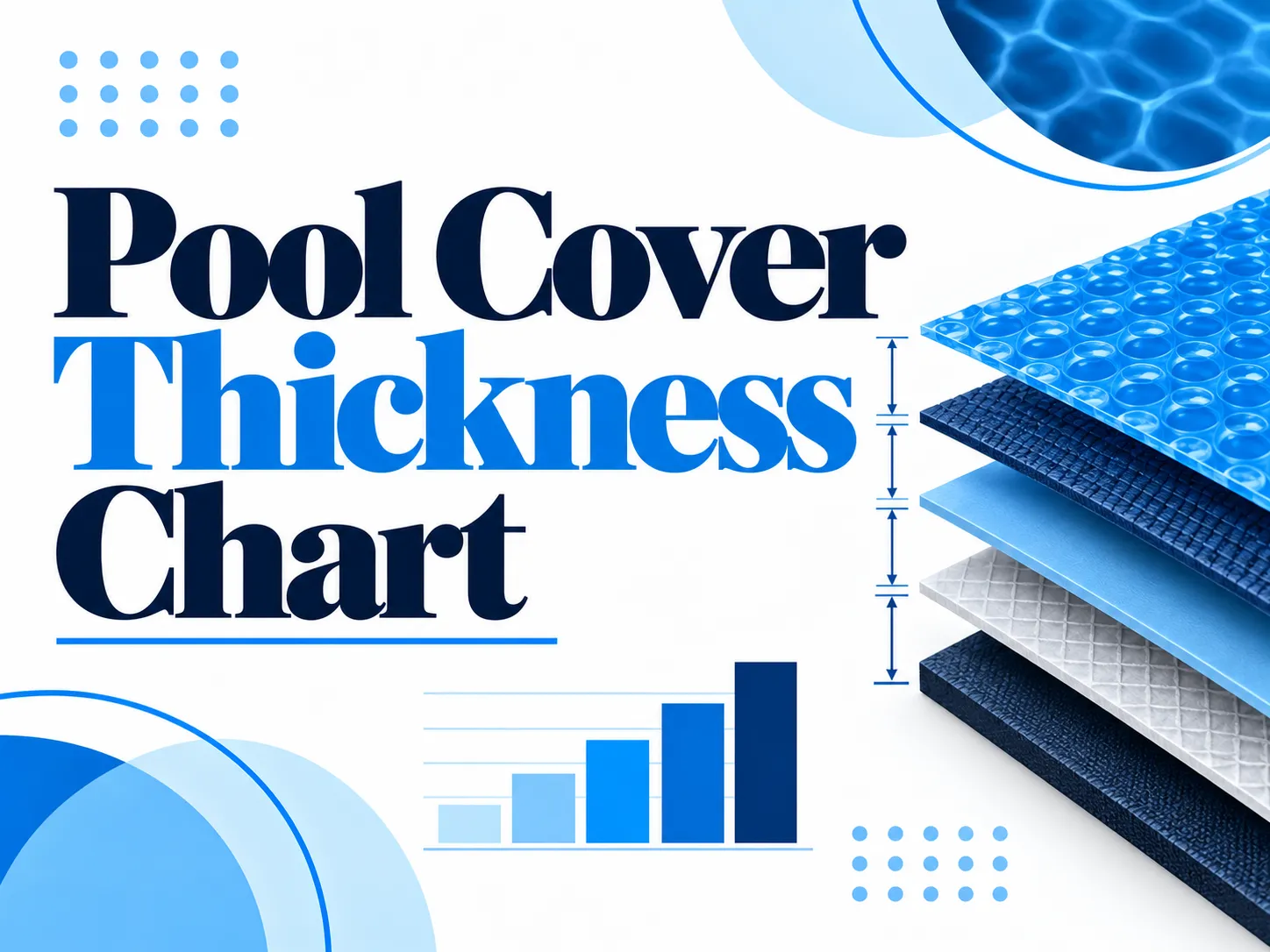
Pool Cover Thickness Chart
The chart below is aimed mainly at bubble-style solar pool covers, because that is the cover category in which mil thickness is commonly used as a primary shopping specification. The metric conversions are exact calculations based on the U.S. National Institute of Standards and Technology definition that 1 mil equals 0.001 inch, or 0.0254 millimeter.
| Thickness | Metric equivalent | Relative handling | Practical interpretation |
|---|---|---|---|
| 8 mil | 0.2032 mm / 203.2 µm | Lighter | Common thin solar-cover class; easier to move on larger pools, with less material than thicker versions. |
| 10 mil | 0.2540 mm / 254 µm | Light to medium | Intermediate size offered by some manufacturers; compare construction and warranty rather than assuming it matches every other 10 mil cover. |
| 12 mil | 0.3048 mm / 304.8 µm | Medium | Widely sold middle thickness that adds material without reaching the handling weight of the thickest common solar covers. |
| 14 mil | 0.3556 mm / 355.6 µm | Medium to heavy | Less universal than 8, 12 and 16 mil, but useful as an in-between specification where available. |
| 16 mil | 0.4064 mm / 406.4 µm | Heavier | Common thick solar-cover class; generally more substantial but more demanding to move, especially on a large pool without a reel. |
Those handling descriptions are relative, not weight ratings. Two covers with the same nominal mil thickness can still feel different because bubble geometry, sheet formulation, reinforcing layers, dimensions and moisture all affect the finished cover. A listed thickness is therefore one useful specification, not a complete quality score.
What Does “Mil” Mean on a Pool Cover?
The word mil creates confusion because it looks like “mm”, but the two units are very different. An 8 mil solar cover is not 8 millimeters thick. It is only 0.2032 mm thick. A 16 mil cover is 0.4064 mm thick. In countries where cover material is advertised in microns, a 400-micron solar blanket is therefore close to 15.75 mil.
This conversion matters when comparing international listings. A seller may describe one cover as 16 mil while another uses 400 microns. Those numbers are close enough to indicate a similar nominal sheet thickness, but they still do not prove identical materials, bubble design, UV stabilization or service life.
Nominal thickness is not the whole construction
Pool-cover thickness is usually a nominal product specification. Manufacturing tolerances, the point at which a textured material is measured and the way a multilayer fabric is built can all matter. This is especially important once you move beyond a simple bubble blanket and begin comparing woven, laminated or coated fabrics.
If two covers have the same mil rating but one uses a different resin, stronger seam construction or a reinforced base fabric, the performance may not be the same. For that reason, compare thickness only within a similar cover category and preferably within products that describe their construction clearly.
Why the Type of Pool Cover Matters More Than the Number Alone
The phrase “pool cover” includes several products that do different jobs. Some float directly on the water to reduce evaporation. Some are stretched or anchored over the pool for off-season debris control. Others are engineered as safety systems. The thickness figure means something different in each case.
| Cover type | Typical construction | Specs that matter most | How to use thickness |
|---|---|---|---|
| Solar / bubble cover | Flexible plastic sheet with air bubbles | Mil or micron thickness, bubble design, optical properties, fit and UV resistance | Useful for comparing similar solar blankets; common retail classes include 8, 12 and 16 mil. |
| Basic winter tarp | Woven polyethylene or similar coated fabric | Scrim count, fabric weight, coating, seams, overlap and tie-down method | Secondary specification; do not choose from mil alone. |
| Mesh safety cover | Woven mesh with straps, anchors and hardware | Certified performance, tensile/burst properties, webbing, anchors, drainage and UV resistance | Not a stand-alone safety measure. |
| Solid manual safety cover | Reinforced solid fabric with straps and anchors | Certified system performance, reinforcement, drainage provisions, anchoring and installation | Compare only within similar reinforced constructions. |
| Automatic safety cover | Reinforced coated or laminated fabric running in tracks | System certification, fabric construction, tracks, drive system, installation and maintenance | One fabric specification among several; it does not establish safety by itself. |
That distinction prevents a common comparison error. A 16 mil bubble blanket and a roughly 20 mil reinforced automatic-cover fabric may sound close numerically, but they are completely different structures intended for different tasks. One should not be treated as an alternative to the other simply because the thickness numbers appear similar.
8 Mil vs 12 Mil vs 16 Mil Solar Pool Covers
Large pool-supply catalogs commonly group solar covers into 8 mil, 12 mil and 16 mil classes. That makes these three sizes the most useful reference points for a solar pool cover thickness chart. The practical differences are mainly the amount of material, ease of handling and the durability you may expect when the products use comparable materials and construction.
8 mil: easier handling with less material
An 8 mil cover is the thinnest of the three common classes. Its main practical advantage is handling. On a broad water surface, every extra layer of material contributes to the total mass you must pull, fold or reel. If a cover is awkward enough that it rarely gets used, the benefit of buying extra thickness is largely lost.
The trade-off is that an 8 mil cover contains less material than an otherwise comparable 12 or 16 mil version. It may therefore be less tolerant of abrasion, rough handling and long UV exposure. That is a general material comparison, not a guarantee of a particular lifespan; storage, chemistry, sunlight and manufacturing quality can change the result substantially.
12 mil: a common middle specification
A 12 mil cover is 50% thicker than an 8 mil sheet by nominal thickness. That does not mean it will last exactly 50% longer or retain exactly 50% more heat. Durability and thermal behaviour do not scale so simply. What the number does tell you is that, within a similar product family, there is more plastic material in the sheet.
For many pool owners, 12 mil is attractive because it sits between very light handling and the extra bulk of 16 mil. The decision becomes more dependent on pool area than the label alone. A medium-thickness cover on a large pool can still be cumbersome if there is no reel or practical storage point.
16 mil: more substantial, but heavier
A 16 mil solar cover is twice the nominal thickness of an 8 mil cover. If the materials and bubble geometry are otherwise comparable, it is reasonable to expect a more substantial sheet and greater resistance to ordinary wear. The disadvantage is equally straightforward: the finished cover will usually be heavier and bulkier.
On a small pool, that added weight may be insignificant. On a wide or long pool, it can determine whether one person can remove the cover conveniently. A reel changes the calculation because it supports the cover and reduces the need to drag or fold a large wet sheet by hand.
What about 10 mil and 14 mil?
They are legitimate intermediate sizes, but they are less universal across brands. Treat them as points on the same continuum rather than as separate technologies. A 10 mil cover sits between 8 and 12 mil in nominal material thickness, while 14 mil sits between 12 and 16 mil.
If a 14 mil cover has stronger seams, better UV stabilization or a more suitable bubble design than a competing 16 mil product, there is no technical reason to assume the 16 mil option must be superior in every respect. The same applies to 10 mil versus 12 mil.
Does a Thicker Pool Cover Retain More Heat?
Thickness can affect thermal behaviour, but it should not be treated as a direct thermometer reading. The largest energy-saving role of many pool covers comes from limiting evaporation at the water surface. The U.S. Environmental Protection Agency states that pool covers can prevent up to 95% of pool-water evaporation when used appropriately. EPA also notes that covers can help retain heat and reduce the need for make-up water.
For evaporation control, continuous coverage matters enormously. A thin cover that fully covers the pool and is used consistently can be more useful than a thick cover that is frequently left rolled up because it is difficult to handle. Gaps around stairs, steps or unusual shapes also leave exposed water surface where evaporation can continue.
Solar heating is more complicated than “thicker equals warmer”. A solar blanket can reduce evaporation and nighttime heat loss, but its color, transparency and optical properties also affect how solar radiation passes through or is absorbed by the cover. Peer-reviewed research on solar pool-cover light transmission shows that heating performance depends on both solar energy entering the pool and heat losses being suppressed, so thickness should be read alongside material and optical properties rather than in isolation.
If your main goal is heat retention, compare the cover’s intended use, transparency, construction and fit first. Use mil thickness as a durability and handling clue, not as a promise of a specific temperature increase.
How Thickness Affects Durability and Daily Handling
More material can improve resistance to wear
Within the same material family, a thicker film generally has more material available to resist small punctures, stretching and abrasion. That is one reason thicker solar covers are often positioned as longer-life options. However, real-world ageing is also driven by ultraviolet exposure, pool chemistry, temperature, mechanical damage and how the cover is stored when it is off the water.
A thick cover can still fail early if it is dragged across rough coping, left exposed to intense sun while folded, or repeatedly stressed at the same edge. Likewise, a thinner cover that is reeled smoothly, rinsed when necessary and protected during storage may remain serviceable longer than a thicker cover that is handled roughly.
Pool size magnifies handling differences
Thickness is measured through the sheet, but the user handles the entire surface area. A small increase in material per square metre becomes more noticeable as the cover gets larger. That is why the “best” thickness for a compact above-ground pool may not be the most practical thickness for a long in-ground pool.
Before choosing a thick solar blanket, picture how it will be removed on an ordinary day. If it must be pulled by one person, folded over irregular coping and carried to storage, lower weight may be more valuable than maximum material thickness. If a properly sized reel is already installed, thicker material becomes easier to manage.
Storage affects lifespan as much as the label suggests
Solar-cover material continues to receive heat and UV exposure when it is rolled or folded beside the pool. Follow the manufacturer’s storage instructions, especially around direct sunlight and heat. Avoid placing sharp tools, furniture or heavy objects on a folded cover, and do not assume a larger mil number makes poor storage harmless.
How to Choose a Solar Pool Cover Thickness
The most useful choice comes from matching the thickness to how the cover will actually be used. Instead of asking which mil is “best” in general, work through the practical constraints of your pool.
- Start with pool dimensions. Larger surface area makes every cover harder to handle. The effect becomes more noticeable as thickness increases.
- Decide whether you will use a reel. A reel can make a heavier cover practical and reduces dragging over the deck or coping.
- Consider how often the cover will move. A cover used every day needs to be convenient enough that you will actually deploy it consistently.
- Check local sun and exposure. Strong UV, wind and long outdoor seasons increase material stress, although thickness is only one part of weather resistance.
- Look at the whole construction. Bubble shape, resin formulation, seams, edge treatment and UV stabilization can matter alongside mil thickness.
- Compare the manufacturer’s warranty terms carefully. Warranty length is not the same as expected service life, and exclusions for chemistry, handling or damage can be important.
- Choose fit before excess thickness. A properly sized cover that covers the water surface is more useful for evaporation control than a thicker sheet with large uncovered areas.
For a simple rule of thumb, 8 mil prioritizes easier handling, 12 mil sits in the middle, and 16 mil prioritizes a more substantial sheet when the added weight is acceptable. That is a practical interpretation, not a universal ranking.
Safety Pool Covers: Thickness Is Not the Safety Rating
This is the most important limitation of any pool cover thickness chart. A child-safety or fall-protection claim cannot be inferred from 8, 12, 16, 20 or any other number of mils.
In the United States, ASTM F1346-23 is the active standard covering performance and labeling requirements for safety covers for swimming pools, spas, hot tubs and wading pools. Its purpose is to reduce drowning risk by inhibiting access to the water by children under five when a compliant cover is correctly installed and used according to the manufacturer’s instructions.
That is a system-level requirement. Cover fabric, openings, drainage, anchoring, operating controls and installation can all affect safety performance. A material can be physically thick yet still be unsuitable as a safety barrier if the complete system is not designed and tested for that use.
The U.S. Consumer Product Safety Commission recommends layers of protection around residential pools and notes that pool covers should be kept well maintained. Requirements vary by jurisdiction, so a safety-cover purchase should be checked against local building rules as well as the applicable product standard.
Winter Pool Covers: Look Beyond Mil Thickness
Basic winter covers are often made from woven polyethylene or another reinforced sheet material. For these products, thickness is less informative by itself because much of the strength comes from the woven scrim and the way the coating, seams and edges are constructed.
A listing may give a scrim such as 8 × 8, 12 × 12 or another thread count, along with material weight in ounces per square yard or grams per square metre. Those figures are not interchangeable with mil thickness. Scrim describes the woven reinforcement, while weight describes how much material is present per unit area. Coating thickness, weave strength and seam quality then determine how the finished sheet behaves.
For an off-season winter cover, compare the following before focusing on a mil number:
- woven scrim or reinforcement specification;
- material weight per square yard or square metre;
- coating and UV resistance;
- seam and edge reinforcement;
- overlap beyond the pool edge;
- anchor, cable, water-bag or tie-down method;
- drainage design and instructions for accumulated water or snow;
- whether the cover is explicitly a debris/winter cover or a certified safety cover.
This approach is more reliable than assuming a winter cover with a larger mil figure must be stronger. Two woven covers can achieve very different tear and tensile properties even when their nominal thicknesses are similar.
Automatic and Reinforced Covers Use Different Thickness Logic
Automatic pool covers commonly use reinforced coated or laminated fabrics that move through a track system. Manufacturers may publish a mil thickness for the fabric, but that number describes only one part of the system. The reinforcement layer, coating distribution, webbing, rope or cable system, tracks, motor and installation all contribute to performance.
This is why an automatic-cover fabric around the 20 mil range should not be compared directly with a 16 mil bubble blanket. The automatic cover may contain a polyester reinforcement and multiple vinyl layers, while a solar blanket is a lightweight floating film formed with bubbles. Their similar-looking numbers do not imply similar strength or purpose.
If the cover is being selected for safety, use the manufacturer’s complete certification and installation requirements rather than fabric thickness as the deciding specification. If it is being selected primarily for evaporation and heat retention, also consider how completely and conveniently the system covers the water surface.
Common Mistakes When Reading a Pool Cover Thickness Chart
Mistaking mil for millimeters
This error makes a cover sound about 39 times thicker than it really is. Remember that 1 mil equals 0.0254 mm. A 12 mil solar cover is about 0.305 mm thick, not 12 mm.
Assuming thicker automatically means warmer
Thickness can influence insulation and durability, but evaporation control, surface coverage, transparency, color, bubble design and weather conditions also affect thermal performance. There is no credible universal formula saying that moving from 8 mil to 16 mil will raise every pool by a specific number of degrees.
Comparing different cover categories by mil alone
A woven winter tarp, mesh safety cover, reinforced automatic cover and solar blanket can all use different construction methods. Their thickness figures do not create a common strength scale. Compare products within the same functional category.
Ignoring the weight of a large cover
A thicker cover may look preferable on a specification sheet but become frustrating in daily use. Before moving up in thickness, consider whether one person can remove it and whether a reel or suitable storage point is available.
Treating a thick cover as a safety barrier
Safety depends on the complete tested system and its installation. A non-safety cover does not become a certified safety cover because its film or fabric is thick. Check the applicable standard, labeling and local requirements.
Frequently Asked Questions
What is the most common pool cover thickness?
For bubble-style solar covers, 8 mil, 12 mil and 16 mil are common retail thickness classes. Other sizes, including 10 mil and 14 mil, are also available. Winter and safety covers may use different specifications, so there is no single most common thickness across every type of pool cover.
Is a 16 mil pool cover better than a 12 mil cover?
It has more nominal material thickness, but that does not make it universally better. A 16 mil solar cover is usually heavier and more substantial, while a 12 mil cover is easier to handle. Construction quality, UV resistance, fit, storage and how often the cover is used can matter as much as the four-mil difference.
How many microns is a 12 mil pool cover?
A 12 mil cover is exactly 304.8 micrometers thick by unit conversion. In ordinary product descriptions, that may be rounded to about 305 microns. This conversion does not account for manufacturing tolerance or textured surfaces.
Is a thicker solar cover safer to walk on?
No. A solar cover should not be treated as walkable or as a fall-protection surface simply because it has a higher mil rating. Safety covers are separate engineered systems that must meet the relevant performance requirements and be correctly installed.
Does pool cover thickness affect evaporation?
The presence and completeness of the cover are usually more important than choosing between nearby solar-cover thicknesses. A cover limits direct contact between pool water and air, which reduces evaporation. Gaps, poor fit and inconsistent use can reduce that benefit regardless of whether the cover is 8, 12 or 16 mil.
What thickness should I use for a large pool?
Consider handling before selecting the thickest option. Large covers become bulky quickly, so a lighter solar cover may be more practical without a reel. If a reel is installed and the cover can be deployed easily, a thicker sheet may be reasonable when durability is a priority.
What to Remember About Pool Cover Thickness
The useful way to read a pool cover thickness chart is to combine the number with the cover’s purpose. For solar blankets, 8, 12 and 16 mil are meaningful comparison points: 8 mil is lighter, 12 mil is a middle specification and 16 mil contains more material but is heavier to handle. Exact metric conversions are 0.2032 mm, 0.3048 mm and 0.4064 mm respectively.
For winter, mesh, solid safety and automatic covers, do not stop at the mil figure. Look at scrim, weight, reinforcement, seams, UV resistance, drainage, anchors, tracks and the manufacturer’s stated performance standard. Most importantly, never infer safety from thickness alone. A cover intended to protect people from pool access must be selected and installed as a safety system, not as a thick sheet of material.
If the goal is evaporation and heat retention, a cover that fits the water surface well and is convenient enough to use consistently is often more valuable than simply choosing the largest number on the label.
Author