
A deck-mounted ladder has to solve two separate fit problems: it must reach the pool floor correctly, and its upper rails or mounting points must line up with the deck at the right height. That is why two ladders that both look suitable for a 52-inch above-ground pool can behave very differently once the deck thickness, coping, pool floor, and mounting surface are taken into account.
The products below range from narrow, nearly vertical rung-style ladders to broad stair-style entries. Narrow ladders conserve swimming space and usually need less room along the pool wall. Stair-style systems use deeper treads and a shallower climbing angle, but they project farther into the water and may require ballast to prevent buoyancy. Material also matters: resin and polyethylene avoid the corrosion concerns of exposed metal, while stainless-steel designs feel more like traditional pool ladders but need closer attention to water chemistry and manufacturer restrictions.
For anyone comparing pool deck ladders for above ground pools, start with actual deck height, the amount of free floor space inside the pool, the rated user weight, and the way the ladder is fixed to the deck. Those four checks eliminate many poor fits before smaller details such as color or rail shape become important.
Quick Comparison
The table below focuses on the specifications that most directly affect fit and day-to-day use. Deck or pool-height ranges are not interchangeable with every installation, so measure from the finished deck surface to the pool floor before ordering.
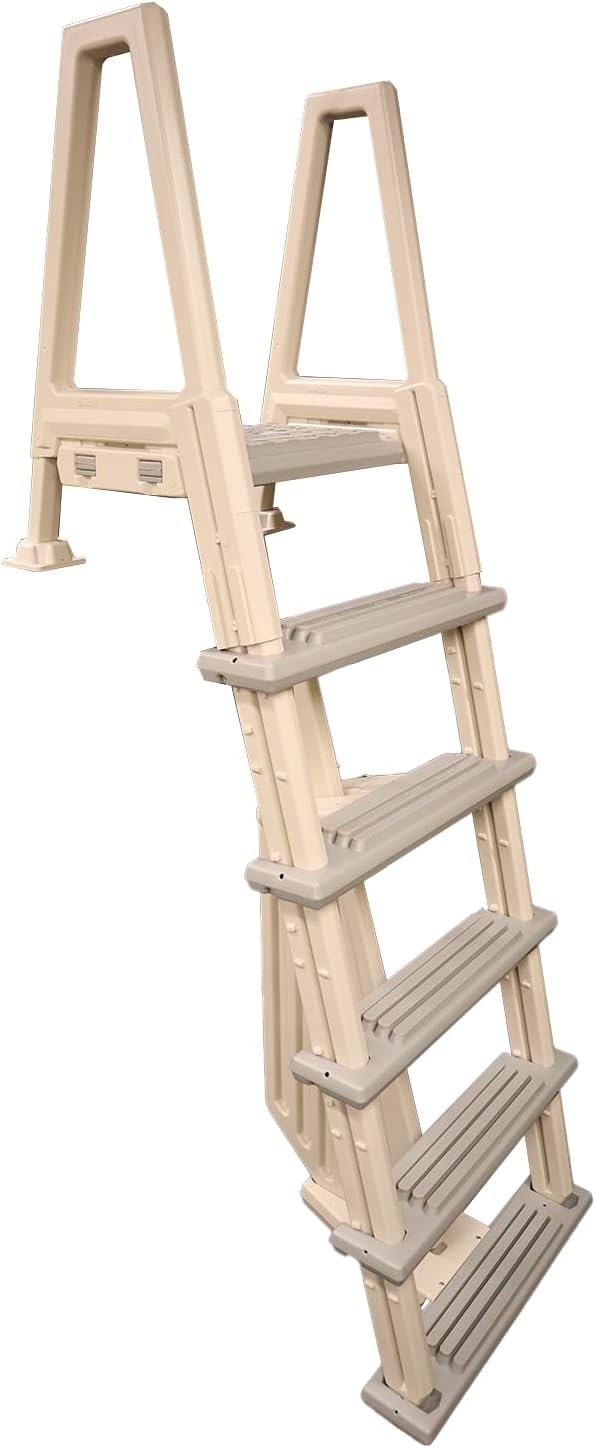
- Adjusts for roughly 42–56 in deck heights
- 300 lb maximum user weight
- Five flat treads plus anti-entrapment barrier

- Fits 46–56 in deck heights
- 250 lb maximum user weight
- Straight-up design with 18 in ladder width

- For above-ground pool decks up to 60 in
- 300 lb load rating
- Four anti-skid treads, each 5.5 in deep
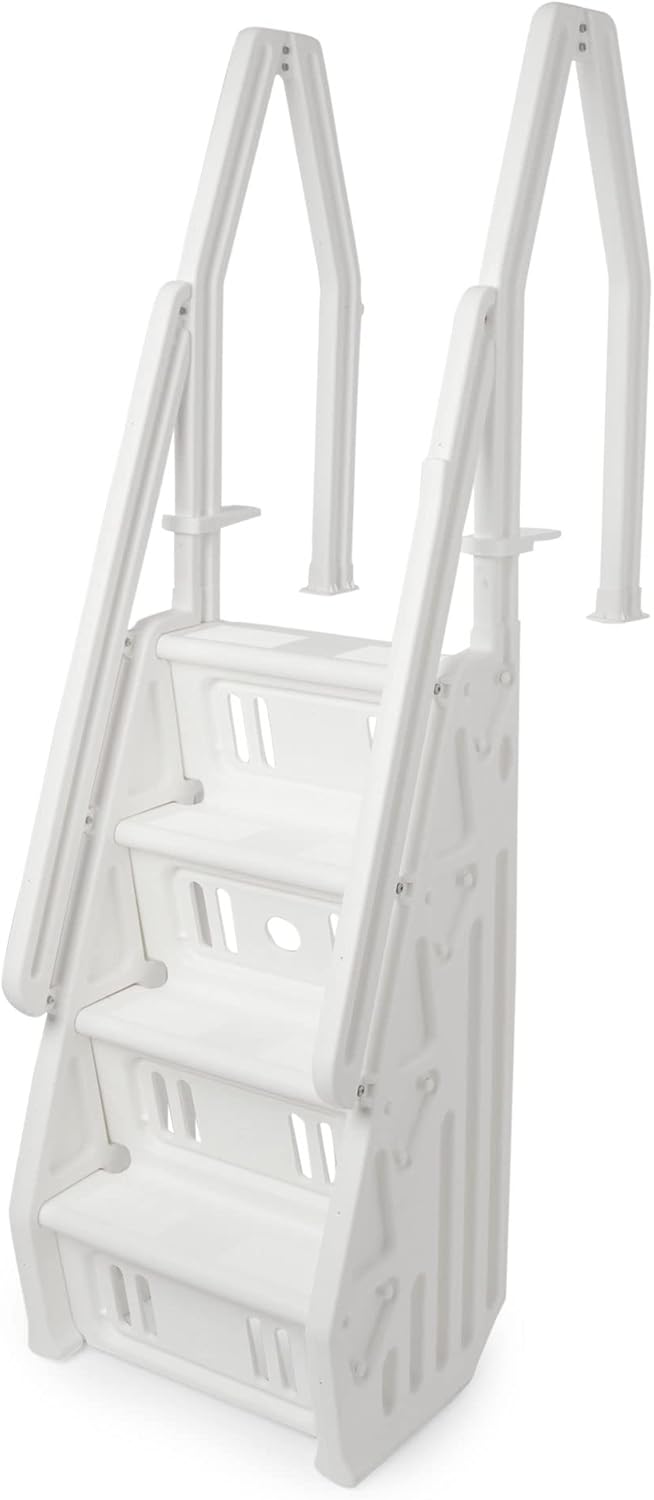
- 24 in wide stair-style entry
- 300 lb load rating
- 7.5 in deep treads; projects about 22 in into pool

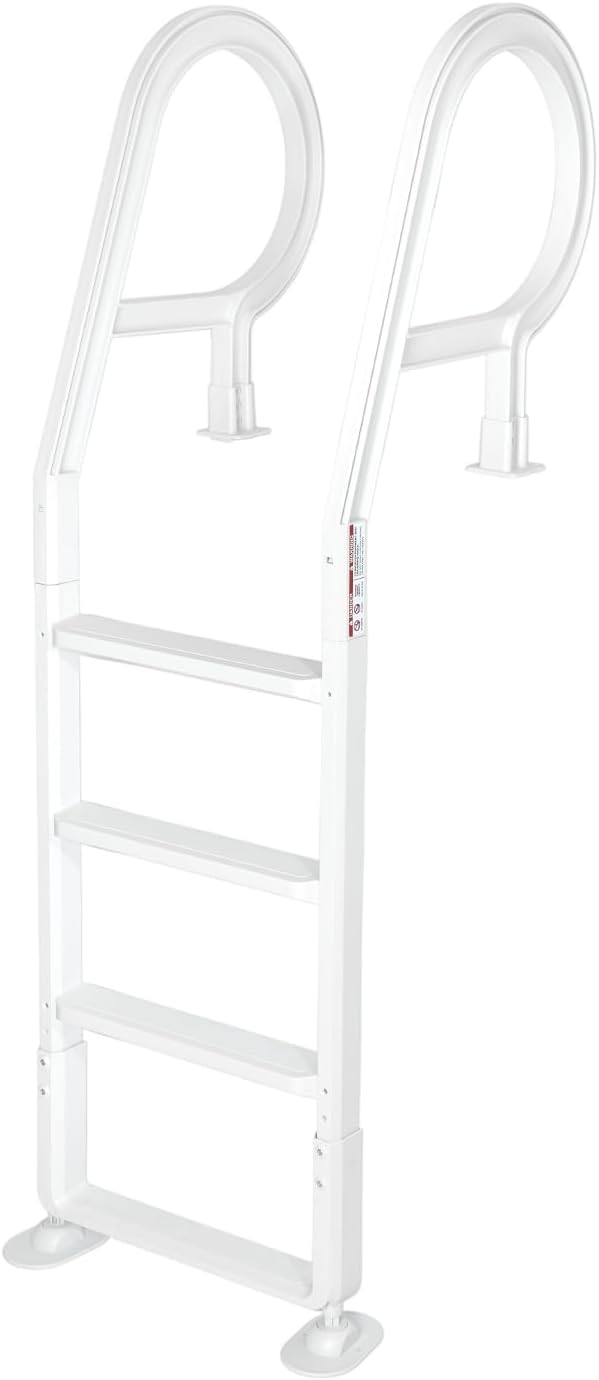
- Four stainless-steel treads
- For above-ground pools up to about 54 in deep
- 225 lb rating; not intended for saltwater pools

- Four-step stainless-steel deck-mounted design
- 250 lb load rating
- About 22 in wide by 76 in high

- For 48–54 in pool depth range
- Five 4.72 in deep steps on a 75-degree incline
- 300 lb capacity; polyethylene construction
- Adjustable for 48, 52 and 54 in heights
- Four 19.5 in wide anti-slip steps
- 225 lb load rating; resin-plastic construction

- For 47–54 in pool depths
- 400 lb load rating
- Five-step PE stair with fillable stability sections
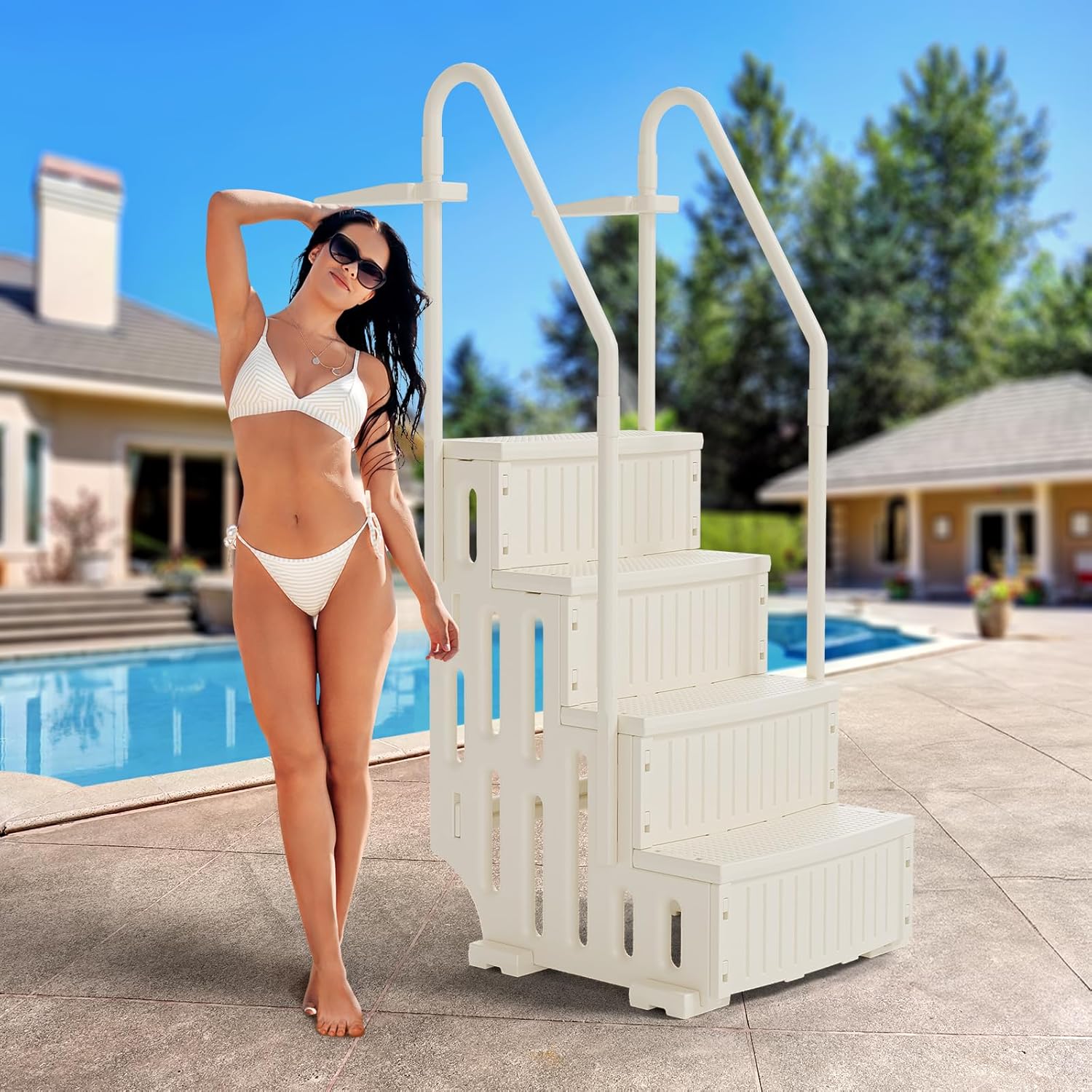
- Four 27.6 in wide by 8.9 in deep steps
- 400 lb load rating
- For pools under 57 in; requires ballast to control buoyancy
What to Look for When Buying Pool Deck Ladders for Above Ground Pools
Measure the finished deck height, not just the pool wall
A pool described as 48, 52, or 54 inches high does not automatically tell you where a deck-mounted ladder will sit. The important measurement is the vertical distance from the finished walking surface of the deck to the pool floor at the ladder location. A deck built slightly above or below the pool top rail can move that number outside a ladder’s adjustment range.
Measure after the pool and deck are fully installed. If the pool floor slopes or has a cove near the wall, check the exact landing point of the ladder as well. Models such as the Confer 6000X and 635-52X have defined deck-height ranges, while products such as the VEVOR and UPHYB are specified for narrower pool-depth ranges. Buying from the nominal wall height alone can leave the bottom step floating or force the upper rails into an incorrect mounting position.
Decide between a vertical ladder and a stair-style entry
A vertical ladder uses relatively shallow treads arranged close to the pool wall. It takes less floor area and can be a practical choice for smaller pools where every foot of swimming space matters. The tradeoff is a steeper climb and less tread depth under the foot.
A stair-style unit angles or steps outward into the pool. The Vinyl Works Deluxe, VEVOR, UPHYB, and VINGLI designs all devote more space to the entry path than a conventional vertical ladder. In return, the user gets deeper or wider standing surfaces. This distinction matters more than the number of steps alone: a four-step stair with an 8- or 9-inch tread is a very different experience from a four-step ladder with a narrow rung.
Check the published load rating
A ladder’s load rating is a hard purchasing limit, not a suggestion. The products in this guide range from 225 pounds to 400 pounds. The Blue Wave Premium and XtremepouwerUS models are listed at 225 pounds, the Confer 635-52X and FibroPool at 250 pounds, several models at 300 pounds, and the UPHYB and VINGLI stairs at 400 pounds.
Choose a model whose documented rating comfortably covers the intended users. Do not assume a metal ladder automatically carries more weight than a molded-plastic stair. The rating belongs to the complete design, including treads, rails, joints, fasteners, and mounting arrangement.
Study tread depth, width, and spacing
Tread geometry changes how much of the foot is supported. The Confer 6000X uses flat 18-by-5-inch treads, the Vinyl Works Snap & Lock uses 5.5-inch-deep anti-skid treads, and the Vinyl Works Deluxe increases tread depth to 7.5 inches. The VINGLI stair goes farther with treads listed at 27.6 inches wide and 8.9 inches deep.
More tread area can feel less ladder-like, but it also creates a larger structure in the water. Step spacing matters too. XtremepouwerUS lists a 10-inch rise between steps, while VINGLI lists approximately 11 inches. Users who prefer a gradual entry should examine both tread depth and vertical rise rather than looking only at total width.
Confirm how the ladder mounts to the deck
Deck attachment is what keeps the top of an in-pool ladder from shifting under load. Some products include dedicated deck flanges or brackets; others use a platform or mounting arms. FibroPool’s stainless ladder passes through two deck-mounted brackets and requires holes through the deck, while the Vinyl Works Deluxe uses deck and front mounting flanges. Confer’s 6000X and 635-52X are also intended to be secured to a deck.
The deck itself must be capable of holding the fasteners. Wood, composite, concrete, and tile can require different anchors. A package that includes wood-deck hardware should not be assumed to include the correct fasteners for masonry. If a manufacturer’s instructions call for different anchors on concrete or tile, use the specified type rather than improvising.
Allow enough room on the pool floor
The footprint inside the pool is easy to underestimate from a product photo. A near-vertical ladder may sit close to the wall, while a sloped stair can project two feet or more into the water. Vinyl Works states that its Deluxe 24-inch step occupies about 22 inches of pool space. VEVOR’s overall depth is roughly 32 inches without its base, reflecting its more inclined layout.
Before buying, mark the expected footprint with a tape measure at the proposed entry location. Check for skimmer returns, cleaners, coves, floor slopes, benches, and other obstructions. A large stair can be comfortable to climb but annoying if it narrows a small round pool’s usable swimming area.
Plan for buoyancy and ballast
Large hollow plastic stairs naturally want to float until they are filled or weighted as directed. Some manufacturers address this with fill ports, water-flow openings, or sand ballast. The Confer 635-52X calls for 10 pounds of sand. The 6000X requires 10 pounds of sand when used with pools taller than 48 inches. UPHYB uses fillable sections for water or sand, and VINGLI instructs the owner to add sand through its fill holes.
Use only the ballast method specified for the exact ladder. Loose weights, blocks, or sharp-edged objects placed on a liner can create new hazards. Correct ballast also matters during installation because a floating lower section can pull against deck mounts and prevent the steps from sitting as intended.
Match the material to the pool environment
Molded resin and polyethylene are attractive around chlorinated water because they do not rust and they can form broad textured steps. Stainless steel provides a slim, familiar ladder form and rigid one-piece rails, but stainless is not immune to corrosion in every environment. The exact Blue Wave Premium listing specifically states that the ladder is not suitable for saltwater pools.
If a pool uses salt chlorination, verify the ladder manufacturer’s compatibility statement instead of relying on the word “stainless.” Rinse exposed hardware when appropriate, keep water chemistry within the pool and ladder manufacturers’ ranges, and inspect fasteners and rails during the season.
Confer Plastics 6000X Heavy Duty Above Ground In-Pool Ladder
The Confer 6000X is a conventional deck-entry ladder built around a compact, nearly vertical layout. It is intended for above-ground pools with a surrounding deck and is adjustable across roughly 42 to 56 inches of deck height. Its 300-pound maximum user weight puts it above the lighter-duty 635-52X, Blue Wave, FibroPool, and XtremepouwerUS ratings in this group.
Design and Build
This model uses an all-plastic structure with five flat treads, dual handrails, a deck platform, and an anti-entrapment barrier. The treads are about 18 inches wide and 5 inches deep. That footprint gives more surface than a narrow metal rung but remains considerably more compact than the broad VINGLI or Vinyl Works Deluxe stair systems.
The molded construction avoids having a metal ladder body submerged in the water. Grey treads contrast with the warmer grey rails, which can help make the step positions easier to distinguish underwater. The handrails extend about 22 inches above the deck area, giving the user something to hold before the first submerged step.
Fit, Ballast, and Installation
The 6000X must be attached to the deck. The adjustable range is one of its strongest practical features because it covers many common above-ground pool and deck combinations. An optional extension kit is available for unusually tall installations, but that accessory should be treated as a separate configuration rather than assuming the standard ladder can simply be stretched beyond its listed range.
Ballast depends on pool height. For pools taller than 48 inches, Confer calls for 10 pounds of sand in addition to the water-filling procedure described for the ladder. Sand is not included. Following that instruction is important because the submerged plastic structure otherwise has buoyancy that can work against the deck attachment.
Practical Strengths
The combination of a 300-pound rating, five treads, and a compact wall-hugging footprint makes the 6000X useful where a full staircase would take too much room. It also includes an anti-entrapment barrier, an important design detail on a vertical ladder installed close to the pool wall. The flat treads provide a larger standing surface than a round metal rung without turning the unit into a broad stair.
Confer also lists a five-year manufacturer warranty for this model. That is useful context for a permanently mounted pool accessory because ladders remain exposed to sun, pool chemicals, and repeated wet/dry cycles through the season.
Important Limitations
This is still a ladder rather than a staircase. The 5-inch tread depth and near-vertical climb will not suit someone specifically shopping for deep stair treads or a more gradual entry angle. The deck must also accept permanent mounting hardware, and the lower portion needs to be installed at the prescribed distance and position rather than simply dropped into the water.
Buyers should also distinguish the 6000X from the 635-52X. They are visually similar, but the 6000X carries a higher published weight rating and uses an anti-entrapment barrier. Mixing specifications between the two can lead to an incorrect purchase.
Who Should Consider It
The 6000X makes sense for a standard above-ground pool with a deck, limited room inside the pool, and a need for a 300-pound rated entry. Buyers who want deeper stair treads, a lower-angle climb, or a 400-pound rating should look at the stair-style models farther down the guide.
Pros
- 300 lb rating is higher than several narrow ladders in this guide
- Five flat 18 x 5 in treads balance footing area with compact size
- Adjustable across a broad common deck-height range
- Anti-entrapment barrier and dual handrails are built into the design
Cons
- Near-vertical layout is less stair-like than inclined entry systems
- Requires deck attachment and correct ballast procedure
- 10 lb of sand is required for pools taller than 48 in
Confer Plastics 635-52X In-Pool Ladder for Decks
The Confer 635-52X takes the compact approach even further. It is a straight-up in-pool ladder for deck heights from 46 to 56 inches, with an 18-inch overall ladder width and a 250-pound user limit. Its footprint is aimed at buyers who want a simple entry path without giving up the floor area required by broad pool stairs.
Straight-Up Layout
The 635-52X is designed to sit close to the wall rather than angle far into the pool. Confer’s installation guidance calls for positioning the ladder a few inches from the pool wall so the structure sits correctly without creating an unnecessary gap. When installed as directed, the design does not require the separate barrier used on some other ladder configurations.
The molded resin construction is non-corrosive and maintenance-oriented, and the ladder includes handrails and a deck platform. The straight-up geometry also makes the unit visually less bulky than a wide staircase.
Height and Weight Limits
Its adjustment window is 46 to 56 inches. That is narrower at the low end than the 6000X, so a deck below 46 inches should rule it out unless an approved configuration specifically changes the fit. The maximum user weight is 250 pounds, another important difference from the 6000X’s 300-pound rating.
The ladder is 18 inches wide, with 22-inch-high handrails above the upper area. Those dimensions support a compact installation, but the width should also be checked against the intended user and the surrounding deck opening.
Installation and Ballast
The 635-52X must be secured to the deck and requires 10 pounds of sand for stability. Because the lower structure is plastic, the ballast is part of the intended installation rather than an optional convenience. The hardware and deck platform are included, but normal tools are still needed for assembly and attachment.
An extension system is available for taller setups, subject to the manufacturer’s stated limits. A buyer who already knows the deck exceeds 56 inches should decide on the approved extension configuration before ordering instead of assuming the standard ladder will reach.
Where It Fits Best
This model is most attractive where pool space is limited and the user weight remains within 250 pounds. It can also suit owners who prefer molded plastic in the water instead of stainless steel. The narrow form leaves more open water than the Vinyl Works Deluxe, VEVOR, UPHYB, or VINGLI stairs.
Important Limitations
The key tradeoff is climbing comfort. A straight vertical ladder asks the user to step down more like a household ladder than a staircase. It also offers less margin on load capacity than the 300- and 400-pound products in this guide.
If the primary reason for replacing an older ladder is to gain broad, deep steps, the 635-52X is probably the wrong direction. Its main advantage is efficiency of space, not a staircase-like entry.
Pros
- Compact straight-up design preserves pool floor space
- Fits many common 46–56 in deck installations
- Non-corrosive molded construction
- Deck platform and required mounting hardware are part of the system
Cons
- 250 lb rating is lower than the 6000X and several stair systems
- Requires 10 lb of sand for ballast
- Steeper entry than inclined or wide-step alternatives
Vinyl Works Snap & Lock 4-Step Above Ground Pool Ladder
The Vinyl Works Snap & Lock ladder sits between a basic narrow rung ladder and a large molded staircase. It uses four anti-skid treads that are 5.5 inches deep and is listed for above-ground pool decks up to 60 inches high, with a 300-pound load rating. Its snap-and-lock assembly is intended to reduce the amount of traditional fastening needed during ladder assembly.
Tread and Rail Design
Each of the four treads has a broad, flat anti-skid surface rather than a round rung. At 5.5 inches deep, they provide slightly more foot support than the Confer 6000X’s 5-inch treads while staying far shallower than the 7.5-inch Vinyl Works Deluxe steps or VINGLI’s 8.9-inch stair treads.
The listing specifies 31.5-inch handrails. The lower tread can pivot so it can sit correctly against the pool floor as the ladder is positioned. That detail is useful because the floor near an above-ground wall is not always perfectly flat.
Fit and Capacity
The 300-pound rating places the Snap & Lock alongside the Confer 6000X, Vinyl Works Deluxe, and VEVOR. Its maximum deck-height specification of 60 inches also gives it more upper-range flexibility than several models limited to the mid-50s.
Vinyl Works documentation for this ladder line identifies it as an above-ground pool deck ladder. That matters because product listings can sometimes use broad pool-language that makes a deck ladder sound universal. The deck and pool geometry still have to match the installation instructions.
Assembly and Day-to-Day Use
The snap-and-lock construction can make assembly less hardware-heavy, but the finished ladder still has to be mounted correctly at the deck. It should not be treated as a freestanding drop-in accessory. Once mounted, the narrower footprint keeps it out of the main swimming area more effectively than a full stair.
Four steps mean the vertical rise between treads will be more noticeable than on some five-step entries. For confident swimmers who mainly need a stable way over the pool wall and onto the deck, that can be an acceptable compromise. For anyone prioritizing a gradual walk-down entry, step count and tread depth should push the comparison toward the larger stair systems.
Who Should Consider It
This model is well matched to owners who want a 300-pound-rated ladder, a deck height that may approach 60 inches, and flat anti-skid treads without the footprint of a 24- to 28-inch wide stair. It is also worth comparing directly with the Confer 6000X: both are compact deck ladders, but their tread geometry, adjustment ranges, and assembly designs differ.
Who Should Consider Another Option
A buyer who needs a 400-pound rating should look elsewhere. The same applies if deep stair treads are the main priority. The Snap & Lock’s 5.5-inch tread is generous for a ladder, but it is not a substitute for a molded pool staircase.
Pros
- 300 lb rating suits more users than 225- or 250-lb ladders
- Fits deck installations up to 60 in high
- Four 5.5 in deep anti-skid treads provide flat footing
- Compact form uses less pool space than broad stair entries
Cons
- Only four steps, so entry is less gradual than many five-step stairs
- Treads are still much shallower than staircase-style products
- Requires a proper deck installation rather than freestanding use
Vinyl Works Deluxe 24-Inch Wide In-Pool Step Ladder
The Vinyl Works Deluxe changes the experience from climbing a ladder to using a compact set of pool steps. The entry is 24 inches wide, its treads are 7.5 inches deep, and the system is rated to 300 pounds. Vinyl Works identifies the IN-24 design for deck heights in the mid-40s through 60 inches; the manufacturer’s product information specifies a 46-to-60-inch adjustment range.
A Wider, Deeper Entry
The primary reason to choose this model over the Snap & Lock is tread geometry. A 7.5-inch-deep stair supports more of the foot than a 5- or 5.5-inch ladder tread. The handrail clearance is about 20.25 inches, so the user walks between two rails rather than climbing a narrow ladder frame.
The stair projects roughly 22 inches into the pool. That is a meaningful amount of space, but it is still less intrusive than some larger inclined systems. For a small above-ground pool, the 22-inch projection should be marked on the floor plan before buying.
Mounting and Stability
The Deluxe uses two sets of mounting flanges: deck-mount and front-mount hardware help secure the step system rather than relying only on its submerged base. The molded structure is designed to allow water circulation and reduce entrapment concerns. A smoothly rounded lower base also avoids sharp metal contact points against a vinyl liner.
Because it is a larger molded assembly, careful installation matters. The deck surface needs to support the mounts, and the stair must sit squarely on the pool floor. An uneven base can change the way load transfers to the rails and deck hardware.
Practical Advantages
The 300-pound rating matches several compact ladders, so the main gain is not capacity but comfort underfoot. The deeper treads and double handrails are useful for swimmers who dislike narrow ladder rungs. Maintenance-free molded materials also keep most of the submerged structure free of corrosion concerns.
The wide step faces make the system visually substantial. That can be helpful for locating the exit point underwater, but it also means this product is not discreet. Buyers wanting the smallest possible obstruction should stay with a conventional ladder.
Important Limitations
This step system consumes more pool floor area than a near-vertical ladder, and its 20.25-inch rail clearance may not suit every user. The 300-pound rating is solid but still below the 400-pound UPHYB and VINGLI products.
The listing and manufacturer materials show slightly different lower bounds for adjustment, so the conservative approach is to use the manufacturer’s 46-inch minimum when deciding fit. A deck close to the lower boundary should be measured carefully before purchase.
Pros
- 24 in wide stair-style design provides more standing area than narrow ladders
- 7.5 in deep non-slip treads are substantially deeper than ladder treads
- 300 lb load rating
- Uses deck and front mounting flanges for a more integrated installation
Cons
- Projects about 22 in into the pool
- Takes more visual and physical space than a vertical ladder
- 400 lb users need a higher-rated model
Blue Wave Premium Stainless Steel In-Pool Ladder
Blue Wave’s Premium ladder is the most traditional stainless-steel option in this group. It uses four stainless-steel treads and stainless handrails, with a resin swivel base at the bottom. The exact listing gives it a 225-pound load capacity and specifies use with above-ground pools up to about 54 inches deep.
Stainless-Steel Construction
The rails and four steps create a slim ladder that occupies little space compared with molded stairs. Each of the main treads is approximately 18 inches wide and 3 inches deep. The lower resin tread is wider, at about 24 inches, and can pivot to sit against the pool floor.
That narrow tread depth makes this a true ladder rather than a step system. It is well suited to swimmers comfortable with a steeper climb, especially where preserving floor area is important. The curved rails give a familiar grip as the user transitions from water to deck.
Capacity and Pool Compatibility
The exact Amazon listing and Blue Wave’s descriptive material state a 225-pound user capacity. Some Blue Wave marketing material for similar configurations displays a higher figure, so the safer purchasing decision is to follow the 225-pound rating attached to this exact ladder listing.
Blue Wave also states that this ladder is not suitable for saltwater pools. That restriction deserves more attention than the generic corrosion resistance associated with stainless steel. If the pool uses a salt chlorination system, choose a ladder explicitly approved for that environment.
Installation and Floor Contact
The swivel base helps the lower end follow the pool floor rather than forcing a rigid metal edge against the liner. The ladder still needs correct upper attachment at the deck. Measure both the depth and mounting position so the lower tread can land flat without pulling the rails away from their intended alignment.
Because the unit is relatively slim, it can work where a wide stair would conflict with a cleaner path or take too much swimming room. The tradeoff is that a 3-inch tread provides much less underfoot area than the molded resin alternatives.
Maintenance Considerations
Stainless steel should be inspected through the season rather than assumed maintenance-free. Keep pool chemistry within the intended range, rinse and clean deposits as needed, and watch joints, fasteners, and surfaces for discoloration. The listing carries a one-year limited warranty.
Who Should Consider It
This ladder is a fit for non-saltwater above-ground pools where a compact stainless design is preferred and all users are below the 225-pound limit. Buyers seeking deeper steps, higher capacity, or a resin-only submerged structure have stronger options elsewhere in this list.
Pros
- Slim stainless-steel design uses little pool floor space
- Four flat stainless treads with a pivoting resin bottom step
- Traditional curved handrails are familiar to many swimmers
- Suitable for many above-ground pools up to about 54 in deep
Cons
- 225 lb capacity is among the lowest in this comparison
- 3 in deep treads provide limited foot support compared with molded stairs
- Listing states it is not suitable for saltwater pools
FibroPool 4-Step Stainless Steel Above Ground Pool Ladder
FibroPool’s four-step deck ladder combines single-piece stainless rails with wide textured steps and a deck-through mounting method. The exact listing rates it to 250 pounds and gives overall dimensions of about 22 inches wide by 76 inches high. It is intended for above-ground pools with a raised deck rather than freestanding A-frame use.
One-Piece Rail Layout
Each stainless rail runs from the lower ladder area up through the deck and bends into the handrail. That continuous tube avoids a rail joint at the transition from submerged ladder to handrail. FibroPool offers different upper bend styles, but the deck-mounted concept remains the same: the rails pass through mounting points fixed to the deck.
Four textured steps provide the climbing surfaces, and a plastic lower step rests on the pool floor. The combination keeps metal rails rigid while giving the bottom a liner-friendlier contact surface.
Through-Deck Installation
This ladder requires more deck preparation than a simple surface-mounted plastic unit. The included brackets bolt to the deck, and a hole is drilled through the deck for each rail. The rails pass through those openings and are locked at the correct height with set screws in the brackets.
FibroPool states that the supplied mounting system works with wood and composite decks. The hardware included with the exact Amazon listing is described for wood-deck installation. Owners of other deck surfaces should verify suitable anchors rather than assuming the same fasteners apply.
Fit and Capacity
The ladder is intended for common above-ground pools in the roughly 48-to-54-inch wall-height range when the deck is built near the top of the wall. Because the rails physically pass through the deck, the relationship between deck height and the rail bend is especially important. A deck that sits unusually high or low can put the curved section in the wrong place.
The 250-pound load rating is higher than Blue Wave’s 225 pounds but below the 300- and 400-pound models. The 22-inch overall width keeps the ladder compact compared with broad stair systems.
Practical Tradeoffs
Stainless construction creates a clean, conventional appearance and avoids the bulk of a molded staircase. On the other hand, installation requires drilling the deck, and the user still climbs a relatively steep four-step ladder. It is not the product to choose when the main goal is a gradual stair entry.
As with any stainless ladder, water chemistry and the specific pool environment deserve attention. FibroPool describes the frame as weather-resistant stainless steel, but owners should still inspect it regularly rather than treating stainless as corrosion-proof.
Pros
- Continuous stainless rails create a rigid deck-to-pool structure
- Includes through-deck mounting brackets and wood-deck hardware
- 250 lb capacity exceeds the Blue Wave exact listing
- Compact 22 in overall width preserves swimming space
Cons
- Requires drilling through the deck for installation
- 250 lb rating is below many resin alternatives
- Four-step ladder remains steeper than stair-style systems
VEVOR Inclined 5-Step Pool Ladder, Taupe
The VEVOR U10 in taupe is an inclined five-step entry rather than a vertical ladder. It is specified for 48- to 54-inch pool depths, carries a 300-pound maximum load, and uses polyethylene construction. The 75-degree climbing angle and 4.72-inch-deep treads aim to make the entry less vertical without consuming as much space as a very deep staircase.
Inclined Five-Step Geometry
Five steps spread the climb across more contact points than the four-step ladders in this guide. VEVOR lists the structure at a 75-degree angle, with each tread approximately 4.72 inches deep. The treads are textured for wet-foot traction, and dual handrails run along the entry path.
At roughly 31.9 inches deep, 23.8 inches wide, and 70.5 inches high without the base, it occupies noticeably more floor area than the compact Confer, Blue Wave, or FibroPool ladders. That added depth is the price of the inclined arrangement.
Fit, Capacity, and Materials
VEVOR specifies a 48-to-54-inch compatible pool-depth range and a 300-pound load limit. The main structure is PE, so the submerged body does not have the corrosion considerations of stainless-steel rails. The taupe color can also blend more quietly with beige or tan pool interiors than bright white stairs.
The bottom step should rest firmly on the pool floor. That contact matters because the incline is intended to transfer load down through the staircase instead of hanging entirely from the deck.
Mounting to Different Deck Surfaces
The system includes pre-drilled base plates for upper attachment. VEVOR’s instructions distinguish between deck surfaces: expansion hardware may be needed for concrete or tile rather than using fasteners intended for wood. Buyers with a masonry deck should plan the anchor method before beginning assembly.
The hollow components also need to be filled or stabilized as directed so the submerged structure does not lift. This is especially relevant to a PE stair because its larger volume creates more buoyancy than a thin metal ladder.
Who Should Consider It
The VEVOR is a useful middle ground for a buyer who wants five steps and an inclined climb but does not need the very deep 8.9-inch treads of the VINGLI stair. Its 300-pound capacity matches several established deck ladders, and its 48-to-54-inch fit range covers common above-ground pool depths.
Important Limitations
The larger footprint should be checked in a small pool. The 4.72-inch tread depth is also closer to a wide ladder tread than to a household stair, despite the inclined shape. A buyer prioritizing maximum underfoot area may prefer the Vinyl Works Deluxe or VINGLI.
Pros
- Five-step design spreads the climb more gradually than many four-step ladders
- 75-degree incline is less vertical than straight-up models
- 300 lb capacity
- PE construction avoids a submerged stainless ladder body
Cons
- Larger in-pool footprint than compact vertical ladders
- 4.72 in tread depth is shallower than broad stair systems
- Correct anchoring depends on the deck surface
XtremepouwerUS Heavy Duty Deck Entry Ladder
This XtremepouwerUS model is a four-step resin-plastic deck-entry ladder that adjusts for 48-, 52-, and 54-inch installations. The exact Amazon listing gives it a 225-pound load capacity, 19.5-inch-wide steps, and an overall size of about 26.6 inches wide by 75.4 inches high.
Four-Step Resin Layout
The ladder uses four reinforced anti-slip steps with approximately 10 inches of vertical rise between adjacent steps. The 19.5-inch width is generous for a compact ladder, but the product remains a steeper entry than a five-step inclined stair.
Resin plastic keeps the submerged body free of rust and allows molded texture to be built directly into each tread. The tall handrails extend well above the water line, supporting the transition onto the deck.
Adjustment Range
The listing identifies three height settings: 48, 52, and 54 inches. That stepped adjustment is different from a continuously variable rail or leg system, so buyers should confirm that one of those positions fits the actual deck and floor relationship.
Its 225-pound rating is the same published limit as the Blue Wave Premium exact listing and lower than every other product in this guide. That specification alone can eliminate it for households that need more capacity.
Installation and Pool Fit
Assembly is required, and the product is supplied with its installation accessories and manual. The upper area still needs a firm deck connection. The ladder should not be selected merely because the pool wall is within the 48-to-54-inch range; the finished deck surface and pool-floor landing point are the measurements that determine correct fit.
The compact footprint is an advantage in smaller pools. A 19.5-inch-wide step gives useful lateral room without the 27-plus-inch tread width of a large stair system.
Strengths and Limitations
The main strengths are simplicity, corrosion-resistant resin construction, and relatively wide steps for a narrow ladder. The principal limit is the 225-pound capacity. It also uses four steps with a 10-inch rise, so people seeking a gradual stair entry should compare it with the five-step VEVOR or UPHYB models.
Pros
- Resin-plastic body avoids rust in the main submerged structure
- 19.5 in wide anti-slip steps
- Height settings cover common 48, 52 and 54 in installations
- Compact design preserves more pool floor area than broad stairs
Cons
- 225 lb capacity is one of the lowest ratings here
- Four 10 in rises create a steeper entry than five-step alternatives
- Height adjustment is limited to specified positions
UPHYB 5-Step Pool Ladder with Double Handrails
The UPHYB five-step ladder is a higher-capacity molded entry designed for pool depths from 47 to 54 inches. The exact listing specifies polyethylene construction, a 400-pound load capacity, five non-slip steps, and overall dimensions of about 23.7 inches wide by 69.8 inches high.
Five Steps and 400-Pound Rating
The 400-pound rating is one of the highest in this comparison and materially changes who can use the product within its documented limits. Five steps also reduce the size of each climb compared with many four-step ladders, while double handrails provide a continuous grip on both sides.
The structure is PE rather than metal. That avoids corrosion in the main body and allows textured tread surfaces to be molded into the step faces. It also creates buoyancy, which the design addresses through openings and fillable sections.
Buoyancy Control
UPHYB uses hollow side panels that allow water to flow through the structure. Fillable pipes can be loaded with water or sand through dedicated ports to help keep the stair seated on the pool floor. That ballast process is part of achieving a stable installation, not a step to skip because the stair feels heavy on dry land.
Follow the exact fill instructions and keep caps or plugs secure. Adding improvised external weights is unnecessary when a product provides a purpose-built ballast system and can introduce hard objects near a vinyl liner.
Fit and Footprint
The specified pool-depth range is 47 to 54 inches. Its 23.7-inch width is broader than a narrow ladder but still slimmer than the 27.6-inch VINGLI stair. The overall shape is a stair/ladder hybrid, giving more body and step area than a traditional stainless ladder without becoming as wide as some full pool steps.
As with the VEVOR and VINGLI products, verify the floor landing area. Molded stairs need a stable base; a pronounced cove or slope can keep the lower structure from sitting flat.
Who Should Consider It
This model is particularly relevant when a 400-pound published capacity is needed but the buyer still wants a five-step molded entry rather than a very broad four-step staircase. The 47-inch lower end also gives it a slightly different fit window from the 48-to-54-inch VEVOR.
Important Limitations
The higher capacity does not eliminate installation requirements. The ladder must still be mounted correctly and ballasted according to the instructions. Its molded body also occupies more space than the Confer, Blue Wave, FibroPool, or XtremepouwerUS ladders.
Pros
- 400 lb capacity is among the highest in this guide
- Five non-slip steps and dual handrails
- 47–54 in compatible depth range
- PE body includes purpose-built water/sand fill areas for stability
Cons
- Molded stair body takes more pool space than a vertical ladder
- Ballast procedure is required for correct stability
- Needs a suitable flat landing area on the pool floor
VINGLI 4-Step Pool Safety Stair, Full Beige
The VINGLI Full Beige entry is the broadest stair-style option in this comparison. It uses four molded steps listed at 27.6 inches wide, 8.9 inches deep, and about 11 inches high, with a 400-pound load rating. The listing specifies use with above-ground or in-ground pools under 57 inches in height.
Deep, Wide Treads
An 8.9-inch tread depth changes the feel of the entry more than almost any other single dimension in this guide. It supports substantially more of the foot than 3- to 5.5-inch ladder treads. At 27.6 inches wide, the stair also provides much more lateral space than the narrow Confer or stainless-steel ladders.
The tradeoff is obvious in the footprint. This is a substantial molded structure in the pool, not a slim ladder. The overall listed size is about 27.6 inches wide by 78 inches high, and the stairs project far enough from the wall that small-pool owners should map the space before purchase.
Capacity and Stability
The published 400-pound capacity matches the UPHYB and exceeds the other eight products covered here. Broad handrails run along both sides of the stair, supporting a two-handed grip during entry and exit.
VINGLI instructs users to add sand through the fill openings to keep the plastic stair from floating. The buyer needs to supply the sand and a suitable funnel. This is a normal consequence of the large hollow plastic structure, and the ballast should be installed exactly as directed.
Pool Height and Installation
The listing states that the stair is for pools under 57 inches. Because that statement is broader than a precise deck-height adjustment range, measure the actual installation and compare it with the assembly geometry before committing to the product. A deck-mounted handrail system still has to align with the finished deck surface.
The bottom of the stair needs a stable floor area. Wide steps distribute the user’s feet well, but a large base can be more sensitive to coves or floor slopes than a narrow ladder that touches down at only a small bottom tread.
Who Should Consider It
The VINGLI is aimed at buyers who value deep tread surfaces and a 400-pound rating more than preserving maximum swim space. It can be easier to understand as a compact pool staircase than as a conventional ladder. That distinction makes it especially different from the Blue Wave, FibroPool, and Confer models.
Who Should Consider Another Option
A small round pool may feel crowded with a 27.6-inch-wide staircase. Owners who only need a compact exit point and are comfortable with a steeper climb can save considerable space with a vertical ladder. Buyers also need to be willing to handle the sand-ballast step during installation and seasonal removal.
Pros
- 400 lb load rating
- Very wide 27.6 in treads provide substantial lateral room
- 8.9 in tread depth is much deeper than conventional ladder steps
- Dual handrails and molded plastic construction
Cons
- Large stair body consumes more swimming space
- Requires user-supplied sand ballast
- Four steps have an approximately 11 in rise, so the stair is broad but not especially low-rise
Detailed Buying Guide
How to Measure Deck Height Correctly
Use a rigid tape measure and identify the exact point where the ladder will mount. Measure vertically from the top surface of the finished deck down to the pool floor where the bottom step or base will land. Do not measure to the top rail, coping, or waterline unless the ladder instructions specifically ask for that reference.
If the floor slopes toward the center, take a second measurement a foot or two farther into the pool so you understand how quickly the floor drops. Inclined stairs may land farther from the wall than a vertical ladder. A 54-inch wall can therefore produce a deeper landing point for a stair that reaches 30 inches into the pool.
Also measure deck thickness and inspect framing below. Through-deck ladders such as the FibroPool need clear space for rails and hardware under the deck surface. Surface-mounted brackets need solid structure beneath their fasteners, not merely a thin deck board over empty space.
Understanding Height Ranges
A stated range such as 46–56 inches describes the geometry the manufacturer designed around. It does not mean the ladder can be safely modified to any height inside or outside that range. If a model uses fixed pin positions, the usable heights may be discrete rather than infinitely adjustable.
The XtremepouwerUS listing, for example, identifies 48-, 52-, and 54-inch settings. VEVOR specifies a 48–54-inch pool-depth range, while UPHYB specifies 47–54 inches. Those numbers sound similar, but the mounting architecture and floor footprint differ. Match the measurement method in the instructions rather than comparing numbers in isolation.
Choosing Between Four and Five Steps
More steps can reduce the vertical rise per step if the total height is similar, but tread spacing varies by design. A five-step ladder can therefore feel more gradual than a four-step model, yet the actual geometry still needs checking. XtremepouwerUS lists a 10-inch rise on its four-step ladder; VINGLI lists approximately 11 inches on its broad four-step stair.
Step count also affects where the lowest tread sits relative to the floor. Some ladders use a pivoting bottom tread, while molded stair systems use the whole lower base for support. Think about entry from both directions: the user must find the first step while getting out of the pool as well as descending from the deck.
Why Tread Depth Often Matters More Than Width
Width determines lateral room, but tread depth determines how much of the foot can rest on the step. A 19-inch-wide tread can still feel ladder-like if it is only a few inches deep. This is why the Blue Wave’s 18-by-3-inch stainless steps, the Confer 6000X’s 18-by-5-inch treads, and the VINGLI’s 27.6-by-8.9-inch stairs should not be described as equivalent merely because all provide flat surfaces.
Deeper treads are useful to buyers who want a more stair-like motion. They also create more drag and buoyant volume in a molded design and consume more horizontal pool space. The correct choice depends on the user’s mobility and the pool layout rather than on a simple “bigger is better” rule.
Handrail Spacing and Grip
Two rails are most useful when the user can grip them comfortably without twisting the shoulders. The Vinyl Works Deluxe lists about 20.25 inches between rails, which provides a concrete reference point. For other ladders, check the product drawing or measure a comparable opening if body width is a concern.
Rail height above the deck is equally important. A rail that rises well above the deck can be grasped before the user shifts weight onto the top tread. Very low rails make that transition more dependent on balance. Confirm that nearby fencing, gates, pool covers, or deck furniture will not interfere with the handrails.
Deck Structure and Fastener Selection
A ladder can only be as stable as the deck connection supporting it. Deck boards alone may not be sufficient if the mounting screws miss joists or blocking. Before drilling, inspect the underside of the deck and add structural blocking if the ladder manufacturer or local construction practice requires it.
Use the correct fasteners for the deck material. Wood screws, through-bolts, concrete anchors, and tile-compatible anchors solve different problems. VEVOR specifically distinguishes expansion fasteners for hard deck surfaces, while FibroPool’s package is described with wood-deck hardware. Replacing an anchor with whatever happens to fit the hole can undermine the whole installation.
Ballast Without Damaging a Vinyl Liner
Molded plastic ladders often contain air when first placed in water. Built-in sand or water fill chambers are the preferred way to counter that buoyancy because the ballast stays inside smooth plastic walls. Confer, UPHYB, and VINGLI all provide model-specific ballast instructions.
Avoid placing concrete blocks, metal plates, free weights, or abrasive sandbags directly on a vinyl liner unless the ladder manufacturer explicitly approves that method. A concentrated hard edge can damage the liner as swimmers move the stair. If a unit requires ballast, use the designed cavities and specified material.
Stainless Steel Versus Resin or Polyethylene
Stainless ladders are slimmer and can be very rigid for their size. They also look familiar on a pool deck and are relatively easy to lift when removing them for winter storage. FibroPool and Blue Wave represent this style in the comparison.
Resin and PE systems can form deeper textured steps, broad side panels, and enclosed shapes without rusting. They tend to be bulkier and can trap air until flooded or ballasted. Models such as the Confer ladders, Vinyl Works products, VEVOR, UPHYB, XtremepouwerUS, and VINGLI use molded materials to varying degrees.
Neither material family is automatically better. In a saltwater environment, an explicitly compatible resin product may be more straightforward than a stainless model with restrictions. In a small chlorinated pool where space is scarce, a slim stainless ladder may be preferable.
Pool-Liner Contact
A ladder should not concentrate load on a sharp or narrow edge. Pivoting resin feet, broad molded bases, and rounded lower steps are common ways to protect the liner while giving the ladder a stable landing point. Inspect these contact areas during installation and again during the season.
Dirt and grit can work underneath a base and become abrasive. When seasonally removing the ladder, clean both the bottom surface and the liner area. If the manufacturer supplies a liner pad or recommends one, use the approved type and keep it flat.
Seasonal Removal and Storage
Above-ground pool ladders are often removed for winter closing. Plan for that before permanently locating the entry. Large molded stairs may hold significant water or sand and can be awkward to lift. Drain them according to the instructions and have enough room to store them without warping handrails or steps.
Stainless ladders are easier to carry but should be cleaned and dried before storage. Inspect mounting hardware, replace damaged fasteners with approved equivalents, and keep small parts together so the ladder can be reinstalled in the same configuration next season.
Access Control Around an Above-Ground Pool
A ladder is an access point as well as an entry aid. Local pool-barrier rules can address gates, removable ladders, enclosures, and the relationship between a deck and pool wall. Some ladder products include barriers or design features aimed at entrapment or access concerns, but those features do not automatically make an entire pool installation code-compliant.
Check the current rules that apply to the property and follow the pool, deck, and ladder manufacturers’ instructions. If children can reach the pool area, access control should be planned at the system level rather than relying on a single ladder feature.
Direct Product Comparisons
Confer 6000X vs Confer 635-52X
These two Confer ladders share a molded, compact deck-entry concept, but the 6000X has the broader fit and capacity envelope. It adjusts down to roughly 42 inches and carries a 300-pound rating, while the 635-52X is specified for 46–56 inches and 250 pounds. The 6000X also uses an anti-entrapment barrier, whereas the 635-52X is designed to install close enough to the wall that a separate barrier is not required when installed correctly.
The 635-52X remains appealing when a very compact straight-up entry is the priority and its 250-pound rating is sufficient. The 6000X is the stronger fit for households that need the extra 50 pounds of rated capacity or a lower deck-height adjustment.
Vinyl Works Snap & Lock vs Vinyl Works Deluxe 24-Inch Step
The Snap & Lock is a ladder with four 5.5-inch-deep treads. The Deluxe is a stair system with 7.5-inch-deep steps and a 24-inch overall entry width. Both carry a 300-pound rating, so the purchasing decision is mainly about geometry rather than strength.
Choose the Snap & Lock format when pool space is limited and a compact four-step climb is acceptable. The Deluxe uses roughly 22 inches of pool depth but gives the foot more support and creates a more staircase-like motion. Its two mounting-flange sets also make it a more integrated deck installation.
Blue Wave Premium vs FibroPool Stainless Ladder
Both products use stainless-steel rails and a compact four-step format, but their exact ratings differ. Blue Wave’s listing gives a 225-pound capacity and specifically excludes saltwater use. FibroPool’s exact listing gives a 250-pound rating and uses a through-deck bracket system with rails passing into the deck.
Blue Wave uses 18-by-3-inch stainless treads and a pivoting resin lower step. FibroPool uses textured steps and a plastic bottom step with continuous stainless rails. The deck construction may decide between them: FibroPool requires drilling through the deck, while the Blue Wave attachment arrangement is more conventional.
VEVOR vs UPHYB
Both are five-step molded entries intended around common 48- to 54-inch above-ground pool depths. VEVOR is rated to 300 pounds and uses a 75-degree incline with 4.72-inch-deep treads. UPHYB is rated to 400 pounds and is specified for 47–54 inches, giving it a slightly broader lower-end fit and substantially more load capacity.
VEVOR publishes a relatively detailed overall footprint, making it easier to plan around a 32-inch-class depth. UPHYB’s key distinction is its higher capacity and dedicated fillable ballast sections. Buyers who need 400 pounds should prefer the rating of the UPHYB or VINGLI rather than assuming the VEVOR can carry the same load.
UPHYB vs VINGLI
Both products have 400-pound ratings and molded plastic construction, but their step geometry is different. UPHYB uses five steps in a roughly 23.7-inch-wide body. VINGLI uses four very wide steps, each listed at 27.6 inches across and 8.9 inches deep.
The UPHYB is the more compact five-step approach. The VINGLI sacrifices more pool space for large tread surfaces. VINGLI also calls for user-supplied sand ballast, while UPHYB provides sections that can be filled with water or sand. For a small pool, footprint may outweigh the appeal of VINGLI’s broad steps.
XtremepouwerUS vs Confer 6000X
Both are compact molded ladders, but the 6000X has a higher load rating and five treads. XtremepouwerUS is rated to 225 pounds with four 19.5-inch-wide steps and specific 48-, 52-, and 54-inch height positions. The 6000X is rated to 300 pounds and adjusts across a wider nominal range.
XtremepouwerUS can still suit a lighter-duty installation where 19.5-inch step width is attractive and one of its height positions matches the deck. The 6000X is the more flexible fit on paper, especially where the deck is below 48 inches or the user’s weight exceeds the XtremepouwerUS limit.
Common Buying Mistakes
Assuming pool wall height equals deck height
The deck surface can sit above or below the top rail, and the pool floor may slope. Measure the actual ladder path. A product labeled for a 52-inch pool can still be a poor fit if the deck is built several inches higher.
Ignoring the in-pool footprint
Large steps can look compact in a product photo because there is no pool wall for scale. Mark the projection on the pool floor before ordering. A 22- to 32-inch projection is significant in a small round pool.
Buying by material instead of load rating
Stainless steel does not automatically mean a higher rated capacity. The exact Blue Wave listing is 225 pounds, while molded UPHYB and VINGLI stairs are rated to 400 pounds. Use the documented limit for the exact product.
Skipping ballast because the deck mount feels secure
Deck mounting controls the top of the ladder; ballast controls the submerged structure. A large plastic stair that wants to float can pull against its mount even if the deck screws are tight. Follow the fill or sand requirements for the exact model.
Using the wrong anchors for the deck
Fasteners designed for wood are not universal masonry anchors. Through-deck brackets also need clearance and structure below the walking surface. Check the deck material and framing before relying on included hardware.
Overlooking saltwater restrictions
Do not assume all stainless pool ladders are suitable for salt chlorination. The Blue Wave Premium listing specifically says it is not for saltwater pools. Verify compatibility for the actual model before installation.
Choosing deep steps without checking rail clearance
Wide stair treads may be appealing, but the user still has to fit comfortably between the handrails. Check published rail spacing where available and compare it with the intended user’s needs.
Treating a deck ladder as a freestanding ladder
The products in this guide are designed around deck attachment. Mounting points transfer load and control movement. A deck-entry ladder should not be used loose in the pool simply because its bottom happens to touch the floor.
Frequently Asked Questions
How do I know what height pool deck ladder I need?
Measure from the finished top surface of the deck to the pool floor at the exact point where the bottom step or base will sit. Compare that measurement with the ladder manufacturer’s stated range and adjustment method. Do not use pool wall height alone unless the instructions specifically define fit that way.
Is a five-step pool ladder easier to climb than a four-step ladder?
Often, but not automatically. A fifth step can reduce the rise between steps, yet tread spacing and overall height vary. Compare the vertical rise, tread depth, handrail position, and angle rather than using step count by itself.
Are pool stairs better than vertical ladders?
They solve different problems. Stairs provide deeper foot support and may offer a more gradual climbing angle, but they consume more pool floor space and often require ballast. Vertical ladders are compact but steeper and usually have shallower treads.
Do plastic pool steps need sand or water inside them?
Many do. Hollow plastic structures can float, so manufacturers may specify sand, water, or both in internal cavities. Confer, UPHYB, and VINGLI all use model-specific ballast instructions. Follow the exact instructions rather than adding external weights.
Can I mount an above-ground pool ladder to a composite deck?
It depends on the ladder and the deck structure. FibroPool states that its mounting brackets work with wood and composite decks, but the deck still needs adequate structural support at the attachment points. Other products may require different fasteners or backing.
Can a stainless-steel pool ladder be used with a saltwater pool?
Only if the manufacturer approves that exact ladder for the pool environment. Stainless steel can still corrode under certain chloride conditions. The Blue Wave Premium model in this guide specifically states that it is not suitable for saltwater pools.
What load capacity should I choose?
The ladder’s published rating must exceed the weight of every intended user. Do not rely on appearance or material to estimate capacity. The products compared here range from 225 to 400 pounds, so the rating can materially change which models are appropriate.
How much room do wide pool stairs take up?
It varies substantially. The Vinyl Works Deluxe projects about 22 inches into the pool, while VEVOR’s inclined body is roughly 32 inches deep without its base. VINGLI’s treads are 27.6 inches wide and 8.9 inches deep, creating a much larger footprint than a vertical ladder.
Should the bottom step touch the pool floor?
For the deck ladders and stairs designed to land on the floor, yes: the lower step or base should sit in the position specified by the manufacturer so the structure transfers load correctly. A floating or suspended lower end usually signals incorrect height, insufficient ballast, or improper installation.
Can I put a pool ladder directly on a vinyl liner?
Many above-ground pool ladders are designed to contact a vinyl-lined floor through smooth resin feet, pivoting lower steps, or molded bases. Follow the manufacturer’s liner-contact instructions, keep grit out from under the base, and use an approved liner pad if the manufacturer recommends one.
Do deck-mounted ladders need to be removed for winter?
Seasonal recommendations vary with the ladder and climate, but many above-ground pool owners remove entry systems during winter closing. Drain or empty ballast as directed, clean the components, inspect hardware, and store the ladder so rails and molded parts are not distorted.
Final Buying Considerations
The right pool deck ladder for an above ground pool is determined first by fit, capacity, and footprint. A compact ladder is usually the better use of space in a small pool, while a stair-style entry makes sense when deeper foot support is more important than preserving every inch of swim area.
For a compact molded ladder, the Confer 6000X combines five treads with a 300-pound rating and a broad adjustment range. The Confer 635-52X is narrower in capacity and fit but keeps the straight-up concept simple. Vinyl Works’ Snap & Lock is another compact 300-pound option for taller decks, with 5.5-inch-deep treads.
The Vinyl Works Deluxe moves toward a true stair experience with 7.5-inch-deep steps, while VEVOR adds a five-step inclined layout. UPHYB and VINGLI are the two 400-pound-rated entries in this comparison; UPHYB uses five steps and a narrower body, while VINGLI uses very broad, deep four-step treads.
For buyers who specifically want stainless steel, Blue Wave and FibroPool both keep the pool footprint relatively small. Their exact load ratings are lower than several molded ladders, and Blue Wave’s saltwater restriction should be treated as a firm compatibility check.
Before ordering, write down four numbers: finished deck-to-floor height, available floor projection, required user-weight capacity, and available width at the entry point. Then confirm the deck material and mounting method. Those measurements make the differences among these ten ladders much clearer and reduce the chance of discovering a fit problem after assembly.
Author