

Pool equipment can spend months exposed to rain, snow, wind-driven debris, ultraviolet light and repeated freeze-thaw cycles. The right pool equipment covers for winter can reduce that direct exposure, but the cover has to match the equipment beneath it. A small motor shield, a ventilated pump housing and a full heat-pump cover solve different problems, even though they are all sold under the broad pool-equipment-cover label.
The most important decision is whether the equipment will remain in service while the cover is installed. A pump motor that may run needs reliable cooling airflow and access around the drive or fan area. A heater or heat pump that is shut down for the season can use a broader fabric or vinyl enclosure, but the cover should still manage condensation, fit around plumbing and remain secure in wind. Blocking a gas-heater flue, heat-pump fan or motor ventilation can create a much bigger problem than weather exposure.
Winter covers also do not replace normal winterization. Water trapped inside a pump housing, filter tank, heater exchanger or exposed plumbing can freeze even if the outside cabinet is covered. The cover protects surfaces and reduces direct weather contact; draining, blowing out lines, following the equipment manufacturer’s shutdown procedure and maintaining safe airflow are separate tasks.
Quick Comparison

- Rigid one-piece UV-resistant enclosure
- Approx. 22 x 18.5 x 15.5 in manufacturer dimensions
- Ventilated design for jet, centrifugal and variable-speed pumps

- Compact plastic motor shield
- Two adjustable inner brackets
- Approx. 13.2 x 8.5 in outer footprint listed by Amazon

- Approx. 16 x 11 x 15.5 in PVC housing
- Six ventilation holes plus open lower rear area
- Designed around common variable-speed pump drive housings

- PVC mesh fabric construction
- Approx. 55.12 x 21.65 in flat size
- Hook-and-loop pipe access, elastic opening and bottom drawstring

- 40 x 34 x 31 in cover size
- 600D Oxford fabric with PVC inner layer
- Multiple openings for pipes, wiring and ventilation
- Approx. 37.5 x 30.5 x 36 in
- Heavy vinyl exterior with non-woven lining
- Mesh side vents with hook-and-loop seams and adjustable closures

- 600D Oxford fabric with PVC waterproof coating
- Plush lining, openable vents and hose-access flap
- Windproof buckle, two drawstrings and storage bag
What to Look for When Buying Pool Equipment Covers for Winter
Match the cover to the exact equipment type
Start with the component you are actually trying to protect. Motor covers such as the Blue Devil and Horizon products focus on the electrical motor or variable-speed drive area. Pump housings such as the PumpHaus cover protect a larger portion of the pump assembly while maintaining an open, ventilated structure. Lewtemi is shaped around a tall filter body, while the Desunqin and Climate Shield covers are sized for larger heater or heat-pump cabinets.
A cover that is physically large enough is not automatically compatible. A heater may have a top exhaust, a heat pump may have a large fan, and a cartridge filter may have an air-relief valve and pressure gauge at the top. Those features determine where fabric can safely sit and where clearance must be maintained.
Decide whether the equipment will run while covered
This question separates permanent or semi-permanent shields from seasonal wraps. A rigid pump housing with large open areas can protect an operating pump while still allowing air to circulate. A close-fitting fabric enclosure can trap heat if it is left closed around a running motor, and a winter cover over a heat pump can obstruct the fan that moves a large volume of air through the coil.
If the equipment must run during winter, follow the pump, heater or heat-pump manufacturer’s clearance and ventilation instructions rather than assuming a cover’s vents are enough. For equipment that is fully shut down, the priorities shift toward keeping precipitation, debris and UV exposure away from the cabinet while preventing the cover from becoming a sealed moisture trap.
Ventilation matters as much as water resistance
An entirely airtight enclosure can hold damp air against metal components and electrical housings. That is why several products in this group use intentional ventilation: PumpHaus has an open enclosure layout, Horizon adds six vents plus an open lower rear area, Climate Shield uses mesh side vents, and Bitubi provides vents that can be opened. The goal is not to let weather blow straight through the cover; it is to avoid trapping heat or condensation where it can linger.
Measure around pipes, valves and conduit
Measure the installed equipment rather than relying only on the manufacturer cabinet dimensions. Include unions, elbows, valve handles, chlorinator connections, conduit, control boxes, gauges and any pipework that projects beyond the main body. A flexible cover can often accommodate modest irregularities, but rigid housings require enough internal clearance or carefully planned cut-outs.
For soft covers, check how plumbing passes through the enclosure. Hook-and-loop seams, pipe flaps and drawstrings can make installation much easier than forcing a cover over rigid pipes. For rigid covers, verify that any cutting or drilling will not weaken the mounting points or interfere with ventilation.
Choose rigid or flexible construction intentionally
Rigid plastic or PVC covers keep their shape, do not absorb water and can create a defined air gap around a motor. They are usually a stronger fit for year-round shielding of a pump or drive. Fabric and vinyl covers fold for storage, adapt to larger cabinets and are easier to fit around irregular plumbing, making them useful for seasonal protection when equipment is shut down.
Do not confuse a cover with freeze protection
A winter cover can slow direct wind and precipitation exposure, but it does not guarantee that water inside the equipment will remain above freezing. The safest buying approach is to treat the cover as the outer weather barrier and winterization as the internal protection procedure. In freezing climates, equipment manuals and local winterization practices should determine what is drained, disconnected or protected before the cover is fitted.
PumpHaus Above-Ground Pump Cover, UV-Resistant, Rust-Proof, Sound-Dampening Enclosure for Jet, Centrifugal and VS Pumps
- Rigid one-piece UV-resistant enclosure
- Approx. 22 x 18.5 x 15.5 in manufacturer dimensions
- Ventilated design for jet, centrifugal and variable-speed pumps
PumpHaus takes the rigid-enclosure approach rather than the fabric-wrap approach. The manufacturer identifies this as model 265075 and describes a one-piece, non-rusting, UV-resistant housing for pumps used with pools, irrigation systems, wells and similar outdoor installations. That makes it useful for owners who want a cover to remain in place for long periods rather than only during seasonal shutdown.
Design and Build
Manufacturer documentation lists the enclosure at approximately 22 inches long, 18.5 inches wide and 15.5 inches high. Retail packaging dimensions may appear differently, so the installed-equipment measurements are the more useful comparison. The shell is broad enough for many centrifugal, jet and variable-speed pumps, but it is still a fixed-size housing; large unions or tall drive modules can change fit quickly.
The rigid material will not sag onto the motor or plumbing after rain or snow. That air gap is a practical advantage around electrical equipment because surfaces remain separated from the cover itself. The wide base also includes points that can be secured, which helps turn the cover into a semi-permanent installation rather than a loose seasonal accessory.
Airflow and Operating Clearance
PumpHaus is intentionally ventilated. The open lower edges and enclosure geometry allow air to move around the motor instead of trapping the heat generated during operation. That is one reason this style makes more sense for a pump that may need to run with the cover installed than a closely fitted winter bag.
Ventilation still depends on the actual installation. Leaves, snowbanks, walls, fences or other equipment can restrict the open sides even if the cover itself is ventilated. Keep the pump manufacturer’s required service and cooling clearances in mind, especially with variable-speed motors that contain electronic drives.
Installation and Plumbing Fit
The housing includes a cut-out template for the discharge line, so the installer can adapt the cover to the pipe location rather than disconnecting every line. This is useful on existing equipment pads, but it also means measuring twice before cutting. A pipe opening placed too low, too high or too far to one side cannot be moved after the material is removed.
Before cutting, place the enclosure over or beside the pump and mark the complete path of the plumbing, not only the pipe diameter. Allow clearance for unions that may need to be loosened later. If the cover will be fastened to a concrete or equipment base, confirm that the final position still leaves room to open the pump basket lid and reach valves.
Practical Winter Use
For winter use, the rigid shell is especially helpful against direct rain, sun and wind-driven debris. It can also keep light snow from sitting directly on the motor housing. Because the structure remains open for airflow, it avoids turning the pump into a sealed box when freeze-protection programming or other winter operation requires the pump to run.
The tradeoff is that it is not intended to seal the pump from cold air. In areas where the system is fully closed for winter, the pump still needs to be drained or treated according to its manual. The cover protects the exterior; it does not remove water from the volute, strainer pot or connected plumbing.
Important Limitations
The fixed dimensions are the main limitation. An unusual plumbing manifold, oversized variable-speed drive or very tall strainer lid may interfere even if the basic pump body seems small enough. A rigid enclosure also occupies more permanent space on the pad than a cover that can be folded away in spring.
Who Should Consider It
This design suits a pool owner who wants a durable, ventilated enclosure around an exposed pump and has enough room to install it properly. It is particularly relevant where the pump stays outside year-round and may still operate during cold weather. Buyers who only need a compact cap over the motor or a large wrap around a heater will find more targeted options below.
Pros
- Rigid non-rusting shell shields the motor and pump body from direct weather exposure
- Open ventilation design is more appropriate for equipment that may operate while covered than a sealed fabric wrap
- Wide base and mounting feet support a more permanent installation
- Cut-out template helps adapt the housing around discharge plumbing
Cons
- Fixed enclosure size may not clear oversized unions, valves or unusual plumbing layouts
- Installation can require cutting around pipework rather than simply draping the cover in place
- Rigid construction uses more space around the equipment pad than a foldable seasonal cover
Blue Devil Adjustable Motor Cover, Water Resistant
- Compact plastic motor shield
- Two adjustable inner brackets
- Approx. 13.2 x 8.5 in outer footprint listed by Amazon
The Blue Devil cover is a much smaller solution than PumpHaus. Instead of surrounding the full pump and plumbing area, it creates a rigid weather shield over the motor. That can be enough when the vulnerable part of the installation is the exposed electric motor and the rest of the pump already sits under a roof, equipment shelf or other partial shelter.
Design and Build
Amazon lists durable plastic construction with a heat-resistant white top and blue sides. The listed outer size is approximately 13.2 by 8.5 inches; the listing does not provide a complete three-dimensional envelope in the same way as the larger covers, so owners should compare the motor body and bracket locations carefully.
Two inner brackets can be adjusted to help the cover fit different motors. That is a useful feature because pump motors vary in diameter and in the position of terminal boxes or capacitor humps. The bracket system supports the cover over the motor instead of simply resting a loose sheet directly on it.
Heat and Weather Exposure
The plastic is described as UV resistant and water resistant, with the white upper surface intended to reduce solar heat absorption compared with a dark cover. For an exposed motor, blocking direct sun and rain can reduce the amount of weather that reaches paint, labels, fasteners and the electrical housing.
Because this is a compact shield, it does not fully wrap the sides and lower portions of the pump assembly. That is beneficial for natural airflow, but it also means blowing snow or sideways rain can still reach exposed areas depending on wind direction.
Fit and Adjustability
The adjustable brackets are the main fit advantage. Measure not only the motor diameter but also the distance to nearby pipes and the height of any variable-speed drive or rear-mounted control module. A cover made for a conventional motor may not clear a taller integrated drive even if the basic motor body fits underneath.
Practical Winter Use
In a mild or intermittent winter climate, the Blue Devil is useful as a continuing weather shield because it does not attempt to enclose the whole pump. It can remain focused on keeping precipitation and debris off the motor area while the pump retains broad exposure to ambient air.
For full winter shutdown in a freezing climate, it should be treated as exterior protection only. Drain plugs, pump basket procedures and plumbing protection still follow the pump manufacturer’s directions. The motor cover cannot prevent residual water in the wet end from freezing.
Important Limitations
Coverage is deliberately limited. Owners looking for protection around the strainer pot, unions, plumbing or an entire equipment set will need a larger enclosure. The compact format also means that exact motor shape matters more than it does with an oversized flexible bag.
Who Should Consider It
Consider this cover if the motor is the main exposed component and you want a simple rigid shield with adjustable support. It is also useful where equipment-pad space is tight and a large enclosure would interfere with access. A variable-speed drive that needs more height or specifically placed ventilation may be better matched to the Horizon cover.
Pros
- Compact format protects the motor area without enclosing the full plumbing assembly
- Adjustable inner brackets allow the cover to fit a range of motor shapes
- White top and UV-resistant plastic suit exposed outdoor equipment pads
- Rigid plastic is easy to wipe clean and does not absorb moisture like fabric
Cons
- Covers the motor rather than a complete pump, filter or heater installation
- Limited listed dimensions make careful fit checking essential for larger variable-speed drive housings
- Provides less side and lower-body coverage than a full pump enclosure
Horizon Industries Pump Motor Cover For Variable Speed Pool Pump Motor/Drive Cover
- Approx. 16 x 11 x 15.5 in PVC housing
- Six ventilation holes plus open lower rear area
- Designed around common variable-speed pump drive housings
Horizon Industries addresses a more specific problem: protecting the enlarged motor and electronic drive section found on many variable-speed pool pumps. Those drives can be taller and more angular than a conventional single-speed motor, so a generic low motor cap may not provide enough clearance.
Design and Build
The VSPMC16 cover is listed at approximately 16 inches long, 11 inches wide and 15.5 inches high. It uses white PVC, which provides a rigid barrier and can be cut or drilled when conduit or nearby plumbing requires a custom opening. The back is partly enclosed toward the top while the lower rear remains open.
That open lower rear section matters because variable-speed pumps often position the cooling fan and electrical conduit at the back of the motor. A cover that pressed tightly against this area could restrict cooling or complicate wiring access.
Ventilation and Heat Management
Six vent holes are built into the cover, supplementing the open lower section. This is a more deliberate ventilation scheme than a plain plastic box, and it is consistent with the needs of an electronic drive that produces heat during operation. The cover should still be positioned so walls, snow and stored items do not block those openings.
The manufacturer also uses a white exterior to limit solar heat gain. That may be helpful on a pump pad with full sun exposure, but shade from the cover does not change the pump manufacturer’s required ambient-temperature and airflow limits.
Compatibility
Retail information identifies compatibility with common variable-speed platforms such as Pentair IntelliFlo, Sta-Rite IntelliPro and Hayward EcoStar configurations. Compatibility is still installation-specific. Pipe orientation, automation wiring, conduit placement or a wall immediately behind the pump can interfere even when the pump model itself is listed.
Before purchase, measure the highest point of the drive, the overall motor length and the space behind the cooling area. Also check whether the pump basket lid can be opened without removing the cover. Good service access makes a protective enclosure much easier to live with.
Practical Winter Use
This is a useful year-round shield for a variable-speed drive exposed to rain and sun. In winter, the rigid PVC keeps direct precipitation off the electronics enclosure while the vents allow the pump to operate if freeze-protection settings call for circulation. As with every operating cover, the pump manual has priority if it specifies additional clearance.
Important Limitations
The Horizon cover protects the motor and drive area rather than the complete equipment pad. It will not cover a filter tank, heater or broad valve manifold. Installation can also involve cutting PVC, which is manageable but less reversible than adjusting straps on a fabric cover.
Who Should Consider It
This is the most targeted choice in the group for an exposed variable-speed pump with a tall electronic drive. Owners of compact conventional motors may not need the extra height, while owners shutting down an entire heat pump for winter need a much larger seasonal cover.
Pros
- Shape is intended specifically for variable-speed motor and drive protection
- Six vents and an open lower rear section provide a defined airflow path
- PVC can be cut or drilled to accommodate conduit and tight equipment layouts
- White rigid housing resists UV exposure and pool-equipment chemicals
Cons
- Compatibility is still dependent on the exact pump, plumbing and conduit arrangement
- Rigid PVC may need trimming or drilling during installation
- It is not a full-pad winter cover for filters, heaters or exposed valves
Lewtemi Universal Swimming Pool Filter Cover for Cartridge & Debris Filters
- PVC mesh fabric construction
- Approx. 55.12 x 21.65 in flat size
- Hook-and-loop pipe access, elastic opening and bottom drawstring
Lewtemi shifts the focus from motors to filter tanks. Cartridge and debris filters are tall, cylindrical and often interrupted by pipe connections, pressure gauges and air-relief hardware, so a cover that works well on a rectangular heater is not automatically a good fit. This product uses a flexible wrap that can conform around that shape.
Design and Build
The cover is made from PVC mesh fabric and is listed at approximately 55.12 by 21.65 inches when laid flat. The material is lightweight and foldable, so it is easy to remove once the pool returns to regular operation. Its gray finish also makes dirt less visually prominent than it would be on a bright white cover.
Unlike a rigid shell, the fabric follows the contour of the filter body. That reduces the empty air volume around the tank but means the product provides weather and debris protection rather than impact protection.
Pipe Access and Closure
The design includes adjustable hook-and-loop access around pipe areas, an elastic opening and a bottom drawstring. Those details are important because filter plumbing is rarely identical from one installation to another. A cover that can close around pipes is easier to fit without disconnecting unions or forcing fabric over sharp fittings.
Position the closures so they do not press on a pressure gauge, air-relief valve or clamp band. Those parts still need to remain visible and accessible during servicing. If the filter is winterized and the gauge is removed according to the manufacturer’s instructions, store removed parts where they will not be lost.
Weather Protection
The PVC-mesh construction is intended to reduce direct UV, dirt and weather exposure. For a filter tank that otherwise sits uncovered all winter, that can help keep leaves and grime off the housing and clamp area. The cover should not be pulled so tight that water collects in pockets or the fabric rubs repeatedly against a sharp edge in strong wind.
Installation and Storage
A soft cover is easier to install than a rigid box when plumbing surrounds the filter. Open the access area, wrap the filter, arrange the pipe openings without tension, then secure the elastic and drawstring. When the cover comes off in spring, allow it to dry before folding it for storage.
Important Limitations
The universal description should not be read as a guaranteed fit for every filter. Tall commercial-style cartridges, unusual multiport valve arrangements or filters with broad manifolds can exceed the usable envelope. The flat dimensions are a starting point; circumference, height and pipe locations still matter.
Most importantly, covering the exterior does not winterize the tank. Drain plugs, cartridges, grids, gauges and valves should be handled according to the filter manufacturer’s cold-weather procedure.
Who Should Consider It
This cover is suited to an owner who specifically wants to protect a tall filter housing rather than a pump motor. It is especially useful where pipes make a simple closed bag awkward. Owners seeking a rigid enclosure or a heater-size winter cover should use a product built around those shapes instead.
Pros
- Wrap-style shape is intended for tall cartridge and debris filter housings
- Pipe-access closure reduces the need to disconnect existing plumbing
- Bottom drawstring and elastic opening help control loose fabric in outdoor conditions
- Lightweight cover folds down for off-season storage
Cons
- Soft cover does not provide rigid impact protection
- Universal fit still depends on the diameter, height, valve position and pipe routing of the filter
- A fabric cover should not be treated as a substitute for draining and winterizing the filter body
Heavy Duty Pool Heater Cover, 600D Oxford Pool Pump Cover 40″ x 34″ x 31″, Thickened Swimming Pool Heat Pump Covers with Waterproof PVC Inner Layer, Pool Pump Equipment Cover for Winter Outside
- 40 x 34 x 31 in cover size
- 600D Oxford fabric with PVC inner layer
- Multiple openings for pipes, wiring and ventilation
The Desunqin cover is sized for a much larger piece of equipment than the motor shields above. At 40 by 34 by 31 inches, it is aimed at outdoor pool heaters, heat pumps and similarly sized equipment cabinets. Its flexible construction is intended primarily for seasonal weather protection rather than as a permanent operating enclosure.
Design and Build
The outer shell uses 600D Oxford fabric, backed by a thickened PVC inner layer. That construction is heavier than a basic dust cover and is intended to resist rain, sun and abrasion during outdoor storage. The rectangular shape gives the cover enough volume for many equipment cabinets without requiring a rigid frame.
Fabric construction also means it can accommodate modest differences in cabinet shape and pipe locations. The tradeoff is that the cover has no structural roof; accumulated snow or ice can still press the fabric onto the equipment and should be removed rather than allowed to build up.
Openings and Ventilation
Multiple openings are provided for wiring and piping, which helps the cover fit around equipment that remains connected to the system. These openings can also reduce trapped moisture compared with an entirely sealed bag. They should be arranged so that rain does not have a direct path toward controls or electrical boxes.
A heat pump relies on a large fan and unrestricted air movement during operation. A gas heater requires safe combustion-air and exhaust paths. For that reason, the most conservative use for a winter fabric cover is on equipment that has been shut down according to the manufacturer’s instructions; remove the cover before operation unless the equipment maker explicitly permits otherwise.
Practical Winter Use
For a shutdown heater or heat pump, a full cabinet cover can keep leaves, bird debris, wind-driven dirt and much of the direct precipitation off the outer panels. That reduces the amount of cleanup needed in spring and limits long periods of direct UV exposure on the cabinet finish.
The adjustable drawstrings are valuable in exposed yards. A cover that balloons in wind can rub against corners, work loose or pull against pipes. Tighten the lower edge enough to control flapping without cinching so hard that plumbing or cabinet panels are stressed.
Fit Considerations
Use the 40 x 34 x 31-inch dimensions as the usable target envelope, then measure every fixed projection. Pipe unions, electrical disconnect boxes and raised fan guards can all make an apparently compatible heater larger. Leave enough slack to install the cover without dragging it over sharp metal edges.
Important Limitations
This is not an insulating box that guarantees freeze protection. Any water retained in a heater exchanger, heat-pump plumbing or connected line can still freeze. It is also not a rigid snow shelter, so heavy accumulation should be cleared carefully.
Who Should Consider It
Choose this style if you have a shutdown heater, heat pump or similarly sized pool-equipment cabinet that fits within the measured envelope and you prefer a foldable cover. If cross-ventilation and a fitted lining are higher priorities, compare the Climate Shield design next.
Pros
- Large dimensions suit many heat-pump and heater-sized equipment bodies
- 600D Oxford shell and PVC inner layer provide a more substantial seasonal barrier than a thin dust cover
- Pipe and wire openings make the cover easier to fit around installed equipment
- Adjustable drawstrings help secure the lower edge in wind
Cons
- Large soft cover must be sized carefully so it does not obstruct fans, exhausts or controls
- Seasonal fabric enclosure should be removed before operating equipment when the manufacturer requires open airflow
- Snow or ice accumulation still needs attention because the cover is not a structural roof
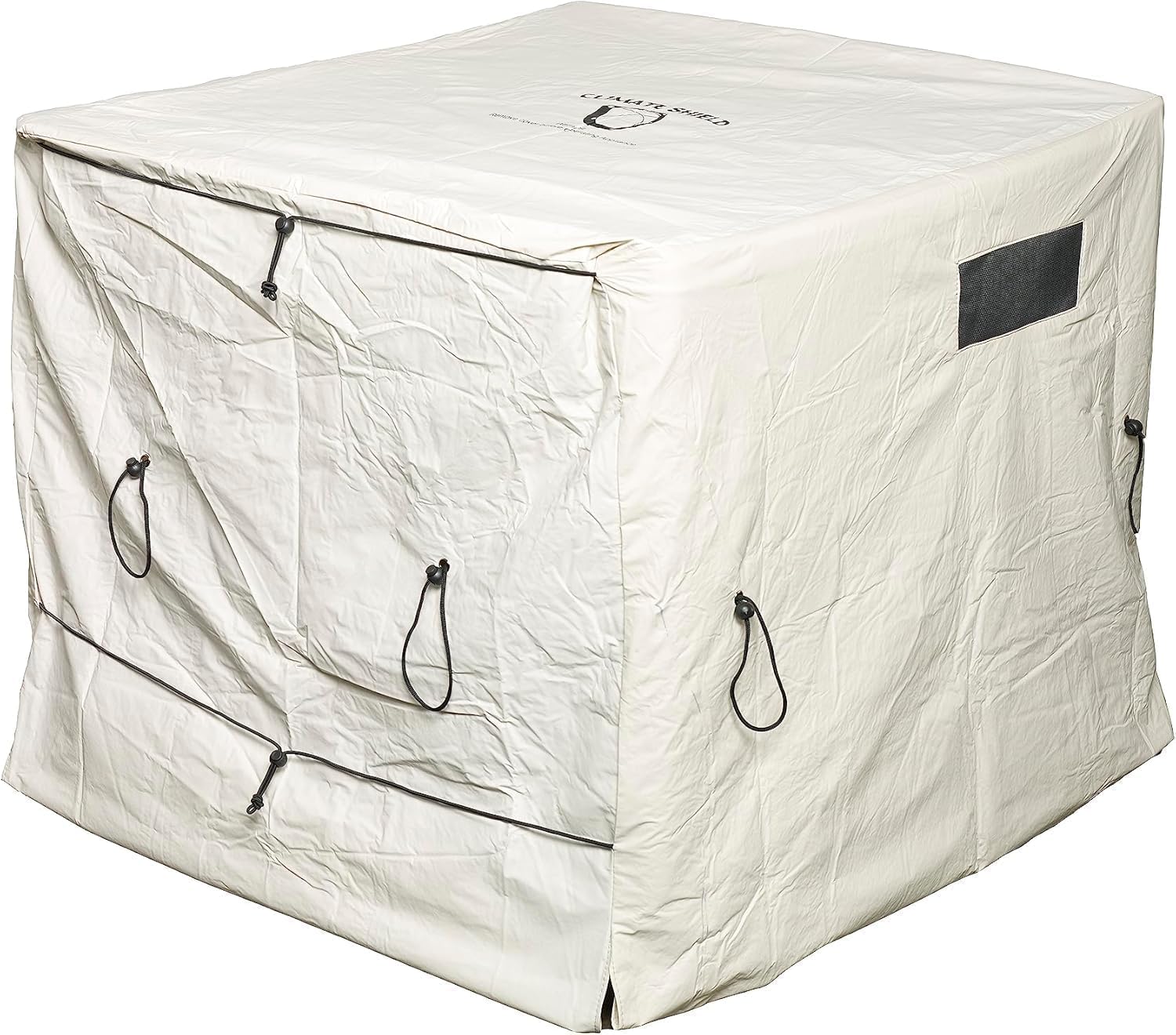
Climate Shield ® by Outdoor Solutions Inc ® Pool Heater Cover – Heavy-Duty Vinyl, Mesh Vents, Insulated Pool Equipment Cover for Winter Protection, Fits Pool Heat Pump & Filter
- Approx. 37.5 x 30.5 x 36 in
- Heavy vinyl exterior with non-woven lining
- Mesh side vents with hook-and-loop seams and adjustable closures
Climate Shield uses heavy vinyl rather than woven Oxford fabric and adds two features that matter during long winter storage: a soft non-woven lining and mesh vents on the sides. The combination aims to block direct weather while giving trapped moisture a path to escape.
Design and Build
The exact Amazon listing for model OSCS-HC gives dimensions of approximately 37.5 inches long, 30.5 inches wide and 36 inches high. The exterior is heavy vinyl, while the inner non-woven cloth layer separates the vinyl surface from the equipment cabinet.
That lining is useful where vinyl might otherwise stick to a painted panel after long periods of moisture and pressure. It also creates a softer contact surface at corners. The cover still needs to be installed over clean equipment; grit trapped between any cover and the cabinet can act like an abrasive when wind moves the material.
Ventilation and Moisture Control
Mesh vents on each side create cross-ventilation. This is one of the clearest differentiators in the group because a winter cover can be water resistant on the outside yet still hold moisture generated by condensation underneath. Side vents encourage air exchange without leaving the entire cabinet exposed.
Ventilation does not make the cover suitable for operating a heater. A gas appliance can have specific combustion and exhaust clearances, and a heat pump fan may move thousands of cubic feet of air. Remove a seasonal cover before operation unless the equipment manufacturer specifically states that the cover configuration is acceptable.
Adjustability and Plumbing Access
Hook-and-loop seams, straps and cinch-style closures help the cover fit around existing plumbing. That is useful on permanent pool equipment because disconnecting heater pipes merely to install a winter cover would add unnecessary work and potential leak points.
Arrange seams so they close around pipes without pulling the entire cover sideways. A centered cover puts less stress on the hook-and-loop joints and helps the lower edge stay even in wind.
Practical Winter Use
For a heater or heat pump that is drained and shut down for the season, Climate Shield provides broad cabinet coverage while still acknowledging the need for ventilation. The heavy vinyl resists direct precipitation, and the lining makes the product feel more like a fitted equipment cover than a simple utility tarp.
Important Limitations
The size is fixed, and the cover has to clear both the cabinet and the installed plumbing. A cover that is too small can put constant tension on seams; one that is excessively large can flap and collect water. The product also does not change the need to drain susceptible internal components before freezing weather.
Who Should Consider It
This design is relevant to owners who want a dedicated seasonal heater or heat-pump cover with built-in side ventilation and a lined interior. It is less relevant to a small pump motor, where a compact rigid shield provides better access and occupies much less space.
Pros
- Heavy vinyl provides broad seasonal coverage for heater and heat-pump cabinets
- Mesh side vents encourage cross-ventilation instead of sealing the equipment completely
- Lining helps separate the vinyl shell from the equipment surface and manage incidental moisture contact
- Hook-and-loop seams and adjustable closures accommodate installed plumbing without full disconnection
Cons
- Exact heater dimensions and plumbing projections must be checked before purchase
- Vented winter enclosure is still not permission to operate a gas heater or heat pump while covered
- Bulkier than a small motor cover and intended for a different type of equipment
Bitubi Pool Pump Covers with Plush Lining,Heavy Duty Waterproof in/Above Ground Pool Pump Motor Enclosure Cover- Protects from Severe Snow and Intense Sun
- 600D Oxford fabric with PVC waterproof coating
- Plush lining, openable vents and hose-access flap
- Windproof buckle, two drawstrings and storage bag
Bitubi combines the wraparound coverage of a fabric winter cover with features aimed specifically at pump installations. It uses 600D Oxford material with a PVC waterproof coating, a plush lining, openable vents and a hook-and-loop access area for hoses or plumbing. The result is more enclosure than a motor cap but less rigid than PumpHaus.
Design and Build
The cover is constructed from water-resistant 600D Oxford fabric with a PVC coating on the weather-facing structure. A plush inner lining cushions the contact surface around the pump. The product also includes a padded handle and storage bag, which are useful if the cover is removed and reinstalled seasonally.
Because the shell is flexible, it can adapt around pump bodies and nearby connections more easily than a pre-formed plastic box. It should still be kept clear of moving parts, cooling inlets and hot surfaces.
A Note on Listed Dimensions
The Amazon listing presents conflicting dimensional information: one section lists 24 x 11 x 11 inches, while another product-description section gives approximately 16.9 x 14.96 x 21.2 inches. That conflict is important enough that the selected size or variant should be verified on the current listing before ordering. Do not assume either set of numbers describes every available configuration.
Measure the installed pump first, including the strainer lid, drive housing, unions and pipe projections. Then compare those measurements with the currently selected Amazon variant rather than buying on the product photo alone.
Ventilation and Hose Access
Openable vents allow the owner to increase airflow when needed, while the hook-and-loop hose area helps the cover close around connected plumbing. These are practical additions because a soft cover without dedicated openings can become tight around pipes or sit directly against motor ventilation slots.
If the pump operates with the cover in place, keep the vents fully open and confirm that the motor manufacturer’s cooling requirements are met. A fabric cover can shift in wind, so periodically check that no panel has moved over a fan or air intake.
Wind and Seasonal Handling
One windproof buckle and two adjustable drawstrings provide three separate ways to restrain the shell. That is helpful on exposed equipment pads where a loose cover can flap against the pump. The padded handle makes it easier to lift the cover off for basket service or seasonal inspection.
After a wet winter, allow the plush lining and outer fabric to dry completely before packing the cover into its storage bag. Storing damp fabric can create odors and keep moisture in contact with the lining longer than necessary.
Important Limitations
The dimensional conflict in the listing requires extra buyer attention. This also remains a soft cover: it can reduce weather exposure but cannot protect the pump from a heavy impact or act as a structural snow roof. Internal freeze protection still depends on correct winterization or manufacturer-approved circulation.
Who Should Consider It
Bitubi fits buyers who want broader flexible pump coverage than a small motor cap and value hose access, wind restraints and removable vents. Buyers who prefer a rigid year-round enclosure may find PumpHaus easier to leave in place, while a heater owner needs the larger geometry of the Desunqin or Climate Shield options.
Pros
- Soft 600D shell wraps more of the pump assembly than a compact motor cap
- Openable vents and hose-access flap help adapt the cover around an installed pump
- Windproof buckle and dual drawstrings provide multiple restraint points
- Padded handle and storage bag make seasonal removal and storage more convenient
Cons
- Amazon listing presents conflicting dimensional information, so the selected variant should be checked carefully before ordering
- Soft cover requires attention to ventilation around an operating motor
- Plush lining can retain moisture if the cover is stored wet, so drying before storage matters
Detailed Buying Guide for Winter Pool Equipment Protection
Rigid enclosures versus fabric covers
Rigid housings keep a consistent air gap around the equipment. That makes them useful around pumps and motor drives because the shell cannot collapse onto a cooling inlet after rain. They also tolerate repeated installation less because they are usually left in one place. The downside is dimensional rigidity: if a union, pipe elbow or control box is outside the planned envelope, the housing may require cutting or may not fit at all.
Fabric covers trade structural shape for adaptability. They can fold around irregular cabinets, pass around connected plumbing and pack away in a small storage space. For winter-shutdown equipment, that is often the better compromise. However, soft covers must be secured against wind and should be checked after snowstorms so heavy accumulation does not push them against vents or delicate panels.
How much ventilation is enough?
There is no single vent area that applies to every pump or heater because heat output and airflow requirements vary by model. Instead of looking for a generic number, preserve every factory cooling opening and follow the equipment manual. A rigid cover should not create a stagnant pocket around a motor, and a seasonal heater cover should come off before the heater or heat pump operates unless the equipment manufacturer explicitly permits a particular cover.
Condensation is the second reason to ventilate. On cold nights, the equipment surface can fall below the dew point and moisture can form inside a cover even when rain never penetrates the outer material. Mesh panels, open lower edges and controlled air gaps allow that damp air to leave.
Water resistance, waterproof coatings and condensation
A waterproof coating is helpful against rain and melting snow, but an exterior barrier does not guarantee a dry interior. Water can enter around pipe openings, rise from a wet pad, or form as condensation. That is why a cover with thoughtful seams and ventilation can perform better in practice than a completely sealed bag.
Inspect the equipment pad itself as well. Standing water at the base of a pump or heater can keep the lower cabinet wet regardless of the cover above it. Improving drainage and keeping leaves from blocking pad runoff can be as important as selecting a heavier fabric.
Measuring a pump cover correctly
Measure the maximum length, width and height of the entire installed pump, not just the motor. Include the strainer pot, lid handle, integrated variable-speed drive, cable gland, unions and any plumbing that cannot pass through a dedicated cover opening. Add modest installation clearance so the cover does not have to be stretched over sharp edges.
Then consider service tasks. You may need to remove the pump basket lid, reach a drain plug or press buttons on a drive. A cover that fits only by wedging tightly between pipes can become frustrating every time the system needs attention.
Measuring heater and heat-pump covers
Heaters and heat pumps are larger and more sensitive to airflow. Measure the cabinet at its widest fixed points, then add plumbing, gas connections, electrical conduit and raised fan guards. If the unit has a top fan, do not select a cover that you expect to leave installed while operating the fan.
For a gas heater, identify the flue or exhaust outlet and consult the manual for required clearances. A winter storage cover is meant for a heater that is off and prepared for cold weather, not as a cap over an operating combustion appliance.
Filter covers need different measurements
A filter is usually taller and narrower than other pool equipment. Measure the tank circumference, total height to the highest fitting, and the position of inlet/outlet pipes. A wrap-style cover should close without pulling on a pressure gauge, air-relief valve or clamp band.
If the filter manufacturer recommends removing the pressure gauge, drain plug or cartridges during winterization, follow that procedure first. The cover is installed after the filter has been prepared, not instead of preparation.
Wind restraint is a real buying feature
A large cover acts like a sail. Drawstrings, buckles, mounting feet and hook-and-loop seams are therefore functional features rather than cosmetic details. A well-secured cover moves less, which reduces abrasion at cabinet corners and lowers the chance that an opening will shift over a vent or pipe.
Do not tie a cover so tightly to plumbing that wind loads are transferred into PVC pipes or fittings. The restraint should control the cover itself and, where possible, anchor to a stable base or the cover’s intended attachment points.
Snow load and ice accumulation
None of the soft covers here should be treated as a load-bearing shelter. Wet snow is heavy, and ice can concentrate weight on a fan guard, filter gauge or plastic lid. After substantial snowfall, remove accumulation carefully without striking brittle cold-weather plastic.
A rigid pump cover handles light accumulation better because it keeps its shape, but even a rigid shell has limits. Keep the area around ventilation openings clear and avoid piling shoveled snow against the enclosure.
Winterization steps still come first
The exact winterization sequence depends on the pool system and climate, but the principle is consistent: protect internal water paths before adding the external cover. Drain pumps and filters when required, blow out or protect lines, shut down heaters according to their manuals, and store removable components as directed. Once the equipment is ready, the cover becomes the final barrier against weather and debris.
Direct Product Comparisons
PumpHaus vs Blue Devil
PumpHaus encloses a much larger portion of the pump and creates a defined protective housing. Blue Devil focuses on the motor only. Choose between them based on coverage and space: PumpHaus is better suited to a pump that sits fully exposed and has room for a permanent shell, while Blue Devil is easier to fit where only the motor needs a rain-and-sun shield and the plumbing area must remain open.
The PumpHaus installation can involve cutting around the discharge line and securing the wide base. Blue Devil uses adjustable brackets and requires less pad space. Both retain broad airflow compared with a full fabric bag, but neither replaces draining a pump that will be shut down in freezing conditions.
Horizon vs PumpHaus
Horizon is more specialized. Its 16 x 11 x 15.5-inch PVC shape, six vents and open lower rear section are built around a variable-speed motor and drive. PumpHaus is broader and can cover more of the pump assembly, but its larger enclosure is not shaped specifically around an electronic drive.
If the main concern is protecting a tall variable-speed drive while keeping its rear cooling area open, Horizon is the more targeted design. If the goal is a general enclosure around the pump body and motor with substantial surrounding air space, PumpHaus provides broader coverage.
Desunqin vs Climate Shield
Both are large seasonal covers for heater or heat-pump-sized equipment, but the materials and moisture-management details differ. Desunqin uses 600D Oxford fabric with a PVC inner layer and measures 40 x 34 x 31 inches. Climate Shield uses heavy vinyl with a non-woven lining and mesh side vents, with the exact OSCS-HC listing around 37.5 x 30.5 x 36 inches.
Desunqin offers a wider rectangular footprint and multiple pipe/wire openings. Climate Shield emphasizes cross-ventilation and lined contact surfaces. The deciding factor should be the installed equipment dimensions and plumbing arrangement rather than assuming the larger numerical volume will automatically fit better.
Bitubi vs Blue Devil
Bitubi is a flexible, more enveloping pump cover, while Blue Devil is a compact rigid motor cap. Bitubi adds plush lining, hose access, vents, a buckle and drawstrings. Blue Devil is simpler and leaves most of the pump openly ventilated.
For seasonal shutdown or a pump that needs broader exterior coverage, Bitubi can protect more surfaces. For a pump that remains in regular service and primarily needs direct rain and sun kept off the motor, the Blue Devil style is less enclosing. The Bitubi listing’s conflicting dimensions make pre-purchase measurement especially important.
Lewtemi vs Heater-Size Covers
Lewtemi should not be chosen merely because its material can wrap around a large object. Its tall, narrow flat format and pipe-access details are meant for filter housings. Heater covers are wider, deeper and shaped around rectangular cabinets. Using the correct geometry reduces excess fabric, keeps closures near the intended pipe locations and makes the final installation more secure.
Common Buying Mistakes
Buying by pool model instead of equipment model
The pool’s brand or gallon capacity tells you little about the size of the pump motor, filter tank or heater cabinet. Covers should be selected from the equipment pad outward: identify each component, model and installed dimensions, then choose the cover geometry that matches it.
Ignoring plumbing projections
A cabinet may fit inside the advertised dimensions while a union, elbow or electrical disconnect does not. Measure every fixed projection. For rigid covers, also plan where pipe cut-outs will go; for soft covers, make sure the closure can reach around the plumbing without stretching.
Wrapping operating equipment too tightly
A pump motor and variable-speed drive generate heat. A heat pump depends on very high airflow. A cover that touches or blocks cooling openings can create overheating risk. Use open, ventilated shields for equipment that may run and remove seasonal heater covers before operation unless the equipment manufacturer explicitly allows otherwise.
Expecting the cover to stop freezing
Exterior covers can reduce wind and precipitation exposure but do not guarantee protection against freezing water inside the system. Draining and winterization procedures remain necessary wherever the manufacturer or local climate requires them.
Using a loose cover with no wind restraint
An oversized cover that is not secured can flap, rub through at corners, pull against pipes or leave the equipment exposed after a storm. Use the product’s drawstrings, buckles, straps or mounting points and inspect the cover after strong winds.
Storing a damp fabric cover
Foldable covers are convenient only if they are stored properly. Dirt and moisture trapped in plush or non-woven linings can create odor and keep the material damp. Clean the cover, allow both surfaces to dry, then pack it away in a dry storage area.
Frequently Asked Questions
Do pool equipment covers prevent freeze damage?
No cover should be treated as a guarantee against freeze damage. A cover can reduce direct weather exposure, but water inside pumps, filters, heaters and plumbing may still freeze. Follow the equipment manufacturer’s winterization procedure for draining, blow-out, freeze protection or other cold-weather steps.
Can a pool pump run with a winter cover on it?
Only if the cover leaves the pump’s required cooling and service clearances open and the pump manufacturer permits that installation. Rigid ventilated shields such as PumpHaus or a properly positioned motor cover are more suitable for operation than a tightly closed seasonal fabric bag. Check the cover after wind or snow to make sure vents remain unobstructed.
Can a pool heater or heat pump run while covered?
A seasonal heater or heat-pump cover should generally be removed before operation. Gas heaters require safe combustion and exhaust paths, while heat pumps require unrestricted fan and coil airflow. The heater or heat-pump manual should control the final decision.
Is a waterproof cover better than a vented cover?
Not automatically. Keeping rain off the equipment is useful, but trapped condensation can also keep surfaces wet. A cover that combines weather-resistant material with controlled ventilation often provides a better winter-storage environment than an airtight enclosure.
How much clearance should I leave around a pump cover?
Use the pump manufacturer’s specified service and cooling clearances as the minimum reference. Also leave practical room for the basket lid, drain plugs, valves and unions. A cover should not require force to install or press against motor vents.
Should a winter equipment cover reach all the way to the ground?
It depends on the design. A heater cover may extend low around the cabinet and use a drawstring, while a pump motor shield intentionally leaves lower areas open for airflow. Avoid sealing the base so tightly that moisture is trapped or drainage around the equipment pad is blocked.
What material works best for pool equipment covers?
Rigid plastic or PVC suits permanent pump and motor shields because it keeps its shape and can maintain an air gap. 600D Oxford fabric and heavy vinyl are practical for larger seasonal covers because they fold for storage and fit irregular plumbing. The best material depends on whether the equipment operates while covered and how much of the equipment must be enclosed.
Are lined pool equipment covers better?
A lining can reduce direct rubbing between a vinyl or fabric shell and the equipment cabinet. It can also make the interior contact surface softer. A lining still needs to dry after wet weather, and it does not replace ventilation or winterization.
How do I keep a pool equipment cover from blowing away?
Use every restraint provided by the cover, such as drawstrings, buckles, straps or mounting feet. Position the cover so wind cannot inflate a large loose cavity. Do not transfer strong wind loads to unsupported PVC pipes; secure the cover to its intended points or a stable base.
Can I put one large cover over the whole equipment pad?
A single oversized cover can create ventilation, access and wind problems, especially if the pad contains an operating pump, heater exhaust and filter controls. Component-specific covers usually make it easier to maintain the correct airflow and service access for each piece of equipment.
Final Buying Considerations
The right winter equipment cover begins with the component, not the weather forecast. For a pump that may operate year-round, the PumpHaus Above-Ground Pump Cover provides a broad rigid enclosure with open ventilation, while the Blue Devil Adjustable Motor Cover uses a much smaller shield focused on the motor. Owners of variable-speed pumps with tall electronic drives should compare the more specialized Horizon Industries VSPMC16 shape and vent arrangement.
For a tall cartridge or debris filter, the Lewtemi Universal Swimming Pool Filter Cover uses a flexible wrap with pipe access and a drawstring rather than trying to adapt a rectangular heater cover. Larger seasonal equipment requires a different scale: the Desunqin 40 x 34 x 31-inch cover uses 600D Oxford fabric and a PVC inner layer, while the Climate Shield OSCS-HC combines heavy vinyl with a lining and mesh side vents.
The Bitubi Pool Pump Cover sits between a compact motor shield and a rigid full enclosure, adding a plush-lined 600D shell, adjustable ventilation and wind restraints. Its Amazon listing contains conflicting dimensions, so checking the currently selected variant against the installed pump is especially important.
Whichever cover you choose, keep three checks at the center of the decision: measure the entire installed equipment envelope, preserve every required cooling or exhaust path, and complete the manufacturer’s winterization procedure before relying on the exterior cover. Those steps matter more than simply choosing the thickest material or the largest listed size.
Used that way, pool equipment covers for winter become a practical final layer of protection: they reduce direct exposure to snow, rain, debris and UV while leaving the underlying pump, filter or heater prepared correctly for the season.
Author