

A pool ladder flange looks like a small part, but it controls how securely a ladder or handrail is tied to the deck. The wrong opening diameter can leave the rail loose, while the wrong base pattern can force new holes into a finished deck. For that reason, choosing a pool ladder flange is mainly a fit-and-mounting decision rather than a cosmetic one.
The products in this guide fall into two main size groups. Several are made for rails around 1.5 inches in outside diameter, while the Poolzilla and ECOTRIC options use larger 1 7/8-inch openings. Material also changes: most of the traditional replacements are cast aluminum, while two compact 1.5-inch sets use stainless steel. Pack quantity, locking hardware, flange footprint, and the number of deck-mounting holes vary as well.
Before ordering, measure the ladder or handrail tube itself with a caliper or a reliable ruler, then inspect the existing deck holes and the structure beneath the deck surface. A flange cannot compensate for weak decking, loose fasteners, rotted wood, cracked concrete, or a rail that is the wrong diameter for the socket.
Quick Comparison
The table below focuses on the differences that matter most during replacement: rail diameter, flange material, package size, and mounting format. A product with the correct tube diameter should still be checked against your existing hole pattern and deck construction before installation.
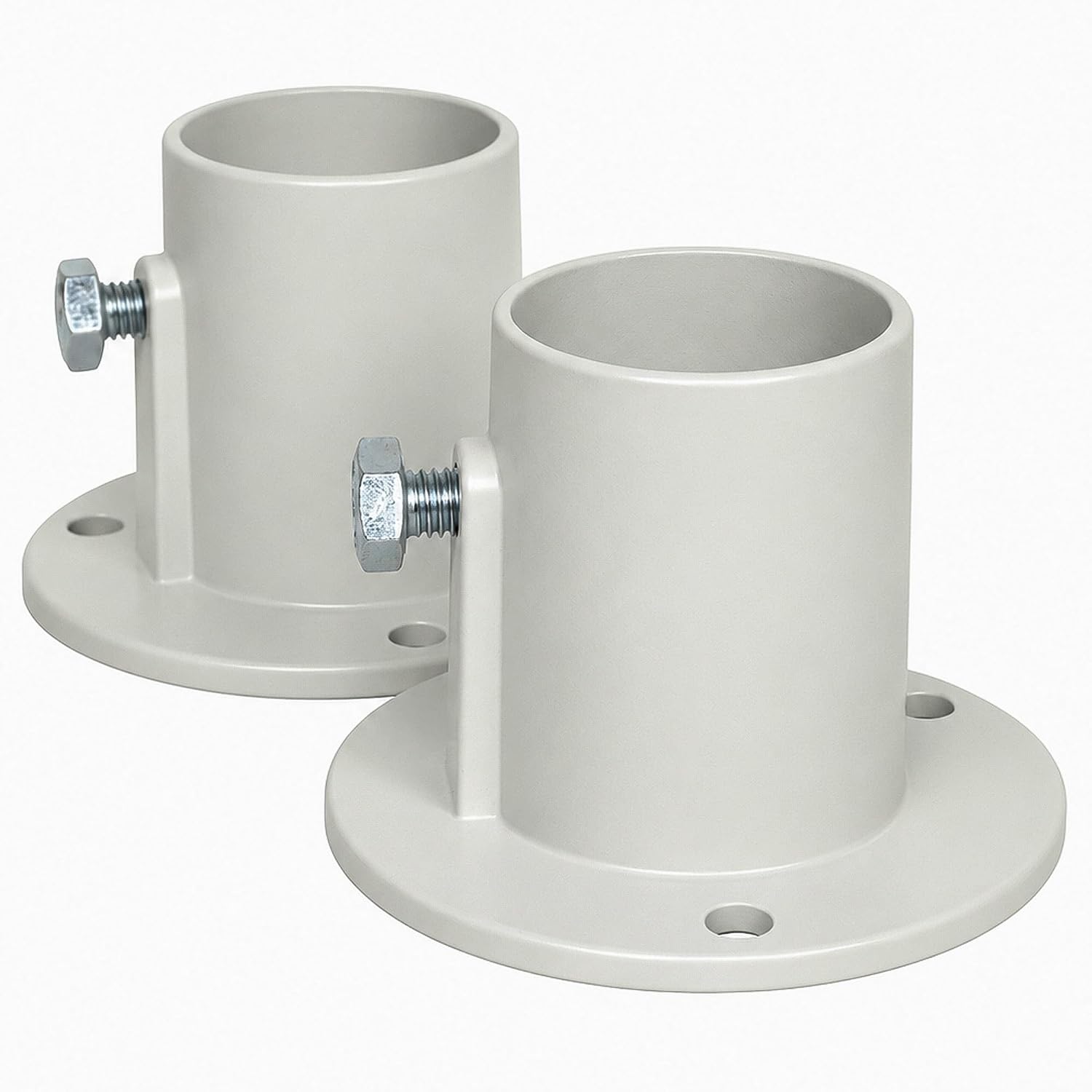
- Cast aluminum, white finish
- 1.5-inch inner diameter; 3.25-inch outside diameter x 2.5-inch high
- Two flanges; pole-mounting hardware included, deck screws sold separately

- Cast aluminum replacement flange
- For ladder rails up to about 1.5-inch outside diameter
- Sold individually; about 2.5 inches high

- 1 7/8-inch rail opening
- 5.2 inches wide x 3.5 inches high
- Two cast-aluminum flanges with bolts and washers

- Fits 1 7/8-inch outside-diameter tubing
- Four-flange package
- Four-hole base; 1/4-inch deck bolts are not included

- 1.5-inch opening
- 3.3 inches wide x 2.4 inches high
- Two cast-aluminum flanges with side locking bolts

- 1.5-inch opening
- 2.36 inches wide x 3.15 inches high
- Two white flanges with locking screws

- 304 stainless steel with white protective coating
- Fits 38 mm / 1.5-inch ladder tubing
- Two flanges with side adjustment screws
What to Look for When Buying a Pool Ladder Flange
Match the Rail Outside Diameter First
The opening in the flange must match the outside diameter of the ladder or handrail tube. A 1.5-inch flange and a 1 7/8-inch flange are not close substitutes. The difference is large enough that a smaller rail can remain loose in an oversized socket even if a side screw is tightened, while a larger rail simply will not fit into a smaller opening.
Measure the metal or plastic rail itself, not an escutcheon ring, trim cover, paint buildup, or an old flange. If the tube measures close to 38 mm, that is approximately 1.5 inches. Tubing marketed as 1 7/8 inches is roughly 47.6 mm. Some pool handrail products are also described as 1.9-inch tubing, so check the actual measurement instead of relying only on category names.
Check the Base Footprint and Hole Pattern
A replacement flange can have the correct tube opening and still be inconvenient if the base does not cover or align with the previous holes. Compact 1.5-inch mounts may use three deck holes, while larger cast-aluminum models often use four. A wider base can spread load across more deck area, but it also occupies more space and may interfere with coping, trim, or an edge board.
If you are replacing an existing flange, measure the outside width of the old base and the center-to-center spacing of its mounting holes. Reusing sound holes is often cleaner than drilling a new pattern, but never reuse damaged or enlarged holes merely to avoid deck work. The fastener must bite into structurally sound material below the flange.
Cast Aluminum vs Stainless Steel
Cast aluminum is common in above-ground pool ladder flanges because it can form a thick, rigid socket and broad base without excessive weight. Aluminum also performs well around water when the finish remains intact. It is a practical material for traditional ladder mounts that resemble the factory-style hardware supplied with many above-ground pool ladders.
Stainless-steel flanges can be slimmer and are useful where a compact bracket is preferred. The Hugexpen set specifically identifies 304 stainless steel, while the Screw Man listing identifies stainless steel without stating a grade. Stainless steel is corrosion resistant, not corrosion proof. Chlorine residue, salt, trapped moisture, scratches, and contact with dissimilar metals can still produce staining or corrosion over time, so periodic inspection remains sensible.
Understand What Hardware Is Included
Pool ladder flanges typically need two different kinds of fastening. One fastener or side screw secures the ladder rail inside the flange, while separate anchors or screws secure the flange base to the deck. Product listings do not always include both. For example, the Blue Wave set includes hardware for attaching the ladder poles to the flange but states that deck-mounting screws are sold separately. The ECOTRIC set includes rail hardware but says the four 1/4-inch deck bolts are not included.
Choose deck fasteners for the actual substrate: wood, composite, concrete, resin, or another material. Hardware that is suitable for pressure-treated lumber is not automatically suitable for concrete, and thin decking may require reinforcement beneath the surface.
Do Not Treat a Flange as a Structural Repair
A new flange can tighten a sound ladder installation, but it cannot make a damaged deck safe. If the old flange pulled out because the deck is soft, cracked, split, or badly corroded around the fasteners, repair the substrate before installing new hardware. Also inspect the ladder rails for cracks, bent tubing, worn holes, and corrosion at the point where the side locking bolt contacts the rail.
Blue Wave Cast Aluminum Pool Ladder Flanges for Above Ground Pools, 2-Pack
The Blue Wave set is a conventional two-flange replacement for above-ground, in-pool ladders with rails up to 1.5 inches in outside diameter. Its main advantage is that the Amazon listing gives unusually clear dimensional information: each flange has a 1.5-inch inner diameter, a 3.25-inch outside diameter, and a height of 2.5 inches. That makes it easier to compare with an existing mount before drilling.
Design and Build
Each flange is cast aluminum with a white, rust-resistant finish. The body is thicker and more substantial than a simple sheet-metal collar because it has to hold the vertical ladder rail while also transferring movement into the deck fasteners. The 3.25-inch base is compact enough for many above-ground deck layouts without being as narrow as some stainless-steel brackets in this guide.
Blue Wave sells the pair specifically for anchoring an in-pool ladder to a deck. The set includes two flanges, which matches the two rails used by a typical ladder. It also includes the hardware used to attach each ladder pole to its flange. The fasteners that attach the flange itself to the deck are not included, so those need to be selected for the deck material.
Important Specifications
- 1.5-inch inner diameter
- 3.25-inch outside diameter
- 2.5-inch flange height
- Cast aluminum construction
- Two flanges in the package
- Pole-mounting hardware included; deck screws not included
The 1.5-inch inner diameter is the most important number. If your ladder rail is closer to 1 7/8 inches, move to a larger flange rather than trying to force the rail into this socket. If the rail is substantially smaller than 1.5 inches, the side fastener should not be treated as a way to compensate for a major size mismatch.
Practical Use and Installation
The base is pre-drilled for surface mounting. Blue Wave lists compatibility with wood, composite, poured concrete, and resin or plastic deck surfaces, but the correct anchor changes with the substrate. On a wood deck, the screws need solid framing or adequately thick decking beneath the flange. On concrete, use anchors intended for concrete rather than ordinary wood screws.
During installation, set both flanges parallel to each other and confirm that the ladder rails enter without being forced sideways. A ladder that is pulled inward or outward to meet misaligned sockets can remain under constant stress and may loosen the deck fasteners over time. Tighten the rail-retaining hardware after the base mounts are secure and the ladder sits naturally.
Important Strengths
This model is easy to understand because it is a purpose-built 1.5-inch ladder flange supplied as a pair. The clear dimensions reduce guesswork, and the cast body provides a rigid socket around the rail. It also has a traditional white finish that visually blends with many above-ground ladders and resin decks.
Important Limitations
The main limitation is size. It is not a universal pool handrail anchor and should not be purchased for 1 7/8-inch or 1.9-inch rails. The deck screws are also a separate purchase. Finally, Blue Wave compatibility language should not replace measuring: even a rail described as “standard” can differ in outside diameter or use a different mounting layout.
Who Should Consider It
This set makes the most sense for an above-ground pool owner replacing both deck flanges on a 1.5-inch in-pool ladder, especially when a traditional cast-aluminum mount is preferred. It is also useful for a new installation where the deck can be drilled to match the flange rather than the flange having to match old holes.
Who Should Consider Another Option
Choose another option if the rail is 1 7/8 inches, if only one flange needs replacement, or if the old installation requires a different hole pattern. The Swimline single flange is more economical for a one-sided repair, while Poolzilla and ECOTRIC offer larger sockets for 1 7/8-inch rails.
Pros
- Two-piece set matches the two rails used by most above-ground in-pool ladders
- Cast aluminum body is more rigid than many molded plastic replacement flanges
- Amazon listing specifies a 1.5-inch inner diameter and gives full flange dimensions
- Pre-drilled base supports surface mounting on several common deck materials
Cons
- Deck-mounting screws are not included
- The 1.5-inch opening is not suitable for larger 1 7/8-inch or 1.9-inch rails
- Compatibility still depends on rail diameter, deck structure, and mounting-hole layout
Swimline Cast Aluminum Above Ground Pool Ladder Replacement Deck Flange
Swimline model 8702 is the straightforward single-flange option in this group. It is sold individually rather than as a pair, which is useful when one existing flange is damaged and the other remains serviceable. Swimline identifies it as an aluminum deck flange for pool ladder installation, and retailer documentation specifies compatibility with above-ground ladder rails measuring 1.5 inches in outside diameter or less.
Design and Build
The part uses cast aluminum and a white finish. Its overall shape is the familiar socket-on-base design used for surface-mounted above-ground ladder rails. The Amazon listing states a height of 2.5 inches and describes the rail size as 1.5 inches. Because the listing uses the word “circumference” for that 1.5-inch figure, it is better to rely on the manufacturer and retailer compatibility wording that describes 1.5-inch outside-diameter rails.
Compared with a two-pack, buying one flange avoids paying for a second part that may not be needed. The tradeoff is that a full new ladder installation needs two units. If the two sides of an old ladder are heavily weathered, replacing only one flange can also leave mismatched wear and hardware, so inspect both sides before deciding.
Important Specifications
- Swimline part 8702
- Cast aluminum construction
- For above-ground ladder rails up to about 1.5-inch OD
- About 2.5 inches high
- Sold individually
This is a 1.5-inch class flange, not a 1 7/8-inch handrail anchor. The difference matters because larger handrail tubing is common around in-ground pools and some heavy-duty pool-entry systems. Measure the tube at a clean, round section above the old flange before ordering.
Practical Use and Installation
A single replacement works best when the new flange can occupy the same footprint and the old deck holes are still structurally sound. Compare the hole layout before removing the existing part if possible. If the old flange failed because a screw pulled through the deck, move beyond simple part replacement and repair the deck material or add proper backing.
Once mounted, the ladder rail should sit straight in the socket without rocking. The deck fasteners should clamp the flange evenly; overtightening one side against an uneven surface can distort the installation or cause the base to sit crooked.
Important Strengths
The strongest reason to choose this Swimline part is that it is a known replacement component from an established pool-equipment manufacturer and is sold one at a time. That is convenient for maintenance rather than a complete ladder rebuild. Aluminum construction also avoids the flexibility found in some inexpensive molded-plastic flanges.
Important Limitations
Because it is sold individually, the apparent purchase price should not be compared directly with two-packs or four-packs without accounting for quantity. It is also limited to approximately 1.5-inch rails. Buyers replacing a wider handrail or slide rail should look at the 1 7/8-inch Poolzilla or ECOTRIC options instead.
Who Should Consider It
This is a practical choice for replacing one worn or broken flange on a Swimline-style above-ground ladder or another ladder with a rail no larger than 1.5 inches. It is especially useful when the existing installation already uses a similar cast-aluminum socket and base.
Who Should Consider Another Option
Choose a pair if both sides need replacement, and choose a larger-diameter flange for 1 7/8-inch rails. If corrosion resistance and a slim bracket are more important than matching a traditional cast flange, the stainless-steel Screw Man or Hugexpen sets may be more relevant.
Pros
- Simple single-flange replacement for a damaged deck mount
- Official Swimline part 8702 uses corrosion-resistant aluminum construction
- Useful when only one side of an existing ladder mount needs replacement
- Compatible with common above-ground ladder rails at or below 1.5-inch OD
Cons
- Sold individually, so a full two-rail installation requires two flanges
- Not intended for 1 7/8-inch or 1.9-inch handrail tubing
- Mounting hardware and deck condition still need to be checked separately
Poolzilla 2-Pack Deck Anchor Flange in White, 1 7/8 Inch
The larger Poolzilla flange is built for 1 7/8-inch ladder or handrail posts. That immediately separates it from most above-ground ladder flanges, which commonly target 1.5-inch rails. The wider socket and larger base make it useful for heavier rail tubing, but they also mean it occupies considerably more deck area.
Design and Build
Poolzilla specifies a cast-aluminum body with a white finish. Each flange measures about 5.2 inches wide and 3.5 inches high. The base uses four pre-drilled mounting holes, and the two-pack includes bolts and washers for securing the rail in the flange. This is a substantially larger footprint than the company’s 1.5-inch version, which measures about 3.3 inches wide.
The larger base can be helpful when a sturdy mounting surface is available because it spreads the connection across more deck area. It is not automatically better, however. Near a pool edge or narrow deck board, a 5.2-inch footprint may be difficult to position without crossing seams or hanging over an edge.
Important Specifications
- 1 7/8-inch rail opening
- 5.2-inch overall flange width
- 3.5-inch height
- Cast aluminum construction
- Four pre-drilled base holes
- Two flanges with rail bolts and washers
The critical fit is the 1 7/8-inch opening. This corresponds to tubing of roughly 47.6 mm outside diameter. Do not confuse it with 1.5-inch ladder rails simply because both are common around pools. The rail should fit the socket closely enough for the side bolt to retain it without using makeshift spacers.
Practical Use and Installation
Four mounting holes give the installer multiple fastener points, but the deck beneath all four must be structurally sound. When replacing a smaller flange, expect the hole pattern to change. Fill or repair abandoned holes properly rather than leaving open penetrations where water can reach wood framing or collect beneath the new base.
The included bolt and washers simplify rail retention, but they do not remove the need to select suitable deck anchors. Dry-fit the flange, rail, and ladder position before drilling. The wider base should sit fully supported and flat, not partly on coping, trim, a board gap, or a raised screw head.
Important Strengths
This is one of the clearest choices in the guide for 1 7/8-inch tubing because both the Amazon listing and Poolzilla product information identify that diameter. The large base, cast aluminum construction, and two-piece pack suit paired ladder rails or handrails where both sides are being installed together.
Important Limitations
Its size is also its main drawback. It is unsuitable for 1.5-inch rails and can be too wide for tight deck layouts. The four-hole mounting pattern may require fresh drilling even if an older flange already exists. Buyers should also distinguish this ASIN from Poolzilla’s visually similar 1.5-inch version.
Who Should Consider It
Consider this set for a pool ladder or handrail with verified 1 7/8-inch tubing and enough flat deck area for a 5.2-inch base. It is particularly sensible when both rails need matching new mounts.
Who Should Consider Another Option
If the rail measures 1.5 inches, use a correctly sized flange instead. If you need four large-diameter mounts rather than two, the ECOTRIC four-pack can reduce the need to buy multiple pairs.
Pros
- Sized for larger 1 7/8-inch ladder and handrail tubing
- Wide 5.2-inch base gives more deck contact area than compact 1.5-inch flanges
- Two-flange package suits a paired ladder or handrail installation
- Cast aluminum construction with included pole bolts and washers
Cons
- Too large for typical 1.5-inch ladder rails
- Its wider footprint may not line up with holes from a smaller existing flange
- Deck fasteners and the condition of the deck substrate still need separate verification
ECOTRIC 1 7/8-Inch Cast Aluminum Deck Anchor Flange, 4-Pack
ECOTRIC targets the same larger tubing class as the 1 7/8-inch Poolzilla flange but supplies four mounts instead of two. That makes the package relevant for two ladders, a ladder plus handrail, a multi-rail entry setup, or an installation where keeping identical spare flanges is useful. The listing states that the socket is intended for tubing with a 1 7/8-inch outside diameter.
Design and Build
The flanges are cast aluminum and designed for surface mounting. Each base is symmetrically pre-drilled for four deck fasteners. The listing specifies 1/4-inch mounting bolts for those base holes but states that those bolts are not included. The rail-retaining arrangement uses a bolt through holes near the upper part of the socket.
One practical detail is the difference between package hardware and complete installation hardware. ECOTRIC includes the four flanges and the hardware shown with the product, but the listing explicitly warns that additional hardware may be required. That is important for concrete decks, thick composite systems, or wood decks where longer fasteners or structural backing may be necessary.
Important Specifications
- Fits 1 7/8-inch outside-diameter tubing
- Four cast-aluminum flanges per package
- Four pre-drilled base holes per flange
- Base holes intended for 1/4-inch mounting bolts
- Deck-mounting bolts are not included
- Instructions included
The Amazon title also references 1.9 inches, while the feature text specifies 1 7/8-inch outside-diameter tubing. Because those figures are close but not identical, measuring the actual rail is important. The safest purchasing approach is to match the physical tube diameter to the stated 1 7/8-inch socket rather than assuming every 1.9-inch-labeled rail will fit identically.
Practical Use and Installation
The four-pack is most useful when consistency matters across several mounting points. Using the same flange design keeps socket height and base geometry uniform. During layout, orient each flange so the through-bolt or retaining holes line up in a practical direction and do not interfere with the deck edge.
Because the deck bolts are not included, choose corrosion-resistant hardware appropriate for the substrate. The flange can only transfer load into the fasteners and deck below it; a four-hole base does not help if those holes are drilled into weak material.
Important Strengths
Pack quantity is the major advantage. Four matching 1 7/8-inch flanges can be useful for larger projects and may simplify future maintenance because a spare remains on hand. The listing also provides specific mounting information rather than relying on a vague “universal” description.
Important Limitations
This is not the right choice for ordinary 1.5-inch above-ground ladder rails. Buyers also need to supply the 1/4-inch deck bolts, and the listing notes that additional hardware may be required. The 1.9-inch wording in the title should be treated cautiously against the more specific 1 7/8-inch feature description.
Who Should Consider It
The ECOTRIC pack is suitable for verified 1 7/8-inch rails when more than two flanges are needed or when matching spares are desirable. It can also make sense for a pool area with separate ladder and handrail assemblies that use the same tubing diameter.
Who Should Consider Another Option
For a single two-rail installation, a two-pack can be simpler. For 1.5-inch rails, choose a smaller socket. If the existing deck has a compact three-hole pattern, this four-hole base will likely require a new drilling layout.
Pros
- Four-piece pack is useful for two ladders, multiple rails, or keeping matched spares
- Listing specifies 1 7/8-inch outside-diameter tubing compatibility
- Cast aluminum surface-mount design suits ladders, handrails, and similar pool rails
- Base is pre-drilled for four deck fasteners
Cons
- Deck-mounting bolts are not included
- The listing notes that additional hardware may be required
- Not suitable for 1.5-inch tubing without a correctly engineered adapter
Poolzilla 2-Pack Deck Anchor Flange in White, 1 1/2 Inch
Poolzilla’s smaller deck anchor flange is intended for 1.5-inch ladder and rail tubing. Although it shares the same general cast-aluminum construction as the company’s 1 7/8-inch product, the dimensions and mounting pattern are different enough that the two versions should be treated as separate parts rather than interchangeable sizes.
Design and Build
The 1.5-inch version measures about 3.3 inches wide and 2.4 inches high. Its base uses three pre-drilled mounting holes. The two-pack includes the flanges and rail-retaining bolts. This compact geometry can work well on above-ground pool decks where space around the coping is limited.
The Amazon listing contains inconsistent color wording in one bullet while the product title identifies the white version. The ASIN and dimensional information are more useful identifiers than generic color text. If finish matching is important, compare the listing image and selected variation before purchase.
Important Specifications
- 1.5-inch socket diameter
- 3.3-inch overall width
- 2.4-inch height
- Cast aluminum construction
- Three pre-drilled mounting holes
- Two flanges in the package
These dimensions put it in the same general rail-size category as the Blue Wave, Swimline, Screw Man, and Hugexpen options. The meaningful differences are base width, hole count, material, and package hardware. A 1.5-inch measurement alone does not guarantee that the new base will reuse old holes.
Practical Use and Installation
Three-hole mounting can be convenient on a smaller base because it reduces the number of deck penetrations. The tradeoff is that a deck previously drilled for a four-hole flange will not align. Dry-fit the new flange over the existing area and make sure any unused holes are repaired or sealed appropriately.
The compact base should be seated on a flat, solid surface. Avoid positioning one mounting ear over a deck-board edge or gap. After fastening the base, insert the rail fully and tighten the retaining bolt so the tube is secure without deforming thin-wall tubing.
Important Strengths
This model combines a common 1.5-inch socket with cast-aluminum construction and a two-piece package. It is smaller than the 1 7/8-inch Poolzilla flange, making it more practical where deck space is limited. The two-pack also avoids mixing different flange heights or finishes on the two rails of one ladder.
Important Limitations
It cannot replace the larger Poolzilla flange simply because both look similar. The three-hole base may also complicate replacement of a four-hole mount. Buyers should verify the selected white variation because listing text can show variant-related inconsistencies.
Who Should Consider It
This set suits a 1.5-inch above-ground ladder or handrail where a compact cast-aluminum pair is preferred. It is especially relevant for installations where the 3.3-inch base fits the available deck area better than a 5.2-inch large-rail flange.
Who Should Consider Another Option
Use the larger Poolzilla or ECOTRIC flange for 1 7/8-inch tubing. If only one flange is damaged, a single Swimline replacement may reduce unused parts. If you prefer stainless steel, the Screw Man and Hugexpen sets offer 1.5-inch alternatives.
Pros
- Compact size is suited to common 1.5-inch above-ground pool ladder rails
- Two-piece package covers both ladder rails in a typical installation
- Cast aluminum body offers a rigid replacement for many plastic deck mounts
- Three-hole base is useful where a compact mounting footprint is preferred
Cons
- Not interchangeable with the larger Poolzilla 1 7/8-inch version
- A three-hole base may not match an existing four-hole deck pattern
- Listing text varies on finish details, so match by ASIN and dimensions rather than color wording alone
Screw Man 1 1/2-Inch Stainless Steel Deck Anchor Flange, 2-Pack
The Screw Man set changes the construction style from thick cast aluminum to a more compact stainless-steel flange. It is intended for 1.5-inch pool ladder handles, rails, and similar tubing. The listing specifies a flange width of about 2.36 inches and a height of about 3.15 inches, so it is narrower but taller than several cast-aluminum options.
Design and Build
Each flange uses a three-hole deck-mount pattern and a side locking screw for the rail. The package includes two white flanges and two locking screws. The product listing identifies the material as stainless steel but does not state a stainless grade, so it is best to describe it simply as stainless steel rather than assuming 304 or 316 construction.
The smaller base can be helpful where there is limited space around the ladder rail. It can also be a disadvantage on a deck with old holes from a larger flange because the new base may not cover them. Measure the previous footprint before removing the old hardware if appearance matters.
Important Specifications
- 1.5-inch socket diameter
- About 2.36 inches wide
- About 3.15 inches high
- Stainless-steel construction
- Three pre-drilled mounting holes
- Two flanges and two locking screws
The socket diameter places it in the 1.5-inch group, but the proportions are different from the cast-aluminum Blue Wave and Poolzilla products. This is a good example of why matching the tube diameter is only the first step. The deck footprint and mounting-hole pattern still determine how cleanly it can replace an existing bracket.
Practical Use and Installation
Align the three base holes over solid deck material, then select fasteners suitable for that surface. The side locking screw should contact the ladder rail squarely. If the rail can rock significantly before the screw is tightened, recheck the measured tube diameter rather than relying on the screw to draw an undersized rail against one side of the socket.
Stainless steel should be rinsed periodically if the pool uses salt chlorination or if concentrated pool chemicals splash onto the bracket. Surface deposits can retain chlorides and create staining even on corrosion-resistant metal.
Important Strengths
The narrow stainless format is useful for buyers who want a compact two-flange set for 1.5-inch tubing. Three deck holes keep the base simple, and the side locking screw provides direct rail retention. The dimensions are clearly stated in the listing, making pre-purchase comparison easier.
Important Limitations
The listing does not identify the stainless alloy. Its 2.36-inch width also means it provides less base coverage than broad cast-aluminum flanges, so it may expose previous holes or deck discoloration. It is not a replacement for 1 7/8-inch handrail anchors.
Who Should Consider It
Consider this set for a 1.5-inch ladder or handrail where a compact stainless-steel bracket is desirable and the three-hole base fits the deck layout. It is particularly relevant when the existing flange is also narrow.
Who Should Consider Another Option
If you specifically want a listed 304 stainless grade, the Hugexpen set provides that detail. If you need a broader cast base or a more traditional above-ground ladder appearance, Blue Wave or Poolzilla may fit the project better.
Pros
- Stainless-steel construction provides a different material option from cast aluminum
- Two-piece set is sized for 1.5-inch ladder or railing tubing
- Three pre-drilled deck holes simplify layout for a compact base
- Side locking screws secure the rail inside the flange
Cons
- Smaller 2.36-inch base offers less footprint than wide cast-aluminum 1 7/8-inch mounts
- Not compatible with larger 1 7/8-inch tubing
- The listing does not identify the stainless-steel grade, so material claims should not be extended beyond what is stated
Hugexpen 2-Pack 1.5-Inch 304 Stainless Steel Pool Ladder Deck Flanges
The Hugexpen pair is another compact 1.5-inch stainless-steel option, but its listing goes further by identifying the material as 304 stainless steel. The bracket is coated white and uses an adjustable side screw to secure the ladder rail. The listing specifies compatibility with 38 mm, or 1.5-inch, above-ground pool ladder tubing.
Design and Build
The 304 stainless body is covered with a white waterproof coating intended to resist oxidation and corrosion in outdoor pool environments. Coating can also help the bracket visually match white above-ground pool ladders. As with any coated metal part, scratches around screws and deck fasteners should be inspected because damage can expose the metal and create sites where staining begins.
A side screw tightens the rail in the socket. This is convenient for installation, but it still assumes the rail is the correct nominal size. The bracket should not be used as an adjustable clamp for tubing that is substantially smaller than 1.5 inches.
Important Specifications
- 304 stainless-steel construction
- White protective coating
- Fits 38 mm / 1.5-inch ladder rails
- Two flanges in the package
- Side adjustment/locking screw
The 38 mm metric figure is helpful because it confirms the intended rail class. A true 38 mm tube is about 1.496 inches, essentially the 1.5-inch size used by many above-ground pool ladders. It remains different from 1 7/8-inch tubing, which is almost 10 mm larger in diameter.
Practical Use and Installation
Before drilling, position both ladder rails in the brackets and confirm that the ladder sits square to the deck. Mark the deck holes only after the rail spacing is correct. Use deck anchors appropriate for the substrate and tighten them evenly so the flange bases sit flat.
After installation, check the side screws periodically. Repeated ladder movement can loosen mechanical fasteners over time, particularly if the deck flexes. A quick seasonal inspection should include the deck screws, rail-retaining screws, coating condition, and the rail itself.
Important Strengths
The clearest advantage is material identification: the listing specifies 304 stainless steel rather than using a generic stainless label. The 1.5-inch compatibility is also clearly stated in both inches and millimeters. For buyers comparing compact metal brackets, that reduces uncertainty.
Important Limitations
A stainless-steel bracket is not automatically the correct mechanical replacement for a cast-aluminum flange. Base dimensions and hole patterns may differ, and the smaller footprint may not cover the previous mounting area. The white coating can also be scratched during installation if tools slip.
Who Should Consider It
This set is suited to 38 mm / 1.5-inch rails where a compact 304 stainless-steel bracket is preferred. It is useful for replacing a similar narrow flange or for a new deck installation where the hole layout can be chosen freely.
Who Should Consider Another Option
Choose a cast-aluminum model if you want a broader traditional base or need to match an existing aluminum flange. For 1 7/8-inch rails, the Poolzilla large flange or ECOTRIC four-pack is the correct size family.
Pros
- Listing specifically identifies 304 stainless steel
- Sized for 38 mm / 1.5-inch above-ground pool ladder rails
- Side screw lets the rail be tightened inside the flange
- White coating is intended to add moisture and oxidation protection
Cons
- Not intended for larger 1 7/8-inch or 1.9-inch tubing
- The compact bracket format may not cover old holes from a larger cast flange
- Coated stainless steel still needs periodic inspection around fasteners and scratches
Detailed Buying Guide for Pool Ladder Flanges
How to Measure a Pool Ladder Rail Correctly
Measure across the outside of the round tube, not around its circumference. A digital caliper is the simplest tool because it gives a direct outside-diameter reading. If you only have a ruler, place it across the widest part of the tube and read edge to edge. Remove loose paint, mineral buildup, or an escutcheon cover from the measurement point so the reading reflects the actual rail.
Common measurements in this group are about 1.5 inches and 1 7/8 inches. Those sizes should not be rounded into one another. A 1 7/8-inch rail is 0.375 inch larger than a 1.5-inch rail, so a flange made for one size is mechanically different from the other.
Why the Deck Material Matters
A flange is only the visible connector. The deck beneath it carries the load. On a wood deck, screws should enter solid, healthy lumber and often benefit from placement over framing or added blocking. Composite boards may require manufacturer-approved fasteners and backing because the surface board alone may not be intended to carry repeated ladder loads.
Concrete installations normally use masonry anchors sized for the hole, flange, and load. Resin or plastic decks may need through-bolts, backing plates, or specific reinforcement. Do not assume the screws used in the old flange are automatically appropriate for a new one, especially if the new base has more holes or a different footprint.
Three-Hole vs Four-Hole Bases
Neither pattern is inherently better for every deck. A four-hole base can distribute fastening around a wider perimeter, while a compact three-hole base can fit where deck space is tight. The stronger installation is the one that uses correct fasteners in sound material with the flange sitting fully supported.
For replacement work, hole pattern matters mainly because drilling additional holes can weaken a narrow board or leave old penetrations exposed. If the old holes are oversized or damaged, simply moving a new flange a small distance may not be enough. Repair the deck properly or add structural backing before relying on the ladder again.
Flange Height and Rail Engagement
A taller socket provides more vertical contact with the rail, but height alone does not determine stability. Rail diameter, socket fit, side-bolt position, base rigidity, and deck fastening all work together. For example, the Screw Man listing gives a height of about 3.15 inches, while the Blue Wave flange is about 2.5 inches high. Those numbers are useful for matching an existing installation, not for declaring one design universally stronger.
Side Screws, Through-Bolts, and Rail Retention
Most surface-mount pool ladder flanges need a way to stop the rail from lifting or rotating. Some use a side screw that presses against the tube. Others use a bolt through aligned holes. A through-bolt provides positive mechanical retention but requires the rail hole to line up correctly. A set screw is easier to adjust but should not be used to compensate for a badly undersized rail.
Inspect the rail where the screw contacts it. Thin-wall aluminum or stainless tubing can be dented by excessive tightening. Tighten enough to remove movement and follow the product instructions rather than using maximum force.
Replacing One Flange vs Replacing Both
If one flange breaks because of a localized impact and the other side is in good condition, a single replacement such as the Swimline can be practical. If both flanges are the same age and show cracking, corrosion, loose sockets, or enlarged deck holes, replacing the pair can create a more consistent installation.
Replacing both also avoids mixing socket heights or hole patterns. However, do not replace a sound original part solely for symmetry if doing so would require unnecessary new drilling into a limited deck surface. Inspect first and choose the least invasive sound repair.
Corrosion and Seasonal Maintenance
Pool hardware lives in a difficult environment: water, chlorine, salt, sun, temperature changes, and cleaning chemicals all reach the mounting area. Rinse hardware with fresh water if concentrated chemicals splash onto it. Keep debris from collecting around the base, and inspect for white aluminum oxidation, rust staining, coating damage, loose bolts, or cracks.
At the beginning of each swimming season, grasp the rail and apply moderate movement in several directions. The flange should not rock independently of the deck. If it does, determine whether the side screw, deck fasteners, flange body, rail, or deck substrate is moving. Tightening a screw without identifying the source can hide a structural problem temporarily.
Direct Product Comparisons
Blue Wave vs Swimline 1.5-Inch Cast Aluminum Flanges
Both target the common 1.5-inch above-ground ladder category and use cast aluminum. The Blue Wave package includes two flanges and publishes a 3.25-inch outside diameter and 2.5-inch height. The Swimline 8702 is sold individually and is useful for replacing one side. For a complete two-rail installation, compare the total quantity needed rather than the price of one Swimline flange against a Blue Wave pair.
The better fit depends on the existing base geometry. If your old flange closely resembles Swimline part 8702, a single direct replacement can minimize deck changes. If both sides need replacement and the 3.25-inch Blue Wave footprint fits the deck, the matched pair is more convenient.
Poolzilla 1 7/8-Inch vs ECOTRIC 1 7/8-Inch
These are the two large-rail options in the group. Poolzilla provides two cast-aluminum flanges with a 5.2-inch-wide, 3.5-inch-high body and four base holes. ECOTRIC provides four cast-aluminum flanges and specifies a four-hole base intended for 1/4-inch deck bolts, which are not included.
Choose based on project scale and footprint, not simply pack size. A single ladder usually needs two flanges, while a larger project may benefit from ECOTRIC’s four-pack. Poolzilla’s published base dimensions make it easier to pre-check available deck space.
Poolzilla 1.5-Inch vs Poolzilla 1 7/8-Inch
These products share branding and cast-aluminum construction but are physically different. The 1.5-inch version is about 3.3 inches wide and uses three deck holes; the 1 7/8-inch version is about 5.2 inches wide and uses four. The larger model should not be treated as a heavier-duty upgrade for a 1.5-inch rail because the socket itself is too large.
Screw Man vs Hugexpen Stainless-Steel Flanges
Both are two-piece sets for 1.5-inch rails and use compact stainless-steel brackets with side locking screws. The main documented distinction is material detail: Hugexpen specifies 304 stainless steel and a white protective coating, while Screw Man identifies stainless steel without stating a grade. Screw Man publishes dimensions of about 2.36 inches wide by 3.15 inches high.
For replacement, the base size and hole pattern may matter more than the stainless grade. Compare the old flange footprint first. If the new base is smaller, old holes can remain visible or require repair.
Cast Aluminum vs Stainless Steel for a 1.5-Inch Rail
Blue Wave, Swimline, and the smaller Poolzilla use cast aluminum; Screw Man and Hugexpen use stainless steel. Cast flanges typically have a thicker, more traditional socket and broader base. Stainless brackets can be slimmer and may fit tight areas. Neither material solves incorrect sizing or weak decking, so choose the geometry that fits the installation first, then consider material preference.
Common Buying Mistakes
Ordering by Appearance Instead of Diameter
Many ladder flanges look nearly identical in small product photos. A 1.5-inch flange and a 1 7/8-inch flange can share the same general shape while being completely incompatible. Measure the rail before comparing finishes or pack quantities.
Assuming All 1.5-Inch Flanges Share the Same Base
The Blue Wave, Poolzilla, Screw Man, Hugexpen, and Swimline options all belong to the 1.5-inch size family, but their bases differ in width, height, hole count, and construction. The socket size only confirms rail fit; it does not confirm deck-hole compatibility.
Forgetting Deck Fasteners
Some products include a rail bolt but not the anchors needed to fasten the flange to the deck. Read the package contents carefully and choose substrate-specific hardware before starting the job. Stopping mid-installation often leads to using whatever screws are available rather than the correct ones.
Mounting Over Damaged Deck Material
A new flange should not be used to cover soft wood, cracked resin, spalled concrete, or enlarged old holes. The base may look secure at first while the underlying fasteners continue to move. Repair or reinforce the deck so the mounting screws or anchors have sound material to hold.
Using the Side Screw as a Size Adapter
A retaining screw is meant to lock a correctly sized rail in place. It is not an adapter for a rail that is much smaller than the socket. Large gaps allow the rail to rock and put concentrated force on the screw, flange wall, and deck fasteners.
Ignoring Old Hole Locations
A smaller replacement base may expose old holes; a larger base may overlap a deck seam or coping edge. Measure the old footprint before ordering and plan how abandoned holes will be repaired or sealed.
Frequently Asked Questions
What size pool ladder flange do I need?
Measure the outside diameter of the ladder or handrail tube. The products in this guide are mainly for either 1.5-inch tubing or 1 7/8-inch tubing. Match the socket to the measured rail, then verify the base footprint and mounting-hole pattern.
Is 1 7/8 inch the same as 1.9 inches?
They are close, but not numerically identical. One and seven-eighths inches equals 1.875 inches. Some pool hardware is marketed using rounded 1.9-inch language, so check the manufacturer’s specific fit statement and measure the rail before ordering.
Can I use a 1 7/8-inch flange on a 1.5-inch pool ladder?
No, not as a normal direct fit. The gap is too large for a proper socket connection. Use a flange designed for the rail’s actual outside diameter unless a manufacturer provides a purpose-built adapter system.
Are pool ladder flanges universal?
No. Rail diameter, base width, flange height, mounting-hole count, hole spacing, and retention hardware can all differ. “Universal” category wording should never replace physical measurements.
Do pool ladder flanges come with deck screws?
Not always. Some sets include the bolt or screw that secures the ladder rail but do not include the hardware that anchors the flange to the deck. Select deck fasteners for wood, composite, concrete, resin, or the specific substrate you have.
Is cast aluminum or stainless steel better for pool ladder flanges?
Both can work well when correctly sized and installed. Cast aluminum is common for thick traditional ladder mounts, while stainless steel can support a slimmer bracket design. Fit, base geometry, fastener quality, and deck condition are more important than choosing material by name alone.
Can I replace only one pool ladder flange?
Yes, if only one flange is damaged and the other is still structurally sound. A single part such as the Swimline 8702 is useful for that situation. Inspect both sides because flanges installed at the same time often age together.
How many flanges does an above-ground pool ladder usually need?
A standard ladder with two rails normally uses two deck flanges. Handrail systems and larger entry assemblies may use a different number, so count the mounting posts on the actual equipment.
Can a new flange reuse old deck holes?
Only if the hole pattern aligns and the old holes are still structurally sound. Enlarged, split, corroded, or loose holes should be repaired rather than reused automatically.
How tight should the rail locking screw be?
Tighten it enough to secure the rail without crushing or visibly deforming the tubing. Follow the product instructions and recheck the fastener after initial use because hardware can settle.
Final Buying Considerations
The correct pool ladder flange starts with one measurement: the outside diameter of the ladder or handrail rail. For a 1.5-inch rail, the Blue Wave and Poolzilla cast-aluminum pairs provide traditional broad mounts, Swimline is useful as a single replacement, and the Screw Man and Hugexpen sets offer compact stainless-steel alternatives. For 1 7/8-inch tubing, the larger Poolzilla pair and the ECOTRIC four-pack are the relevant size family.
After diameter, compare the base footprint, number of deck holes, included rail hardware, and the fasteners required for your deck. A flange that fits the tube but cannot be anchored properly to the deck is not a suitable replacement. Measure first, inspect the deck structure, and choose the mounting geometry that matches the actual installation rather than relying on appearance or “universal” wording.
Author