
Pool railings look simple until you compare how they actually mount, how far they extend over the steps, and how their materials behave around chlorinated or saltwater pools. A compact surface-mounted grab rail may be ideal beside a spa or narrow deck, while a longer four-bend rail can provide a continuous handhold along several pool steps. The best fit depends less on appearance than on geometry, deck construction, corrosion exposure, and the way swimmers enter and leave the water.
This guide compares eight railings for swimming pools ranging from small stainless-steel grab rails to larger return-to-deck designs. Several use surface-mount base plates and include drilling hardware, while others are intended for traditional deck-anchor installations. There is also a polymer-composite SAFTRON model that takes a different approach to heat, corrosion, and electrical conductivity than exposed stainless steel.
Before ordering any rail, measure the deck area, the position of the first underwater step, the available mounting surface, and the distance a user needs a secure handhold. A rail can be the right size on paper but awkward in practice if its base overlaps coping, a cover track, a joint, thin pavers, or an unsuitable section of deck. Installation quality matters as much as the rail itself because the fasteners and substrate carry the load transferred through the handrail.
Quick Comparison of Railings for Swimming Pools
- Approx. 48 in long × 36 in tall
- 1.67 in stainless-steel tube
- Integrated 9.75 × 3.875 in mounting base
- Approx. 30 in long × 22 in tall
- Compact surface-mount footprint
- Screws, lead anchors and masonry bit included

- 304 stainless steel
- 250 lb stated load capacity
- 4 ft removable blue nylon grip cover

- 30 × 22 in compact format
- 304 stainless steel with blue grip cover
- Expansion fasteners included

- 55 in long × 32 in high
- 304 stainless steel construction
- 4 ft nylon grip plus mounting kit

- 304 stainless steel
- 375 lb stated load capacity
- Blue grip cover; concrete, wood or brick mounting options

- 50 × 36 × 8 in overall format
- 1.9 in stainless-steel tubing
- Deck anchors and escutcheons not included

- 48 in wide × 32 in high four-bend profile
- Reinforced polymer-composite construction
- Matching white escutcheons included
The table shows the biggest structural differences, but dimensions alone do not tell the whole story. A 55-inch rail can provide more hand-contact length along a sloped entry, yet it also needs more clear space and transfers leverage into its mounting base. A compact 30-inch rail takes less room and may suit a spa or short stair run, but it cannot provide the same continuous reach as a long four-bend design.
What to Look for When Buying Pool Railings
Rail shape and usable reach
Think about where the hand needs support, not just where the rail bolts to the deck. A short grab rail is useful when the main need is a steady handhold during the transition from deck to the first step. A longer angled or four-bend rail follows the path of the steps more closely and can keep a handhold available for a greater portion of the entry and exit movement.
Return-to-deck designs curve back toward the deck instead of terminating over the water. That can be useful around pool covers, wide step areas, or layouts where a lower rail end would interfere with the waterline or step space. The tradeoff is a larger footprint and more geometry to verify before drilling.
Mounting method and deck condition
Several rails in this guide use a surface-mount plate secured by expansion anchors or similar fasteners. This approach avoids cutting large anchor sockets into an existing slab, but it still depends on strong concrete, masonry, or properly supported wood beneath the base. Thin pavers, cracked concrete, loose coping, hollow decking, or a mounting point too close to an edge can compromise the installation even when the rail itself is strong.
Traditional anchor-mounted rails such as the Aqua Select format may fit existing deck sockets or can be installed with separate anchors. That style can look clean and makes removal possible when the anchor system is designed for it, but the anchors and escutcheons may be separate purchases. Measure the rail spacing and verify anchor compatibility before assuming an older set of sockets will fit a new rail.
Stainless-steel grade and pool chemistry
“Stainless steel” is not a single material specification. Several products here explicitly use 304 stainless steel, which is common for pool hardware, but 304 can be more vulnerable to staining or corrosion in aggressive chloride environments than 316 stainless steel. VEVOR specifically warns buyers of its 304 model to consider 316 stainless or another material for saltwater pools.
Pool chemistry, splash concentration, coastal air, cleaning chemicals, and how often the rail is rinsed can all influence corrosion. Even stainless steel benefits from regular fresh-water rinsing and periodic cleaning. If a listing does not state the steel grade, as with the FibroPool US product page, do not assume it is 304 or 316 based only on appearance.
Grip covers, surface temperature and hand comfort
Blue nylon grip sleeves appear on the VEVOR, Coocure, Migoda, and Garvee-style rails. A cover can improve traction when wet and reduce direct contact with metal that has heated in strong sun. It is also another component to maintain: fabric or nylon covers can collect sunscreen, dirt, moisture, and pool chemicals, so they should be inspected and cleaned rather than left permanently damp.
The SAFTRON rail approaches heat differently by using a high-impact polymer exterior instead of an exposed stainless-steel gripping surface. That design is intended to remain more comfortable in sun and avoids the metallic surface entirely. Buyers who dislike grip sleeves may prefer that construction, although the rail has a substantially different material system and mounting considerations.
Tube diameter, base size and leverage
Tube diameter affects grip feel and also hints at the scale of a rail. FibroPool lists a 1.67-inch tube on its large and small quick-mount models, while VEVOR lists a 1.9-inch tube for its 48 × 36 model and Aqua Select also lists 1.9-inch tubing. Larger is not automatically better; hand size, grip strength, local code requirements, and mounting rigidity all matter.
Long rails create more leverage at the base than short rails. That makes correct anchor placement, fastener torque, edge distance, and substrate strength especially important on 48- to 55-inch models. If the deck is questionable, repairing or reinforcing the mounting area before installation is more sensible than relying on larger fasteners alone.
Load ratings and what they do not mean
Some manufacturers publish a load capacity, while others do not. VEVOR states 250 pounds for its 48 × 36 rail, and the Garvee listing states 375 pounds for its 55 × 32 model. Those figures are useful for comparing the products as listed, but they do not guarantee that every installation will support the same force because the deck, anchors, fastener pattern, installation quality, and direction of loading also matter.
Do not invent a load rating for a model that does not publish one. For a rail intended for frequent high-load assistance, commercial use, or an accessibility requirement, verify the complete installed system against the applicable code or professional specification rather than relying only on a retail listing.
FibroPool Large Pool Handrail
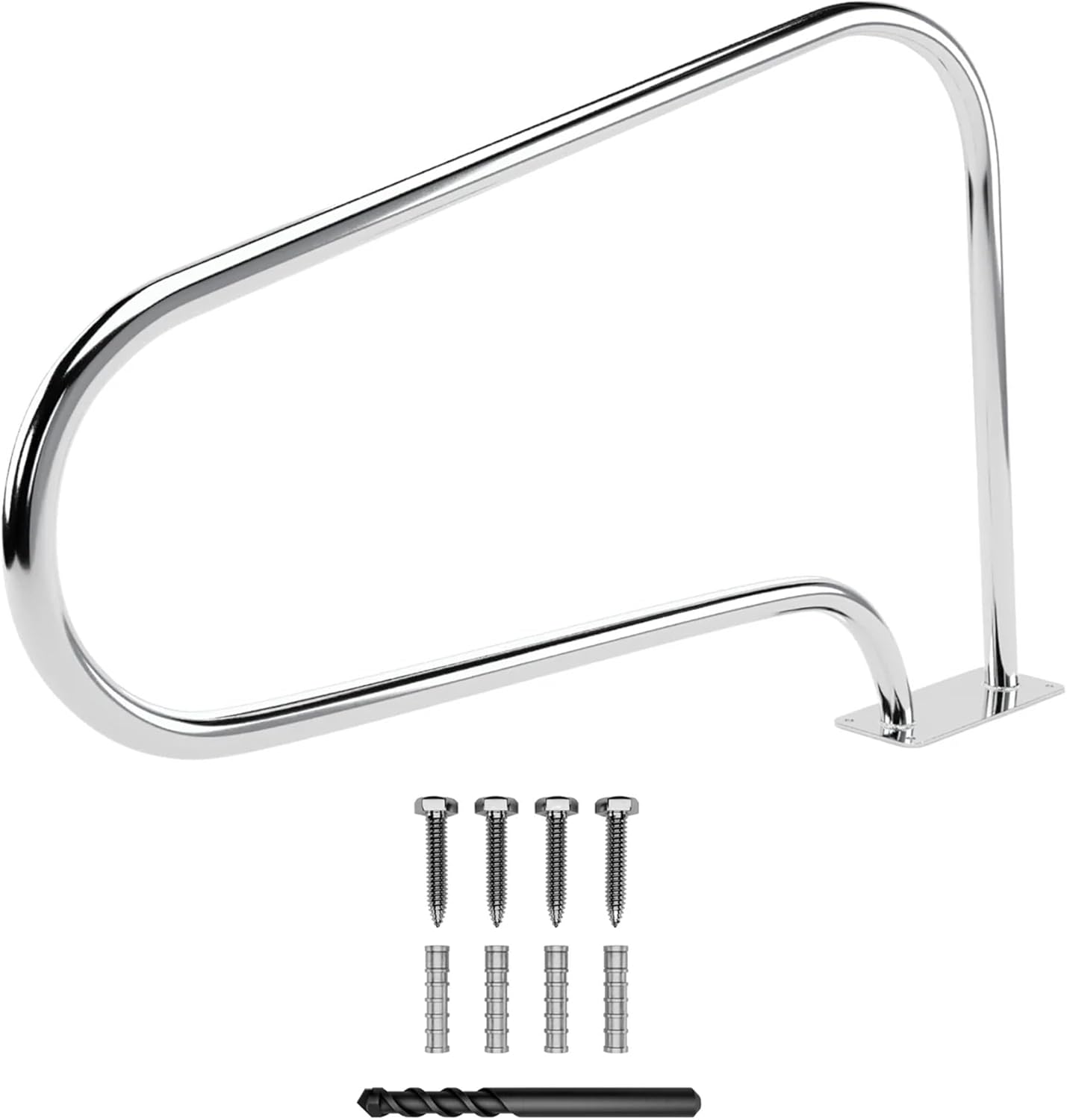
FibroPool’s large quick-mount rail is built around a simple idea: provide a long, curved stainless-steel handhold without requiring traditional in-deck anchor sockets. The official product information gives approximate dimensions of 48 inches long by 36 inches tall, with a 1.67-inch tube diameter. That makes it one of the longer surface-mounted rails in this comparison, but its base remains relatively compact.
Design and Build
The rail uses an all-stainless-steel construction and a polished surface. FibroPool lists the integrated base plate at approximately 9 3/4 inches by 3 7/8 inches. That narrow rectangular footprint can help when deck space is limited, yet it concentrates the installation forces into a relatively small area, so the condition and thickness of the deck under the plate deserve attention.
The curved profile extends from the deck toward the pool and provides a long upper gripping section. Compared with the smaller FibroPool model, the extra length and height give the hand more travel as a swimmer moves toward the water. It is still a single rail rather than a paired stair system, so its placement relative to the steps is crucial.
Important Specifications
- Approximate rail size: 48 in long × 36 in tall
- Tube diameter: approximately 1.67 in
- Base plate: approximately 9 3/4 in × 3 7/8 in
- Construction: stainless steel with polished finish
- Included hardware: four 2 1/4 in screws, four lead anchors, and a 1/2 in masonry drill bit
The manufacturer does not state a stainless-steel grade on its current US product page. That is an important distinction for buyers with saltwater pools or unusually aggressive water chemistry, where knowing whether a rail is 304, 316, or another alloy may influence the purchase.
Installation and Practical Use
FibroPool’s surface-mount approach is attractive for an existing concrete deck because it avoids installing large anchor sockets. The supplied masonry bit and lead anchors cover the basic concrete-drilling hardware, while the installer still needs an appropriate hammer drill, wrench, measuring tools, and a structurally sound mounting area. A template and careful marking help prevent a base that is slightly twisted relative to the pool edge.
The long rail gives users more opportunity to establish a grip before stepping down. At the same time, a long rail can amplify movement at the base if the anchors are not seated correctly. After installation, periodically check for looseness and inspect the base area for cracks or movement instead of assuming the fasteners will remain unchanged indefinitely.
Important Strengths
Its main advantage is the combination of a long reach and an integrated surface-mount base. Buyers who do not want to source separate deck sockets receive the core mounting hardware in the package. The 1.67-inch tube is also slightly narrower than the 1.9-inch tubing used on several larger alternatives, which some users may find easier to wrap a hand around.
Important Limitations
The listing does not provide the same published load-capacity figure seen on the VEVOR or Garvee models, and the stainless-steel grade is not specified on FibroPool’s US page. Buyers who require a documented load rating, 316 stainless steel, or a saltwater-specific material should verify those requirements before choosing this model.
The compact base is useful for space, but it should not be treated as permission to install close to a weak slab edge or over decorative material that is not designed to take structural anchor loads. The strongest rail is only as stable as the deck connection beneath it.
Who Should Consider It
This model makes sense for a conventional inground pool with a sound concrete or appropriately supported deck where a relatively long handhold is wanted and surface mounting is preferred. It is particularly relevant when a small base footprint matters but a short spa-style grab rail would not provide enough reach.
Pros
- Long 48 × 36 in format provides more reach than compact grab rails
- Integrated quick-mount base avoids separate deck sockets
- Includes screws, lead anchors and a masonry drill bit
- 1.67 in tube is slimmer than many 1.9 in rails
Cons
- Stainless-steel grade is not specified on the current US manufacturer page
- No published load-capacity figure in the verified product information
- Long rail places meaningful leverage on a relatively compact base
FibroPool Easy Mount 30 × 22 in Pool Rail
The smaller FibroPool rail uses the same quick-mount concept as the large model but reduces the overall reach for compact pool and spa areas. FibroPool lists it at approximately 30 inches long and 22 inches tall, with the same 1.67-inch tube diameter and 9 3/4 by 3 7/8-inch base plate used on the larger version.
Design and Build
A shorter rail can be the better physical fit when the deck is narrow, the entry has only a few steps, or the handhold is needed mainly at the deck edge. It also reduces the amount of metal projecting over the pool compared with a 48- or 55-inch design. The tradeoff is less continuous support once the user moves farther down the stairs.
The rail is stainless steel with a polished finish, but the current FibroPool US page does not identify the alloy grade. For a standard chlorinated residential pool that may not be a deciding factor for every buyer, but saltwater owners should not assume salt compatibility from the phrase “stainless steel” alone.
Important Specifications
- Approximate size: 30 in long × 22 in tall
- Tube diameter: approximately 1.67 in
- Base plate: approximately 9 3/4 in × 3 7/8 in
- Four 2 1/4 in screws and four lead anchors included
- 1/2 in masonry drill bit included
The hardware package is a practical advantage because the drill-bit size and supplied anchors are intended to work together. The installer still needs to confirm that the deck material and thickness are suitable for that anchoring method. Wood decks may require different structural backing and fasteners than a concrete slab.
Practical Use
This is closer to a grab rail than a long stair-following rail. That distinction matters: it can give a user a firm point to hold while stepping onto or off the first step, but someone who needs support through several submerged steps may prefer a longer angled model such as the VEVOR, Migoda, or Garvee designs.
Its smaller height can also be useful beside a spa, where a 36-inch-tall pool rail might feel oversized. On the other hand, a taller user or a deep first step may benefit from a rail that rises farther above the deck and reaches farther toward the water.
Installation
The official instructions described by FibroPool require a hammer drill, wrench, and measuring tape. Because the base dimensions match the large model, the compact rail does not necessarily need a smaller mounting plate; instead, the savings are mainly in overall rail size. Marking the four anchor holes accurately and keeping the plate flat on the deck will have more effect on final rigidity than rushing the drilling step.
Who Should Consider It
The small FibroPool rail is a logical option for spas, small inground pools, or deck layouts where a 48- to 55-inch rail would intrude into the walking area. It also suits buyers who want a straightforward surface-mounted stainless rail but do not need a published high load-capacity claim.
Who Should Consider Another Option
Choose a longer design if the handhold needs to remain available through several pool steps. Saltwater owners should also look closely at a 316 stainless or nonmetallic alternative if material compatibility is a priority, since FibroPool does not specify the stainless grade for this model on its US page.
Pros
- Compact 30 × 22 in format fits tighter deck areas
- Same integrated quick-mount base concept as the larger FibroPool rail
- Includes concrete anchors, screws and a masonry drill bit
- 1.67 in tubing offers a relatively manageable grip diameter
Cons
- Shorter reach provides less continuous support down a longer stair run
- Stainless-steel grade is not specified in the verified US product information
- No verified published load rating for this model
VEVOR 48 × 36 Pool Rail
VEVOR’s 48 × 36-inch rail is one of the more fully specified products in this group. The manufacturer identifies 304 stainless steel, a 250-pound load capacity, an 18.5-pound product weight, 1.9-inch tubing, and a detachable 4-foot nylon grip cover. It is a larger surface-mounted design intended to give a long handhold alongside pool steps.
Design and Build
The rail uses 304 stainless steel with 0.08-inch tube-wall thickness and a 0.16-inch base thickness according to VEVOR. A 1.9-inch tube is noticeably larger in the hand than FibroPool’s 1.67-inch tube. That can feel substantial, although people with smaller hands or limited grip range may prefer a slightly slimmer diameter.
The blue nylon sleeve covers much of the upper gripping area. Its practical purpose is twofold: adding traction when hands are wet and reducing direct contact with metal that may be hot in the sun or cold in cooler weather. Because it is removable, it can be taken off for cleaning or inspection rather than becoming a permanently trapped moisture layer.
Important Specifications
- Size: 48 in long × 36 in high
- Material: 304 stainless steel
- Stated load capacity: 250 lb
- Product weight: approximately 18.5 lb
- Tube diameter: 1.9 in; tube thickness: 0.08 in
- Base thickness: 0.16 in
- 4 ft nylon grip cover included
Practical Use
The long angled profile gives a swimmer more hand contact than a compact grab rail. That can be helpful on entries with several steps because the grip begins high on the deck and continues toward the water. The 36-inch height also provides a prominent above-deck section, which can be easier to reach before a user starts descending.
The published 250-pound load capacity is useful context, but it should be read as a product specification rather than a promise for every deck installation. Concrete strength, anchor embedment, placement relative to slab edges, and fastener condition all affect the real installed system.
Installation and Included Hardware
VEVOR supplies mounting hardware that includes screws, anchors, a drill bit, a wrench, and nut covers with this rail configuration. The base comes pre-drilled, so the task is mainly accurate positioning, drilling, cleaning the holes, installing the anchors, and tightening the plate evenly. A level deck surface is important because forcing a rigid base plate against an uneven slab can create rocking or stress points.
Saltwater Considerations
This is one product where the manufacturer gives a direct caution: for saltwater pools, VEVOR recommends choosing 316 stainless steel or another suitable material because this 304 stainless model can be at risk of rusting. That warning is more useful than a generic “rustproof” label because it acknowledges the difference between typical pool exposure and a more aggressive chloride environment.
Who Should Consider It
The VEVOR rail suits buyers who want a large surface-mounted rail with a published load rating, known 304 stainless grade, and an integrated grip cover. It also includes most of the installation accessories, which reduces the number of separate hardware decisions for a typical concrete installation.
Pros
- Verified 304 stainless-steel construction
- Published 250 lb load capacity
- Long 48 × 36 in profile with 4 ft grip cover
- Detailed tube and base specifications plus installation hardware
Cons
- Manufacturer warns 304 stainless may be a poor fit for saltwater pools
- 1.9 in tube may feel large for users with smaller hands
- Fabric grip cover needs periodic cleaning and inspection
Coocure 30 × 22 304SS Pool Rail
This 30 × 22-inch Coocure rail occupies the compact end of the comparison. The exact ASIN is identified by third-party listing data as a Coocure model using 304 stainless steel, with a blue grip cover and expansion-screw mounting hardware. Its reported item weight is about 4.13 kilograms, or roughly 9.1 pounds.
Design and Build
The shorter three-bend shape is intended to place a handhold near the deck edge without extending as far into the pool as the 48- to 55-inch rails. That makes it easier to position around small entries, spas, or narrow decks. The smaller rail also produces less overhang, although a compact footprint does not eliminate the need for strong anchors and sound deck material.
The 304 stainless specification provides more useful material information than a generic stainless label. For normal freshwater chlorinated use, 304 is common in pool hardware, but saltwater and coastal exposure can be more demanding. Buyers in those environments should consider whether 316 stainless or a polymer-composite rail is more appropriate.
Important Specifications
- Nominal size: 30 × 22 in
- Material: 304 stainless steel
- Blue grip cover
- Approximate item weight: 4.13 kg / 9.1 lb
- Expansion-screw mounting hardware listed with the product
A verified load-capacity figure was not consistent enough across dependable sources for this exact ASIN, so it is better not to treat a capacity claimed for a similar 30-inch rail as applying here. If a documented rating is a purchase requirement, choose a model for which the manufacturer clearly publishes it.
Practical Use and Grip
The blue sleeve gives the upper hand-contact area a less slippery feel than bare polished metal and can reduce direct contact with a sun-heated rail. On a short rail, the cover placement matters because there is less total gripping length; a user may transition quickly from the covered section to exposed stainless as they move down the steps.
The compact geometry is useful when the entry only needs a support point rather than a long continuous guide. It is less appropriate where users expect to keep one hand on the rail through a long staircase or sloped entry.
Installation
The listing identifies a base-mounted system with expansion fasteners. On concrete, installation should start with checking the slab for cracks, joints, coping edges, or embedded systems such as cover tracks. On wood, the rail should be fastened into structural framing or properly engineered blocking rather than deck boards alone.
Who Should Consider It
This model is aimed at buyers who want a compact 304 stainless rail with a grip sleeve and do not need the reach of a 48- or 55-inch design. It competes most directly with the small FibroPool model: the Coocure has a verified 304 stainless designation and grip cover, while FibroPool provides more manufacturer detail about its base dimensions and included masonry bit.
Pros
- Compact 30 × 22 in footprint
- 304 stainless grade is identified for the exact ASIN
- Blue cover provides a covered wet-hand grip area
- Expansion mounting hardware is included
Cons
- Short rail does not provide long continuous support down multiple steps
- No reliably verified load rating for this exact model
- 304 stainless deserves extra caution in saltwater or severe chloride exposure
Migoda 55 × 32 4-Bend Pool Handrail
The Migoda is a long four-bend rail measuring 55 inches long by 32 inches high. Verified archived Amazon listing information for this exact ASIN identifies 304 stainless steel, a brushed finish, and a 4-foot nylon grip cover. It is substantially longer than the compact 30-inch rails and is shaped to keep a handhold available farther along a pool entry.
Design and Build
A four-bend layout gives the rail a distinctive return and angled shape rather than a simple loop. The 55-inch length is the key functional difference: it provides a long upper and sloped gripping path while the lower section returns toward the deck-side structure. That can suit larger step runs, but it requires more planning around the pool edge and any cover mechanism.
Archived product information lists dimensions of approximately 55 × 2 × 32 inches and an item weight around 31 pounds. The heavier overall assembly is consistent with a long stainless rail and broad geometry. Because it is a rigid, extended rail, correct base alignment matters; even a small mounting error can become more noticeable at the far end.
Important Specifications
- Size: 55 in long × 32 in high
- Material: 304 stainless steel with brushed finish
- 4 ft nylon grip cover
- Four pre-drilled mounting holes approximately 0.37 in in diameter
- Package information lists four screws, four anchors, one wrench, one drill bit and four screw caps
The archived exact-ASIN listing did not provide a load-capacity figure that should be treated as equally authoritative as VEVOR’s or Garvee’s published numbers, so this comparison does not assign one. The rail should instead be evaluated on its dimensions, material, mounting hardware, and suitability of the installation site.
Practical Use
The 55-inch length gives Migoda one of the longest gripping paths in this group. For a user who wants to establish a grip before stepping down and keep it through more of the descent, that geometry can be more useful than a short grab rail. The blue nylon cover also extends over a large part of the upper contact zone, which can be helpful in direct sun.
Long rails can intrude more into a pool’s visual and physical space. Before drilling, mock up the outline with tape or a lightweight tube so you can see where the upper bend, lower return, and user’s arm will sit relative to the coping, steps, and walking path.
Installation
The four pre-drilled base holes and included installation accessories make the rail a surface-mount design rather than a traditional socket-mounted rail. The listed kit is useful, but the installer still needs the correct drilling equipment and should verify the hardware against the actual deck material. The same anchor set should not automatically be assumed suitable for concrete, brick, pavers, and wood without checking how the load reaches the structure underneath.
Who Should Consider It
Migoda is relevant for a buyer who wants a long 55-inch rail, known 304 stainless construction, and a covered grip. It is a stronger geometric match for longer step entries than the 30-inch models. Buyers with a saltwater system, a narrow deck, or a requirement for a clearly documented load rating may prefer another option.
Pros
- Long 55 × 32 in four-bend shape provides extended hand-contact length
- 304 stainless steel and brushed finish are identified for the exact model
- 4 ft nylon grip cover reduces direct contact with bare metal
- Mounting kit includes anchors, screws, wrench, bit and caps
Cons
- Large rail requires more clear deck and pool-edge space
- Archived exact listing does not provide a load rating used in this guide
- 304 stainless is not the first material choice for every saltwater environment
Garvee 55 × 32 Pool Handrail, 375 lb Capacity
The Garvee rail targets the same long-entry use case as the Migoda but adds a clearly stated 375-pound load capacity in the Amazon listing. It is described as a 55 × 32-inch 304 stainless-steel pool stair rail with a grip cover. Third-party catalog data for the exact ASIN lists an item weight of approximately 17.97 pounds.
Design and Build
The long angled shape gives users a handhold that tracks toward the water rather than stopping near the deck edge. The rail uses 304 stainless steel and a blue grip sleeve over the main hand-contact area. Its listed support figure is higher than the VEVOR 48 × 36 model’s 250-pound figure, but load ratings should still be interpreted in the context of the installed base and substrate.
A 55-inch rail takes meaningful room. The extra reach is valuable only when it aligns with the stairs and does not interfere with a pool cover, cleaning equipment, deck furniture, or circulation around the entry. Measure both the rail envelope and the base location rather than focusing only on the 55 × 32 dimensions.
Important Specifications
- Nominal size: 55 × 32 in
- Material: 304 stainless steel
- Stated load capacity: 375 lb
- Approximate item weight: 17.97 lb
- Grip cover included
- Mounting described for concrete, wood, or brick with included hardware
Practical Use
The combination of a long hand path and published 375-pound rating makes this model particularly relevant to buyers who place a high value on a documented support specification. That does not make it a certified accessibility rail or guarantee the installed deck will carry the same load. It does make the manufacturer’s intended loading clearer than on products with no published figure.
The sleeve can make the rail more comfortable in direct sun, but it should be kept clean and allowed to dry. Any cover should be removed periodically so the stainless surface underneath can be inspected for staining, trapped debris, or surface corrosion.
Installation
The product information describes mounting to concrete, wood, or brick. Those substrates require different fastening strategies in real construction. Concrete expansion anchors rely on adequate embedment and edge distance; wood requires structural framing behind the deck surface; masonry can vary dramatically in strength. Treat the included hardware as a starting kit, not a substitute for evaluating the mounting surface.
Important Limitations
This is still a 304 stainless rail, so the same chloride considerations apply as with VEVOR and Migoda. The listed 375-pound capacity may attract buyers who want a stronger-sounding figure, but comparing capacities between manufacturers is not the same as comparing laboratory tests performed under identical standards. Use the number as a model-specific specification, not as a universal safety margin.
Who Should Consider It
The Garvee is suited to a larger pool entry where a long covered rail and a published load capacity are priorities. It is less attractive for a tight spa deck or for a saltwater owner who specifically wants 316 stainless or a nonmetallic rail.
Pros
- 55 × 32 in geometry provides long stair-side reach
- 304 stainless construction is clearly identified
- 375 lb stated load capacity is higher than several comparable listed rails
- Grip cover and multi-surface mounting hardware are included
Cons
- Large size needs careful clearance planning
- 304 stainless may require more attention in saltwater conditions
- Published capacity still depends on a correctly engineered installation
Aqua Select Premium Stainless Steel Pool Hand Rail
Aqua Select’s 50 × 36 × 8-inch rail differs from the quick-mount products because the verified product information states that deck anchors and escutcheons are not included. That makes it more appropriate for buyers who already have compatible anchor sockets or who plan a traditional anchor installation with separately selected hardware.
Design and Build
The rail is stainless steel with 1.9-inch-diameter tubing. Its 50-inch length puts it between the 48-inch FibroPool/VEVOR rails and the 55-inch Migoda/Garvee rails. The 36-inch height creates a tall deck-side grip, while the 8-inch dimension in the listing describes the rail’s spacing/profile rather than a broad surface-mount base.
Aqua Select’s product information also identifies a five-year manufacturer limited warranty. Warranty terms are useful, but they do not change the importance of pool chemistry and installation. One retailer carrying this exact ASIN specifically notes that the model is not saltwater compatible, which should be taken seriously by saltwater-pool owners.
Important Specifications
- Overall listed size: 50 × 36 × 8 in
- Tubing diameter: 1.9 in
- Construction: stainless steel
- Five-year manufacturer limited warranty listed
- Deck anchors and stainless escutcheon plates are not included
- Exact-ASIN retail information notes the model is not saltwater compatible
Practical Use
This rail is most attractive when a pool already has deck anchors in the right position and size. Reusing a compatible anchor system can produce a cleaner deck appearance and may make the rail removable, depending on the anchor design. The key word is compatible: socket spacing, tube diameter, embedment, and anchor condition all need to match.
If no anchors are present, the total project is more involved than buying a surface-mount kit. You need appropriate anchors, escutcheons if desired, precise spacing, and enough deck depth for the anchor bodies. On a new build or major renovation, that may be entirely reasonable; on a finished deck, a bolt-down rail can be simpler.
Installation
The seller instructions describe drilling into concrete and anchoring the rail in place, but because the listing explicitly excludes deck anchors, buyers need to plan the complete mounting system. This is not a minor detail: the anchor sockets are part of the structural connection and should be chosen for the rail dimensions and deck construction.
Important Strengths
Aqua Select provides a familiar 1.9-inch pool-rail tube format and a long 50-inch shape without a large integrated surface plate. For decks already designed around socket-mounted rails, that can look cleaner and avoid exposed base fasteners. The stated five-year limited warranty is also a useful product-support detail.
Who Should Consider Another Option
A buyer who wants everything needed for a quick surface installation may prefer FibroPool, VEVOR, Coocure, Migoda, or Garvee because those listings include base mounting hardware. Saltwater owners should also choose a product whose material is explicitly intended for that environment rather than ignoring the compatibility warning associated with this model.
Pros
- 50 in length and 36 in height provide substantial reach
- 1.9 in stainless tubing fits a common pool-rail format
- Five-year limited manufacturer warranty is listed
- Traditional anchor-style installation can create a clean deck appearance
Cons
- Deck anchors and escutcheons are not included
- Exact-ASIN retail information says it is not saltwater compatible
- Installation may require more planning than an integrated surface-mount base
SAFTRON RTD-448-W 4-Bend Return-to-Deck Handrail
SAFTRON’s RTD-448-W is the material outlier in this group. Instead of presenting an exposed stainless-steel gripping surface, the rail uses a high-impact polymer exterior with a reinforced interior. The manufacturer’s data sheet identifies the fully reinforced RTD-448 as a 48-inch-wide by 32-inch-high four-bend return-to-deck rail with 1.90-inch outside-diameter tubing.
Design and Build
The return-to-deck geometry brings the rail back toward the deck rather than leaving a lower leg extending into the pool. This can be useful where a pool cover or entry design favors an above-water return. The white polymer exterior is integrated into the rail rather than added as a removable fabric sleeve, so the hand contacts the nonmetallic surface directly.
Manufacturer documentation lists a reinforced interior, a 1.90-inch outside diameter, 1.38-inch inside diameter, 0.25-inch wall thickness, and 6-inch bend radius. The published shipping weight for the fully reinforced RTD-448 is about 17.5 pounds. Matching-color escutcheons are included with the rail.
Heat, Corrosion and Electrical Considerations
The polymer exterior is designed to resist pool chemicals, salt, and sun exposure and to stay more comfortable to touch in direct sunlight than bare metal. That is a practical advantage for exposed decks where stainless rails can become uncomfortably hot. It also removes the need for a fabric grip sleeve simply to isolate the hand from metal.
SAFTRON and authorized distributors describe the rail as non-conductive and indicate that the rail itself does not require the same grounding or bonding treatment as a conventional metal rail. Local electrical and building requirements still govern the complete installation, including nearby equipment and any metallic mounting components, so code compliance should be confirmed rather than assumed from the rail material alone.
Important Specifications
- Model: RTD-448-W
- Nominal size: 48 in wide × 32 in high
- Four-bend return-to-deck configuration
- Tubing: 1.90 in OD, 1.38 in ID, approximately 0.25 in wall
- 6 in bend radius
- Reinforced polymer-composite construction
- Matching white escutcheons included
- Five-year manufacturer warranty listed
Practical Use
This model is especially interesting for saltwater pools, hot sunny decks, and buyers who want to avoid exposed stainless steel. The rail’s color is part of the polymer surface, so scratches do not reveal a chrome-like finish underneath in the same way a coated metal rail might. The white finish also changes the visual character of the pool edge compared with polished stainless.
The return-to-deck shape needs careful measurement. A rail can fit the step length but still conflict with coping, cover tracks, or existing anchors if the bends do not align with the pool geometry. SAFTRON publishes dimensioned data, so use the manufacturer drawing rather than estimating from photos.
Who Should Consider It
The RTD-448-W is relevant when corrosion resistance, a cooler-touch surface, nonmetallic construction, or return-to-deck geometry matters more than having a conventional stainless appearance. It is also the clearest alternative in this group for a buyer who specifically wants to avoid 304 stainless in a saltwater environment.
Who Should Consider Another Option
Choose a stainless surface-mount rail if you prefer a metallic finish, want a simpler bolt-down base included with the rail, or need a more compact shape. The SAFTRON is a specialized return-to-deck design rather than a universal replacement for every existing rail socket or step layout.
Pros
- Polymer exterior is designed for resistance to pool chemicals, salt and sun
- Surface remains more comfortable in direct sunlight than exposed metal
- Four-bend return-to-deck shape can suit pool covers and certain step layouts
- Matching escutcheons and five-year warranty are listed
Cons
- Distinct white polymer appearance may not suit buyers who want polished stainless
- Return-to-deck geometry requires careful fit measurements
- Mounting approach may require compatible anchors or separately planned hardware
Detailed Buying Guide for Pool Handrails
Start with the step geometry
Stand at the intended entry and map the movement of a person going from dry deck to the first, second, and third steps. Mark where a hand would naturally reach before the first step down and where that hand would be as the body moves into the pool. This simple exercise often makes the choice between a 30-inch grab rail and a 48- to 55-inch stair rail obvious.
A rail should be positioned so the user does not have to twist away from the stair path to reach it. Long rails are useful only if their slope follows the entry. A rail mounted too far behind the steps can force a backward reach; a rail mounted too far forward can block the usable stair width or create an awkward shoulder angle.
Measure the deck before choosing the rail
Do not measure only the open top surface. Check coping width, expansion joints, cover channels, skimmer lids, plumbing penetrations, nearby fencing, and any change in deck thickness. A surface-mount plate must sit fully on strong material, and anchor holes need enough distance from slab edges to avoid breakout.
For traditional socket-mounted rails, measure center-to-center spacing and tube diameter rather than assuming all 1.9-inch-looking rails share the same geometry. Existing anchors can corrode, loosen, or be misaligned. If the old rail was removed years ago, clean and inspect the sockets before ordering around them.
Understand 304 stainless steel versus saltwater exposure
304 stainless steel offers useful corrosion resistance and is widely used for outdoor and pool hardware, but high chloride exposure is a known challenge. Saltwater chlorination does not mean the pool is as salty as seawater, yet it still increases chloride exposure compared with many conventional freshwater pools. Splash zones can become especially concentrated as water evaporates from the rail surface.
For saltwater installations, look for a manufacturer that explicitly approves the material for that environment. 316 stainless steel generally offers better chloride resistance than 304 because of its alloy composition, while nonmetallic polymer-composite rails avoid exposed stainless on the gripping surface. Even compatible materials still need cleaning and inspection.
Do not treat “rustproof” as zero-maintenance
Retail titles frequently use words such as rustproof or corrosion resistant, but pool rails live in a demanding combination of water, chlorine, sunscreen, body oils, heat, and outdoor contamination. Stainless surfaces can develop tea staining, deposits, or localized corrosion when neglected. Rinse the rail with fresh water, use non-scratching cleaning methods, and avoid leaving aggressive chemicals in contact with the surface.
Grip sleeves should be washed and dried according to their material. A dirty sleeve can become slippery, and trapped debris can abrade the finish underneath. Inspect beneath removable covers several times during the swimming season rather than treating the cover as permanent.
Match the anchor system to the substrate
Concrete decks
Concrete generally provides the most straightforward base for expansion anchors, but slab thickness, strength, edge distance, cracks, and reinforcement still matter. Drill holes to the diameter and depth specified by the anchor system, remove drilling dust, and tighten in a balanced pattern. If the slab is thin or damaged, a professional repair or different anchoring approach may be necessary.
Wood decks
A rail should not rely on deck boards alone. The fasteners need to transfer the load into joists, blocking, or another structural member. A mounting plate that feels solid immediately after installation can loosen later if it is attached only to surface boards that flex or shrink.
Pavers, brick and stone
These surfaces vary greatly. A decorative paver can crack under anchor expansion, and thin stone may not be structural. Some installations need through-bolting, engineered backing, or a concrete footing beneath the finish surface. The fact that a product description mentions brick or masonry does not mean every masonry deck is automatically suitable.
Think about the grip, not only the rail
A 1.67-inch tube and a 1.9-inch tube can feel different to someone with small hands or limited finger flexion. A removable nylon sleeve changes the effective grip diameter again. If the rail is being installed specifically for someone who needs more assistance, compare the person’s comfortable grip range before drilling permanent holes.
The position of the hand-contact area is equally important. A short rail may have an ideal diameter but end before the user reaches the lower step. Conversely, a long rail can be excessive on a shallow spa entry and may become an obstacle in a narrow deck path.
Consider pool covers and cleaning equipment
Automatic cover tracks, manual cover reels, robotic cleaner cords, vacuum hoses, and skimmer access can all conflict with a new rail. Return-to-deck designs such as the SAFTRON can solve some cover-layout problems, but only if the bends clear the mechanism. Surface-mounted bases can also obstruct a cover path if they sit too close to the pool edge.
Make a cardboard or tape outline of the base and rail path before drilling. This low-tech step can reveal conflicts with furniture, gates, cover hardware, or foot traffic that are difficult to judge from a product photo.
Plan for inspection after installation
A pool rail is not a set-and-forget accessory. Check fasteners for loosening, inspect the deck around anchors, look for corrosion or staining, and verify that the rail does not rock. Any noticeable movement deserves attention before the rail is used as a support point.
After winter, construction work, deck resurfacing, or chemical problems, inspect again. A rail that was secure last season can change if the deck cracks, anchors corrode, or hardware is removed and reinstalled incorrectly.
Direct Product Comparisons
FibroPool Large vs FibroPool Small
These two rails share the same basic construction idea: polished stainless tubing, a compact 9 3/4 × 3 7/8-inch surface-mount plate, 1.67-inch tube diameter, and a hardware kit with screws, lead anchors, and a masonry drill bit. The decision is mainly about reach. The large model is approximately 48 inches long and 36 inches tall, while the small model is about 30 inches long and 22 inches tall.
Choose based on the stair path rather than assuming the larger version is automatically safer. A short spa or tight deck can be better served by the compact model because it leaves more room to walk. A full inground-pool stair entry may benefit from the large rail because the handhold continues farther toward the water.
VEVOR 48 × 36 vs Garvee 55 × 32
Both are large 304 stainless surface-mounted rails with blue grip covers, but the documented specifications differ. VEVOR publishes a 250-pound load capacity, 18.5-pound product weight, 1.9-inch tube diameter, and detailed tube/base thicknesses. Garvee lists a 375-pound capacity and a longer 55-inch overall format, with an item weight around 17.97 pounds.
The VEVOR documentation is stronger on component dimensions and includes an explicit saltwater warning. Garvee’s appeal is the longer 55-inch reach and higher stated capacity. Neither should be selected for a saltwater installation merely because the listing uses “rustproof” language; both are identified as 304 stainless and should be evaluated against the pool environment.
Coocure 30 × 22 vs FibroPool Small
These are the closest compact alternatives in the group. The Coocure is identified as 304 stainless and includes a blue grip cover, while FibroPool’s small rail has a narrower 1.67-inch tube and a manufacturer-documented base size and hardware kit. FibroPool does not specify the stainless grade on its US product page.
The Coocure is more informative on alloy grade; FibroPool is more transparent about its exact base dimensions and included 2 1/4-inch screws, lead anchors, and 1/2-inch masonry bit. Neither has a verified load figure used in this guide, so buyers who require a documented capacity may prefer VEVOR or Garvee.
Migoda 55 × 32 vs VEVOR 48 × 36
Migoda provides seven additional inches of nominal length and uses a four-bend 55 × 32 profile, while VEVOR is 48 × 36 with a 1.9-inch tube. Both are 304 stainless and both use a 4-foot nylon grip cover. Migoda’s archived exact-ASIN information details the four mounting holes and accessory kit; VEVOR adds a published 250-pound capacity plus tube and base thickness specifications.
The practical choice is length versus documentation and height. Migoda reaches farther along the stair path; VEVOR rises higher above the deck and gives more complete structural measurements. Either one needs significant deck space compared with a compact grab rail.
Aqua Select vs SAFTRON RTD-448-W
These two products represent different installation and material philosophies. Aqua Select is a conventional stainless rail with 1.9-inch tubing and a 50 × 36 × 8-inch listed format, but deck anchors and escutcheons are not included. SAFTRON uses a reinforced polymer-composite construction, four-bend return-to-deck shape, 1.90-inch outside diameter, and includes matching color escutcheons.
For a saltwater pool or very hot exposed deck, SAFTRON’s nonmetallic exterior is the more relevant material system to investigate. For an existing traditional stainless-rail installation with compatible sockets, Aqua Select may be a more straightforward visual and dimensional fit. The anchor layout should decide the issue before appearance does.
Common Pool Railing Buying Mistakes
Buying by overall size without mapping the stair path
A 55-inch rail is not automatically more useful than a 30-inch rail. If the longer rail projects into the wrong part of the entry, conflicts with a cover, or places the grip too far from the steps, the extra length becomes a disadvantage. Measure the actual hand path and mounting point together.
Ignoring what is under the deck surface
Tile, pavers, composite boards, or decorative concrete may hide the structure that actually carries the rail. Surface fasteners must reach suitable structural material. Do not assume that a visually solid deck is thick or strong enough for a handrail installation.
Assuming all stainless steel behaves the same
304, 316, unspecified stainless, and stainless with a protective cover should not be treated as identical. Saltwater compatibility is especially important. If a manufacturer warns against a material for saltwater use, do not rely on the generic word “rustproof” elsewhere in the marketing.
Using a published load rating as the only safety check
The rail and the mounting system work together. A high stated capacity does not fix cracked concrete, weak blocking, incorrect anchors, or poor edge distance. For a user who depends heavily on the rail, the installation deserves the same scrutiny as the rail specification.
Forgetting maintenance access
A grip cover needs to come off for cleaning, anchors need to be inspectable, and traditional sockets may need periodic cleaning. Leave enough room around the rail to maintain it. A rail wedged tightly against cover hardware or landscaping can be difficult to inspect and repair.
Frequently Asked Questions
Are 304 stainless-steel pool handrails suitable for saltwater pools?
They can be vulnerable to chloride-related staining and corrosion, and suitability depends on the manufacturer, water chemistry, exposure, and maintenance. VEVOR explicitly advises saltwater-pool buyers to consider 316 stainless steel or another material for its 304 model. If saltwater use is a priority, select a rail whose manufacturer specifically supports that environment.
Is 316 stainless steel better than 304 for pool railings?
316 stainless steel generally offers better resistance to chloride corrosion than 304 because of its alloy composition. That makes it a common preference for saltwater or coastal exposure. It still requires maintenance, and the anchor system must also use compatible corrosion-resistant materials.
How tall should a pool handrail be?
There is no single ideal height for every residential pool. The correct height depends on the steps, deck level, user reach, and applicable local requirements. In this guide, compact rails are around 22 inches high while larger models reach 32 to 36 inches, which illustrates how different the intended use can be.
Is a 30-inch rail enough for an inground pool?
It can be enough when the main need is a grab point near the first step, especially on a small entry. For a longer staircase where the user wants a continuous handhold while descending several steps, a 48- to 55-inch rail may provide more useful reach.
Do surface-mounted pool rails require professional installation?
Some homeowners with the right tools and construction experience can install them, but drilling structural concrete and selecting anchors are not purely cosmetic tasks. If the deck condition, thickness, reinforcement, edge distance, or hidden utilities are uncertain, professional installation is a sensible choice.
Can I install a pool rail on a wood deck?
Yes, some rails are described for wood installations, but the base should be fastened into structural framing or properly designed blocking rather than deck boards alone. The included concrete-style anchors are not automatically appropriate for wood.
Do grip covers make a pool rail safer?
A textured cover can improve wet-hand traction and reduce contact with hot metal, but it does not eliminate slip or fall risk. Covers also require cleaning and inspection. If they become loose, dirty, degraded, or waterlogged, they should be serviced or replaced.
What is a return-to-deck pool handrail?
A return-to-deck rail bends back toward the deck instead of ending with a lower leg extending down toward the water. This geometry can work well around certain step layouts and pool-cover systems. The SAFTRON RTD-448-W in this guide is a four-bend return-to-deck example.
Do all pool handrails include anchors and escutcheons?
No. Several surface-mount rails in this guide include screws, anchors, drill bits, or other installation pieces, while Aqua Select specifically does not include deck anchors or escutcheons. SAFTRON lists matching-color escutcheons with the RTD-448-W. Check the exact package before scheduling installation.
How often should pool handrail anchors be checked?
Inspect them routinely during the swimming season and whenever the rail develops movement, the deck cracks, the rail is removed, or the pool area undergoes maintenance. A handrail that rocks, rotates, or shows damaged fasteners should be taken out of service until the cause is corrected.
Final Buying Considerations for Railings for Swimming Pools
The strongest buying decision starts with the pool layout. Compact rails such as the FibroPool 30 × 22 and Coocure 30 × 22 models suit entries where deck space is limited and the user mainly needs a grab point near the top step. The FibroPool Large and VEVOR 48 × 36 extend the handhold farther, with VEVOR adding a known 304 stainless grade, grip cover, and 250-pound stated capacity.
For longer stair runs, the 55 × 32 Migoda and Garvee rails provide more reach. Migoda supplies a four-bend 304 stainless design and extensive mounting kit, while Garvee adds a published 375-pound capacity. Those larger rails need more clearance and careful anchoring because their length creates greater leverage at the mounting point.
Aqua Select is most relevant where a traditional 1.9-inch stainless rail and separately planned deck anchors make sense. It should not be treated as a saltwater-first choice based on the exact-model compatibility information. SAFTRON’s RTD-448-W goes in the opposite direction with a reinforced polymer-composite exterior, return-to-deck geometry, included escutcheons, and material characteristics aimed at heat, chemical, and salt exposure.
Whichever design fits the pool, confirm the exact measurements, mounting surface, material compatibility, and hardware before drilling. A pool railing is a structural support point, so good placement and a sound installation matter more than cosmetic differences. The right rail should fit the way people actually move through the pool entry while remaining practical to inspect, clean, and maintain over time.
Author