
Swimming pool hose adapters solve several different connection problems that often look similar at first glance. A hose that will not fit a new pump, a skimmer connection that draws air, and two flexible hoses that need joining may each require a different fitting. Buying by hose diameter alone is a common way to end up with the wrong part.
The critical details are the type of connection—threaded collar, male pipe thread, clamp-on barb, pool-wall adapter or inline coupling—and the actual dimensions at both ends. This guide compares twelve options for Intex-style systems, compatible Hayward fittings, universal flexible hoses and specific skimmer repairs. It explains where each product belongs, what to verify, and when another fitting type is more appropriate.
Start by identifying what needs to connect. If you are replacing a broken piece, its molded number, original position and sealing ring are often more useful than the filter pump’s advertised gallons per hour. The comparison below is organized around those real installation differences.
Quick Comparison of Swimming Pool Hose Adapters

- Type B conversion for 1¼-inch pool fittings
- Connects to 1½-inch screw-on hose arrangements
- Two adapters; Intex part 10722/25009

- Adapter A for threaded equipment connections
- Changes a threaded interface to clamp-style hose attachment
- Two genuine Intex replacement adapters

- Two threaded-to-clamp adapters
- Collars listed at approximately 2¼-inch inner diameter
- O-ring seals for matched threaded connections

- Three stepped hose adapters
- 1½-inch male threaded equipment end
- Accepts 1¼- or 1½-inch flexible hoses

- Three inline hose couplings
- Intended for 1¼- and 1½-inch hose connections
- No threaded pump port required for inline use

- Hayward SPX1091Z7 replacement fitting
- Male threaded to stepped hose connection
- Pair for compatible skimmers and chlorine feeders

- 11238-style wall-mount surface skimmer fitting
- Listed for Intex skimmer applications
- Intended to connect a skimmer hose at the pool wall

- Four 4560-style connection adapters
- Listed for 40mm hose to standard filter ports
- Four gaskets and sealing tape included

- Two Type A and two Type B adapters
- Includes two clamps and two washers
- For selected 1¼- and 1½-inch Intex arrangements

- Three-port T-shaped hose fitting
- Listed 1½- to 1¼-inch hose arrangement
- Polypropylene construction

- Two shutoff-style plunger valves
- Pipe holder and two clamps listed
- For compatible 1¼- and 1½-inch pool hoses
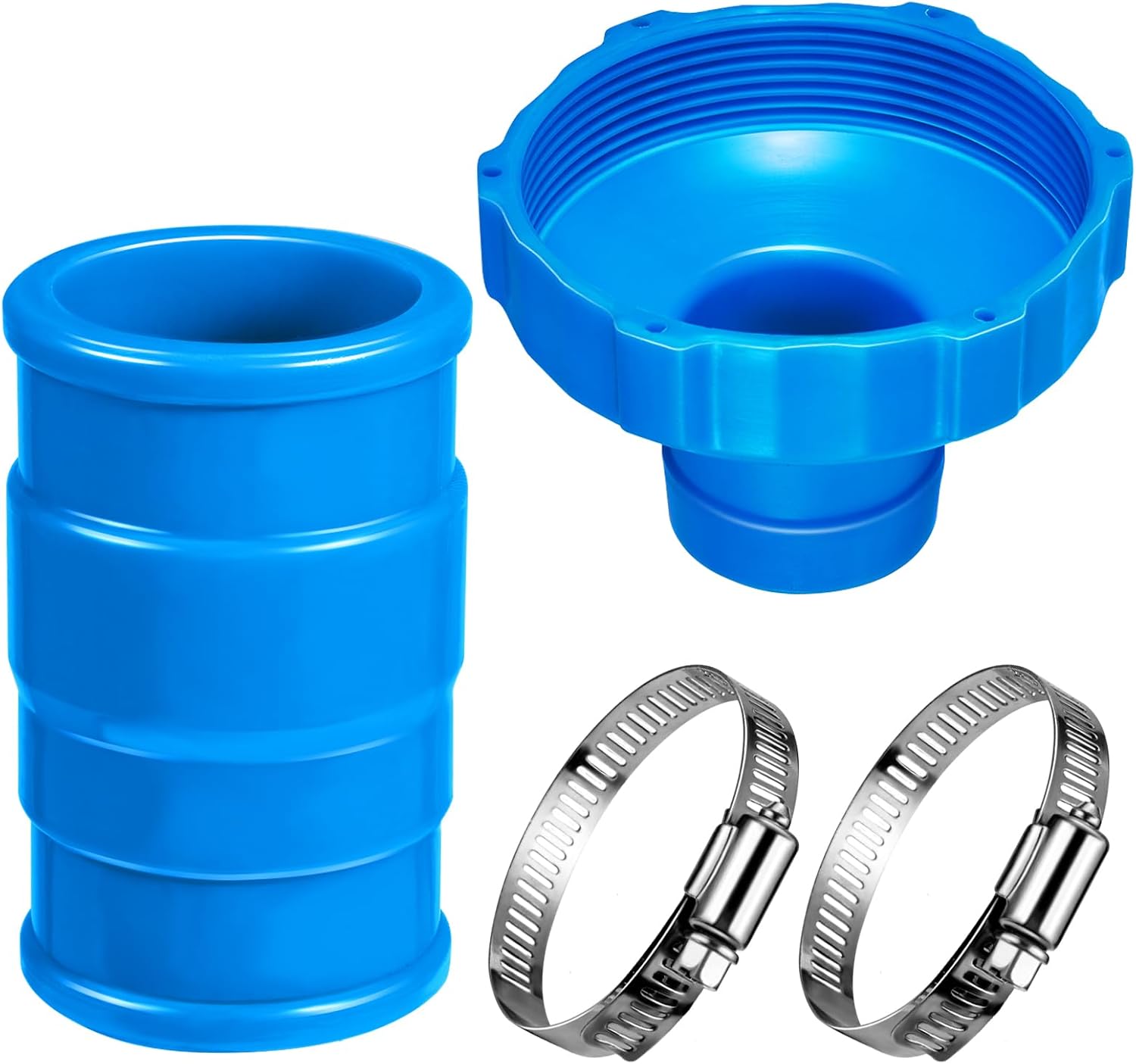
- Rubber connector and B-style adapter
- Two stainless-steel hose clamps
- For listed 1½-inch skimmer or vacuum hose applications
The twelve products are not twelve interchangeable versions of one adapter. Intex Type A and Type B address distinct interfaces; stepped male-thread fittings suit certain equipment ports; hose couplings join loose hose ends; and the T-splitter or plunger-valve products change the plumbing arrangement itself. Narrowing the fitting family before choosing a brand saves more time than comparing package quantities first.
What to Check Before Buying a Pool Hose Adapter
Identify both ends of the connection
First examine the equipment-side end. Is there a visible male thread on the pump, a female threaded recess, a rotating union collar on the existing hose, a plain spigot designed for a clamp, or a special fitting attached to the pool wall? Those shapes are mechanically different even if they all connect hoses labelled 1½ inches.
On the other side, record whether the flexible hose has a smooth opening, molded cuff, permanent screw-on nut or a short rigid end. A clamp-on adapter needs a hose that can seat over its intended barb; a collar adapter needs a matching thread and usually a dedicated seal. Photographing both ends before dismantling the system avoids confusing a hose connector with a pump connector.
Measure hose bore and mating thread separately
Above-ground pool hoses commonly use nominal internal diameters of 1¼ inches (about 32 mm) or 1½ inches (about 38 mm). A product may also quote 40 mm, collar diameter or pipe-thread size. These figures can refer to different physical features, so do not treat two similar numbers as evidence that parts screw or slide together.
Use a ruler or caliper on the existing part, taking a measurement at the surface that actually seals or grips. For a threaded joint, identify male versus female, examine thread spacing and check the original manufacturer part number. Measuring the outside of a corrugated hose is not a reliable way to determine its intended nominal bore.
Decide whether you need conversion, joining, branching or a valve
A reducer changes a connection size. A Type A or Type B adapter deals with a specified Intex interface. A straight coupling joins two hose ends. A combo adapter screws into a suitable equipment port and accepts a clamp-on hose. A T-piece adds a third connection, while a valve controls water flow. These tasks call for different shapes and different checks.
Do not assume a larger package or a multipurpose label means the fitting is suitable for every location. For example, adding a T-splitter to an ordinary single return line can change circulation behavior. Installing a valve may be useful during service, but only if the pool and pump instructions permit that valve configuration.
Check what seals the joint
A rubber washer usually seals by being compressed against a flat mating face. An O-ring seals in its intended channel. Some male pipe-thread connections use thread-sealing tape as specified by the equipment maker. A clamp seals by securing compatible hose material onto an appropriate spigot. They are different mechanisms.
Never rely on excessive tightening to correct missing or damaged seals. New adapters do not automatically fix cracks in old pump ports, brittle hose cuffs or deformed wall fittings. Inspect the surface the seal contacts and plan replacement of damaged mating parts if necessary.
Intex 25009 Hose Conversion Adapter B Kit (Pair)
- Type B conversion for 1¼-inch pool fittings
- Connects to 1½-inch screw-on hose arrangements
- Two adapters; Intex part 10722/25009
What this conversion actually changes
The Intex 25009 is intended for a pool that has smaller 1¼-inch wall fittings but needs to connect to the larger 1½-inch hose arrangement used with many higher-flow Intex systems. It is an interface between the pool-wall connection and the replacement hose arrangement, not an ordinary straight joiner between two loose hoses. That distinction matters because a coupling that joins two hose ends cannot necessarily be secured at the pool's inlet or outlet.
Sizing and pump-upgrade planning
Intex identifies this Type B design with part numbers 10722 and 25009. The manufacturer describes this kind of conversion as useful when moving from a smaller 530- or 1,000-GPH setup to equipment in the 1,500-GPH class or above. Pump flow rate is a clue about the hose system, not proof of fit: existing pool wall ports, new hose ends and the required strainers or valves still need to be checked.
Installing a matched pair
Two adapters are supplied, which suits installations that require changes at both the suction and return ports. Inspect the two pool-wall connections before removing the existing fittings, since a pool can have different hardware at each port. Shut down power, isolate the water with the appropriate plugs or valves, and protect the liner when turning the fittings. Once assembled, check each junction for drips and suction-side air entry.
What to consider before ordering
This is the wrong category of fitting for a threaded pump port that simply needs a clamp-on hose: that job typically calls for Adapter A or a compatible threaded-to-barbed piece. It is also not a substitute for a skimmer-specific wall fitting. Buyers who already have larger wall connections might not need a Type B adapter at all. Confirm the current pool fittings, not just the pump brand printed on the housing.
Pros
- Directly addresses small pool-wall ports in a larger-hose upgrade
- Two-piece kit can cover inlet and outlet
- Identifiable Intex part number 10722/25009
- Purpose differs clearly from generic straight couplings
Cons
- Does not convert every threaded pump port to a clamp barb
- Pool-wall connection geometry must match
- May require other valves, hoses or inlet hardware
Intex 25007 Adapter A with Collar (Pair)
- Adapter A for threaded equipment connections
- Changes a threaded interface to clamp-style hose attachment
- Two genuine Intex replacement adapters
The role of the collar
This Intex Adapter A pair handles a different junction from the 25009 Type B kit. A threaded collar engages compatible equipment-side hose threads, while the outgoing portion accommodates a hose secured in the appropriate clamp arrangement. It is relevant when an Intex pump, chlorine generator or salt system already provides a threaded connection but the existing flexible hose is not fitted with the matching screw-on end.
Equipment compatibility, not just hose size
The listing identifies the 25007 series and names selected Intex filter pumps rated 1,500, 2,000, 2,500 and 4,000 GPH, provided their ports use the correct threaded connections. That final qualification is essential. Two pumps with similar advertised flow can have different unions, seals or hose fittings. Check the collar shape, mating thread and required washer against the original part before treating the flow-rate range as a compatibility guarantee.
Practical installation details
A collar-based adapter must sit squarely on its mating connection, and its sealing component must be present and in good condition. A crooked collar can seem tight while still leaving a leak path. The hose side should also match the intended clamp size, with the clamp positioned over the fitting rather than the unsupported end of the flexible hose. Tighten enough for a firm seal without crushing the plastic.
Its strongest application and boundary
The main appeal is replacing a recognisable Intex-style threaded-to-clamp connection without improvising a string of separate plumbing parts. The two-pack format is useful if the supply and return have the same type of connection. It will not correct a pool-wall port mismatch that requires Type B, and it should not be assumed to share threads with every brand of pump simply because the nominal hose diameter is similar.
Pros
- Manufacturer-designated 25007 Adapter A part
- Pair supplied for two appropriate connection points
- Collars intended for compatible threaded Intex equipment
- Useful when retaining clamp-type flexible hoses
Cons
- Not interchangeable with Type B wall adapters
- Requires a matching threaded port and sound seal
- Pump GPH alone cannot establish fitting compatibility
TonGass 25007-Style Threaded Hose Adapters (2-Pack)
- Two threaded-to-clamp adapters
- Collars listed at approximately 2¼-inch inner diameter
- O-ring seals for matched threaded connections
An alternative to an Adapter A pair
The TonGass option competes most closely with the Intex 25007, rather than with Intex Type B. It provides two adapters that mate with a suitable threaded connection and present a clamp-style hose attachment. This is potentially useful when replacing worn collars or bringing an older clamp-on hose into a system that has threaded pool equipment. The adapters are sold as replacement-style parts rather than as a complete pump conversion package.
Why collar diameter deserves attention
The manufacturer listing describes an internal collar measurement of approximately 2.25 inches and refers to compatibility with Intex-style filter and saltwater equipment using matched threaded connections. That collar measurement is not the diameter of the water passage or necessarily the diameter printed on the hose. Comparing the old collar to the new one gives a better first screening step than comparing hose diameters alone.
Seals and use with flexible hose
O-ring sealing is a meaningful part of this design. A correctly seated seal can prevent water from escaping around a threaded joint, but it will not compensate for the wrong thread profile or a cracked mating surface. At the clamp end, the hose must fully cover the intended spigot. If the hose is hardened or has stretched from years of use, replacing the hose end may be more sensible than repeatedly tightening the clamp.
Choosing it over the Intex-branded pair
The comparison is primarily about exact dimensions, parts condition and purchasing preference, not a demonstrated filtration improvement. Both products serve the threaded-to-clamp problem. TonGass can be considered for a matching 25007-style configuration; the Intex pair has the advantage of being sold as its own named replacement component. Do not use either as a substitute for checking the thread and sealing interface.
Pros
- Two adapters in the set
- Threaded-collar design targets the Adapter A use case
- O-rings are specified for the connection
- An alternative for matched threaded-to-clamp conversions
Cons
- Approximate collar size still requires physical confirmation
- Not a wall-port Type B conversion
- Generic compatibility wording does not cover every pump
U.S. Pool Supply Universal Combo Hose Adapters (3-Pack)
- Three stepped hose adapters
- 1½-inch male threaded equipment end
- Accepts 1¼- or 1½-inch flexible hoses
Stepped hose end explained
This three-pack uses a familiar above-ground pool plumbing approach: a male-threaded connector at one end and a stepped hose connection at the other. The steps serve two common hose sizes, 1¼ and 1½ inches, on the same general adapter body. Unlike the Intex collars that secure around a proprietary-style threaded hose interface, this fitting screws into a corresponding female threaded equipment port.
Where the threads are intended to go
The listed equipment uses include compatible above-ground pumps, filters, skimmers and chlorine feeders. The product is also marketed as a replacement alternative for Hayward SPX1091Z7 and SPX1091Z4-style fittings. A nominal 1½-inch male pipe thread is not the same as a 1½-inch hose outer diameter. Matching thread form, sealing method and installation depth matters far more than assuming the repeated number makes every connection interchangeable.
Three adapters can be useful
One fitting may solve a single skimmer connection; three fittings allow a buyer to address multiple equipment ports or keep a spare for routine pool maintenance. The included quantity makes sense in a pool system with several matching threaded entries. It does not mean the three fittings will independently connect three hose runs together: each unit still needs the appropriate threaded female equipment port.
Limitations of a universal label
Universal in this context describes a useful stepped hose design within a family of compatible ports. It does not confer compatibility with Intex screw-on collars, compression connections or every skimmer assembly. An old adapter stamped with a specific part number is a better identification guide than the general type of pool in the backyard. Proper thread sealing must also follow the equipment manufacturer's instructions.
Pros
- Handles both common clamp-on hose diameters
- Three fittings for multiple compatible ports
- Useful alternative to SPX1091Z7-style adapters
- Straightforward equipment-thread-to-hose arrangement
Cons
- Requires the right female threaded equipment port
- Not suitable for Intex collar-style unions by default
- Thread sealing requirements vary by equipment
ATIE 1½-to-1¼-Inch Pool Hose Couplings (3-Pack)
- Three inline hose couplings
- Intended for 1¼- and 1½-inch hose connections
- No threaded pump port required for inline use
A hose-to-hose connector, not a wall fitting
The ATIE product is useful for a different repair: joining two compatible flexible pool hose ends. It is described as an inside coupling for female hose ends in the 1¼- and 1½-inch size families. This makes it relevant to an interrupted vacuum hose, a flexible line that needs a connection point, or certain filter-to-skimmer hose repairs. There is no reason to buy a threaded equipment adapter if the problem is simply two open hose ends.
Working with mismatched flexible hoses
A combination connector can help where an existing section and a replacement hose use different nominal diameters, but the exact section that grips each hose must be examined. A hose labelled 1½ inches is normally described by its internal bore, not by the outer size of the coupling. Different corrugation patterns and cuff designs can change how securely a hose grips an otherwise correctly sized connector.
Assembly and hose condition
Before fitting the coupling, cut or remove any damaged section of flexible hose, provided doing so is compatible with the hose construction. Keep hose ends round and free of splits. The connection must resist movement when the pump starts and stops, and suction-side junctions need particular attention because tiny leaks can draw air without leaving obvious puddles. Use clamps only where the hose and fitting are designed to accept them.
The tradeoff of an added joint
An inline coupling preserves usable hose sections instead of replacing an entire run, but it creates an extra joint that must remain supported and accessible. Multiple couplings installed close together make a line harder to inspect and increase potential leakage points. This is not a replacement for a matching male-threaded skimmer adapter, a proprietary Intex collar or a dedicated Type B pool-wall connection.
Pros
- Direct solution for joining compatible open hose ends
- Three couplings for several hose repairs
- No threaded equipment connection required
- Suitable for selected vacuum and filter hose arrangements
Cons
- Cannot replace threaded pump or skimmer fittings
- Extra inline joint needs inspection
- Hose cuffs and corrugations can affect fit
Hayward SPX1091Z7 Combo Hose Adapters (2-Pack)
- Hayward SPX1091Z7 replacement fitting
- Male threaded to stepped hose connection
- Pair for compatible skimmers and chlorine feeders
A part number with a defined application
Hayward SPX1091Z7 is a recognizable replacement in above-ground pool plumbing, especially around selected Hayward skimmers and feeders. The supplied listing is for two adapters. The design uses a threaded equipment connection and a hose attachment end, rather than an Intex screw-collar arrangement. Buyers replacing an existing Hayward fitting can often start by reading the molded part marking on the damaged component.
Compatibility with Hayward components
The specific Amazon listing identifies the Hayward SP1090WM wide-mouth skimmer family and chlorine feeder applications. Hayward documentation also describes the SP1091Z7 male combo adapter as a hose connection part for designated skimmer plumbing. That does not establish a fit for every Hayward filter, every inlet port or equipment manufactured by another company. A precise model and connection drawing remain the safest basis for choosing it.
Threaded sealing and the hose end
Hayward installation literature for a related skimmer specifies thread-sealing tape on the male adapter thread, illustrating that sealing the threaded side is a separate job from fastening the hose side. Always follow the directions for the actual skimmer or feeder being installed rather than applying sealant indiscriminately. The stepped hose end must also be paired with a compatible hose and the appropriate clamp, where required.
Comparing it with a multi-pack alternative
This Hayward-marked option is particularly relevant when replacing the SPX1091Z7 itself. The U.S. Pool Supply three-pack instead offers a compatible-style stepped adapter with an extra piece in the package. Quantity is secondary to matching the molded part, port thread and hose connection. If the original equipment's parts diagram specifies a different adapter number, neither product should be chosen solely because its hose barb looks familiar.
Pros
- Specific SPX1091Z7 replacement identity
- Two pieces for matching applications
- Hayward skimmer and feeder use cases are documented
- Stepped hose end supports compatible flexible hoses
Cons
- Not a solution for proprietary Intex hose collars
- Must match the precise female thread and equipment model
- Two-pack does not include an entire skimmer assembly
UASAM 11238 Surface Skimmer Hose B Adapter
- 11238-style wall-mount surface skimmer fitting
- Listed for Intex skimmer applications
- Intended to connect a skimmer hose at the pool wall
Why skimmer adapters are a separate category
The UASAM 11238 addresses the connection between a wall-mounted surface skimmer arrangement and the pool's circulation path. The skimmer collects floating debris at the water surface and needs a compatible suction connection to the filter system. This part is not an ordinary threaded-to-clamp pump adapter, nor does it simply reduce any larger filter hose to a smaller one. Its wall-side attachment is the deciding feature.
Check the skimmer rather than the pump alone
The listing refers to Intex wall-mounted surface skimmer equipment and identifies the 11238 fitting. It also associates the assembly with a 25016 pool hose. These references are useful starting points, but Intex skimmer kits and pool-wall fittings have changed over time. The skimmer's adapter seat, wall fitting and hose connection should be compared with the part being replaced.
Physical dimensions and identifying the fit
The product description provides approximate dimensions around the wall-facing connection and hose-facing outlet. Such measurements can help identify an old piece, but the engagement shape is just as important. Photograph the existing connection with its mating wall fitting visible before ordering. A skimmer adapter that almost threads or pushes in is not suitable for a suction-side connection, where air leakage can make the system harder to prime.
Where it belongs in the repair plan
Choose this product when an otherwise usable skimmer cannot connect properly because its specific wall-hose adapter is missing or damaged. If the hose itself is split, a replacement hose or suitable coupling is a different purchase. A filter upgrade needing larger pump hoses may call for Type B conversion pieces rather than a skimmer fitting. The advantage here is application specificity; the limitation is that it does only that application.
Pros
- Purpose-built for a wall-mounted surface skimmer connection
- 11238 reference helps identify the part
- Focuses on a missing skimmer-to-wall interface
- Less guesswork than using a generic pump connector
Cons
- Not a universal pump or hose reducer
- Compatibility depends on the exact skimmer and wall fitting
- Does not replace damaged skimmer hose itself
4560 40mm-to-1½-Inch Pool Hose Adapters (4-Pack)
- Four 4560-style connection adapters
- Listed for 40mm hose to standard filter ports
- Four gaskets and sealing tape included
A different route between pool and filtration fittings
This 4560-style kit targets setups where a nominal 40 mm hose arrangement must connect to more standard above-ground filter hardware. The listing describes use with selected Intex and Coleman pools and equipment using compatible connections, including some Hayward pump or skimmer arrangements. In practice, the shape and pitch of the threaded ends determine whether it works. A brand match alone is not a complete fit check.
Why the pack contents matter
The listing specifies four connectors, four gaskets and sealing tape. With several matched ports, that combination can be convenient compared with buying each sealing component separately. Each gasket still has to sit in its intended recess. Sealing tape is only appropriate for threaded joints whose installation instructions call for it; a union designed to seal on a gasket should not be forced together with layers of tape that interfere with its seating.
Understanding the metric-to-imperial wording
40 mm is approximately 1.57 inches, but those numbers do not demonstrate that a 40 mm component will attach to every hose called 1½-inch. Metric tube measurements can describe a different surface from a nominal hose bore, and proprietary threads complicate matters further. Compare both ends of the old connector, especially whether the kit needs to engage a hose nut, a pump housing or an equipment port.
Where four pieces help—and where they do not
A four-pack makes sense when replacing multiple identical connectors across a circulation system or keeping like-for-like spares. It does not automatically supply the adapters needed for four different connection designs. If only one port differs, a single correctly specified Hayward-style or Intex adapter could be a simpler answer. Avoid buying extra fittings as a workaround for an unknown thread size.
Pros
- Four connectors plus gaskets for multi-port jobs
- Metric 40mm reference for an identifiable conversion
- Can suit selected cross-brand pool equipment
- Sealing supplies are listed in the package
Cons
- Metric and nominal hose labels can be misleading
- Cross-brand compatibility must be measured carefully
- Not all threaded joints should use sealing tape
Svepndic Type A & B Pool Hose Conversion Kit
- Two Type A and two Type B adapters
- Includes two clamps and two washers
- For selected 1¼- and 1½-inch Intex arrangements
A mixed kit for more than one connection style
Svepndic combines two Type A pieces and two Type B pieces in one package, along with two metal clamps and two rubber washers. That range can help when an above-ground pool uses more than one kind of connection or when the existing hardware has not been fully standardized. A mixed kit does not make the A and B fittings interchangeable: each is intended for a different side or configuration of the system.
The thread dimensions are the key specification
The listing explains its Type A and Type B designs using approximately 2⅜-inch matching thread measurements and differentiates between external male-thread and internal female-thread interfaces. Those figures should be verified against the actual connection being replaced. The 1¼- and 1½-inch hose descriptions refer to the flexible hose side of the conversion; they must not be confused with the larger collar-thread dimensions.
Clamps, washers and kit planning
The two supplied clamps and washers are useful when they correspond to the joints in your particular assembly. The quantity also deserves attention: the set contains four plastic adapters but only two of each listed accessory. That is not necessarily a problem for its intended configuration, yet it means buyers should plan where each seal and clamp belongs before disassembling their pool. Replacement seals should be seated cleanly rather than stacked for extra thickness.
Who gains the most from a combination pack
This option is better suited to an owner dealing with several connection types than someone who already knows one exact OEM part is missing. If the failed component is an Intex 25009 pool-wall Adapter B, a named replacement can simplify the comparison. If the problem is an equipment-thread-to-clamp connection, a pair of dedicated Adapter A pieces could be easier to assess. The Svepndic kit offers breadth; that also calls for more careful identification during installation.
Pros
- Contains both named adapter types
- Includes clamp and washer accessories
- Useful for mixed-connection repair inventories
- Explicit sizing guidance for the two connection styles
Cons
- The four adapters are not functionally interchangeable
- Only two clamps and two washers are listed
- Exact thread and port fit still needs checking
LISINAN 1½-to-1¼-Inch Pool Hose T-Splitter
- Three-port T-shaped hose fitting
- Listed 1½- to 1¼-inch hose arrangement
- Polypropylene construction
Three ports change the plumbing decision
Unlike the straight adapters in this guide, LISINAN uses a T-shaped body with three hose interfaces. It can be relevant where a pool cleaner, vacuum or filter hose arrangement genuinely requires a branch. A T-fitting is not simply a more flexible way of joining two hose ends. Opening another flow path changes the circuit, and that matters especially near the suction side of a filtration system.
Size markings are not a plumbing diagram
The product is listed for 1½-inch to 1¼-inch hose connections and made from polypropylene. It is still important to identify which individual branch uses which nominal hose size. An assumed position of the smaller port could lead to an incorrect purchase. Check images of the individual connection ends and compare each branch to the hoses the installation actually uses.
Understanding flow and suction
Splitting a line can redistribute flow. That does not guarantee safe or equal flow through each branch, and it should not be used to bypass manufacturer limits on suction fittings or cleaning accessories. A T-joint installed in an unintended location may reduce cleaning effectiveness, cause air leaks, or create a difficult-to-prime system. The correct arrangement depends on the filter and pool equipment instructions, not on the visual convenience of the connector.
When it is a sensible option
Consider this product only when the pool's existing plumbing or an accessory installation specifically calls for a three-way connection with compatible hose sizes. If the aim is a single reducer from a large pump hose to a small pool hose, a dedicated inline reducer is easier to understand and inspect. If the task is repairing a skimmer wall fitting, the three-way body solves the wrong problem entirely.
Pros
- Provides a genuine third connection branch
- Uses listed 1¼- and 1½-inch hose interfaces
- Polypropylene body
- Useful for systems explicitly calling for a T-fitting
Cons
- Not an ordinary two-ended hose adapter
- Requires planning for how each branch affects flow
- Unsuitable as an improvised suction-system bypass
MASCARRY Pool Hose Plunger Valve Kit (2-Pack)
- Two shutoff-style plunger valves
- Pipe holder and two clamps listed
- For compatible 1¼- and 1½-inch pool hoses
This kit adds flow control, not just conversion
The MASCARRY kit combines a hose connection with plunger valves and a pipe holder. The ability to close a compatible valve can make filter servicing less disruptive where the pool design supports shutting off flow at the hose connection. That is a different benefit from changing a thread profile or reducing hose diameter. A valve assembly also has more moving and sealing parts than a basic rigid adapter.
A holder can support the connection
The listing includes a pool pipe holder intended to reduce strain where the hose meets the pool wall. Supported hoses are useful because a full flexible line can pull on the wall fitting as the pump runs or people move around the equipment. The support must be installed as intended, and it does not justify hanging the weight of the pump or filter on a pool wall. Confirm that the holder corresponds to your pool construction.
Valve operation during maintenance
A shutoff valve may help isolate the water when cleaning or changing a compatible filter component. Even with valves, switch off and unplug the pump before opening the system, and follow the equipment's pressure-release instructions. Closed valves must be reopened before normal circulation; operating a pump against the wrong valve position can damage equipment. A valve should not be mistaken for an automatic safety device.
Fit and complexity considerations
The description references connections for compatible 1¼- and 1½-inch hoses and advises checking pool dimensions before purchase. The kit is a stronger candidate for a buyer seeking new shutoff functionality as part of the repair. Someone who only needs a missing Hayward SPX1091Z7 thread-to-hose adapter would be adding unnecessary hardware. Similarly, the kit should not be selected solely because its main image resembles an Intex fitting.
Pros
- Includes shutoff-style valve functionality
- Pipe holder helps address hose support
- Two valves and two clamps are listed
- Useful for compatible maintenance-oriented setups
Cons
- More components and seals to maintain
- Valve operation must follow pump instructions
- Compatibility depends on pool-wall hardware
TAINAT Intex-Compatible Adapter B Skimmer Hose Kit
- Rubber connector and B-style adapter
- Two stainless-steel hose clamps
- For listed 1½-inch skimmer or vacuum hose applications
A focused skimmer and vacuum connection repair
The TAINAT set is centered on attaching skimmer or vacuum hose accessories to a compatible Intex pool connection. Its listed contents include a rubber connector, a B-style adapter and two stainless-steel clamps. Unlike the Intex 25009 pair, which addresses a general small-wall-fitting to larger-hose conversion, this kit uses a rubber coupling and clamps as part of its particular skimmer-hose installation.
The included connector matters
The supplier specifies a rubber connector approximately 3.5 inches long, with other cross-sectional measurements given in its listing. These measurements should be compared with the actual skimmer-side connection before purchase. Rubber couplings can conform to the intended mating surfaces, but stretching them over incompatible fittings or heating a hose end to force a fit risks damaging the hose. A snug supported connection is the goal.
Clamps and hose routing
Two clamps provide attachment points for the relevant rubber connector arrangement. Install them on the sections designed to accept compression, without positioning their bands across a fitting edge. The hose should approach the wall connection without a strong sideways pull. After reassembling the skimmer, prime the suction system as directed and watch for air bubbles, poor flow or signs of leakage.
Compared with other skimmer fittings
UASAM 11238 focuses on a particular skimmer wall-adapter geometry, while TAINAT supplies a connection kit including flexible rubber and clamps. Those products should not be treated as substitutes until the skimmer model and mating hardware are identified. TAINAT is most appealing if the missing connection includes the specific rubber coupling arrangement rather than just a molded wall fitting. Other adapter types in this guide serve pump or inline hose connections instead.
Pros
- Includes rubber coupling and B-style adapter
- Two clamps are included
- Addresses a specific skimmer/vacuum hose repair
- Avoids forcing hose ends over incompatible fittings
Cons
- Not a general-purpose threaded pump-port adapter
- Rubber dimensions must match the skimmer arrangement
- Different from the Intex 25009 conversion pair
Detailed Buying Guide: Matching Adapters to Pool Plumbing
Understand the difference between Type A and Type B
For Intex-style connection work, the A/B terminology is more than a size label. Type B is commonly associated with adapting smaller pool-wall fittings to larger hose systems, including upgrades to higher-flow Intex filtration equipment. Type A is used to connect certain threaded equipment interfaces to the appropriate clamp-type hose. These parts can appear in the same upgrade project but are installed at different physical locations.
To plan a change, trace the entire route: pool suction opening, wall fitting, suction hose, pump port, outlet hose and pool return fitting. Assign the correct adapter to each junction rather than assuming that two Type B pieces complete every upgrade. A wall connection can have a built-in shutoff valve or strainer assembly that changes which adapter is required. If available, match the original equipment’s exploded parts drawing.
A 1½-inch hose is not a 1½-inch thread
Nominal hose dimensions normally refer to an internal water passage. Pipe-thread nomenclature describes a mating thread standard and does not equal the thread’s measured outer diameter. A 1½-inch male threaded Hayward-style combo fitting can therefore appear substantially wider across its threads than the hose it eventually accepts. This is normal, but it explains why using the same number in two product titles does not establish mechanical compatibility.
A 40 mm listing deserves particular caution. It is tempting to equate 40 mm with 1½ inches by conversion, yet the stated number may refer to a union, tube outside diameter or another measurement. A part described as 40 mm-to-1½ inches is intended to bridge a defined connection family, not to make every 40 mm component universal. Check thread shape, gasket seat and orientation.
Which side needs a male thread?
A male-threaded adapter screws into a female threaded port. Some Intex-style equipment instead has a projecting connection that accepts a rotating female hose collar. Those parts meet in different ways. On a complex system, you can encounter both types along the same circulation path. The pool’s branding does not settle this by itself because accessories and pumps are frequently mixed.
Never force a partly engaging plastic thread. Cross-threading can damage the more expensive pump or skimmer housing before it becomes obvious. If a new part starts crooked, stop, remove it and inspect for mismatched thread form or debris. A fitting that goes only a turn or two before binding is a warning, not a sign that it needs a longer wrench.
Clamps, cuffs and couplings
A clamp-style hose connection relies on adequate overlap between a hose and its spigot. The hose material must sit fully on the correct diameter section. A clamp positioned too close to the open end often distorts the hose without securing it. Conversely, a clamp placed over the wrong step of a combination connector can compress an area that is too narrow or unsupported.
Hose couplings are useful for connecting flexible lengths, but some vacuum hoses use molded cuffs that do not behave like plain cut hose. Corrugated hose and reinforced hoses may require different connectors or cuffs. Examine both original ends before ordering a three-pack of simple inline couplings. On suction lines, small gaps can draw air and cause bubbles or loss of prime even when the fitting looks dry.
Gaskets and O-rings
Keep the original seal for comparison until the new fitting is confirmed to match. A seal’s outside diameter, thickness and groove position can be more important than the advertised hose size. A flattened, nicked or hardened O-ring can prevent a leak-free connection even if every threaded part is correct. Replacing the damaged seal with the proper part is often more effective than overtightening the adapter.
Only use approved lubricants and sealing materials where the pool equipment instructions call for them. Petroleum-based substances can damage certain elastomers, and loose strands of thread-sealing material can enter the circulation path. The correct method depends on whether a joint seals against a gasket, a flat surface or a thread. Do not combine methods indiscriminately.
When extra valves help
Shutoff valves can reduce the amount of water escaping during certain pump or filter service tasks, especially when the pool design does not otherwise provide convenient isolation. They also add seals and moving components that need to function correctly. A kit such as the MASCARRY serves this maintenance objective, while a simple hose adapter has no shutoff function.
Before opening a filter housing, switch off the pump and follow the specific pressure-release and isolation instructions. A valve in the wrong position can obstruct circulation, and certain pump configurations should not operate with closed suction or return lines. Where support brackets are supplied, use them to keep hose strain off flexible pool walls rather than as a substitute for proper equipment mounting.
Skimmer connections and suction considerations
Surface skimmers connect to the pool’s suction side and must match the intended wall fitting, hose and flow arrangement. Skimmer kits can contain molded components with part identifiers such as 11238, while alternative kits incorporate flexible rubber couplings. Both may be described as skimmer hose adapters, but they cannot be selected as interchangeable parts from that description alone.
Suction safety deserves attention. Do not remove protective strainers or alter suction outlets outside the pool manufacturer’s approved installation. A T-splitter or improvised branch can alter the flow distribution and may create a hazardous or poorly performing setup if used where it does not belong. Follow the skimmer, filter and pool manuals for permitted connection arrangements and any necessary flow limits.
Installation order and checking for leaks
Begin with the pump unplugged, and isolate the water or lower the level as required by the equipment instructions. Lay out the new pieces beside the removed parts and verify the threads, hose connection diameters, sealing surfaces and orientation. Fit the seal in the correct location. Hand-start plastic threaded unions squarely and apply the manufacturer’s specified final tightening method.
On reassembly, route hoses without tight bends or sideways loads at the connectors. Reopen all valves required for circulation, fill or prime the system as directed and then run the pump while checking each joint. Look for water drips on the pressure side and persistent air bubbles or prime loss on the suction side. Stop the pump before adjusting a suspect connection.
Direct Product Comparisons: Which Connection Is Different?
Intex 25009 Adapter B vs Intex 25007 Adapter A
The 25009 Type B kit is for a smaller pool-wall connection transitioning to larger hose arrangements. The 25007 Type A pair addresses certain threaded equipment connections that need to accept clamp-style hose. One does not replace the other. A pump upgrade can involve both if the old pool has small wall ports and the new equipment requires a different hose attachment. Identify each junction independently before ordering either pair.
Intex 25007 Adapter A vs TonGass 25007-Style Adapters
Both are intended for compatible threaded-to-clamp configurations. The Intex product has a named OEM part reference; TonGass lists a two-piece replacement-style design with O-ring seals and a collar measurement. Choose according to the original part and its mating threads, not presumed performance differences. If the existing system specifically calls for the Intex 25007, the OEM identification simplifies selection.
Hayward SPX1091Z7 vs U.S. Pool Supply Combo Adapters
Both address an equipment female-thread-to-flexible-hose task with stepped hose ends. Hayward’s two-pack is linked to a specific replacement part number and selected skimmer or feeder applications. The U.S. Pool Supply three-pack is marketed as a compatible-style alternative for SPX1091Z7 and SPX1091Z4 uses. The extra unit is useful only if the port, thread and hose end match.
ATIE Inline Couplings vs LISINAN T-Splitter
The ATIE piece joins two compatible hose sections along one line. LISINAN adds a third branch. If the task is repairing a damaged vacuum hose or joining two flexible lines, the ATIE design is the straightforward category to investigate. A T-fitting belongs in a specified branching configuration, not as a general substitute for a hose union; changing suction plumbing without manufacturer guidance is not advised.
UASAM 11238 vs TAINAT Skimmer Hose Kit
These both speak to skimmer-related repairs but use different connection concepts. UASAM targets the 11238-style wall-mount skimmer fitting, while TAINAT lists a B-style adapter, rubber connector and two clamps for a particular 1½-inch hose arrangement. If only the molded skimmer wall part is missing, look for the exact 11238 shape; if the connection calls for the supplied rubber assembly, inspect TAINAT’s fit dimensions.
4560 Four-Pack vs Svepndic Mixed A/B Kit
The 4560 listing focuses on 40 mm-to-standard-port conversion pieces and includes gaskets. Svepndic supplies both Intex-style A and B components with clamps and washers. These are not simply competing quantities of the same part. Identify which connection family your pool uses and then select the kit that addresses it. Buying a larger assortment is not a substitute for matching the original connection.
MASCARRY Valve Kit vs a Basic Adapter
MASCARRY adds shutoff valves and hose support, which can change the way suitable equipment is serviced. A basic Hayward-style or Intex-style adapter only makes a connection. If the existing system already has working isolation valves and the sole problem is a broken threaded adapter, adding more valves is unnecessary. If the pool supports the kit and service isolation is needed, the extra functions justify evaluating the additional complexity.
Common Pool Hose Adapter Buying Mistakes
Shopping by brand without checking the port
An Intex pool can use a replacement pump from another brand, and an older Hayward skimmer may have been connected to non-original hoses. The name printed on the pool does not identify every fitting along the water path. Read the part number on the component being replaced and confirm what it connects to.
Treating the stated hose diameter as the thread diameter
A nominal 1½-inch hose and a nominal 1½-inch pipe-threaded adapter are described using different measurement conventions. A rotating collar also has its own physical diameter. Measure the relevant surfaces and compare the required sealing mechanism, rather than assuming matching numerals mean matching threads.
Forgetting that the suction side can leak air
A suction connection may not visibly drip because the running pump creates negative pressure at that joint. Instead, air enters and produces bubbles, poor priming or noisy operation. If those symptoms begin immediately after a hose change, inspect the adapter seal and hose cuff without assuming the pump itself has failed.
Ordering a coupling to replace a missing wall fitting
A straight coupling is for the ends of compatible flexible hoses. The pool-wall interface or skimmer seat may have locking tabs, threads, seals or an unusual profile. Check whether the damaged piece was attached to the wall or simply joined two hose lengths before buying.
Forcing a tight plastic union
A plastic threaded part should start squarely without excessive force. Binding can indicate a cross-thread or incompatible profile. Overtightening also risks cracking a port or deforming an O-ring seat. Disassemble and check the geometry rather than solving resistance with a larger tool.
Assuming more adapters can correct an unsafe layout
A chain of couplings, reducers and splitters adds joints and can complicate flow. The correct solution might be a single specified hose or wall fitting. In particular, suction equipment should not be reconfigured with extra branches or removed protective fittings without the manufacturer’s permitted arrangement.
Frequently Asked Questions
What is the difference between Intex Adapter A and Adapter B?
Adapter A generally connects certain threaded equipment-side connections to a compatible clamp-style hose arrangement. Adapter B generally addresses smaller 1¼-inch pool-wall connections when fitting larger 1½-inch hose systems. They solve different ends of a circulation line and should not be substituted without checking the actual parts.
Can I attach a 1¼-inch hose to a 1½-inch pool pump?
Only with a compatible connection arrangement approved for the pump and pool. A physical reducer is one part of the decision; the pump’s required flow, hose restrictions, wall inlet and outlet fittings must also be considered. Do not assume a smaller hose is appropriate just because an adapter is sold for both diameters.
Why will a 1½-inch threaded adapter not fit my 1½-inch hose nut?
The sizes can describe different nominal standards. A pipe-threaded fitting and a proprietary rotating hose collar may both be sold with the number 1½ inch while having different mating geometry. Compare the original equipment part, the male or female orientation and the sealing surface.
Are all swimming pool hose adapters interchangeable between Intex and Hayward?
No. Certain products are advertised for specified cross-brand configurations, but different systems use proprietary collars, female pipe ports, slip fittings and gaskets. A compatible-style adapter should be checked against each end of the actual connection.
Do I need two hose adapters or just one?
Count the mismatched junctions, not just the number of hoses. A filter upgrade can require a conversion at both pool-wall ports, but another repair may involve only one skimmer outlet or one damaged hose. Pair and multi-pack quantities are convenient only when the individual fittings actually suit the required locations.
What is a combo hose adapter?
A combo adapter typically has a threaded equipment end and a stepped hose end for more than one common flexible hose diameter, often 1¼ and 1½ inches. It is useful on certain threaded pump or skimmer ports. It is not automatically suitable for rotating Intex hose collars or wall fittings.
Can I use a pool hose coupling to extend a vacuum hose?
An appropriate inline coupling can join compatible hose ends, provided the hose cuff construction supports that connection. The joint must be secure and must not introduce air on a suction line. Some vacuum hoses use specially molded cuffs and require a matching hose connector rather than an ordinary reducer.
Is a T-splitter a substitute for a hose reducer?
No. A T-splitter provides three flow connections instead of two. Adding another branch can alter flow and suction conditions, so its use should be specified by the equipment configuration. For a simple connection between two hoses, an approved straight reducer or coupling is normally the correct category.
Do hose adapter connections always need Teflon tape?
No. Some threaded fittings use thread-sealing tape according to the equipment instructions; others seal using a flat gasket or O-ring and should be assembled using that intended seal. Putting tape on a gasket-sealed union can prevent correct seating. Follow the precise manufacturer installation instructions.
What causes air bubbles after changing a pool hose adapter?
A suction-side joint that is not seated, a damaged O-ring, cracked hose cuff, loose clamp or inadequately primed system can introduce air. Switch off the pump before adjusting fittings, inspect the connection and then reprime it as instructed. Persistent bubbles may also arise elsewhere in the suction plumbing.
How can I identify a skimmer hose adapter?
Look for a molded part number, the skimmer model and the connection shape at the pool wall. For example, a 11238-style surface-skimmer component serves a different task from a generic male-threaded hose barb. Compare the old part with the manufacturer’s skimmer parts diagram when available.
Should I replace a complete hose or add several adapters?
One correct adapter can avoid replacing an otherwise sound hose. However, a cracked, hardened or heavily patched hose may remain unreliable even with new connectors. Multiple improvised connections add places for air or water to escape; a properly specified replacement hose is often more practical in that situation.
Final Buying Considerations for Swimming Pool Hose Adapters
Start with the joint that has to change. For a smaller Intex wall port joining a larger hose arrangement, the Intex 25009 Adapter B belongs on the shortlist. For a matching threaded-to-clamp equipment connection, the Intex 25007 or TonGass 25007-style pair addresses a different need. Hayward SPX1091Z7 and U.S. Pool Supply combo adapters serve compatible male-thread-to-hose applications, while ATIE couplings join flexible hose ends.
Skimmer repairs call for particular attention to the wall and hose interface: UASAM 11238 and TAINAT are application-specific options, not general replacements for every filter hose. The 4560 and Svepndic kits cover distinct multi-part conversion situations. LISINAN is a three-port T-fitting; MASCARRY includes shutoff valves and support hardware. Each should be bought for that function rather than simply for the hose sizes printed on its package.
Before making a final choice, verify the mating thread or wall fitting, confirm the nominal hose bore, inspect the gasket or O-ring, and determine how many identical connections actually need repair. The right adapter is the one that solves the exact connection without unnecessary added joints or changes to the pool’s approved circulation arrangement.
Author