
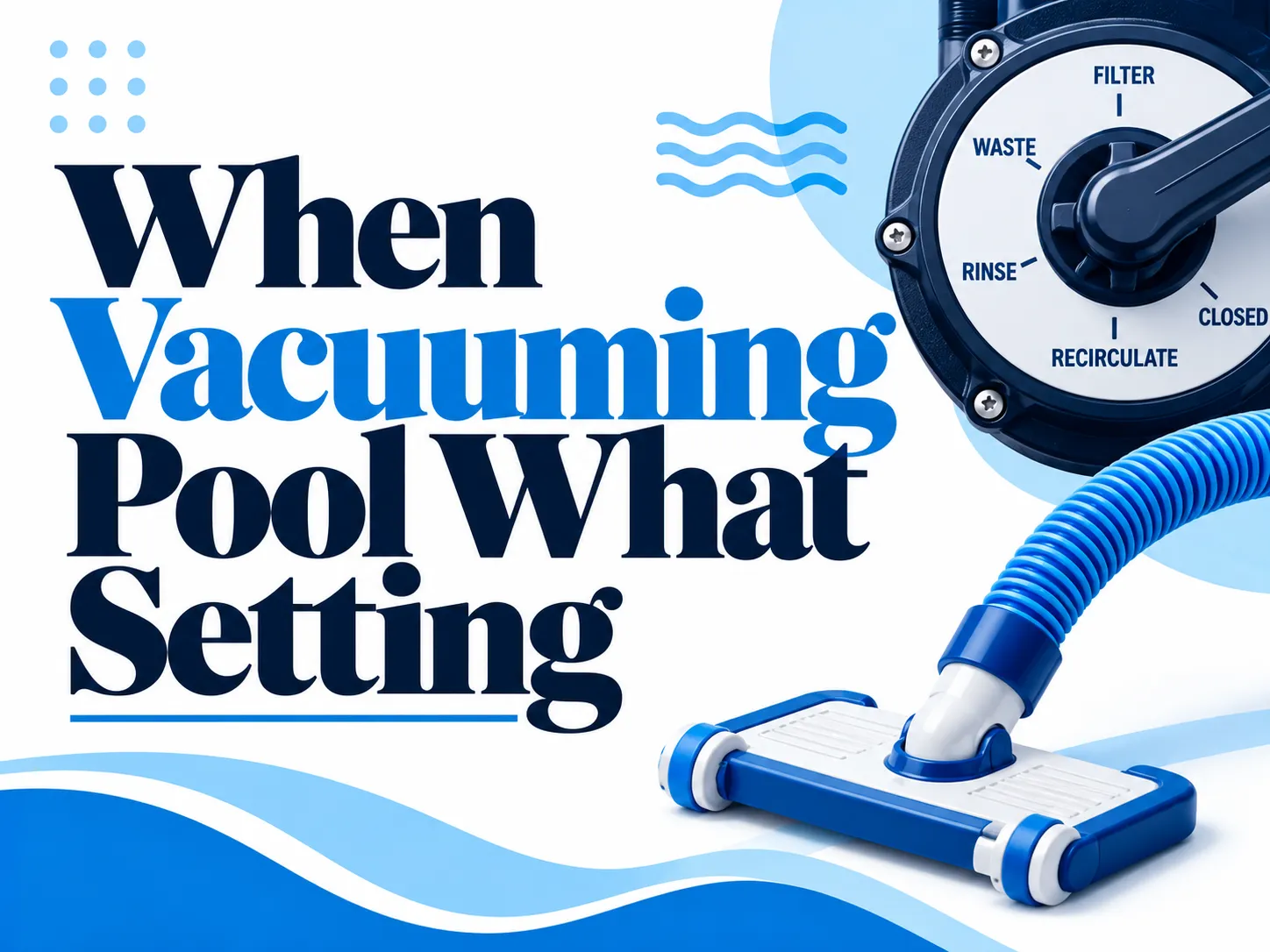
For ordinary pool vacuuming, set a multiport valve to FILTER. In this position, the pump pulls water and debris through the vacuum line, sends the water through the pool filter, and returns the filtered water to the pool. Use WASTE instead only when you intentionally want the vacuumed water and debris to bypass the filter and discharge out of the pool.
That distinction matters because the two settings do very different jobs. FILTER conserves pool water but loads the debris into the filter. WASTE avoids sending heavy contamination through the filter, but it lowers the pool’s water level quickly and requires an appropriate discharge route. BACKWASH, RINSE, RECIRCULATE, and CLOSED are not normal vacuuming settings.
What Setting Should the Pool Filter Be on When Vacuuming?
If your pool uses a sand or diatomaceous earth (D.E.) filter with a six- or seven-position multiport valve, the normal answer is FILTER. Official valve manuals from both Jandy and Hayward describe FILTER as the position for normal filtration and vacuuming through the filter.
The Jandy sand-filter manual identifies FILTER as the setting for normal filtration and vacuuming, while WASTE bypasses the filter and is used for vacuuming directly to waste or lowering the water level. Hayward gives the same functions in its VariFlo multiport-valve instructions.
These definitions provide a useful rule that applies across many conventional multiport systems: choose FILTER when you want the filter to capture the material, and choose WASTE when you deliberately want the material and water to leave the system without passing through the filter.
What Each Multiport Valve Setting Does During Vacuuming
Understanding the valve positions prevents one of the most common pool-maintenance mistakes: selecting a setting because its name sounds useful rather than because its water path is correct.
| Valve setting | What it does | Use while vacuuming? |
|---|---|---|
| FILTER | Sends vacuumed water through the filter and then back to the pool. | Yes. This is the normal setting for routine vacuuming. |
| WASTE | Bypasses the filter and sends water out through the waste line. | Yes, when intentionally vacuuming dirty water out of the pool. |
| BACKWASH | Reverses flow through the filter to remove trapped dirt from the filter media. | No. It is for cleaning the filter, not the pool floor. |
| RINSE | Flushes the valve and filter after backwashing before normal filtration resumes. | No. It is part of the backwash sequence. |
| RECIRCULATE | Bypasses the filter but returns water to the pool. | Generally no. Vacuumed fine debris can simply return to the pool because it is not filtered. |
| CLOSED | Stops flow through the valve. | No. Never run the pump with the multiport valve in Closed. |
Some valves also have a WINTER or WINTERIZE position. That position is for off-season draining or freeze protection according to the valve manufacturer’s instructions; it is not a vacuuming setting.
Use FILTER for Normal Pool Vacuuming
FILTER is the best choice for most routine cleaning because it removes debris while keeping the water in the pool. The vacuum hose becomes part of the normal suction path. Water enters through the vacuum head, travels through the hose and pump, passes through the filter, and returns to the pool.
This setting is appropriate for normal amounts of sand, insects, small leaves, grit, and other routine debris that the filter is designed to collect. It is also the logical setting when the water level is already near normal and you do not want to lose water unnecessarily.
What happens to the debris on FILTER?
Large material may be caught by a skimmer basket, leaf canister, or pump strainer before it reaches the filter, depending on your setup. Smaller particles continue to the filter media, where they are trapped until the filter is backwashed or cleaned.
Because the filter is collecting what you vacuum, its resistance can increase during a dirty cleaning job. Watch the filter-pressure gauge and follow the cleaning or backwashing threshold specified for your exact filter. There is no single pressure-rise number that should be applied to every filter model.
When FILTER may become inefficient during a dirty job
If the pool floor contains a thick layer of fine sediment or dead algae, the filter can load rapidly. Suction may weaken, the pressure gauge may rise, or fine material may become difficult to remove efficiently. In that situation, vacuuming to WASTE may be more appropriate if the system supports it and the material is suitable for discharge.
Do not switch valve positions while the pump is running. Jandy and Hayward both instruct users to stop the pump before changing a multiport-valve setting.
How to Vacuum a Pool on the FILTER Setting
Before starting, confirm that the pool has enough water for the skimmer and suction system to operate normally, empty baskets that are already full, and remove large leaves or sticks with a net. A manual vacuum works more reliably when large debris is removed before it can block the vacuum head or hose.
-
Assemble the vacuum
Attach the vacuum head to the telescopic pole and connect the vacuum hose securely to the head.
-
Fill the vacuum hose with water
Submerge the vacuum head and hose so the hose fills with pool water. Removing air from the hose helps the pump maintain prime when suction is connected.
-
Turn the pump off before moving the multiport valve
If the valve is not already on FILTER, shut the pump off completely, press or operate the valve handle as its manual directs, and select FILTER.
-
Connect the vacuum to suction
Connect the water-filled hose to the skimmer vacuum plate, skimmer suction opening, or dedicated vacuum port specified for your pool. Keep the hose as full of water as practical so excess air does not enter the system.
-
Restart the pump and check suction
Start the pump according to the equipment instructions. Confirm that the pump remains primed and that the vacuum head has steady suction before cleaning the entire floor.
-
Vacuum slowly
Move the head across the floor in controlled, overlapping passes. Fast movements can stir fine sediment into suspension instead of drawing it into the vacuum.
-
Restore normal circulation after cleaning
Turn the pump off before disconnecting or changing valve positions, remove the vacuum equipment, clean baskets as needed, and return the pool to its normal filtration arrangement.
If filter pressure reaches the cleaning threshold specified by the filter manufacturer during the job, stop and service the filter before continuing. For a backwashable filter, that may mean performing the correct backwash-and-rinse sequence. Cartridge filters are normally opened and cleaned according to their own instructions rather than backwashed.
When to Use WASTE While Vacuuming
WASTE creates a different water path. Instead of sending the dirty water through the filter and back into the pool, the valve routes it directly to the waste line. Jandy describes this position as bypassing the filter for vacuuming to waste or lowering the pool level. Hayward gives the same basic function for its VariFlo valve.
This setting can be useful when the material on the bottom is so fine or abundant that sending it through the filter would load the filter very quickly or risk returning some of the material to the pool. Common situations include a large amount of settled fine debris after a cleanup or material that a treatment process specifically instructs you to remove to waste.
WASTE is not automatically “better” than FILTER. It trades filter loading for water loss. Every minute the pump runs on Waste removes pool water, so the water level must be watched throughout the job.
Water loss is the main limitation
Vacuuming to WASTE can remove a substantial amount of water during a long cleaning session. A pool that starts near the minimum operating level can fall below the skimmer opening faster than expected. If the suction line begins drawing air, the pump can lose prime and circulation can become unreliable.
Plan the job before you start. Remove large debris with a net, vacuum only the material that needs to be discharged, and stop to refill the pool if necessary. Fresh replacement water can also affect water chemistry, so test and rebalance the pool afterward as appropriate.
Wastewater disposal rules vary
Do not assume pool water can be discharged onto a street, storm drain, neighbour’s property, natural waterway, or landscaped area. Local drainage and environmental rules differ, and treated pool water may require specific handling. Jandy’s filter instructions explicitly tell users to ensure wastewater disposal complies with applicable requirements and does not cause flooding or damage.
Why BACKWASH Is Not the Setting for Vacuuming the Pool
BACKWASH sounds like it might be useful for dirty water because water also exits through the waste line, but its purpose is different. In Backwash, the valve reverses the normal flow through the filter so trapped dirt is flushed out of the filter media.
That makes BACKWASH a filter-cleaning mode, not a pool-floor vacuuming mode. Vacuuming while the valve is on Backwash can send water through a flow path that was not intended for normal vacuum suction and can interfere with the correct backwash process.
If the filter becomes dirty while you are vacuuming on FILTER, finish or pause the vacuuming job, turn off the pump, disconnect or isolate the vacuum setup as appropriate, and then follow the filter manufacturer’s backwash procedure. After backwashing, many sand-filter systems require a RINSE step before returning to FILTER.
Why RINSE, RECIRCULATE, and CLOSED Are Usually Wrong
RINSE is for the filter after backwashing
RINSE sends water through a post-backwash path to settle or flush the filter and valve before normal filtration resumes. It is a short service step, not a setting for collecting debris from the pool floor.
RECIRCULATE bypasses the filter but returns water to the pool
RECIRCULATE is useful when water needs to move through the plumbing without passing through the filter. During vacuuming, however, that means fine debris drawn into the system can be returned to the pool because the filter has been bypassed. It therefore does not perform the job most people expect from vacuuming.
There can be specialised maintenance situations where recirculation is intentionally selected, but those are separate from ordinary pool vacuuming. If a chemical-treatment or equipment procedure calls for Recirculate, follow that specific procedure rather than using it as a substitute for Filter or Waste.
CLOSED must not be used with the pump running
CLOSED blocks the normal water path. Jandy’s multiport-valve manual states that there is no circulation in this position and warns against operating the pump with the valve closed. It is not a vacuuming mode.
What If Your Pool Has a Cartridge Filter?
Many cartridge-filter systems do not use a traditional six-position multiport valve. Cartridge filters are generally cleaned by removing and washing the cartridge elements rather than backwashing them. If there is no multiport valve, there may be no FILTER/WASTE selector to choose from.
In a basic cartridge setup, a manual vacuum connected to the pool’s suction system normally sends debris through the pump and into the cartridge filter. Some pools have separate plumbing or a dedicated waste valve that allows vacuuming water out of the pool, but that depends on the installation.
Do not try to create a Waste function by changing unrelated valves unless you know the plumbing layout. If you cannot identify the suction, return, and waste lines confidently, use the equipment manual or have a pool professional identify the system before changing valve positions.
What If Your Multiport Valve Does Not Have a WASTE Setting?
Not every valve provides all six common positions. Some systems have only Filter and Backwash, while others use separate plumbing valves rather than a multiport selector. If your valve does not have a Waste position, do not substitute Backwash or Recirculate.
Normal vacuuming can still usually be done through FILTER if the system is designed for manual vacuuming. For a job that truly needs vacuum-to-waste operation, the correct solution depends on the plumbing. A dedicated waste line, three-way valve, auxiliary pump, or other system-specific arrangement may be required.
The safest way to identify the available options is to use the filter, valve, and pump manuals for the exact equipment installed. Valve labels alone may not reveal how custom plumbing has been configured.
Which Setting Is Better for Algae and Fine Sediment?
For a light amount of ordinary sediment, FILTER is usually appropriate. For a heavy layer of very fine material that would rapidly load the filter, WASTE can be useful because the debris leaves the pool instead of entering the filter.
Algae requires more than vacuuming. If algae is actively growing, the underlying sanitation and circulation problem also needs to be corrected. Vacuuming can remove loose or dead material, but it does not replace proper water treatment, brushing, filtration, or testing.
If a treatment product specifically instructs you to let material settle and then vacuum it to waste, follow the product directions and the pool-equipment instructions together. Do not improvise chemical doses or valve settings simply because the water is cloudy.
Troubleshooting Common Problems While Vacuuming
The vacuum has weak suction
Weak suction can come from air in the vacuum hose, a full skimmer or pump basket, an obstructed hose, a dirty filter, a valve that is not fully in position, or other circulation problems. Start with the simple checks: make sure the hose is full of water, baskets are clear, and the valve is fully seated on the intended setting.
If suction remains poor, stop the system and follow the pump and filter manuals. Do not partially position a multiport handle between labelled settings unless the manufacturer specifically instructs that position for winterisation.
The pump loses prime when the hose is connected
This often indicates that air entered the suction line. A vacuum hose that was not completely flooded before connection can introduce a large air pocket. Loose hose connections, a water level that is too low, or other suction-side air leaks can also contribute.
Debris returns to the pool
If fine debris appears at the return fittings while vacuuming on FILTER, stop and investigate instead of continuing to circulate the material. Possible causes include a filter problem, an incorrectly seated valve, or material that is too fine for the current filtration condition. The correct fix depends on the filter type and equipment condition.
The water level drops too quickly on WASTE
Water loss is expected on WASTE because the return path to the pool is bypassed. If the level is falling faster than you can complete the cleaning safely, stop the pump and refill before continuing. Do not allow the skimmer or suction line to begin pulling air.
Common Setting Mistakes to Avoid
- Changing the multiport valve while the pump is running. Stop the pump first, then move the handle to the required position.
- Using BACKWASH to vacuum the pool. Backwash is for cleaning the filter media, not for normal pool-floor vacuuming.
- Using RECIRCULATE for dirty-floor vacuuming. The filter is bypassed, so fine material can return to the pool.
- Running the pump with the valve on CLOSED. Closed is not an operating position for vacuuming or filtration.
- Using WASTE without watching the water level. The pool can lose water quickly enough for the suction system to draw air.
- Vacuuming heavy debris through the filter without monitoring pressure. A dirty job can load the filter much faster than normal circulation.
- Assuming every pool has the same plumbing. Cartridge systems, slide valves, multiport valves, and custom installations can have different water paths.
Frequently Asked Questions
Should I vacuum my pool on Filter or Waste?
Use FILTER for normal routine vacuuming because it sends the water through the filter and back to the pool. Use WASTE when you intentionally need to bypass the filter and discharge dirty water, such as during a heavy fine-debris cleanup.
Can I vacuum my pool on Backwash?
No. BACKWASH is designed to clean the filter by reversing the normal flow through the filter media. It is not the normal setting for vacuuming debris from the pool floor.
Can I vacuum on Recirculate?
RECIRCULATE bypasses the filter but sends the water back to the pool, so it is generally unsuitable for ordinary vacuuming. Fine debris can travel through the system and return through the pool’s return fittings instead of being captured.
Should I vacuum algae on Filter or Waste?
Light residue may be handled on FILTER if the filter can capture it without loading excessively. A large amount of settled fine material may be better removed on WASTE when the system supports that option. Vacuuming is only one part of algae cleanup; sanitation and filtration problems also need to be corrected.
Do I need to backwash after vacuuming?
Not automatically. Check the filter-pressure gauge and follow the cleaning threshold in the filter manufacturer’s manual. A light vacuuming session may not load the filter enough to require backwashing, while a dirty job can increase filter resistance much more quickly.
What setting do I use with a cartridge filter?
Many cartridge-filter systems do not have a multiport valve at all. Normal vacuuming usually sends the water through the cartridge filter, while any vacuum-to-waste option depends on separate plumbing. Use the specific plumbing and filter instructions for your installation.
Choose FILTER for Routine Cleaning and WASTE for Deliberate Discharge
If you are standing at the equipment pad wondering “when vacuuming pool what setting should I use?”, the practical answer is FILTER for normal vacuuming. That setting lets the filter capture routine debris while the cleaned water returns to the pool.
Switch to WASTE only when you have a reason to bypass the filter and remove water from the pool at the same time. Turn the pump off before changing a multiport-valve position, monitor the water level during waste vacuuming, and follow the exact filter and valve manuals for your equipment. BACKWASH, RINSE, RECIRCULATE, and CLOSED each serve different purposes and should not be treated as interchangeable vacuum settings.
Author