A two-speed swimming pool pump can make everyday circulation less demanding than running one motor setting for every task. The important choice is not simply between 1.5 HP, 2 HP and 2.5 HP labels. It is between different voltages, flow-versus-pressure capabilities, plumbing connections and ways of switching from the lower setting to the higher one.
A pump for an above-ground pool using flexible hoses is not automatically interchangeable with a 230V inground model installed on a rigid PVC pad. Some of the pumps below include timer controls, two are built around wireless remotes, and others concentrate on straightforward dual-speed operation. Those differences affect installation, daily use and what additional control equipment you might need.
The best place to begin is your existing filter rating, supply voltage, suction and return fittings, and the amount of water the system must circulate. Compare the relevant pump curve where available. Then use this product-by-product guide to narrow the shortlist without treating maximum gallons per hour as the flow you will necessarily get in your own pool.
Quick Comparison of 2 Speed Swimming Pool Pumps
The table separates electrical configurations, control styles and headline flow ratings. Published flow and head limits are not necessarily measured at the same operating point. Each row links to its corresponding exact model and variant.

- 2.5 HP; 230V inground configuration
- Up to 104 GPM; stated 79 ft maximum head
- 1.5-inch and 2-inch connections supplied
- 115V two-speed motor: 1,750/3,450 RPM
- Manufacturer lists 4,980 GPH maximum flow
- 1.5-inch NPT fitting arrangement

- 1.5 HP dual-speed motor on 115V
- Wireless remote with four schedule segments
- High/low operation for filtration routines

- 2 HP, 115V above-ground layout
- Up to 86 GPM high / 40 GPM low
- 1.25-inch and 1.5-inch adapters included

- 110V–120V; 1.5 HP high / 0.35 HP low
- 110 GPM high / 52 GPM low listed
- 54 ft high / 14 ft low maximum head

- 2.5 HP 230V dual-speed arrangement
- Up to 104 GPM; 79 ft maximum head
- 1.5-inch and 2-inch connectors supplied

- 2 HP high / 0.5 HP low; 115V
- 5,186 GPH high / 2,578 GPH low stated
- Programmable recurring dual-speed timer

- 1.5 HP dual-speed; 115V
- 4,750 GPH high / 2,100 GPH low listed
- 1.5-inch and 2-inch adapter options

- Riptide Series 1.5 HP dual speed
- 220V specification; 6,604 GPH rated high flow
- Self-priming body with filter basket

- 110V–120V, 2 HP high / 0.44 HP low
- 118 GPM high / 57 GPM low stated
- 56 ft high / 14 ft low maximum head

- 2 HP dual speed on 230V
- Wireless remote; four program segments
- Up to 113.5 GPM listed maximum flow
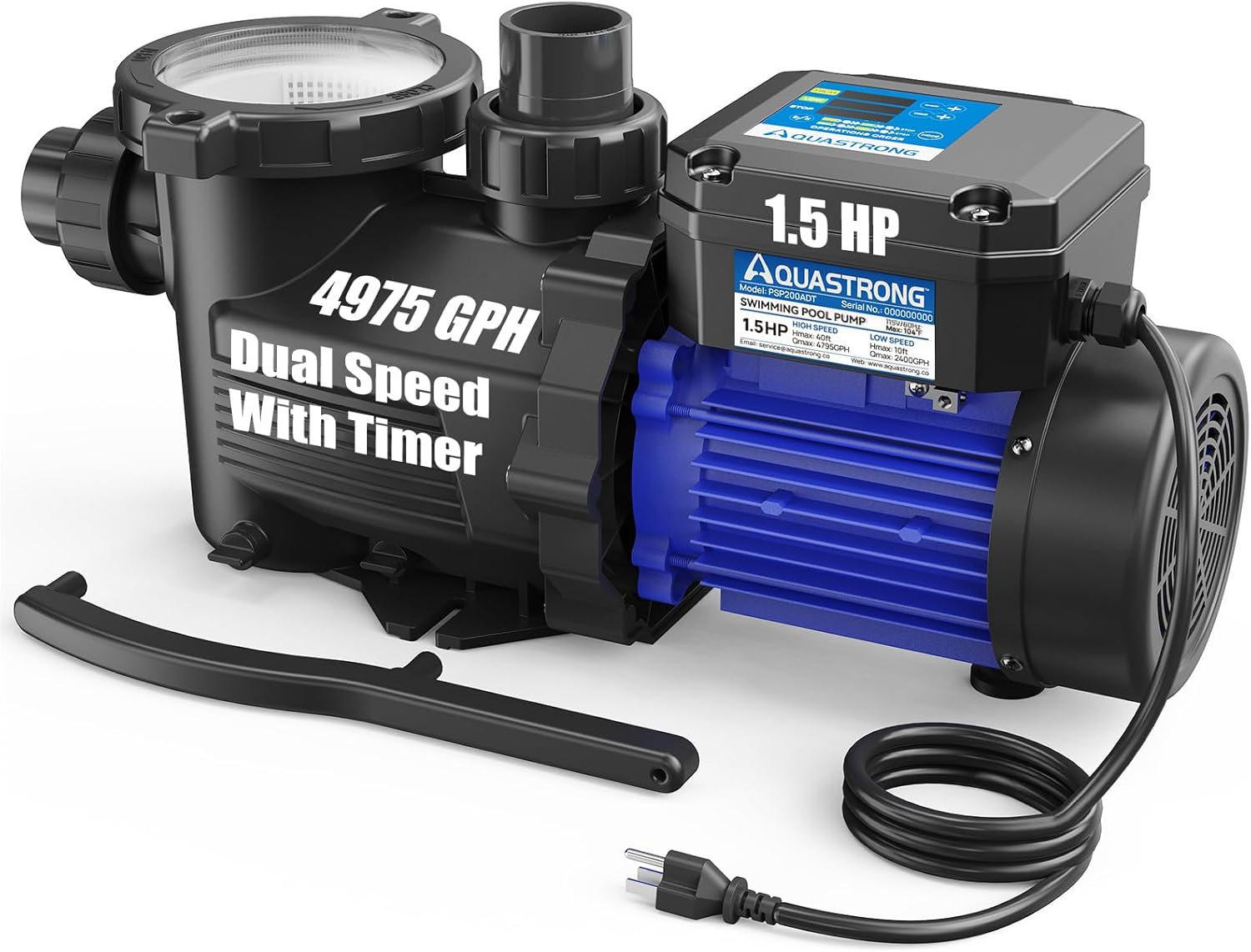
- 1.5 HP high / 0.5 HP low on 115V
- 4,795 GPH high / 2,400 GPH low listed
- Built-in 24-hour recurring schedule
What to Check Before Buying a Dual-Speed Pool Pump
Match the electrical supply before horsepower
A pump marked 115V or 110V–120V belongs on the electrical supply specified by its label and manual. A model marked 220V or 230V requires the appropriate circuit and installation. Never substitute a different-voltage pump and assume an adapter plug will make it compatible. Pool installations also call for appropriate GFCI protection, bonding and code-compliant equipment placement.
Compare the pump with your filter rating
Every sand, cartridge or DE filter has a maximum approved flow and sometimes preferred operating ranges for particular functions. Excessive pump output can cause high filter pressure, channeling or unnecessary strain. Too little flow can undermine heaters, salt chlorine generators, suction cleaners and backwashing. Filter compatibility can rule out a product before its other features matter.
Identify the plumbing connection type
A 1.5-inch adapter may describe a nominal PVC pipe size, an NPT threaded connection or a hose-end fitting. They are not interchangeable. Measure and identify the existing fittings, check suction and discharge orientation, and confirm the actual unions supplied with the specific pump. A package that includes two adapter sizes is helpful only if they mate with your equipment.
Decide how speed changes will be controlled
Two speeds do not automatically mean two push-button settings on the motor. Some units have a built-in control, others use a timer or remote, and some installations require external switching. Determine whether your existing timer or automation can switch the pump safely and whether you want schedules that repeat without daily input.
IVY&LANE J20007E 2.5 HP 230V Dual-Speed Inground Pump
- 2.5 HP; 230V inground configuration
- Up to 104 GPM; stated 79 ft maximum head
- 1.5-inch and 2-inch connections supplied
The IVY&LANE J20007E is aimed at inground installations that already have 230-volt pump power and need a stronger high-speed operating mode. Its advertised 104 GPM ceiling and 79-foot maximum head make it a different proposition from compact above-ground pumps. Those two limits describe different ends of a performance curve, however; they are not a promise that the unit delivers 104 GPM against 79 feet of resistance.
What the J20007E Is Built Around
This is a substantial 2.5 HP dual-speed pump rather than a small hose-fed cartridge-filter replacement. The specified 27-by-10-by-13-inch housing and approximately 48.5-pound weight deserve attention when an existing equipment pad has limited space. Its transparent strainer cover makes debris checks straightforward, while the large basket catches material before it reaches the impeller. The body uses reinforced polymer construction rather than exposed metal wetted surfaces.
Power and Hydraulic Fit
The 230V supply is an installation requirement, not a minor convenience. Check the existing circuit, breaker, conductor sizing, bonding arrangement, and control equipment against the pump nameplate and installation manual. Its listed dual motor speeds are approximately 3,450 and 1,725 RPM. The higher speed is relevant when the filter needs a faster cleaning cycle or the circulation system has a demanding return path; the lower speed can be better for extended ordinary filtration provided the minimum flow needs are still satisfied.
Why Connection Details Matter
Both 1.5-inch and 2-inch fitting options are listed, which helps with common rigid-PVC layouts. Fittings alone do not guarantee drop-in compatibility. A replacement must still line up with the existing suction and discharge centerlines, have adequate straight pipe for unions, and leave room to remove the lid. A 2-inch fitting does not erase losses elsewhere in a system built with narrow plumbing and restrictive fittings.
Who It Fits—and What to Check
Consider this model for a 230V inground equipment area where the circulation system can use its upper-speed capability. Check whether the existing filter, heater, chlorinator and valves permit the expected flow before selecting it. Oversizing a pump can mean higher noise, greater filter pressure and unnecessary electricity use. If the pool already operates properly at modest circulation rates, a lower-power dual-speed pump with a suitable pump curve could be more sensible.
Pros
- 230V inground-oriented design
- Two available union sizes
- High stated head limit for demanding layouts
- Accessible clear-lid strainer basket
Cons
- Requires suitable 230V electrical service
- Large, heavy body needs equipment-pad space
- Maximum head and maximum flow are not simultaneous
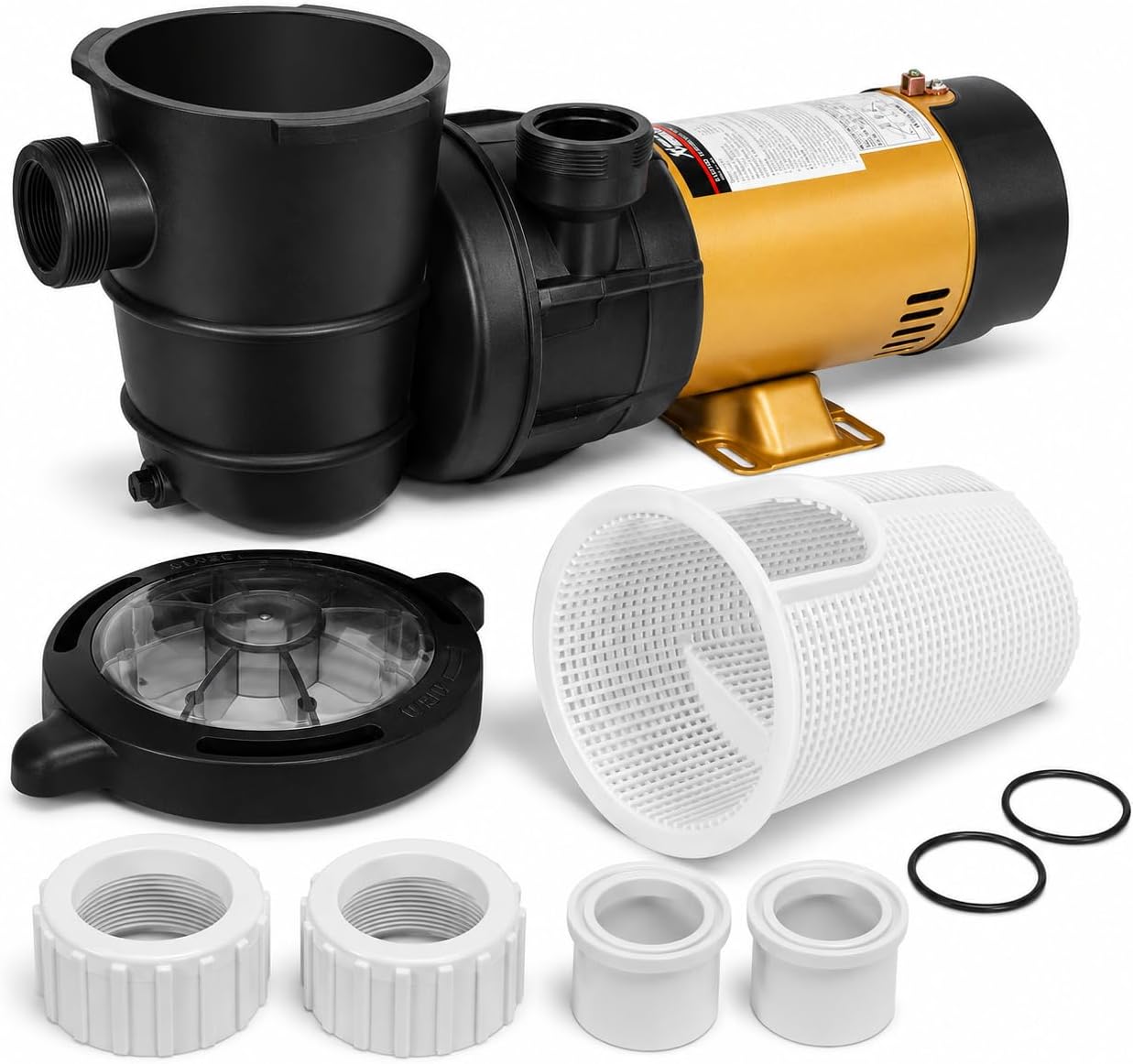
XtremepowerUS 75113 1.5 HP Two-Speed Above-Ground Pump
- 115V two-speed motor: 1,750/3,450 RPM
- Manufacturer lists 4,980 GPH maximum flow
- 1.5-inch NPT fitting arrangement
The XtremepowerUS 75113 keeps the control arrangement comparatively straightforward: a 1.5 HP pump with a low-speed mode for routine circulation and a high-speed mode for faster movement. That makes it a practical reference point for buyers who want two distinct motor speeds without paying for extensive electronic programming. It is chiefly an above-ground option, so its application is narrower than a general inground replacement.
A Relatively Compact Pump Layout
The manufacturer specifies a body about 22 inches long, 7.5 inches wide and 10.5 inches high. Its integrated strainer basket is topped by a see-through cover, allowing you to notice a full basket without opening the suction side unnecessarily. The supplied fitting arrangement is specified as 1.5-inch NPT. Owners replacing a hose-based pump should check the actual connection hardware rather than interpreting 1.5 inches as a universal hose-clamp size.
What the Two Speeds Do
XtremepowerUS lists approximately 1,750 RPM on low and 3,450 RPM on high, with a headline maximum circulation figure of 4,980 GPH. Running at the lower setting reduces the water movement and load compared with high speed, but it is only useful if the filter and other circulation equipment continue to function correctly. Faster operation is a better candidate for particular cleaning tasks and for applications that need stronger flow. The settings are two fixed choices, not a continuously adjustable speed range.
Installation and Maintenance
A grounded, GFCI-protected 115V supply is essential, as is a stable and ventilated mounting surface. Suction-side connections must seal against air as well as water, because even a small air leak can stop reliable priming. Before energizing the pump, fill the strainer housing and follow the supplied priming procedure. Periodically remove leaves and inspect the cover O-ring for dirt or damage; a clear basket alone does not guarantee that the filter downstream is clean.
Reasons to Choose Something Else
A buyer wanting scheduled speed changes without a separate control should compare the timed Aquastrong or remotely controlled VIVOHOME products. The 75113 is also not the natural choice for a 230V-only equipment pad or an installation whose plumbing and filtration are engineered around an inground pump. Its strongest argument is straightforward, two-speed circulation with published speed figures.
Pros
- Published 1,750/3,450 RPM settings
- 115V configuration for suitable installations
- Clear basket cover and manageable footprint
- Manufacturer documentation lists key technical details
Cons
- Primarily intended for above-ground pools
- No integrated programmable timer in this version
- 1.5-inch NPT fittings must be matched to existing plumbing
VIVOHOME VH1895 1.5 HP 115V Remote-Timer Pump
- 1.5 HP dual-speed motor on 115V
- Wireless remote with four schedule segments
- High/low operation for filtration routines
The VIVOHOME VH1895 is built around how the pump is controlled, not simply its horsepower. A wireless remote and four programmable operating segments allow a pool owner to organize normal filtration and periods of higher circulation without repeatedly going to the equipment area. The advantage is most relevant when the pump is difficult to reach or the daily filtration schedule changes.
Remote Control Versus a Basic Speed Switch
The supplied remote manages low- and high-speed choices and scheduled operating periods. Documentation for this 1.5 HP 115V model describes four schedule segments and a manual operating mode for a temporary timed run. That is different from a simple two-position switch, which typically leaves the owner to handle speed selection and operating hours separately. Electronic convenience still requires the owner to understand how the clock and recurring program work.
Flow and Motor Considerations
Product literature associated with the VH1895 lists a high-speed flow figure around 6,024 GPH and a lower-speed figure around 3,648 GPH. Treat these as the stated figures for the model rather than predicted output through your actual filter and hoses. Filter loading, pipe size, suction elevation and return restrictions can all reduce circulation. The 115V electrical requirement makes it distinct from the visually similar 230V VH1896.
The Value of Scheduled Low-Speed Running
A useful schedule might allocate a low-speed period for standard water mixing and a separate high-speed period when the cleaner or other connected equipment needs increased flow. The correct duration depends on pool volume, sanitizing requirements and the system's measured performance. A built-in schedule can reduce forgotten switches, but it does not remove the need to check water quality, skimmer action or filter pressure. Remote control should not be treated as a substitute for a safe electrical disconnect.
Fit and Long-Term Ownership
Before purchasing, identify the exact fitting configuration and available clearance at both pump ports. Confirm that the control arrangement meets your equipment setup, particularly if a separate pool automation panel already switches the pump. If remote convenience is not important, a less complex mechanical two-speed model might be easier to operate and troubleshoot. A buyer with a 230V circuit should compare the VH1896 instead of assuming the two units are interchangeable.
Pros
- Four configurable schedule segments
- Wireless control avoids repeated trips to pump pad
- 115V dual-speed setup
- Temporary manual timed operation described for model
Cons
- More controls to learn than a basic two-speed switch
- Remote is another component to keep accessible
- Not interchangeable with the 230V VH1896
VIVOHOME VH1116 2 HP 115V Above-Ground Dual-Speed Pump
- 2 HP, 115V above-ground layout
- Up to 86 GPM high / 40 GPM low
- 1.25-inch and 1.5-inch adapters included
The VIVOHOME VH1116 is especially interesting for above-ground pools with smaller existing hoses. Unlike many pumps that assume a rigid 2-inch plumbing arrangement, this 115V dual-speed model lists adapters for 1.25-inch and 1.5-inch connections. That hardware can reduce the number of extra parts needed during a replacement, although every union and hose end still needs a physical size check.
Connection Flexibility Comes First
The manufacturer's specification lists two sets of adapters: 1.5-inch fittings and 1.25-to-1.5-inch fittings. This is an important distinction if a pool has a smaller flexible hose circuit rather than glued PVC. The approximately 23.6-by-10-by-10.3-inch body also leaves a manageable, though not tiny, footprint next to a raised pool wall. Its clear-lid basket sits at the suction end for routine debris removal.
How Its High and Low Modes Compare
VIVOHOME lists up to 86 GPM in the faster mode and 40 GPM in the slower one, together with separate stated head figures of 41 and 14 feet. Those numbers make the two settings visibly different on paper. For a small cartridge filter, however, pushing the full high-speed maximum through narrow hoses is not desirable or necessarily achievable. Match the filter's approved flow range and the pool's plumbing before assuming the stronger setting is beneficial.
Electrical and Operating Details
The specified 115V motor draws different currents across the two operating modes, so a correctly protected circuit matters even with a normal-looking plug. VIVOHOME also describes thermal protection, a reinforced thermoplastic pump body, and a removable basket beneath a transparent cover. Fill and prime the pump before operating it; never intentionally run a circulation pump dry. The bottom drain is useful when equipment must be emptied for cold-weather storage.
Who Should Compare Another Model
Buyers whose equipment pad is already plumbed with 2-inch rigid pipe could find the supplied small-hose connections less helpful. Someone who wants automatic speed scheduling should consider the Aquastrong timer versions or a VIVOHOME remote-timer model. For the right above-ground system, the clearest advantage here is the combination of a 115V motor and included small-hose adapter options.
Pros
- Includes 1.25-inch and 1.5-inch connection options
- Manufacturer publishes both speed flow figures
- Integrated strainer and lower drain plug
- 115V above-ground application
Cons
- Smaller adapters do not overcome a restrictive filter
- Not a direct substitute for every inground pump
- No four-segment remote scheduler on this VH1116 version
VEVOR HAP1100A 1.5 HP/0.35 HP Above-Ground Pump
- 110V–120V; 1.5 HP high / 0.35 HP low
- 110 GPM high / 52 GPM low listed
- 54 ft high / 14 ft low maximum head
VEVOR presents the HAP1100A as a two-speed above-ground pump with separate power ratings for its high and low settings. That 1.5 HP/0.35 HP pairing helps clarify the intended operating pattern: brief or task-specific stronger circulation followed by lower-power routine use. The published 110 and 52 GPM figures describe the two ends of this design, not a guarantee of those flow rates once a pool filter is connected.
Published Operating Modes
The manufacturer lists a maximum high-speed flow of 110 GPM with up to 54 feet of head, and a lower-speed maximum of 52 GPM with up to 14 feet of head. Its high-speed rotating speed is specified as 3,450 RPM. The higher nominal flow makes this a pump to evaluate carefully against the sand-filter rating, return plumbing and suction fittings. A pool with a compact filter is not automatically suited to a larger pump simply because it can move more water in a low-resistance test.
Construction and Water Handling
The unit has a reinforced polypropylene housing and a detachable strainer basket viewed through a clear cover. VEVOR states a maximum water temperature of 122°F for this range. That temperature tolerance is not a recommendation to use any pool pump as a spa heater circulation pump without verifying the complete application. The short manufacturer-listed cord also means the planned connection point needs attention during site preparation.
Speed Selection Is an Installation Question
Before purchasing, inspect the actual wiring and switching instructions supplied with the unit. VEVOR's product Q&A for this dual-speed range warns that speed changes may depend on external switching rather than a conveniently mounted two-position selector. Do not assume that plugging the unit into a standard outlet gives immediate access to both speeds. If wiring changes are necessary, they belong with a qualified installer familiar with local pool electrical rules.
Which Buyer Benefits
The HAP1100A suits an above-ground installation where the 110V–120V circuit, approved filter and control arrangement line up with the pump. Owners interested mainly in remote programming should look elsewhere. The key attraction is an explicitly documented separation between higher-output and lower-power modes, with the accompanying installation checks taken seriously.
Pros
- Both high and low power ratings stated
- Detailed high/low flow and head figures
- Clear-lid debris basket
- Reinforced polymer housing
Cons
- External switching/control requirements need confirmation
- 110 GPM peak can exceed smaller filter requirements
- Short cord may restrict placement
VIVOHOME VH1165 2.5 HP 230V Dual-Speed Pool Pump
- 2.5 HP 230V dual-speed arrangement
- Up to 104 GPM; 79 ft maximum head
- 1.5-inch and 2-inch connectors supplied
The VIVOHOME VH1165 belongs to the larger 230V side of this comparison. It lists the same headline 104 GPM maximum flow and 79-foot head limit as the IVY&LANE 2.5 HP entry, so it is sensible to compare fit, housing and service considerations rather than declare either model stronger from those two numbers. Its intended applications include inground and suitably equipped above-ground installations.
Size and Installation Requirements
The VH1165 body is specified at roughly 27.8 inches long, 10.6 inches wide and 12.6 inches high. At approximately 44.8 pounds, it needs a properly supported equipment pad and enough clearance to unscrew the lid. Its included 1.5-inch and 2-inch connection options can assist with an existing PVC system, provided the replacement port locations and union styles match. Any change to the 230V supply or bonding should be made by a qualified professional.
The Difference Between Speed and Head
Product documentation identifies high and low operating speeds at roughly 3,450 and 1,725 RPM. Running slower can reduce electrical demand and pump noise, but the delivered flow also drops. The published 79-foot head is the stated maximum head limit; it should not be paired arithmetically with the stated 104 GPM to predict a working point. A proper pump curve and an understanding of total dynamic head are the right tools for deciding whether a given equipment layout is suitable.
Water Path and Maintenance
A clear strainer lid and removable basket give access to routine pump maintenance. Keep the lid sealing surface clean and inspect the gasket whenever the housing is opened. Drain points and winterizing procedures matter in freezing climates because standing water can crack wet-end components. The pump is self-priming in the sense described by the manufacturer, but that does not mean it is safe to start with an empty housing or a closed suction valve.
Strengths and Boundaries
Choose the VH1165 when 230V power and high-capacity filtration are already part of the system plan. A small above-ground pool using narrow hoses and a light cartridge filter is unlikely to benefit from the higher capacity without a wider equipment upgrade. There is also no reason to select a 2.5 HP model if a properly sized 1.5 HP pump supplies adequate flow at the required head.
Pros
- Strong published maximum-head specification
- Both common PVC connector sizes supplied
- Two clearly separated motor-speed settings
- Large accessible strainer basket
Cons
- Requires 230V compatible electrical installation
- Larger footprint than compact above-ground units
- High nameplate horsepower is not useful without suitable plumbing
AQUASTRONG PSP200ADT 2 HP 115V Pump with Timer
- 2 HP high / 0.5 HP low; 115V
- 5,186 GPH high / 2,578 GPH low stated
- Programmable recurring dual-speed timer
The AQUASTRONG PSP200ADT is a useful middle ground for a buyer who wants a timer built into a conventional dual-speed pump. It has a 2 HP high setting, a lower-power 0.5 HP setting and a 115V supply requirement. The integrated scheduler is more significant than an extra fraction of headline flow when the real objective is consistent everyday filtering.
Timer and Speed Are Linked
AQUASTRONG describes programmed high-speed and low-speed operating periods on this model. The point is to arrange a recurring circulation cycle rather than leaving the pump at high speed all day. Product specifications list 5,186 GPH maximum flow in the high mode and 2,578 GPH in low mode. The manufacturer also identifies different head limits for each mode, which reinforces that low-speed operation has less pressure capability and must be checked against the connected system.
What the 115V Model Offers
The official PSP200ADT specification lists a 115V supply, 10.5/3.5 amp operating figures and 1.5-inch/2-inch connection options. Those connections make it more flexible than a pump sold with only a single hose-end size, although the supplied unions must still be matched carefully to the existing pipe. Its integral strainer lid provides visibility into debris accumulation. For pools with easily clogged baskets, this access is a practical maintenance advantage, not a replacement for proper filtration.
Good Uses for Automatic Cycles
An automated day can include a shorter higher-speed period when a pool cleaner or other approved attachment needs additional movement, followed by a lower-speed period for normal mixing. Calculate run duration from actual circulation and sanitizer needs instead of assigning the same hours to every pool. The timer also needs correct clock settings after power interruptions if the model does not retain all settings. Confirm how the pump behaves after an outage before relying on unattended schedules.
Situations Requiring More Thought
A 2 HP figure by itself should not decide a replacement. If the existing filter has a lower maximum rated flow, a smaller pump may be more appropriate. Someone who already owns a reliable external automation panel may get little value from another on-pump timer. The PSP200ADT is most persuasive for owners seeking 115V dual-speed circulation with built-in operating times.
Pros
- Onboard recurring speed scheduling
- Separate 2 HP/0.5 HP operating ratings
- Published flow figures for both modes
- 1.5-inch and 2-inch adapter choices
Cons
- Timer setup adds a learning step
- Peak output must still match filter rating
- 115V only for this specified variant
Vidapool SPD150-LV 1.5 HP 115V Dual-Speed Pump
- 1.5 HP dual-speed; 115V
- 4,750 GPH high / 2,100 GPH low listed
- 1.5-inch and 2-inch adapter options
The Vidapool SPD150-LV is a 1.5 HP 115V option for owners who want a comparatively moderate nominal output rather than the much higher high-speed figures of some VEVOR models. Vidapool lists 4,750 GPH on high and 2,100 GPH on low. That difference gives a concrete starting point for thinking about an everyday circulation schedule, provided both speeds work properly with the pool's filter.
Why Its Flow Ratings Matter
Converted to minutes, the stated maximum high flow is about 79 GPM, while the lower setting is about 35 GPM. These figures describe advertised pump capability, not delivered flow through every filter. They do show that changing speed is meant to produce a substantial shift in circulation. A filter that needs a minimum amount of flow for an accessory must still be checked before running that accessory on low speed.
Plumbing and Positioning
Vidapool lists 1.5-inch and 2-inch adapter choices and a 40-foot stated maximum head. The model is marketed for inground as well as above-ground use, but application suitability ultimately depends on suction elevation, plumbing losses and installation instructions. Measure the distance between the pump ports and any nearby wall or fence before ordering. Allow clearance to lift the strainer lid and clear winterizing drain points without moving the entire unit.
Ownership and Servicing
The pump incorporates a strainer at the front end, where leaves and debris can be intercepted. Regular basket cleaning protects circulation and helps distinguish a blocked strainer from a dirty filter. The manufacturer advertises a two-year warranty for this model, which is useful to confirm alongside the seller's applicable support arrangements. Keep proof of purchase and the exact SPD150-LV identification rather than relying on a generic 1.5 HP description when requesting parts.
Its Place in the Shortlist
The SPD150-LV is attractive when the circuit is 115V, the system could use 1.5-inch or 2-inch connection hardware and an owner values a straightforward 1.5 HP dual-speed arrangement. It lacks the central appeal of the remote-timer VIVOHOME models, and a buyer seeking a built-in schedule may find an Aquastrong timer version more convenient. Pick it for hydraulic and installation fit, not because every 1.5 HP pump is equivalent.
Pros
- Moderate 1.5 HP high-speed configuration
- Separate 4,750/2,100 GPH figures
- 1.5-inch and 2-inch fitting options
- Manufacturer states a two-year warranty
Cons
- No specified remote timer in SPD150-LV
- Real-world flow depends on plumbing resistance
- Check use above the pool waterline against installation instructions
AQUASTRONG Riptide PSPAD150-HV 1.5 HP 220V Pump
- Riptide Series 1.5 HP dual speed
- 220V specification; 6,604 GPH rated high flow
- Self-priming body with filter basket
The AQUASTRONG Riptide PSPAD150-HV is one of the more easily confused entries because its nominal 1.5 HP rating resembles smaller 115V pumps, while its specified voltage and stated flow place it in another class. This Riptide dual-speed variant is listed for 220V power and up to 6,604 GPH. It should be considered only where the electrical installation and hydraulic system are appropriate for that exact model.
Riptide Identification Is Essential
The model reference PSPAD150-HV helps distinguish this unit from other Riptide products, including single-speed variants and pumps with different horsepower ratings. The provided listing identifies a pure-copper motor, an integrated filter basket and a self-priming configuration. Check the full model code on the actual product packaging. Similar-looking dark-gray pump housings cannot establish electrical equivalence or whether a timer is included.
Reading the 6,604 GPH Headline
The advertised upper flow is equivalent to roughly 110 GPM. Without a verified flow-versus-head curve for the exact plumbing arrangement, it cannot be used directly as the rate at which the owner's pool will circulate. The listing also gives a maximum head figure of approximately 63 feet in associated product details. That head limit and the maximum-flow value describe separate operating conditions and should not be multiplied or interpreted as simultaneous output.
Electrical and Plumbing Constraints
Treat the 220V rating as a reason to check the nameplate, supply frequency, breaker and wiring method before ordering. Many North American installations use nominal 230V circuits, but the correct operating range must come from the manufacturer's own approved instructions, not from assuming 220V and 230V labels always mean the same thing. Verify the exact unions and intended installation position as carefully as the voltage. Fittings that look similar in listing photographs are not enough to prove a leak-free connection.
Which Buyer Is Better Served
A pool owner already planning a higher-voltage installation may consider this Riptide model for its advertised high-flow capability. A homeowner replacing a 115V, plug-in above-ground pump should not view it as an uncomplicated upgrade. Buyers needing predictable daily schedules should confirm timer functionality separately rather than inferring it from the dual-speed description.
Pros
- Distinct 220V dual-speed option
- Up to 6,604 GPH stated high-speed capacity
- Riptide model number aids exact identification
- Self-priming design with strainer basket
Cons
- Electrical compatibility needs careful checking
- No verified onboard timer for this specific variant
- High maximum flow is not the working flow at installed head
VEVOR HAP1500A 2 HP/0.44 HP Above-Ground Pump
- 110V–120V, 2 HP high / 0.44 HP low
- 118 GPM high / 57 GPM low stated
- 56 ft high / 14 ft low maximum head
The VEVOR HAP1500A sits next to the HAP1100A in the same family but offers a different high-speed envelope. The manufacturer gives it 2 HP at high speed and 0.44 HP at low speed, compared with 1.5/0.35 HP for the smaller model. Its higher published flow and head figures are worth considering only if the rest of the pool system can use them.
The Meaning of the Higher Rating
At high speed, VEVOR lists a maximum of 118 GPM and 56 feet of head; at low speed, the values are 57 GPM and 14 feet. This is a modest numerical increase over the 1.5 HP VEVOR's stated 110/52 GPM and 54/14 feet figures. It does not follow that the larger pump will improve water quality or reduce cleaning time in every pool. Filtration efficiency, the filter's permitted flow, and water treatment practices matter more than simply chasing the largest motor.
Construction and Physical Fit
The published housing dimensions are approximately 22.83 by 7.09 by 10.63 inches, with a clear strainer cover and reinforced polypropylene outer shell. That footprint is close to the smaller VEVOR but not identical in height. The listed water temperature limit is 122°F. A detachable basket is useful for removing leaves before they reach the impeller, although blocked plumbing or a dirty filter still requires attention elsewhere in the circulation loop.
Controls and Power Arrangements
This is an AC110V–120V dual-speed model, and the product family includes speed selection arrangements that require checking external switching or control connections. The VEVOR support Q&A specifically cautions against assuming that a manual speed switch is fitted to the pump housing. Identify exactly how your intended installation will provide safe, correctly wired speed selection. A qualified professional should address any hardwiring, bonding or GFCI protection questions.
Where the Extra Capacity Makes Sense
The HAP1500A is a candidate for an approved above-ground system with a compatible filter and a genuine need for greater high-speed flow. If the equipment was selected around a smaller pump, higher rated flow can work against the installation rather than help it. For owners who value scheduled automation more than maximum output, a lower-capacity timer-equipped model could be the more practical purchase.
Pros
- Higher VEVOR-family published output
- Distinct high/low power figures
- Clear inspection lid and basket
- Similar compact width to 1.5 HP VEVOR
Cons
- Flow increase over the smaller VEVOR is not dramatic
- Speed-switch arrangement must be verified
- Not appropriate for every small filter system
VIVOHOME VH1896 2 HP 230V Remote-Timer Pump
- 2 HP dual speed on 230V
- Wireless remote; four program segments
- Up to 113.5 GPM listed maximum flow
The VIVOHOME VH1896 is the higher-voltage member of the company's wireless remote-timer pair. It combines a 2 HP 230V pump with a remote control and four programmed periods. For equipment pads already supplied with the correct high-voltage circuit, this gives a more automated alternative to larger manually switched two-speed pumps.
Controls Drive Its Appeal
The remote supports scheduled high- and low-speed periods, giving the owner a way to allocate circulation through the day without visiting the motor. The stated control range is up to about 197 feet under suitable conditions; obstacles and interference can affect useful distance. The remote also has a manual timed mode described for this family. Learn the default behavior after a power interruption, especially if the schedule is expected to resume unattended.
How It Differs From VH1895
The closely related VH1895 is the 1.5 HP, 115V unit. The VH1896 instead specifies 2 HP and 230V, with product details listing up to 113.5 GPM and a head figure of 65.6 feet. Electrical voltage, motor rating and hydraulic ratings therefore differ even if remote operation looks familiar. Do not use the lower-voltage unit's fittings or electrical assumptions to install the higher-voltage model.
Fittings and Wet-End Details
The product listing includes several fitting types, among them connections described for 1.25-to-1.5-inch hose, 1.5-inch piping and 2-inch piping. That assortment can be helpful, but PVC slip unions, NPT threads and flexible hose barbs are not interchangeable just because the stated diameter matches. Identify the mating end at each port and confirm seals, adapters and pipe alignment before replacing an existing pump.
Ideal Ownership Situation
Choose the VH1896 when the pool installation warrants a 230V pump and the owner intends to use programmed high- and low-speed cycles. It is less compelling for a small 115V plug-in above-ground setup or for someone whose external automation already performs the same functions. The main differentiator here is a combination of higher-voltage circulation capability and remote scheduling, not a guarantee of lower electricity bills.
Pros
- Four-segment remote scheduling
- 2 HP high-voltage variant with clear identity
- Multiple fitting types included in listing
- Temporary timed remote operation
Cons
- Needs a correct 230V electrical installation
- Remote adds a component to manage
- More functions than needed for basic two-speed operation
AQUASTRONG PSP150ADT 1.5 HP 115V Pump with Timer
- 1.5 HP high / 0.5 HP low on 115V
- 4,795 GPH high / 2,400 GPH low listed
- Built-in 24-hour recurring schedule
The AQUASTRONG PSP150ADT offers the built-in timer approach without the 2 HP high-speed rating of its larger PSP200ADT sibling. This 115V 1.5 HP dual-speed model is listed at 4,795 GPH on high and 2,400 GPH on low. Buyers whose filter does not need the bigger motor can compare the control convenience without automatically stepping up in horsepower.
Understanding the Integrated Timer
The on-pump controls are designed for recurring 24-hour speed sequences, including high, low and stop periods. Owners can build a regular cycle rather than relying on remembering to turn a manual switch each morning. The settings are not the same as the fully adjustable RPM controls found on a true variable-speed drive. Here the owner programs durations for two discrete motor speeds and the off period.
Hydraulic and Electrical Specifications
AQUASTRONG's official data specifies 115V operation, 1.5 HP/0.5 HP high-and-low power ratings and 1.5-inch/2-inch connection hardware. The stated 4,795 and 2,400 GPH figures are useful for comparison, but the manufacturer's own product description contains inconsistent wording in one passage about the high-speed figure. Use the formal model specification and check the label or manual when a precise duty point is critical. A filter's permissible flow remains the key boundary.
Everyday Use and Maintenance
A transparent strainer lid shows when leaves are accumulating, while a drain plug aids storage and servicing. The control panel needs to remain accessible if operating times will be adjusted during the season. As with every self-priming pool pump, initial filling and an airtight suction line are essential; do not run it dry. The manufacturer describes a limited warranty, and owners should retain the exact PSP150ADT model number for service inquiries.
Its Main Buying Advantage
This is a sensible option for a 115V pool whose circulation demand fits a 1.5 HP high-speed pump and whose owner wants scheduled filtration without a separate timer box. The two power settings provide flexibility, while the onboard clock handles repetition. If the system already includes robust scheduling controls, the simpler, non-timer PSP150AD version is worth comparing before paying for redundant electronics.
Pros
- Built-in 24-hour high/low/off scheduling
- 1.5 HP high rather than 2 HP rating
- Official model-specific specifications available
- 1.5-inch and 2-inch fittings included
Cons
- On-pump schedule is less convenient than wireless control
- Published flow copy contains minor inconsistencies
- A two-speed timer cannot dial in arbitrary RPM
Detailed Buying Guide: Matching a Two-Speed Pump to Your Pool
Horsepower is a starting label, not a sizing method
Pool-pump horsepower is useful for identifying product classes, but it does not say how many gallons the pump will actually move through a particular pool. A 1.5 HP design with a favorable hydraulic curve can deliver more usable circulation at a given system head than a larger label would suggest. Motors, impellers and wet-end geometry matter together. Select a pump from required flow and total dynamic head rather than choosing the largest number on the box.
In this group, the headline 2.5 HP choices include the IVY&LANE J20007E and VIVOHOME VH1165. The VEVOR models list a different high/low horsepower pair, and Aquastrong publishes separate high and low ratings for its timed models. Those numbers explain each product's intended operating modes, but they cannot replace a system-specific performance match.
How gallons per minute relates to gallons per hour
Flow is often advertised as gallons per hour (GPH) on one listing and gallons per minute (GPM) on another. Multiply GPM by 60 to express the same figure in GPH. For example, 86 GPM corresponds to 5,160 GPH, while 110 GPM corresponds to 6,600 GPH. This conversion makes comparison easier but does not prove that the pumps were tested at identical pressure conditions.
What matters to the pool is the operating point where the pump curve intersects the resistance of the complete plumbing system. The resistance increases as flow rises, so a pump working against narrow hoses or a restrictive filter will normally circulate less than its free-flow maximum. Compare pump curves at a realistic total dynamic head instead of ranking products solely by the first large number in an advertisement.
Understanding total dynamic head
Total dynamic head represents the combined pressure and friction losses the pump must overcome while circulating water. Filter resistance, fittings, elbows, valves, heaters and pipe length contribute. Elevation and the arrangement of suction-side equipment can also be important, particularly during priming. A larger stated maximum head suggests a different capability than a low-head circulation pump, but it is not a direct measurement of your installed system.
A new pump that is much stronger than the existing unit can produce high pressure without making the entire system more effective. If the filter gauge already runs near its maximum acceptable pressure, investigate restrictions and sizing before upgrading the motor. The right approach is to estimate or measure actual duty conditions and read the manufacturer's flow-versus-head chart for the exact model.
The practical role of high speed
High speed is useful when the pool needs temporarily greater flow: certain suction cleaning operations, filter backwashing where permitted, or circulation through equipment with minimum-flow requirements. It can also help after a large debris load if the filter and plumbing are suitably sized. More flow is not universally better, and not every cleaner benefits from the same rate.
Switch to the higher setting only within the operating limits of the downstream equipment. A heater or saltwater generator may need enough flow to activate its sensor, yet a filter may have a much lower safe limit than the pump's theoretical peak. Where those needs conflict, the circulation system must be corrected rather than relying on a stronger pump.
The practical role of low speed
Low-speed running can reduce energy use and operating noise because pump load generally falls sharply as rotational speed declines. The energy benefit depends on the actual motor and hydraulic system. A lower setting that supplies an acceptable filtration rate over a longer period can be more useful than constantly running high speed, but total electricity cost also depends on runtime.
At low speed, watch the skimmer action, filter pressure and sanitizer flow switch. If surface debris stops reaching the skimmer or an appliance repeatedly reports low flow, the lower setting is not appropriate for that operating task. A good schedule uses both modes intentionally instead of assuming that low speed should handle everything.
115V versus 230V and the installation budget
A 115V pump may be convenient where a suitably rated, code-compliant electrical connection already exists. A 230V replacement can be sensible where that voltage is already installed and the pump is properly matched to the pool. Neither voltage alone tells you which model will use less electricity per gallon circulated. Real consumption depends on watts drawn at the selected speed and the total hours of operation.
The cost of a replacement often includes more than the pump: electrical work, union adapters, new valves, plumbing alterations and possible changes to an existing timer. Consult a qualified electrician or pool professional for bonding, GFCI, cord-and-plug versus hardwired arrangements, and the pump's required distance from water. Never bypass protective devices to make a new pump fit an old setup.
Timer, remote or basic switch?
An integrated timer is useful when you want the same filtration cycle to run every day. The Aquastrong PSP150ADT and PSP200ADT add that function directly to the pump. A wireless remote adds convenience when the equipment is inconveniently located; the VIVOHOME VH1895 and VH1896 provide segmented scheduling and manual control through a remote. A conventional two-speed unit can be simpler for a pool already managed by an external controller.
Think about reliability as well as features. Will the pump return to its schedule after a power outage? Is a remote battery required, and can you adjust the schedule without the remote? Does the control integrate with existing automation? These are better ownership questions than comparing the sheer number of buttons.
Above-ground versus inground installation
Above-ground pools often have short suction runs and relatively low equipment elevation, sometimes with flexible hoses and compact filters. Inground systems more often include rigid pipe, longer runs, valves, heaters and higher total head. Product labels reflect intended applications, but the exact manufacturer's installation limits matter more than the marketing category.
Inspect the pump's priming instructions if it will sit above the waterline. A self-priming designation generally means the pump is designed to evacuate air after its housing has been filled, not that it can run dry indefinitely. Be particularly careful with storable pools, whose equipment and electrical standards can differ from permanently installed pools.
Fittings, unions and pipe diameter
The size printed on a pipe fitting is not always its measured outside diameter. Nominal PVC, female-threaded ports, NPT threads and hose barbs need their exact mating hardware. A pump advertised with 1.25-inch and 1.5-inch connections may serve a very different installation from one supplied with 1.5-inch and 2-inch rigid-PVC unions.
Check whether the old plumbing has enough straight section for a new union or whether an adapter will push the equipment beyond the space available. Avoid reducing large pump ports immediately into a long run of narrow hose without checking acceptable velocity and friction loss. The extra restriction can defeat the purpose of buying a higher-flow pump.
Noise, vibration and siting
A pump on a loose slab or against an equipment wall can transmit vibration into the surroundings. Keep the mounting level, maintain motor ventilation and avoid rigid pipe stresses that pull the wet end out of alignment. Low-speed operation usually sounds calmer, although poor priming, cavitation or worn bearings can create noise at either speed.
If a new pump is unexpectedly loud, first look for air leaks, a blocked strainer, too little available suction flow or mounting problems. Do not assume that a louder pump is working harder in a useful way. A pump drawing air or operating near cavitation can be damaged even while it appears to circulate water.
Strainer baskets and maintenance access
The clear pump lid is a small but important service feature across these products. It allows a quick look at leaf accumulation and air trapped under the lid. For a practical installation, leave enough overhead space to remove the lid, access the basket and inspect the O-ring without dismantling the plumbing.
Before opening a strainer housing, switch off power and relieve pressure using the equipment manufacturer's procedure. Clean the basket without striking its plastic mesh, then refit the sealing ring carefully. An incorrectly seated lid can admit air at the suction side and cause repeated prime loss.
Seasonal shutdown and replacement parts
Winterizing instructions depend on the local climate and pool system. In freezing areas, drain the pump as directed and protect components that could hold trapped water. Do not leave a water-filled wet end exposed to freezing temperatures. Check that the pump design permits accessible drain plugs and that valves isolate the system for service.
For long-term maintenance, write down the exact product model and keep the manual. Generic horsepower labels are not sufficient for sourcing an impeller, lid gasket, seal or replacement union. Parts availability and after-sales contact options are meaningful ownership factors, particularly with less familiar pump models.
Direct Comparisons That Change the Buying Decision
IVY&LANE J20007E vs VIVOHOME VH1165
Both are 2.5 HP, 230V dual-speed choices with 104 GPM stated maximum flow, 79-foot maximum head and 1.5-inch/2-inch fitting options. Their biggest practical differences are the pump body dimensions, weight and exact installation documentation. The IVY&LANE J20007E is listed at about 27 by 10 by 13 inches and 48.5 pounds; the VIVOHOME VH1165 is about 27.8 by 10.6 by 12.6 inches and 44.8 pounds. Compare union spacing, electrical controls and service access instead of inventing a performance winner from identical headline limits.
VEVOR HAP1100A vs VEVOR HAP1500A
VEVOR specifies 1.5/0.35 HP and 110/52 GPM for the smaller HAP1100A, while the HAP1500A is rated at 2/0.44 HP and 118/57 GPM. The maximum head figures move from 54 feet to 56 feet on high, while both list 14 feet on low. The increase is real on the published figures but modest compared with the consequences of filter incompatibility. Choose the larger model only when the required duty point and filter capacity justify it; verify the speed-switch wiring for either one.
AQUASTRONG PSP150ADT vs PSP200ADT
Both Aquastrong models provide 115V power and an integral timer, with high and low speed settings. The 1.5 HP PSP150ADT is listed at 4,795/2,400 GPH, while the 2 HP PSP200ADT is listed at 5,186/2,578 GPH. Their differences in flow are smaller than the horsepower labels initially suggest. A pool with modest plumbing resistance and a compact filter could be better matched to the PSP150ADT; the stronger model is useful only where the filter and required flow support it.
VIVOHOME VH1895 vs VH1896 remote-timer models
Both VIVOHOME units focus on remote scheduling with four programmable periods, but they are not voltage variants that can be swapped without rechecking the installation. The VH1895 is listed at 1.5 HP and 115V, whereas the VH1896 is 2 HP and 230V and includes its own specified set of fitting options. The deciding factors are the electrical circuit, pump-duty requirements and exact pipe connections, not which remote looks more convenient.
XtremepowerUS 75113 vs Vidapool SPD150-LV
These are two simpler 1.5 HP, 115V approaches without the four-segment wireless scheduling of the VIVOHOME models. XtremepowerUS publishes 1,750/3,450 RPM speeds and 4,980 GPH maximum flow, with a 1.5-inch NPT fitting arrangement. Vidapool lists 4,750 GPH high and 2,100 GPH low with 1.5-inch and 2-inch adapters. The choice depends on the exact union style, pump curve and how the owner intends to control operating hours.
AQUASTRONG Riptide vs the 115V 1.5 HP choices
The Riptide PSPAD150-HV uses a stated 220V supply and up to 6,604 GPH high flow, which sets it apart from 115V products with the same 1.5 HP label. It should not be selected simply as an upgrade from XtremepowerUS, Vidapool or Aquastrong PSP150ADT. Confirm the supply and the hydraulic requirement first, then compare the model-specific performance data. A convenient onboard timer can be a more valuable distinction than a bigger maximum flow figure.
Common Mistakes When Choosing 2 Speed Swimming Pool Pumps
Assuming all two-speed pumps have a built-in selector
A dual-speed motor can need an external switch or suitable control wiring, depending on the design. Check the manual and confirm the exact control hardware included. A timer-equipped unit and a motor with two available windings are not the same purchase.
Treating maximum flow as the pool circulation rate
Advertised maxima are useful comparison points but are not a guarantee through your filter, heater or narrow return line. Match a duty point on the pump curve with the real resistance of the system. An oversized pump is not a shortcut around undersized plumbing.
Confusing nominal pipe size with hose diameter
A 1.5-inch PVC union does not necessarily connect to a 1.5-inch flexible hose without an adapter. Note whether an end is threaded, slip-fit or barbed. Verify both pump ports rather than measuring only one.
Ignoring the filter and sanitation equipment
A filter with a lower allowable flow cannot safely be assumed to handle a stronger pump. Conversely, low-speed operation must provide adequate flow for heaters and sanitizer flow switches where connected. Read all equipment manuals together.
Buying by horsepower before checking voltage
A familiar 2 HP label says nothing about whether a motor belongs on a 115V or 230V installation. Do not improvise adapters, extension cords or wiring changes. Confirm the nameplate and local electrical requirements before committing to a pump.
Forgetting service access and the long-term routine
A tight installation may work until the first basket cleaning or winter shutdown. Leave room for the clear lid, drain plug, electrical connections and fittings. Confirm the availability of replacement seals and O-rings for the exact model.
Frequently Asked Questions
Is a two-speed pool pump the same as a variable-speed pump?
Not necessarily. A two-speed pump normally has two fixed operating speeds. A variable-speed design generally offers a broader range of adjustable RPM settings. Some marketplace titles use "variable 2-speed" loosely, so check the actual controls and listed motor speeds.
Does low speed always save electricity?
Lower motor speed commonly draws less power, but total electricity use depends on operating time and the pump's actual efficiency. A longer low-speed filtration period can still make sense, provided the pool reaches the circulation and sanitation performance it needs.
Can a 2 HP pump replace a 1.5 HP pool pump?
Only if the new unit is compatible with the electrical circuit, filter flow limit, suction and return plumbing, and system duty point. The horsepower difference alone is not enough information. An oversized replacement can increase pressure and operating cost.
How many hours should a two-speed pump run each day?
There is no single runtime for every pool. Water volume, bathing load, sanitizer system, actual circulation rate, filter performance and local climate all matter. Start with equipment guidance and adjust based on tested water quality and adequate mixing.
Can I connect a two-speed pump to an existing timer?
Potentially, but only if the timer and control wiring support that exact motor and intended speed switching. Some timers control only power on and off. Verify how the pump switches between speeds and use qualified electrical help where required.
Is higher GPH always better for pool cleaning?
No. Water movement has to stay within filter and plumbing limits. Increasing flow above an approved range can reduce effective filtration or cause excessive pressure. A properly sized pump and clean filter are more important than the largest advertised number.
What does maximum head mean?
Maximum head is the upper pressure or height-equivalent limit the pump can develop under its specified conditions. It does not mean that the pump delivers maximum rated gallons per minute at that same head. Flow generally falls as system head rises.
Do I need 115V or 230V for an above-ground pool?
It depends on the exact pool equipment and installation. Many above-ground setups use 115V pumps, while some larger systems use higher voltage. The pump nameplate, protective circuit, bonding and installation manual determine compatibility—not the pool wall type alone.
Can these pumps work with saltwater pools?
Some product listings specifically mention saltwater compatibility, but confirm that claim for the exact pump and the permitted salt concentration. A salt chlorine generator also has its own minimum flow requirements. Corrosion resistance should never be assumed from the presence of a plastic housing alone.
Why will a self-priming pump not start moving water?
The strainer pot may need to be filled, the suction line may have an air leak, a valve may be closed, or the basket/filter may be clogged. Stop the pump and follow its priming and troubleshooting instructions. Never let the motor continue running dry while trying to force a prime.
Is a wireless remote worth having on a pool pump?
It can be useful if the equipment pad is hard to reach or you regularly adjust schedules. The VIVOHOME VH1895 and VH1896 add programmed periods and remote control, but that convenience has less value if your existing automation already handles speed changes.
Which model is best for a small above-ground pool?
Start with the pool filter's approved flow and the existing supply voltage and hose sizes. The VIVOHOME VH1116 includes smaller-hose fitting options, while the XtremepowerUS 75113 and Vidapool SPD150-LV offer comparatively straightforward 1.5 HP setups. None should be selected without verifying compatibility with the actual filtration system.
Final Buying Considerations for 2 Speed Swimming Pool Pumps
A suitable two-speed pump should serve the existing pool rather than force an unnecessary equipment upgrade. For a 115V above-ground system using smaller hoses, the VIVOHOME VH1116 deserves a connection-size check. The XtremepowerUS 75113 and Vidapool SPD150-LV are straightforward 1.5 HP comparisons. For integrated scheduling, the Aquastrong PSP150ADT and PSP200ADT offer distinct rated flows without requiring a wireless remote.
If remote scheduling is a priority, compare the VIVOHOME VH1895 and VH1896 according to their different voltages and motor ratings. At the higher-capacity end, the IVY&LANE J20007E and VIVOHOME VH1165 are 230V options with stronger published head limits. The VEVOR pair gives explicit high- and low-speed ratings, but control wiring and filter suitability deserve particular attention. The Aquastrong Riptide is another high-voltage candidate, not a plug-in substitute for a 115V pump.
Before purchasing, confirm the nameplate voltage, acceptable filter flow, real suction and return connections, pump placement, motor control method and model-specific pump curve. Those checks matter more than a small difference in advertised peak GPH. The right unit is the one that supplies the required water circulation safely and efficiently in the installation you actually have.
Author