
A pool heater can spend months exposed to rain, wind-blown debris, snow, ice and strong sunlight even when the swimming season is over. A winter cover adds a removable barrier around the cabinet, but the useful differences between covers are mostly about fit, fabric, ventilation, plumbing access and retention in wind. A cover that is several inches too shallow, too narrow or too short can be harder to secure than a simpler model that actually matches the heater.
The most important distinction in this group is size. Several of these pool heater covers for winter are built around the common 40 × 34 × 31-inch heat-pump profile, while the Climate Shield OSCS-HC is taller at 37.5 × 30.5 × 36 inches and the MICOE is much slimmer at 38.39 × 15.94 × 26.38 inches. Those measurements are not interchangeable. Measure the equipment itself, including protruding controls, unions and pipe positions, before choosing a cover.
Material also changes how a cover behaves. The 600D Oxford models use a woven synthetic shell, usually paired with a waterproof or PVC-backed inner surface. Climate Shield uses a heavier vinyl-style shell with lining and mesh ventilation. MICOE uses lighter 420D Oxford. None of these material labels alone proves that one cover will last longer in every yard; stitching, fit, sun exposure, standing water and wind movement all affect service life.
A final point matters in freezing climates: a cover is weather protection, not winterization by itself. Pool-heater and pool-equipment manufacturers commonly instruct owners to drain water from equipment and plumbing before sustained freezes because trapped water can expand and damage heat exchangers, headers and lines. A storage cover goes on after the equipment has been shut down and prepared according to the heater manufacturer’s instructions.
Quick Comparison
Use the table as a fit-first shortlist. The measurements and closure details matter more than choosing by appearance because a heater cover has to clear the cabinet, plumbing and ventilation areas without being stretched tight.
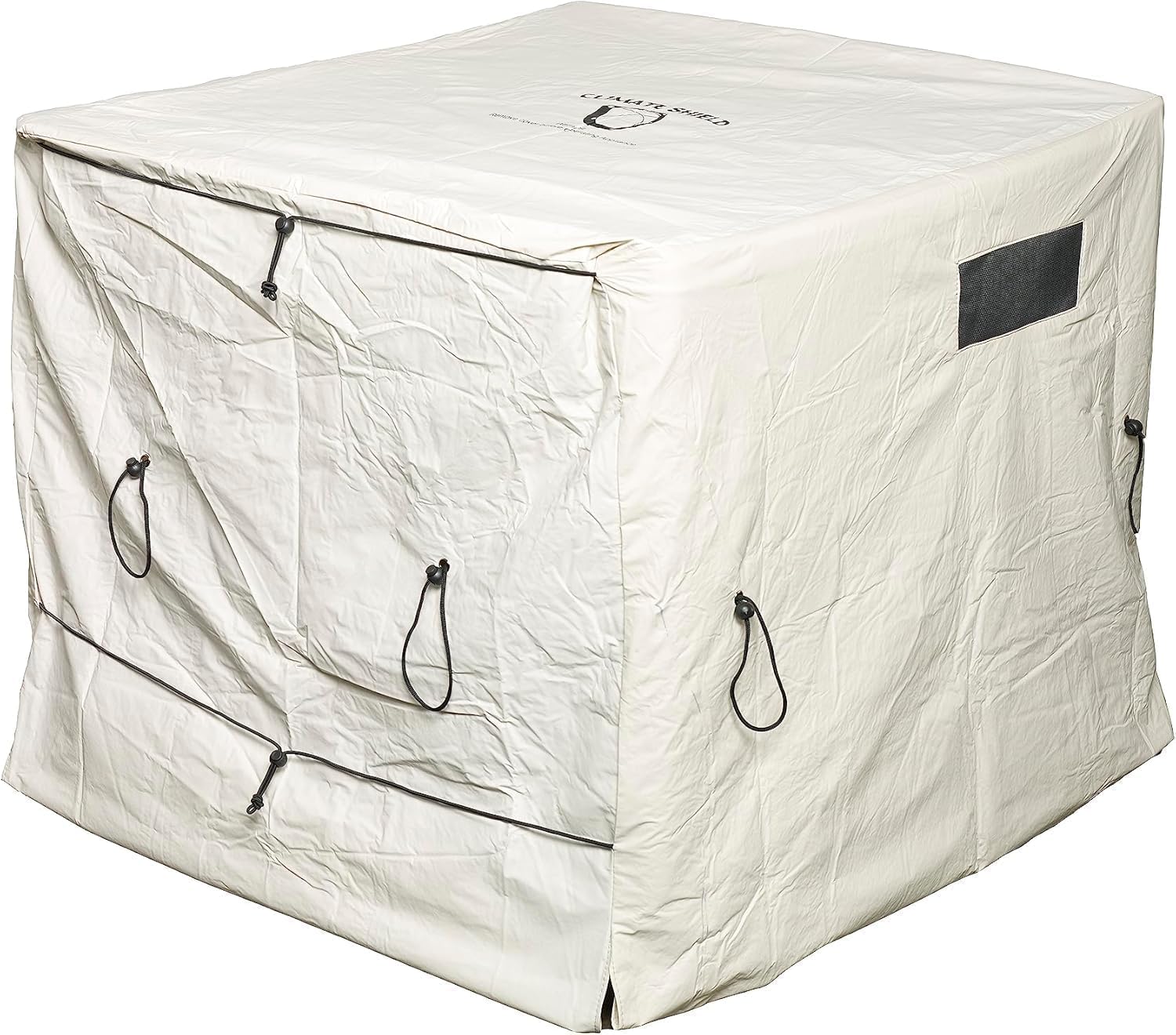
- 37.5 × 30.5 × 36 in. exterior size
- Heavy-duty polyvinyl construction with lining
- Built-in mesh vents and adjustable closure system

- Polyvinyl shell with nonwoven lining
- Side mesh vents for cross-ventilation
- Cinch straps and hook-and-loop seams for adjustable fit

- 40 × 34 × 31 in. nominal fit
- 600D Oxford fabric construction
- Hose opening plus storage bag
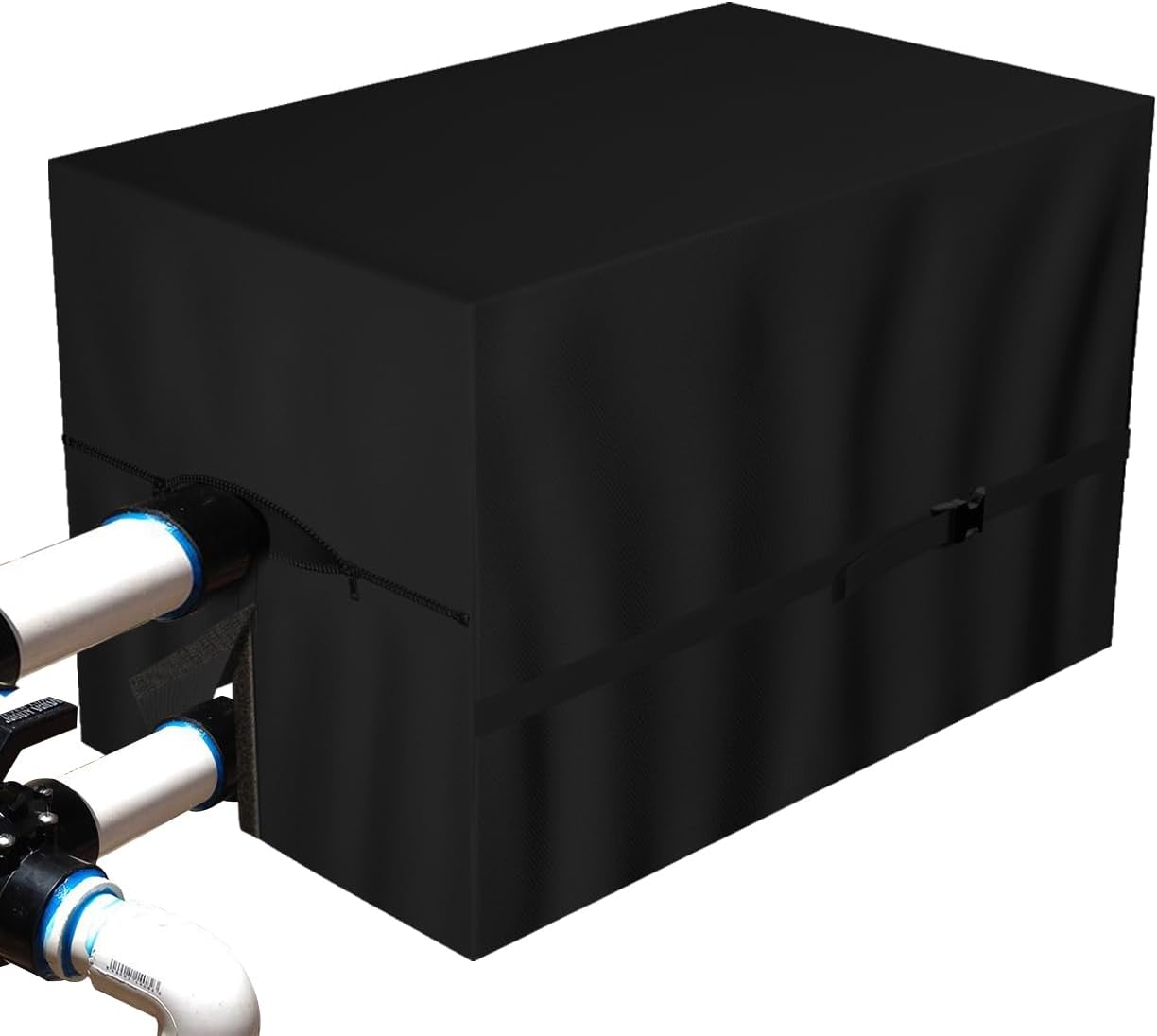
- 600D Oxford outer construction
- Side mesh vents
- Fixing straps for outdoor storage
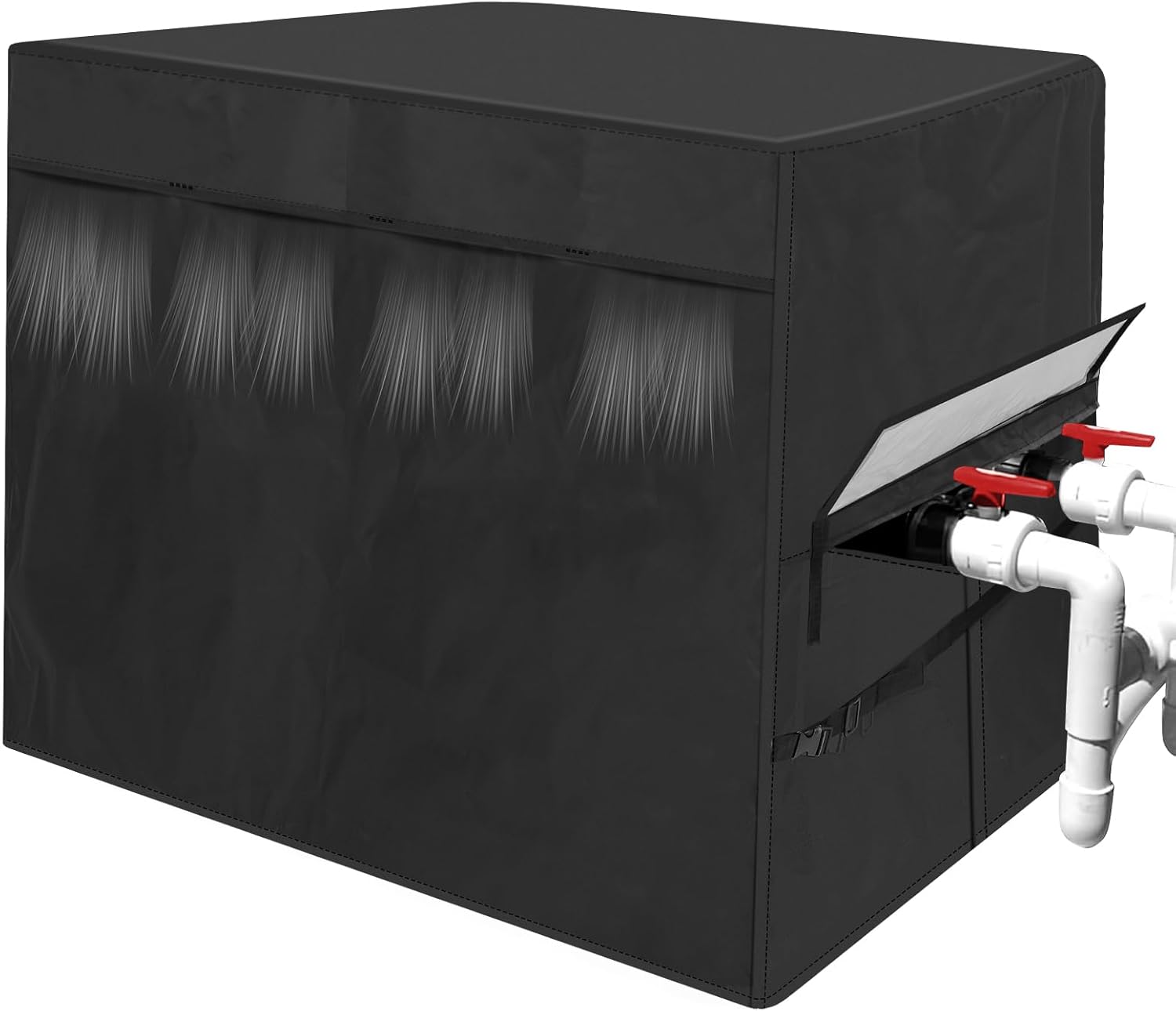
- 40 × 34 × 31 in. size
- 600D Oxford fabric with PVC-coated inner surface
- Top vent, hose channel and fixing straps

- 39.7 × 33.8 × 30.7 in. size
- 600D Oxford with PVC inner layer
- Side vents, handles, hose channel and adjustable restraints
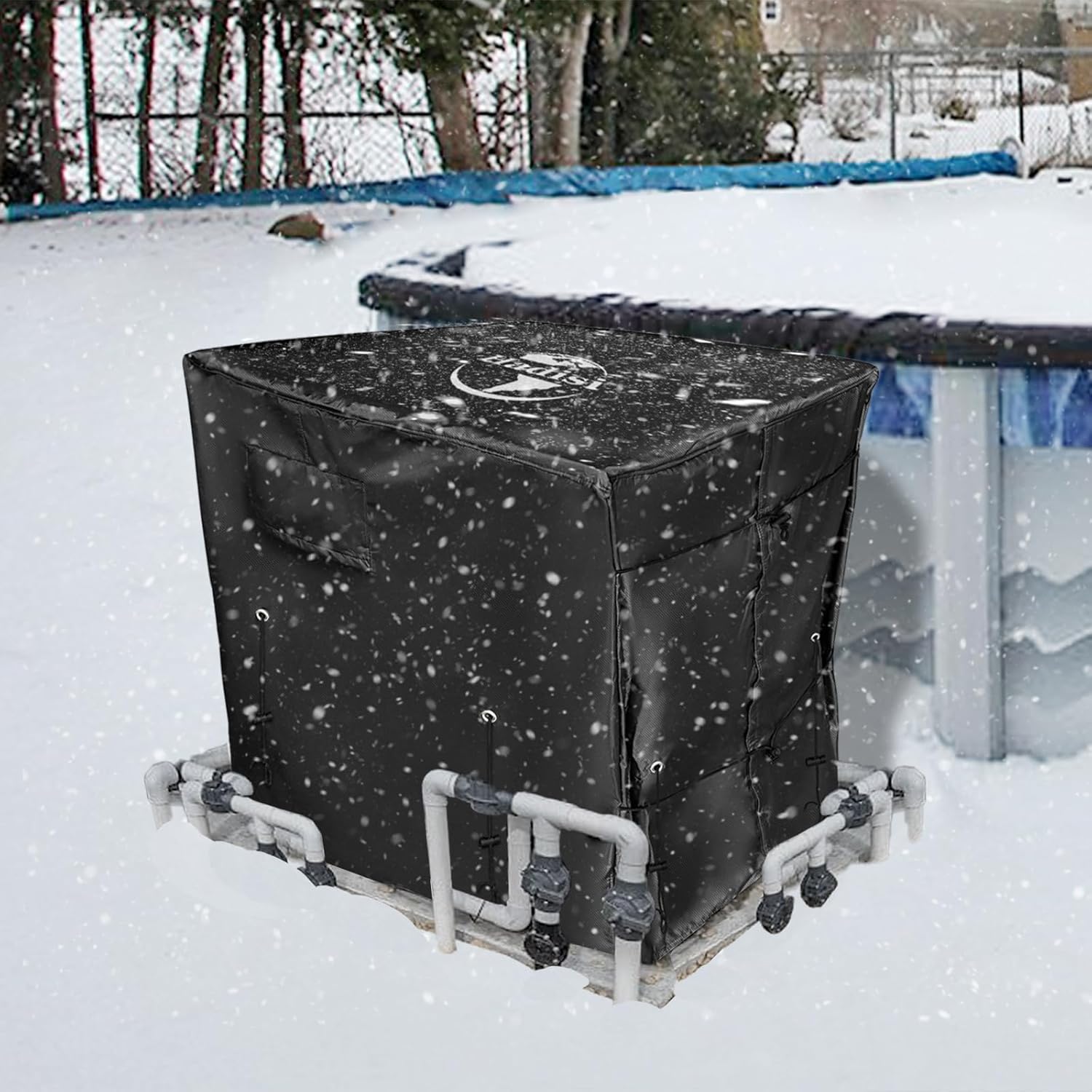
- Fits equipment up to about 39 × 30 × 36 in.
- 600D Oxford outer with plush lining and waterproof coating
- Scalable/adjustable shape for different cabinet sizes

- Nominal 40 × 34 × 31 in. class; listed cover about 39.7 × 33.8 × 30.7 in.
- 600D Oxford fabric with waterproof PVC inner layer
- Top ventilation and multiple adjustment points

- 38.39 × 15.94 × 26.38 in. slim profile
- 420D Oxford fabric
- Pipe-position hook-and-loop access, drawstrings and adjustable straps
What to Look for in Pool Heater Covers for Winter
Measure the heater, not the old cover
Start with the heater cabinet itself. Record the maximum width, depth and height, then include any fixed projections that the cover must pass over. A nominal 40 × 34 × 31-inch cover may work well on a cabinet slightly smaller than those dimensions, but it can become difficult to install if unions, conduits or control housings sit outside the main cabinet envelope.
Do not assume that “fits Hayward” or “universal” means every model from that brand will fit. Manufacturers sell heat pumps in different capacities and cabinet designs. The safer method is to use brand compatibility only as a clue, then verify the actual measurements and pipe layout.
Leave practical clearance around pipes and fittings
Pool heaters rarely sit as isolated boxes. Water lines, electrical conduits, drain points and service fittings can interfere with a cover. Hose channels, hook-and-loop seams or split openings are useful because they let the fabric wrap around connected plumbing instead of forcing you to disconnect lines just to install a seasonal cover.
Look at where the opening is placed, not simply whether an opening exists. A well-made side channel on the wrong side of your installation can be less useful than an adjustable seam. If the plumbing exits low on the cabinet, the cover also needs enough slack near the bottom to close without pulling upward.
Ventilation matters during storage
A completely sealed outdoor enclosure can trap damp air. That is why several models here use mesh or fabric vents. Ventilation can help stored equipment dry after normal condensation or weather exposure, but it does not make a full cover suitable for running a heat pump. An operating heat pump needs large, unobstructed intake and discharge airflow.
If the heater will remain active during part of winter, use the equipment manufacturer’s cold-weather procedure rather than assuming a storage cover can stay on. MICOE explicitly instructs users to remove its cover during operation, and that is a sensible rule for full-cabinet covers unless the heater and cover manufacturers state otherwise.
Choose fabric by exposure and handling needs
A 600D Oxford shell is common in this group because it balances abrasion resistance with foldability. PVC-backed versions add a water-resistant inner barrier. A 420D cover is lighter and easier to handle, although the fabric itself is not as heavy as 600D. Vinyl covers feel different again: they can form a substantial weather shield, but they are bulkier to fold and store.
Fabric weight should not be treated as a complete durability score. A correctly sized 420D cover that stays secure can experience less stress than an oversized 600D cover that flaps continuously in wind. Reinforced seams, secure straps, controlled drainage and keeping sharp cabinet edges from rubbing the fabric can be equally important.
Check how the cover is secured
Wind is one of the most demanding conditions for a loose equipment cover. Drawstrings tighten the lower perimeter, while buckle straps can wrap or cinch the body. Hook-and-loop seams are useful around pipes and projections. Models with several restraint methods take slightly longer to fit but give more ways to remove slack.
The goal is snug rather than stretched. Fabric pulled tight over corners can abrade, while very loose fabric can flap and rub. After installation, check that water cannot form a heavy pocket on a flat section of the cover and that no strap is pressing against a fragile valve, wire or sensor housing.
Climate Shield Pool Heater Cover (OSCS-HC)
- 37.5 × 30.5 × 36 in. exterior size
- Heavy-duty polyvinyl construction with lining
- Built-in mesh vents and adjustable closure system
The OSCS-HC is one of the more distinctive covers in this comparison because its 37.5 × 30.5 × 36-inch shape is taller and slightly narrower than the common 40 × 34 × 31-inch group. That proportion can suit upright heat-pump cabinets or equipment that needs extra vertical room without the depth of a 34-inch cover.
Design and Build
Climate Shield uses a heavy-duty polyvinyl shell with a lining rather than the woven Oxford construction used by most of the other products here. The material creates a substantial external barrier against seasonal weather and debris. The listing also identifies mesh ventilation panels, which are important on a cover made from a less breathable shell material.
The cover weighs about 2.4 pounds, so it is not excessively heavy despite the vinyl-style construction. The shape is flexible rather than rigid, and the closure arrangement uses hook-and-loop seams and cinch points to adapt around the equipment.
Fit and Installation
The stated 37.5-inch length, 30.5-inch width and 36-inch height should be compared with the widest and deepest parts of the heat pump, not only the manufacturer’s nominal cabinet specification. If a pipe union extends past 30.5 inches, for example, that projection may become the real limiting measurement.
The adjustable seams are useful where permanently connected plumbing would otherwise block a one-piece cover. This can reduce the temptation to disturb plumbing connections just for winter storage. The cover should still sit low enough to protect the cabinet without pulling tight over pipe fittings.
Practical Winter Protection
The lined polyvinyl construction is aimed at long-term outdoor storage, while the mesh areas give trapped air somewhere to move. That combination makes more sense than a fully sealed plastic wrap, especially because condensation can form around outdoor equipment as temperatures change.
In freeze-prone regions, install the cover only after following the heater manufacturer’s shutdown and drain procedure. The cover protects the outside of the equipment from weather exposure; it cannot prevent damage from water left inside a heat exchanger or plumbing passage that freezes.
Important Strengths and Limitations
Its strongest differentiator is the tall 36-inch profile combined with a narrower 30.5-inch width. Buyers whose equipment falls between the squat 31-inch covers and taller cabinets may find this proportion easier to fit. The vented vinyl-and-lining construction is also different from the 600D Oxford options.
The tradeoff is that the same proportions make it a poor fit for wider 34-inch-deep cabinets. Measure carefully before assuming “universal” compatibility. Vinyl is also bulkier to fold than a lighter woven cover, so it needs a little more storage room when removed.
Who Should Consider It
This model makes the most sense for an inactive outdoor heater or heat-pump cabinet close to 37.5 × 30.5 × 36 inches, especially where adjustable seams are useful around installed lines. Buyers with a conventional cabinet close to 40 × 34 × 31 inches should compare the wider BeadChica, tiscover, GOCOHHI or Adnee dimensions instead.
Pros
- 37.5 × 30.5 × 36-inch size suits many upright pool heat-pump cabinets
- Mesh vent panels help the covered cabinet breathe during storage
- Adjustable hook-and-loop seams and cinch points accommodate plumbing lines
- Lined vinyl construction adds a barrier against weather and surface debris
Cons
- Its 36-inch height and narrower footprint will not match every heat-pump cabinet
- A full cover should not be treated as a substitute for draining and freeze protection
- Vinyl construction is less compact to fold than lighter Oxford-fabric covers
Outdoor Solutions Inc. Climate Shield Heat Pump Cover and AC Cover
- Polyvinyl shell with nonwoven lining
- Side mesh vents for cross-ventilation
- Cinch straps and hook-and-loop seams for adjustable fit
This Climate Shield model follows the same general philosophy as the OSCS-HC but is sold as an adjustable heat-pump and outdoor AC cover. Its main advantage is not a single published box size; it is the way the polyvinyl shell, lining, cinch straps and hook-and-loop seams can adapt around different cabinet and line layouts.
Design and Build
The shell uses polyvinyl with a nonwoven lining and side mesh vents. The vents are an important detail because a lined vinyl enclosure can otherwise hold damp air around the cabinet during long storage periods. They allow passive cross-ventilation without leaving the whole unit exposed.
This model is also listed at about 2.4 pounds, making it manageable to install and remove. Its beige finish differs from the black Oxford covers, although color should be a secondary decision compared with fit and retention.
Fit and Adjustment
The cover is presented as a universal-fit design using cinch straps and hook-and-loop seams. That is useful for equipment with pipework or conduits that prevent a simple bottom-up slip cover from closing cleanly. The seams can be worked around connected lines instead of treating every installation as a bare rectangular cabinet.
“Universal” still has limits. Before ordering, compare the heater’s width, depth and height with the cover’s available adjustment and look at where the service lines leave the cabinet. A flexible closure cannot compensate for a shell that is fundamentally too small.
Practical Use
This is best understood as an offseason enclosure. It protects an idle cabinet from precipitation, wind-carried dirt and direct exposure while maintaining some ventilation. That can reduce seasonal cleaning around coils, grilles and cabinet seams when the pool reopens.
Do not use the presence of vents as a reason to operate a heat pump while fully covered. Heat pumps move large amounts of air through the evaporator coil and discharge that air from the cabinet. A winter storage cover should be removed before normal operation unless the equipment maker explicitly approves a different arrangement.
Important Strengths and Limitations
The most useful feature is adjustability around awkward installations. Compared with a fixed 40 × 34 × 31-inch sleeve, the Climate Shield system gives more freedom to work around lines and cabinet shapes. The lined shell and mesh vents also address two opposing needs: shielding and moisture release.
The limitation is that buyers who prefer a simple measurement-based fit may find a universal design less predictable. If your heat pump has a straightforward rectangular cabinet, a cover with clearly stated dimensions can be easier to evaluate before purchase.
Who Should Consider It
Consider this model if your installation has nonstandard line positions or if a cinch-and-seam system is more useful than a fixed pipe opening. If you already know your heater fits a 40 × 34 × 31-inch envelope, one of the dimension-specific 600D covers may be simpler to shortlist.
Pros
- Adjustable closure system is useful around pipes, conduits and cabinet projections
- Side mesh vents reduce the tendency to create a completely sealed enclosure
- Polyvinyl shell and lining provide a substantial storage barrier
- Can also suit compatible outdoor AC-style cabinets, adding flexibility
Cons
- Fit is marketed as universal, so careful measurement is still necessary
- No single fixed cabinet dimension should be assumed from the universal-fit description
- The cover should be removed before operation unless the equipment and cover instructions explicitly permit otherwise
BeadChica Pool Heater Cover 40 × 34 × 31 in.
- 40 × 34 × 31 in. nominal fit
- 600D Oxford fabric construction
- Hose opening plus storage bag
The BeadChica cover is a straightforward fixed-size option for heat pumps close to 40 inches long, 34 inches wide and 31 inches high. That makes it easier to compare with a cabinet drawing than a general “universal” cover. Its 600D Oxford shell, hose opening and storage bag focus on practical seasonal use.
Design and Build
The main shell is 600D Oxford fabric. “600D” refers to the yarn denier used in the woven material; it is useful as a relative fabric specification but does not by itself tell you the quality of the seams or coatings. Here, the heavier woven construction is intended to withstand outdoor storage conditions better than a thin indoor dust cover.
The black rectangular cover folds rather than holding a rigid shape, and the included storage bag gives it a defined place during the swimming season. That matters more than it sounds: covers left loose in a shed are easily punctured or lost among other pool-closing equipment.
Fit and Plumbing Access
The 40 × 34 × 31-inch size is the deciding specification. It belongs to the same general size class as the tiscover and Adnee covers, with the GOCOHHI only a few tenths of an inch smaller in each direction. If your heater is close to the maximum dimensions, allow for control boxes, pipe unions and cabinet handles rather than assuming an exact edge-to-edge fit will be comfortable.
A hose opening with hook-and-loop access allows connected plumbing to pass through the side. This is more useful than a completely closed skirt on many pool pads, but check that the opening corresponds with your line location. A cover should not have to twist around the cabinet to reach the plumbing.
Practical Winter Protection
For an idle heat pump, the shell can reduce direct exposure to snow, rain splash, leaves and wind-blown dust. It also keeps debris from collecting as easily in cabinet recesses. That can make spring cleanup simpler, particularly around equipment pads surrounded by trees or landscaping.
The cover does not provide freeze protection to water left inside the unit. Before sustained cold, follow the heat-pump manual for draining or blowing out the water circuit as applicable. Once the system is properly closed, the cover becomes the external layer of protection.
Important Strengths and Limitations
The advantage here is clarity: the buyer gets a common heat-pump cover size, heavy woven fabric, a plumbing opening and a storage bag without a complicated adjustment system. That suits installations where the cabinet already falls comfortably within the stated envelope.
The limitation is the same fixed geometry. Tall equipment over 31 inches or narrow, vertical cabinets can fit poorly even if one dimension looks close. The side opening also needs to align with the actual installation.
Who Should Consider It
This is a sensible shortlist candidate for a rectangular heat pump around the 40 × 34 × 31-inch class and for owners who want a simple 600D slip-on design. For a taller unit, look at the 36-inch-high Climate Shield OSCS-HC or Hadisi profile; for a narrow unit, the MICOE dimensions are in a different class entirely.
Pros
- 40 × 34 × 31-inch dimensions make fit checking straightforward
- 600D Oxford fabric gives the cover a heavier woven shell than many lightweight dust covers
- Hose-access opening helps the cover sit around connected plumbing
- Storage bag keeps the cover contained when the heater returns to seasonal use
Cons
- The fixed rectangular size leaves less room for unusually tall or narrow cabinets
- A hose opening is useful only if it aligns with the actual plumbing layout
- Dark fabric can absorb heat in strong sun, so offseason placement and ventilation still matter
MOSPDE Pool Heat Pump Cover for Winter
- 600D Oxford outer construction
- Side mesh vents
- Fixing straps for outdoor storage
MOSPDE takes a more general-fit approach. The listing emphasizes 600D Oxford fabric, side mesh vents and fixing straps rather than a prominent fixed three-number cabinet size. That puts more responsibility on the buyer to check the actual equipment envelope before treating the cover as compatible.
Design and Build
The outer construction is described as thicker 600D Oxford cloth with a waterproof inner treatment. This gives the cover the familiar combination of woven exterior and moisture barrier used by several products in this category. The black shell is intended for year-round outdoor storage exposure rather than indoor dust protection.
Side mesh vents are the feature that most clearly separates it from a plain rectangular bag. They provide an exit path for damp air and temperature-driven condensation while the equipment is shut down.
Securing the Cover
Fixing straps help keep the shell from lifting in wind. This matters on an equipment pad because the broad side of a heat-pump cover can behave like a sail if the lower edge is loose. The best installation keeps slack controlled without pulling the material hard against cabinet corners.
After fitting, inspect the cover from all sides. Straps should not cross fragile controls, and fabric should not be forced against sharp sheet-metal edges. If a pipe or electrical conduit pushes the cover outward, re-position the closure rather than simply tightening harder.
Practical Winter Use
MOSPDE describes protection against rain, snow, sunlight, dust and overnight moisture. Those are appropriate roles for a storage cover. The vented construction helps with passive moisture management, while the 600D shell provides the physical weather barrier.
Cleaning is simple: the cover can be rinsed and air-dried. Dry it before folding for storage. Packing a wet cover tightly can trap moisture and encourage odor or coating deterioration even if the fabric itself is made for outdoor use.
Important Strengths and Limitations
The combination of 600D fabric, side vents and straps covers the three practical needs of shielding, breathing and retention. It is a useful configuration for buyers who prefer a conventional soft cover rather than a lined vinyl enclosure.
The weak point is sizing certainty. Because the product is presented around a standard/universal fit rather than one clear numeric cabinet envelope, do not buy it solely from the brand name or the shape shown in photographs. Measure the equipment and confirm the current listing’s fit guidance.
Who Should Consider It
This cover is better suited to buyers who value vented 600D construction and are prepared to verify fit carefully. If you want a product you can compare directly against a 40 × 34 × 31-inch cabinet drawing, the BeadChica, tiscover, GOCOHHI or Adnee specifications are more explicit.
Pros
- 600D fabric is intended for seasonal exposure rather than indoor dust protection alone
- Side vents give moisture and trapped air a path to escape
- Fixing straps help control movement in wind
- Simple hose-cleaning care is practical for an outdoor cover
Cons
- The listing emphasizes a standard/universal fit rather than a clearly stated numeric size
- Buyers must pay extra attention to cabinet shape and plumbing clearances
- Ventilation does not mean the cover should remain installed while the heat pump is operating
tiscover Pool Heater Cover for Hayward 40 × 34 × 31 in.
- 40 × 34 × 31 in. size
- 600D Oxford fabric with PVC-coated inner surface
- Top vent, hose channel and fixing straps
The tiscover model uses the familiar 40 × 34 × 31-inch format but adds several fit-management features: a PVC-coated inner surface, a side hose channel, fixing straps and a top vent. That combination is aimed at a conventional rectangular pool heat pump that remains plumbed in place during winter shutdown.
Design and Build
The shell is 600D Oxford fabric with a PVC-coated inner side. The Oxford layer supplies the woven structure, while the coating provides a barrier against water passing through the fabric. This layered construction is common in outdoor equipment covers because it remains foldable while adding weather resistance.
A vent near the top gives rising damp air an exit route. That is particularly useful after temperature swings, when condensation can form on cold metal surfaces even if rain never reaches the cabinet directly.
Fit and Plumbing Access
At 40 inches long, 34 inches wide and 31 inches high, the cover belongs to the largest cluster in this comparison. If your cabinet is around 39 inches by 33 inches by 30 inches, the extra clearance can make installation easier. If the heater itself is already at the stated maximum, projections may make the fit too tight.
The side hose channel allows plumbing to pass through while the lower portion of the cover remains closed. This is a practical feature on pool pads where pipes enter low on one side of the heater. Confirm the line side before relying on the channel.
Wind and Weather Management
Fixing straps help hold the cover to the cabinet in gusty weather. A secure lower edge reduces flapping, which can wear both the cover and painted cabinet surfaces over time. Do not overtighten; a little room for the fabric to settle is better than forcing seams over sharp corners.
The cover should be placed on clean, dry equipment after the heater has been prepared for winter. Leaves or grit trapped between the cover and cabinet can act as an abrasive when wind moves the fabric.
Important Strengths and Limitations
The main advantage over a basic 40 × 34 × 31 cover is the combination of a pipe channel, vent and retention straps. These features address installation realities instead of treating the heater as an isolated box.
The limitation is that it still depends on a fixed rectangular size. A tall 36-inch cabinet will not become compatible just because the fabric has straps, and a narrow cabinet may leave a large amount of loose material to manage.
Who Should Consider It
This model suits a heat pump close to the 40 × 34 × 31-inch class where the plumbing exits from a compatible side and wind retention matters. Buyers with narrower equipment should not choose it simply because the heater brand is mentioned; dimension matching comes first.
Pros
- Clearly stated 40 × 34 × 31-inch dimensions simplify cabinet comparison
- PVC-coated inner surface adds a water-resistant barrier behind the Oxford shell
- Side hose channel is intended to accommodate connected plumbing
- Top vent and fixing straps address moisture release and wind retention
Cons
- The rectangular 40 × 34 × 31-inch profile will be loose or tight on cabinets far from that shape
- Pipe-channel placement still has to match the installation
- A covered heater still requires the manufacturer’s winter draining procedure in freezing climates
GOCOHHI Pool Heater Cover 39.7 × 33.8 × 30.7 in.
- 39.7 × 33.8 × 30.7 in. size
- 600D Oxford with PVC inner layer
- Side vents, handles, hose channel and adjustable restraints
GOCOHHI is very close to the common 40 × 34 × 31-inch category, but its stated measurements are 39.7 × 33.8 × 30.7 inches. Those small differences matter if your heater is already near 40 inches in any direction. The design adds side vents, handles, a hose channel, a drawstring and adjustable buckle restraints.
Design and Build
The cover uses 600D Oxford fabric with a PVC inner layer. This gives it a substantial woven shell while keeping the cover flexible enough to fold. The black exterior has two side vent areas so moisture is not relying on a single opening at the top.
Integrated handles are a small but practical addition. A large soft cover can be awkward to lift evenly over a heat-pump cabinet; handles give you controlled grip points when installing or removing it.
Fit, Closures and Plumbing
Use the exact 39.7 × 33.8 × 30.7-inch dimensions for fit checking rather than rounding upward. A cabinet that measures a true 40 inches long may already be too close for comfort, especially if a service panel or fastener protrudes.
The cover combines a hose channel, elastic drawstring, hook-and-loop closure and adjustable buckle straps. That gives more ways to shape the lower edge around plumbing and reduce slack. The tradeoff is more installation steps than a simple drop-over cover.
Practical Winter Protection
For seasonal shutdown, the 600D/PVC construction can reduce direct exposure to precipitation, dirt and sunlight. The vents are useful after humid weather or temperature changes, particularly on a pad where the cabinet does not receive much winter sun to dry naturally.
Before covering, make sure water has been dealt with according to the heater’s winterization instructions. Exterior waterproof fabric cannot protect an internal heat exchanger from freeze expansion. Also remove the cover before operation if it restricts intake or discharge airflow.
Important Strengths and Limitations
This is one of the more feature-rich fixed-size covers here. The handles make handling easier, while multiple restraints give more control in wind. Dual vents are also preferable to relying on incidental gaps around the bottom for air exchange.
The limitation is precision. Because the dimensions are slightly under the nominal 40 × 34 × 31 class, buyers should not assume the same fit as a true 40 × 34 × 31 cover. If your heater is near the limit, the extra fractions can decide whether the cover sits comfortably.
Who Should Consider It
Choose this style if your cabinet fits safely inside 39.7 × 33.8 × 30.7 inches and you want several ways to secure the lower edge. For equipment at or beyond 40 inches, verify clearance carefully or choose a larger cover rather than stretching seams.
Pros
- Dimensions are close to the common 40 × 34 × 31-inch heat-pump cover class
- Dual side vents add airflow paths on opposite sides of the enclosure
- Handles make installation and removal easier than gripping loose fabric
- Drawstring, hook-and-loop closure and adjustable buckle straps provide multiple ways to secure the cover
Cons
- The nearly 40-inch footprint is unsuitable for slim equipment such as narrow vertical units
- More straps and closures mean more points to position correctly during installation
- The cover must be removed for operation if it obstructs the heater’s intake or discharge airflow
Hadisi Pool Heater Winter Cover with Plush Lining
- Fits equipment up to about 39 × 30 × 36 in.
- 600D Oxford outer with plush lining and waterproof coating
- Scalable/adjustable shape for different cabinet sizes
The Hadisi cover addresses a different fit problem: equipment that may need more height and an adjustable body rather than the broad 40 × 34 × 31-inch profile. It is intended for heaters up to roughly 39 inches wide, 30 inches deep and 36 inches high and uses 600D Oxford fabric with a plush lining and waterproof coating.
Design and Build
The plush lining makes Hadisi unusual in this group. Instead of placing the coated Oxford shell directly against the cabinet, there is a softer inner contact layer. That can reduce hard fabric contact on painted surfaces, although any lining should be kept dry before long-term storage.
The outer layer is 600D Oxford with waterproof treatment, so the cover still has a conventional outdoor shell. Its adjustable construction is intended to scale down around equipment smaller than the maximum envelope.
Fit and Size Tradeoffs
The maximum profile of about 39 × 30 × 36 inches is taller but notably shallower than the 34-inch-deep covers. That makes Hadisi a candidate for upright equipment but not for a heat pump that needs the full 34 inches of depth.
Measure at the deepest projection. A cabinet may be only 29 inches deep while the pipe unions extend farther. If those fittings must remain under the cover, they become part of the required depth.
Practical Winter Use
A plush-lined cover should go over a clean, dry cabinet. If moisture is trapped between a soft lining and painted metal for months, the lining can slow drying. Allow the heater to dry after shutdown, then install the cover with its closures adjusted so the body is secure without being compressed against the equipment.
The extra 36-inch height is useful where controls or fan housings rise above the shorter 31-inch group. It also reduces the need to pull a short cover downward, which can stress seams and expose the bottom edge.
Important Strengths and Limitations
Hadisi’s strongest points are its taller maximum profile, adjustable shape and soft lining. Those features serve a different buyer from the broad, fixed-size Hayward-style covers.
Its main limitation is the 30-inch depth. If your heat pump is 32 to 34 inches deep, this should be ruled out regardless of the 39-inch width and 36-inch height. The lining also adds material that must be dried and stored carefully.
Who Should Consider It
This model is most relevant for a taller heater that stays within the 39 × 30 × 36-inch envelope and for owners who prefer a lined inner surface. For a wider/deeper conventional cabinet, use one of the 34-inch-deep covers instead.
Pros
- 36-inch maximum height suits some taller cabinets that do not fit shorter 31-inch covers
- Plush lining provides a softer contact surface against the equipment cabinet
- Adjustable construction offers more flexibility than a rigid fixed-size shell
- 600D Oxford outer is intended for outdoor seasonal protection
Cons
- The 30-inch depth limit is narrower than several 34-inch-class covers in this comparison
- A soft lining can hold moisture if the cover is installed over wet equipment and cannot dry
- Adjustability does not remove the need to verify the heater’s maximum width, depth and height
Adnee Pool Heat Pump Cover 40 × 34 × 31 in.
- Nominal 40 × 34 × 31 in. class; listed cover about 39.7 × 33.8 × 30.7 in.
- 600D Oxford fabric with waterproof PVC inner layer
- Top ventilation and multiple adjustment points
Adnee is sold in the nominal 40 × 34 × 31-inch class, while the detailed cover specification is about 39.7 × 33.8 × 30.7 inches. That is effectively the same dimensional class as GOCOHHI, so buyers should use the smaller exact measurements rather than relying on rounded naming.
Design and Build
The shell combines 600D Oxford fabric with a waterproof PVC inner layer. Top ventilation openings allow warm, damp air to escape while the heater is stored. The cover remains flexible enough to shape around a rectangular cabinet rather than using a rigid frame.
Multiple adjustment points are a key part of the design. The listing describes several drawstrings/closures intended to reduce excess fabric and hold the cover in place, which can be useful on a pad exposed to crosswinds.
Fit and Adjustment
Fit should be checked against 39.7 × 33.8 × 30.7 inches. A heater that is exactly 40 × 34 × 31 inches on a technical drawing leaves essentially no room for projections or installation tolerance in a cover this size.
The multiple adjustment points can be an advantage on slightly smaller cabinets because loose panels can be gathered rather than left to flap. On the other hand, each closure takes time to position, so this is less of a one-step installation than a simple elastic-bottom cover.
Practical Winter Protection
The PVC-backed Oxford construction is intended to keep precipitation and debris off the cabinet, while the top vents address trapped air. This is a useful combination for a heater that will sit inactive outdoors for months.
As with the other full covers, winter protection starts inside the equipment. Drain and prepare the water circuit according to the heater manual in areas subject to freezing, then use the cover as the exterior shield. Do not run the heat pump with its intake or discharge blocked.
Important Strengths and Limitations
Adnee’s strength is controlled fit around a common residential heat-pump size. The vented, PVC-backed 600D body and multiple restraints address weather, moisture and wind without a hard enclosure.
The main caution is dimensional rounding. The difference between a nominal 40 × 34 × 31 description and an exact 39.7 × 33.8 × 30.7 cover can matter on a cabinet near the limit. Treat the exact figure as the maximum shell size, not as extra clearance.
Who Should Consider It
This cover suits equipment safely below the exact dimensions and owners who want several points of adjustment. If the heater measures close to the full nominal size, consider a cover with more verified clearance rather than forcing the fabric.
Pros
- Near-40 × 34 × 31 dimensions match a common residential heat-pump cabinet class
- PVC-backed 600D Oxford combines a woven exterior with an inner moisture barrier
- Top vents give warm, damp air an escape route during storage
- Multiple drawstrings/adjustment points help reduce loose fabric around the cabinet
Cons
- Nominal and listed exact dimensions differ slightly, so use the smaller exact measurements when checking clearance
- Numerous adjustment points take longer to set than a basic slip-on cover
- It is intended as storage protection, not permission to operate a heat pump with restricted airflow
MICOE Pool Heater Cover 38.39 × 15.94 × 26.38 in.
- 38.39 × 15.94 × 26.38 in. slim profile
- 420D Oxford fabric
- Pipe-position hook-and-loop access, drawstrings and adjustable straps
MICOE is the outlier in this group because it is only 15.94 inches deep. Its 38.39 × 15.94 × 26.38-inch profile is intended for a much slimmer outdoor unit than the 30- to 34-inch-deep pool heat-pump cabinets covered by most of the other products. That difference should be the first screening step.
Design and Build
The cover uses 420D Oxford fabric rather than 600D. The lighter material makes the cover easier to fold, lift and store, while still providing a weather-resistant barrier for compatible equipment. It also comes with a storage bag.
Adjustable straps and drawstrings help control the fabric, and hook-and-loop openings at pipe positions allow connected lines to pass through. These are practical details on slim outdoor units where pipes or conduits project from the side or lower cabinet.
Fit and Equipment Type
Do not choose this model for a standard 34-inch-deep heat pump merely because the length is close to 40 inches. The 15.94-inch depth is less than half the depth of several other covers in this article. Width/depth mismatch will prevent proper installation even if length and height appear reasonable.
For a slim unit that actually falls within 38.39 × 15.94 × 26.38 inches, the narrower shape can be an advantage because there is less loose fabric to gather. A closer shape generally reduces wind flap and makes the straps more effective.
Operation and Winter Storage
MICOE explicitly instructs users to remove the cover while the heat pump is operating so airflow can remain unobstructed. That direction is particularly important because a heat pump depends on free air movement across its coil and fan discharge.
During offseason storage, the 420D shell can keep precipitation and debris off the cabinet after the equipment has been correctly winterized. Allow the unit and cover to dry before long-term closure, and use the drawstrings/straps to prevent wind from lifting the fabric.
Important Strengths and Limitations
The strength is specialization: this is a much slimmer cover with lighter fabric and useful pipe-access details. It avoids putting an oversized 34-inch-deep bag around equipment that is only about 16 inches deep.
The limitation is equally clear. It does not substitute for the broad 40 × 34 × 31-inch covers, and its 420D material is lighter than the 600D shells used by most competitors here. Buyers should choose it because the dimensions match, not because it looks similar in a product image.
Who Should Consider It
Consider MICOE only if your outdoor heater or heat-pump unit is close to its slim 38.39 × 15.94 × 26.38-inch envelope. For a conventional pool heat pump around 34 inches deep, choose a cover from the 40 × 34 × 31-inch group instead.
Pros
- Much narrower 15.94-inch depth fits a different equipment profile than 34-inch-deep covers
- 420D Oxford keeps the cover lighter and easier to fold than many 600D alternatives
- Pipe-position hook-and-loop access helps route the cover around installed lines
- Storage bag and adjustable restraints make seasonal handling straightforward
Cons
- The 15.94-inch depth makes it unsuitable for conventional wide heat-pump cabinets
- 420D fabric is lighter than the 600D shells used by most other covers here
- The listing specifically instructs users to remove the cover while the heat pump is operating
Detailed Buying Guide
How much extra room should a cover have?
A soft equipment cover needs enough room to pass over the widest part of the cabinet without pulling hard on seams. A small amount of clearance also accommodates control housings, bolt heads and plumbing unions. At the same time, excessive extra material can flap in wind and collect water.
There is no single clearance number that applies to every cover because closure systems differ. Use the manufacturer’s stated cover dimensions as an outer fit envelope and avoid treating an exact match as guaranteed clearance. If the heater is already at the stated maximum in one direction, investigate the cover’s cut and openings before ordering.
600D vs 420D Oxford fabric
Denier describes the linear mass of the yarn, so 600D fabric generally uses heavier yarn than 420D fabric. In equipment covers, that usually means 600D feels more substantial while 420D is lighter and easier to pack. Denier does not tell you coating thickness, seam quality, UV stabilizers or how well the cover fits.
For a sheltered equipment pad, a lighter cover that stays secure can be entirely practical. On an exposed pad, heavier fabric may resist abrasion better, but wind movement can still wear it if the fit is poor. Treat denier as one input rather than a complete durability rating.
PVC backing and waterproof coatings
Many Oxford covers add PVC or another waterproof coating on the inner surface. This reduces water penetration through the woven shell. It does not mean the entire installation becomes watertight because seams, vents, hose openings and the open bottom can still admit moisture.
That is usually beneficial. Pool equipment outdoors needs protection from direct precipitation, but it also benefits from the ability to dry. A cover that sheds rain while allowing some ventilation is more practical than wrapping the cabinet tightly in non-breathable plastic.
Why vents are useful
Outdoor equipment changes temperature throughout the day. Warm humid air can enter an enclosure and later condense as the cabinet cools. Mesh vents or covered vent openings allow some air exchange, reducing the amount of moisture held in a closed space.
Vents should not be confused with operating airflow. Heat pumps need a much larger volume of air through the evaporator coil and fan discharge than a storage vent can provide. Remove full covers before operation unless the equipment manual expressly states otherwise.
Plumbing openings and hook-and-loop seams
A cover can fit the cabinet dimensions and still fail in practice if it cannot pass around the connected water lines. Split seams, hook-and-loop channels and hose openings solve that problem by letting the lower edge close around pipes rather than over them.
Before purchase, stand at the equipment pad and note which side the water lines use and how high they enter the heater. If a product photo shows an opening on the opposite side, check whether the cover can be rotated without placing its vents or controls incorrectly.
Straps, drawstrings and wind
A bottom drawstring is useful for gathering the skirt, while horizontal buckle straps control the body of the cover. Multiple closures are especially helpful on a cabinet smaller than the cover’s maximum dimensions. They also reduce flapping that can abrade fabric against metal corners.
Secure the cover to the equipment, not to fragile nearby plumbing. After strong wind or the first snow, inspect the fit. Snow load or pooled water can change the tension on straps and may require repositioning.
Prepare the heater before covering it
In climates with sustained freezing temperatures, pool-heater winterization normally includes shutting down the equipment and removing water from the heater and associated plumbing according to the manufacturer’s instructions. Trapped water can freeze, expand and damage heat exchangers or headers. Covering a water-filled heater does not solve that problem.
The exact procedure varies by heater type and installation. Gas heaters, heat pumps, bypass arrangements and automation systems have different shutdown requirements. Follow the manual for your model or use a qualified pool professional if the system includes isolation valves, compressed-air blowout steps or other procedures you are not comfortable performing.
Clean and dry before long-term storage
Remove leaves, grass clippings and abrasive grit from the cabinet before covering. Clear drainage openings and make sure the pad is not holding standing water. A dirty cabinet under moving fabric can develop scratches, and a wet cabinet under a lined cover can take longer to dry.
The cover itself should also be clean and dry when stored. Rinse off surface dirt, let the fabric air-dry completely, then fold it loosely into its storage bag or a dry container. Avoid placing sharp pool tools on top of a folded cover.
Think about spring removal
A winter cover should be easy to remove without disturbing plumbing or service panels. Handles help on large fabric covers, while adjustable seams can be opened around fixed pipes. Before restarting the heater, remove the cover fully, inspect the cabinet and clear any debris from air intakes and discharge areas.
Also reverse the heater’s winterization steps exactly as specified by its manufacturer. Replacing drain plugs, reopening valves and restoring water circulation may be required before power or heat is applied.
Direct Product Comparisons
Climate Shield OSCS-HC vs BeadChica 40 × 34 × 31
These two covers target different cabinet proportions. Climate Shield OSCS-HC is 37.5 × 30.5 × 36 inches, so it gives up width/depth in exchange for five extra inches of height. BeadChica is 40 × 34 × 31 inches and therefore suits a broader, shorter cabinet.
Construction also differs. Climate Shield uses lined polyvinyl with mesh ventilation and adjustable seams, while BeadChica uses 600D Oxford with a hose opening. Choose between them by cabinet shape and line layout first; material preference should come second.
BeadChica vs tiscover 40 × 34 × 31
Both occupy the same nominal size class and use 600D Oxford fabric, but tiscover adds a PVC-coated inner surface, a top vent and fixing straps alongside its hose channel. BeadChica keeps the design simpler and includes a storage bag.
If the equipment pad is exposed to wind or condensation is a concern, the extra vent/retention details on tiscover may be useful. If you mainly want a straightforward fixed-size cover that stores neatly, BeadChica’s simpler arrangement may be easier to manage.
GOCOHHI vs Adnee
These two are extremely close in size: both sit around 39.7 × 33.8 × 30.7 inches and both use 600D Oxford with a PVC-type inner barrier. The decision is therefore more about closure details than basic cabinet compatibility.
GOCOHHI emphasizes side vents, handles, a hose channel, drawstring and buckle straps. Adnee emphasizes top ventilation and multiple adjustment points. Handles may matter if you frequently remove the cover, while multiple cinch points can be useful if the heater is smaller than the cover envelope.
Hadisi vs the 40 × 34 × 31 group
Hadisi is taller and shallower. Its maximum profile is about 39 × 30 × 36 inches, so it can fit an upright cabinet that exceeds the 31-inch height of the common covers. The tradeoff is four fewer inches of depth compared with a 34-inch cover.
The plush lining is also unique among these products. That may appeal if you want a softer inner contact surface, but it makes dry installation more important because absorbent or soft layers can slow evaporation if enclosed while damp.
MICOE vs every wide heat-pump cover
MICOE should not be treated as a direct replacement for the 40 × 34 × 31-inch group. At only 15.94 inches deep, it targets a different cabinet profile. Its 420D construction is also lighter than the 600D shells used by most of the wide covers.
If your equipment is slim enough, that narrower cut is an advantage because the fabric will not hang loosely around the sides. If your heat pump is 30 to 34 inches deep, MICOE can be eliminated immediately regardless of its other features.
Climate Shield adjustable cover vs MOSPDE universal-style cover
Both rely more on adjustable fit than on a single prominent fixed rectangle. Climate Shield uses a lined polyvinyl shell with hook-and-loop seams, cinch straps and mesh vents. MOSPDE uses 600D Oxford with side vents and fixing straps.
Choose the Climate Shield style if adaptable seams around lines are the main concern. Choose the MOSPDE style if you prefer a woven 600D body. In either case, verify current fit guidance because the word “universal” is not a substitute for physical measurements.
Common Buying Mistakes
Buying by heater brand alone
A cover described for Hayward or another major brand is not automatically compatible with every heater from that company. Heat-pump capacities and generations use different cabinet sizes. Measure your exact unit and compare the numbers.
Ignoring pipes and control projections
Cabinet width and depth are only the starting point. Unions, conduits, handles and control housings can add inches to the real envelope. Decide whether those items need to sit inside the cover or pass through an opening.
Assuming “waterproof” means airtight or maintenance-free
Outdoor covers still have seams, vents and lower openings. They reduce direct exposure; they do not create a sealed storage chamber. Check the heater and cover periodically for trapped debris, pooled water or shifted straps.
Covering wet equipment immediately
Let the heater cabinet dry after cleaning or shutdown before installing a lined cover for months. Moisture trapped against metal surfaces is the opposite of what a winter cover is intended to achieve.
Using the cover instead of winterizing
Freeze damage happens inside the water circuit. A fabric or vinyl cover cannot stop trapped water from freezing when temperatures fall far enough. Drain and prepare the equipment according to its manual before treating the cover as the final exterior layer.
Running the heater under a full storage cover
Heat pumps require unobstructed airflow. A small mesh vent is not an operating air intake. Remove the full cover before running the unit unless both the heater manufacturer and cover manufacturer explicitly allow operation with that specific cover arrangement.
Frequently Asked Questions
Should I cover my pool heater for winter?
A properly fitted cover can reduce direct exposure to rain, snow, leaves, dust and sunlight while an outdoor heater is shut down. In freezing climates, use it after completing the heater manufacturer’s winterization procedure rather than as a replacement for draining or freeze protection.
What size pool heater cover do I need?
Measure the maximum width, depth and height of the cabinet, then account for fixed projections and plumbing that must fit inside the cover. Choose a cover with enough clearance to install without stretching the seams. Do not rely only on the heater brand name.
Is a 40 × 34 × 31-inch cover a standard size?
It is a common size class among the products in this comparison, but it is not a universal standard for all pool heaters. BeadChica and tiscover use that nominal size, while GOCOHHI and Adnee are slightly smaller at about 39.7 × 33.8 × 30.7 inches.
Is 600D Oxford better than 420D for a heater cover?
600D uses heavier yarn than 420D and usually feels more substantial, but denier alone does not determine total durability. Coating, stitching, fit, wind movement and UV exposure also matter. A 420D cover that correctly matches a slim unit can be a better purchase than a heavier cover that fits poorly.
Do pool heater covers need vents?
Vents are useful during storage because they allow some air exchange and can reduce trapped dampness. They do not provide enough airflow for normal heat-pump operation. Full covers should generally be removed before the heater runs.
Can I leave the plumbing connected while using a winter cover?
Many covers are designed to fit around connected plumbing using hose channels, hook-and-loop seams or split openings. The specific opening still needs to match your installation. Never force a cover against a pipe or fitting just to close the lower edge.
Does a winter cover stop a pool heater from freezing?
No. A cover shields the exterior but does not reliably keep internal water above freezing. In cold climates, water should be removed or managed according to the heater manufacturer’s winterization instructions because frozen water can damage internal components.
Can I run a pool heat pump with the winter cover on?
A full equipment cover can restrict the large volume of air a heat pump needs. MICOE specifically directs users to remove its cover during operation. As a general rule, remove storage covers before running the heater unless the equipment documentation explicitly says otherwise.
How should I clean a pool heater cover?
Remove loose dirt, rinse or wipe the cover according to its care instructions, and allow it to air-dry completely before folding. Avoid harsh cleaning methods that can damage waterproof coatings or stitched seams.
Should the cover be tight or loose?
Aim for a secure, relaxed fit. It should not flap excessively in wind, but it also should not be stretched hard over cabinet corners or pipe fittings. Use drawstrings and straps to control extra material rather than forcing an undersized shell.
What is the main difference between Climate Shield and Oxford-fabric covers?
Climate Shield uses a lined polyvinyl-style shell with mesh ventilation and adjustable seams, while most of the other products here use woven Oxford fabric with waterproof backing or coating. Fit, dimensions and plumbing access remain more important than choosing one fabric family by name.
Final Buying Considerations
The best way to narrow pool heater covers for winter is to eliminate the wrong shapes first. For equipment close to the broad 40 × 34 × 31-inch class, BeadChica and tiscover provide straightforward stated dimensions, while GOCOHHI and Adnee sit just under that nominal size with more adjustment features. Climate Shield OSCS-HC and Hadisi are taller at 36 inches, but their shallower dimensions suit a different cabinet profile.
If your installation has awkward plumbing, adjustable seams and hose channels deserve as much attention as the fabric. Climate Shield’s hook-and-loop/cinch approach is useful around irregular line positions, while several 600D covers provide dedicated pipe channels and straps. For a narrow outdoor unit, MICOE’s 15.94-inch depth puts it in a separate category from the wide heat-pump covers.
After fit, compare ventilation, retention and handling. Vents help stored equipment breathe, straps reduce wind movement, and handles or storage bags make seasonal removal easier. Then match the material to your exposure: lined vinyl, 600D Oxford and lighter 420D Oxford each make different tradeoffs in bulk, weight and handling.
Finally, treat the cover as the outside layer of a complete winter shutdown. Prepare the heater’s water circuit and controls exactly as its manufacturer requires, let the cabinet dry, install the cover without blocking or stressing plumbing, and remove it before the next operating season. That approach protects both the cover and the equipment it is meant to shield.
Author