
Sand-filter performance depends on the media inside the tank as much as the pump moving water through it. A filter that calls for No. 20 silica sand needs the correct particle grading, not just a bag marked “sand.” Material that is too fine can escape through the laterals or restrict flow, while overly coarse material can let debris pass through the bed.
This comparison of options for the best 20 silica sand for pool filter use focuses on the details that change a purchase: grade, particle-size certainty, preparation, bag weight, and filter compatibility. The products below include explicitly labeled #20 sands alongside related pool-filter media whose precise grading deserves an additional check. That distinction matters more than a bright-white color or a broad promise of clearer water.
For many high-rate residential sand filters, manufacturer instructions specify approximately 0.45–0.55 mm silica sand, but the requirement on your own filter label or manual takes priority. The seven choices differ in how clearly their listings communicate that requirement, and in whether they arrive in 20-pound or 50-pound bags.
Quick Comparison of Pool Filter Silica Sands
- 50-pound bag of white silica filter sand
- Listing identifies 20-grade filtration media
- Useful single-bag size for calculating a full filter refill
- Specified as 20-grade angular silica
- Washed and screened for filter applications
- 50-pound package for sand-filter refills

- 50-pound Mystic White II pool-filter sand
- Manufacturer describes washed, specially graded angular silica
- Confirm exact #20 grade on the bag before purchase
- 50-pound bag of natural silica pool-filter media
- Listing describes washed, screened 20–40 sieve sand
- Check particle-size compatibility before using as #20 media

- Explicit #20-grade filter sand
- 50-pound silica bag
- Marketed as non-staining and non-corroding

- 20-pound bag rather than standard 50-pound size
- Listing specifies #20 grade
- Described as prewashed and kiln-dried

- HTH model 67120; 50-pound bag
- Swimming-pool sand-filter replacement medium
- Confirm #20 particle size against filter requirements
The key dividing line is verified grade versus a general pool-sand label. AquaQuartz, Silurian, Play22, and CLASSIC SAND & PLAY explicitly identify #20 grade in their listings. Mystic White II is offered by its manufacturer in multiple grades, Palmetto lists a 20–40 sieve specification, and the abbreviated HTH product title does not establish the exact particle-size distribution. Those distinctions should guide the final check against your filter manual.
What to Look for Before Buying #20 Pool Filter Sand
Match the Filter Manual, Not Just the Keyword
The same phrase, “pool sand,” can appear on products with different sieve classifications. Start with the make and model of the sand filter, then find the media-grade statement in its documentation. Many Hayward high-rate filter manuals specify No. 20 silica at roughly 0.45–0.55 mm. Pentair’s Tagelus instructions also describe No. 20 sand using a similar particle-size range and a uniformity requirement.
A listing that says #20 grade offers a useful starting point, but it still does not prove that every manufacturer uses identical grading tolerances. If the label states 20–40 mesh or simply calls the material “filter sand,” compare the actual effective particle size and distribution if the filter requires narrow tolerances. The word “silica” only names the material; it does not settle the grading question.
Plan for the Correct Total Weight
A 50-pound bag does not correspond to a particular pool size. A small above-ground filter may take a modest amount, while a large residential tank can require several bags. The filter vessel’s media capacity, not the gallon count of the swimming pool, determines the sand order.
Calculate the complete replacement quantity before buying. For example, a filter calling for 150 pounds typically needs three 50-pound bags; one needing 100 pounds takes two. A 20-pound format allows finer increments only when the specified media amount makes that practical. Do not overfill to use up a remaining partial bag, because empty space above the sand bed is essential to backwashing.
Look for Washed, Screened Pool-Grade Material
Pool-filter sand should be prepared for a closed recirculation system. Washing removes loose fines and contaminants; screening helps control which grain sizes remain in the bag. These steps are important because new media can initially release cloudiness if loose fines remain.
Even washed sand often needs a thorough initial backwash and rinse. Packaging claims such as “no clogging” are not a substitute for correct installation, a suitable grain distribution, or ongoing maintenance. Surface cleanliness, pressure trends and water flow should be checked after every refill.
Consider Handling, Dust, and Filter Access
Fifty pounds is convenient for measuring larger refills but can be awkward to lift above a top-mounted filter valve opening. If the equipment pad has limited overhead space, smaller bags can reduce strain and the chance of spilling material into the standpipe.
Dry silica sand creates respirable dust when poured carelessly. Follow the bag’s safety instructions, avoid generating airborne dust, work with suitable ventilation and use appropriate personal protection. Do not inhale silica dust, and keep children and bystanders away from the work area.
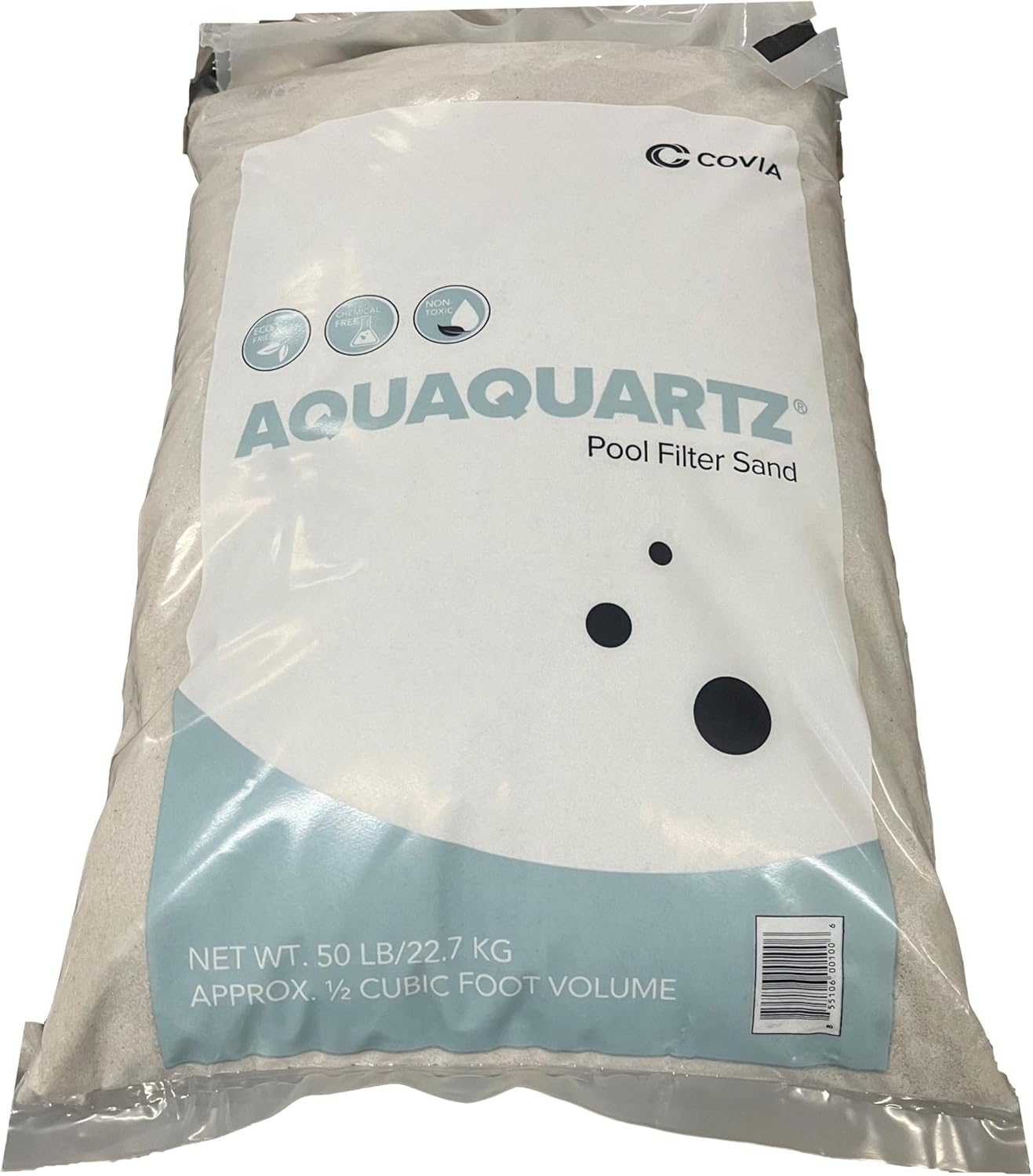
FairmountSantrol AquaQuartz-50 #20 Silica Sand, 50 lb
- 50-pound bag of white silica filter sand
- Listing identifies 20-grade filtration media
- Useful single-bag size for calculating a full filter refill
AquaQuartz-50 and Its #20-Grade Positioning
The FairmountSantrol AquaQuartz-50 is a straightforward 50-pound white silica sand option explicitly described as 20-grade pool-filter media. Its main practical appeal is that the listing speaks directly to the common sand-filter requirement instead of requiring a buyer to infer suitability from a generic mineral description. For an owner replacing traditional silica in a filter designed around No. 20, that makes the initial specification check more direct.
The “50” in the name aligns with the 50-pound bag, but it should not be confused with a mesh number or a filter tank rating. The “20-grade” claim still needs to be matched to the actual instructions for the installed filter. Tank size, allowable filter pressure and media quantity are separate specifications supplied by the filter manufacturer.
Practical Filtration and Bag Handling
A silica sand bed traps suspended dirt as pool water moves through spaces between grains. The flow path and bed depth matter more than the white appearance of the media. A sound sand-filter setup retains water circulation while collecting debris that the circulation system has brought into the filter.
The full 50-pound sack works well for a 100-, 150-, or 200-pound requirement because there are fewer containers to open and empty. That same weight is less convenient if the filter sits close to a wall or inside a narrow enclosure. Open the bag slowly and use a sand guide or manufacturer-approved protective method to keep sand out of the center standpipe.
Checking Fit and Avoiding Mistakes
This is a reasonable product to evaluate when your manual specifically calls for No. 20 silica sand. It is not a universal choice for cartridge filters, diatomaceous-earth filters or systems with proprietary glass-media quantities. Some alternative filter media also require different weights because their bulk densities are not the same as silica.
Check the filter’s exact required grade and weight before purchase. After filling, use the valve sequence prescribed in the filter manual and confirm that there is no persistent sand returning through the pool jets. An unusual amount of return sand can indicate a damaged lateral or installation problem rather than a defect in the new sand.
Pros
- Explicit 20-grade identification on the listing
- A 50-pound bag is a convenient unit for larger sand-tank quantities
- White silica media intended for pool filtration
- Simple mineral medium that can be backwashed
Cons
- Heavy bag requires careful handling and pouring
- No specific flow-rate or micron rating is established for this ASIN
- Correct quantity depends on the filter tank rather than pool dimensions
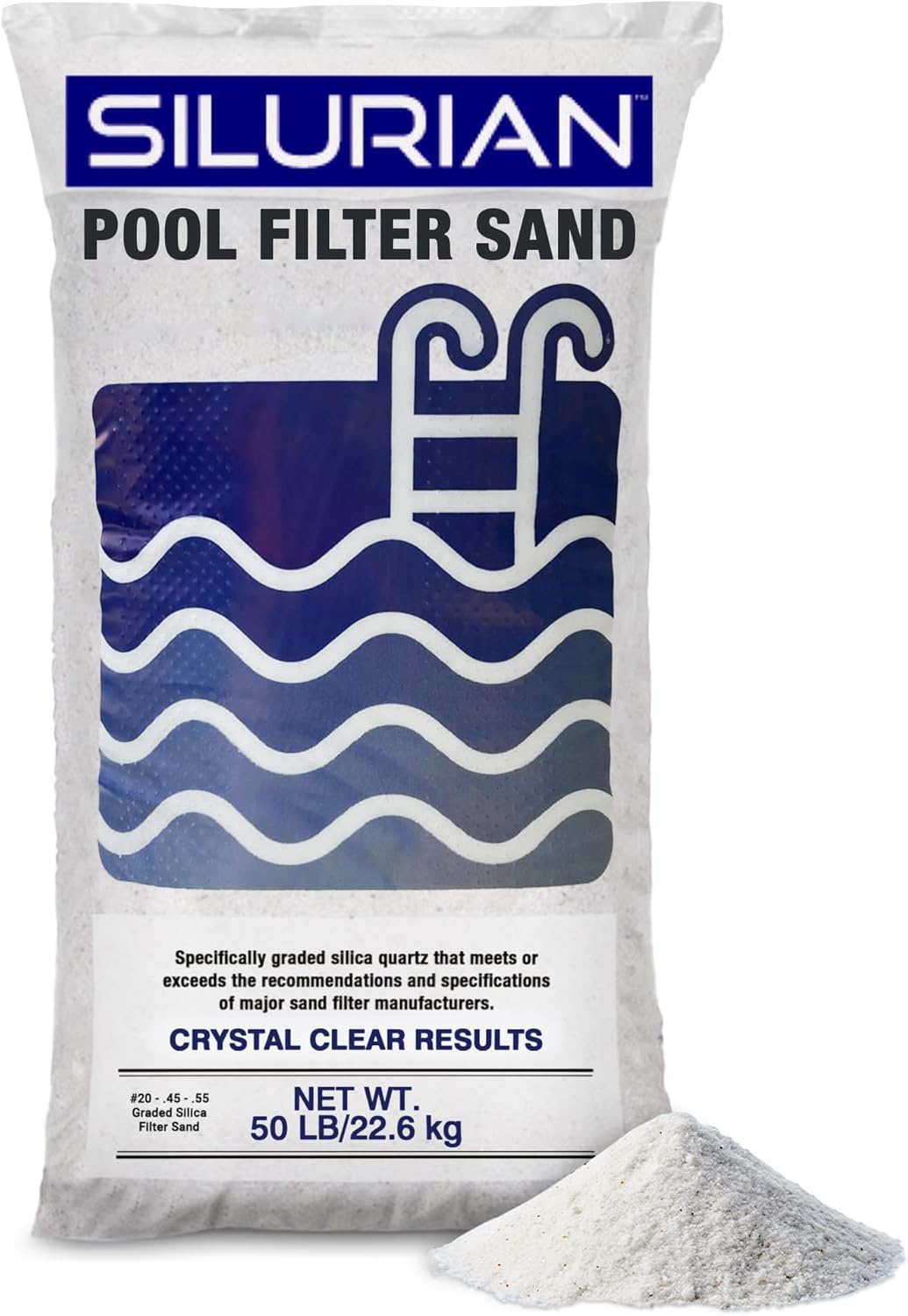
U.S. Silica Silurian #20 Angular Pool Sand, 50 lb
- Specified as 20-grade angular silica
- Washed and screened for filter applications
- 50-pound package for sand-filter refills
Angular Grains and Screening
U.S. Silica Silurian is sold here as a #20-grade angular swimming-pool filter sand in a 50-pound bag. The listing specifies washed and screened material, which distinguishes it from inexpensive bulk construction sand. Angular grain geometry is relevant because grains contact and interlock differently from smoothly rounded decorative sand.
That geometry should not be translated into an unsupported promise of a particular micron-removal rating. Filtration efficiency also depends on particle-size distribution, bed depth, filter design, circulation and how much captured debris is already in the media. The important verification point is that the grains fall inside the range specified for your tank.
Where This Model Fits in a Maintenance Plan
An owner changing an entire sand bed can calculate quantities in 50-pound increments. If a vessel requires 250 pounds of silica sand, for example, the job calls for five standard bags. That is simpler than working from many small packages, although the total load demands room to stage the sand safely.
The washed-and-screened description is a meaningful preparation attribute. It is still sensible to perform the filter maker’s startup backwash and rinse, because packaging and handling can introduce loose particles. Monitor the clean starting pressure after the new media settles; that number becomes the reference for later maintenance.
Strengths and Limitations for #20 Buyers
Among the products here, Silurian offers one of the clearer listing-level links between angular grain structure and a #20 designation. Buyers who want a named silica producer and an explicitly identified grade have useful information before deciding. It is a better match for that use than a product whose label only says “pool filter sand.”
The limitation is not the weight or color; it is the need to confirm the stated size distribution against the filter’s own instructions. Terms such as “enhances flow” describe an intended benefit, not a guarantee for every system. A blocked line, undersized pump or damaged laterals will not be corrected by changing to this bag.
Pros
- Direct #20 grade identification
- Angular grain geometry is relevant to particle capture
- Washed and screened processing is stated for this product
- 50-pound bag simplifies multi-bag fill calculations
Cons
- Specified grain dimensions should still be compared with the filter manual
- A 50-pound bag is cumbersome in a confined equipment area
- Screening does not eliminate the need to backwash and rinse after filling
U.S. Silica Mystic White II Pool Filter Sand, 50 lb
- 50-pound Mystic White II pool-filter sand
- Manufacturer describes washed, specially graded angular silica
- Confirm exact #20 grade on the bag before purchase
Why Mystic White II Needs a Grade Check
U.S. Silica Mystic White II is an established swimming-pool filtration sand line, and this ASIN is presented as a 50-pound bag. The manufacturer describes the line as high-purity, washed, graded, angular sand developed to provide consistent flow through a filter bed. It also states that multiple sizes are available, including No. 20 grade.
That last detail matters. The presence of a #20 option in the product family does not independently confirm that every Mystic White II package has identical grains. Because the exact Amazon title for this ASIN does not explicitly identify the mesh size, check the bag marking or seller’s technical specification before buying it for a filter with a strict No. 20 requirement.
What the Manufacturer’s Processing Claims Mean
Washing and grading are useful in a filter media because unwanted fines can initially cloud the water or create an excessively compact bed. Angular shape also provides a different contact pattern from rounded play sand. U.S. Silica describes the material as inert, odorless and resistant to undesirable packing in normal intended use.
Those characteristics do not remove routine cleaning. Oils, dirt and organic material still accumulate during pool operation, and a sand filter needs backwashing when its pressure rises according to the manufacturer’s guidance. Proper water chemistry remains just as necessary as clean filter media.
Who Should Consider This Bag
Mystic White II deserves consideration by buyers who prefer a product line with dedicated manufacturer filtration documentation and who can confirm the specific grade being supplied. If the seller can establish No. 20 sizing for this ASIN, the 50-pound format works with a normal high-rate filter refill plan.
For anyone unable to verify the grade, one of the products explicitly identified as #20 is the less ambiguous purchasing path. Do not choose the white color as a substitute for a grain-size check. The actual media specification, not its brightness, determines compatibility.
Pros
- Recognizable Mystic White II manufacturer product line
- Manufacturer describes washed and graded angular material
- Intended for above-ground and inground sand filtration
- 50-pound packaging supports conventional refill calculations
Cons
- Manufacturer offers multiple grades; this ASIN title does not itself establish #20
- Specific grain-size range should be confirmed before ordering
- Not a substitute for filters requiring glass or another specified medium
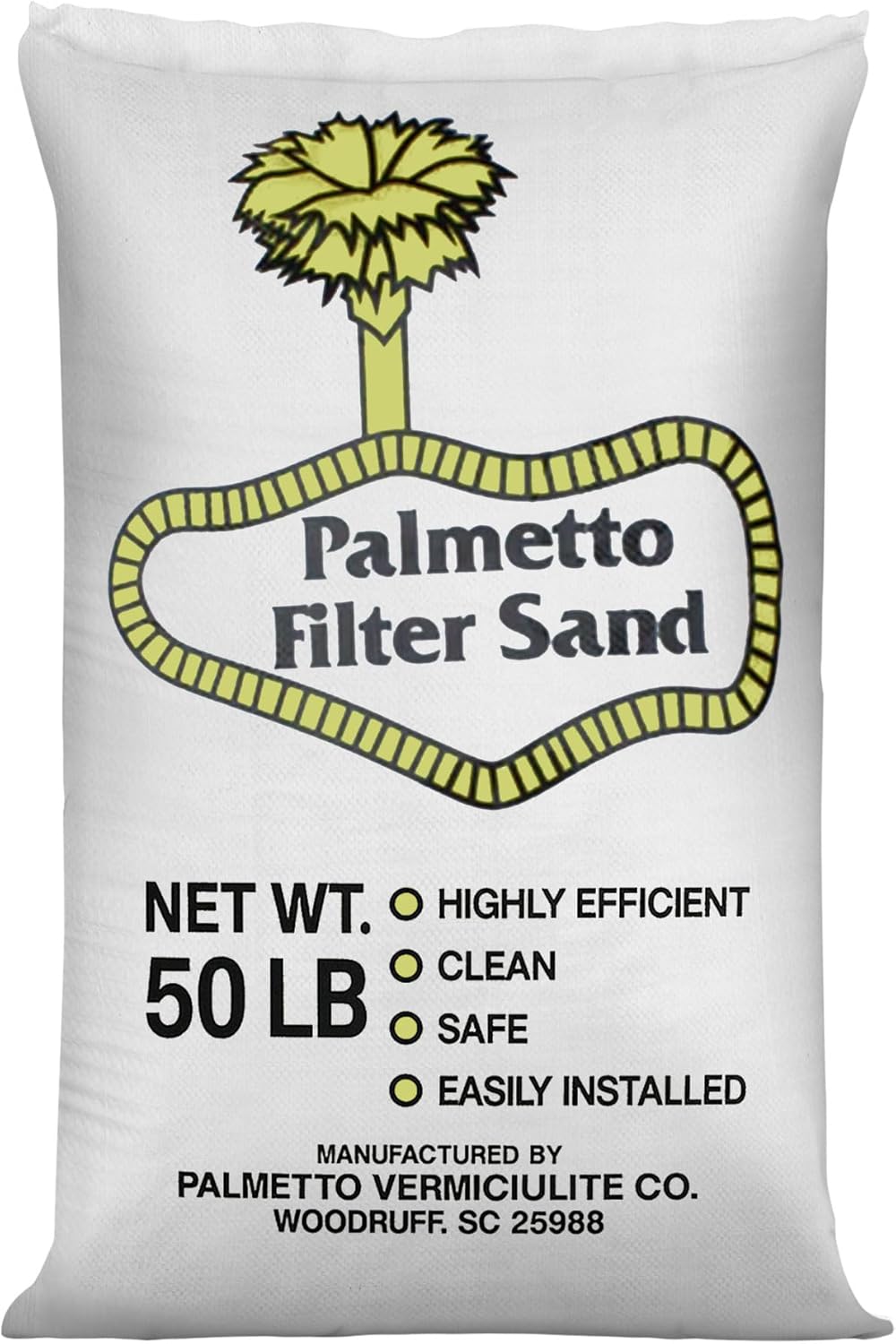
Palmetto Natural Silica Pool Filter Sand, 50 lb
- 50-pound bag of natural silica pool-filter media
- Listing describes washed, screened 20–40 sieve sand
- Check particle-size compatibility before using as #20 media
Understanding the 20–40 Sieve Description
Palmetto sells this as 50 pounds of natural silica pool-filter sand. The listing describes washed and screened grains in a 20–40 sieve classification. That communicates that the sand has been screened, but the sieve-range notation must not be treated as automatically identical to a narrow No. 20 pool-filter specification.
Mesh terminology can describe a distribution passing one sieve and retained on another, whereas many filter manuals specify an effective grain diameter in millimeters. When a filter requires 0.45–0.55 mm silica, the prudent step is to compare a supplier’s actual particle-size data rather than relying on the “20” appearing somewhere in the listing.
What Palmetto Offers for Pool Maintenance
The product is specifically sold for sand filters used with residential and commercial swimming pools. A pre-screened sand product is preferable to unsorted landscaping material because the latter can contain oversized grains, fines or foreign matter. Palmetto’s 50-pound packaging also follows the familiar unit used by many tank capacity charts.
For a filter that accepts Palmetto’s stated grading, the user experience follows the same general routine as other silica media: isolate and depressurize the system, protect the standpipe, add the correct media amount and complete the specified backwash-and-rinse startup. Do not run the pump while shifting the multiport valve.
Buying Implications of Its Broader Label
Palmetto is a sensible candidate when the exact sieve distribution is compatible with your filter or when your equipment instructions explicitly support it. Its strengths lie in being purpose-made pool filter sand with a stated screening approach rather than an unspecified bag of fine aggregate.
Its tradeoff is labeling clarity for a buyer searching specifically for a #20 grade. If the manual is strict, obtain written confirmation of the particle-size range. If that cannot be established, do not assume that a visually similar grain will behave the same in the tank.
Pros
- Pool-filter purpose is explicit rather than general-purpose sand
- Washed and screened 20–40 sieve description
- Single 50-pound bag suits common refill calculations
- Useful option when a filter accepts its stated grading
Cons
- 20–40 sieve designation is not automatically identical to a 0.45–0.55 mm #20 specification
- Does not remove the need to confirm media compatibility
- One 50-pound bag will not fill most larger tanks
Play22 #20 Grade Pool Filter Sand, 50 lb
- Explicit #20-grade filter sand
- 50-pound silica bag
- Marketed as non-staining and non-corroding
A Familiar 50-Pound Format With Explicit #20 Labeling
The Play22 offering is sold as No. 20-grade pool filter sand in a 50-pound bag. Its listing describes non-staining and non-corroding silica for above-ground and inground pools. Compared with a listing that leaves its grade unstated, the explicit #20 identification makes the initial shortlist more straightforward.
Non-staining is best understood as a claim about the sand material under appropriate conditions. Metal staining, mineral imbalance, organic deposits and inadequate pool chemistry can still cause discoloration. A new sand bed cannot prevent every water-quality problem, so it would be misleading to treat that phrase as a guarantee.
How It Works Within a Sand-Filter System
This bag supplies a conventional granular medium, not a chemical water treatment. As a filter operates, suspended particles accumulate in the bed and gradually increase resistance to flow. Cleaning relies on the filter valve’s backwash cycle, followed by rinsing where the model requires it.
Owners who already have a clean pressure baseline can use that number to tell when the filter needs attention. Immediately after replacing media, note the operating pressure at normal pump speed. A rising gauge may indicate debris accumulation; persistent low flow can also originate in suction restrictions, baskets or plumbing.
Purchase Considerations
Play22 fits buyers who need a conventional 50-pound bag and can match the #20 listing to their filter’s grain-size requirement. The clearly stated grade is useful, but the full effective-size curve is not supplied in the short title, so highly specific filter instructions still warrant a closer check.
If you must lift sand into a tall tank by yourself, the 20-pound CLASSIC SAND & PLAY package is easier to handle, though more bags will be required. For a routine 150-pound refill in a spacious equipment area, a conventional 50-pound format is normally more practical.
Pros
- The listing clearly identifies #20 grade
- 50-pound bag is familiar for pool-filter maintenance
- Specifically presented for above-ground and inground pools
- Silica medium works with normal backwash maintenance where specified
Cons
- Non-staining language is a product claim, not proof that all water-stain causes disappear
- The full effective-size distribution is not clearly established
- A heavy sack can be awkward to position over an open filter
CLASSIC SAND & PLAY #20 Pool Filter Sand, 20 lb
- 20-pound bag rather than standard 50-pound size
- Listing specifies #20 grade
- Described as prewashed and kiln-dried
Why a 20-Pound Bag Can Be the Better Size
CLASSIC SAND & PLAY uses a 20-pound package rather than the 50-pound size common to the other products here. The listing explicitly states No. 20 grade and describes the sand as prewashed and kiln-dried. Those details make it relevant to shoppers who prioritize a clearly described grade but do not want to move an entire 50-pound sack at once.
The tradeoff is simple arithmetic. A 100-pound requirement takes five of these bags, while a 200-pound tank needs ten. More packages mean more opening, carrying and disposal. The smaller format therefore has the strongest appeal for smaller media capacities, limited lifting ability or difficult access above the filter.
Prewashing, Drying, and Installation
The manufacturer’s stated prewashing and kiln-drying steps distinguish this product from untreated sand. Dry material may pour readily, but it can still produce irritating or hazardous dust. Pour slowly and follow the filter maker’s water-first filling instructions to cushion the lower laterals.
Keep the central standpipe covered throughout filling, then remove the cover before reassembly. If the top of the tank requires a specific freeboard, measure that according to the manual rather than filling until the tank looks full. Leave room for the bed to expand during backwash.
Appropriate Use and Its Limits
For a filter whose instructions call for #20 silica and allow the relevant grade range, this 20-pound product is a practical alternative to larger bags. Its intended residential and commercial pool applications do not mean it can be placed in any filtration vessel regardless of design.
Use it for a complete replacement in the manufacturer-stated quantity or for a confirmed media shortage after fixing the reason sand was lost. Adding sand to a filter merely because pressure is high can make matters worse; elevated pressure more often calls for an inspection of debris load, valve position and flow restrictions.
Pros
- 20-pound format is easier to move in tight spaces
- Explicit #20 designation
- Prewashed and kiln-dried preparation listed
- Practical for a smaller stated media requirement or topping up a compatible filter
Cons
- More individual bags are needed for a large refill
- Do not assume that topping up is suitable without diagnosing lost media
- Smaller package does not change the filter manufacturer’s capacity requirement
HTH 67120 Pool Filter Sand, 50 lb
- HTH model 67120; 50-pound bag
- Swimming-pool sand-filter replacement medium
- Confirm #20 particle size against filter requirements
Identifying the Product Behind the Short Listing Name
The brief Amazon listing title, “Pool Filter Sand, 50-Lb.,” gives relatively little information. The product details identify the brand as HTH, the model as 67120 and the supplier as Innovative Water Care. Those identifiers are important because they distinguish the package from similarly named filter sand products.
The 50-pound format places this item alongside the conventional refill bags in the comparison. The short listing title does not, by itself, establish an exact #20 grain size, so matching the bag’s grading information with the filter instructions is necessary before using it for a tightly specified media replacement.
When the HTH Model Makes Sense
HTH 67120 is presented as filtration media for swimming pools, so it is more relevant to a pool sand filter than generic building or craft sand. A buyer familiar with HTH pool-care products may prefer an identifiable model whose manufacturer information can be checked against the package.
Its stated package weight is useful when planning a full change. For a 150-pound media requirement, three bags of 50 pounds provide the nominal quantity. The actual fill level still needs to meet the tank instructions because material density and allowable freeboard can differ.
The Most Important Verification Before Purchase
If the filter requires a specific narrow No. 20 silica range, ask for the HTH 67120 grain specification or inspect the bag details before ordering. Treat the absence of an explicit #20 statement on the abbreviated title as unresolved information rather than silently filling in the blank.
It is also important to distinguish a worn or fouled filter bed from mechanical damage. Replacing filter sand will not repair a broken standpipe, a cracked lateral or a failing multiport valve gasket. Troubleshoot the equipment if sand continues to return to the pool after installation.
Pros
- Identifiable HTH model number 67120
- 50-pound weight is straightforward for fill planning
- Designed for swimming-pool sand filters rather than decorative use
- Useful option when its media specification matches the tank manual
Cons
- The short Amazon title does not independently verify a #20 grain range
- A filter using alternative media needs a separate compatibility check
- Bag weight alone provides no information about grain-size uniformity
Detailed Buying Guide: Choosing the Best #20 Silica Sand for Your Pool Filter
What “No. 20” Means in a Sand Filter
The No. 20 designation is a media-grading reference used by many high-rate pool sand filters. Hayward filter documentation commonly specifies 0.45–0.55 mm silica, while Pentair’s Tagelus guide gives about 0.44–0.55 mm and adds a uniformity criterion. The purpose is to keep the media coarse enough to stay above the laterals yet fine enough to trap suitable suspended particles.
This is not the same thing as picking a bag because the label contains “20” somewhere. For example, a 20-pound bag states weight, while a 20–40 mesh band describes sieve classification. Neither alone establishes that a particular sample matches every No. 20 sand-filter specification. Compare technical grain-size information whenever the wording differs.
The filter manual can also specify a mix of sand and supporting pea gravel for certain configurations. Never convert such a formula into all-sand loading without approval. Different media arrangements affect the underdrain, effective bed depth and permitted water flow.
Effective Size, Uniformity, and Why the Range Matters
Particles in a bag of sand are not all exactly the same diameter. A useful technical description therefore distinguishes nominal grade, effective size and uniformity. Effective size is often defined using the sieve diameter at which 10 percent of the sample is finer, while the uniformity coefficient compares characteristic points in the distribution. These measures indicate how tightly the grains are grouped.
If sand contains too many fines, water can meet extra resistance and very small particles may wash into the pool. A bed containing excessive coarse grains can leave larger channels through which suspended matter passes more readily. Distribution, not just an average grain measurement, helps determine behavior.
Two products carrying the same broad grade label should not be assumed equivalent where a filter has an unusually strict requirement. Ask for technical grading data from the seller or manufacturer if the packaging does not resolve a genuine mismatch. This is especially important after an earlier refill produced persistent cloudiness or sand return.
Angular Silica Versus Rounded Decorative Sand
Many sand-filter media products specify angular quartz or silica rather than rounded play sand. Angular grains form a network of contact points that can support mechanical particle capture. Material selected for sandboxes, masonry, beaches or aquariums can be washed yet still have a different particle-size distribution or impurities.
Choosing pool-specific sand reduces guesswork, but it does not mean all branded pool sand is identical. Look for a clear filtration grade and suitable preparation. A bag describing only color and purity without mesh size can still leave a critical compatibility question unanswered.
Pure-looking white sand also does not automatically filter better than tan material. Water clarity results from the correct media bed working alongside circulation, sanitation, brushing, vacuuming and balanced pool chemistry. Color is mostly a secondary selection factor.
Calculate How Many Bags Your Filter Needs
First find the required pounds of media for the exact tank model and configuration. The specification is often on the tank label or in a manual table. Pool diameter, gallons and horsepower are not reliable shortcuts for determining media weight.
A 100-pound requirement normally corresponds to two 50-pound bags or five 20-pound bags. A 175-pound specification needs the correct total quantity rather than blindly using three or four 50-pound bags; the manufacturer may provide instructions for a combination of sand and gravel or a target bed height. Treat any leftover partial bag as extra material, not an invitation to fill past the specified line.
Account for the old media’s disposal and the combined purchase weight before ordering. Five 50-pound bags are 250 pounds of sand to move, even though each sack looks manageable on its own. Protect the storage area against moisture and keep loose bags closed until used.
Replace the Full Bed or Add More Sand?
Sand does not normally disappear rapidly from a functioning closed filter. If the filter is low on media, investigate the reason before topping it up. Sand can be lost through a faulty internal lateral, a damaged standpipe, inappropriate backwashing or a previous underfill.
A complete change may make sense when media is contaminated, persistently channeling, heavily calcified or otherwise unsuitable after troubleshooting. High pressure alone does not prove the sand has reached an arbitrary age limit. Check the pressure gauge, baskets, water chemistry, run time and valve function first.
If the installed medium is an alternative such as glass or zeolite, do not mix in silica without checking the system requirements. Mixed densities and different filtration characteristics can change bed behavior and required loading. The safest default is to follow the approved media recipe.
Loading Sand Without Damaging the Laterals
After shutting off electrical power, isolating the equipment where appropriate and relieving pressure, open the filter according to its manual. Inspect the internal laterals and center standpipe. A hairline fracture in a lateral can let sand escape into the return flow even when the grains are correctly sized.
For filters that specify it, partially fill the tank with water before adding sand. The water cushions the impact on the underdrain components. Use the manufacturer’s sand shield or another specifically approved standpipe cover, and pour slowly with the tank centered and stable.
Load the specified weight while observing the intended freeboard. Replace seals only as directed, seat the valve properly, and follow the maker’s recommended startup cycle. Never loosen a clamp or open the pressurized filter. Many manuals require a backwash followed by rinse before returning to normal filtration.
Starting Up: Backwash, Rinse, and Establish a Baseline
Backwashing reverses flow through the media bed and carries away collected debris and loose particles to waste. A rinse cycle, where provided, allows the bed to settle and directs remaining dirty water away from the pool. The sequence and duration depend on the valve and filter instructions, not on the sand brand.
Always stop the pump before changing a multiport valve setting. Starting or switching a valve under the wrong conditions can damage seals or create unsafe pressure conditions. Do not leave the valve between positions, and do not operate equipment whose pressure-relief procedures are unclear.
Once filtration is stable, record clean operating pressure at the usual pump speed. Variable-speed pumps produce different gauge readings at different RPM settings, so a later comparison must use the same speed. Follow the manufacturer’s pressure-rise threshold instead of relying on a universal number.
Sand in Pool Returns: Filter Media or Hardware?
A small amount of dust during initial startup can differ from a persistent stream of identifiable sand grains at the return jets. If granules repeatedly appear beneath a return fitting, stop and inspect the filter. Common possibilities include cracked laterals, a displaced standpipe, overfilling, or sand that is too fine for the internal underdrain.
Confirm the material really is sand rather than calcium scale or settled debris. Note when it appears: immediately after a backwash, continuously during filtering, or only after switching modes. That timing can help narrow the likely cause.
Replacing the bed with a different brand while leaving a broken lateral untouched often wastes money and repeats the same problem. Resolve the mechanical fault first, then refill with approved media.
Water Clarity Is Not a Sand-Only Issue
Sand filtration removes suspended physical material; it does not replace disinfection or chemical balance. Cloudy water can result from inadequate sanitizer, algae growth, poor circulation, pH or alkalinity problems, or particles too small for the operating filter to capture efficiently.
A healthy sand bed becomes progressively loaded as it captures dirt, and cleaning is part of normal operation. Backwashing unnecessarily frequently can waste water and disturb the bed before sufficient dirt has accumulated. Follow the equipment guidance and pressure observations rather than performing it on an arbitrary daily schedule.
Vacuuming, brushing and emptying skimmer baskets reduce the material the sand bed must manage. When the filtration system is correctly sized and operated, appropriate #20 media can do its intended job without being credited for every aspect of pool cleanliness.
Silica Dust and Disposal Safety
Crystalline silica dust is a respiratory hazard when fine particles become airborne. Keep the bag close to the filling opening, reduce the pour height, avoid dumping aggressively, and use respiratory and eye protection appropriate to the task and product instructions. Never blow sand residue away with compressed air.
Use water or suitable dust-control methods where permitted by the equipment instructions, and avoid producing dry dust while cleaning up spills. Take particular care in small enclosed equipment rooms. Follow local waste-disposal requirements for used sand, especially if it contains chemical contamination.
Used media should never be dumped into a storm drain or returned to the swimming pool. Dispose of it responsibly and keep the worksite clear of tripping hazards, heavy bags and unsecured valve parts.
Direct Comparisons: Which Pool Filter Sand Fits Your Setup?
AquaQuartz-50 vs U.S. Silica Silurian #20
These are both 50-pound silica products explicitly described as 20-grade media. AquaQuartz makes a simple case for a conventional #20 replacement, while the Silurian listing adds a clear angular-grain and washed-and-screened description. The extra processing language is helpful information, but it is not proof of a quantified performance difference between two correctly specified media beds.
Choose between them using the exact grading data available for the bag, your filter’s required range, and practical availability. Changing from one properly sized sand to another will not alter the physical capacity of the pump or the design limits of the tank.
Mystic White II vs Palmetto 20–40 Sieve
Mystic White II has detailed manufacturer-level information about angular, washed and graded silica, but the product family includes multiple grades. Palmetto’s listing explicitly mentions a 20–40 sieve classification, which provides a different kind of size clue without automatically establishing a narrow #20 specification.
For either bag, ask a direct question before buying: does the exact supplied package satisfy the effective particle-size requirement in the filter manual? Once that answer is settled, weight, handling and product availability become ordinary purchasing considerations.
Play22 50 lb vs CLASSIC SAND & PLAY 20 lb
Both listings identify a #20 grade. Play22 offers the standard 50-pound handling unit, which is convenient for multiple-bag refills where the tank can be accessed easily. CLASSIC SAND & PLAY uses 20-pound bags and describes prewashing and kiln drying, making it more manageable for a filter with limited clearance.
The smaller bag is not inherently better filtration media, and the larger bag is not inherently stronger. The practical difference is how many packages must be purchased, carried and poured to reach the approved sand quantity.
HTH 67120 vs Clearly Labeled #20 Sand
HTH’s 67120 is identifiable by brand and model number, but its short listing title does not plainly state the sand’s precise #20 grading. AquaQuartz, Silurian, Play22 and CLASSIC SAND & PLAY communicate that claim more directly on their listings.
If the HTH package documentation confirms the appropriate range, it deserves comparison on the same fundamentals as the others. Without that confirmation, choosing an explicitly specified product avoids guessing about the particle size.
Common Mistakes That Lead to Poor Sand Filtration
Buying Playground or Construction Sand
Washed play sand may look similar to pool filtration sand, yet its distribution, angularity and contamination limits can be different. Substituting it can cause poor capture, excessive pressure drop, or material entering the pool. Use media approved for the specific sand filter.
Mistaking a Sieve Range for a Single Grade
A label such as 20–40 mesh identifies a range, not automatically the same effective-size specification as every No. 20 high-rate sand filter. Check whether your manufacturer states a nominal grade, a particular millimeter range or an approved media standard.
Ignoring the Sand Capacity and Freeboard
An overfilled tank may not have enough room for proper backwash expansion, while an underfilled bed may not operate as intended. Measure according to the actual vessel manual, not to the pool’s gallon capacity or the convenient quantity of whole bags.
Pouring Directly Onto Unprotected Laterals
Heavy dry sand falling onto the filter’s plastic internals can damage them. Follow the water-first guidance and use the sand shield specified for the filter. Inspect the underdrain before assuming the replacement sand caused a later sand-return problem.
Skipping Backwash and Rinse After Refilling
Even screened media can contain loose fine material from transport. The manufacturer’s startup cleaning sequence helps send this material to waste rather than into the pool. Stop the pump before turning a multiport valve and do not rush pressurized equipment.
Replacing Sand to Fix a Chemistry or Circulation Problem
The sand bed cannot correct an inadequate sanitizer level, algae outbreak, worn pump or blocked suction line. Diagnose pressure and flow behavior, test pool water and inspect circulation components before deciding that a sand purchase is necessary.
Frequently Asked Questions
What is #20 silica sand for a swimming pool filter?
It is a common grade of granular silica used in many high-rate sand filters. Numerous filter manuals describe it at approximately 0.45–0.55 mm. Consult your own tank instructions because the approved size, allowable variation and total weight can differ.
Can I use 20–40 mesh sand instead of #20 pool filter sand?
Do not assume the two labels are interchangeable. A 20–40 sieve range describes grain screening differently from a narrow manufacturer-specified effective particle size. Compare the actual distribution or obtain confirmation before substituting.
How much #20 sand should I put in my filter?
Use the filter model’s specified media weight and target level. A pool’s water volume does not reveal the sand capacity. Some tanks require gravel support or a specific empty space above the sand.
Is a 20-pound bag better than a 50-pound bag?
The bag weight affects carrying and quantity planning, not the filtration quality of identical approved media. Smaller bags are easier to handle and can fit smaller refill quantities; 50-pound bags reduce packaging for large sand beds.
Does white pool filter sand clean water better than tan sand?
Color by itself does not establish filtration performance. Grain size, uniformity, clean preparation, correct tank loading and water circulation matter much more.
Does Mystic White II always come in #20 grade?
No single grade should be assumed from the family name alone. U.S. Silica says Mystic White II is offered in multiple sizes, including No. 20. Confirm the grading of the specific 50-pound package before installation.
Is pool filter sand the same as sandbox sand?
No. Pool filtration sand is chosen for a controlled grain distribution and intended hydraulic use. Sandbox sand is selected for different purposes and should not replace specified filter media unless the filter maker explicitly approves it.
Why is sand coming back into my pool after a refill?
Possible causes include a damaged lateral, displaced standpipe, overfilled tank or media that is too fine. A brief initial release of dust differs from recurring visible granules. Inspect the filter hardware and check the grade rather than assuming another new bag will fix it.
Should I rinse #20 silica sand before putting it in a filter?
Follow the filter maker’s process and the material instructions. Typically the filter is filled carefully, then backwashed and rinsed with the valve set correctly. Do not bypass the startup cycle simply because a bag is described as prewashed.
How often should pool filter sand be replaced?
There is no single replacement interval that fits every installation. Media condition, contamination, water balance and mechanical integrity are more useful clues than age alone. Diagnose restricted flow, channeling or persistent clarity problems before replacing an otherwise serviceable bed.
Can #20 silica sand be used in a cartridge or DE filter?
No. Cartridge and diatomaceous-earth filters use different filtration components and media arrangements. Only use sand in equipment expressly designed and approved for that material.
Can sand filtration replace pool sanitizer?
No. Sand removes suspended physical debris but does not provide the disinfection required for safe swimming. Test and maintain sanitizer, pH and other chemistry according to applicable pool guidance.
Final Buying Considerations
For a filter explicitly requiring standard No. 20 silica sand, begin with products whose listings state that grade clearly: FairmountSantrol AquaQuartz-50, U.S. Silica Silurian, Play22, and CLASSIC SAND & PLAY. The 20-pound CLASSIC SAND & PLAY package is convenient for difficult access or smaller quantities; the 50-pound options work naturally for bigger refills. The correct grain-size specification still comes from your filter manual.
U.S. Silica Mystic White II has useful manufacturer documentation, but verify the exact grade supplied with this ASIN. Palmetto describes a 20–40 sieve product that should not be equated automatically with a narrow #20 range, and HTH 67120 needs confirmation of the precise particle size if your manual specifies one. These may be suitable media in the right filter, but the missing details should not be replaced with assumptions.
The final decision is less about choosing an exciting bag and more about getting three basics right: the approved grain size, the correct fill weight, and careful installation. If those match the filter’s design, proper backwashing and routine pool care give the sand bed the best opportunity to perform its intended role.
Author