
A pool that looks cloudy despite balanced water chemistry often needs more attention to its circulation and filtration. Replacing worn filter sand with recycled glass is one possible improvement, but the correct media is determined by the filter tank, internal laterals, permitted grain size, and filling instructions—not by the pool’s gallon capacity alone. Glass belongs in a compatible sand-style filter, not in a cartridge housing or a diatomaceous-earth grid assembly.
For buyers searching for the best glass media for pool filters, the practical questions are straightforward: will the glass work in the existing tank, how much should be loaded, and what happens during the first backwash? Both products compared here arrive as 40-pound bags of recycled glass. Their listings use similar performance claims, so the more useful comparison is between the available product documentation, the filter’s requirements, and the amount needed for a complete media change.
Start by locating the exact model number on your filter tank. That single detail is more important than attractive filtration numbers on a bag: it tells you the intended bed depth, media quantity, and whether alternative materials are permitted. Then compare the two products and follow the installation guidance below before ordering several bags.
Quick Comparison

- 40 lb bag of recycled glass media
- Sold as Harsco Metals & Minerals filter glass
- BrightLine line provides a published sand-to-glass weight guide
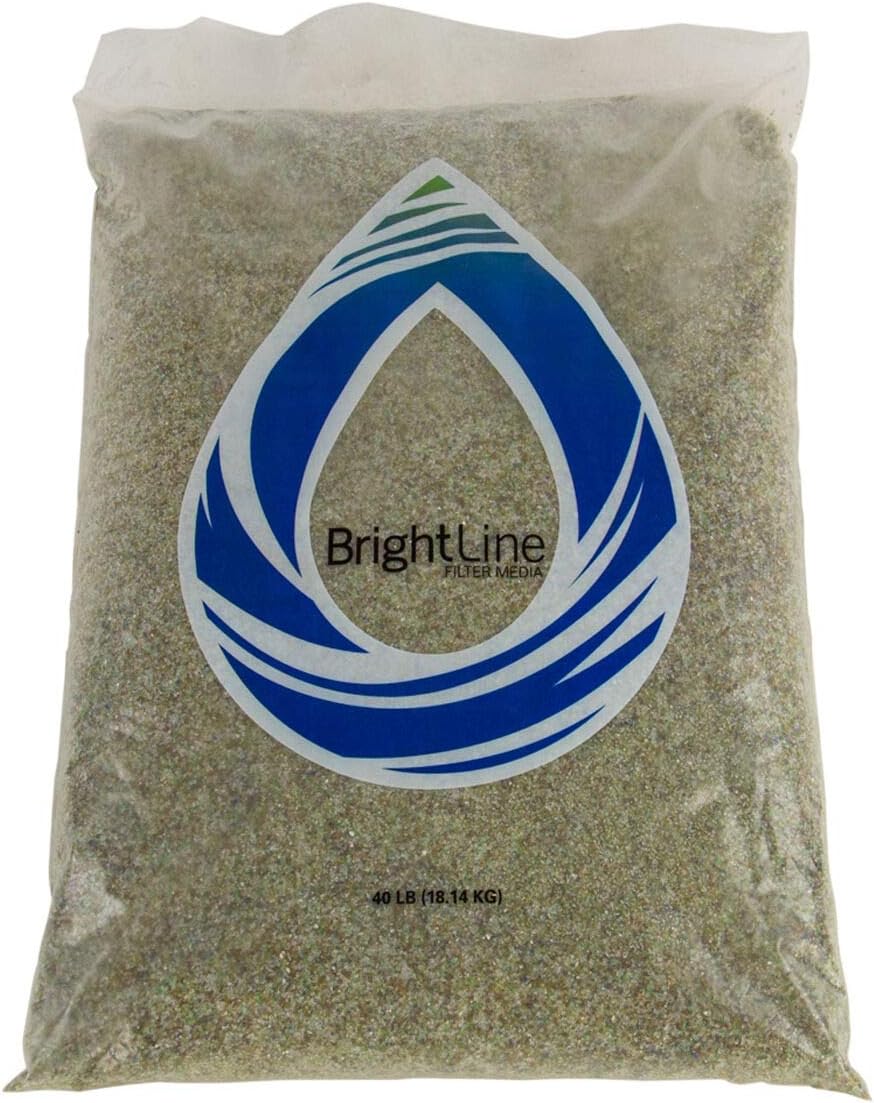
- 40 lb bag of 100% recycled filter glass
- SPOOLSUPPLI-branded listing
- Lists 5-micron filtration and 20% less media as product claims
These are replacement filter media, not complete filters. Neither bag includes a pump, tank, multiport valve, replacement laterals, or a conversion kit. Both are described as recycled-glass products, and each listing promotes fine-particle removal; the marketing numbers should not be interpreted as a guarantee for every sand-filter system.
What to Look for When Buying Glass Pool Filter Media
Compatibility Comes Before Particle-Capture Claims
Glass media normally replaces sand inside a sand-filter pressure vessel, where water passes through a packed granular bed before returning to the pool. That does not mean every sand filter accepts every glass blend. Some manufacturers publish alternative-media capacities; others specify particular sieve sizes or advise against substitutions. The applicable equipment manual should settle that question.
Pay special attention to smaller above-ground filter systems. Their distributors, standpipes, and lateral slots can differ substantially from those in large in-ground tanks. If the granules are too fine for the internal collection system, material can migrate into the return line. A product being labeled “pool filter glass” does not resolve a mismatch with a particular tank.
Bag Weight Is Not the Same as Sand Capacity
Both candidates are sold in 40-pound bags. Sand filters, however, are frequently labeled according to how many pounds of specified filter sand they hold. Glass has different bulk-density characteristics, so replacing 150 pounds of sand with 150 pounds of glass can leave the tank filled differently than intended.
For the BrightLine product associated with the Harsco line, a published buying chart uses approximately 80% of the original sand weight. Under that particular chart, a 150-pound sand requirement corresponds to 120 pounds of BrightLine glass, or three 40-pound bags. Do not automatically apply this chart to unrelated brands or to equipment whose manufacturer gives a different glass quantity.
Particle Size and the Underdrain Matter Together
The filter performs by forcing water through spaces between individual grains. Smaller gaps can retain finer suspended debris, but the flow rate, bed depth, and distribution of grain sizes all affect real filtration. Very fine media is not automatically better if it creates excessive resistance or escapes through the laterals.
Look for the approved grade or particle-size range in the filter manual and, when available, the glass supplier’s technical sheet. The two listings reviewed here do not clearly establish a complete, manufacturer-certified sieve distribution for every installation. Where that information is required, obtain the correct grade confirmation before choosing either bag.
Backwash Performance Is Part of the Purchase
A sand filter cleans itself by reversing the flow to lift and flush debris from the media bed. Some glass-media sellers describe easier backwashing and reduced water consumption, but results depend on the pump and the vessel’s ability to expand the bed properly. A weak backwash may leave dirt trapped even when the material itself is suitable.
Plan for a waste outlet that can safely discharge water during both initial rinsing and later maintenance. If your filter has no working backwash function, simply changing sand to glass will not fix the underlying problem. Confirm the valve operates correctly and that the backwash line is not obstructed.
Choose Documentation, Not Just a Micron Number
A stated “5-micron” capability communicates what a supplier wants buyers to expect from fine filtration. It is not necessarily a laboratory measurement of your installed filter at your pump’s operating flow. Two bags carrying identical numbers may still differ in grain distribution, washing, packaging, or technical support.
One advantage of a more clearly documented media line is the ability to check load charts, handling guidance, and installation details. If the less-documented bag appears cheaper, calculate the full cost only after determining that it meets the same technical requirements. Lower upfront expense does not compensate for having to empty the tank and reload it a second time.
Harsco Metals & Minerals Filter Glass, 40 lb
- Harsco Metals & Minerals-branded 40 lb bag
- Recycled glass intended for suitable sand-filter tanks
- BrightLine product information includes a sand-to-glass loading chart
Harsco Metals & Minerals offers a 40-pound recycled filter-glass bag for pool owners who want to replace an existing sand bed. The listing identifies the product as filter glass, while retail information for the associated BrightLine line gives a concrete conversion chart and explains how its quantity differs from conventional sand. That additional guidance is useful when the tank requires several bags rather than one.
Construction, Material and Pack Size
The material is recycled glass that has been processed into granular filtration media. Unlike loose decorative glass or crushed landscaping aggregate, pool filtration material must be graded for use inside a pressure filter. The published product description points toward a replacement for standard filter sand in appropriate pool systems; it is not intended as a loose pool-cleaning additive.
The 40-pound package is heavy enough that planning the loading job matters. Most medium and large tanks need multiple bags, and the total weight can make moving supplies around a crowded equipment pad inconvenient. Count the required bags first, keep them dry until installation, and provide a clean area for opening and pouring the media.
The Harsco-branded listing also uses a specific manufacturer part designation, “FILTER GLASS,” and a consistent package size. This helps identify the correct offering among pool-store listings that may display different bag artwork. Package photography can change, but the ASIN and supplied Amazon URL identify the selection discussed here.
Filtration and Water-Clarity Claims
BrightLine marketing material describes filtration of particles as small as 5 microns and a reduction in media weight compared with conventional sand. Those figures help explain the intended market position: the product aims to retain finer suspended matter without loading the tank with the same weight of sand. They should still be treated as performance claims rather than a promise about any particular pool.
In a properly operated filter, improved fine-particle capture can help with water that looks dull because of suspended dirt or dust. It does not replace an adequate daily pump run time, properly directed returns, brushing, vacuuming, or the sanitizer required to keep pool water safe. Cloudiness caused by algae growth or imbalanced chemistry cannot be solved by changing the bed alone.
For realistic expectations, compare the state of the current sand bed with the condition of the entire filtration system. Sand that has become heavily fouled or channelled can make any correctly sized replacement media appear like a dramatic improvement. That does not prove a universal advantage over a new, correctly operated bed of specified filter sand.
Sizing a Complete Media Change
The practical benefit of the published BrightLine guide is that it connects a familiar sand-tank rating to an approximate glass order. Under the line’s 80%-by-weight chart, 100 pounds of sand corresponds to 80 pounds of glass, while 200 pounds of sand corresponds to 160 pounds of glass. That turns an uncertain multi-bag purchase into a straightforward calculation for compatible filters.
However, loading by weight is only one part of the process. The installed glass must reach the recommended level while leaving the appropriate open space for backwashing. If a filter manufacturer specifies a different quantity or bed configuration, follow that document rather than the general conversion chart. Some tanks also require a support layer or a particular pouring sequence.
Keep the label or product record after installation. During a future service visit, knowing exactly which glass was used helps avoid mixing unidentified grain sizes or relying on the old sand-capacity label as though the tank still contains silica sand.
Practical Installation and Maintenance
Emptying the old sand is typically the most labor-intensive stage. The new glass should be added only after the tank is depressurized, the valve or access opening is removed as directed, and the standpipe and laterals are inspected. Cracked laterals can pass media into the pool regardless of the glass brand; replacing them after filling the tank is far more disruptive.
Protect the standpipe opening during filling so granules cannot fall into the return plumbing. Add water to the tank first if the filter manual directs it, then pour carefully to avoid dropping heavy material onto exposed internal components. Reassemble with clean seals, carry out the prescribed backwash and rinse sequence, and record the clean-filter pressure.
After normal operation begins, watch for a persistent cloud of fine material at the returns or unexplained loss of media. Either symptom deserves inspection rather than repeated chemical treatment. Keep backwashing according to the filter’s pressure guidance instead of assuming that a product described as long-lasting never needs attention.
Who Should Consider This Glass
This bag is worth considering if you have a compatible sand-filter vessel, a known sand capacity, and want a recycled-glass option with a separately published loading guide. Buyers carrying out a whole-tank refill benefit more from reliable quantities than those simply replacing a small amount of missing material. It is also a logical candidate for owners who prefer to retain their existing filter hardware rather than replace the entire unit.
The clearest reason to choose another product would be an instruction in your filter manual calling for a different media grade or an explicit requirement for a different manufacturer-approved material. A cartridge or DE filter owner needs the components designed for that system, not this bag. Anyone unable to verify glass compatibility should resolve that issue before ordering.
Important Limitations
The product title identifies the material and weight, but it does not provide a universal tank-compatibility list. Its 5-micron, extended-life, and lower-backwash descriptions are supplier claims with outcomes that depend on installation and pool conditions. Owners should not assume reduced sanitizer requirements or a fixed number of years between replacement jobs.
Another consideration is the amount of preparation involved. A 40-pound bag is only part of a successful conversion: the valve must work, the equipment pad must allow safe access, and the correct bed height must be maintained. If the old tank leaks, has damaged internals, or is undersized for the pool, new glass will not correct those limitations.
Pros
- Identifiable Harsco Metals & Minerals 40 lb package
- Associated BrightLine documentation includes a sand-to-glass quantity chart
- Recycled-glass alternative for compatible sand filters
- Published material aims at fine-particle filtration
Cons
- Filter-model compatibility still must be checked
- Several bags may be required for a full tank refill
- Advertised micron and lifespan figures are not guaranteed in every system
SPOOLSUPPLI Recycled Pool Filter Glass, 40 lb
- SPOOLSUPPLI product listing and manufacturer identity
- 40 lb bag labeled as 100% recycled glass
- Listing states fine-particle filtration and sand-weight reduction
The SPOOLSUPPLI 40-pound glass media is a second recycled-glass replacement option. Its exact Amazon listing identifies SPOOLSUPPLI as the manufacturer and promotes use in sand-filter applications, with advertised benefits resembling those of the Harsco-branded bag. The main purchasing decision is therefore not whether both claim to filter fine particles—they do—but whether the SPOOLSUPPLI product documentation is sufficient for your particular filter.
What the Listing Establishes
The product is sold as a single 40-pound bag of 100% recycled swimming-pool filter media glass. It is a consumable media refill rather than a complete filtration system, and no pump or pressure vessel is part of the offering. The listing also describes use with or without pea gravel in accordance with the filter manufacturer’s recommendations.
That last qualification matters because buyers sometimes treat a media seller’s statement as permission to remove a support bed from every tank. A gravel layer is not universally required, and it is not universally optional. Internal geometry and the equipment manufacturer’s instructions determine the correct answer. The SPOOLSUPPLI listing does not override those requirements.
The name displayed on the Amazon page is fairly generic, but the manufacturer field provides a useful distinction. Treat this as the SPOOLSUPPLI product associated with ASIN B09WWWV224. Do not assume it is the same factory product as another 40-pound recycled-glass bag merely because some advertising statements match.
Fine Filtration and Media-Weight Claims
SPOOLSUPPLI advertises filtration down to 5 microns, a media requirement around 20% lower by weight than sand, and a working life described as three times longer than sand. These are the seller’s published product claims. An appropriate installation might benefit from the stated design objectives, but the listing does not establish guaranteed measured performance for every flow rate or every pool.
The apparent similarity to Harsco’s marketed figures should be read carefully. A shared micron claim does not verify identical grain sizing, cleaning processes, or backwash characteristics. More importantly, the actual filter vessel must accommodate the grade being used. That can matter much more than a nominal small-particle figure when a replacement bed is first installed.
If fine haze remains after changing media, first examine turnover, circulation and pool chemistry. Very small colloidal particles can be difficult for any ordinary pool filter to capture consistently. Adding more glass or continually backwashing a recently installed bed can make matters worse if the real issue is flow distribution.
Buying by the Bag Without Underfilling the Tank
A 40-pound package can seem convenient, but a complete change may require two, three, four or more bags depending on the tank. Identify the actual permitted glass-media weight before checkout. Do not fill to the original sand weight automatically, and do not use the remaining space as a reason to pour in extra material.
Where a filter maker lists a specific glass capacity, that figure is the most useful starting point. If the manual is silent but accepts glass, request a recommended fill quantity and particle-size specification from the relevant supplier or equipment manufacturer. An approximate 80% conversion appears in this product’s marketing, yet an approximate ratio is less reliable than exact guidance for the tank.
When several bags are necessary, ordering the same identified product for the entire fill helps avoid mixing media of uncertain grades. If only one bag is available and the total requirement is substantially larger, waiting for enough matching material is generally preferable to improvising with unknown leftover media.
Backwashing, Rinsing and Day-to-Day Behavior
The seller states that the material is intended to last longer than traditional sand, but physical fouling still occurs. Oils, airborne dust, dead algae and other debris accumulate in the bed, and the system must be cleaned using its valve and manufacturer-approved backwash procedure. A longer expected media life never means maintenance-free operation.
Initial backwashing is especially important after a fresh load. Some dust or small grains can be present during handling, and the first cycles help carry loose material to waste rather than into the pool. The sequence, duration and clean-start pressure should follow the equipment manual. If your backwash water stays dirty indefinitely, investigate pump flow, loading and existing contamination.
SPOOLSUPPLI makes sense as a media choice only within a functioning sand-filter system. A weak pump, stuck valve, dirty plumbing line or broken lateral can prevent the filter from operating normally regardless of the product inserted into the vessel. Those problems should be corrected first.
Who Should Consider It
This is a reasonable candidate for an owner whose sand-filter manufacturer permits recycled glass, whose tank specifications are known, and who can confirm the product grade before installation. The straightforward 40-pound size makes it easy to order in multiples after the required amount is established. Buyers interested in recycled material without replacing the existing tank may find that approach appealing.
It is less suited to buyers who need a clearly published brand-specific loading manual at the point of purchase or who are trying to solve a compatibility question without any documentation. Its generic-looking name does not prove poor material quality, but it leaves more responsibility with the buyer to verify technical details. That difference can matter during a first media conversion.
Important Limitations
No universal filter compatibility can be inferred from the bag’s wording. The precise particle-size distribution, appropriate support-bed arrangement and certified performance for an individual installation should be verified if the filter maker requires them. Do not interpret “100% recycled” as evidence that the media will suit every set of laterals.
The competing Harsco line has a published quantity chart, while the SPOOLSUPPLI listing concentrates primarily on headline performance statements. This is a documentation distinction, not a proven difference in filtering ability. The better choice will depend on whether both products satisfy the specific tank requirements and on the total expense of purchasing the correct number of bags.
Pros
- Identified SPOOLSUPPLI 40 lb recycled-glass product
- Intended as an alternative media for compatible sand filters
- Seller provides a simple 5-micron filtration claim
- Available as a uniform bag size for larger refills
Cons
- Exact grade and filter-specific quantity require verification
- Few model-specific installation details in the listing
- Similar marketing numbers do not establish equivalence with other brands
Detailed Buying Guide: Glass Media for Sand Pool Filters
How a Sand-Style Filter Actually Works
A sand filter is a pressure vessel containing a granular filtration bed. The pump moves pool water into the filter, where it passes through the particles and then through the collection laterals before returning to the pool. Debris is retained within the bed instead of remaining suspended in the water. During backwash, the water direction changes to loosen and carry accumulated dirt to waste.
Glass media replaces the granular material; it does not change the basic hydraulics. The filter still requires correct flow, a sound pressure vessel, an intact collection system and an operating valve. For that reason, glass cannot make an undersized pump move more water or turn a broken filter into a working one. It is a media upgrade, not a substitute for appropriate equipment.
Finer captured particles can be helpful when dust and suspended debris cause dull-looking water. However, filtration has several interacting variables: contact time, grain distribution, media-bed depth, dirty-bed pressure loss, and backwash effectiveness. A single nominal micron rating is not an adequate description of the whole system.
Glass Media, Conventional Sand, Cartridges and DE
Traditional pool filter sand is selected for a particular grading and is widely supported by equipment manuals. It is comparatively straightforward to replace and readily available. Glass offers an alternative with different grain properties and supplier-reported improvements in fine-particle removal and backwash behavior, but compatibility and media quantity deserve more attention before installation.
Cartridge filters use pleated elements that are removed and hosed clean, rather than backwashed through a multiport valve. DE filters typically use powder on grids or fingers and require their own specific maintenance procedure. A 40-pound bag of glass has no role inside a cartridge housing or as DE recharge powder.
If your system is already a good-quality cartridge filter, there may be no practical reason to switch to a sand tank simply to try glass. The relevant purchase is a compatible replacement cartridge. Likewise, a properly maintained DE filter has different strengths and maintenance requirements. Select the media only after identifying which type of filter you actually own.
Understanding Filtration Ratings in Microns
A micron is one-thousandth of a millimeter. Manufacturers use micron figures to describe the size of particles a filter may capture, but the wording can refer to different testing methods and removal percentages. “Filters to 5 microns” does not automatically mean that every 5-micron particle is removed on a single pass at every operating condition.
Particle removal also changes as the bed begins to collect debris. A newly backwashed filter and a partially loaded filter can behave differently even with the same media. Water flow that is too high can reduce the opportunity for particles to be retained. In practice, repeat circulation and proper maintenance are critical components of clear water.
Treat the headline value as a product characteristic to investigate, not the sole purchasing criterion. A tested rating with a stated flow rate and removal efficiency would provide stronger evidence than an unsupported number. For these two bags, the prudent choice still starts with the equipment manual.
Checking the Tank Capacity and Fill Depth
The filter model plate commonly lists a recommended media mass, a sand designation, and possibly a maximum operating pressure. A manual may additionally specify the distance between the top of the bed and the upper diffuser. Those instructions exist because the media needs room to expand during backwash without leaving the tank.
For example, filling beyond the intended level can carry granules out through the waste line, restrict proper agitation, or disturb water distribution. Underfilling reduces the filtration bed available for dirt capture and can compromise expected performance. Both mistakes can occur if the buyer translates the old sand weight directly into glass without consulting relevant guidance.
Write down the manufacturer, model, tank diameter and original fill instructions. If a glass-media capacity is explicitly published, use it. If not, confirm that the supplier’s guidance is applicable before treating any general conversion ratio as an installation instruction.
Media-Weight Conversion: A Worked Buying Example
The Harsco-associated BrightLine chart uses 80 pounds of glass for a filter rated at 100 pounds of sand, 120 pounds of glass for 150 pounds of sand, and 160 pounds of glass for 200 pounds of sand. At a 40-pound bag size, those examples correspond to two, three and four bags respectively. This is a useful ordering calculation for a compatible filter following that chart.
It is not a universal conversion rule. Another equipment manufacturer may specify a different glass-media weight for a particular vessel. The pool equipment documentation has priority, and a fill-level or support-bed instruction can also affect the final amount. Do not compensate for a different density by forcing the old sand mass into the tank.
Plan the purchase in whole bags and avoid mixing unidentified granules from another supplier to use up leftover stock. A partial remaining bag can be stored dry for a documented compatible application, but adding random material to an operating bed without knowing its grade is not a sensible maintenance shortcut.
Why Grain Size Is More Useful Than Brand Slogans
Glass media is available in different particle sizes. Depending on the filter design, finer material forms the primary cleaning layer while a coarser layer can support flow around the underdrain. Some residential tanks use a single approved grade; larger or differently designed vessels can require layered media. There is no single grading rule that applies to every sand filter.
If media passes into the pool, grain size is one possible cause, but damaged laterals or poor assembly can create the same symptom. If the filter clogs quickly or cannot backwash properly, a bed containing overly fine grains may contribute to the problem. This is why buying material by an exact approved sieve range offers more confidence than relying on an attractive micron claim.
Ask for technical documentation when the listing does not state the grade required by your equipment. The effort is particularly worthwhile for older filters whose parts have been replaced or whose internal design is not obvious from the exterior.
Do You Need Pea Gravel Under the Glass?
Pea gravel can serve as a support layer in certain filter designs, protecting the lower collection system and helping distribute water. Many residential filters, however, use lateral arrangements that do not call for such a layer. The correct answer is found in the equipment manufacturer’s specification, not in the pool’s depth or surface area.
Both glass options are marketed for situations in which a gravel base may or may not be used, subject to the filter manufacturer’s instructions. That conditional wording should be respected. Adding gravel to a tank designed for a single media bed alters the available depth; omitting a required gravel layer can leave the lower internals insufficiently protected.
If you remove an old bed and discover gravel beneath it, determine whether it was installed according to the manual before deciding what to do next. The mere presence of gravel does not establish that it was originally required.
Flow Rate, Pump Selection and Filter Pressure
The pool pump sets water in motion, but the entire plumbing system determines the actual flow through the filter. A glass-media replacement does not raise the rated maximum flow or pressure of the tank. Oversized pumps, restrictive valves or closed lines can create conditions that no filter-media change will solve.
An operating pressure gauge is essential for interpreting filter behavior. Record the baseline reading after a clean installation under normal valve and pump settings. Follow the equipment maker’s recommended pressure-rise threshold for backwashing. A high pressure reading might indicate a dirty bed or a downstream restriction; a low reading can reflect different hydraulic problems.
If installing glass causes an immediate large pressure change, stop and check the fill, grain compatibility and valve assembly. Do not assume that higher pressure proves the media is capturing more debris. Operating outside the equipment manufacturer’s limits is a safety issue, not a filtration enhancement.
Service Life Versus Real Cleaning Requirements
Some glass-media sellers promote a longer replacement interval than traditional sand. Longer potential service life can be valuable because removing hundreds of pounds of old material is messy work. However, the practical lifespan depends on water chemistry, contamination, backwash effectiveness, filter condition and how frequently the system operates.
A stable filtration bed still accumulates oils, mineral deposits and fine dirt. Backwashing remains necessary when indicated. In extreme circumstances, contaminated media may need deep cleaning or replacement earlier than suggested by marketing material. Conversely, a properly maintained sand bed can remain serviceable for many seasons.
Use symptoms, pressure behavior and equipment inspection to judge maintenance needs. Media life should not be used as a reason to ignore cloudy water, persistent pressure rise, or recurring debris at the returns.
Recycled Content and Environmental Tradeoffs
Both products are advertised as 100% recycled glass. Using post-consumer or other recovered glass can divert material into a useful filtration application. If a media product lasts longer or needs less backwash water in a particular system, that can reduce maintenance-related resource use as well.
Environmental benefits are not fully explained by recycled content alone. Material processing, transportation, packaging and how frequently water must be discharged also contribute. A substantial multi-bag order still involves shipping heavy material. Buyers should evaluate the product that works correctly in their filter instead of selecting the one with the strongest environmental slogan.
Preserve water by fixing leaks, maintaining correct chemistry and backwashing only when appropriate. Those practices matter regardless of which recycled-glass bag is selected.
Upfront Cost and Long-Term Cost
Price per bag does not show the whole cost of a media conversion. Multiply the price by the number of bags required for your specific tank, then account for any shipping charges, disposal of used sand and replacement gaskets or laterals uncovered during service. Labor may be the largest part of the job if access to the vessel is difficult.
A longer replacement interval can offset a higher purchase cost, but only when it is actually achieved. Similarly, reduced backwash water use is worthwhile when the existing pump and tank produce those savings. Avoid assuming a precise dollar saving based on generic claims, especially without knowing local water costs and your normal backwash frequency.
If both candidates have the correct grade and quantity guidance, compare total cost for the completed installation. The price difference between two single bags is less useful than the expense of a full set of matching media.
Health, Hygiene and Realistic Water-Chemistry Expectations
Physical filtration removes debris; sanitizer controls microorganisms. Replacing sand with glass does not eliminate the need to monitor free chlorine or another approved sanitizing system, pH, and other relevant water parameters. Product descriptions that imply reduced chemical demand should not be interpreted as permission to relax water-treatment practices.
Glass media does not directly remove every dissolved contaminant. Metals, dissolved minerals and chloramine problems require diagnosis and appropriate treatment, not simply finer granular material. If a pool has persistent green or cloudy water, check sanitizer residual, circulation time and visible algae before blaming the media.
The safest result is a system in which chemistry, circulation and filtration support each other. That requires routine testing even after a media upgrade.
How to Replace Sand With Glass Filter Media
Changing filter media is a mechanical service job involving a pressurized vessel and electrical equipment. The instructions for your exact pump, valve and filter take precedence over this general sequence. If access is difficult, plumbing is brittle or the tank appears damaged, use a qualified pool service professional rather than attempting to force a disassembly.
- Identify the filter and approved media. Find the label and manual; verify glass is permitted and confirm the grade, total fill, bed depth and any required support layer. Do not buy by pool gallons alone.
- Switch off and isolate the pump. Prevent automatic start-up, release pressure exactly as specified by the manufacturer, and make sure the pressure gauge reads zero before opening the vessel. Never remove a valve or clamp from a pressurized filter.
- Drain the tank as directed. Allow access to the media without spilling water around electrical connections. Keep the equipment pad clear and protect nearby drains from unwanted loose granules.
- Remove old sand carefully. Scoop or vacuum out material without striking the standpipe or laterals. An approved wet/dry vacuum and suitable protective equipment can make the job more manageable when the manual permits the method.
- Inspect the internals. Examine laterals, center pipe, diffuser, seals and valve. Replace cracked parts before reloading. A new glass bed will not compensate for an opening in the underdrain system.
- Prepare the vessel. Cover the open standpipe as instructed and add any recommended initial water. Keep the correct support layer if specified by the manufacturer. Do not improvise a layer of arbitrary decorative gravel.
- Load the correct amount slowly. Add the approved glass grade without dumping a whole bag directly onto fragile internals. Maintain the recommended level and freeboard rather than trying to use every remaining pound.
- Reassemble and check the seals. Clean contact surfaces and confirm the multiport valve or top assembly is seated properly. Follow the specified fastening procedure; overtightening plastic parts can cause damage.
- Backwash and rinse to waste. Follow the manufacturer’s startup sequence to remove dust and settle the bed. Change multiport positions only with the pump stopped, unless the specific equipment instructions say otherwise.
- Return to normal filtration and document the baseline. Check for leaks, verify pressure and return flow, and watch for granules reaching the pool. Keep the installation details for future maintenance.
What to Monitor During the First Week
The first operating days provide useful information about how the new media and the rest of the system interact. Note whether pressure stabilizes after the initial rinse and whether water returns are free of visible particles. Make sure the pump primes normally and that there are no leaks around the vessel seal or valve connections.
Inspect the pool floor near the return jets. A small amount of loose dirt following the change can have several causes, but repeated deposits that resemble the installed media require attention. Stop the system and check assembly or lateral integrity rather than letting the pool accumulate granules.
Direct Comparison: Harsco Filter Glass vs SPOOLSUPPLI Glass
Product Identification and Available Guidance
The Harsco Metals & Minerals offering has a defined brand identity and is associated with published BrightLine guidance for replacing sand by weight. That matters for owners who know the tank’s sand capacity and want an established chart to discuss with their equipment supplier. The SPOOLSUPPLI offering is also clearly identified by its own ASIN and manufacturer field, but the Amazon product text is less detailed about the particular tank configurations it supports.
Neither distinction guarantees better filtration in the pool. It means the buyer has different amounts of supporting information to work with. If your filter manual supplies the exact requirements and both products demonstrably meet them, the documentation gap becomes less important. If the tank’s specifications are uncertain, clearer technical support has greater value.
What Their Shared 40-Pound Weight Actually Means
Both bags carry the same nominal weight, so neither offers a per-bag capacity advantage. Their usefulness depends on how many bags the filter calls for. A pool owner refilling a tank requiring 120 pounds of a verified compatible media would need three 40-pound bags of that material. Another tank requiring 160 pounds would need four.
The example should never substitute for the filter manufacturer’s quantity. It simply shows how weight affects ordering and storage. Do not compare bag count without comparing the correct total media weight for the system.
Comparing the Advertised Performance
Both listings feature messages about removing particles down to 5 microns and using less media weight than sand. The figures make the products appear similar, yet the listings do not provide a head-to-head laboratory test under identical pump flow, tank geometry and contamination load. Declaring a measured performance winner would therefore be unsupported.
For an actual purchase, consider the documented grain grade, the filter’s recommended quantity, compatibility, and access to replacement supply. Those factors control whether the media can be installed and maintained successfully. Marketing language becomes secondary once the equipment requirements are known.
Which Buyer Is Better Served by Each?
The Harsco-branded bag is a logical starting point for a buyer who values the published BrightLine weight-conversion guidance and is able to confirm that this glass meets the tank’s grade requirements. The SPOOLSUPPLI alternative suits a buyer who has already established compatibility and can obtain the necessary grade and fill instructions, making the purchase primarily a question of availability and completed-installation cost.
If neither can be confirmed as appropriate for your vessel, the right decision is not to choose whichever sounds more persuasive. Use the specified sand or another verified approved medium until the compatibility question is answered.
Common Buying and Installation Mistakes
Buying Glass for the Wrong Type of Filter
The presence of a pressure gauge does not prove you have a sand filter. Cartridge and DE systems can also have pressure vessels and gauges. Check how the filter is opened and serviced: cartridges are removed and rinsed; sand-style filters contain bulk granular media and typically have a backwash valve.
Ordering glass for a cartridge housing is not a small compatibility error. The material cannot replace a pleated cartridge. Identify the equipment first, then buy the correct service part.
Assuming Every Filter Uses the Same Conversion Ratio
A seller may state that glass weighs about 20% less than sand for a given replacement application. Other equipment manuals can specify different glass capacities. Applying an unverified conversion across all tank sizes risks overfilling or underfilling.
The recommended bed depth, backwash clearance and support layer all matter. Never add more material simply because the tank looks empty above the media; that space may be necessary for proper backwash expansion.
Mixing Different Media Without Knowing Their Grades
Mixing leftover filter sand, generic glass and several unidentified coarse grades might seem economical. It also makes the bed difficult to specify or troubleshoot. Different particle sizes can migrate or stratify during operation in ways the filter maker did not intend.
If a layered configuration is required, follow the exact sequence and materials listed for the system. Otherwise, use the approved single grade rather than blending miscellaneous products.
Ignoring Damaged Laterals and Seals
Loose media returning to the pool after a refill is often blamed on the new bag. Broken laterals, a misseated standpipe or a valve problem can produce very similar symptoms. Inspect these components while the tank is empty because correcting them later usually means removing the new bed.
Old O-rings and worn clamp components can also leak after reopening. Avoid treating a media replacement as a reason to disregard a cracked pressure vessel or visibly damaged hardware.
Skipping the Initial Backwash and Rinse
Freshly handled granular media can release dust and fines. Running directly into normal filtration without the specified cleaning sequence can send cloudy water back to the pool. Backwash and rinse settings exist to direct unwanted material to waste before regular circulation resumes.
The specific valve sequence and time should come from the equipment manual. Turning a multiport valve with the pump running can damage internal seals and cause other problems.
Treating Media Replacement as a Chemical Fix
New glass can capture suspended dirt, but it cannot supply a missing sanitizer residual or eliminate the source of an algae bloom. Water that quickly becomes green after treatment may have a circulation, chemistry or contamination issue requiring separate attention.
Correct the chemistry and operating conditions instead of buying additional glass as a substitute for diagnosis. Clear-looking water is not itself proof that the pool is properly sanitized.
Frequently Asked Questions
Is glass filter media better than pool filter sand?
Glass can offer worthwhile fine-particle filtration and may backwash differently from conventional sand, depending on the product and filter. It is not automatically the better choice for every system. A properly specified sand bed in a compatible, well-maintained filter is preferable to glass of an uncertain grade or quantity. Compare the equipment manual, replacement cost and service requirements before deciding.
Can recycled glass be used in any sand filter?
No universal compatibility should be assumed. A manufacturer may approve glass with a particular grain size, specify a different media amount, or limit acceptable alternatives. Older or smaller tanks can have collection internals that make grade selection especially important. Confirm requirements for the exact filter model before replacing the existing sand.
How many 40-pound bags of glass does my filter need?
That depends on the filter model and the selected media. For an installation that follows BrightLine’s published conversion chart, a tank originally holding 150 pounds of sand corresponds to 120 pounds of BrightLine glass, or three bags. Other filters and glass products can require different quantities, so verify the final fill specification rather than using that example universally.
Can I use glass filter media in a cartridge pool filter?
No. Cartridge filters use pleated elements designed to fit their housings, not loose granular beds. Glass is intended for compatible sand-style pressure filters. If you own a cartridge filter, use its specified cartridge replacement and cleaning procedure.
Do I need gravel underneath glass media?
Only if the exact filter installation instructions require a gravel or other support layer. Some tanks use a single grade of granular media, while others require a base and additional layers. A product listing that describes gravel as optional does not replace your equipment manufacturer’s specification.
Will glass media remove algae from a swimming pool?
A compatible glass bed can catch some particulate material, including dead algae and other suspended debris as water circulates. It does not disinfect pool water or stop algae growth on its own. Maintain an appropriate sanitizer level, balanced chemistry, brushing and adequate circulation.
How often should glass filter media be backwashed?
Follow the pressure-rise guidance and operating instructions for your filter. Backwash frequency depends on pool debris, pump flow, usage and how quickly the bed loads with dirt. Claims of reduced backwash water do not mean the bed should be left indefinitely without cleaning.
How long can recycled-glass media last?
Both products promote a longer working life than sand, but an individual bed’s service interval cannot be guaranteed from the listing alone. Contamination, deposits, repeated treatment problems and insufficient backwashing can shorten useful life. Inspect the system and respond to actual filtration problems rather than relying only on a marketed replacement interval.
Why is glass or gritty material coming from the pool return jets?
Potential causes include damaged laterals, an improperly seated standpipe, incompatible or excessively fine media, incorrect filling, or a valve issue. If the debris resembles the newly installed glass and continues to appear, stop the system and inspect it. Repeated backwashing without finding the cause can waste water and material.
Does a 5-micron claim mean all tiny particles will disappear?
No. A nominal particle-size claim does not establish complete capture of every particle at every operating flow. Filter performance depends on the vessel and water conditions as well as the media. Cloudiness can also come from dissolved contaminants, active algae or water chemistry, which need different corrective steps.
Can I top up an old sand bed with recycled glass?
Unless the filter or media manufacturer explicitly approves the combination, a full, correctly specified media replacement is the safer planning assumption. Partial top-ups create uncertainty about the grain distribution and remaining bed depth. If media is being lost from the tank, find and correct the cause of that loss before adding anything.
Is glass media suitable for both in-ground and above-ground pools?
Pool position alone is not the deciding factor. Glass may be suitable for compatible sand filters serving either type of pool. The correct tank design, internals, media grade, quantity and operating flow matter far more than whether the pool is installed above or below grade.
Final Buying Considerations
The best glass media for pool filters is the product that satisfies the specifications of the sand-filter vessel you already own. Both the Harsco Metals & Minerals Filter Glass, 40 lb and SPOOLSUPPLI Recycled Pool Filter Glass, 40 lb are offered as 40-pound recycled-glass media, and both promote fine filtration. Their overlapping marketing numbers do not establish a measured performance advantage for either one.
Harsco’s associated BrightLine quantity guide makes it a useful starting point when planning a multi-bag refill. SPOOLSUPPLI remains a potential option for buyers able to verify the required media grade and load for their filter. In either case, confirm compatibility, order the complete approved quantity, inspect the vessel internals, and carry out the specified startup backwash. Those steps have a larger influence on a successful replacement than choosing a bag on its micron claim alone.
Author