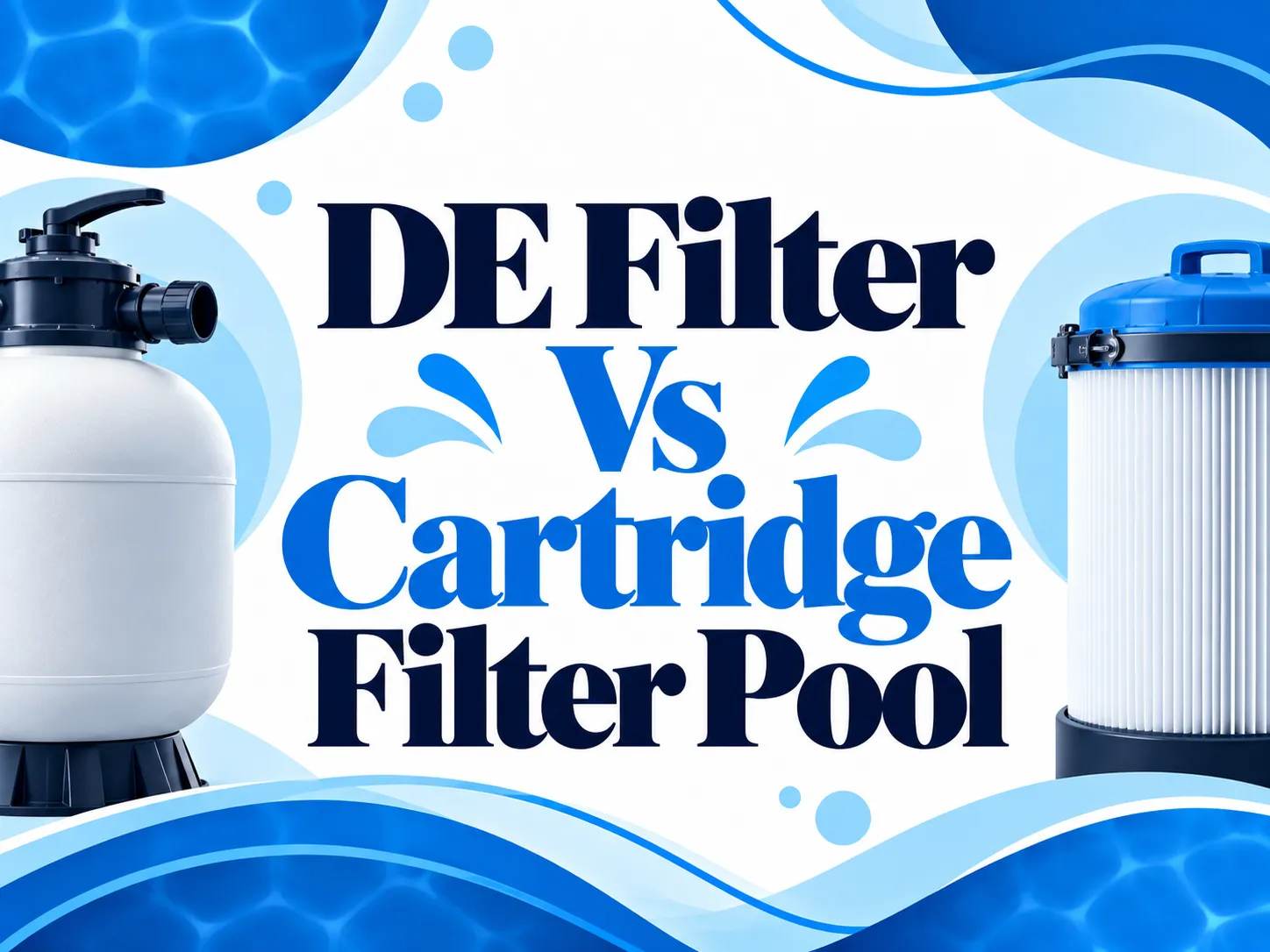
A DE filter vs cartridge filter pool decision changes far more than how small a particle the equipment can trap. It changes the cleaning routine, the amount of water sent to waste, the parts kept on hand, and how the filter needs to match the existing pump and plumbing. Two filters that produce clear water can demand very different amounts of work through a swimming season.
Cartridge models trap suspended material within pleated elements that are removed and washed when dirty. Diatomaceous earth, usually shortened to DE, coats internal grids with a fine filtration layer; the media must be restored following backwashing or complete cleaning. Neither style fixes incorrect water chemistry, poor circulation, or debris left in the pool, so filter choice is one part of a functioning circulation system.
The five products below include two large multi-cartridge in-ground filters, two Hayward vertical-grid DE filters, and a compact INTEX pump-and-cartridge system for compatible above-ground pools. The last one serves a different installation category. The most useful first step is to separate those use cases before comparing specifications that were never intended to measure the same thing.
Quick Comparison: DE and Cartridge Pool Filter Options
This comparison shows the key specification that affects installation and service for each exact model. Filter area figures describe the internal media design; 420 square feet of cartridge area is not directly equivalent to 60 square feet of DE grid area. The listed flow ratings are manufacturer design figures, not measured flow through a particular pool.

- 420 sq. ft. across four polyester cartridges
- 150 GPM listed residential design flow
- 2-inch plumbing connections; no routine backwashing

- 325 sq. ft. using four reinforced-polyester cartridges
- 122 GPM listed design flow
- 24-inch width; 34.5-inch tank height

- 60 sq. ft. vertical-grid diatomaceous earth filtration
- 120 GPM listed design flow
- 7.5 lb manufacturer-listed initial DE charge
- 36 sq. ft. vertical-grid DE filtration
- 72 GPM listed design flow
- 4.5 lb manufacturer-listed initial DE charge

- Integrated pump and Type A cartridge filter
- 1,000 GPH pump flow; 750 GPH system flow listed
- For compatible above-ground pools up to 6,000 gallons
DE Filter vs Cartridge Filter for a Pool: What Changes?
How each type actually traps dirt
A cartridge filter passes pool water through pleated synthetic fabric. Particles collect on or within the pleats and restrict flow as the element becomes loaded. Restoring performance means shutting down, relieving pressure, opening the housing, and cleaning or replacing the element. No new powder is added after routine cleaning.
A conventional vertical-grid DE filter uses fabric-covered grids as a support for powdered diatomaceous earth. Once charged, the DE creates the filtration layer that catches very fine debris. When the pressure rises sufficiently, the owner can backwash using the proper control valve, then replenish the DE. Backwashing does not eliminate the need to open the tank for periodic thorough grid inspection.
Water clarity and particle size
DE filtration is generally associated with finer particle capture than standard pleated cartridge filtration. Waterway Plastics describes DE performance around 3–5 microns, while published cartridge filtration ranges are typically broader and depend on the media. Those figures are useful as category-level guidance, not a guaranteed micron rating for each filter in this comparison.
Water that is cloudy because of unbalanced sanitizer, inadequate circulation, or an active algae problem will not necessarily become clear simply by installing a finer filter. Water chemistry, sufficient circulation time, brushing, vacuuming, and debris removal still matter. A correctly operated cartridge system can maintain very clear residential pool water without the handling steps involved with DE.
Backwashing versus removing cartridges
Cartridge vessels generally use no routine backwash cycle. They conserve the water that a DE backwash would discharge, although rinsing cartridges still consumes water and can create a messy work area. A homeowner willing to lift out four large elements can often maintain this type without storing loose filtration powder.
DE systems offer a convenient way to discharge accumulated debris between deeper services, provided a compatible multiport or slide valve and compliant waste route are installed. After that flush, the grids need fresh DE media according to the manufacturer’s procedure. The easier short cleaning step comes with powder storage, measurement, disposal considerations, and valve maintenance.
Why square footage cannot be compared across types
Cartridge area reflects the many pleats of filter fabric. DE area measures the grid surface on which the powder coating sits. That is why 420 square feet on a large cartridge filter does not make it seven times better than a 60-square-foot DE filter, and why the two numbers cannot rank filtration fineness.
Within the same technology, area can help distinguish dirt-holding capacity and flow-related sizing. A larger cartridge housing may require less frequent service under similar conditions, while a 60-square-foot DE filter offers more media area than a 36-square-foot model. Actual cleaning intervals still depend on debris load, pump operation, water condition, and whether the system was sized correctly.
What to Check Before Choosing Either Filter
Pool type and existing pump flow
The strongest dividing line in this list is pool construction and circulation hardware. The four Pentair and Hayward filter vessels are designed around the plumbing and pumps of conventional in-ground installations. The INTEX C1000 is an integrated, low-flow circulation and filtration product for specified above-ground pools with suitable small hoses.
Check the installed pump’s operating flow under real plumbing resistance, not only the maximum number printed on the pump. A filter’s listed design flow must be considered alongside the pump curve, suction outlets, return fittings, pipe diameter, heaters, chlorinators, and any other restrictions. Exceeding the approved flow of a component is not a reasonable way to shorten filtering hours.
Equipment-pad dimensions and service access
A tank can fit the floor space and still be impossible to open beneath a shelf, deck, or enclosure. Pentair lists substantial vertical clearance for the CCP420, and Hayward publishes head-removal and side-access requirements for its models. A measurement from the pad to the overhead obstruction is therefore just as important as the tank’s height.
Measure access to union nuts, drain plugs, air-relief valves, and the clamp ring. Leave enough working room to lift and rinse cartridges or reach DE grids without bending plumbing. Remember that an installer must be able to stand clear while the filter is pressurized and service the unit with all power shut off.
Existing waste line and local restrictions
Changing from DE to cartridge filtration can remove the recurring need for a backwash-to-waste connection. Switching the other direction may require a compatible valve, waste piping, and a destination that is permitted locally. The cleanest plan is to decide how backwash water and spent DE will be managed before any concrete is cut or new pipe is installed.
Never assume a storm drain, landscape bed, or neighborhood gutter accepts filter waste. Discharge and disposal requirements vary by jurisdiction. If a separation tank or other capture method is needed, count its space and cost as part of the DE system rather than treating the filter vessel as the complete installation.
Replacement elements and consumables
The purchase of the tank is only one expense. For a cartridge filter, determine how many elements are inside, identify the genuine replacement part numbers, and consider what a complete replacement set involves. Cartridge elements are not interchangeable merely because two housings have similar square-foot ratings.
For DE, plan for powder, damaged grid fabric, manifolds, seals, and the eventual wear of the backwash valve. Both systems have O-rings, clamps, gauges, and other components that must remain in safe condition. A low purchase price can be offset by an inconvenient service configuration or hard-to-find replacement parts.
Pentair EC-160301 Clean & Clear Plus 420 Filter
- 420 sq. ft. across four polyester cartridges
- 150 GPM listed residential design flow
- 2-inch plumbing connections; no routine backwashing
This is the large-cartridge option for a residential in-ground installation where the owner wants considerable pleated area without a DE backwash routine. Pentair identifies the EC-160301 as the e-commerce version of its CCP420 model. The stated filter area is 420 square feet spread across four cartridge elements, with a listed residential flow figure of 150 GPM.
Four-element layout and tank construction
The Clean & Clear Plus uses four nonwoven polyester cartridges inside an injection-molded, fiberglass-reinforced polypropylene tank. The four-element layout provides extensive surface area in one housing, a practical benefit on pools that collect repeated fine debris throughout an active season. It is also a commitment: full cleaning means dealing with four elements rather than rinsing a single small cartridge.
The housing includes clamp-ring access and a drain for clean-out and winterization. Pentair specifies 2-inch plumbing connections and an internal air-relief arrangement. These are features of a permanent filter assembly rather than a stand-alone pump, so the existing pump, filter pad, valves, and return line remain part of the installation plan.
Sizing the 420-square-foot model correctly
A 150 GPM listing is not a recommendation to run the pool at 150 GPM. It is a design figure that must be compatible with the other equipment and actual system hydraulics. For example, a pump delivering considerably less than that figure may still be suitable if the required circulation and sanitation objectives are met. Conversely, oversized pumps can create problems regardless of how large the filter looks.
Pentair’s published dimensional chart lists a 21.5-inch filter diameter and 68 inches of vertical clearance for the CCP420. Measure above the pad as carefully as across it; extracting a long cartridge beneath an enclosure can be difficult even if the shell fits. This is especially important when replacing a shorter sand or DE vessel in a tight equipment bay.
What servicing involves
Maintenance follows the rise in pressure above the clean starting value rather than an arbitrary weekly schedule. Pentair advises cleaning when the gauge reads roughly 10 PSI above that initial level. A freshly cleaned filter can run longer before another cleaning in a well-managed pool, but pollen bursts, algae cleanup, and heavy swimming use can change the interval dramatically.
Cleaning requires stopping the pump and automatic controls, isolating electrical power, safely relieving internal pressure, and only then opening the shell as directed by the manual. Remove the cartridges for a thorough low-pressure hose rinse, inspect the pleats, and check the seals and clamping components before reassembly. Never loosen the clamp while the system is pressurized or stand over the tank during restart.
Strongest purchasing argument
The main reason to select this size is the combination of substantial cartridge area and a DE-free service routine. There is no powder to measure after a cleaning and no normal backwash cycle that dumps pool water. That can be attractive where discharge space is limited, water conservation matters, or multiple members of a household share maintenance tasks.
A cartridge filter is not maintenance-free, however. Four large, dirty cartridges must be lifted and cleaned, and a complete replacement set is a meaningful purchase when the media eventually wears out. The increased service area can be beneficial, but only if the owner has an accessible place to rinse the elements without creating a nuisance.
Who should consider another filter
An owner strongly prioritizing the finest DE-style particle capture may prefer a correctly sized ProGrid model and accept its additional media handling. A pool with limited overhead access should also consider the tank geometry before ordering this tall CCP420. The Hayward 325-square-foot cartridge alternative is worth comparing when the required design flow fits and a shorter housing is desirable.
Finally, this unit is a filter vessel, not a pump-and-filter package. It is not intended to connect directly to the small 1.25-inch hoses commonly fitted to temporary above-ground pools. Choosing it for such a pool would create more plumbing and pump questions than it solves.
Pros
- Four-cartridge 420-square-foot filter area for substantial debris-loading capacity
- No backwash valve or recurring DE powder required
- 150 GPM listed design flow allows use in appropriately engineered larger pool systems
- Fiberglass-reinforced tank with large clean-out drain
Cons
- Four large elements require space and time to remove and rinse
- Replacement cartridge set is an ongoing ownership expense
- Manufacturer specifies substantial overhead service clearance
Hayward W3C3030 SwimClear 325 Cartridge Filter
- 325 sq. ft. using four reinforced-polyester cartridges
- 122 GPM listed design flow
- 24-inch width; 34.5-inch tank height
The W3C3030 provides a second full-size cartridge option but with a different balance of filter area, flow rating, and physical height. Hayward’s SwimClear C3030 technical documentation lists 325 square feet of effective filtration across four reinforced-polyester elements and a 122 GPM design flow. The W3-prefixed retail listing is the model being compared here.
Compact height with multi-element filtration
Hayward lists the C3030 filter tank at about 24 inches wide and 34.5 inches high, with 16 inches of additional clearance for head removal. That makes the main shell much shorter than the Pentair’s listed service-clearance envelope, but it does not mean the Hayward can be installed directly under a low lid. The top still has to come off safely, and the cartridge assembly needs room to lift out.
Its injection-molded, glass-reinforced copolymer tank contains four reinforced-polyester cartridges. This shares the basic maintenance advantage of other multi-element cartridge filters: the filtering medium stays on removable elements, with no fresh DE powder added each time. A pressure gauge and removable upper assembly support periodic cleaning.
Flow and pool system compatibility
Hayward publishes 122 GPM as the design flow for the 325-square-foot configuration, while its documentation separately provides a broader performance range. For purchasing purposes, the listed design flow is the more useful comparison point; it is not a claim that every pool equipped with this housing will move 122 gallons each minute.
Check the pump curve and the entire system before treating the SwimClear as an upgrade for a smaller existing filter. Pipe restriction, heating equipment, return layout, and suction fittings influence actual flow. Hayward recommends 2-inch piping when flow is 90 GPM or higher. Oversizing the pump and hoping that a new filter fixes hydraulic restrictions is not a sound plan.
Cleaning and day-to-day operation
In normal service, the cartridges gradually collect fine dirt, oils, and other suspended particles. As resistance grows, pressure rises relative to the clean baseline and flow can decline. The proper response is to follow the Hayward manual for cleaning, not to add more pump speed indefinitely in an attempt to overcome a plugged cartridge.
Service means taking the system completely out of operation, relieving pressure, removing the top, and lifting out and rinsing the four elements. Avoid harsh scrubbing or concentrated water jets that damage pleats. Check the tank O-ring, clamp, and air-relief components before return to service. A replacement element needs to match the C3030 configuration rather than a superficially similar SwimClear size.
Where the 325-square-foot choice makes sense
A buyer considering two full-size cartridge vessels can start by asking whether 122 GPM is compatible with the planned circulation. If it is, the Hayward is a plausible alternative to the Pentair 420 without paying for unused capacity. Smaller nominal area does not mean poor water quality; it means the filter must be judged in relation to the pool’s load and the desired interval between cleanings.
This unit also suits owners who dislike routing a DE backwash line or who prefer to clean elements away from the equipment pad. Water is still needed for rinsing, and a homeowner may find handling four elements tedious. The difference is that cleaning happens as an intentional cartridge service rather than through a backwash-and-recharge cycle.
Limitations to consider before buying
The 325-square-foot filter area is below the Pentair CCP420’s figure, so it provides less nominal pleated surface within the same general technology. Neither figure specifies how many weeks the filter can run between services, because dirt and pump conditions vary. The lower number alone is not a reason to reject it.
A buyer expecting a completely assembled filter-and-pump package should look elsewhere. The W3C3030 is a filter vessel and must be incorporated into an appropriately designed existing or new pool system. Check inlet and outlet orientation, unions, lid access, and replacement cartridge costs before ordering.
Pros
- 325-square-foot four-element arrangement for conventional in-ground circulation
- Rinsable cartridge elements eliminate normal backwashing and DE recharging
- 122 GPM listed design flow suits an appropriately matched pump and plumbing system
- Relatively modest tank height compared with taller large-capacity filters
Cons
- Requires 16 inches above the unit for head removal in addition to its installed height
- All four elements must be serviced for a full cleaning
- Smaller nominal filter area than the Pentair 420 model
Hayward W3DE6020 ProGrid 60 DE Filter
- 60 sq. ft. vertical-grid diatomaceous earth filtration
- 120 GPM listed design flow
- 7.5 lb manufacturer-listed initial DE charge
The W3DE6020 is the higher-capacity DE option in this particular comparison. Hayward’s DE6020 ProGrid technical data specifies 60 square feet of vertical-grid filtration area and a 120 GPM design flow. That makes its intended application quite different from a compact cartridge pump, while its maintenance style differs materially from the two large cartridge vessels.
What the vertical-grid system contains
Inside the tank are fabric-covered curved grids that carry the diatomaceous earth coating. Pool water passes through the DE layer, which holds fine material before water continues to the return plumbing. Hayward describes an up-flow filtration arrangement with top-down backwashing, plus a corrosion-resistant glass-reinforced tank and service-access clamp.
The 60-square-foot rating applies to its DE grid area rather than the pleated area used by cartridge models. It therefore should not be placed on a single numerical ranking with the Pentair 420 or Hayward 325. A fair comparison starts with filtration style, operating flow, and cleaning work before evaluating square footage within each type.
Design flow, DE quantity, and space
Hayward lists 120 GPM as the DE6020 design flow and 7.5 pounds as the recommended fresh DE quantity for an initial full charge. These numbers are relevant for very different reasons. The flow figure informs system design, while the powder quantity governs how the freshly cleaned grids are coated according to the manual’s starting instructions.
After an ordinary backwash, follow the manufacturer’s specific recharging guidance rather than blindly assuming every service requires the same amount as a full teardown. The manual also lists a filter-height dimension of about 46.1 inches and 22 inches of required overhead service clearance. A surrounding fence or roof needs to accommodate valve operation and access to the internal grid assembly.
What buying a DE filter adds to the project
A control valve is necessary to carry out the backwash process. Hayward offers compatible valve configurations, but a photograph of a ProGrid tank with a valve should not be treated as proof that the valve is supplied in a particular purchase package. Confirm the seller’s included components, valve model, plumbing size, and waste connection explicitly before planning installation.
The DE powder itself is another recurring item. It must be stored dry, handled to minimize airborne dust, measured according to the manufacturer’s instructions, and disposed of under local rules. Where a backwash-waste route is impractical or prohibited, the 60-square-foot ProGrid loses part of its convenience advantage.
Pressure rise and cleaning routine
DE filters start with a fresh coating on clean grids. As the coating captures suspended particles, resistance increases; the gauge’s rise over the starting pressure signals the need for service. The exact cleaning threshold and detailed valve sequence should come from Hayward’s current manual for the installed arrangement.
During backwash the flow is redirected to flush spent DE and captured dirt to waste. After the valve is returned to filtration mode, appropriate DE is added to recoat the grids. Backwashing cannot cure torn grid fabric, a damaged manifold, or heavy residues that need physical washing of the grid assembly. Periodic opening and inspection remain part of ownership.
Best buyer fit and important compromise
This model suits someone who favors fine DE filtration and has an equipment pad with sufficient space for the larger tank, proper backwash plumbing, and accessible servicing. Compared with the ProGrid 36-square-foot model, its 60-square-foot grid area and 120 GPM flow rating give it a broader potential fit in higher-flow systems. Neither attribute removes the need to select the correct pump and valve.
The main compromise is ongoing complexity. The system can discharge dirt without the owner lifting out the grids every time, but cleaning consumes water and DE, and the grids still require care. Homeowners who value water retention and fewer consumables may favor one of the large multi-cartridge filters instead.
Pros
- DE-coated vertical grids provide fine-particle filtration
- 60-square-foot DE area provides more rated grid area than the DE3620
- 120 GPM listed design flow for a suitably matched circulation system
- Backwash-capable design supports interim cleaning without opening the tank
Cons
- Needs a compatible backwash control valve and waste discharge arrangement
- Requires DE media and correct recharging after backwashing
- Full internal grid cleaning remains necessary periodically
- Larger tank and service-clearance requirement than the 36-square-foot model
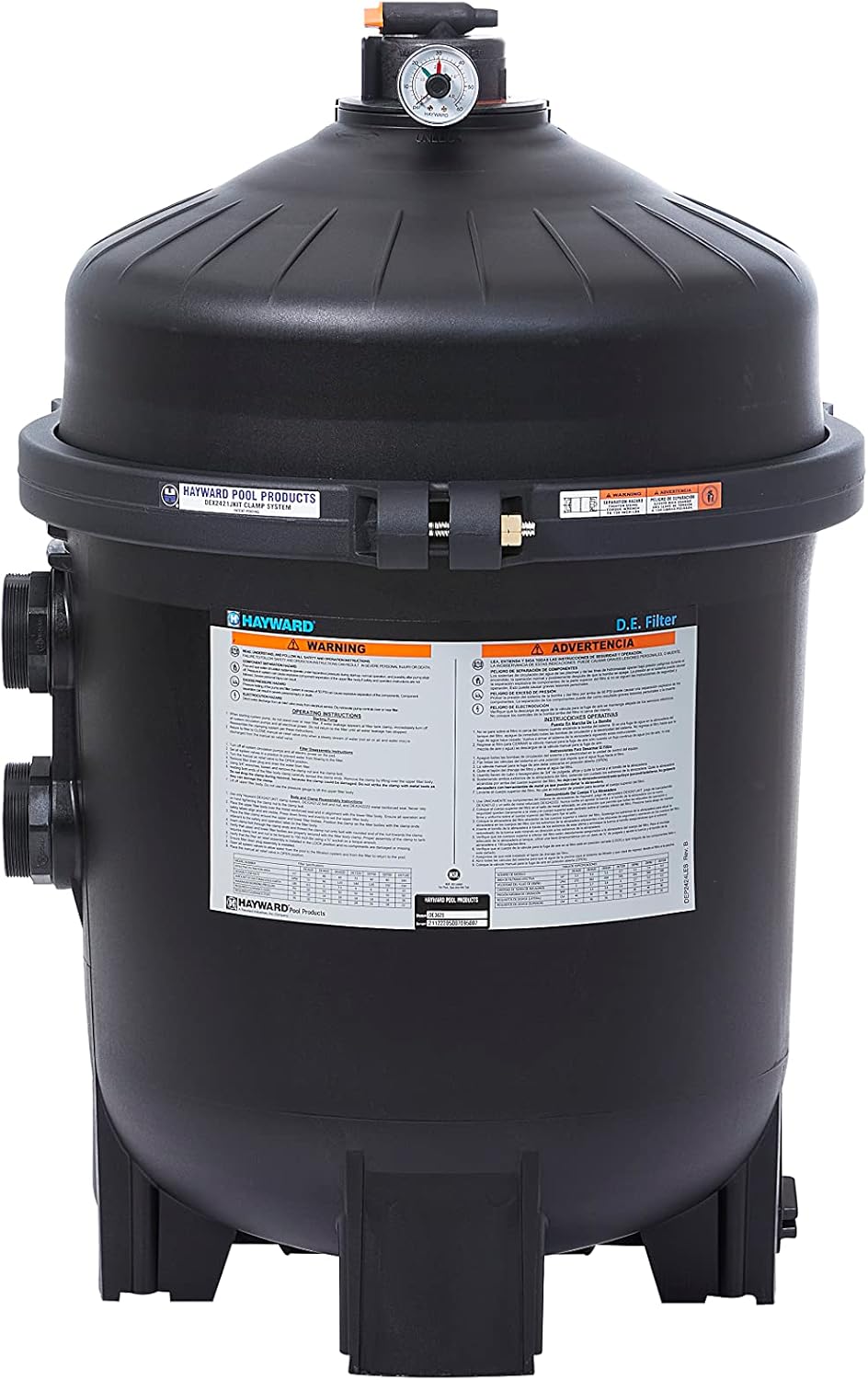
Hayward W3DE3620 ProGrid 36 DE Filter
- 36 sq. ft. vertical-grid DE filtration
- 72 GPM listed design flow
- 4.5 lb manufacturer-listed initial DE charge
The W3DE3620 is the smaller of the two vertical-grid ProGrid models listed here. Hayward specifies 36 square feet of DE area, a 72 GPM design flow, and a 4.5-pound initial DE charge for its DE3620 configuration. It offers the same basic filtration method as the larger DE6020, but its lower flow rating makes the intended system match different.
Size and grid configuration
Hayward’s ProGrid arrangement uses fabric-covered internal grids inside a rigid filter housing. Powdered DE forms the active filtration coating, meaning the fabric is not meant to run as a bare standalone cartridge after cleaning. That distinction is fundamental to keeping a DE filter working correctly and protecting the grid material.
The DE3620’s manual specifies a filter-height dimension of around 34.1 inches and an overhead clearance requirement of 16 inches. The reduced height may help on constrained pads, though side access and compatible valve position still determine whether the unit can actually be maintained. Do not judge installation by shell height alone.
Why the 72 GPM rating matters
The 72 GPM design figure is the critical number to examine before choosing this smaller DE tank. A high-output in-ground pump, especially a variable-speed pump operated at high speed for cleaners or water features, may place demands beyond what the selected filter and associated plumbing should handle. The acceptable system configuration must follow all rated components.
For a system already operating comfortably within the relevant limits, this model may offer sufficient filtration without installing the physically larger DE6020. Pool gallon capacity by itself cannot settle this question. Plumbing hydraulics, speed settings, equipment pressure losses, and required circulation all belong in the decision.
Initial coating and ongoing care
Hayward’s published initial DE charge for the 36-square-foot model is 4.5 pounds. This is not a recommendation to throw an unmeasured amount into the skimmer after every cleaning. The correct preparation and charge follow the manual and depend on whether the grids have been completely cleaned or simply backwashed.
Once operating, the pressure differential above a clean filter baseline signals accumulated material. Backwashing can provide an interim cleaning route through a properly matched valve, followed by correct DE replenishment. The grid assembly should still be examined periodically for tears, damaged seams, broken support pieces, and deposits that water reversal cannot remove.
Plumbing and valve details
Because this is a DE vessel, it needs a control valve and a route for waste water. Check the exact port and valve selection before buying; fitting assumptions based on a different ProGrid size can lead to mismatches. Also consider whether the old filter used a top-mount or side-mount configuration and where the pump and return connections are located.
Local rules for backwash discharge can affect the true installation cost more than the difference between two filter tanks. A system requiring extra valves, revised piping, or a DE separation arrangement may no longer be the simple replacement first imagined. Those are installation decisions rather than defects of the W3DE3620 itself.
Who should choose the larger model instead
Owners with anticipated flow above the 36-square-foot unit’s appropriate design range should evaluate the DE6020 or other correctly rated options rather than relying on the smaller shell. More grid area can provide useful dirt-loading margin when debris conditions are similar, although it also takes more space and an appropriate DE charge.
A purchaser hoping to avoid DE handling altogether should move to a cartridge vessel. The smaller ProGrid still requires media, a backwash method, and periodic grid care. Its strength is providing DE filtration in a smaller-rated configuration, not eliminating the work normally associated with DE.
Pros
- DE filtration in a smaller rated configuration
- Lower listed initial DE charge than the 60-square-foot ProGrid
- 34.1-inch filter-height dimension in the Hayward manual
- May be easier to accommodate where a larger ProGrid model will not fit
Cons
- 72 GPM design flow may restrict higher-flow circulation plans
- Smaller grid area can mean less dirt-holding margin under heavy loads
- Still requires a compatible backwash valve and replenished DE media
- Cannot be selected on pool volume alone without checking actual pump flow
INTEX C1000 1000 GPH Cartridge Pump
- Integrated pump and Type A cartridge filter
- 1,000 GPH pump flow; 750 GPH system flow listed
- For compatible above-ground pools up to 6,000 gallons
The INTEX C1000 belongs in this guide because shoppers often encounter it while comparing cartridge filtration systems, yet it serves a different kind of pool. It combines a pump with a replaceable cartridge in a compact assembly rather than acting as a high-flow filter tank connected to a separately selected in-ground pump. Treating it as a lower-priced alternative to the Pentair and Hayward vessels would be an installation mistake.
An integrated system for compatible above-ground pools
INTEX lists the C1000 family with a 1,000 GPH pump-flow capacity and a 750 GPH system flow rate under normal connected conditions. The second figure is especially important: it represents water moving through the assembled system rather than the isolated pump’s nominal capacity. Converted for comparison, 750 gallons per hour equals 12.5 gallons per minute, far below the rated flow figures of the full-size in-ground filter vessels.
The manufacturer describes suitability for compatible above-ground pools holding up to 6,000 gallons and using 1.25-inch hose fittings. The specific pool wall openings, hose connections, and included fittings must still be checked. A pool with larger connections may require adapters or a different pump model, and an in-ground pool’s 2-inch plumbing is not a direct match.
Cartridge media and replacement cycle
The C1000 uses INTEX Type A replaceable cartridges. These small pleated elements are intended to be rinsed or exchanged as routine maintenance, and INTEX recommends replacing the Type A cartridge approximately every two weeks for efficient operation. This is a very different replacement pattern from the larger, reusable elements found in the Pentair and Hayward multi-cartridge vessels.
A small filter cartridge can load quickly when a pool contains fine dirt or algae debris. For a compatible seasonal pool, frequent element changes may be reasonable because access is straightforward and the elements are relatively compact. The same arrangement is inconvenient for a much larger body of water requiring stronger circulation and greater debris capacity.
Connecting the pump and operating it
The compact unit uses flexible hoses and an above-ground pool connection arrangement. Before setup, confirm water level, inlet and return orientation, hose gasket condition, the ability to prime as specified, and electrical protection in accordance with the manual. Do not place the unit into operation with an empty filter housing or improperly secured hose connections.
Intex describes a Hydro Aeration inlet fitting on the current C1000 product specification. Such fittings are part of the pool return arrangement, not a substitute for sanitation. A higher visible air-bubble count should not be interpreted as evidence that the water is chemically safe. Keep testing and dosing according to pool-care requirements.
How it compares with full-size cartridge systems
All three cartridge-based entries avoid loose DE media, but the similarity largely ends there. The Pentair and Hayward vessels provide hundreds of square feet of cartridge area for engineered in-ground circulation. The C1000’s small element and integrated pump are aimed at simpler above-ground setups, with the corresponding limitations in flow and service intervals.
The C1000 may be useful where a compatible small pool needs a replacement circulation package. It is not a sensible choice for a pool whose plumbing, heater, and cleaner depend on a large existing pump. Buying the wrong category of equipment can be more expensive than selecting a properly matched unit from the outset.
Practical reasons to choose or avoid it
Ease of connection to specified above-ground pools and a simple Type A consumable are its major advantages. Households dealing with a seasonal pool can find that arrangement easier to manage than servicing a large pressure vessel. The tradeoff is continuing cartridge use and a limited circulation capacity compared with permanent in-ground systems.
If your pool exceeds the manufacturer’s compatible size range, has different wall fittings, or requires substantially higher circulation, consider an appropriate larger INTEX system or another pool-specific pump and filter package. If you already own a separately pumped in-ground pool, the first four products belong to the relevant class of filters; the C1000 does not.
Pros
- Includes both circulation pump and cartridge filtration in one small system
- Uses widely available INTEX Type A replacement cartridges
- 1.25-inch hose connections suit specified compatible above-ground pools
- No DE powder or separate backwash assembly needed
Cons
- Far lower system flow than the large in-ground filter vessels in this guide
- Frequent small-cartridge replacement is part of the intended maintenance
- Not a drop-in replacement for 2-inch in-ground equipment plumbing
- Hose and fitting compatibility must be checked before purchase
Buying Guide: Matching Filter Type to the Pool
Calculate a circulation target before picking equipment
The filter should be chosen as part of the circulation design, not as a decorative tank that happens to connect to the pump. Pool volume, local health or building requirements, pump speed, pipe size, and water features all contribute to the operating flow target. The pump curve shows how much water the pump delivers against actual system resistance, which is rarely its advertised maximum output.
A simple theoretical turnover calculation divides pool volume by the number of hours assigned to circulate one pool volume, then converts gallons per hour to gallons per minute. For example, a 24,000-gallon pool circulated over eight hours requires an average theoretical rate of 50 GPM. That calculation does not replace hydraulic design or mean that all water is perfectly mixed after one turnover, but it offers a useful starting point.
Compare the result with the filter’s appropriate rated flow and the lowest-rated other component. Consider whether the pump runs continuously at one speed or changes speed for cleaning and heating. A low-speed schedule can reduce operating energy in some configurations, but it must still achieve effective skimming, sanitation, heating, and required flow through other equipment.
Distinguish filter area from rated flow and head loss
Three figures are often confused on product pages: filtration area, flow rating, and maximum tank pressure. Filtration area describes the media, flow rating describes a design circulation figure, and maximum pressure is a structural operating limit. None can replace the others in sizing a safe system.
A large filtration area can provide debris capacity without necessarily providing a proportionally larger approved flow. Likewise, a filter that tolerates 50 PSI pressure is not intended to be operated at that pressure as a goal. Always use manufacturer pressure and flow limitations, and investigate abnormal pressure rather than trying to power through it.
Think through total maintenance work, not just cleaning frequency
A DE filter can be backwashed without immediately removing all of its grids. That is convenient during a busy season when the equipment is properly plumbed to waste. Yet every backwash requires attention to valve positioning, pump shutdown rules, water discharge, and recharging with the correct DE amount. The internal grid assembly will still need occasional complete cleaning.
A large cartridge filter eliminates normal backwashing, so it does not discharge a tank of water to waste each time the pressure rises. Cleaning instead involves opening the vessel, moving dirty cartridges, and rinsing all surfaces and pleats. A spacious equipment pad with good drainage makes this considerably less unpleasant than a cramped indoor closet or narrow side yard.
The choice turns on which routine fits the property and the owner. One household may gladly rinse four cartridges to avoid handling DE. Another may prefer a properly routed DE backwash for frequent interim debris removal. Neither method is passive; pressure tracking and inspection remain essential.
Assess leaf, pollen, dust, and algae loads separately
Leaf litter should largely be kept out of the filter with skimmer baskets, pump baskets, leaf traps, and manual cleaning. Sending large debris through the circulation system makes any filter work harder. A pool under trees may need more frequent skimming and basket emptying regardless of the filter media selected.
Fine spring pollen and windblown dust create a different challenge because they can pass the surface baskets and accumulate in the filter. DE can offer very fine particle capture, but it can also build resistance as the DE layer collects this material. Cartridge filters similarly load up faster during these events. Compare the anticipated debris load with available filter area and a realistic service schedule.
An algae outbreak is primarily a water-treatment and circulation problem. Cleaning the filter is part of removing dead algae and other suspended solids, but installing a larger or finer unit does not replace appropriate sanitizer, testing, brushing, and vacuuming. If the filter repeatedly clogs soon after cleaning, investigate the underlying water condition before buying a new tank.
Understand water consumption and disposal
Traditional DE backwashing sends water, debris, and spent filtration media through a waste line. That water must be replaced, sometimes requiring adjustments to salt, stabilizer, and other pool chemistry. The amount discharged depends on the equipment and procedure, so generic fixed backwash-volume claims do not provide a reliable operating budget for every property.
A cartridge filter still needs rinse water, but routine maintenance does not require intentionally reversing the full pool circulation stream to waste. That makes it particularly attractive where backwash discharges are difficult to route. If the local municipality restricts DE disposal, the design implications should be resolved before choosing a ProGrid system.
Plan for replacement cartridges and DE grid parts
For the Pentair CCP420 and Hayward C3030, identify all cartridge part numbers associated with the exact housing. An element that appears similar may have a different end-cap opening, height, core, or filtration material. Do not rely on generic dimensions without confirming compatibility with the manufacturer or a trustworthy supplier.
DE grids use fabric bags or covers fitted over support structures, typically assembled around a manifold. A tear can allow DE to return to the pool even when the tank appears intact. Verify the correct grid set and manifold parts for DE6020 versus DE3620 rather than assuming components interchange across the ProGrid range.
Pressure gauges, tank O-rings, air relief assemblies, clamp parts, and drain fittings deserve attention whichever type is selected. A worn seal or incorrect clamp component is a safety issue, not just a small leak. Replace damaged pressure-vessel components with the manufacturer-specified parts and follow the complete service procedure.
Check what the seller is actually supplying
Pool equipment photos often show a filter next to a control valve, pump, or connection accessories, but a photograph does not establish the contents of the box. Confirm whether unions, pressure gauge, air relief, cartridge elements, DE grids, backwash valve, and drain plugs are included in the exact SKU offered. A missing valve or connection set can stop an installation even if the filter model itself is correct.
This matters especially for Hayward’s ProGrid range because compatible valves are selected according to the installation. It also matters for the INTEX C1000 because above-ground pool hose and fitting configurations differ. Keep a parts list based on the actual equipment you own, not the accessories pictured on a page for another variation.
Make the equipment pad safe to service
Pool filters are pressure vessels. Before opening one, stop the pump, disable timers and automatic controls, isolate electrical power, and release pressure according to the exact manual. Wait until the gauge indicates zero, and inspect the safety clamp, air relief assembly, and housing before reassembly. Never remove a band clamp or lid with pressure inside the vessel.
Install the system on a stable, well-drained base, with unobstructed access to valves and a route for service water. Do not direct pressure-relief water toward electrical equipment. A qualified pool professional is the appropriate choice where the plumbing, electrical connection, or filter clamp service is uncertain. A dependable filter is only useful if it can be serviced safely.
Direct Comparisons That Affect the Buying Decision
Pentair EC-160301 Clean & Clear Plus 420 Filter vs Hayward W3C3030 SwimClear 325 Cartridge Filter
These are the most direct competitors in the list because both are four-element cartridge filter vessels intended for conventional in-ground pool systems. The Pentair offers 420 square feet of cartridge area and a listed 150 GPM flow; the Hayward has 325 square feet with a listed 122 GPM design flow. Those differences are meaningful for sizing and possible debris-holding margin, but they do not demonstrate that one makes clearer water under every condition.
Physical service access changes the calculation. Pentair lists 68 inches of vertical clearance for the CCP420, while Hayward’s C3030 document gives an approximately 34.5-inch tank height plus 16 inches for head removal. The actual enclosure geometry still must be measured. The practical winner is the one that meets the system’s flow needs while leaving room for safe cartridge cleaning.
Hayward W3DE6020 ProGrid 60 DE Filter vs Hayward W3DE3620 ProGrid 36 DE Filter
These models share the same DE-coated vertical-grid operating principle. The DE6020 is rated at 60 square feet and 120 GPM, while the DE3620 is rated at 36 square feet and 72 GPM. Hayward’s respective initial charges are 7.5 and 4.5 pounds of DE, so choosing the larger grid assembly also changes the amount of media needed after a complete cleaning.
A larger ProGrid is not automatically desirable in a tight equipment space or a lower-flow circulation system. The smaller model has less tank height and a lower design-flow figure; it can be appropriate when the pump and pool design match. Higher anticipated flows or heavier debris loading can justify evaluating the 60-square-foot model, provided the required valve and service clearance also fit.
Hayward W3DE6020 ProGrid 60 DE Filter vs Pentair EC-160301 Clean & Clear Plus 420 Filter
This is the clearest illustration of the technology decision. The Pentair puts four washable cartridges in a tank and avoids normal backwashing and DE powder. The ProGrid uses DE-coated grids that support a very fine filtration medium, with a valve-operated backwash-and-recharge routine.
The Pentair’s 420-square-foot figure and the ProGrid’s 60-square-foot figure are not competing measurements on the same scale. Instead, compare the design flows of 150 GPM and 120 GPM within the wider system design, then consider whether cartridge rinsing or DE handling better fits the household. Waste-disposal access may settle the issue before filtration fineness does.
Hayward W3C3030 SwimClear 325 Cartridge Filter vs Hayward W3DE3620 ProGrid 36 DE Filter
The SwimClear’s 325 square feet of cartridge area and 122 GPM design flow suggest a different circulation capacity from the ProGrid DE3620’s 36-square-foot DE grid area and 72 GPM design flow. Those differences matter when the pump and pool return system are already established. A switch from one type to the other is not a like-for-like tank exchange unless the hydraulic requirements are compatible.
For maintenance, the choice is between lifting and rinsing four cartridges or maintaining DE-coated grids, a control valve, and a waste route. The DE3620 may be shorter as a vessel, but its valve placement and operational access still need space. An owner who dislikes recurring media purchases may lean toward the SwimClear, while one who values DE-style fine filtration may accept the ProGrid routine.
INTEX C1000 1000 GPH Cartridge Pump vs the In-Ground Filters
The INTEX unit is intended for a compatible small above-ground pool with flexible hose connections. Its 750 GPH system flow equals 12.5 GPM and its filter cartridge is a frequently replaced Type A element. It should not be compared as a cheaper equivalent to an in-ground tank rated for dozens or more gallons per minute.
A small seasonal pool owner often needs an integrated pump, compatible hoses, and a replaceable cartridge. An in-ground pool owner replacing a large filter typically needs to preserve or re-engineer a separate pump and plumbing system. Those are different projects. Choosing within the correct installation class matters more than the sticker price of the filter.
Common Pool Filter Buying Mistakes
Using the largest square-foot number as the only ranking
Filter area is not a universal performance score. A DE grid rating and a pleated cartridge rating describe different media geometries, so dividing one by the other creates a misleading ratio. Compare flow, maintenance design, filtration type, and actual debris demands first.
Confusing the pump’s maximum flow with system flow
Pump marketing numbers may reflect conditions that differ from a real pool’s resistance. The INTEX example makes the distinction visible by listing a 1,000 GPH pump rating and a lower 750 GPH connected-system rating. Full-size pool pumps similarly operate at a point determined by plumbing hydraulics, not their biggest advertised figure.
Buying a DE filter without a compatible valve
A ProGrid vessel needs a properly matched means of backwashing, and that can require additional hardware and waste plumbing. Do not assume that the valve in a product photo is automatically included. Check the exact ordered components and recommended valve configuration before the installer arrives.
Forgetting the space needed to remove filter elements
A short-looking tank is not necessarily easy to maintain. Filter tops, cartridges, and DE grid assemblies all need lifting clearance. Measure above and beside the installation, including the path to remove components without hitting a roof, fence, or electrical equipment.
Buying replacement media by appearance alone
The wrong cartridge can fail to seal or fit properly. The wrong DE grid set may have different dimensions or manifold geometry. Cross-check exact model and parts diagrams, and treat off-brand compatibility claims with care where they do not identify your specific filter model.
Cleaning only by the calendar
A pressure gauge provides information about changing resistance across the filter. Cleaning solely every Saturday can waste effort during light use and miss a heavy debris load after a storm. Record a clean starting pressure and follow model-specific pressure-rise guidance and visible flow changes.
Treating filtered water as sanitized water
Filters remove particles; they do not substitute for a disinfectant residual, proper pH, or monitoring of pool chemistry. Even visibly clear water can be unsafe if sanitation is neglected. Evaluate equipment alongside the complete water-treatment plan rather than assuming the finest filtration medium solves every water problem.
Frequently Asked Questions
Is DE filtration better than cartridge filtration for pool clarity?
DE generally captures finer particles than standard pool cartridge media, which can be an advantage for polishing suspended haze. Both types can maintain clear water in a correctly balanced and circulated pool. A DE filter is not automatically the better purchase if backwash disposal, DE handling, or installation complexity creates more problems than the particle-size benefit solves.
Which type wastes less pool water during normal cleaning?
Cartridge filters typically avoid the substantial backwash discharge associated with conventional DE systems. Their elements still need rinsing, so water use is not zero. On properties where discharging backwash water is difficult, a cartridge system often has the more convenient operating arrangement.
Can a DE filter run without adding DE powder?
A conventional vertical-grid DE filter should not be operated normally without the prescribed DE coating. The grids support the powder layer; they are not simply washable pleated cartridge filters. Follow the exact Hayward instructions for initial and post-backwash charges.
How often should a cartridge pool filter be cleaned?
The answer depends on pressure rise above the clean starting point, observed circulation, and the manufacturer’s instructions. Pentair’s Clean & Clear Plus guidance uses an increase of about 10 PSI as a cleaning signal. Cleaning frequency changes with pollen, debris, pool use, and water chemistry, so one universal weekly schedule is not reliable.
Does a larger cartridge filter always provide greater flow?
No. A larger cartridge area often provides more dirt-holding surface, but the filter’s approved design flow and the system’s pump and plumbing determine what flow is appropriate. The Pentair 420 and Hayward 325 have different manufacturer-listed flow figures; neither should be used beyond its applicable ratings.
How much DE does the Hayward ProGrid 60 require?
Hayward lists 7.5 pounds as the recommended initial full charge for the DE6020 model. Recharging after backwashing should follow the manual’s specific procedure, which may differ from a complete initial charge. Measuring the amount correctly is important for coating the grids as intended.
How much DE is used in the ProGrid 36?
The DE3620’s manufacturer-listed initial full charge is 4.5 pounds. Like the DE6020, it requires correct preparation and a model-specific recharge procedure after backwashing. Do not use the larger model’s DE quantity on the smaller tank.
Can I replace an in-ground DE filter with a cartridge filter?
Yes, provided the replacement is properly sized for the pump and pool system and the new plumbing arrangement follows the manufacturer’s requirements. Changing from DE to cartridge can remove the recurring backwash process, but pipe connections, height, clearance, and rated flow must be checked. A qualified installer can confirm whether an existing valve and waste line should be removed or bypassed.
Is the INTEX C1000 sufficient for an in-ground pool?
The C1000 is specified for compatible smaller above-ground pool systems, not as a direct replacement for large in-ground circulation equipment. Its listed connected-system flow is 750 GPH, and it uses small hose fittings and Type A cartridges. An in-ground pool should be evaluated with appropriately rated pump and filter equipment.
Do cartridge filters need replacement cartridges every two weeks?
That schedule is associated with INTEX’s small Type A elements, not all cartridge filters. Large four-element systems such as Pentair’s CCP420 and Hayward’s SwimClear C3030 use different elements that are repeatedly cleaned and replaced when condition warrants. Always follow the care guidance for the exact filter and element.
Why is DE powder coming out of the pool returns?
Possible causes include a damaged grid or seam, an improperly seated manifold, or other internal sealing problems. If DE is returning to the pool, stop and diagnose the issue rather than continually topping up powder. The correct repair depends on the filter model and the condition of the internals.
Should I choose the filter with the higher pressure rating?
Pressure ratings are safety and design limits, not target operating points or indicators of filtration quality. A high observed gauge reading can mean a clogged filter or a circulation problem. Select equipment by the manufacturer’s approved operating limits and the overall system design, not by treating pressure as a performance contest.
Final Buying Considerations
For most in-ground pool owners comparing DE filter vs cartridge filter pool setups, the deciding factors are the required circulation flow, maintenance method, and workable equipment-pad layout. A large cartridge filter avoids normal backwashing and DE powder but asks the owner to remove and rinse several substantial elements. A vertical-grid DE filter provides very fine filtration but adds a backwash valve, powder handling, and waste-management responsibilities.
The Pentair EC-160301 Clean & Clear Plus 420 is the higher-area cartridge choice here, with a 150 GPM listed design flow and considerable overhead-clearance requirements. The Hayward W3C3030 SwimClear 325 is a smaller four-cartridge alternative with a 122 GPM design figure and a shorter tank. Select between them on hydraulic fit, available access, and the benefit of extra cartridge area rather than assuming the larger model is necessary for every pool.
On the DE side, the Hayward W3DE6020 ProGrid 60 offers more grid area and a higher design-flow figure than the W3DE3620 ProGrid 36. The smaller DE model can be appropriate for a genuinely lower-flow setup but should not be forced into a high-output pump installation. The INTEX C1000 is an altogether different integrated pump-and-filter option for compatible above-ground pools.
Measure the space, identify the existing pump and plumbing, confirm exactly what the purchase includes, and decide which cleaning routine is realistic for the property. Those checks are more likely to prevent an expensive installation mistake than choosing a filter solely by the clearest-sounding marketing claim.
Author