
A SwimQuip pool light can look like an ordinary underwater lamp from the deck, but the replacement bulb depends on what is inside the sealed fixture. Older Sta-Rite SwimQuip lights were supplied in both 12-volt and 120-volt configurations. A lamp intended for one voltage is not a substitute for the other, even when the screw base appears identical.
The four options here are replacement bulbs, not complete underwater light assemblies. Two are 50-watt daylight LEDs, and two are 500-watt incandescent R40 flood lamps. They differ in electrical supply, light color, operating cost, heat and the kind of original installation they are intended to replace. The correct choice begins with the fixture label and its approved lamp specification.
A search for swimquip pool light replacements can also lead to listings that prominently mention Pentair or Hayward. That wording is not proof that a bulb has been approved for every SwimQuip housing. Before buying, identify the fixture model, confirm whether it uses a serviceable screw-in lamp and have a qualified pool-light professional check the replacement against the manufacturer’s instructions.
The comparison below separates the voltage classes first, then the LED and incandescent options. If the housing, cord, sealing surfaces, lens or electrical installation is compromised, repairing the bulb alone will not correct those problems. A complete listed light assembly or other professionally selected repair may be necessary.
Quick Comparison of SwimQuip Pool Light Bulb Options
- 120V version with E26 screw base
- 50W LED, advertised 5,000-lumen output
- Cool daylight white; verify housing clearance

- 12V AC/DC input; not a 120V lamp
- 50W LED with advertised 5,000 lumens
- E26 medium base and 5,000K daylight white

- 500W, 120V incandescent R40 reflector lamp
- E26 medium screw base; 2,700K warm light
- Manufacturer-rated 5,400 lumens and 2,000 hours

- Two R40 incandescent bulbs per pack
- 500W each, 120V and E26 medium base
- Advertised 3,000K warm-white output
The Allisable and Venste LEDs both advertise 50 watts and 5,000 lumens, but they are not interchangeable: the Allisable listing is for 120V operation, while the Venste listing is for 12V input. The Halco and Generalman choices use 120V, 500W R40 incandescent designs. A voltage match is necessary, but it is only one part of a safe and compatible replacement.
What to Check Before Buying a SwimQuip Pool Light Bulb
Identify the original fixture and rated voltage
Start with the identification printed on the underwater light housing, the approved parts documentation or the service record. Pentair’s SwimQuip parts catalog identifies 05082-series replacement lights as 12V, 300W units and 05086-series replacement lights as 120V, 500W units. It also lists separate bulb part numbers for 12V 100W, 12V 300W and 120V 500W applications. These distinctions are central to the purchase.
Do not decide voltage from the wall switch, the pool age or the shape of the lamp. A low-voltage underwater fixture usually depends on a suitable isolating transformer, and a 120V lamp cannot be connected to its 12V secondary. Conversely, a 12V replacement bulb must not be installed on a 120V supply. Where the fixture markings are missing, stop and identify the equipment before ordering.
Understand the bulb base and lamp envelope
All four products in this comparison use or advertise an E26 medium screw base, but that common feature does not establish complete compatibility. The lamp also has to fit behind the lens, clear the reflector and internal hardware, and be acceptable in the sealed operating environment. Some LED replacements have wider bodies or different cooling arrangements than the original glass R40 lamp.
Check the complete length and outside diameter of the existing lamp against the replacement specifications. The two LED listings describe a bulb body measuring approximately 3.74 by 4.72 inches, while Halco provides dimensions for its R40 reflector lamp. Physical clearance must be checked against the real housing, not inferred merely from a photo of the bulb.
Decide between traditional warm light and LED daylight
An R40 incandescent bulb makes a warmer pool appearance, especially with the approximately 2700K Halco lamp or the advertised 3000K Generalman bulbs. The listed LEDs give a cooler white appearance, with Allisable specifying daylight around 6000K and Venste specifying 5000K. Color temperature describes the tone of the light, not how safely it can be used in a fixture.
Water color, plaster or liner color, lens condition and pool depth all affect how a given bulb looks after installation. A white-finish pool can reflect a cool lamp differently from a dark-finish pool. If you are replacing only one of several matching lights, compare color temperature and lamp technology so that the pool does not end up with noticeably mismatched colors.
Check sealed-fixture approval, heat and service condition
Underwater pool lights are specialized sealed electrical equipment. Even if an aftermarket lamp screws into the socket, the complete combination must comply with the fixture manufacturer’s instructions and applicable electrical requirements. Heat behavior, water sealing, grounding, bonding and GFCI protection are not details that can be settled through a general compatibility claim.
A cracked lens, deteriorated gasket, corroded socket or damaged cord changes the job from a bulb purchase to an equipment repair. Pentair installation guidance calls for a new lens gasket when reassembling certain serviceable underwater lights, and it warns against operating the assembly out of water beyond the permitted brief check. Use the procedures and replacement parts specified for the actual SwimQuip housing.
Consider whether the fixture should be replaced instead
A replacement bulb makes sense when the existing light is serviceable, correctly installed and approved for that lamp type. It makes less sense when the original housing is obsolete or physically damaged, or when an owner wants an LED conversion that the fixture manufacturer has not approved. The broader repair decision should be made before spending money on bulbs.
The Pentair catalog describes SwimQuip lights as replacement-only products for their intended discontinued SwimQuip niche arrangement. That history is one reason to treat generic cross-brand compatibility cautiously. A professional can compare the installed niche, luminaire, certification and local code requirements before recommending repair or a complete lighting replacement.
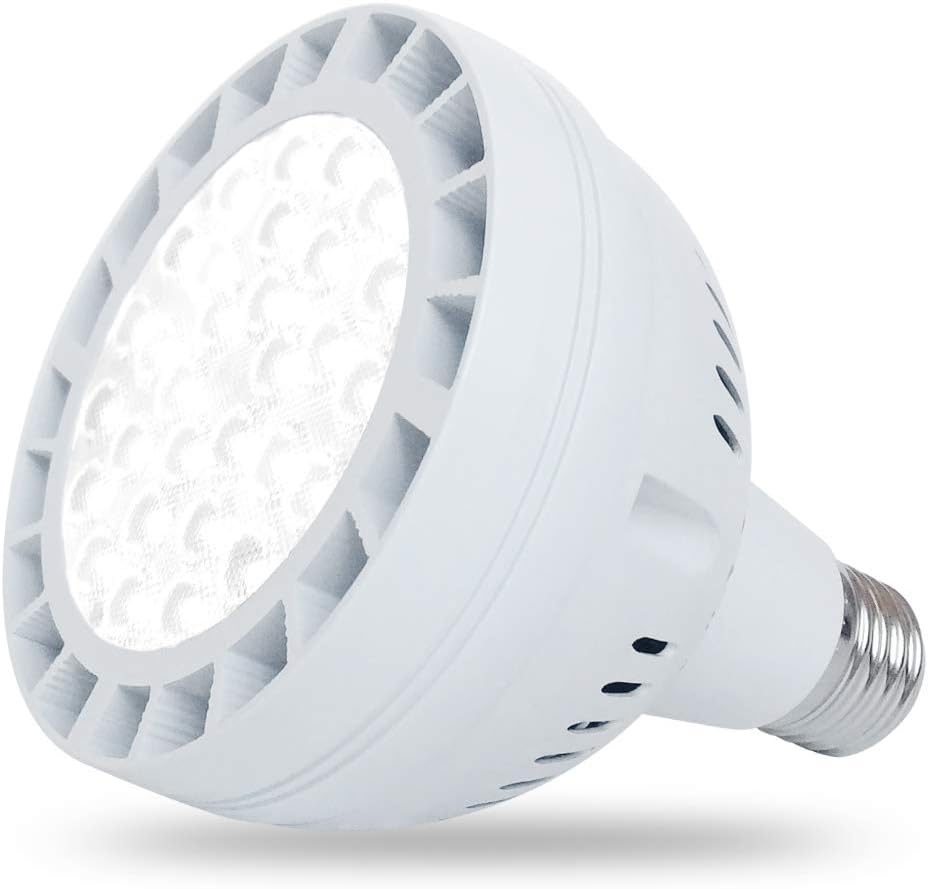
Allisable 50W 120V Daylight LED Pool Bulb
- 120V version with E26 screw base
- 50W LED, advertised 5,000-lumen output
- Cool daylight white; verify housing clearance
The Allisable 50W LED is listed as the 120V version of a daylight-white replacement bulb for selected inground pool lights. Its main attraction is the lower electrical input compared with an older 500W incandescent lamp, provided the existing fixture is permitted to use this LED. It should not be treated as a universal upgrade simply because the listing mentions well-known pool-light brands.
Electrical specification and light output
The listing identifies a 50-watt LED design, 120V operating version and advertised light output of 5,000 lumens. That luminous-output figure is a seller specification, not a measurement of the brightness delivered through a specific underwater lens. The relevant distinction for a buyer is the 120V category and the much smaller stated power draw relative to traditional high-wattage incandescent bulbs.
The marketing text also describes a broad AC input capability but explicitly says this selected version is not for AC/DC 12V use. That warning takes priority over assumptions about similar-looking versions sold elsewhere. If a technician establishes that the installed SwimQuip assembly is a 12V light, this 120V listing is not the appropriate option.
Daylight appearance in the pool
This lamp is described as daylight white, with listing details specifying approximately 6000K. That produces a comparatively crisp, cool tone rather than the yellow-amber appearance associated with the older R40 flood lamp. Owners replacing multiple identical lights should be particularly attentive to mixing this cooler color with an existing warm incandescent lamp.
A numerical 5,000-lumen rating does not guarantee the same pattern as an R40 reflector. Bulb geometry, direction of emitted light and the glass lens affect distribution through the water. A pool with darker finishes or a lens that has become hazy may appear different from the seller’s demonstration photographs even when the lamp is working as intended.
Dimensions, base and fixture space
The Allisable listing describes an E26 screw-in bulb and an approximately 3.74-by-4.72-inch body. Those dimensions deserve attention because some older housings were shaped around a glass reflector lamp. An LED can carry cooling components and a differently shaped light-emitting face, so the bulb must have sufficient clearance without touching parts of the sealed assembly.
An E26 socket alone does not certify that the light housing can accept the bulb. The exact lens, gasket, internal reflector and required thermal environment remain part of the fit check. The manufacturer’s service instructions and the fixture’s listing must allow the selected replacement before the pool-light professional installs it.
What the lower wattage changes
A 50W input is 450 watts below a 500W incandescent lamp while both are energized. Over 100 operating hours, that difference corresponds to about 45 kilowatt-hours of electricity for the lamp alone. Actual household cost depends on the electricity tariff and system losses, but the power reduction is a clear potential reason to examine an approved LED conversion.
Lower wattage does not mean the bulb runs cool enough for every enclosure. LED electronics still produce heat, and the thermal behavior depends on the housing and surrounding water. A component that performs acceptably in a supported fixture should not be assumed suitable for an unsupported SwimQuip body, even if its rated watts are lower.
Installation and maintenance considerations
This is a lamp-only replacement. It does not provide a new watertight light enclosure, safe electrical circuit, underwater cable, lens gasket or mounting hardware. A bulb failure accompanied by moisture behind the glass must be investigated as a sealing problem rather than corrected simply by fitting another light source.
Service should be handled by a qualified pool-light professional who can isolate and verify power is off, confirm the correct lamp specification, inspect the assembly and restore the required seal. Manufacturer instructions for the installed fixture determine whether a replacement gasket or other service parts are required. An attractive plug-and-play description is not a substitute for that process.
Where it fits in this comparison
Among these products, Allisable is the daylight LED choice for a 120V replacement scenario. It is the closest voltage-class alternative to the Halco and Generalman 500W bulbs, although its technology and physical shape differ considerably. The Venste lamp is another 50W LED, but its 12V input places it in a different installation category.
Consider this bulb only after confirming that the actual 120V fixture, socket, dimensions and certification permit the conversion. Buyers who need to preserve a manufacturer-specified 500W R40 incandescent configuration should instead examine the documented R40 lamp type. Owners with 12V lights should not use this option at all.
Pros
- Targets a 120V circuit rather than the 12V LED configuration
- 50W input is lower than a traditional 500W lamp
- Bright daylight-white output suits owners wanting a cooler color
- E26 replacement format is intended for selected legacy housings
Cons
- Not suitable for 12V fixtures
- SwimQuip fit and electrical approval require model-specific confirmation
- LED body dimensions and thermal management can limit fit
- Not a complete sealed underwater light assembly
Venste 50W 12V Daylight LED Pool Bulb
- 12V AC/DC input; not a 120V lamp
- 50W LED with advertised 5,000 lumens
- E26 medium base and 5,000K daylight white
The Venste 50W bulb addresses a different electrical supply: it is sold for 12V AC/DC input and is explicitly described as incompatible with AC 120V. That makes its voltage identification the defining feature, not its resemblance to the Allisable LED. It is intended as a daylight LED alternative where an approved 12V underwater pool-light assembly accepts a medium-base replacement lamp.
Why 12V matters more than the matching appearance
Older SwimQuip equipment includes 12V configurations, and Pentair’s replacement-parts records distinguish them from the 120V assemblies. The Venste listing gives 50 watts of LED input at 12V, so it belongs in the low-voltage category. The appearance of a threaded socket cannot tell an owner that a fixture is low voltage; that must come from verified equipment information.
Even within a 12V installation, the transformer matters. Its output type and voltage, condition, installation method and capacity must meet the requirements of the installed fixture and its permitted replacement lamp. A low-voltage bulb cannot be selected solely because a transformer exists somewhere near the equipment pad.
Light color and claimed output
Venste describes a daylight-white lamp with a 5000K color temperature and a seller-stated output of 5,000 lumens. Compared with an incandescent floodlight, this points toward a whiter appearance rather than an amber glow. It does not establish that every pool will be illuminated uniformly or that it will duplicate the optical distribution of the original bulb.
The listing positions the LED as a replacement for higher-wattage traditional lamps, but that is an intended brightness comparison, not authorization to ignore the fixture’s rated lamp type. The correct judgment includes voltage, operating conditions, shape and enclosure approvals. Brightness claims should not outweigh an incompatibility with the actual underwater assembly.
E26 socket and LED housing dimensions
A medium E26 base is identified in the product details. The listing also describes dimensions of around 3.74 inches by 4.72 inches. Those figures allow a technician to compare physical clearance with the older lamp and assess whether the glass lens can be fitted without pressure on the LED assembly.
The product description names certain familiar pool-light families, including older Sta-Rite SwimQuip equipment, within broad compatibility wording. That wording is not enough to establish which exact model, generation or approved replacement combination is covered. The original SwimQuip model and its service documentation should determine the fit decision.
Practical power difference
If an approved 50W LED replaces a 300W incandescent light, the nominal lamp-level reduction is 250 watts during operation. In 100 hours that is 25 kilowatt-hours less energy at the lamp, before accounting for transformer losses. This gives a useful way to understand the potential operating difference without making promises about brightness or payback.
The transformer can still consume energy, and the condition of an older electrical system affects the value of an upgrade. Replacing a bulb does not modernize the transformer, the junction box or the protective devices. A complete inspection is therefore more informative than comparing LED and incandescent wattage in isolation.
Service, sealing and common failure points
A functioning low-voltage circuit does not eliminate underwater electrical hazards. The light still needs the proper sealed fixture, cord condition and approved installation. The technician should inspect the gasket seat, lens, retaining hardware and connections specified for the assembly when determining whether a lamp change is appropriate.
A new bulb should not be used as a diagnostic shortcut if the previous light stopped working after water appeared behind the lens. Moisture suggests a sealing or fixture problem; a new lamp may fail again without correcting the cause. The small cost of a lamp is not a reason to overlook the condition of the entire underwater light.
Who should consider Venste rather than Allisable
The Venste is relevant when the actual fixture uses a suitable 12V supply and the replacement has been confirmed acceptable. It offers a daylight output at a lower listed lamp wattage than older 12V incandescent options. Anyone with a 120V SwimQuip fixture must cross it off the shortlist regardless of the attractive LED specifications.
For a confirmed 12V installation that is not approved for this LED, the appropriate route is the manufacturer-specified lamp or a complete compatible light replacement selected by a professional. The Allisable, Halco and Generalman products in this article do not solve that 12V compatibility problem.
Pros
- Designed for a 12V supply, unlike the other three products
- 5000K light gives a neutral-daylight appearance
- 50W LED power draw is lower than 300W incandescent input
- Advertised E26 base and compact bulb form may suit certain housings
Cons
- Must not be connected to a 120V socket circuit
- Transformer output, capacity and LED compatibility must be checked
- Fit is not confirmed for every SwimQuip model
- Bulb alone cannot repair a damaged gasket or housing
Halco R40FL500/HG 500W 120V Flood Bulb
- 500W, 120V incandescent R40 reflector lamp
- E26 medium screw base; 2,700K warm light
- Manufacturer-rated 5,400 lumens and 2,000 hours
The Halco R40FL500/HG is a conventional incandescent reflector flood bulb with a published manufacturer part number, 104042. Halco specifies 500 watts, 120 volts, an E26 medium screw base and an R40 shape. Its main appeal for an older pool light is not technological novelty but a recognizable lamp specification that can be checked against equipment documentation.
Manufacturer specification and SwimQuip relevance
Halco rates this model at approximately 5,400 lumens, a 2,700K color temperature and an average operating life of 2,000 hours. These are manufacturer specifications rather than general claims applied to several unrelated bulbs. The R40 reflector format directs light differently from many multi-diode LED replacements, and its warm color closely reflects the traditional incandescent pool-light appearance.
Pentair’s SwimQuip parts list identifies the 05086-family complete light as a 120V, 500W assembly and names replacement bulb 79102100 for 120V, 500W use. Pool-parts distributors cross-reference the Halco R40FL500/HG with some older SwimQuip equipment. That makes it a relevant lamp to investigate, but the cross-reference is not a blanket approval for every SwimQuip model.
Physical format and base
This bulb uses an R40 reflector envelope and medium E26 base. Its glass reflector is substantially different from the flat or finned appearance of many LED conversion bulbs. The original housing must accommodate the full reflector lamp, and the installed socket must be sound and rated for the lamp and fixture conditions.
Manufacturer documentation describes the R40FL500/HG as a general incandescent reflector flood lamp, and specialty suppliers also market it for compatible pool and spa lights. Those two uses should not be collapsed into a claim that it is waterproof by itself. In an underwater application, the listed and correctly assembled fixture supplies the necessary enclosure.
Warm light and optical behavior
The 2700K color temperature puts the Halco at the warmest end of this four-product selection. Water illuminated with that kind of lamp tends to look more golden than under the white LEDs. Someone restoring the appearance of an older pool, or matching another warm incandescent light, has a concrete reason to consider the traditional lamp type.
The published 5,400-lumen rating is slightly above the advertised 5,000 lumens for each LED here, but those numbers alone do not predict perceived brightness in the pool. The lens, reflector and direction of light distribution influence what reaches the water. A qualified comparison avoids treating a small difference in lumen figures as a guaranteed visual ranking.
Energy consumption and operating cost
At its rated power, a 500W incandescent lamp consumes 0.5 kilowatt-hours for each hour it operates. At 200 hours, that totals about 100 kilowatt-hours for one lamp, excluding other system loads. It is ten times the nominal lamp input of a 50W LED, although any LED replacement still must be authorized for the fixture.
Heat is another practical consequence of the incandescent design. The bulb and fixture can become extremely hot, and underwater-light manufacturers typically require that the installed assembly be submerged during normal operation for cooling. This is not a lamp to operate casually on a countertop to compare colors or prove it works.
Expected replacement cycle and handling
Halco publishes a 2,000-hour average rated life for this model. Rated life is a statistical specification, not a promise that each bulb will work for exactly that long. Actual service can be shortened by inappropriate voltage, fixture defects, excessive heat, moisture and handling damage. Preserve the manufacturer-specified sealing components whenever the enclosure is opened.
The advantages of a standard glass reflector lamp come with limitations. Repeated bulb changes can require disassembling the underwater housing, and every reassembly must restore the required water seal. Where the lens, gasket or housing is not serviceable, an otherwise suitable R40 replacement does not eliminate the need for a larger repair.
Who should consider Halco
Halco is a sensible item to compare with an existing 120V, 500W SwimQuip lamp when a technician verifies the R40FL500/HG specification and the replacement’s approval. Its published specifications make it easier to assess than a product with ambiguous wattage or undisclosed color temperature. It also offers a traditional warm appearance that the cool white LEDs do not reproduce.
Owners of 12V SwimQuip fixtures should not consider this 120V bulb. The same applies to anyone whose equipment label calls for a different lamp type or wattage. A professional should resolve the original part-number cross-reference and the condition of the sealed assembly before choosing this lamp as a replacement.
Pros
- Exact R40FL500/HG model with published manufacturer specifications
- 120V 500W format corresponds to documented 05086-series SwimQuip lamps
- Warm 2700K output resembles traditional incandescent pool lighting
- Manufacturer lists 5400 lumens and 2000-hour average life
Cons
- 500W electrical draw is much higher than either 50W LED alternative
- Generates substantial heat and needs an approved 500W fixture
- Incorrect for 12V SwimQuip light assemblies
- Fit and sealed-fixture approval still require confirmation
Generalman 500W 120V R40 Pool Bulbs (2-Pack)
- Two R40 incandescent bulbs per pack
- 500W each, 120V and E26 medium base
- Advertised 3,000K warm-white output
Generalman sells this option as a two-pack of R40 incandescent pool light bulbs. Each bulb is advertised as 500W, 120V, with an E26 medium screw base and a 3000K warm-white color. Its main distinction from the Halco bulb is the two-bulb package and somewhat less amber listed color temperature, not a different voltage or power class.
What is included and who needs two
Two matching bulbs are useful when a pool has two approved 120V, 500W R40 fixtures and both need replacement. Buying two together can also keep a compatible spare available, but that benefit matters only when the lamps are identical to the originals in all the necessary technical details. A pool with one light or incompatible equipment does not gain value simply from receiving an extra bulb.
The product is not a set of complete underwater lights. It does not supply two housings, cords, mounting rings, lenses or new gaskets. A person comparing this pack with a complete replacement luminaire should account for that large difference in what the purchase actually provides.
Voltage, wattage and screw base
The listed electrical requirements place the Generalman beside the Halco rather than beside the low-voltage Venste LED. Each installed bulb draws 500 watts in a nominal 120V application. Both lamps in the package would consume a combined 1,000 watts if installed and operated simultaneously in two suitable fixtures.
The E26 medium screw base and R40 shape are useful identifiers, but the fixture’s original lamp requirement remains decisive. Check that the installation was designed for a 500W R40 lamp, that its wiring and other components remain sound, and that the replacement is acceptable under the relevant equipment instructions. Avoid using a higher-wattage lamp to compensate for a dirty lens or poor pool-light placement.
Warm-white appearance compared with Halco
Generalman advertises a 3000K color temperature, a warm white that is slightly cooler than Halco’s documented 2700K. The difference can be noticeable when lights are adjacent or reflected against pale pool surfaces. In a pool with two lights, using two bulbs of the same type can reduce the risk of an unintended warm-versus-cool mismatch.
The listing does not provide a manufacturer-confirmed luminous-output specification suitable for a meaningful direct lumen comparison with the Halco R40FL500/HG. It would be misleading to claim that one gives more usable pool illumination based only on a shared 500W power rating. Reflector geometry, lens condition and actual bulb performance still matter.
Why the advertised life should be treated cautiously
The Generalman title refers to a 3,000-hour lifespan, while descriptive text associated with the same listing mentions up to 6,000 hours. These claims conflict, so neither figure gives a dependable basis for choosing the pack over Halco’s published 2,000-hour rated-life specification. A buyer concerned about longevity should look for an authoritative Generalman technical sheet before making a lifespan comparison.
Longer advertised life also would not remove the need to maintain the fixture. Water intrusion, gasket failure and socket deterioration can shorten lamp service regardless of nominal lamp life. The ability to access and reseal the original housing correctly is often more important to the repair than an unsupported comparison of operating hours.
Heat, running cost and storage
Like any 500W incandescent pool lamp, each Generalman bulb imposes a much higher electrical load than either 50W LED option in this selection. A pair operated for 100 hours uses about 100 kilowatt-hours at the lamps, compared with 10 kilowatt-hours for a pair of 50W lamps over the same period. That is a power calculation, not an estimate of the overall pool electricity bill.
An unused spare should be kept protected from impacts and moisture, especially because the package contains glass lamps. Before installing either bulb, inspect it for shipping damage and make sure the existing sealed fixture is in serviceable condition. A visibly compromised lamp or housing should not be put into operation.
Pool-light fit versus product-listing claims
The Generalman listing mentions compatibility with selected Pentair and Hayward fixtures. That statement is not a verified SwimQuip-specific fit chart and does not prove suitability for a particular 05086 assembly. Older equipment may carry multiple brand and model markings, so the actual label and original lamp part number are stronger evidence than a broad retailer description.
For a confirmed 120V, 500W SwimQuip installation, compare this bulb’s exact shape, base, dimensions and any third-party cross-reference with the documented lamp. Its two-pack format becomes relevant only after that check. Anyone dealing with a 12V SwimQuip light should exclude this item regardless of the package size.
When another option is better
Halco provides more directly published manufacturer data for the individual lamp, making it useful when verifiable lamp specifications are the priority. An approved 120V LED alternative could reduce electrical use but would change the technology and possibly the light color. The Venste product is intended for a 12V system and should not be compared as a voltage-compatible substitute.
Generalman is most relevant to an owner with two matching, correctly rated 120V fixtures who wants warm incandescent light and has professional confirmation of lamp suitability. It is less compelling for a single-light repair, an unsupported LED conversion project or a fixture that already needs a complete replacement.
Pros
- Two included bulbs can serve two matching 120V fixtures
- 500W R40 format suits appropriate high-wattage legacy housings
- 3000K specified light color is slightly less amber than 2700K
- E26 screw base is explicitly identified
Cons
- 500W draw per installed lamp is high compared with 50W LEDs
- Listed rated-life details conflict; no dependable lifespan comparison
- No verified SwimQuip fixture-specific approval
- Two-pack provides little value for a single light or wrong fixture type
Detailed Buying Guide for SwimQuip Pool Light Replacements
Read the original model plate before using a parts cross-reference
SwimQuip is associated with older Sta-Rite pool-light equipment, and an existing installation can have been repaired or altered over time. The original model name on a receipt does not necessarily describe every component now installed. Check the fixture identity and its specification against the approved parts documentation, ideally with the underwater light inspected by a qualified electrician or pool-light technician.
Pentair’s SwimQuip catalog distinguishes model 05082 as 12V, 300W and model 05086 as 120V, 500W in its listed replacement assemblies. It identifies 79101900 as a 12V, 300W bulb and 79102100 as a 120V, 500W bulb. Those published differences explain why broad searches for replacement pool bulbs routinely return items that fit different electrical systems.
Older installations sometimes include a niche and housing that have been separated from their original packaging or paperwork. If numbers cannot be identified, do not guess from the shell size. Confirm the electrical supply and listing information through a professional inspection, including the light’s circuit and transformer where applicable.
Understand 12V versus 120V without treating them as equivalents
Voltage describes the supply that the lamp and fixture are designed to use. A 12V lamp is not a lower-brightness version of a 120V lamp that can be exchanged freely. Connecting a bulb to the wrong voltage can damage equipment or create an electrical hazard. This is the single most important difference between the Allisable and Venste LEDs.
Some 12V pool installations use transformers to provide a separate low-voltage supply. The transformer must be installed and rated for the pool-light system, not substituted with an arbitrary household adapter. For a 120V underwater circuit, protective requirements such as GFCI protection and the specified grounding and bonding arrangements remain critical.
When purchasing online, look at the selected variation, not just the product-family page. A listing can contain images or text for multiple voltages even when only one variation has been selected. The ASINs in the comparison identify particular versions; they do not turn different-voltage variants into substitutes.
The difference between a bulb and a listed complete luminaire
A replacement bulb is an internal light source. The underwater luminaire is the entire electrically rated assembly that surrounds it: housing, lens, gasket, cord, mounting components and other specified parts. The fixture—not the bare bulb—provides the sealed configuration intended for underwater use. The lamp must remain within the conditions for which the entire assembly is approved.
An LED replacement can have the same screw base yet differ in heat flow, electrical behavior or overall dimensions. That is why approvals and instructions matter beyond a seller’s “fits most fixtures” statement. A complete listed LED light may be the better solution when the existing luminaire cannot safely accommodate the desired conversion.
Do not interpret statements such as “water resistant” on a bulb listing to mean the bare bulb is suitable for direct submersion. The housing and its seals determine whether the installation is appropriate for operation in the pool. If a fixture label says the unit has no field-replaceable lamp, treat it as a complete assembly rather than opening it for one of these bulbs.
Compare R40 incandescent envelopes with LED replacements
R40 refers to a reflector-lamp shape used by many older incandescent floodlights. It provides a useful visual clue when the existing bulb is a glass flood reflector, but it is not a complete interchangeability standard for underwater equipment. Two R40 bulbs with different voltages or wattages can be unsuitable for the same fixture.
LED retrofit bulbs have their own optical and thermal construction. Some designs carry a broad emitting face or heat-dissipating housing, creating clearance questions behind an older lens. Even a bulb with an E26 base and acceptable overall length should be assessed for proximity to other internal parts and for proper operation in the sealed enclosure.
If the original lamp uses a different kind of base, these four E26 options are not appropriate without a manufacturer-approved conversion method. Do not add socket adapters inside underwater housings merely to make a replacement fit. Mechanical improvisation can compromise the installation and should not be part of a consumer purchasing plan.
Brightness claims versus light distribution
Lumens represent the quantity of light emitted by a lamp under specified conditions. They do not by themselves describe how much light passes through an underwater lens, how uniformly the pool is illuminated or what a swimmer sees near the floor. The Halco manufacturer rates its R40 at 5,400 lumens, while each LED listing advertises 5,000 lumens; those numbers are not direct field test results in the same pool.
A narrow beam can produce a concentrated bright region, while a broader pattern can make surrounding areas look more evenly lit. The pool’s geometry, light height, lens texture, liner color and water clarity influence the final appearance. Replacing a conventional R40 with an LED could therefore change the light pattern even when the advertised lumen rating is similar.
For owners trying to match existing fixtures, equal color temperature and similar optical design may be more useful than chasing a larger lumen number. A noticeably different lamp in one housing can create an uneven overall appearance. Matching types is most practical when the approved replacement and supply conditions allow it.
Color temperature: 2700K, 3000K, 5000K and 6000K
Color temperature is measured in kelvins. Lower values such as 2700K typically appear warmer and more yellow, while higher values such as 5000K to 6000K produce a whiter, cooler appearance. Halco specifies 2700K; Generalman advertises 3000K; Venste lists 5000K; and Allisable’s product details describe 6000K daylight white.
There is no single color-temperature choice that suits every pool appearance. Warm light can complement beige stone or traditional finishes, while daylight white can make pale plaster look cooler. If several underwater lights are controlled together, visual consistency normally benefits from choosing matching lamp technology and color in each approved fixture.
Water clarity and lens condition also affect color. A deteriorated lens or cloudy water can mute the expected difference between two lamps, and no bulb substitution will correct a chemical-balance or maintenance problem. Consider the complete lighting environment before attributing the pool’s appearance solely to the lamp.
How much energy do these lamps use?
Lamp wattage is an electrical input measure, not a complete statement of optical performance. At 50W, either LED is rated to draw one-tenth the electrical power of a 500W incandescent bulb during comparable running time. If both installations are otherwise approved, the difference can be material for a pool owner who leaves the lights on regularly.
For illustration, 100 hours of use corresponds to about 5 kilowatt-hours for one 50W lamp and 50 kilowatt-hours for one 500W lamp. At 300 hours, the same lamps account for about 15 and 150 kilowatt-hours respectively, excluding supporting equipment. These calculations allow owners to apply their own electricity rate without relying on promotional savings estimates.
LED lifetime and maintenance cost cannot be established from wattage alone. If an LED fails prematurely because of an unsuitable enclosure or a defective fixture, the theoretical energy saving is not the whole purchasing picture. Approved compatibility and a sound waterproof assembly should be assessed before estimating long-term savings.
The importance of gaskets and lens seals
A pool-light lens gasket is a functional waterproofing component, not cosmetic trim. When a serviceable underwater fixture is opened, its manufacturer may require a fresh gasket and a prescribed reassembly procedure. Pentair’s Amerlite documentation gives a clear example: it calls for a new gasket whenever the lamp assembly is disassembled and explains the hazard of water leakage.
That example is not permission to use an Amerlite gasket on a SwimQuip housing. Different light families have different sealing parts. Pentair’s SwimQuip catalog identifies its own lens gasket as 05057-0118, so technicians should use the applicable SwimQuip service instructions and parts rather than transferring procedures blindly between models.
Moisture trapped behind the lens, rust, green corrosion, cracks and deterioration around the seal are reasons for professional assessment. A lamp-only replacement should never be used to conceal or bypass those symptoms. Underwater electrical equipment warrants a more cautious approach than an ordinary indoor screw-in bulb.
Grounding, GFCI and existing wiring
Pool lights operate in a wet environment where failure of protective measures can have severe consequences. Correct grounding and bonding arrangements, GFCI protection and suitable wiring methods are part of the entire installation. A new bulb does not improve damaged cabling, an incorrect junction box or a missing protective connection.
Owners should not splice an underwater cord, alter a socket or bypass a GFCI to accommodate a replacement lamp. A qualified professional should evaluate any problems found during service and follow the electrical code and the exact manufacturer instructions. If a previously installed light trips the GFCI, the response is diagnosis and repair, not repeated resets.
A 12V circuit still requires the correct electrical installation and appropriate protective transformer. Lower voltage does not make it reasonable to open underwater electrical equipment without verifying power isolation. The goal is to preserve the approved complete system, not simply to make a bulb illuminate.
When the age of the fixture changes the decision
An older SwimQuip light can remain an understandable repair candidate when its assembly is intact and the specified lamp is obtainable. However, age can make gaskets, mounting hardware or replacement lenses more difficult to source, and the original electrical installation might not meet current requirements. Those facts can favor an approved complete-light replacement rather than repeated bulb purchases.
The Pentair parts catalog refers to SwimQuip replacement lights and notes restrictions associated with their discontinued niches. That should prompt an exact model-and-niche inspection rather than a blanket statement that any modern lamp fits. Professional evaluation is particularly important if the original fixture is no longer identifiable or has been modified.
Matching multiple underwater lights
A pool with two or more lamps introduces another practical decision: consistency. Mixing 2700K incandescent and 6000K LED lamps can give one side a warm cast and another a cooler look. Even two nominally equal-wattage products can have different beam patterns. When a complete set of lights needs service, compare the approved options for all fixtures before replacing one.
The Generalman two-pack is relevant to this situation only if two lights have the same suitable 120V, 500W R40 specification. It should not be used as a reason to replace a working bulb in a different-voltage fixture. If the pool contains mixed fixture generations, each assembly must be identified separately.
When to stop shopping and arrange service
Stop the bulb selection process if the fixture has an illegible label, a broken lens, damaged wire, a corroded socket, standing water inside the enclosure or unexplained electrical faults. These are indications that a fitting and electrical assessment is needed before a lamp choice. A similarly shaped item from an online listing cannot resolve that uncertainty.
For an intact, labeled serviceable fixture, the path is simpler: confirm voltage, original lamp rating, bulb base, physical clearance and manufacturer acceptance. With those established, compare output color, power draw, package quantity and published specifications. The strongest buying decision is the one that remains suitable after all of those checks.
Direct Comparisons Between These Pool Light Bulbs
Allisable 120V LED vs Venste 12V LED
Both LEDs advertise 50W input, an E26 base and 5,000 lumens. Those similarities can make the bulbs appear interchangeable, but the Allisable listing is for 120V and the Venste listing is for 12V AC/DC. The voltage mismatch is fundamental; the decision must follow the verified fixture supply, not the photograph, wattage or lumen figure.
The color specifications also differ. Allisable is described as approximately 6000K daylight white, while Venste is listed at 5000K. Both are much cooler in appearance than the incandescent choices. These color details only become relevant after a qualified professional establishes an acceptable fixture and electrical match.
Allisable 120V LED vs Halco 500W incandescent
These options target nominal 120V use but take different approaches to light. Allisable uses a 50W LED body with a seller-advertised 5,000-lumen output and cool daylight color. Halco is a documented 500W R40 incandescent lamp with an E26 base, a 5,400-lumen manufacturer rating and warm 2700K light. The difference is not only in electricity use; lamp shape and heat behavior also change.
For a 120V, 500W SwimQuip installation that must retain its specified original lamp type, the documented R40 incandescent category is the more relevant starting point. A 120V LED upgrade should proceed only if that precise housing is approved for it. It is not enough to say a bulb works because it threads into the socket.
Halco R40FL500/HG vs Generalman 500W R40 two-pack
These are the closest direct competitors. Each is described as a 120V, 500W R40 incandescent light source with an E26 medium base. Halco supplies a single, explicitly numbered lamp supported by manufacturer data, including a 2700K tone, 5,400 lumens and 2,000-hour average rated life. Generalman advertises two bulbs and a 3000K tone.
Choose according to the exact approved replacement specification, not solely the package quantity. Halco offers more independently verifiable lamp details; Generalman offers a pair for owners who genuinely need two matching bulbs. The Generalman lifespan wording is inconsistent, so it should not be presented as having a confirmed longevity advantage.
Venste 12V LED vs Halco and Generalman 120V R40 lamps
These bulbs belong to different electrical systems. Venste is the sole 12V item in this selection. The Halco and Generalman lamps are 120V incandescent models. A 12V SwimQuip fixture does not become compatible with a 120V R40 simply because the original light was incandescent or the reflector dimensions seem comparable.
The practical comparison for a 12V owner is therefore not which of these four lamps is brightest. It is whether the Venste LED has verified approval for the exact 12V fixture, or whether the original manufacturer-specified 12V lamp or complete replacement is required. Product reviews cannot override that equipment decision.
One 500W lamp vs two 500W lamps
If there is one serviceable light in the pool, one compatible bulb is enough for the immediate repair. A two-pack becomes useful with two identical, approved fixtures or a sensible spare-parts plan. Keeping a spare cannot compensate for unavailable gaskets, an unsafe housing or incompatible voltage.
For two 500W incandescent lights operating together, total rated lamp draw is 1,000W. One 50W LED by contrast has a nominal input of 50W. These figures describe energy demand only, not directly comparable pool brightness. The choice still requires a separate, valid fit decision for each luminaire.
Common Mistakes When Buying a SwimQuip Pool Light
Ordering the wrong voltage variation
Online listings often present 12V and 120V variants with nearly identical product names or photographs. Selecting the wrong version is not a minor fit issue. Before purchase, check the exact ASIN, selected voltage, the fixture plate and the approved lamp specification. Do not rely on the search-result thumbnail or a remembered wattage.
Assuming a Pentair or Hayward fit claim also covers SwimQuip
Brand names in replacement-bulb listings are often broad, while underwater housings are model-specific. SwimQuip has its own historical part numbers, ratings and sealing arrangements. A compatible-sounding claim should lead to a technical check, not replace one. A retailer cross-reference is useful evidence only when it refers to the actual lamp and housing involved.
Buying by E26 base alone
An E26 base can be found on lamps with different voltages, wattages, shapes and operating requirements. All four products here use the same general socket type, yet one is a 12V LED and three are for 120V. The base is necessary for fit, but it says little about sealed-fixture approvals and electrical compatibility.
Treating an LED as a guaranteed direct replacement
A 50W LED can draw substantially less electricity than a 500W incandescent bulb, but lower input power does not guarantee a successful underwater retrofit. The lens space, thermal environment, control circuit, voltage and manufacturer instructions must all be considered. A listed complete LED fixture may be preferable if the original housing does not support an LED bulb.
Skipping the lens gasket or ignoring corrosion
A gasket that looks serviceable may still be unsuitable for reuse after an underwater luminaire has been opened. The actual fixture instructions govern gasket replacement and reassembly. Corrosion, moisture or damaged hardware should be investigated rather than hidden behind a new bulb and an old seal.
Comparing unsupported lifespan claims
Rated lamp life is useful when supplied in a reliable product specification, but marketplace text can contain errors. The Generalman listing presents conflicting lifespan figures, while Halco publishes a manufacturer specification. Comparing the contradictory claims as though they were equivalent verified data could push a buyer toward the wrong purchase.
Running the assembly dry to see how bright it looks
An underwater fixture can require water for proper cooling. Pool-light manufacturers warn against extended operation outside the water, particularly with high-wattage lamps. Testing and commissioning should follow the installed fixture’s instructions and be handled by someone qualified to service pool electrical equipment.
Trying to repair wiring or a damaged housing with a bulb change
A failed bulb can be one part of a larger electrical or sealing fault. Frequent GFCI trips, damaged cords, discolored sockets and water behind the lens all call for diagnosis. Installing another lamp without resolving the cause risks repeating the failure and potentially creating a hazardous condition.
Frequently Asked Questions
What bulb does a SwimQuip pool light use?
It depends on the exact SwimQuip fixture. Pentair’s parts catalog lists different bulbs for 12V 100W, 12V 300W and 120V 500W applications. The original model, voltage and approved part number must be verified before selecting a replacement. There is no single universal SwimQuip bulb.
What is the difference between SwimQuip 05082 and 05086 lights?
Pentair documents 05082-series replacement lights as 12V, 300W units and 05086-series lights as 120V, 500W units. These distinct ratings mean a lamp specified for the 05086 cannot simply be placed into a 05082. Check the full fixture model and any service revisions rather than using only a shared SwimQuip name.
Can a 120V LED pool bulb be used in a 12V SwimQuip fixture?
No. A bulb sold for a 120V electrical supply is not a suitable substitute for a 12V lamp. The Allisable product here is explicitly the 120V variation. A 12V owner should seek a replacement that meets the precise fixture requirements, including its supply and approved lamp configuration.
Can I replace a 500W SwimQuip incandescent bulb with a 50W LED?
Only if the exact underwater light assembly and installation permit that LED replacement. Matching the supply voltage and screw base is not sufficient. Lamp construction, heat dissipation, physical clearance and the fixture’s approved service parts matter. If authorization cannot be established, a professionally selected complete LED replacement may be the appropriate route.
Are Pentair, Hayward and SwimQuip pool light bulbs interchangeable?
Not automatically. Various light families can use similar-looking R40 or E26 bulbs, but their voltages, enclosure designs and permitted lamps differ. Check each fixture’s own model-specific documentation. A seller describing a bulb as compatible with Pentair or Hayward does not establish universal compatibility with older SwimQuip equipment.
What is the meaning of R40 on a pool light bulb?
R40 identifies a reflector-lamp shape, commonly associated with traditional glass flood bulbs. It helps describe the bulb envelope but does not identify its voltage, wattage or approval for underwater use. The Halco and Generalman products are both R40-style incandescent lamps, yet the specific fixture instructions still determine suitability.
Does an E26 base mean a light bulb is waterproof?
No. E26 describes a medium screw-base connection. It does not establish waterproofing or permission to operate underwater. Pool lamps work within a correctly rated and sealed luminaire; the condition of its lens, gasket, housing and electrical connections is essential.
Which looks warmer: a 2700K bulb or a 6000K bulb?
A 2700K bulb generally gives a warmer, more yellow-white light. A 6000K bulb appears cooler and whiter. The Halco 2700K lamp and Allisable daylight LED illustrate that contrast. The actual pool appearance also depends on water clarity, finish, lens and illumination pattern.
Are lumens or watts more important for choosing a pool light?
They answer different questions. Watts describe electrical input, while lumens indicate light output under stated conditions. Neither confirms fixture compatibility. For an underwater replacement, first establish the correct electrical and mechanical fit, then consider light output, color, pattern and energy use.
Will a 50W LED use less electricity than a 500W incandescent bulb?
At their stated input ratings, yes: a 50W lamp uses one-tenth the electrical energy of a 500W lamp during the same operating time. Over 100 hours, those inputs correspond to 5 versus 50 kilowatt-hours for one lamp. Any energy benefit is relevant only if the LED is an acceptable replacement for the actual fixture.
Do I need a new gasket when changing a pool light bulb?
Follow the requirements for your exact underwater light. Pentair’s service guidance for several lamp-replaceable models calls for a new lens gasket after disassembly. SwimQuip housings use their own specified parts, so a professional should obtain the correct gasket and follow the proper reassembly procedure rather than reuse an unverified seal.
Should I replace the bulb or the complete underwater light?
A lamp-only replacement can be appropriate when the existing approved fixture is serviceable, sealed and electrically sound. A damaged housing, compromised cable, unsupported LED retrofit or unavailable correct repair parts can make a complete listed light a more suitable choice. Have the installed fixture and niche assessed before making that decision.
Final Buying Considerations for a SwimQuip Pool Light
The first decision is not LED versus incandescent. It is the actual SwimQuip fixture specification. A 12V light and a 120V light require different replacement lamps, and the approved lamp type matters as much as the base shape. Model numbers such as 05082 and 05086 are therefore more useful than a broad product-title promise of compatibility.
For an approved 120V LED replacement, the Allisable 50W 120V Daylight LED Pool Bulb offers a lower-power, cool-white approach. The Venste 50W 12V Daylight LED Pool Bulb belongs to a low-voltage installation and must never be substituted on a 120V circuit. Neither should be considered a guaranteed retrofit for an existing SwimQuip housing without model-specific approval.
For a verified 120V, 500W R40 incandescent configuration, Halco R40FL500/HG 500W 120V Flood Bulb provides a documented traditional-lamp specification, while Generalman 500W 120V R40 Pool Bulbs (2-Pack) offers two advertised warm-white bulbs for owners with a genuine need for matching replacements. The Generalman lifespan information is inconsistent, so package quantity and fit are more reliable considerations than its advertised operating hours.
Before making the purchase, confirm the original voltage, approved lamp part, E26 base, available clearance and condition of the lens and seals. Have a qualified pool-light professional review the installation and any required gasket, grounding and protective measures. That verification determines whether a bulb is the right repair or a complete underwater light replacement is needed.
Author